Author: space4knews

Nepal Women’s Football Team Prepares to Win SAFF Women’s Championship Despite Suspension Challenges

Despite the suspension of the All Nepal Football Association (ANFA) by the National Sports Council (Rakhap) and the looming threat of suspension by FIFA, Nepal’s women’s football team is rigorously preparing to clinch the SAFF Women’s Championship title. The team is gearing up for the eighth edition of the SAFF Women’s Championship to be held in Goa, India, from May 25 to June 5. Head coach Naveen Neupane emphasized that this championship holds the significance of a World Cup for Nepal, with winning the title as the primary objective. Although key players captain Sabitra Bhandari and Sabita Rana will be absent, both the coach and players have expressed confidence that new players will seize this opportunity. (Kathmandu, April 8)

The Nepal women’s team has been training for several days ahead of the SAFF Women’s Championship, set to take place at the Jawaharlal Nehru Stadium in Margao, Goa. Despite the suspension imposed by Rakhap on ANFA and the resulting threat from FIFA, the squad remains committed to winning the championship. Out of the seven previous editions, Nepal has reached the finals six times but has yet to secure the title, often finishing as runner-up. This year, the team has set an ambitious goal to finally win the trophy. The competition will feature six teams from South Asia, excluding Pakistan, and the match schedule has already been announced.

Coach Neupane acknowledged that internal disputes within Nepal’s football administration might affect players’ mental focus. He called upon the government and relevant authorities to ensure a friendly and pure sporting environment, as the players are set to represent their country with the aim of winning the championship. The Nepal women’s team has long aspired to lift the trophy, having played numerous finals without success. For Neupane, the SAFF Women’s Championship is on par with the World Cup for Nepal, with the entire team’s focus geared toward winning the title.

“The SAFF Championship is a highly prestigious competition for Nepal, and I personally regard it as our World Cup,” Neupane said. “While we use friendly matches for experimentation and gaining experience, for the SAFF Championship, we will field our best and most competitive team. Our primary goal is to achieve a positive outcome.” He noted that the responsibilities of players and coaches differ but reiterated that as coach, he is fully committed to the goal of winning the championship. Nepal has not yet won the SAFF title, and as coach, he feels a strong duty to bring that trophy home. The team is currently training intensively with this goal in mind.

Senior team members Anita Basnet, Hira Bhujel, and Geeta Rana stated that the mix of senior and junior players in the squad strengthens this year’s championship ambitions. Anita commented, “Preparation has been good with a combination of experienced and young players. Our goal is clear—to win the title.” Both Geeta and Hira expressed confidence in Nepal’s potential to claim the SAFF trophy. They also highlighted the benefits gained from the team’s continuous participation in Gold Cup tournaments. Coach Neupane clarified that while friendly matches serve to test new players and tactics, in a prestigious event like SAFF, results remain the top priority.

The absence of Sabitra Bhandari and Sabita Rana presents a challenge for the team. Captain and key player Sabitra Bhandari (Samba) is sidelined due to injury. She underwent surgery in New Zealand following an injury sustained while playing in the Australian league and is currently undergoing rehabilitation in Qatar. Similarly, Sabita Rana is recovering after knee surgery. Both are critical members of the team, and their absence is expected to pose difficulties. Coach Neupane and players have acknowledged this, describing Sabitra and Sabita as the team’s “spinal cord.” However, they also mentioned that this situation provides other players the chance to prove themselves based on merit. “Samba and Sabita have reached this level through hard work. The new players must learn from them and make the most of this opportunity,” Neupane stated.

Anita Basnet added that although their absence will be felt, the new players are well-prepared. “Samba and Sabita are important to the team and of course, we miss them. But younger players like Rashmi and others are ready. Everyone is working hard, and capable players are ready to fill the gaps.” Geeta and Hira also expressed belief that new players will gain valuable experience in their absence. Junior player Jennifer Rana noted that while the absence of senior players is a loss, it presents an opportunity for younger players. “Without our senior sisters Samba and Sabita, the team will miss them, but we young players must utilize this opportunity,” she said. Jennifer, who plays for the Army team as a goal scorer, is focusing on fulfilling a similar role for the national team during training.

This year’s real test is expected to come in the semifinals. Seven teams will participate in the tournament, divided into two groups of three teams each. Nepal has been placed in Group A alongside comparatively less strong Bhutan and Sri Lanka, which might ease the group stage. However, the semifinals will likely pit Nepal against a stronger opponent from Group B, which includes former champion Bangladesh, five-time winner India, and the Maldives. Nepal’s most probable opponents in the knockout stage are India or Bangladesh. Jennifer mentioned, “Coach Naveen is training us to manage high-pressure situations and how to effectively counterattack. India and Bangladesh are teams known for high-pressure play, so we are very focused.”

Although Nepal has consistently been a strong contender in South Asia, the team has yet to win the SAFF Women’s Championship. In past editions, Nepal hosted three consecutive tournaments but fell short in the finals each time. This year, the team is competing on foreign soil, which adds a new dimension to their challenge. Despite the uncertain situation of football within Nepal, the women’s team’s participation itself is a significant achievement. Going forward, the team aims to deliver an outstanding performance and secure the title.

Nepal will play its opening match against Bhutan on May 25, followed by the final group match against Sri Lanka on May 31. The top two teams from each group will advance to the semifinals.

Photo: ANFA

इरानबारे अमेरिकी प्रस्तावलाई रूसले समर्थन नगर्ने

Russia Does Not Support US Proposal on Iran at UN Security Council

Alexander Alimov, 26 Baishakh, Kathmandu – Russia has clearly stated that it will not support the draft proposal on Iran presented by the United States and Bahrain to the United Nations Security Council. Russian Deputy Foreign Minister Alexander Alimov noted that Moscow sees no positive prospects in the document and urged the US and Bahrain to withdraw their proposal.

In an interview with the daily ‘Izvestia,’ Deputy Foreign Minister Alimov said that the current joint draft by the US and Bahrain is on the Security Council’s negotiation table, but Russia cannot support it under any circumstances. He called on the co-authoring nations to refrain from rushing to a decision and to retract the proposal.

According to Alimov, another draft proposal prepared by Russia and China is still under discussion. The Russia-China proposal clearly calls on the conflicting parties to end hostilities, refrain from the use of force, and resolve differences through dialogue.

The Russian Deputy Foreign Minister also highlighted the importance of ensuring freedom of maritime navigation in the draft but informed that no final decision has yet been made on this matter. Expressing concern about the recent clashes and counterattacks between Iran and the US, Russia conveyed hope that the talks will yield concrete results. Alimov emphasized that Russia consistently supports an end to violence and favors political and diplomatic solutions aimed at establishing a lasting agreement between Washington and Tehran. He further warned that any actions obstructing the negotiation process would be a matter of concern.

बेलायतको स्थानीय निर्वाचनमा रिफर्म यूकेको उदय, नेपालीलाई पनि उल्लेख्य सफलता

Rise of Reform UK in UK Local Elections Marks Notable Success for Candidates of Nepali Origin

26 Baisakh, London – The vote count from Thursday’s local elections across three regions of the United Kingdom — England, Scotland, and Wales — has produced unexpected results. In elections held for a total of 5,014 seats across 136 local councils, Nigel Farage’s Reform UK has established a strong lead. Reform UK is a right-wing populist and far-right political party known for its tough and uncompromising stance on immigration.

As of midnight Friday, Reform UK secured 1,428 seats. The ruling Labour Party won 955 seats, Liberal Democrats 832, Conservatives 773, and the Green Party 508, with counting still ongoing. These results delivered a significant setback to Prime Minister Keir Starmer’s Labour Party. Starmer has accepted responsibility for the defeat. Labour lost over a thousand councillor positions in England, and following historic losses in the Welsh Senedd elections, some Labour MPs are pressuring Starmer to resign. When questioned about remaining as prime minister for upcoming elections, Starmer stated, “Yes, I was elected for a five-year term and I want to complete it.”

Meanwhile, Reform UK leader Nigel Farage, speaking to reporters in East London, described the electoral outcomes in England as a “truly historic change”. Farage highlighted that in Chelmsford, Essex, the results reflected a fundamental transformation in voting behavior across the UK. His party has won over 1,400 councillor seats, breaking traditional Labour strongholds in the Midlands, Northeast, and Northwest regions. This local election outcome has initiated fresh debate within national politics. The rise of Reform UK alongside Labour’s relatively weak performance and continued pressure on the Conservative Party marks this election as a pivotal moment in British political landscape.

In Wales, governing Labour faced a severe defeat, losing control of areas they have dominated for 27 years. In Scotland, the Scottish National Party appears set to become the largest party. Voters in Scotland and Wales elected representatives for their respective national parliaments, while councillors and mayors were elected in various English councils.

The presence of candidates of Nepali origin has also made a significant impact. Of approximately one and a half dozen Nepali-origin candidates, many have been elected as councillors, though some were unsuccessful. According to reports, former mayor Jeet Ranabhat was elected councillor from the Plumstead and Glyndon ward of Royal Greenwich Borough, London, securing 1,610 votes. First elected as councillor in 2022, Ranabhat has previously served as mayor and deputy mayor of the borough. His wife, Gaumaya Gurung Ranabhat, was also elected councillor for the first time from the Abbeywood ward of the same borough. Both Ranabhats represent the Labour Party.

In Aldershot’s Rushmoor Borough, Jeev Narayan Belwase was elected as councillor for the Manor Park ward, and former Gurkha Uttar Bahadur Gurung for the Wellington ward. Belwase, a Conservative candidate, secured councillor office for the second time, while Gurung, representing Labour, was elected for the first time.

Belwase has served the community for nearly 25 years, contributing to local police, Rushmoor Borough Council, Citizens Advice Bureau, Rushmoor Volunteer Services, Rushmoor Fire and Rescue Services, and the Primary Care Network. He has chaired the Greater Rushmoor Nepali Community and remained active in NRNA UK. Belwase has also been honored with the Rushmoor Volunteer Services and Hampshire Sheriff Awards and was shortlisted for the BBC Community Hero Award.

Additionally, Pratiksha Gurung was elected councillor for Batter Ward of Reading Borough, becoming the first councillor of Nepali origin there from the Labour Party. Conservative candidate Lakshya Gurung was elected for the third time as councillor from the Edgwarebury ward of Barnet Borough, London. Former deputy mayor Gurung claimed to be the first Nepali to be elected councillor for the third time. Former councillor Kamal Gurung also secured reelection as councillor from Barnet Borough’s Burnt Oak ward representing Labour Party.

Several Nepali-origin candidates faced defeat as well. Dr. Vishal Gurung, Conservative candidate for Rushmoor’s Volington ward, was unsuccessful in his second attempt. Former DSP Shivji Shrestha, running as a Labour candidate in Basingstoke, was also defeated. Narendra Kandel and Tom Adhikari, candidates supported by Jeremy Corbyn’s Your Party in the Royal Greenwich Borough, were unsuccessful. Kandel contested against former mayor Ranabhat in Plumstead and Glyndon, while Adhikari stood in Woolwich. Indrahang Limbu, Conservative candidate in Feltham North ward of Hounslow Borough, London, was defeated. Likewise, Conservative candidate Gyan Prasad Gurung lost in Swindon.

के मोटोपनाले सम्बन्धमा दूरी ल्याउन सक्छ ? – Online Khabar

Can Obesity Create Distance in Relationships?

News Summary

  • Obesity can profoundly affect a person’s mental health, self-confidence, relationships, and marital life.

Obesity is not merely an increase in body size; it can significantly impact mental health, self-esteem, relationships, and married life.

In recent years, obesity has been rapidly rising worldwide. Unhealthy eating habits, low physical activity, stressful lifestyles, and lack of adequate sleep have led many people to suffer from obesity.

Obesity is associated not only with health risks such as diabetes, high blood pressure, heart disease, thyroid problems, and high cholesterol but also negatively affects emotional relationships and sexual life.

Many hesitate to openly discuss these issues, but the widespread problems include decreased self-confidence, growing distance from partners, and increased dissatisfaction in relationships caused by obesity.

According to mental health experts, intimacy is not only physical contact but also emotional closeness, trust, intimacy, and comfort with a partner. When an individual feels dissatisfied with their body, it directly affects their relationship.

1. Feeling Shame and Discomfort About One’s Body

The primary reason obesity affects relationships is reduced self-confidence. Many people do not feel attractive due to increased weight. They may believe their body looks unattractive, which can cause fear of open communication with their partner.

Women, in particular, face greater social pressure regarding body shape. Social media, movies, and advertisements promote an image of the “perfect body.” In such situations, individuals with obesity tend to compare themselves unfavorably with others.

When individuals feel ashamed of their own bodies, they find it hard to be comfortable with their partners. Some may avoid showing their bodies, hesitate to get close, or distance themselves from physical intimacy.

Experts say that if this state persists for a long time, it can increase distance in the relationship. Partners may feel “I am no longer loved,” even though the real issue lies in diminished self-confidence.

Obesity impacts not only body shape but also a person’s mindset and self-esteem, directly influencing intimate relationships.

2. Mental Disturbance and Increased Stress

Obesity has a deep connection with mental health. Studies show higher risks of anxiety, stress, and depression among obese individuals.

When a person constantly worries about their body, health, or what others may think, it elevates mental stress and adversely affects relationships.

Feeling mentally safe and comfortable is essential for intimacy. A person under continuous stress may find it difficult to emotionally connect with their partner.

In some cases, obesity may also affect hormone levels. Excess fat can disrupt the balance of testosterone and estrogen, leading to decreased sexual desire, increased fatigue, and mood changes.

Stress can make individuals irritable, easily annoyed, less communicative, or inclined to distance themselves from their partners. Experts note that reduced communication in such scenarios increases the possibility of emotional distance.

3. Fear of Rejection

Obesity often generates fear in people that “My partner no longer finds me attractive,” known as body image insecurity. Sudden weight gain especially can cause individuals to feel less attractive than before.

Some may physically distance themselves from their partner due to fear of rejection and try to create emotional distance to protect themselves.

However, this fear is not always based on reality. Very often, partners do not think this way, but the insecurity inside the individual can still affect the relationship.

If a partner makes any body-related comments—even jokingly—it can deeply affect someone struggling with obesity. Such comments are especially sensitive triggers.

Over time, this fear reduces openness in the relationship and causes people to suppress their feelings, leading to increased emotional distance.

4. Impact on Physical Health and Consequences

Obesity reduces body energy and physical capacity. Many obese individuals experience quick fatigue, difficulty breathing, or heaviness in the body.

In such cases, the desire to spend time with a partner or engage in an active lifestyle may diminish.

Health issues related to obesity such as diabetes, hypertension, and heart diseases also impact relationships. Some medications may reduce sexual desire.

Excessive obesity in men can increase the risk of sexual dysfunction, while in women it can lead to hormonal imbalances that alter sexual desire. Poor physical health also causes mental discomfort, reducing the energy to remain active in relationships.

5. Increased Emotional Distance

Sexual intimacy is not just physical but also emotional closeness. When people are stressed about their body or health, they may stop expressing their feelings.

Obesity can lead to social withdrawal. People may hesitate to go out, take photos, or participate in social events.

This affects couples’ relationships. Partners may feel the other “is not the same as before.” Experts warn that emotional distance often increases misunderstandings over small issues, and reduced communication can worsen problems.

If both partners avoid open conversations, the relationship may weaken.

How to Address These Issues?

– The most crucial step is open communication between partners. Those feeling insecure about their bodies should share these feelings openly with their partner.

– Instead of criticism, emotional support and encouragement are essential. Positive behavior helps boost self-confidence.

– Adopting a healthy lifestyle is important. Regular exercise, balanced diet, and sufficient sleep promote physical and mental well-being.

– Activities such as walking, exercising, or maintaining healthy eating habits together can strengthen the relationship.

– If stress, depression, or self-confidence issues persist, seeking professional counseling is beneficial.

International studies demonstrate a clear connection between obesity and relationships. Individuals with excessive obesity often have low self-confidence and higher chances of dissatisfaction in relationships.

Research also indicates that couples who regularly exercise and maintain a healthy lifestyle tend to report higher relationship satisfaction.

Meena Kharel Elected Chairperson of Nepal Women Association Affiliated with Nepali Congress

April 8, Kathmandu – Meena Kharel has been appointed as the Chairperson of the Nepal Women Association, affiliated with the Nepali Congress. Party President Gagan Thapa designated Kharel, a resident of Chitwan, to lead the women’s organization. In the recent election, Kharel had contested from Chitwan-2 against Ravi Lamichhane, the Chairperson of the Rashtriya Swatantra Party (RSP). She has been actively working on behalf of vulnerable women and children. Under her leadership, a directive has been issued to conduct the long-overdue general convention of the association. Since 2016, the Women Association has not held any elections, and the previous committee led by Chairperson Usha Mishra was also unable to organize the convention.

Who is Meena Kharel? Meena Kharel is a well-established name in social activism focused on women’s rights, children, and domestic violence issues. Among the residents of Chitwan, she is recognized as a dedicated social worker committed to rescuing women and children facing abuse around the clock. At 54 years old, Kharel has devoted nearly 35 years to social service. She has fought legal battles for women suffering from single and polygamous marriages, and operates a shelter for helpless children who have lost both parents due to forced causes such as abduction. Known for empowering victims by providing vocational training to help them achieve self-reliance and social integration, Kharel remains more active in social fields than direct politics.

Born in 1971, Meena is a permanent resident of Ward No. 4, Bharatpur Metropolitan City. She holds a master’s degree in sociology. Kharel is the founding secretary of Adarsha Nari Club, president of Adarsha Nari Development Center in Bharatpur, and founder coordinator of Adarsha Griha, a rehabilitation center for vulnerable women and children. She also established Hamro Ghar, a street children rehabilitation center in Narayangadh, and has served as president of Adarsha Savings and Credit Cooperative and founder president of the Community Service Center in Narayangadh. As a child, she was arrested for protesting a fee hike. Kharel actively participated in the 1990 people’s movement as a representative of the student federation (Nevisangh).

She served as the student federation chairperson at Birendra Campus and was a member of the District Working Committee of Congress in Chitwan; she is currently a member of Congress’s central committee. In the local elections of 1997, she was elected as a female ward member of Bharatpur Municipality Ward No. 5. The recent parliamentary election was her first time running for parliament. The Nepali Congress has not won in Chitwan-2 since the 2004 elections. In the February 21, 2023 election, Ravi Lamichhane of the Rashtriya Swatantra Party emerged victorious in this constituency. The Maoist Center won Chitwan Constituency No. 3 in 2007, and from 2013 to 2017, Communist Party of Nepal (UML) consistently won here. In 2023, Lamichhane again triumphed followed by his re-election in the 2024 by-election. In those recent elections, candidates from the coalition including the Maoists ran for Congress. This time, Meena ran independently as Congress did not enter an alliance. Despite internal disputes within Congress, she received full party backing. However, the results were unfavorable. With 54,402 votes, Lamichhane was elected, while Kharel secured 14,564 votes. The CPN-UML candidate Asmin Ghimire received 6,992 votes in the race.

Her mandate includes organizing the Women Association’s general convention within a specified time frame, as well as continuing advocacy and support efforts for women and children in need.

MP Khanal Accuses State of Spending Billions Over Seven Decades on Land Certificate Issue

Rastriya Swatantra Samajwadi Party (RSWP) MP KP Khanal accused the state of spending billions of rupees over the past seven decades nurturing political workers by fueling the dream of obtaining land ownership certificates (lalpurja). He emphasized that the state must differentiate between issuing land certificates to unplanned settlements on public land without proper measurement and the issue of living on public land without ownership rights.

On 25th Baisakh in Kathmandu, during the meeting of the Agriculture, Cooperative and Natural Resources Committee under the House of Representatives, MP Khanal declared that the ongoing political disputes around land certificates are no longer acceptable. He spoke during the progress review of the Ministry of Land Management, Cooperatives, and Poverty Alleviation.

Khanal identified himself as the son of a farmer, stating, “Some tried to create controversy by raising the issue of public land, but those spreading misinformation did not understand that I am the son of humble farmers whose family has cultivated the soil for generations without gaining ownership.” He added, “Millions of youths like me still live like ‘non-citizens’ in their own homes.”

He urged the government to grant land ownership certificates to unplanned residents who have lived on public land for generations without proper cadastral surveys. He called on the state to clearly distinguish between fragmentation of public land and those living on land without ownership rights.

Khanal criticized 22 commissions established by old political parties, asserting that their sole role was depleting state treasury funds without delivering results. He proposed forming a powerful committee that includes technical experts knowledgeable in soil and technology rather than party representatives alone. He also appealed for the relocation of squatters to safe locations with guaranteed housing rights.

He affirmed his commitment not merely to occupy a parliamentary seat but to work effectively, stating, “I declared during elections that I am not here for politics centered on land certificates, but to deliver tangible outcomes. Today, I stand to fulfill that promise. For me, the red certificate is bigger than the MP’s logo; it will make brothers across my constituency and the country the rightful owners of their land.”

अमेरिकाकी ती डोरिस, स्याङ्जाकी यी अम्बिका – Online Khabar

Doris Payne and Ambika Pulami Pun: A Comparative Insight Into Their Theft Methods

Summary: Doris Payne engaged in non-violent jewelry thefts for nearly six decades across the United States, Japan, the United Kingdom, and France starting from the 1930s. Ambika Pulami Pun of Syangja, convicted in 18 cases of stealing earrings by gaining children’s trust, has been compared to the 95-year-old Doris Payne. Ambika was arrested and taken into custody by the Kaski Police on April 29 on charges of stealing earrings.

April 25, Kathmandu – In the past, incidents of stolen items were common when Doris Payne entered jewelry stores in America, prompting shopkeepers to file complaints with the police. Investigations often found Doris to be the culprit. She concealed her identity using numerous aliases, 32 different names, 9 passports, multiple birth dates, and 10 social security numbers.

Doris was born into a poor American family in 1930 and turned jewelry theft into her profession from a young age, dominating the world of crime for nearly 60 years. Her method of theft was unique; she never employed violence, issued threats, or engaged in misconduct. Instead, posing as a wealthy woman, she successfully stole items from jewelers. Her crimes extended beyond America to Japan, the UK, and France.

In 1970, Doris was arrested in Nice, France, for stealing a diamond ring worth approximately $500,000 at that time. The ring was never recovered. Even in recent times, despite arrests, police have been unable to locate stolen items. Doris faced multiple arrests and continued facing theft charges until the age of 86. She earned the nickname “Grandmother of Thieves.”

In 2017, Doris was arrested for shoplifting at Walmart but was released on parole due to her age. Now 95, she leads an independent life. A documentary titled The Life and Crime of Doris Payne has been made based on her life of theft.

Ambika Pulami Pun from Syangja appears to follow a theft method similar to Doris Payne’s. Just as Doris avoided violence and impersonated a wealthy woman to steal, Ambika also refrains from violence, instead gaining children’s trust by acting as a friendly companion to them and offering juice before stealing their earrings.

Currently held in custody at Kaski District Police Office, Ambika has prior experience with incarceration. She faces 18 cases of theft and has been convicted in several, yet she shows no sign of reform. She has recently been arrested again for stealing earrings from children using similar tactics.

On April 19 at 4:55 PM, two earrings worth approximately NPR 100,000 went missing from a 6-year-old girl in Hemja Ramchowk, Pokhara. Her family reported the incident to the police. CCTV footage from the crime scene showed a yellow scooter with the plate number ग२५प ३५८४.

The footage revealed a woman wearing a raincoat on the yellow scooter offering juice to the child, after which the earrings were missing. Investigation found that on April 5, the scooter had been rented from ‘A One Motorbike Rental and Tours.’ The woman who rented it is Ambika, now in police custody.

Ambika, aged 25, originally from Chapakot Municipality-3 in Syangja and currently residing in Rambazar, Pokhara, was arrested by Kaski police on April 29 from Mahendrapul, Pokhara. Investigations revealed she deceived children by saying, “I am your mommy’s friend,” showed affection, gave ice cream and juice, and stole their earrings.

Just as American police pursued Doris Payne actively, Nepalese police track Ambika as soon as children’s earrings go missing. According to Kaski police spokesperson DSP Hari Basnet, “Ambika is consistently fortunate in earring theft cases. These incidents occur frequently and she immediately comes under police scrutiny.”

Ambika targets children wearing earrings, and once found alone, she quickly preys on them. Over the past decade, she has become adept at coaxing children and stealing earrings. DSP Basnet confirmed that Ambika has been found guilty in 18 theft cases over this period.

On July 6, 2021 (Asar 22, 2078 BS), Kaski District Court convicted Ambika in 18 theft and robbery cases, sentencing her to 2 years imprisonment and a fine of NPR 20,800 for 11 theft charges. For the remaining 7 cases, she received sentences ranging from 6 months to 1.5 years and fines between NPR 5,200 and NPR 10,400. She has been arrested once again on accusations of stealing earrings.

Sudan Kirati Accuses National Independent Party of Authoritarianism

Senior leader of the Labour Culture Party, Sudan Kirati, has described the National Independent Party as undemocratic and authoritarian. He expressed concern over government interference in the judiciary and the rise of political parties becoming akin to religious institutions, with leaders being idolized. Kirati clarified that the increase in authoritarian tendencies within old political parties and the lack of internal democracy and leadership style were the main reasons he left the CPN Maoist Centre. Kathmandu, 25 Baishakh.

Speaking at an event in Kathmandu on Friday, where he joined the Labour Culture Party led by Harkraj Rai, Kirati made these remarks. He accused the government of interfering in the judiciary and voiced worries about political parties functioning like religious organizations and the deification of their leaders. Criticizing old political parties for rising authoritarianism and leadership pressured by intermediaries, Kirati stated during the party induction program, “The government is riding the horse of Nazism. But remember, Nazism and fascism have reached their end in history. I was not even allowed to speak for two minutes before I left.”

Kirati also made it clear that the disappointing interference in party and government operations is no longer acceptable. He emphasized that the future political path must integrate nature, culture, and technology.

यो वर्षको मनसुनमा कम वर्षा र बढी गर्मी हुन्छ किन भनियो ?

Likely Reduced Rainfall and Higher Temperatures During This Year’s Monsoon in Nepal

The Department of Hydrology and Meteorology has released projections indicating below-average rainfall and higher temperatures across Nepal during this year’s monsoon season. Meteorologist Sudarshan Humagain of the department stated that the rainfall and temperature forecasts were made considering the conditions of El Niño and the Indian Ocean Dipole (IOD). According to the projections, from May 31 to October 1, there is a 35 to 65 percent probability of reduced rainfall and increased temperatures over most areas.

While some regions of Nepal are expected to receive average rainfall, the majority of locations are anticipated to experience below-average precipitation. Sudarshan Humagain from the department’s climate analysis division explained that these projections are based on climate model assessments from the World Meteorological Organization’s Climate Information Production Centers and evaluations from the South Asian Climate Outlook Forum (SASCOF).

The SASCOF meeting held in Male, Maldives, included participation from meteorologists representing nine countries, including Nepal. Currently, the Indian Ocean is neutralizing the ENSO conditions and trending toward El Niño. Climate expert and disaster specialist Dr. Dharma Raj Upreti noted that although rainfall might be adequate until mid-June, dryness is likely toward the end of June, with a possible resurgence of monsoon activity by late September.

This year’s monsoon is projected to bring below-average rainfall with a 55 to 65 percent likelihood to the southern parts of Karnali Province, most of Lumbini Province, eastern Madhesh Province, and southern Koshi Province. Similarly, most areas of Sudurpashchim Province, western Madhesh Province, and central Koshi Province are expected to see below-average rainfall with a probability ranging from 45 to 55 percent.

Government Approves International Grant for Conservation of Endangered Coldwater Trout

News Summary

Prepared after review.

  • The government has approved a $1.45 million international grant dedicated to protecting endangered trout species found in the mid-Trishuli River basin.
  • The Cabinet meeting sanctioned funding from the Global Biodiversity Framework Fund for the conservation of trout species such as Asala, Katle, and Sahar.
  • The project, running from 2026 to 2029, will be implemented in local units of Nuwakot district, aiming to promote biodiversity conservation and sustainable livelihoods for local communities.

April 25, Kathmandu – The government has accepted international grant assistance for the conservation of endangered coldwater trout found in the mid-Trishuli River basin.

During the Cabinet meeting held on April 22, foreign funding was approved for the conservation of trout species including Asala, Katle, and Sahar.

The funding amounts to 1.45 million US dollars, approximately NPR 21.82 crore, sourced from the Global Environment Facility’s (GEF) Global Biodiversity Framework Fund (GBFF). After deducting technical assistance expenses, the remaining 1.27 million USD, equivalent to about NPR 19.11 crore, will be administered through the government’s federal consolidated fund.

The Ministry of Agriculture and Livestock Development will implement the project titled “Conservation of Endangered Coldwater Trout Species and Sustainable Livelihoods of Fishing Communities in the Mid-Trishuli River Basin.” The initiative will focus on local bodies in the Nuwakot district.

This three-year program, set to run from 2026 to 2029, aims to expand biodiversity-friendly practices, enhance production and restoration of threatened fish species, and establish modern aquafarms.

The project is expected to contribute to biodiversity conservation while supporting the livelihoods of local communities dependent on the river ecosystem.

Barah Cooperative Victims Appeal to Ravi Lamichhane for Return of Their Savings

April 8, Biratnagar — Depositors defrauded by Barah Savings and Credit Cooperative Limited in Dharan have sent a letter to Ravi Lamichhane, Chairperson of the Rastriya Swatantra Party (RSP), urging the return of their savings. The Barah Cooperative Victims Coordination Committee wrote to Lamichhane requesting the recovery of nearly NPR 1.1 billion in savings. Victims have reported that the cooperative has embezzled funds belonging to almost 10,000 ordinary depositors across the country, including Dharan in Sunsari district.

Since December 2021, depositors have been unable to retrieve their money due to the absence of repayments and the disappearance of the cooperative’s management, plunging thousands of families into crisis, according to the letter. Invoking the commitments made by RSP during elections, victims have appealed to Lamichhane to help create a conducive environment for recovering the depositors’ funds.

Following the disappearance of key officials, Dharan Sub-Metropolitan City’s executive committee declared Barah Cooperative ‘distressed’ on September 7, 2025. However, the lack of substantive action since then has left victims dissatisfied. The Coordination Committee has demanded a comprehensive investigation into the cooperative’s assets and liabilities, the arrest and prosecution of main executives, and concrete measures to refund the savings. After the distress declaration, chairman Man Bahadur Bishwakarma, director Amar Bahadur Bishwakarma, and Ganga Bahadur Kalikote have been absconding. The letter sent to Ravi Lamichhane outlines these concerns in detail.

पोखराका कब्जा जग्गा आफैं छाड्दै दलका संगठन, संस्था र व्यवसायी

Political Parties, Organizations, and Business Owners in Pokhara Agree to Vacate Encroached Land

April 24, Pokhara – The Pokhara Metropolitan City had issued a notice on April 17 to vacate encroached public and leased land and buildings. Following this, the Pokhara Valley Municipal Development Committee (PVDC) also issued a notice on April 21 to vacate lands under its ownership. The PVDC is the largest government agency holding land in Pokhara and manages properties including the Pokhara bus park, which has been the subject of disputes for five decades, except the areas under lease agreements. According to a recent study by the metropolitan city, out of 205 ropanis of bus park land, only around 19 to 20 ropanis remain vacant. The rest is occupied by squatters, disorganized settlements, and residential structures owned by individuals to whom the committee has sold or leased the land at various times.

In the institution area around Prithvi Chowk, land registered under the Pokhara Valley Municipal Development Committee has been occupied by labor organizations affiliated with the UML, Congress, and Maoist parties. These groups have constructed buildings and operate their offices there or lease them out. Although these labor organizations collect rent, they have not paid any dues to the government.

Buildings belonging to major local sports and cultural organizations such as Sahara Club and the Himalayan Cultural Family are also located in this area. These institutions have similarly been earning income by leasing their buildings. Since 1989, these political organizations have a history of occupying land in coordination with PVDC chairpersons. During the Maoist peace process, the Young Communist League (YCL) even established a camp there. Subsequently, other Maoist-affiliated labor groups built structures on committee land, continuing to house party leaders and members while leasing out parts of the buildings.

Civic activists have repeatedly raised concerns that government land should not be occupied and leased out. Over 11 ropanis of land in front of the Hong Kong Bazaar has been encroached upon by squatters or organizations linked to political parties. After the government led by Mayor Balendra Shah began efforts to clear these encroachments, older political organizations and various institutions agreed to vacate the land and buildings in the Prithvi Chowk area.

Mayor Dhanraj Acharya of Pokhara Metropolitan City has issued multiple notices offering alternatives. Those who have not vacated the premises have now been informed that eviction will proceed in accordance with the law. Mayor Acharya stated that political party-affiliated labor organizations and institutions in the institution area have agreed to vacate the buildings by May 23.

“They have now approached us confirming they will leave. Some business owners have already started efforts to clear these party and institution-run shops. Since the business owners who rented these spaces will need to coordinate, I have advised them to do so themselves,” Mayor Acharya said. “We have many options, but we do not have additional land to offer.”

The mayor added that there is near-complete consensus to vacate the land within the specified deadline. While discussions were held both collectively and individually, and multiple options provided earlier, the time for alternatives has passed, making it necessary to proceed with clearing the land.

Minister Gita Chaudhary Urges Against Compromise: No Bribery or Bargaining with Service Recipients

Minister of Agriculture, Livestock Development, Forest, and Environment Gita Chaudhary has directed the Department of Food Technology and Quality Control to enhance transparency and efficiency in delivering public health-related services. She emphasized prioritizing routine market inspections, monitoring food businesses, and streamlining the import process. Additionally, she instructed the department to expand laboratory services, initiate pesticide and antioxidant testing, and effectively regulate dietary supplements. (25 Baisakh, Kathmandu)

Minister Chaudhary stressed the importance of the department providing exemplary services in its public health role by increasing transparency and efficiency. She noted that during inspections, ensuring the cleanliness and quality of all food and grain products consumed by citizens is crucial, underscoring that the department’s leadership will be decisive in protecting human health.

During oversight activities, Minister Chaudhary acknowledged challenges in regulatory work due to food diversification, food compatibility, the use of processing aids, limited standards, and the restricted scope of laboratory services. She issued a stern warning against any malpractice such as soliciting bribes, delays, or bargaining at checkpoints with service recipients.

Minister Chaudhary also instructed the department to conduct regular monitoring of markets and production sites, oversee all food businesses ranging from hotels to roadside vendors, and introduce efficiency in food permit issuance and import procedures. She further directed expanding the scope of laboratory services to enhance testing for adulteration, pesticides, heavy metals, mycotoxins, and water quality, ensuring more effective operations.

Supreme Court Issues Interim Order Preventing Eviction of Squatter Settlements

News Summary

Editorial reviewed.

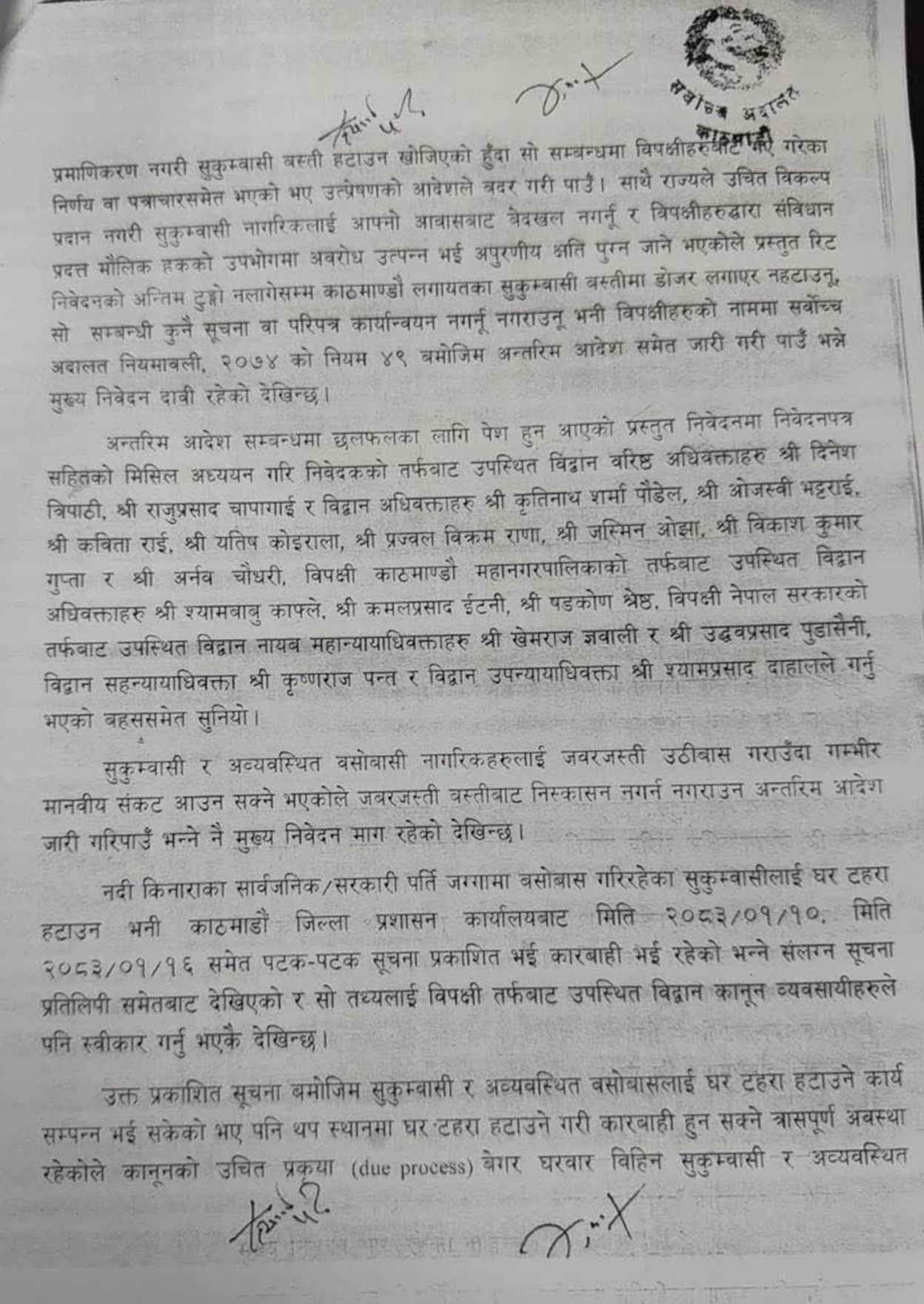
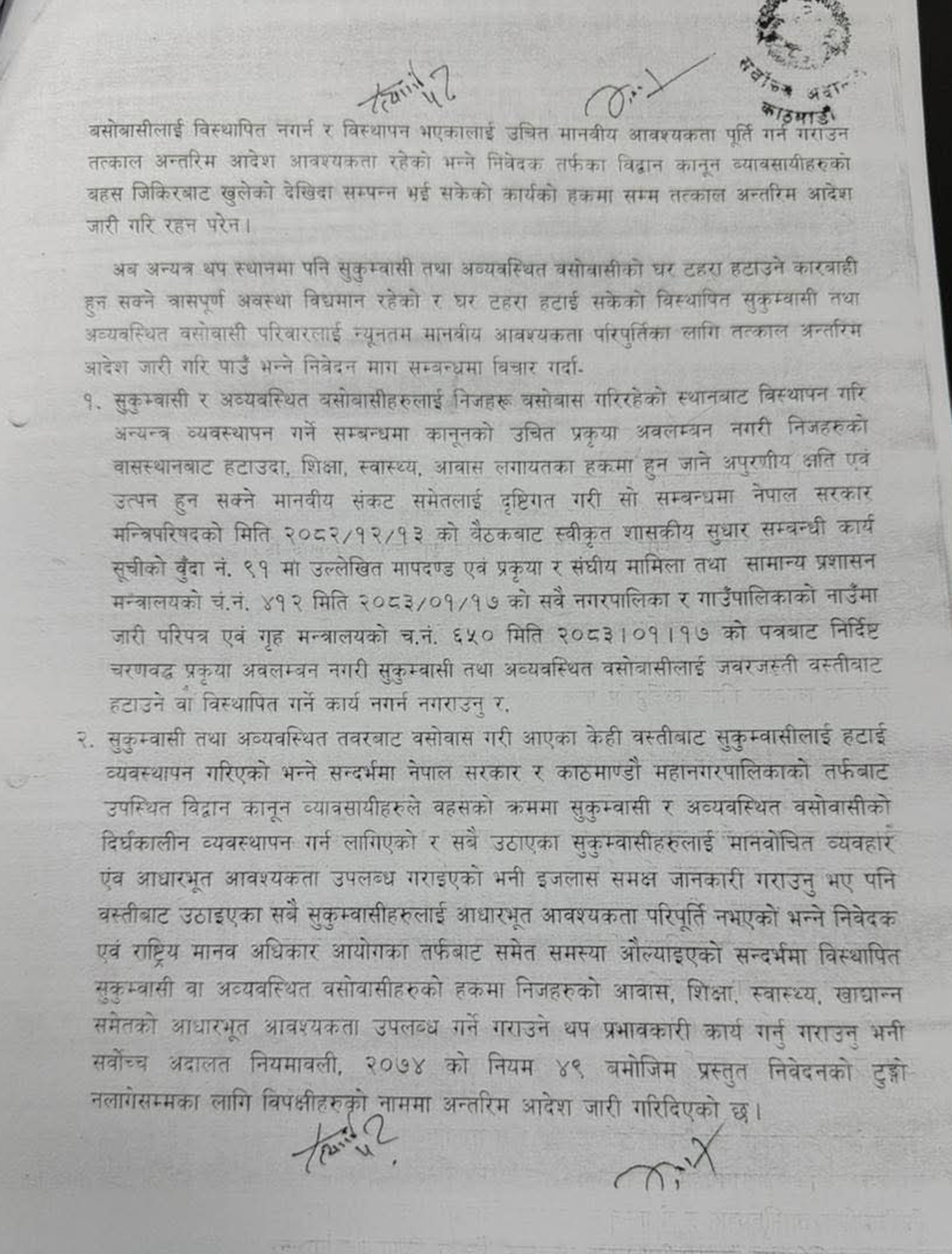
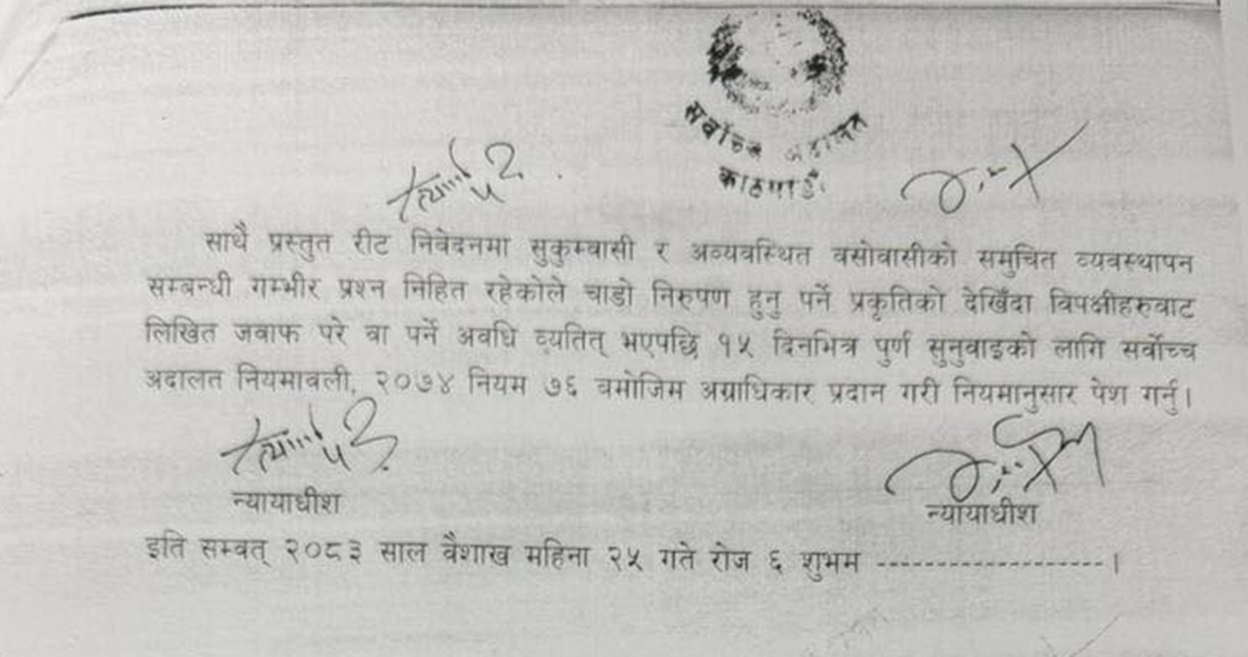
  • The Supreme Court has issued an interim order preventing the eviction of squatter settlements established along riversides and public areas in Kathmandu.
  • The order was issued by the bench of Supreme Court Justices Kumar Regmi and Nityanand Pandey in response to a petition opposing the clearance of these settlements.
  • The petition demanded that no family be evicted without identification, verification, and provision of alternative arrangements for landless families.

April 8, Kathmandu – The Supreme Court has issued an interim order restraining the eviction of disorganized squatter settlements located along various riverbanks and public spaces in Kathmandu.

A joint bench of Supreme Court Justices Kumar Regmi and Nityanand Pandey granted the interim order on a writ petition filed against the eviction of these settlements.

The petitioners, including Gopal Rana and ten others, filed the writ on April 24, opposing the planned eviction of the squatter settlements.

The writ challenged the eviction notices issued by the District Administration Office and Kathmandu Metropolitan City to clear these squatter settlements situated along Kathmandu’s riverbanks.

The interim order states, “Forced eviction of squatters and unorganized residents from their places of settlement without following due legal process may cause irreparable harm and human rights crises affecting their rights to education, health, and housing. Therefore, pursuant to Government of Nepal Cabinet’s reform agenda dated 2078/12/13 (March 26, 2022), item number 91, eviction or displacement of such settlements without following prescribed procedures shall not be carried out.”

The Supreme Court has also directed the effective provision of basic necessities such as housing, education, health, and food to the displaced squatters and unorganized residents.

The National Human Rights Commission has also pointed out the plight of displaced and informal settlers and demanded effective management to ensure their access to shelter, health, education, food, and other essential needs.

The writ petition called for identification, verification, and alternative arrangements for landless families living in squatter settlements in the Kathmandu Valley or anywhere in the country, and that no family be evicted, displaced, or forcibly penalized without these provisions.

View the interim order here: