Author: space4knews

Today’s Foreign Currency Exchange Rates Announced

25 Baisakh, Kathmandu – Nepal Rastra Bank has set the foreign currency exchange rates for today (Friday). According to the prescribed rates, the buying rate of the US Dollar is NPR 150.51 and the selling rate is NPR 151.11. The European Euro’s buying rate is NPR 177.07 and the selling rate is NPR 177.77. The British Pound Sterling has a buying rate of NPR 204.87 and a selling rate of NPR 205.68. The Swiss Franc’s buying rate is NPR 193.46 and the selling rate is NPR 194.23. The Australian Dollar has a buying rate of NPR 109.21 and a selling rate of NPR 109.65. The Canadian Dollar’s buying rate is NPR 110.45 and selling rate NPR 110.89. The Singapore Dollar’s buying rate is NPR 118.90 and selling rate NPR 119.37. The Japanese Yen (per 10 units) has a buying rate of NPR 9.63 and a selling rate of NPR 9.66, while the Chinese Yuan’s buying rate is NPR 22.13 and selling rate NPR 22.22.

The Saudi Arabian Riyal’s buying rate is NPR 40.13 and selling rate NPR 40.29. The Qatari Riyal’s buying rate is NPR 41.29 and selling rate NPR 41.46. According to the central bank, the Thai Baht’s buying rate is NPR 4.68 and selling rate NPR 4.70. The UAE Dirham’s buying rate is NPR 40.98 and selling rate NPR 41.14, while the Malaysian Ringgit has a buying rate of NPR 38.49 and selling rate of NPR 38.65. The South Korean Won (per 100 units) has a buying rate of NPR 10.37 and selling rate of NPR 10.42. The Swedish Krona’s buying rate is NPR 16.36 and selling rate NPR 16.42.

The Danish Krone has a buying rate of NPR 23.69 and selling rate of NPR 23.79. Nepal Rastra Bank has set the Hong Kong Dollar’s buying rate at NPR 19.22 and selling rate at NPR 19.30. The Kuwaiti Dinar’s buying rate is NPR 491.54 and selling rate NPR 493.50. The Bahraini Dinar’s buying rate is NPR 398.91 and selling rate NPR 400.50. The Omani Riyal has a buying rate of NPR 390.90 and selling rate of NPR 392.46. Similarly, the Indian Rupee (per 100 units) has a buying rate of NPR 160.00 and selling rate of NPR 160.15. The central bank has stated that it may amend the exchange rates at any time if necessary. The exchange rates set by commercial banks may differ, and updated details will be available on the central bank’s official website.

Today’s Foreign Currency Exchange Rates Announced

April 7, Kathmandu – Nepal Rastra Bank has set the foreign currency exchange rates for today (Friday).

According to the established rates, the buying rate for one US dollar is NPR 150.51, and the selling rate is NPR 151.11.

Similarly, the buying rate for one Euro is NPR 177.07, and the selling rate is NPR 177.77.

The buying rate for one British Pound Sterling is NPR 204.87, with a selling rate of NPR 205.68.

The Swiss Franc has a buying rate of NPR 193.46 and a selling rate of NPR 194.23.

The Australian Dollar’s buying rate is NPR 109.21, and the selling rate is NPR 109.65.

One Canadian Dollar’s buying rate is NPR 110.45, with a selling rate of NPR 110.89.

For the Singapore Dollar, the buying rate is NPR 118.90, and the selling rate is NPR 119.37.

The Japanese Yen (10 units) has a buying rate of NPR 9.63 and a selling rate of NPR 9.66, while the Chinese Yuan’s buying rate is NPR 22.13 and selling rate is NPR 22.22.

The Saudi Arabian Riyal shows a buying rate of NPR 40.13 and a selling rate of NPR 40.29, and the Qatari Riyal has buying and selling rates of NPR 41.29 and NPR 41.46 respectively.

According to the central bank, the Thai Baht is set at a buying rate of NPR 4.68 and a selling rate of NPR 4.70.

The UAE Dirham’s buying rate is NPR 40.98, with a selling rate of NPR 41.14, and the Malaysian Ringgit has a buying rate of NPR 38.49 and selling rate of NPR 38.65.

The South Korean Won (100 units) has a buying rate of NPR 10.37 and a selling rate of NPR 10.42, while the Swedish Krona’s buying rate is NPR 16.36 and selling rate is NPR 16.42.

The Danish Krona has a buying rate of NPR 23.69 and a selling rate of NPR 23.79.

Nepal Rastra Bank has fixed the Hong Kong Dollar’s buying rate at NPR 19.22 and the selling rate at NPR 19.30.

The Kuwaiti Dinar shows a buying rate of NPR 491.54 and a selling rate of NPR 493.50.

The Bahraini Dinar is priced at NPR 398.91 for buying and NPR 400.50 for selling.

The Omani Riyal has a buying rate of NPR 390.90 and a selling rate of NPR 392.46.

Similarly, the Indian Rupee (100 units) has a buying rate of NPR 160.00 and a selling rate of NPR 160.15.

The central bank has indicated that these exchange rates may be revised at any time as necessary. Commercial banks may set different exchange rates, and updated rates will be available on the central bank’s official website.

आहा ! अर्मके झरना – Online Khabar

Armke Waterfall: Tourism Opportunities and Challenges

April 8, Myagdi. The Armke Waterfall, located in Dhaulagiri Rural Municipality-4, remains largely overlooked. Situated near Bagar Jeltung, the last human settlement along the Dhaulagiri circuit trail, this waterfall is hidden from the attention of many tourists due to lack of management, infrastructure, and promotion. The Armke Waterfall is beautiful and captivating, where water cascades down two tiers from the foothills of a high mountain into the Myagdi River. At the base of the waterfall is a pond approximately 200 meters deep, adjacent to a natural hot spring pool.

Tourists often observe and photograph the waterfall from a distance, but the area remains quiet and under-visited. Hariprasad Tilija, a ward member of Dhaulagiri Rural Municipality-4, has expressed interest in developing the Armke Waterfall and the hot spring pool as tourist destinations. He stated, “Recently, a road was constructed near the Armke Waterfall as part of the access route for the Myagdi River Hydropower Project. With improved road facilities, an increase in tourist activity at Armke Waterfall is expected.”

Currently, during the winter season, visitors can reach the base of the waterfall and the hot spring pool via a temporary wooden bridge and a diversion road. However, during the monsoon season, the waterfall’s water spray causes wooden structures around the pool to become wet and rot. It takes about a 10-minute walk and a 5-minute vehicle ride from Jeltung to reach the Armke Waterfall and hot spring pool. The hot spring, with a temperature of 50 degrees Celsius emerging from underground, is believed to provide relief from various health issues through bathing. Visitors trekking the Dhaulagiri mountain and the Dhaulagiri circuit trail through Bagar are likely to visit the hot spring and waterfall, which is expected to support and benefit their stay in the area.

प्रधानमन्त्रीसँग प्रतिपक्षी दलका नेताको सवालजवाफ – Online Khabar

Prime Minister Engages in Q&A with Opposition Leader During Constitutional Council Meeting

News Summary

Produced by AI. Editorial review completed.

  • During the Constitutional Council meeting, Prime Minister Balendra Shah proposed breaking the seniority order to recommend Dr. Manoj Sharma as Chief Justice.
  • Leader Bhishmaraj Angdembe strongly opposed the proposal citing violation of seniority and stated Congress would not support it.
  • A question and answer session lasting about one and a half hours occurred between the Prime Minister and opposition leaders, focusing on basing the recommendation on judicial performance.

April 7, Kathmandu – It has emerged that during the Constitutional Council meeting, Prime Minister Balendra Shah and Nepali Congress opposition leader Bhishmaraj Angdembe engaged in an extended question and answer session.

According to a member of the Constitutional Council, Prime Minister Shah introduced the agenda item concerning the recommendation for Chief Justice at the start of the meeting. Initially, he proposed recommending Justice Dr. Manoj Sharma, who is fourth in seniority according to the Supreme Court hierarchy.

After the proposal was presented, most members remained silent. National Assembly Chair Narayan Dahal and Deputy Speaker Rubi Kumari did not respond either. However, opposition leader Bhishmaraj Angdembe strongly opposed the proposal.

Angdembe told Prime Minister Shah, “You have broken the seniority protocol. In 80 years of judicial history, there has been no precedent for violating seniority. You proposed bringing forward the fourth-ranking judge. You are violating the constitution. Congress will not support this.”

The council members said a Q&A session then began between the Prime Minister and Angdembe.

Prime Minister Shah responded, “The recommendation is based on judicial performance data. Justice Dr. Manoj Sharma has delivered the most judgments.”

Angdembe replied, “Is judicial output the primary criterion? You cannot bypass seniority.”

Prime Minister Shah further stated, “Justice Manoj Sharma resolved approximately 7,500 cases over five years. In contrast, Acting Chief Justice Sapana Pradhan Malla delivered about 4,000 judgments during the same period. Therefore, Sharma is more suitable.”

Angdembe contested, “It is incorrect to evaluate based on the number of cases handled. The most senior judge should be proposed according to legal tradition and constitutional provisions. I will speak in favor of law, tradition, and the constitution.”

Prime Minister Shah reiterated, “The person with the highest judicial output is the most qualified.”

This exchange continued for about one and a half hours, with most other members remaining silent. Throughout, the Prime Minister repeatedly relied on judicial performance data to justify recommending Dr. Manoj Sharma.

According to a statement circulated by the Prime Minister’s Secretariat to the media, data covering the last five years of judicial work by six Supreme Court justices was presented. The data showed Justice Manojkumar Sharma judged approximately 7,400 cases, the highest among all.

In the same timeframe, Acting Chief Justice Sapana Pradhan Malla ruled on roughly 4,700 cases. Behind Sharma, justices Hari Phuyal and Kumar Regmi resolved the next highest number of cases. The Prime Minister used this statistical information as the basis for recommending Dr. Sharma.

Following the prolonged Q&A session, the meeting agreed to draft the minutes of the decision. During this process, opposition leader Angdembe announced his intention to submit a written dissent, which was supported by National Assembly Chair Narayan Dahal.

प्रधान्यायाधीश सिफारिसबारे के भन्छन् पूर्वन्यायाधीशहरू ?

Former Chief Justices Share Views on Appointment Recommendation of Chief Justice

April 7, Kathmandu. The Constitutional Council has decided to recommend Dr. Manojkumar Sharma, a Supreme Court justice, for the position of Chief Justice. Among the six candidates eligible for the role, Sharma ranked fourth in seniority. Judges Sapana Pradhan Malla, Kumar Regmi, and Hari Phuyal are senior to Sharma. We have sought the perspectives of three former Chief Justices regarding this recommendation.

According to former Supreme Court Chief Justice Gauri Dhakal, the council’s decision sends a negative message to the public. She states, “It is not just about serving justice; it conveys a message of serving injustice. This will have an adverse impact on the administration of justice.” Another former Chief Justice, Balram KC, believes the government has made a decision that affects the judiciary. He holds the view that acting Chief Justice Sapana Pradhan Malla is fully qualified and capable in every respect.

Former Supreme Court Chief Justice Girishchandra Lal suggests the decision should be seen in a positive light. He comments, “This decision might have been made to avoid political interference. It could also be due to the absence of political affiliation. Although it differs from previous decisions, it should not be wholly criticized. I wouldn’t call it excellent either.”

Gauri Dhakal (former Chief Justice, Supreme Court) said, “When recommendations are made bypassing seniority, those aspiring to become judges are compelled to reconsider three times. I myself have experienced this. When I was in the High Court, a junior judge was appointed as Chief Justice instead of me. I was mentally unwell during that time. I fully understand the mental state in such circumstances.” Balram KC (former Chief Justice, Supreme Court) said, “I have supported this government’s work, but I cannot support this decision. The government should not have interfered in the judiciary at this time.”

Girishchandra Lal (former Chief Justice, Supreme Court) said, “Generally, the Chief Justice is recommended based on seniority. However, there is no constitutional obligation that it must be only based on seniority. The council can decide according to the circumstances.”

विश्वप्रकाशको प्रभाव बढ्दा सिटौला बन्दैछन् रक्षात्मक

As Bishwprakash’s Influence Grows, Sitoula Becomes More Defensive

In Jhapa, the balance of power between the factions of Nepali Congress leaders Krishna Prasad Sitoula and Bishwprakash Sharma has been shifting, with Sharma gaining influence as the party’s Deputy Chairperson. The Congress has relieved Krishna Prasad Sitoula from his post as leader of the National Assembly Parliamentary Party and assigned Kamaladevi Pant to that responsibility. Following a special general convention in Jhapa, there has been a transformation in the mindset of leaders and activists, sparking a new phase of politics aimed at managing competition.

As of April 24 in Kathmandu, while the Deuba faction in central Nepali Congress politics has reportedly sidelined the Koirala faction, the political dynamics in Jhapa tell a different story. Previously, the Sitoula faction appeared to overshadow Bishwprakash Sharma’s faction. However, recent developments illustrate a changing political equation. Sharma, who has closely collaborated with Sitoula, has become increasingly influential from the district level up to the central leadership since the special general convention. His rising activity within the party and growing acceptance among the youth cadre have established him as a new power center within the organization.

Conversely, Sitoula, who had maintained strong control over the organization for a long time, has recently adopted a more defensive posture. The shift in power balance within his home region of Jhapa is reflected in a diminishing influence at the central level. Sharma, serving as Deputy Chairperson, is active in the central working committee led by Gagan Thapa. Meanwhile, Sitoula is gradually disengaging from his central and parliamentary roles. On April 16, the party relieved him of his responsibilities as leader of the National Assembly Parliamentary Party. Capitalizing on Deputy Chairperson Sharma’s growing influence, parliamentary party leader Bhishmaraj Angdembe replaced Sitoula with Kamaladevi Pant for that role. Historically, Sitoula held a strong grip over Jhapa, and even during Sharma’s tenure as general secretary, Sitoula was the key figure at events in his home district. However, since Sharma’s elevation to Deputy Chairperson, he has been consolidating his hold in Jhapa.

“Even when Bishwprakash was general secretary, Krishna Sitoula was often the chief guest at events, while Bishwprakash was treated as a special guest,” said a local leader in Jhapa. “But nowadays, that dynamic has changed. Since the special general convention, Bishwprakash has become dominant across all areas.” According to this leader, before the convention, party programs in Jhapa were conducted under Sitoula’s direct guidance, with no event proceeding without his approval. Local leaders once considered close to Sitoula are now aligned with the central leadership. Sitoula’s refusal to accept the leadership chosen through the special convention was evident, as Koshi Province committee chair Uddhav Thapa—previously believed to be a Sitoula ally—attended meetings in Sanepa along with the newly elected leadership. Chairperson Thapa organized two events under the chief patronage of Gagan Thapa. The Sharma faction attributes some obstruction and non-cooperation in Jhapa to these developments.

“Province Chairperson Thapa, who was considered close to Krishna Sitoula, has successfully held two high-profile events,” said a Sharma-aligned leader in Jhapa. “This has resolved a key cause of obstruction and non-cooperation within Jhapa.” District Chairperson Deuman Thebe is also supporting the elected leadership, despite Sitoula’s wishes. While some members of Sitoula’s faction have urged their cadres not to renew active membership, Chairperson Thebe has taken an active role in the ongoing membership update campaign. “Deuman sir was once a close associate of Krishna sir and won his position with Krishna’s support; the opponent candidate then was Ram Kattel,” explained the leader. “Now, Thebe himself is leading efforts to update active membership.” The membership renewal campaign, which will begin on May 5, aims to digitize the party’s record of active members.

Sub-chairpersons Kesharaj Pandey and Sher Bahadur Bhattarai, both from Sitoula’s group, are also involved in the membership update activities. “After running in the election, Kesharaj Pandey is now active in the update process,” one local leader noted. “Sher Bahadur Bhattarai has accepted the process smoothly following court approval and is moving forward.” Since the special general convention, the mindset and priorities of Congress leaders and activists in Jhapa have shifted. Rather than suppressing competition at the district level, politics is now geared towards managing it effectively.

The growing strain between Sharma and Sitoula began during their time as presidents of the Nepal Student Union, when relations were fairly cordial. However, tensions increased following the party’s 12th General Convention. Sharma contested for Jhapa chairperson in 2010 BS (Bikram Sambat), while Sitoula backed his close ally Uddhav Thapa for the position, exacerbating the rift. The conflict that grew in Jhapa eventually reached Kathmandu. Sitoula was aligned with the close circles of Girija Prasad Koirala and Sushil Koirala, and Sharma felt uneasy when Sushil served as acting chairperson. When former Nepal Student Union presidents were appointed as central members, Bishwprakash Sharma was overlooked, further straining their relationship. Although both leaders pursued their paths differently, their internal disputes deepened without strengthening ties.

For the 14th General Convention, Sharma announced his candidacy for general secretary and tried to launch his campaign from Jhapa. However, due to lack of support from district leadership, he began his campaign independently from Birtamod, with Sitoula’s faction leaders not attending his events. As tensions escalated, Sharma was elected general secretary. He then organized a gratitude meeting in his home district, which Sitoula’s faction boycotted. The 14th General Convention also exposed competition in the Jhapa district convention, where former deputy chairperson Deukumar Thebe competed against deputy chairperson Ram Kattel for the chairpersonship, with Thebe emerging victorious by securing 1,765 votes against Kattel’s 1,515 out of a total 3,311 votes. Kesharaj Pandey and Sher Bahadur Bhattarai won the deputy chairperson posts. While Chairman Thebe remains active, district chairpersons close to Sitoula have shown reluctance to renew active membership. When asked about the intensifying conflict between Sitoula and Sharma, Thebe declined to comment, stating, “This is a central-level issue. We are district-based and cannot say much. Whether there is discord or not, that question should be addressed to them.”

Rastriya Prajatantra Party Parliamentary Leader Gyanendra Shahi Voices Dissent Over Chief Justice Recommendation

Gyanendra Shahi, leader of the Rastriya Prajatantra Party parliamentary group, has expressed dissatisfaction regarding the Constitutional Council’s recommendation of Manojkumar Sharma as the new Chief Justice. Shahi warned that subordinating the judiciary to the executive would disrupt the balance of power and undermine judicial impartiality. He cautioned that this unprecedented recommendation could weaken civil rights and seriously erode democratic values. Kathmandu, 24 Baisakh.

On Thursday evening, through social media, Shahi publicly conveyed his discontent over the Constitutional Council’s endorsement of Manojkumar Sharma as the prospective Chief Justice. He stated, “Under the rule of law, the executive, judiciary, and legislature should be independent yet complementary to each other.” He added, “If the judiciary falls under the executive’s control, the balance of power is destroyed, justice ceases to be impartial, and although the consequences may appear minor now, their detrimental effects could become profound over time.”

Shahi emphasized that this break from established tradition in the recommendation process will weaken citizens’ rights. He warned, “Should this situation arise, democratic values, principles, and citizens’ rights will be seriously compromised.”

राणाकालपछिको पहिलो नजिर, जसले विधि मिचेर प्रधानन्यायाधीश सिफारिस गर्‍यो

First Event Post Rana Era: Violation of Rules in Chief Justice Recommendation

The Constitutional Council has recommended Dr. Manoj Sharma, the fourth most senior justice of the Supreme Court, for the position of Chief Justice. The proposal, put forward by Prime Minister Balen Shah, was approved by four members, while two members expressed their written dissent. This decision breaks an 85-year-old judicial tradition by reversing the seniority order, establishing Dr. Sharma’s term as six years. Kathmandu, 24 Baisakh.

Defying both the constitution and judicial tradition, the Constitutional Council recommended Dr. Manoj Sharma, the fourth senior-most justice of the Supreme Court, as Chief Justice. Although two members of the council expressed disagreement, four members, acting on Prime Minister Balen Shah’s proposal, approved the recommendation. According to a source, among the six candidates considered, Dr. Sharma was regarded as the most qualified, experienced, and competent individual recommended by Prime Minister Shah.

If the Parliamentary Hearing Committee approves the nomination, Dr. Sharma will serve as Chief Justice for approximately six years. After the removal of the temporary justice provision in higher courts following the promulgation of the new constitution in 2015 (2072 BS), he had retired. Following the customary seniority order, Sapana Pradhan Malla and then Kumar Regmi would have been appointed Chief Justice. However, Thursday’s decision by the Constitutional Council broke a seniority tradition that had been in place for more than eight decades.

Due to an informal understanding that seniority should not be reversed, although prime ministers have sometimes appointed justices favorable to them, the tradition of seniority has never been decisively broken until now. When approached for comments on this matter, many legal professionals remained reticent. Former Prime Minister and former Chief Justice Sushila Karki described Prime Minister Balen Shah’s decision as unnatural and immature.

Industrialist Vijay Shrestha Arrested on Charges of Underfilling Oil in Chhahari and Omkar Brands

24 Baisakh, Kathmandu – An industrialist has been arrested for allegedly packaging and selling sunflower oil with less quantity than specified. Vijay Shrestha, the proprietor of Omkar Oil Industries Pvt. Ltd., which produces Chhahari and Omkar branded sunflower oil, was taken into police custody. Shrestha’s company is located at Mahadev Khola, Lele, Ward No. 5, Godavari Municipality, Lalitpur.
The Kathmandu Valley Crime Investigation Office of the Nepal Police also seized 905 cartons of oil from Shrestha. According to the police, an investigation was launched based on specific information that the company was packaging and distributing one-liter and half-liter bottles of Chhahari and Omkar branded sunflower oil with less weight than the prescribed standard.
During the investigation, the police found that the oil packets were under the designated weight. SP Rameshwar Karki, spokesperson for the Crime Investigation Office, stated that Shrestha along with the seized oil cartons are now under investigation for fraud-related offenses. The case has been forwarded to the District Police Office in Lalitpur for further proceedings and necessary legal action.

कतारमा छोरीको तीन महिनादेखि तलब छैन, यता घर ढल्यो – Online Khabar

After Three Months Without Daughter’s Salary in Qatar, a Family’s Home Collapses Back Home

April 6, Kathmandu — The entire Sukumbasi settlement in Manohara has been completely vacated. There are no sturdy buildings, houses, or huts left. Everything that once stood has turned into rubble. Former residents occasionally come back hoping to salvage some of their belongings, sifting through the debris.

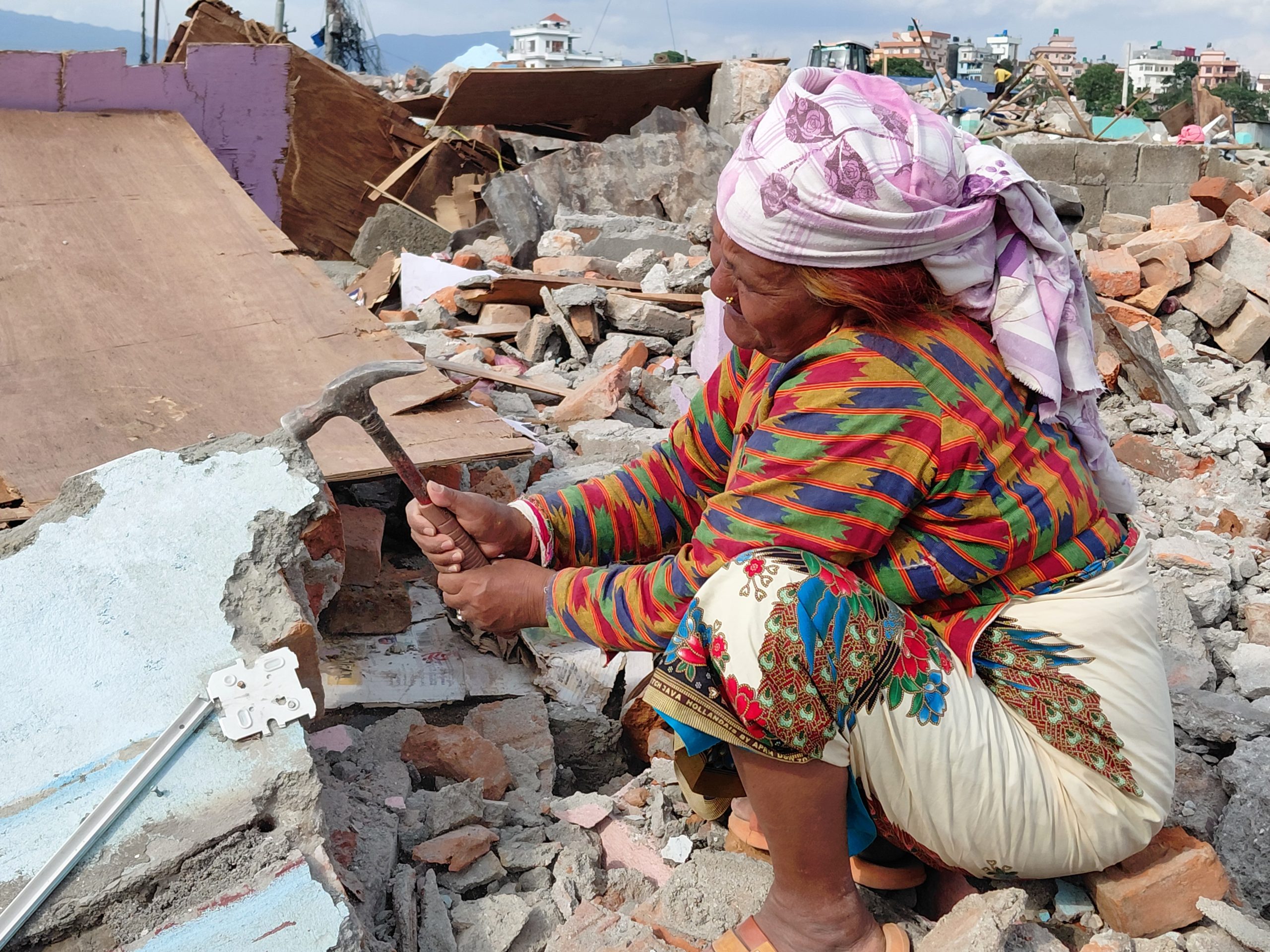
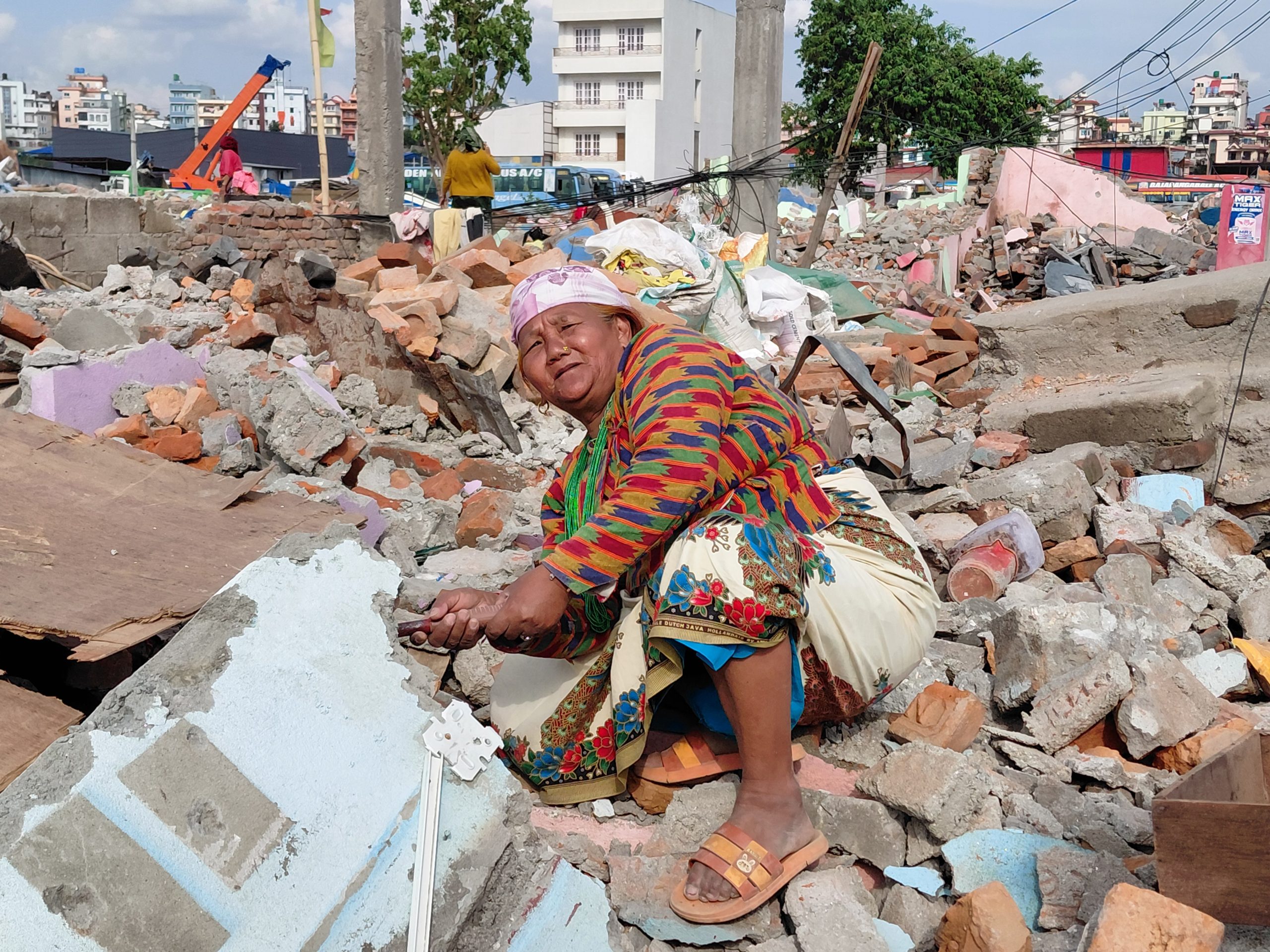
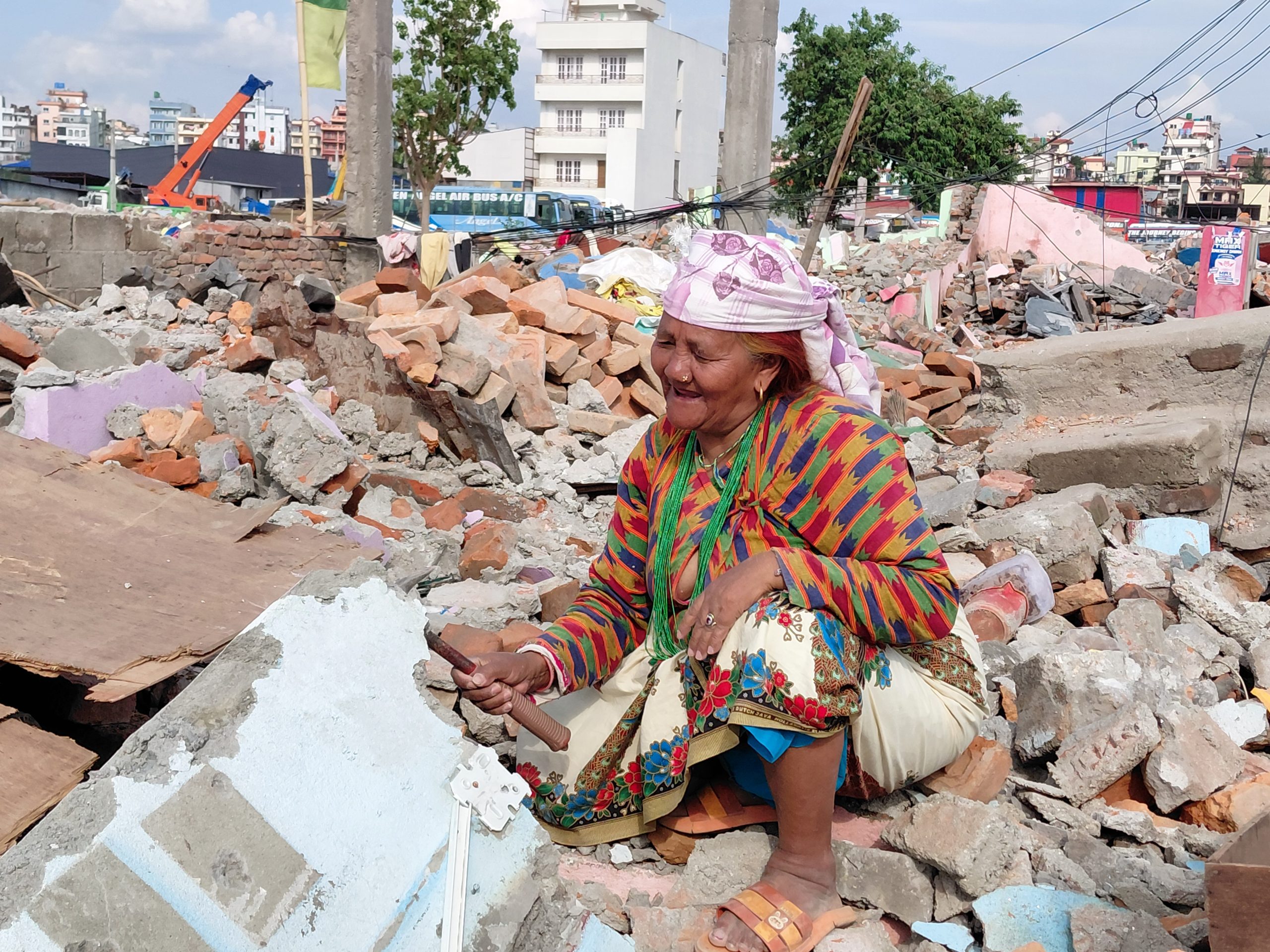
At the time of our visit, we found Chandrakumari Magar near the eastern bank of Manohara, in the central part of the settlement. She was pounding small wall fragments left behind after a bulldozer demolished her former house. Her husband, Ram Bahadur Gurung, was nearby, sorting through other materials.

Their goal was to extract as many intact bricks as possible to fulfill two purposes: one, to reuse those bricks to build a new shelter on a different plot of land,

and two, if the relocation plan fails, to sell the bricks and raise some money.
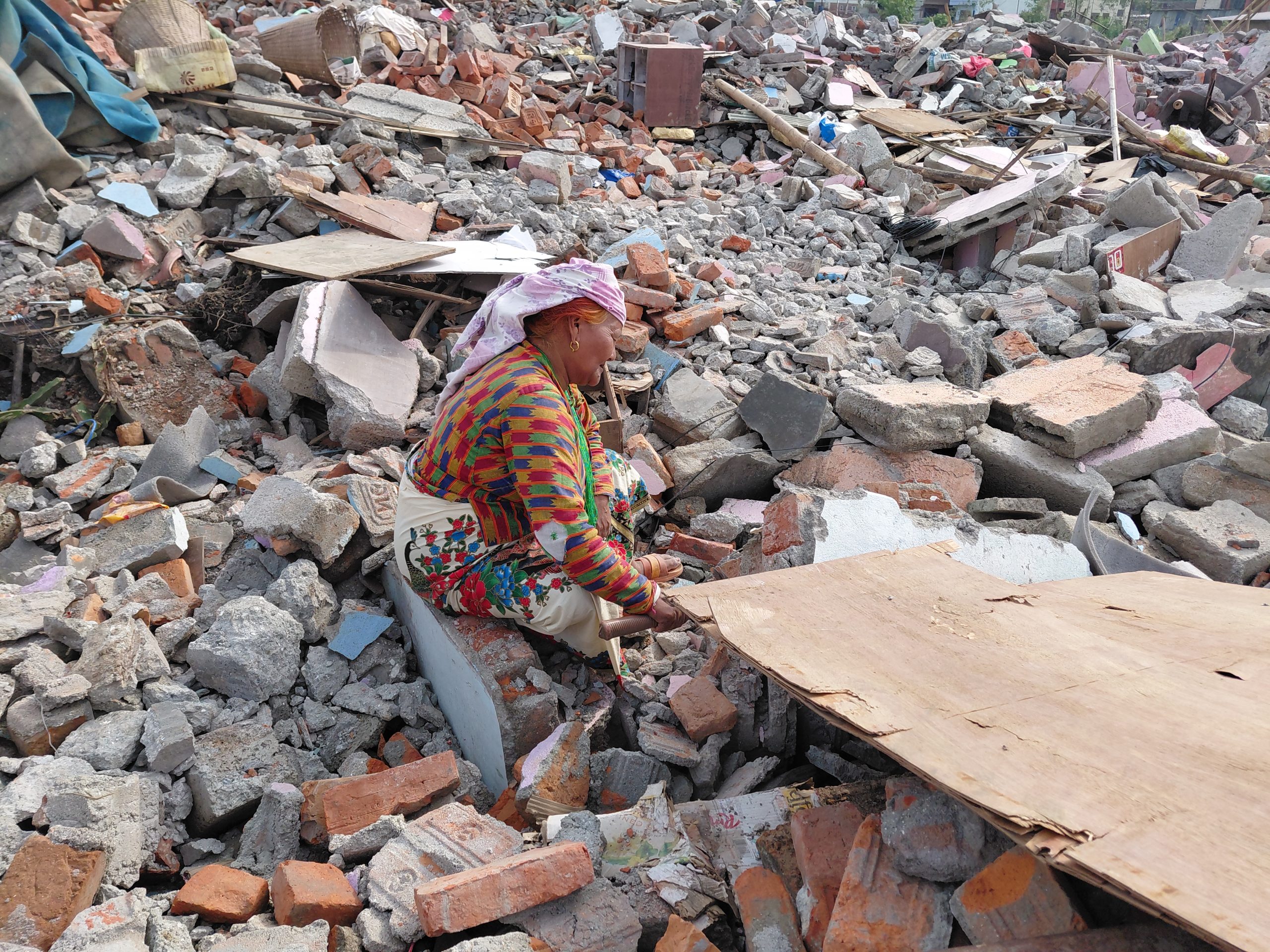
They had already gathered some intact bricks and stacked them nearby. Despite their advancing years, with hands over 60 years old, they were still hard at work. While speaking with us, Chandrakumari struck the hammer repeatedly and moved forward.

000

Chandrakumari hails from Okhaldhunga but doesn’t recall much about her early life in her native village. Her father passed away during her childhood, and she is unaware of her mother’s whereabouts. She had a brother who tragically died after being crushed by a tree while working in Solukhumbu. She estimates her age to be around 60 but does not know the exact number. She also has no record of her husband’s age.

With no support in the village, she moved to the city to earn a livelihood, hopeful of finding work in Kathmandu. Chandrakumari arrived when she was about 24 or 25 years old.

In Kathmandu, she first worked at a carpet-weaving factory, where she met Ram Bahadur Gurung.

Ram Bahadur is also originally from the east but moved to Kathmandu as a child around 6 or 7 years old and doesn’t remember his past. To make ends meet, he worked as a day laborer in Kathmandu. Their shared work brought them close, and they eventually married.

Following the wedding, they started living in a rented room in Kaushaltar, where their eldest daughter, Sapana Gurung, was born. Their financial condition began worsening to the point they could no longer pay rent. There was very little left in the village.

At that time, through connections, Chandrakumari learned about the possibility of obtaining land in the Manohara area. The idea that they could receive land and build a house there was very appealing, especially since there would be no hassles like paying rent. Finding everything favorable, the family moved to the Sukumbasi settlement.

It was there their two other daughters, Bipana and Kalpana, were born. Both attended Saraswati Basic School up to grade 8 and passed the School Leaving Certificate (SLC) from there.

Even after settling near the Manohara bank, Chandrakumari and Ram Bahadur never stopped working as day laborers. They knew no other way to earn a decent income. With their earnings, they gradually improved their shelter.

When their eldest daughter went abroad to work, the money she sent back helped them build a permanent shelter.
The settlement was rapidly growing. New residents were building houses; grocery, snack, and meat shops were opening; and many houses added additional floors. During this expansion, neither local authorities nor the federal government responded, leaving many unaware of the circumstances.

They never knew that their settlement was on public land. Despite the growth, they believed it was like any other settlement in Kathmandu. They thought, as squatters, they had a rightful claim to reside there.

000

When Balen Shah was elected mayor of Kathmandu Metropolitan City, the issue of squatters surfaced prominently. There were several attempts during Balen’s tenure to run bulldozers through the squatter settlements. However, these efforts remained incomplete, yet the residents began fearing eviction.

Following strong opposition from hundreds of residents and public support from political leaders defending squatters, Balen’s endeavors failed, giving Chandrakumari’s family hope that they would not face displacement.

Recently, in the past elections, Chandrakumari’s family voted for Balen Shah’s party. Meanwhile, Ravi Lamichhane, president of Rastriya Swabhiman Party (RSP), had pledged to defend squatters forcefully, and Balen had promised land ownership certificates in Jhapa. The family trusted these assurances.

Chandrakumari remembers lining up at Lokanthali School on election day to cast a vote marked with a bell symbol.

But now she does not regret casting her vote, though she openly criticizes the leaders she supported. “Ravi Lamichhane had promised to stand up for squatters even if bulldozers come. I voted for the bell sign,” she said, “but now that my house has been torn down, who is left to stand up?”
“If bulldozers were sent during the metropolitan era, how could we trust anyone now?” she said. “We are not fools. We clearly saw Balen’s actions when he was mayor. We forgot the bell symbol while casting our votes.”

She never imagined their eviction would happen in this way. The destruction of a settlement they had lived in for 25 years and the house they built by painstakingly saving money has deeply wounded her. But even more painful is the government’s treatment and the betrayal of their expectations.

If the government had given them at least three to four days to remove their belongings before demolition, the pain would have been less.

Although rumors were widespread, the family learned about the eviction only on Friday, April 21, with the government providing no sufficient prior notice. Initially, they heard about the eviction as mere hearsay.
At the same time, there were still conflicting messages within the settlement—some people believed eviction wouldn’t happen, while others began removing belongings. Chandrakumari said it was difficult to confirm which information was accurate, and accused the government of providing unclear and insincere communication.

On Friday evening, Chandrakumari went to her youngest daughter’s rented room located slightly outside the settlement. She said she had gone out during the day and, feeling tired, decided to rest at her daughter’s place.

She trusted the eviction wouldn’t happen immediately and that even if it did, they would be given time to remove their things.

However, early Sunday morning the bulldozer came and immediately destroyed the settlement. While her husband could salvage some items during the demolition, much was buried under the rubble.

Among the destroyed belongings were essential medicines. Both Chandrakumari and Ram Bahadur suffer from hypertension and diabetes and require regular medication. Due to heavy rain in the evening, they were unable to retrieve their medicines.

Recalling the lost items, Chandrakumari mentioned that the bulldozer destroyed seven charas plates, 10 pieces of clothes sent from their daughter working in Qatar, and daily garments such as lungis, blouses, and blankets.

Now, they only have a few clothes left. The police promised to help remove belongings, but no one came to assist. Ram Kumar depends solely on what they manage to salvage.

By Monday afternoon, hope of recovering belongings from the debris had vanished as scavengers had taken away many items.

000

The hard-earned life they had built has once again fallen into hardship. Previously they were strong and healthy, but now their health is failing. Without medication, their conditions will worsen.
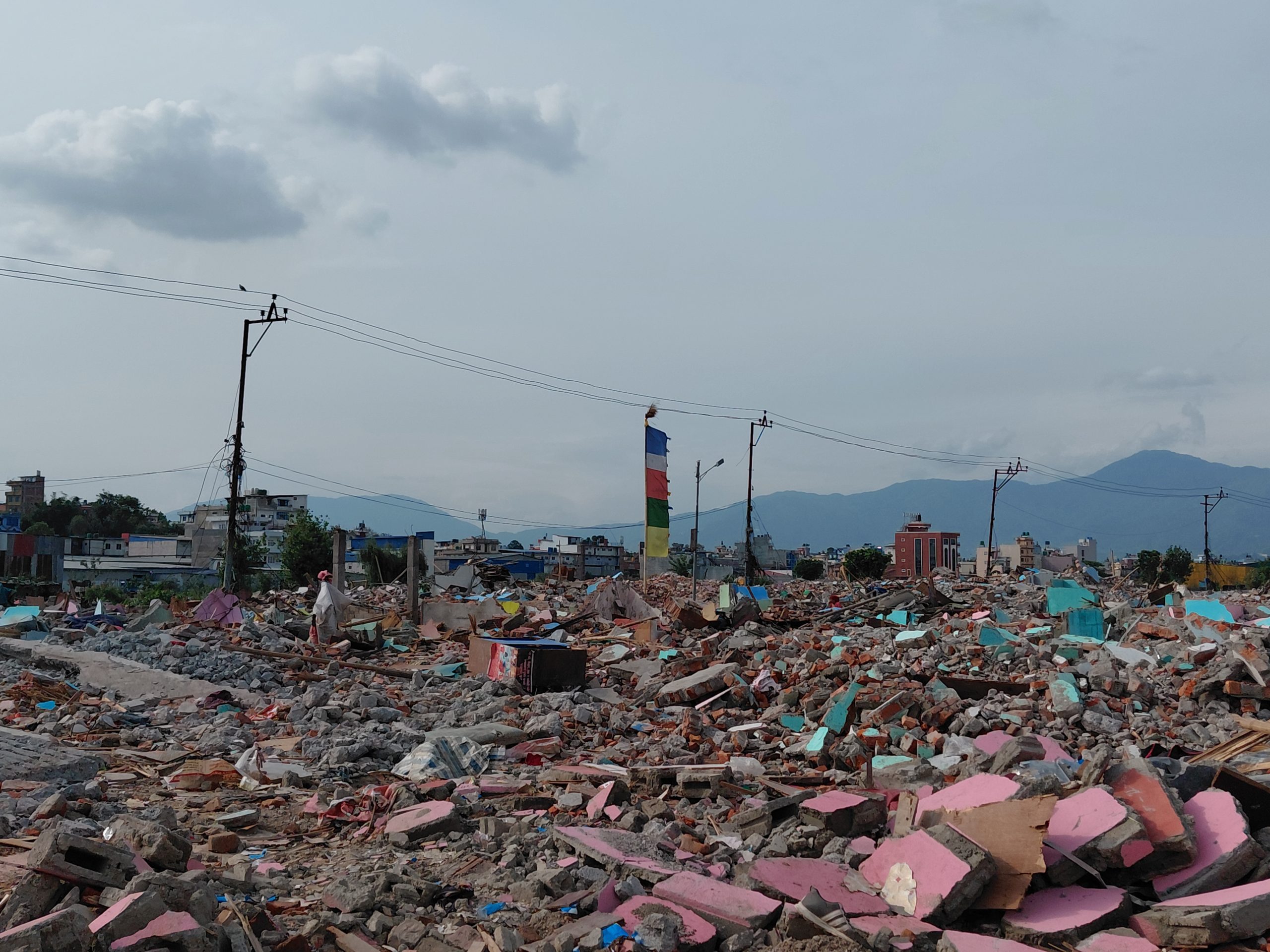
Their deepest pain is from the destruction of their home. More than that, they worry about the future. They still need to arrange marriages for their two daughters. Their primary concern now is where they will live and go next.

“My daughters will leave once married. The daughter working in Qatar hasn’t received her salary for three months due to the war,” Chandrakumari said. “After all this, who can we trust? Balen has brought misery to our old age.”

Despite everything, they have no intention of going to government-run holding centers. They are determined to preserve their dignity despite poverty and mistreatment. They plan to survive through their own hard work for as long as possible. If they find land, they are considering renting and building a new shelter; otherwise, they might rent a room.

“Our daughters can fend for themselves. We will endure as long as we live. But how can we squeeze into a room that isn’t even as decent as a rich person’s toilet?” she said. “Maybe they looked down on us because we had nothing.”

Five Arrested in Saptari for Kidnapping and Shooting Incident

April 24, Saptari — Police have arrested five individuals accused of kidnapping and injuring 47-year-old Mohammad Sadam and 60-year-old Mohammad Tahir Miyan from Siraha Lahan Municipality-10 by shooting them. The kidnapping occurred in the month of Magh, and the shooting incident came to light on Magh 4. According to authorities, 42-year-old Mina Khatun from Kharchuhiya, Khandak Municipality-5, had abducted Sadam and Tahir, who were on their way to purchase land, forcibly taken their money, and shot them, resulting in injuries.

The Saptari District Police Office identified those arrested as landowner Mina Khatun; 43-year-old Hazrat Miyan from Rupani Rural Municipality-5; 45-year-old Manjit Miyan from Rajgadh Rural Municipality-6; 48-year-old Mumtaz Miyan from Bhirpur, Khandak Municipality-6; and 35-year-old Upendra Mochi from Surunga Municipality-3. The Saptari District Court has authorized a five-day investigation period into charges including kidnapping, unlawful confinement, and attempted murder against the accused. Additionally, police noted that Mumtaz Miyan faces 13 registered fraud cases, while Upendra Mochi is involved in a pending criminal case related to homicide.

काठमाडौंको घर बेचेर गाउँमा उद्यम, २ करोड लगानीमा फार्मस्टे सञ्चालन

Selling Kathmandu Home to Launch Farm Stay in Village with 20 Million Investment

News Summary

Created by AI. Editorially reviewed.

  • Gita Adhikari from Tanahun sold her house in Kathmandu and started ‘Green Himalaya Farm Stay’ in her village.
  • The farm stay spans 75 ropani land, cultivating vegetables and fruits alongside dairy farming, offering local produce to tourists.
  • The farm stay provides regular employment to six people and attracts both domestic and international visitors.

April 7, Chitwan – While many people continue to migrate from villages to cities and abroad seeking facilities and opportunities, Gita Adhikari of Bhanu Municipality-9, Chiti, Tanahun, has sold her house in Satungal, Kathmandu, and launched a farm stay enterprise in her own village.

After residing outside the village for nearly 25 years, Gita is now managing ‘Green Himalaya Farm Stay’ within about 1.5 kilometers of Archaldhara Customs area in Tanahun.

She shared, “Initially, I planned to live simply in the village and farm vegetables and fruits. However, staying here inspired me to try something new. I invested close to 20 million rupees in renovating the traditional stone and mud house and establishing the farm stay.”

Located about 1.3 kilometers south from Archaldhara on the Tanahun-Dumre to Besisahar road, ‘Green Himalaya Farm Stay’ combines tradition with modernity. The farm aims to connect the younger generation with rural tourism and to set a model of successful entrepreneurship.

The ancestral stone and mud home has been repaired and painted. The “kitchen house” is built using stone, and added conveniences and an attractively landscaped lawn with fencing enhance the courtyard.

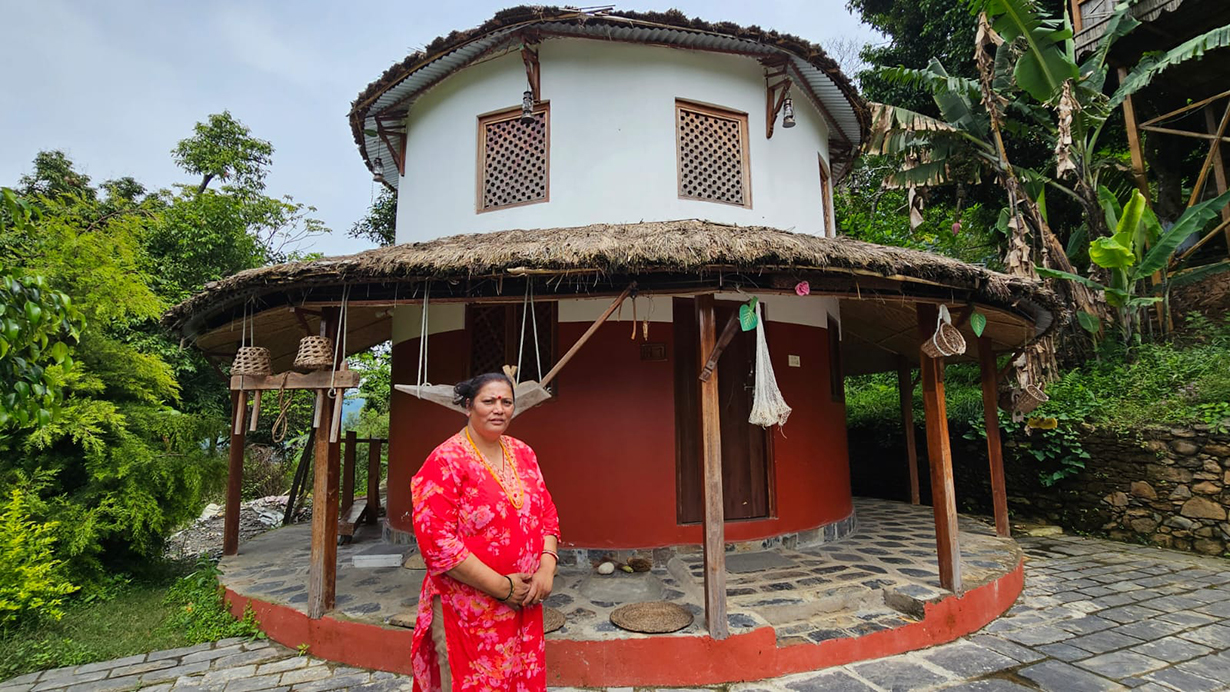
Traditional farming tools such as dhiki (traditional rice husker), yanto (winnower), plow, juwa (rice pounder), khurpeto (small sickle), and fishing traps are preserved in a specially built roundhouse that serves as a focal point for visitors.

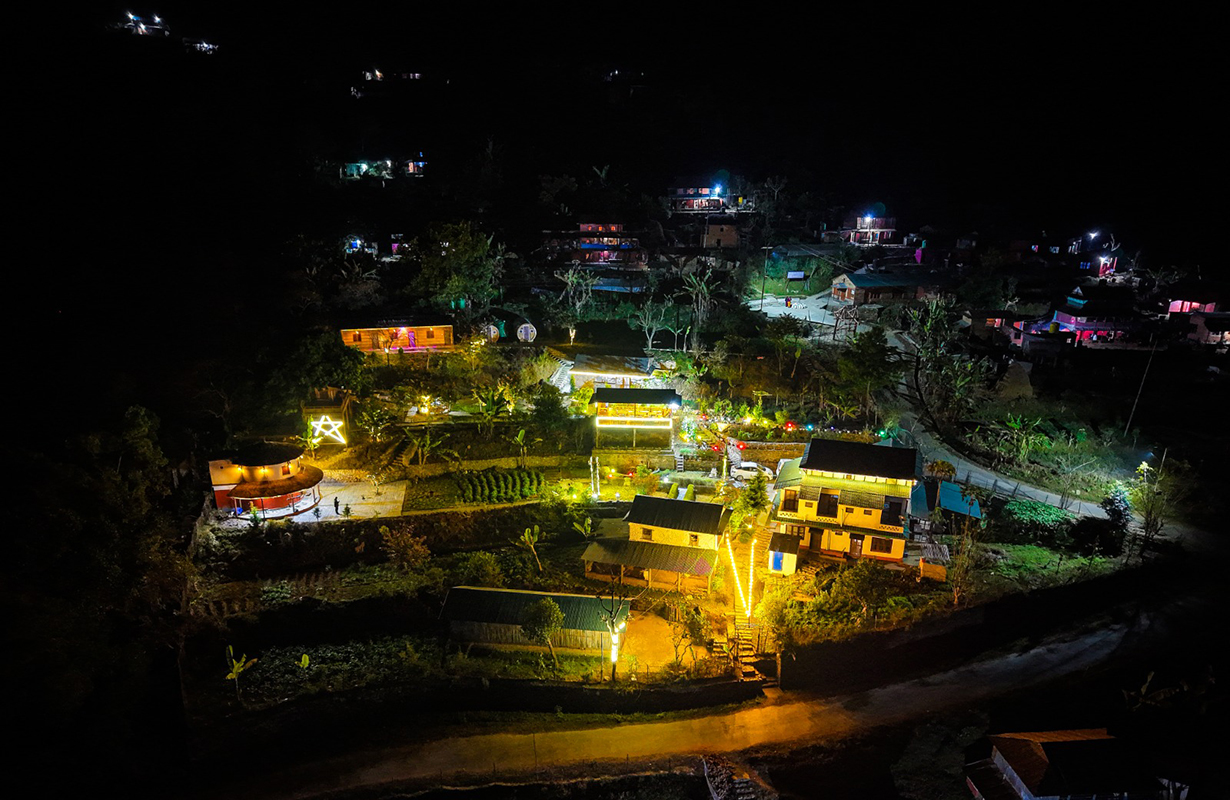
The roundhouse’s ground and first floors feature fully equipped guest rooms with bathrooms. Nearby, a treehouse has been constructed on a lychee tree for tourist accommodation. Additionally, a three-room villa and two barrel houses provide unique stay experiences.

Barrel House

Gita explained, “Our village houses were traditionally built from stone and mud, but these homes are disappearing. To help tourists remember the past and educate the younger generation, we have constructed a stone and mud house.”

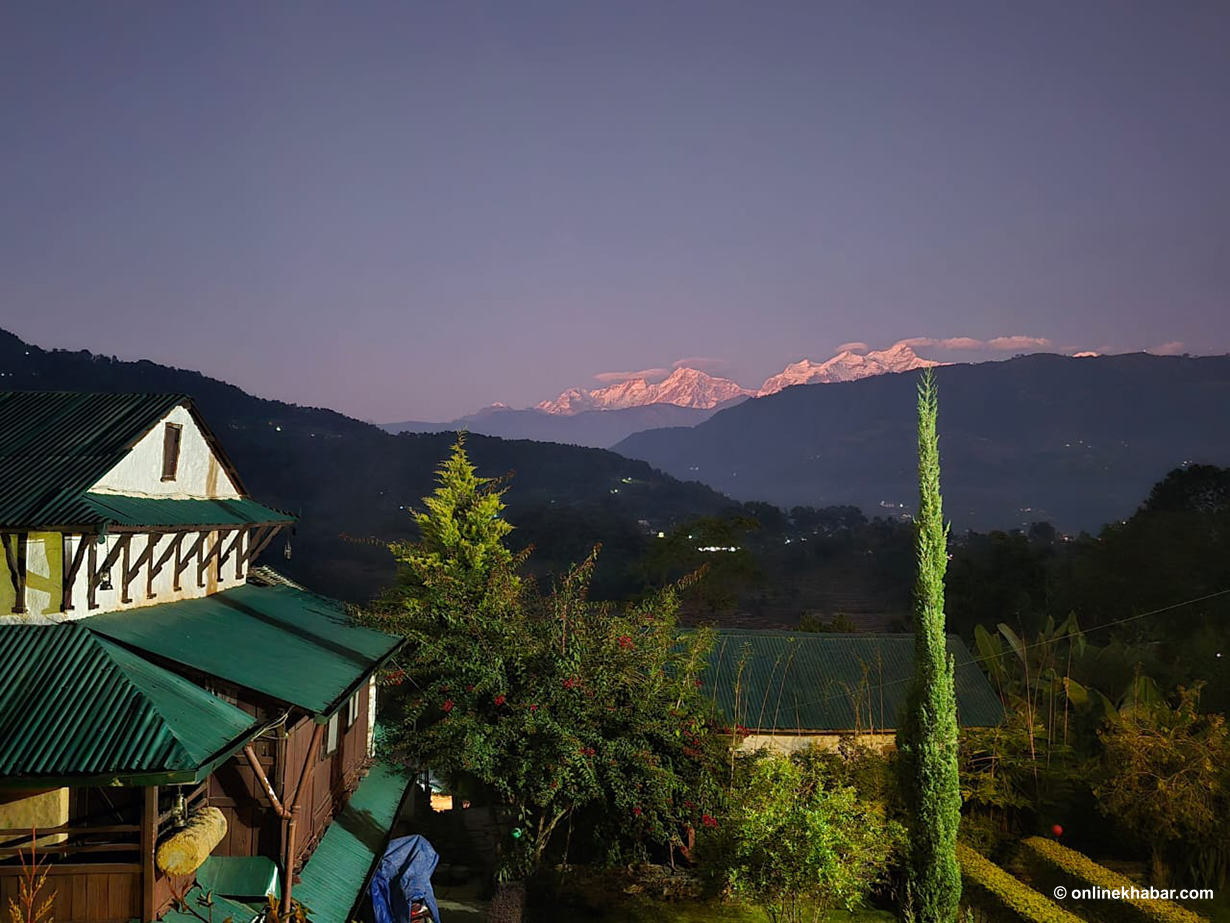
From here, various Himalayan peaks and scenic hills are visible to the north. Situated amidst lush green mountains, the farm stay has been named ‘Green Himalaya Village Farm Stay.’ The goal is to promote rural tourism connected with local agriculture using indigenous products.

Her husband, Rajendra Dev Pandey, added, “Following the concept of ‘farm to kitchen and kitchen to farm,’ our aim is to involve the younger generation in rural tourism.”

Currently, six people have regular employment at the farm stay, with more hired as needed. Tourists from various parts of Nepal including Tanahun, Chitwan, Lamjung, Kathmandu, Pokhara, Dhankuta, Ilam, and Butwal, as well as international visitors, have been frequent guests.

The charge for visitors is NPR 2,500 per person, NPR 4,500 for a couple, and NPR 2,000 per person for groups of more than ten people.

Guests are served snacks including sticky rice and maize, evening meals featuring local chicken, and breakfast including fruits, milk, yogurt, millet bread, and vegetables.

According to the founder, the farm stay can accommodate 30 guests simultaneously, expandable up to 40 if necessary. Many tourists also visit during the day just to enjoy the surroundings and sample meals.

Guests Served Produce From Own Farm

Vegetables and fruits grown on the farm are offered to guests. The farm stay spreads over 75 ropani, with about 10 ropani occupied by buildings and the rest utilized for farming and cattle rearing.

Guests are served rice, mustard oil, vegetables, local chicken meat, milk, yogurt, sticky rice, and clarified butter sourced directly from the farm.

Fruits such as mango, lychee, peach, avocado, and nuts are also provided. If farm production is insufficient, fresh vegetables, fruits, chicken, eggs, and milk are procured from neighboring villages to ensure 100% organic quality. This has also increased income opportunities for locals.

Gita remarked, “When we left the village, the farmland was barren. We made it cultivable, planting various fruits and medicinal herbs. We have worked hard to provide visitors a unique experience.”

Revitalizing Village Life

Gita and Rajendra observed increased activity in the village since their return. Rajendra noted, “Educated people are coming back, and the urge to leave the village has lessened. Living in the village is easier and more peaceful than the city. I supported my wife’s wish to return, which sends an important message.”

Their investment and efforts have inspired other homeowners to start community homestays, where guests share accommodations and cultural programs are conducted.

They have two children; their son lives in America and daughter works in Kathmandu. Although initially opposed, their children are now eager to return to the village.

Focus on Preserving Traditional Materials and Agro-Tourism

They believe agro-tourism educates young people about agriculture and traditional materials. Various school students, farmers, and cooperative groups visit the farm stay to learn ways to revive the village.

Village infrastructure has improved, with paved roads, water supply, internet, and health posts available. Rajendra remarked, “If educated people return with the intention to contribute, it can have a positive social impact. We chose to leave comfortable city life and do something meaningful in the village.”

Parents are pleased when their children visit the farm stay to learn about agro-tourism. Gita explained, “Tourists get to understand the traditional social fabric of the village. Our goal is to establish how the village was and is now.”

She added, “Working with your hands outdoors is far more satisfying than living confined in the city. I have no regrets about selling my Kathmandu home and returning to the village. I am eager to undertake more new initiatives.”


Nepali Congress Condemns Chief Justice Recommendation as Undemocratic and Arbitrary

April 6, Kathmandu: The main opposition party, Nepali Congress, has expressed serious disagreement with the Chief Justice recommendation made by the Constitutional Council. Party spokesperson Devaraj Chalise commented in a press release issued on Thursday night that the government’s recent ordinance concerning the Constitutional Council was introduced to facilitate such arbitrary appointments. “Nepal’s Constitution embraces the fundamental principles of separation, control, and balance of power by establishing the Constitutional Council,” the press note states. “It clearly provides for the participation of the government, opposition parties, and impartial institutions to ensure constitutional bodies are free from direct executive control.”

Congress noted that this arrangement reflects the Constitutional Assembly’s profound understanding and democratic foresight. “Its core purpose is to establish constitutional bodies not as subordinate to the government but as independent watchdogs,” the statement added. However, Congress pointed out that the ordinance reduces the quorum to allow decisions to be made by just three members—including the Prime Minister—thus opening the door for appointments to constitutional bodies by a limited group. “This ordinance was brought for such arbitrary appointments, as is now proven,” the press note said.

The Supreme Court’s decision on June 27, 2024 (Jestha 14, 2081 BS) clarified that the decisions of three members in a six-member Constitutional Council cannot be considered a majority. Congress recalled this precedent, emphasizing that ignoring this and sidelining the natural right of the senior-most judge, thereby affecting a traditionally upheld constitutional authority, was unfortunate.

Congress claimed that the ordinance and the subsequent decision-making process are gradually transforming the independent judiciary into an extension of the executive branch. “This could lead to crucial constitutional bodies such as the Commission for the Investigation of Abuse of Authority, the Election Commission, and the Public Service Commission being operated to favor the government agenda. It will weaken protection of citizens’ fundamental rights and ultimately erode the principle of separation of powers, steering the country toward autocratic governance,” Chalise stated in the press release.

Acknowledging the supremacy of the Constitution in a democracy, the press note stressed, “The Constitution does not make the Prime Minister a decisive ruler but assigns only a responsible coordinating role.” Yet, the Chief Justice recommendation made by the Constitutional Council today with a limited vote openly violates the Constitution’s core spirit, judicial independence, and democratic values, Congress concluded. “Nepali Congress firmly and seriously opposes such an undemocratic and arbitrary move,” the statement affirmed.

नेपाल पुलिस क्लब कोहलपुर गोल्डकप फुटबलको फाइनलमा – Online Khabar

Nepal Police Club Advances to Final of Kohalpur Gold Cup Football Tournament

News Summary

Created by AI with editorial review.

  • Nepal Police Club defeated Royal Football Club Karnali 5-3 on penalties in the semifinal of the Kohalpur Gold Cup football to advance to the final.
  • Kohalpur Racing Sahara Club secured their final spot by defeating Laligurans Association Club Pokhara in the first semifinal.
  • The final between Kohalpur Racing Sahara Club and Nepal Police Club will be held on Baisakh 26, with the winner receiving NPR 800,000 as prize money.

April 7 (Baisakh 24), Banke – The departmental team Nepal Police Club has secured a place in the final of the fourth Kohalpur Gold Cup football tournament. On Thursday, Nepal Police Club defeated Royal Football Club Karnali 5-3 on penalties in the second semifinal match to reach the final.

The match, played with great enthusiasm, ended goalless in regular time. This was the first match in the current edition of the Kohalpur Gold Cup where the result was decided by penalty shootout, as no previous matches had used penalties to determine the winner.

Having won the penalty shootout, Nepal Police Club confirmed their place in the final, where they will face the host team Kohalpur Racing Sahara Club.

All five Nepal Police Club players successfully converted their penalties. The goal scorers for Police Club were captain Ram Bagale, Anil Tamata, Sanjiv Lama, Hemant Shrestha, and Sujan Magar.

For Karnali, Karan Shahi, Divash Bisi, and Bikram Ali scored, while captain Sudan Bishwakarma was unsuccessful in his attempt.

In the first semifinal held on Wednesday, the host Kohalpur Racing Sahara Club defeated Laligurans Association Club Pokhara to secure their spot in the Kohalpur Gold Cup final.

The final match to decide the champion will be played between Kohalpur Racing Sahara Club and Nepal Police Club on Baisakh 26 (April 9).

The tournament features eight teams, with the champion receiving a prize of NPR 800,000 and the runner-up awarded NPR 400,000.

The Most Valuable Player of the tournament will receive a prize of NPR 51,000.

ICRA Nepal Upgrades Rating of MAW Hire Purchase

Credit rating agency ICRA Nepal has upgraded the long-term debt rating of MAW Hire Purchase Pvt. Ltd. to LBBB-. The agency reported that the company’s non-performing loans decreased from 4.36% in October 2024 to 1.95% in October 2025. MAW provides vehicle and mobile phone financing services and has a net worth exceeding NPR 670 million. (April 7, Kathmandu)

ICRA Nepal has improved the rating grade of MAW Hire Purchase Pvt. Ltd., a hire purchase company, citing positive changes in the company’s financial position. According to ICRA Nepal, the long-term debt rating was upgraded from LBB+ to LBBB-.

Similarly, the short-term debt rating has been raised from A4+ to A3+. ICRA noted that the company’s non-performing loan ratio declined from 4.36% in October 2024 to 1.95% in October 2025. MAW offers financing services especially for vehicles—including Yamaha, Royal Enfield, and Foton—as well as mobile phones.

ICRA also highlighted that the company’s net worth exceeds NPR 670 million, and MAW is eligible to borrow up to 10 times its net worth. Having reported consistent profits over the past five years, the company has achieved a superior rating compared to other hire purchase firms. Founded in 2011, MAW Hire Purchase’s head office is located in Biratnagar, with its primary operations center in Tripureshwor, Kathmandu.