Author: space4knews

ट्रम्पका विशेष दूत गोर काठमाडौं आउँदै, बालेनसँग भेट होला ?

Trump’s Special Envoy Sergio Gaur Arriving in Kathmandu: Will He Meet Prime Minister Balen Shah?

April 30, Kathmandu – Sergio Gaur, the special envoy of US President Donald Trump, is scheduled to arrive in Kathmandu this evening. According to a source at the Ministry of Foreign Affairs, Gaur’s visit marks one of the highest-level diplomatic engagements from the United States since the formation of the government led by Balen Shah.

At 39 years old, Gaur serves as the US Special Envoy for South and Central Asia and also holds the position of the US Ambassador to India. Considered a close aide to Trump, Gaur’s dual roles signify a higher official standing compared to that of Samir P. Kapur, the US Assistant Secretary of State, who visited Kathmandu earlier on April 20.

This will be Gaur’s first visit to Kathmandu, where his agenda is expected to focus on business, investment, and the expansion of bilateral governmental relations, according to ministry sources. He is scheduled to hold meetings with Nepal’s Finance Minister Dr. Swarnim Wagle and Foreign Minister Shisir Khanal.

While political discussions are anticipated during his stay, it remains uncertain whether Gaur will meet Prime Minister Balen Shah. The Prime Minister’s Press Advisor, Deepa Dahal, stated, “The Prime Minister is currently occupied with domestic issues, particularly concentrating on good governance.”

In recent years, most foreign diplomats visiting Nepal have met with the Prime Minister and senior political leaders. However, sources indicate that the government under Balen Shah has shifted its engagement approach. During his visit, Samir P. Kapur met with Rastriya Swatantra Party Chairman Ravi Lamichhane and various senior ministers but was unable to meet the Prime Minister.

Similarly, it appears likely that Gaur will also meet only with leaders from the Rastriya Swatantra Party and senior ministers, due to limited availability of the Prime Minister. However, meetings with Finance Minister Dr. Swarnim Wagle and Foreign Minister Shisir Khanal are confirmed.

Trump and Putin Discuss Ukraine and Iran Conflicts

April 30, Kathmandu — US President Donald Trump stated that he had a discussion with Russian President Vladimir Putin regarding the conflicts in Ukraine and Iran. According to Trump, President Putin expressed a willingness to assist in ending the conflict in Iran. “We had an in-depth conversation about the war in Ukraine; he is willing to help,” Trump said at a press conference. “However, I told him that he must stop the war before I can offer any assistance.” Responding to another question, the US President revealed that Putin showed interest in participating in the uranium enrichment process in Iran. Uranium enrichment is the process of increasing the percentage of the useful isotope within natural uranium.

What Would Happen If Ambassadors Are Selected Through Open Competition?

Foreign Minister Shisir Khanal

Image Source, RSS

The government led by Prime Minister Walendra Shah ‘Balen’ has publicly announced preparations to appoint Nepalese ambassadors through open competition, a move that has sparked various criticisms.

Two experienced former ambassadors speaking to media described this initiative as potentially “harmful” and “impractical.” They suggest that improving the current system of political appointments would be a more appropriate path forward.

Currently, about 50% of Nepal’s ambassadors are career diplomats who rise through ranks within the Ministry of Foreign Affairs, while the remaining 50% are appointed based on political considerations.

The current government has not disclosed the exact percentage of ambassadors it plans to appoint through open competition. Sources from the Foreign Ministry say that this decision will be finalized at the highest levels.

Foreign Minister Shisir Khanal is actively engaged in drafting the appointment criteria, with advertisements expected to be released within the next week.

‘भूमिहीनलाई छिटोछिटो व्यवस्थापन गर्ने नाममा गल्ती गर्ने छुट छैन’

‘There Is No Room for Errors When Swiftly Managing Landless Issues’

The news summary has been compiled and prepared after editorial review. We do not take any partisan stance; regardless of which government comes into power, we are the body responsible for the strict implementation of established policies and regulations. The rule of law should not depend on individual mindsets. Currently, the certification process is ongoing. Forcing certification without completing the data collection and verification processes in squatter settlements is legally unacceptable. The government has decided to complete the digital certification of landless individuals within 60 days and to provide land to actual squatters within 1000 days. The government led by Balendra Shah began the eviction from squatter settlements in Thapathali, Gairigaun, and Manohara within a month and initiated data collection and certification.

Coordination between the Land Problem Solving Commission, formed to distribute land to landless Dalits and squatters and to manage unplanned settlements, and the federal government appears weak. Both parties seem to prioritize their own interests over the issues confronting more than 1.2 million landless individuals. In an interview regarding the government’s recent steps and land issues, Hari Prasad Rizal, Chairperson of the Land Commission, stated, “The Government of Nepal and the state must operate in accordance with the constitution and the law. We work accordingly.”

He emphasized the necessity for the government to inform the public about legal procedures and methods. He added, “Currently, the government’s work does not align with legal processes, which is why a statement was issued calling such actions inconsistent and incorrect.” If there is a tendency for the government to remove or force the resignation of the Commission, why not cooperate instead? This is a democratic country where all actions must conform only to the constitution and the law.

Why is it challenging to resolve the problems of the landless quickly? Land-related issues are extremely sensitive, and rushing can lead to serious mistakes. Strict certification is necessary to ensure that benefits do not go to the wrong people. The government must act only in a just and constitutional manner. In conclusion, he said, “We must all follow the rules and cooperate without putting personal interests first.”

What Does the Ordinance on the Constitutional Council Submitted to the President’s Office Include?

Summary of the News

Briefly prepared and editorially reviewed.

  • The government has submitted an ordinance on the Constitutional Council to the President’s office that allows decision-making with at least three officials.
  • The ordinance proposes that the opinions of three officials, including the Prime Minister, will be decisive for the council’s decisions.
  • The President had previously returned a bill as unconstitutional for allowing decisions by minority opinion.

April 29, Kathmandu – The government has submitted an ordinance pertaining to the Constitutional Council (its functions, duties, and powers) to the President’s office, enabling decisions to be made with the agreement of only three officials.

According to sources close to the Prime Minister and Council of Ministers’ office, the ordinance has revised the quorum and the number of members required for decision-making.

As per Article 284 of Nepal’s Constitution, the Constitutional Council is formed under the chairmanship of the Prime Minister and includes the Chief Justice, the Speaker, the Chairman of the National Assembly, the Leader of the Opposition party, and the Deputy Speaker as members. If the Chief Justice’s position is vacant, the Minister of Law replaces the Acting Chief Justice as a member.

This article states that “Other functions, duties, and powers of the Constitutional Council as well as the procedures for appointing the Chief Justice or heads or officials of constitutional bodies shall be as provided by federal law.”

Under the previous act, the council had six members. A quorum was achieved with four of these members, including the Prime Minister. Initially, the law required a unanimous decision; if not possible, then decisions would be reached by consensus at a second meeting.

If consensus still could not be reached, the decision would be made by majority vote of all council members. Although the Oli government issued multiple ordinances to amend the act, the bills were never passed by Parliament, leading to legal gaps.

Currently, the government has submitted an ordinance that proposes the decisive opinion of three officials, including the Prime Minister, regarding decisions of the Constitutional Council. Previously, the majority of all six members (i.e., at least four) was required for valid decisions.

Regarding the council’s current composition, Prime Minister Balendra Shah and Speaker Dol Prasad Aryal are affiliated with the Rastriya Swatantra Party. The National Assembly Chairman Narayan Prasad Dahal comes from a Maoist background.

Only two days ago, the Leader of the Opposition, Bishma Raj Angdambe, comes from the Nepali Congress, and Deputy Speaker Ruby Kumari is an elected MP from the Labour Culture Party, whose chairperson, Harka Sampang, often delivers harsh critiques of the government’s activities.

Among the council’s six members, Dahal, Angdambe, and Ruby Kumari are opposition members. The Chief Justice, who attends the council, is usually expected to remain neutral, meaning the Prime Minister could be in the minority regarding his proposals. Even if the Chief Justice supports the proposal, the votes between both sides might be evenly split. According to officials familiar with the ordinance, “The ordinance was issued aiming to amend quorum procedures based on this very dynamic.”

The Federal Parliament had also passed a bill concerning the Constitutional Council in late February 2023 (Falgun 2079) and sent it to the President for certification. However, President Ramchandra Paudel returned it for reconsideration, stating that allowing decisions by minority opinion was not in compliance with the constitution. No further progress occurred since then.

Currently, there is no legal obstacle to unanimous decisions in the Constitutional Council. However, legal uncertainty persists regarding which proportion of dissenting votes is considered decisive if consensus is not reached. The government concluded that delays occur in calling meetings under the existing law, hence it plans to move forward through the ordinance route.

Iran War: Social Media Posts in Gulf Countries Risk Imprisonment or Exile

Since the war between the US and Israel against Iran began two months ago, Gulf countries have taken action against individuals for social media posts deemed a threat to national security. Authorities have detained people and imposed penalties including imprisonment and exile. New directives have further limited judicial appeals, and in some cases, citizenship has been revoked through the misuse of existing laws.

After stripping 157 people of their citizenship, Bahrain’s Ministry of Interior stated, “Bahraini nationality has been revoked for those who praise Iranian measures, show sympathy towards them, or maintain contact with foreign parties.” Security forces have intensified surveillance of social media users and activists. International and local human rights organizations have condemned these measures, citing serious infringements on freedom of thought and expression.

Detainees in Bahrain and Kuwait come from diverse backgrounds, including journalists, influencers, human rights defenders, and ordinary citizens. These countries have accused these individuals of attempting to incite ethnic conflict, spreading misinformation, misusing mobile phones, and threatening state security. Some Gulf states imposed bans early in the conflict on collecting and publishing videos or information about Iranian attacks within their territories.

Recently, Kuwait introduced new nationality legislation while Bahrain issued royal decrees. According to a Kuwaiti activist requesting anonymity, wartime provisions have been applied to monitor online activities. Security checkpoints have been set up in public areas where officials check people’s mobile phones for messages, photos, and voice notes.

शेखर कोइरालाले पनि बोलाए छुट्टै भेला – Online Khabar

Shekhar Koirala Calls for Separate Bagmati Province-Level Meeting of His Faction

April 30, Kathmandu – Dr. Shekhar Koirala, leader of a faction within the Nepali Congress, is convening a meeting of his group. Koirala has called for a separate Bagmati Province-level gathering for his faction. The meeting will include outgoing central members, current central members elected through the special general convention to the central working committee, members of parliament and former MPs, district chairpersons, former district chairpersons, and regional chairpersons. According to Koirala’s secretariat, the meeting will begin at 8 a.m. at Opera Hotel in Baluwatar.

Earlier, on Wednesday, the outgoing acting chairperson Purna Bahadur Khadka also held discussions by convening a meeting of his own faction. Since the special general convention, unity has not been achieved within the Nepali Congress. One faction’s inability to accept the other has led to parallel activities within the party.

Portugal Marks Buddha Jayanti with Special Program

April 30, Lisbon (Portugal) – The 2570th birth anniversary of Lord Gautam Buddha, the proponent of world peace, is being celebrated in Portugal through a special event. The Nepal Indigenous Nationalities Federation in Portugal is organizing the program, which is slated for Friday, May 1, in the capital city, Lisbon, to observe Buddha Jayanti in a distinctive manner. On this occasion, a special worship ceremony of Lord Buddha will be held at the Ginásio Clube Hall in Anjos, Lisbon, with Buddhist spiritual leaders conducting meditation sessions and delivering discourses.

The federation’s president, Chopkumar Ranamagar, stated that the event aims to spread Buddha’s messages of peace, compassion, and friendliness, as well as to promote Buddha and his birthplace. President Ranamagar urged the Nepalese community residing in Portugal to participate, emphasizing the desire to make the event grand and successful. Each year, Nepalese organizations active in Portugal collaborate to celebrate Buddha Jayanti.

आज अधिकांश विदेशी मुद्राको भाउ बढ्यो – Online Khabar

Most Foreign Currencies Appreciate Today

The Nepal Rastra Bank has set the buying rate of the US dollar at NPR 151.46 and the selling rate at NPR 152.06. The Euro’s buying rate is fixed at NPR 177.29 and the selling rate at NPR 177.99. The values of the Swiss Franc, Australian Dollar, Canadian Dollar, and Singapore Dollar have also increased. Kathmandu, 17 Baisakh.

According to the exchange rates determined by Nepal Rastra Bank for today, the values of the US dollar, Euro, and British pound sterling have risen. The US dollar’s buying rate today stands at NPR 151.46 and the selling rate at NPR 152.06. Yesterday, the US dollar had a buying rate of NPR 150.97 and a selling rate of NPR 151.57. The European Euro’s buying rate today is NPR 177.29 and the selling rate NPR 177.99.

Today, the UK pound sterling’s buying rate is NPR 204.60 and the selling rate NPR 205.41. Yesterday, its buying rate was NPR 203.55 and the selling rate NPR 204.36. The Swiss Franc’s buying rate today is NPR 191.92 and the selling rate NPR 192.68. Yesterday, these were NPR 191.16 and NPR 191.92 respectively.

The Australian Dollar has a buying rate of NPR 108.41 and a selling rate of NPR 108.84 today, compared to NPR 108.13 and NPR 108.56 yesterday. The Canadian Dollar’s buying rate today is NPR 110.72 and selling rate NPR 111.15, up from NPR 110.46 and NPR 110.90 respectively. Similarly, the Singapore Dollar’s buying rate is NPR 118.56 and selling rate NPR 119.03 today, having been NPR 118.18 and NPR 118.65 yesterday. Furthermore, the Indian Rupee’s buying rate for 100 rupees is NPR 160 and the selling rate NPR 160.15. The Rastra Bank has stated that these exchange rates may be revised at any time as necessary. Commercial banks may offer different rates, and the updated rates are available on the central bank’s website.

Radhaswami Satsang in Kirtipur Provides Meals to Displaced Residents; Here Is the Menu

The Radhaswami Satsang Ashram located at Sundarighat in Kirtipur has initiated a meal program for displaced residents starting today. The ashram is currently sheltering 161 individuals from 57 families, providing meals from morning until evening according to a planned menu. These displaced people were relocated to the ashram after a bulldozer operation was conducted in their settlement on Saturday and Sunday.

The Radhaswami Satsang Ashram itself is responsible for feeding the displaced residents residing there, a service confirmed by one of the ashram’s caretakers. Additionally, a police officer assigned to the shelter’s security also verified that the Radhaswami Satsang began providing meals to the displaced individuals from today.

A daily meal schedule has been prepared for those staying at the ashram. Each day at 7 a.m., residents receive tea and biscuits; at 10:30 a.m., lentils, rice, vegetables, and pickles are served. Tea snacks are provided at 2 p.m., and dinner is offered at 6:30 p.m., mirroring the breakfast menu. The displaced residents sheltered at Radhaswami Satsang come from areas including Thapathali, Shantinagar, and Gairigaun. According to the police, there are 161 displaced people from 57 families in Kirtipur.

हामी चौथो अंग होइनौं – Online Khabar

We Are Not the Fourth Estate – Journalist Kamal Prasai Shares His Views

News Summary

  • Kamal Prasai was beaten by police and had his camera memory card stolen while covering the eviction of squatters.
  • Despite the attack, Kamal stated on Facebook, “I am a journalist who gets beaten, but I am not at all discouraged,” reaffirming his dedication to journalism.
  • The need for the state to manage squatter settlements within legal frameworks and with humanity was emphasized.

Among friends capturing an espresso shot, Kamal Prasai is currently undergoing nasal surgery at Bir Hospital. During tensions between police and the public at Manohara’s squatter settlement clearance, Kamal was reporting cautiously and responsibly.

On the evening of April 26 (Baisakh 12), the day after Democracy Day, amidst continuous rain, Kamal went to photograph the squatter settlement when some individuals assaulted him by snatching police batons and beat him, also stealing his camera’s memory card.

The news of Kamal’s assault saddens us, but the reactions on social media have caused even greater pain. Comments like “journalists deserved to be beaten more” have deeply wounded him—more profoundly than any physical injury.

On Facebook, Kamal wrote, “I am a journalist who gets beaten, but I am not discouraged in the slightest. Because I am hurt precisely because I portray the truth and turn the pages of society.”

“Our society has become one that mocks others’ suffering. Yet, without being disheartened, I am committed to giving this society a positive message through this profession and intend to continue.”

This brief expression from Kamal sheds light on many aspects of Nepalese press, governance, and society.

Why has our society started to mock and find pleasure in others’ suffering? This question is not Kamal’s alone but must be raised by all working in the civic domain.

The idea of viewing journalism and civil society as the fourth estate of the state is not new. In 1787, Edmund Burke described journalism in the British Parliament as the fourth estate, playing a role in holding governments accountable.

Since then, a global tradition has recognized journalism as the fourth estate.

However, we are not the opposition either, whose roles, rights, and duties are constitutionally defined. We independently raise questions and represent the citizens’ curiosity.

After more than 150 years of experience, we realize that we are not the fourth estate of the state. Just as parliament, government, and judiciary operate from their official places, we are not meant to occupy such a formal position.

Our primary association is with citizens, not the state.

Moreover, the state and government are not the same. In Nepal, there is a growing tendency to conflate the government as the state and thus to consider media as a government arm, which is erroneous.

Going forward, let us consider ourselves as part of the citizen community rather than the fourth estate and encourage others to do the same.

We are not opposition; we are independent voices of the citizens, addressing societal issues.

Kamal Prasai and other photojournalists documented harsh crackdowns during the Janatantra Andolan (People’s Movement). They captured videos and photos of destruction, arson, and looting at sensitive locations like Singha Durbar, Sheetal Niwas, and the Parliament.

Last year on March 29 (Chaitra 15), during a royalist demonstration, policeman Suresh Rajak was suspiciously killed while performing his duties. Deependra Dhungana from Naya Patrika survived a shooting incident.

Narendra Shrestha’s photo of burning Singha Durbar won the World Press Photo Award. Many photojournalists—not just them—have captured society’s realities.

Dear viewers, if any photojournalist’s feelings have been hurt, we sincerely apologize.

Those making divisive and misleading comments on Facebook are not like our friends; they tell stories visually and focus on quality.

Among thousands of news and opinion pieces, mistakes may occur, but we strive to correct them. This remains our professional obligation.

Now, let’s talk about the squatters.

Much reporting and multimedia content has been presented. We reflect on what resonates with Kamal’s sentiments: Why have we not found practical solutions to squatter hardships? A democratic state has the authority to manage within laws and regulations—why resort to violence?

Some squatters had obtained permits from the previous government. They were monitored irregularly by the army and police. Children were unable to take exams smoothly; conditions in holding centers were inadequate. Teenage girls referred to their shacks as homes, not hotels or holding centers.

The previous Kathmandu mayor, Balendra, made similar mistakes; currently, due to harsh state policies, these errors are being repeated. We are engaging in unnecessary criticism on Facebook.

The army and police are our brothers; then who are these squatters? The Constitution of Nepal guarantees all citizens the right to live with dignity.

Today, the spirit of the Constitution is fading, and it is time for us to show humanity.

The Nationalist Sovereign Party’s 100-point declaration clearly stated arrangements for homeless squatters, but implementation has faced challenges.

We must break the habit of deriving satisfaction from the suffering of opposing groups. Other people’s problems are real. Only after their education, employment, and housing are assured should relocation occur.

Today, whether it is a holding center or hotel, English terms are used to objectify squatters. Democracy remains a luxury for the upper-middle class.

Let us visit squatter settlements and understand their problems. State leaders frequently change policies; we must avoid drawing pleasure from others’ pain. This is our country.

Before the Constitution, it is time to show humanity. Let us acknowledge we are not the fourth estate and encourage others to understand this. Kamal, please forgive us.

Nepali Congress Seeks Clarification from Seven Provincial Lawmakers Including Three Ministers

April 29, Kathmandu – The Central Disciplinary Committee of the Nepali Congress has requested explanations from seven provincial lawmakers, including three ministers, for allegedly undermining the party’s official candidates during the House of Representatives election. This decision was made at the committee meeting held on Wednesday.
The ministers asked to provide clarifications include Devkaran Prasad Kalwar, Minister of Forests from Lumbini Province and a Central Committee member; Pradeep Sunuwar, Minister from Koshi Province and former Central Committee member; and Prachandavikram Nyaupane, Minister of Transport and Tourism from Lumbini Province. Other provincial lawmakers include Raju Khanal, Deputy Speaker of the Lumbini Provincial Assembly, as well as Jangilal Rai, Sakuntidevi Mahara, and Kaushalkishor Rai from Madhesh Province. This information was confirmed by Krishna Prasad Dulal, Acting Chief Secretary of the Nepali Congress Central Office. The officials and lawmakers have been given five days to submit their explanations.

सबै राजनीतिक नियुक्ति खारेज गरिने – Online Khabar

Government Recommends Ordinance to Rescind All Political Appointments to the President

The government has forwarded an ordinance to the President aimed at nullifying all political appointments. This ordinance seeks to ensure transparency and competitiveness in public body appointments and to eliminate partisan politicization. Additionally, ordinances proposing amendments to the Cooperative Act, university regulations, Health Science Academy, and 20 other legislations have also been submitted. Kathmandu, 16 Baisakh.

Under this decision, the government will introduce a special ordinance addressing the dismissal of public officials and has recommended it to the President. A note from the Prime Minister’s Secretariat states, ‘This ordinance is intended to remove officials appointed politically and currently holding positions in public bodies.’

The recommended ordinances aim to foster transparency and competition in public appointments, end political party interference, expedite public construction projects, refund small savers’ deposits in cooperatives, and improve services related to land, revenue, and surveying.

An ordinance to amend the Constitutional Council (Duties, Responsibilities, Authority, and Procedures) Act, 2066 has also been recommended. The ordinance includes provisions to regulate cooperatives, require licenses for operations, and establish a ‘Revolving Relief Fund’ for the immediate repayment of savings to members of troubled cooperatives.

Nepali Army Fully Prepared for Disaster Management Operations

Kathmandu – The Nepali Army has announced the completion of its preparations for this year by incorporating its past experiences in disaster management. According to Assistant Rathi Rajaram Basnet, the Army’s spokesperson, during the flood on October 5 last year that impacted Kathmandu and various other parts of the country, the Nepali Army’s rescue teams were actively deployed and similar preparedness continues to this day. He recalled that due to relentless rainfall at that time, 28 flood-affected locations within the Kathmandu Valley had been preemptively assigned Army units equipped with necessary tools to minimize disaster-related losses and conduct rescue operations.

Furthermore, last year in Bhaktapur’s Changunarayan-6, Bastola village faced continuous landslides from local cliffs, placing the settlement at risk. The Army unit deployed from Ranashur Gulm in Kharipati, Bhaktapur, successfully relocated locals to safer locations. In Kathmandu’s Budhanilkantha 10, Akashedhara area, when fallen trees blocked roads, the Fast Rifle Battalion efficiently cleared the obstruction. Similarly, in Lalitpur Metropolitan City-9, Chyasal, when a tree swept away by floodwaters beneath the Bagmati river bridge caused blockages in the river, the Rajdal Battalion was dispatched to clear the obstruction. Basnet also highlighted that the Nepali Army carried out successful search and rescue operations in various locations outside the valley last year.

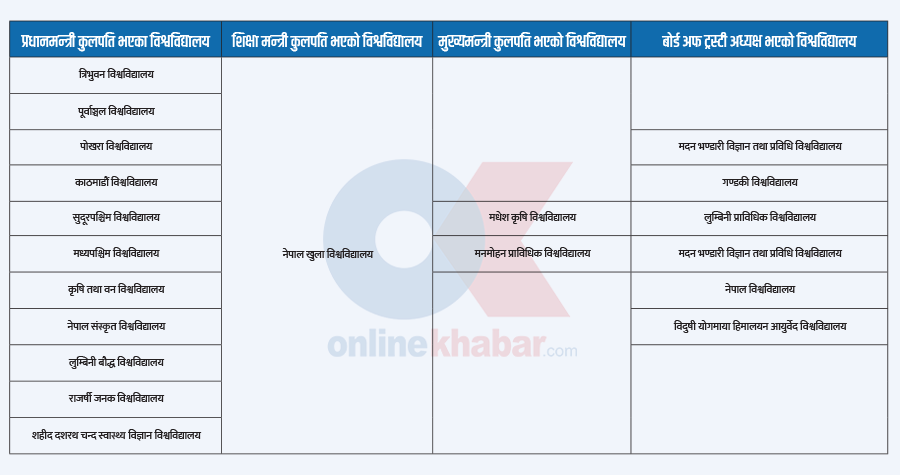
सरकारले विश्वविद्यालयका सबै पदाधिकारी हटाउन सक्ने

Government Prepares Rules Allowing Removal of All University Officials

News Summary

Reviewed editorially.

  • The government has recommended a university-related act amendment ordinance to the President, allowing the removal of university officials.
  • The ordinance abolishes the fixed four-year term of office for officials, granting the government the authority to remove them at will.
  • Nepal currently has 18 universities, and the government aims to fulfill its commitment to shift from politically influenced appointments to merit-based selections.

April 29, Kathmandu – The government has recommended an ordinance to the President that creates provisions allowing the removal of current university officials.

Among three ordinances recommended to the President’s office on Wednesday is an amendment to the Nepal University Act, which proposes changes to various provisions of university laws.

According to government sources, this ordinance removes the existing provisions regarding the term of office of university officials.

Currently, the act stipulates a four-year term for university officials, but the ordinance seeks to abolish this fixed term.

Sources indicate that the ordinance does not specify a fixed term, effectively allowing the government to remove incumbent officials at any time.

The appointment system includes positions such as Vice Chancellor, Rector, and Registrar, with the Chancellor usually being the Prime Minister and the Pro-Chancellor the Education Minister.

The appointment process has been criticized for being driven by political quotas.

The government and the ruling alliance had committed to replacing this system with merit-based appointments, a promise that is now poised to be implemented.

How many universities are there in Nepal?