Author: space4knews

Conflict in the Middle East Raises Concerns for Nepal’s Bottled Water Industry

Water industry representatives demand price increases for bottled and jarred water due to soaring plastic and fuel costs

Image source, Getty Images

Bottled water industry leaders are calling for price hikes to reflect increases in plastic raw material costs, but officials emphasize that no decision can be made without public hearings involving stakeholders.

The Chairman of the Nepal Bottled Water Industry Federation told the BBC that if maximum pricing guidelines set by the water pricing commission remain unchanged, many water industries across the country may be forced to close.

Business owners expressed particular concern over the steep increase in petroleum product prices and raw materials for the production of bottles and jars, attributing this rise to the ongoing conflict in the Middle East.

Currently, businesses argue that the price of bottled water should increase by 5 Nepalese rupees per liter, and jarred water should see a rise of 10 to 12 rupees.

The commission responsible for wholesale and bottled water pricing has stated that any decision will be made only after public hearings and consultations with concerned parties.

New Diamond Secures Spot in PM Cup NVL Volleyball League Final with Four Consecutive Wins

April 28, Kathmandu — New Diamond Youth Sports Club has advanced to the final of the Red Bull Dashain PM Cup NVL Women’s and Men’s Volleyball League 2083, in the women’s category. In the match held Tuesday at the Dashrath Rangashala covered hall in Tripureshwor, New Diamond defeated APF with a confirmed score of 25-21, 20-25, 25-18, 25-21. New Diamond will now face Nepal Police in the final league stage match. Regardless of the outcome of this match, New Diamond has already secured a top-two position.

After four matches, New Diamond has accumulated 12 points, ascending to the top spot, while APF, which has suffered two losses, holds 6 points.

On the same day, in another women’s match, Tribhuvan Army Club decisively defeated Sudurpashchim with scores of 25-15, 25-10, 25-5. Securing their first win in four matches, Army Club now has 3 points.

Currently, APF has only one match remaining against Nepal Police, while the Police Club is scheduled to play both APF and New Diamond.

वर्षातको मौसममा घरको हेरचाह गर्ने १० उपाय – Online Khabar

10 Essential Tips for Home Maintenance During the Rainy Season

It is crucial to inspect your home for any leaks before the rainy season begins, as repairs become much more difficult once the leaks worsen during heavy rains. While many enjoy the rainy season, it requires special attention to home care because the raindrops can affect the house in various ways. Therefore, certain important precautions should be taken to maintain the home during this time.

1. Laundry Care: During the rain, not only do we get wet, but our clothes also do, and they tend to take a long time to dry, which is a significant issue. Most people tend to avoid washing bed covers, curtains, and towels during the rain, but this is not a sustainable solution as unpleasant odors can develop over time. Hence, regular cleaning of essential clothes is important. If clothes do not seem to dry quickly at home, dry cleaning can be a good alternative.

2. Freshening the Home: The rainy season is conducive to bacterial growth, so it is necessary to clean the house regularly. After cleaning, placing fragrant flowers or a few drops of preferred essential oils in every room can fill the home with a fresh and pleasant aroma.

3. Outdoor Plant Care: Indoor plants require special attention during the rainy months. Reduced sunlight due to clouds can affect their growth. It is advisable to place indoor plants outside for short periods, especially on balconies. Rain can also promote pests on plant leaves, and bringing them indoors may cause these problems to spread. Protect plants from excessive rain to prevent damage.

4. Carpet Maintenance: Carpets attract moisture and dust during the rainy season, which can cause unusual odors. Daily vacuuming is necessary to prevent this. If possible, carpets can be removed during the rainy season and put back afterward.

5. Electrical Equipment Maintenance Before the Rains: Rain and wind can cause fluctuations in power supply, potentially damaging electrical equipment. It is advisable to have an electrician inspect and repair wiring before the rains begin. If wires are wet or deteriorated, replacing them reduces the risk of short circuits. Leakage near switchboards should never be ignored and must be repaired immediately.

6. Protecting Books: If you have a large collection of books at home, protecting them from rain effects is important. Once damaged, restoring books to their original condition is difficult. Placing naphthalene balls and silica gel packs on bookshelves will help protect against moisture and pests.

7. Leak Inspection Before Rains: If leaks are present when the rain starts, repairs become challenging. To prevent leaks from worsening, it is best to thoroughly check the entire house and repair any leaks before the rainy season begins.

8. Ensuring Proper Ventilation: Humidity is high during the rainy season, which can cause unpleasant odors inside the home. Proper ventilation is essential to prevent this. Keeping windows open to create cross-ventilation allows fresh air in and prevents musty smells.

9. Avoid Renovation During Rainy Days: It is advisable not to undertake major repairs or renovations during the rainy season. These activities should be done only in dry weather so that the work can dry properly and last long.

10. Furniture Care: Wooden furniture can absorb moisture and swell during rain. Regular waxing helps protect furniture from dampness and prevents pest infestation. If wooden doors, drawers, or windows swell and do not close properly, lightly sanding the affected areas can help restore their function.

TMC-BJP Clash in West Bengal: What Is the State of the Left After 34 Years of Rule?


April 14, Kolkata. In the West Bengal Assembly elections, the presence of the Bharatiya Janata Party (BJP) and the Trinamool Congress (TMC) is visible in every street and corner. Flags, banners, and posters of both parties are seen waving everywhere.

However, on Sunday evening at Culture More in the Dum Dum North Assembly constituency in Kolkata, the scene was entirely different.

Wherever one looked, people were seen holding the red flags of the Communist Party of India (Marxist) [CPI(M)]. The CPI(M) candidate, Dipsita Dhar, was conducting a roadshow here. Dipsita is also a former president of the Jawaharlal Nehru University Student Union.

Aparna Ghosh, a government employee, was watching this roadshow from her home’s doorway. When asked, “The communist party is considered quite weak in West Bengal, yet this roadshow has gathered a large crowd,”

she responded, “This young woman is well-educated and sensible. In my opinion, the left is the only alternative to TMC in Bengal.”

Ghosh noted that the TMC gives women monthly financial aid of 1,500 rupees while the BJP has promised 3,000 rupees. She asked, “Does this empower women in Bengal? Rather, this scheme makes women dependent. Women need education and employment, not just charity. Parties have turned people into voters, not citizens, relying solely on handouts.”

What is the voters’ perception of the Left?

Near Aparna’s home, a tea stall is run by Anna Mandal, who said, “Many people come to the rallies of the Left, but they disappear during voting time. So, I am not very optimistic about the crowds at Left rallies.” However, he mentioned a three-way contest in Dum Dum North between TMC, BJP, and the Left.

In the 2016 Assembly elections, the CPI(M) won from this constituency but lost to TMC in 2021. In that election, CPI(M) failed to secure any seats, with its vote share falling below 5%.

For the 2024 Lok Sabha elections, the alliance has not allocated any seats to CPI(M). Since 2011, CPI(M) has been continuously weakening in West Bengal.

In this context, how do the Left expect to win in this election?

Answering this question, CPI(M) candidate Dipsita Dhar stated, “We are not pursuing popular politics. Our politics focuses on raising awareness and empowering people.” She asserted that now people are realizing the condition in which TMC has left Bengal. “Everyone is also observing the state of BJP-ruled states. This time, the Left will show good results in West Bengal,” she said.

Dipsita added, “Only the Left can defeat TMC in West Bengal.”

According to her, with BJP strong, TMC is also strong. “To defeat TMC, BJP must be weakened. Currently, the perception is that CPI(M) and Congress cannot defeat TMC,” she added.

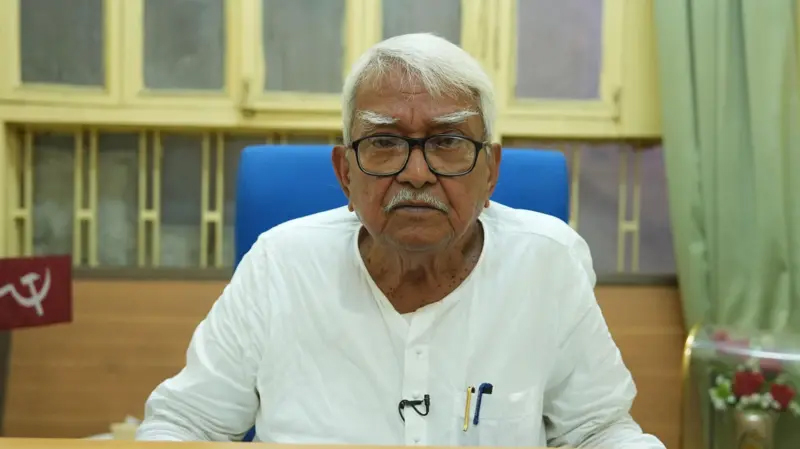
Senior CPI(M) leader Biman Bose, aged 87, remains actively involved in daily campaigning. He stated, “I walk at least 12 to 15 kilometers every day campaigning. This time, I can say our party will not be reduced to zero.”

Senior CPI(M) leader Biman Bose

Have Left leaders joined BJP?

Since TMC came to power in 2011, many have claimed that numerous Left leaders have shifted to BJP. Senior journalist Sayantan Ghosh highlighted such shifts in his book ‘Battleground Bengal.’

Ghosh wrote:

My first meeting with Hiren Chatterjee (also called ‘Huru Da’) took place in a smoke-filled tea stall in South Kolkata when I was just a school student. Huru Da wore an open shirt and old pants, but his voice carried the strength of a seasoned trade union leader of CPI(M). Amid cups of sweet tea and bidi smoke, he narrated tales of communism, labor struggles, and the harsh history of trade unions. His stories captivated everyone from auto drivers to passerby, painting a world where the red flag promised justice. As a child, I listened wide-eyed, unaware I would become a political journalist following his tales.

By 2011, when Mamata Banerjee’s TMC ended 34 years of Left rule, rumors arose about a suspicious case involving Huru Da. He never spoke openly, shrugging off questions.

In 2017, during Durga Puja in Kolkata, the auto drivers’ union—once a CPI(M) stronghold—had become a TMC bastion. Huru Da was nowhere to be found. I thought perhaps he had vanished at the city’s edge, a sign of Bengal’s shifting politics. One evening, I saw him again at a familiar tea stall, older but still animated while narrating stories—this time about the campaign to unseat Mamata Banerjee. Surprised, he smiled and said, ‘BJP is the only force that can defeat Mamata.’

Challenges for the Left

The senior journalist further wrote in his book ‘Battleground Bengal’:

I couldn’t believe it—Huru Da, once a staunch communist, now rallying for BJP? When I expressed my surprise, he laughed and said, ‘We have moved from Left to Right.’

His words reflected not just personal transformation but a larger political shift in Bengal where BJP’s saffron color was replacing the Left’s red flag.

However, Brinda Karat, a veteran Left leader, disagrees with claims that Left cadres have shifted to BJP. She said, “Left voters may have moved to BJP due to fear of TMC, but I don’t believe cadres have defected.”

Senior journalist Suman Bhattacharya accuses Karat of misrepresenting facts. “Where did BJP’s West Bengal Assembly deputy leader Shankar Ghosh come from? Clearly from CPI(M). He still sports a Che Guevara tattoo. Bankim Ghosh, once a cabinet minister under the CPI(M) government, is now with Suvendu Adhikari. Isn’t the son of Anil Basu, a seven-time CPI(M) MP from Arambagh, also in BJP? The son of Amitabh Nandi, former CPI(M) MP from Dum Dum is in BJP as well. And the son of Tapan Sen, CPI(M) national trade union secretary, is with BJP?”

“In my understanding, BJP has taken over CPI(M)’s vote base and leaders in West Bengal,” Bhattacharya explained.

Bhattacharya said many expected post-2011 that Bengal’s politics would be limited to TMC and Left. However, starting in 2014, when Narendra Modi became Prime Minister, a new wave of change began. “BJP gradually rose in Bengal, while the Left faced a continuous decline.”

In the 2019 Lok Sabha elections, the Left Front did not win a single seat in Bengal, securing only about 7% vote share.

The 2021 Assembly election was even more dismal. For the first time in history, both the Left Front and Congress, which once dominated Bengal politics for decades, finished with zero seats. TMC won 213 seats, while BJP rose to 77 seats.

Silence at the Left Party Headquarters

At the CPI(M) headquarters on Alimuddin Street in Kolkata, an unusual quietness prevails even during election season. Only a few elderly people are seen sitting, rolling bidis or working on computers.

Eighty-seven-year-old Biman Bose resides at this office. Joining the party at age 30 by leaving home, he remains continuously active. He attributes the party’s condition to “the failure to manage the rise of TMC and identity politics effectively.”

Translated and adapted from BBC Hindi

Parliamentary Committee Directs Timely Implementation of Infrastructure Management

The Infrastructure Development Committee has directed the government to complete the management of stalled infrastructure projects promptly. Chairperson Ashish Gajurel emphasized the need for policy reforms to avoid repeating past mistakes in upcoming projects. The committee has also formed a subcommittee to review progress and address issues related to national pride projects. Kathmandu, 15 Baisakh.

At a meeting held on Tuesday at Singha Durbar under the House of Representatives committee, the Infrastructure Development Committee instructed the government to immediately organize ongoing development projects. Gajurel stated that policy improvements are essential to prevent the recurrence of previous shortcomings in forthcoming projects. By thoroughly examining ambiguities and errors in regulations, procedures, and implementation levels, the committee aims to provide concrete suggestions and directives to the government.

Gajurel stressed that the government must be accountable to the committee regarding development activities. He highlighted the importance of ministers and secretaries attending parliamentary committee sessions to provide clear explanations. “The management of stalled infrastructure projects must be completed in a timely manner. Mistakes made in the past should not be repeated in upcoming projects,” he said.

The committee reaffirmed its commitment to work independently without succumbing to any pressure. “Ministers and secretaries of the government must also appear before the committee and answer questions. There is no alternative to their presence during parliamentary committee oversight,” he added. Furthermore, the committee has established a subcommittee to prepare a report on the progress, challenges, and solutions related to national pride projects.

Trump Proposes 40% Increase in Defense Spending Amid Major Cuts to Social Security

U.S. President Donald Trump has proposed a massive $1.5 trillion military budget for the upcoming fiscal year. In doing so, he aims to cut $7.3 billion from domestic programs, while shifting Medicaid and Medicare responsibilities to state governments. The budget allocates significant funds to the Department of Homeland Security and ICE, prioritizing mass deportation campaigns.

April 28, Kathmandu — President Donald Trump unveiled a $1.5 trillion military budget proposal for Fiscal Year 2027 that marks a historic 40 percent increase in defense spending compared to the previous year. This annual budget proposal, released on Friday, reiterates the White House’s core principle of “Peace Through Strength” by prioritizing military power and law enforcement.

Trump’s 2027 budget sets a target to increase defense spending by $45.5 billion compared to 2026. Russell Vought, Director of the Office of Management and Budget (OMB), stated in the proposal, “The FY 2027 budget advances the President’s vision of reforming the federal government by controlling non-defense spending.” A highlight of this budget is the introduction of the “Golden Dome” missile defense system.

The plan also proposes cuts totaling $7.3 billion in domestic programs, which will impact initiatives on climate change, renewable energy projects, housing, education, and healthcare equity. There are also significant reductions in refugee resettlement and foreign aid programs. Controversially, the proposal seeks to remove Medicaid and Medicare from federal oversight, transferring their administration entirely to state governments.

सरकारद्वारा दुई अध्यादेश जारी गर्न राष्ट्रपतिलाई सिफारिस

Government Recommends Two Ordinances to President Ramchandra Paudel

The government has recommended the issuance of two ordinances related to cooperatives and the Constitutional Council to President Ramchandra Paudel. This recommendation followed a cabinet meeting held on Monday, where the cabinet endorsed the issuance of these two ordinances. President Paudel’s press advisor Kiran Pokharel stated, “The cabinet has forwarded two ordinances for recommendation.” April 28, Kathmandu.

The government has formally recommended these two ordinances to President Ramchandra Paudel. The cabinet’s Monday meeting approved forwarding the ordinances concerning cooperatives and the Constitutional Council to the President’s office. Kiran Pokharel added, “The ordinances are currently under review.” The documents were sent the same day to the President’s office at Shital Niwas.

Earlier, on April 20, the cabinet had recommended the President summon a parliamentary session. Acting on this, President Paudel convened the session for May 1. However, the government subsequently recommended the President postpone the parliamentary session scheduled for April 23.

The President, following the government’s recommendation, suspended the parliamentary session despite the House of Representatives being summoned earlier. Meanwhile, the government has recommended the issuance of an ordinance to appoint members to the Constitutional Council. The Constitutional Council, which recommends constitutional appointments, consists of six members: the Prime Minister, Speaker of the House, Chairperson of the National Assembly, Deputy Speaker, Chief Justice, and the Leader of the Opposition.

On Monday, the Congress party appointed a new parliamentary party leader, selecting Bhishmaraj Angdembe. With this appointment, the Constitutional Council now holds full membership.

One Dead in Scooter Accident at Itahari Diversion

April 28, Sunsari – A scooter accident in Itahari Sub-Metropolitan City–5 of Sunsari has resulted in one fatality. The deceased has been identified as 35-year-old Rajviren Urao from Bhokraha–6, according to Chandra Bahadur Khadka, Deputy Superintendent of Police in Sunsari. Last night, on the East-West Highway at the under-construction diversion site in Itahari–5 Kalanki, a scooter bearing the number KO 2 P 4589 lost control and overturned, seriously injuring Urao. He was rushed to B.P. Koirala Institute of Health Sciences in Dharan for treatment, where he unfortunately succumbed to his injuries, police reported.

Traffic Police Penalize 2,746 Drivers in 24 Hours for Various Violations

In the past 24 hours, traffic police have penalized 2,746 vehicle drivers for various traffic violations. A total revenue of NPR 2,964,501 was collected from these actions. The traffic police have urged the public to report drivers operating vehicles under the influence of intoxicants and stressed strict action against such offenses.

April 28, Kathmandu – During inspections carried out across various locations in the Kathmandu Valley by traffic police until this morning, 79 drivers were found operating vehicles under the influence of intoxicating substances, 225 were penalized for ride-sharing violations, 175 for running red lights, 148 for speeding, 324 for lane crossing, 149 for driving on sidewalks, 55 for horn usage violations, 54 for violating passenger boarding and alighting rules, and 1,537 for other infractions, amounting to a total of 2,746 drivers penalized, according to Traffic Police Spokesperson and Superintendent Nareshraj Subedi.

He stated, ‘In the past 24 hours, a total of 2,746 drivers violating traffic rules in the valley were penalized, resulting in revenue collection of NPR 2,964,501.’ Since driving under the influence of intoxicants is illegal and punishable, the traffic police have requested passengers and the public to promptly inform the nearest police station, the Traffic Control Room hotline at 103, or the police hotline at 100 if they suspect a driver is under the influence of intoxicating or narcotic substances.

कानमा रौं हुनुले के-के गर्छ ? समुद्र शास्त्रको यस्तो व्याख्या

What Does Having Hair in Your Ears Mean? Insights from Samudra Shastra

Do you have hair growing inside your ears? If not, you may have noticed many people who do. In reality, having hair in the ears is a normal biological process. Whether or not one has ear hair does not significantly impact overall biological health. However, according to Samudra Shastra, the presence of hair in the ears is considered an important sign that conveys meaningful information about a person’s temperament, health, career, love life, and intelligence.

Samudra Shastra is an ancient discipline that analyzes a person’s nature and future based on the external features and structures of the body. It is also often regarded as a branch of astrology. According to this tradition, growing hair in the ears symbolizes happiness, prosperity, and wealth. Individuals with this trait are not only hardworking but also highly honest.

Samudra Shastra indicates that people who have sparse and fine ear hair tend to have a calm nature, preferring to live peacefully and avoid conflicts. Those with thick and coarse ear hair are typically confident and hold unique perspectives across various areas of life. Additionally, individuals with dense ear hair appear to have better health.

Such people often possess strong immune systems, which help protect them from various illnesses. They also tend to have longer lifespans. The tradition regards those with light and soft hair in the ears as very intelligent. These individuals have the ability to undertake great tasks, achieve success, and understand different aspects of life deeply. Conversely, people with excessively thick and tangled ear hair often encounter difficulties. Their lives may have many ups and downs, and they rarely feel satisfied with anything. In particular, they may grapple with various physical and mental health issues over time.

Five Members of Gold Necklace Robbery Gang Arrested

Symbolic image


News Summary

Prepared by AI. Reviewed editorially.

  • Police arrested five members of a gang involved in snatching gold necklaces from women in Kathmandu’s Payutar area.
  • The arrested individuals are aged between 19 and 44, hailing from Nuwakot and Solukhumbu districts.
  • The gang has been involved in seizing gold necklaces from women in various locations since Chaitra of last year.

April 28, Kathmandu – Police have apprehended five members of a gang involved in robbing gold necklaces.

The arrested are Savin Tamang, 21, Bimal Tamang, 26, and Sujan Tamang, 21, all from Kakani Municipality-3, Nuwakot; Satish Amatay, 44, from Bidur Municipality, Nuwakot; and Ritika Majhi, 19, from Solukhumbu.

On Chaitra 12, while a woman was walking near Fun Park in Matatirtha, two individuals on a motorcycle snatched her gold necklace and fled the scene.

Again, on Chaitra 19, a group seized the gold necklace of a 70-year-old woman in Naykap and escaped.

On Baishakh 6, while a woman was walking in Chandragiri, a group on a motorcycle forcibly grabbed her necklace.

Police identified the arrested group as involved in these necklace snatchings. They were detained by the Thanikot Police Team from Kathmandu’s Payutar area.

Authorities recovered 12.90 grams of gold, large and small wrenches, a khukuri knife, and a screwdriver from the suspects.

Saurabh Bhardwaj Calls Raghav Chadha Ungrateful, States ‘If He Had Not Been Made MP by Us, He Wouldn’t Have Married Parineeti’

Political tensions have escalated following the collective defection of seven Aam Aadmi Party (AAP) MPs to the Bharatiya Janata Party (BJP). Raghav Chadha has labeled AAP a toxic workplace, accusing the party of corruption. In response, Saurabh Bhardwaj called Chadha ungrateful and claimed that his marriage was only possible due to the party position he was granted. Kathmandu, April 28.

Seven MPs associated with the Rajya Sabha from AAP recently left the party en masse and joined the BJP, intensifying the political deadlock. The dispute between Raghav Chadha and AAP leader Saurabh Bhardwaj has taken a deeply personal turn. Chadha described AAP’s work environment as a “toxic workplace” lacking freedom for its members and alleged that the party is currently controlled by corrupt individuals.

Chadha stated that despite dedicating 15 years to the party, he was barred from speaking and working effectively within Parliament, which compelled him to seek an alternative path. Responding to these accusations, Bhardwaj publicly branded Chadha as ungrateful. He further suggested that Chadha’s marriage was made possible solely because of the position given to him by the party. On social media, Bhardwaj said, “If your marriage to Parineeti Chopra could happen today, it is only because AAP appointed you as a Rajya Sabha MP.”

This statement has sparked widespread debate in Indian political circles and on social media platforms. Bhardwaj condemned Chadha’s actions as betrayal and accused him of disregarding the basic ethical norms, such as serving the notice period, upon leaving the party. Raghav Chadha’s marriage to actress Parineeti Chopra took place in September 2023 in Rajasthan. At the time, AAP chief Arvind Kejriwal and Punjab Chief Minister Bhagwant Mann were special guests at the wedding and had given their blessings. However, what was once a cordial relationship has now devolved into personal attacks alongside the ongoing party conflict.

इन्डोनेसियामा रेल दुर्घटना, १४ जनाको मृत्यु ८४ घाइते

Train Collision in Indonesia Kills 14, Injures 84

In Indonesia’s West Java province, a train collision in the Bekasi area resulted in 14 fatalities and 84 injuries, local authorities reported on Tuesday. President Prabowo Subianto visited the victims to express his condolences and pledged a swift investigation into the accident.

Following the incident, President Prabowo Subianto went to a hospital in Bekasi to meet with the victims and offer his sympathies. Train operator and the head of KA Indonesia (KAI), Budi Residin, confirmed the death toll, stating that the police have kept the bodies at the hospital for identification while injured survivors are receiving treatment at various healthcare facilities.

The collision occurred at approximately 8:50 p.m. local time on the Jakarta–Bekasi route, involving long-distance trains. Both the train operator and the National Transportation Safety Committee are currently investigating the causes of the accident.

Preparation Underway to Operate Land Administration Services at Local Levels; Collection of Interested Entities’ Details Ongoing

April 28, Kathmandu. Preparations are underway to operate land administration-related services through local government bodies. The Ministry of Land Management, Cooperatives, and Poverty Alleviation has initiated plans to transfer services currently provided by Land Reform, Land Revenue, and Survey Offices to the local administrative units. To facilitate this, the ministry has requested letters from local bodies interested in providing these services, including details on the necessary human resources and infrastructure they can arrange independently.

According to the ministry’s letter dated April 23, local governments are required to submit their expressions of interest in operating land administration services within seven days. The submission of such letters from various municipalities is already in progress.

Chitwan’s Bharatpur Metropolitan City informed the ministry on April 27 of its intention to take over land administration services. Other municipalities are also expected to submit similar notifications, as confirmed by Rajendra Prasad Gautam, the ministry’s Information Officer. However, municipalities where relevant legislation is still pending have yet to begin operating these services, as the legal framework necessary for their operation is not yet in place. The future of Land Reform, Land Revenue, and Survey Offices remains uncertain due to the absence of finalized laws.

According to Information Officer Gautam, informal discussions are currently underway about merging Land Revenue and Survey Offices. He stated, “The clarity on how much work these offices will handle will only emerge once the law is finalized.” Due to the incomplete legal process, definitive statements about the offices’ futures cannot be made. Nevertheless, the ministry has sought letters from municipalities interested in providing land-related services in anticipation of the new legislation. Gautam added, “If detailed information is received from the municipalities during the law-making process, services can commence immediately after the law is enacted.”

Kim Ju Ae: North Korean Leader Kim Jong Un’s Daughter Presented as Successor Through Fashion

North Korean leader Kim Jong Un’s daughter, Kim Ju Ae, is being positioned as the future successor through her attire and style. Recently released photos show Kim Ju Ae wearing luxurious designer brand outfits. The use of Western-style luxury items is officially banned as “reactionary” and “anti-socialist” in North Korea.

According to experts, Kim Ju Ae’s use of such items is not a sign of teenage preference or rebellion but a deliberate effort to portray her as the supreme leader’s successor. This strategy could play a crucial role in shaping Kim Ju Ae’s public image.