The Patan High Court has issued a temporary stay order halting the screening of the film ‘Lalibazar’ until 22 Baisakh. Citing the Supreme Court’s 2075 ruling on the ‘Nathiya’ and ‘Ailani’ cases, the court has imposed the ban due to concerns over ethnic sensitivities. As the film is deemed likely to affect the dignity of certain communities, the court has summoned both parties for a hearing on 22 Baisakh.
The stay order by the Patan High Court adheres to the Supreme Court’s directives given seven years ago. A single bench led by Justice Prakash Dhungana ordered the film’s screening be halted until 22 Baisakh and called both sides for discussions on the same day. The court grounded its decision on the Supreme Court’s March 15, 2075 order regarding the ‘Nathiya’ and ‘Ailani’ novels along with the film ‘Pandit Baje ko Lauri’.
In those cases, a bench of Justices Ishwar Prasad Khatiwada and Bam Kumar Shrestha emphasized the need for caution in handling ethnic and social sensitive issues and ordered relevant authorities to provide the necessary directives. The Patan High Court order similarly notes the serious nature of the issues raised in relation to ‘Lalibazar’. Considering the petitioner’s arguments and evidence, the court found that the film may harm the honor of certain communities and thus deemed it necessary to immediately halt its screening.
The order is described as an interim measure intended to maintain balance rather than a final judgment. It takes into account the potential for irreparable harm and the principle of balancing convenience, which underpin the temporary suspension of the film’s screening. The court indicated that a final verdict will be delivered only after detailed arguments from both sides. Previously, the Supreme Court had taken seriously the issue of harm to the plaintiff community’s dignity in the ‘Nathiya’ and ‘Ailani’ cases and had instructed sensitivity regarding language, style, and presentation in such works. Further decisions from the court are expected following the hearing scheduled for 22 Baisakh.
Summary: Following the government’s demolition of informal settlements in the Kathmandu Valley, approximately 3,000 children have been unable to attend school. Parents from these displaced communities are temporarily residing at an ashram and demanding new arrangements for their children’s education. Although the National Examination Board issued a facilitation notice, students currently taking exams have yet to receive adequate support. (April 28, Kathmandu)
“Sir, my child’s education is disrupted. They didn’t even provide a room, calling us squatters. If only my child could study,” pleaded Sukumaya Bishwakarma to a human rights activist after being unable to find accommodation near Tikendra Kunj. The activist reassured her, “Don’t cry, arrangements will be made soon.” Her mobile rang: her son asked if they had found a room and whether he should go to school tomorrow. Overwhelmed, Sukumaya wept in the ashram courtyard.
“It has been three days, and I haven’t found a room yet. If even one room was available, the children could study. I would rather stay here at the ashram,” she shared her distress. Responsible for educating her two sons and one daughter while working at Party Palace, she said, “I have to enroll them at Gairigaun School. They are in grades 1 and 3. What if they can’t continue studying? Do poor children have no right to education?” she questioned the government.
Previously living in an informal settlement in Gairigaun, her routine was upended after bulldozers cleared the area. She stopped working due to the urgent need to find schooling and shelter. She has been searching from Thapathali to Tikendra Kunj for three days. “I am exhausted, have no money or work, and my home is destroyed. What if my children cannot study?” she appeared despondent. Despite Article 31 of the Constitution guaranteeing every citizen access to basic education and free education up to secondary level, parents from informal settlements now struggle to secure schooling for their children.
Temporary shelter has been arranged at the Radhaswami Satsang Vyas Ashram for displaced residents from Thapathali, Shantinagar, and Gairigaun settlements. They reside in halls named “Family One” and “Family Two,” which the displaced consider their homes. On Monday afternoon, seniors, postpartum and pregnant women, and children were inside the hall. When asked about the whereabouts of parents, some were out seeking rooms or working. Children played or rested on beds. Girls of school-going age—Tabita Pariyar, Barsha Mahto, and Sabina Magar—were discussing their education and shared their makeshift homes within the ashram.
“This is my home,” said Tabita, a grade 6 student, whose house was demolished in Thapathali. She attended Guheśhwari Bal Shiksha School but has not been able to return. “Friends have probably gone to school, but I don’t know when I will go,” she expressed uncertainty. Barsha Mahto studies in grade 7 at Pragati School in Kupandol. “I want to go to school, but how? It’s far, and I need to join a new class since we were moved from Thapathali,” she explained. “My father carries heavy loads to support my education. We don’t have money to move elsewhere. I don’t know what to do.” Many children rely on their parents’ labor to continue schooling.
Tabita noted, “All our parents do similar work.” Ridima Shrestha, a grade 3 student at Vishwiketan School, wishes to continue at the same institution. “My friends are there; I want to stay, but I don’t know what will happen,” she said. While these children once had books and notebooks in hand, they currently face uncertainty about whether they can continue studying at all. Though from different backgrounds, they share the same hall, each having their own space, and many have formed friendships within the community. Some friends were classmates even before the demolitions. The government has promised to arrange new accommodations within 15 days, yet the fear of separation from friends, persisting for years, remains.
“Thapathali was better than here. Our home was destroyed. We have to leave in 15 days. After that, I won’t see my friends,” Ridima shared. Nearby, Ayusa Khatun sighed on her bed. Her schooling at Gairigaun has been disrupted. “I don’t know if I will continue studying. Our home is gone. Where will I stay and study?” she questioned. Arranged beds for each family run in a row. School-age children like Surya Mahto and Titis Majhi lamented missing enrollment campaigns due to distance and expressed frustration. “We want to study, but desire alone is not enough. How will we get to school? Where will we stay? What will we eat? We don’t know,” they asked collectively.
Children of Niraj Thapa, whose daughter is in grade 1 and niece in grade 4 at Vishwiketan School, face educational barriers due to the demolition in Thapathali. “Our children’s schooling has stopped. Even if we live on cold ground, we will manage. I have an 18-month-old child; we must keep them healthy,” she explained. After the bulldozers cleared the settlement on Saturday, her family moved to the ashram. They cannot work nor find rooms. “Those who had homes went there, those with rooms stayed there. We came here on Saturday without any options. What if it rains? How will we protect the children? We haven’t had a good night’s sleep,” she shared. “Our children’s future looks bleak. They cannot attend school.”
Although the Constitution grants free higher education rights to persons with disabilities and economically disadvantaged citizens, poor children from informal settlements still face significant barriers to education.
Grivani Thapa is currently taking her grade 12 exams which began on Monday, but she has no textbooks. “I am sitting for exams, but the bulldozers destroyed my books. I stayed awake all night to prepare,” she said. After the demolition, she searched Thapathali for her books but found none—likely destroyed. “The government didn’t even allow us to study during exams. What is the point of legal rights if they don’t apply to the poor?” she challenged authorities.
She and other students recall Prime Minister Balen Shah’s election speech promising education plans for all, regardless of wealth. “Today is an exam, but we have no books or money. Where are our rights?” she asked.
The National Examination Board issued a notice to facilitate students from informal settlements during exams, but this has not eased Grivani’s difficulties. The Child Rights Act 2075 ensures the rights of children to education, sports, nutrition, and health, but has not effectively protected displaced children. The government claims a policy of not excluding children from school.
New academic sessions and enrollment campaigns began on April 28, but parents remain in the ashram, unsure where to enroll their children. Niraj said, “In the end, it is the poor who suffer. Please ask the government.” Currently, the government has decided to transfer students from informal settlements to suitable schools and released a six-point circular to facilitate this.
However, as of Monday at the ashram, the circular appears to have had little impact on the 48 children of school-going age present. Preliminary reports indicate that approximately 3,000 children from informal settlements in Thapathali, Manohara, Shantinagar, Gairigaun, and other areas of the Kathmandu Valley attend school from nursery to grade 12.
The demolition of all 941 houses in the Manohara squatter area, located along the border of Bhaktapur and Kathmandu, has been completed. A total of 937 families were residing in this area — 131 from Kathmandu’s side and 806 from Bhaktapur. During clashes with the squatters, 22 security personnel were injured, and the settlement was vacated peacefully.
On 15th Baisakh, Kathmandu – The demolition of all structures in the Manohara squatter settlement on the boundary of Bhaktapur and Kathmandu has been finalized. According to police reports, 941 households were demolished, comprising 131 from Kathmandu and 810 from Bhaktapur. The area was inhabited by a total of 937 families, with 131 in the Kathmandu sector and 806 in Bhaktapur.
More than two dozen JCB machines were employed to dismantle the structures in the area. This included the demolition of a community school along with all buildings within the Manohara squatters’ settlement. On Saturday evening, during the removal process, stone-throwing incidents occurred in the area. In the clashes with the squatters, 22 security officials, including Navaraj Dhungana, Deputy Superintendent of Police and Chief of Police Post Thimi, were injured.
By Sunday morning, when approximately two thousand security personnel arrived, nearly 80 percent of the squatters had already vacated on their own. The process of peacefully clearing the settlement continued and was completed on Sunday and Monday.
On Baishakh 12, the day squatter settlements along the riversides of Kathmandu were demolished, the military was present with arms, raising questions.
After the Nepal Army and Police requested details of squatters from municipalities in Bardiya, Banke, and other areas, debate has emerged regarding the justification of such demands.
Hari Prasad Rijal, Chairperson of the Land Issues Resolution Commission, stated that the army and police directly seeking information from municipalities is an overreach of authority.
May 29, Kathmandu – On Baishakh 12, the squatter settlements along the riversides in Kathmandu were demolished, and armed military personnel were also visible around the area. While military officers have described this presence as mere coincidence, the issue has generated widespread questions.
Recently, it has come to light that the Nepal Army and Nepal Police have been requesting detailed information about informal and squatter settlements from various local municipalities, sparking debate about the reasonableness of such actions.
Some critics have termed this an abuse of authority, while others argue that collecting such data is necessary.
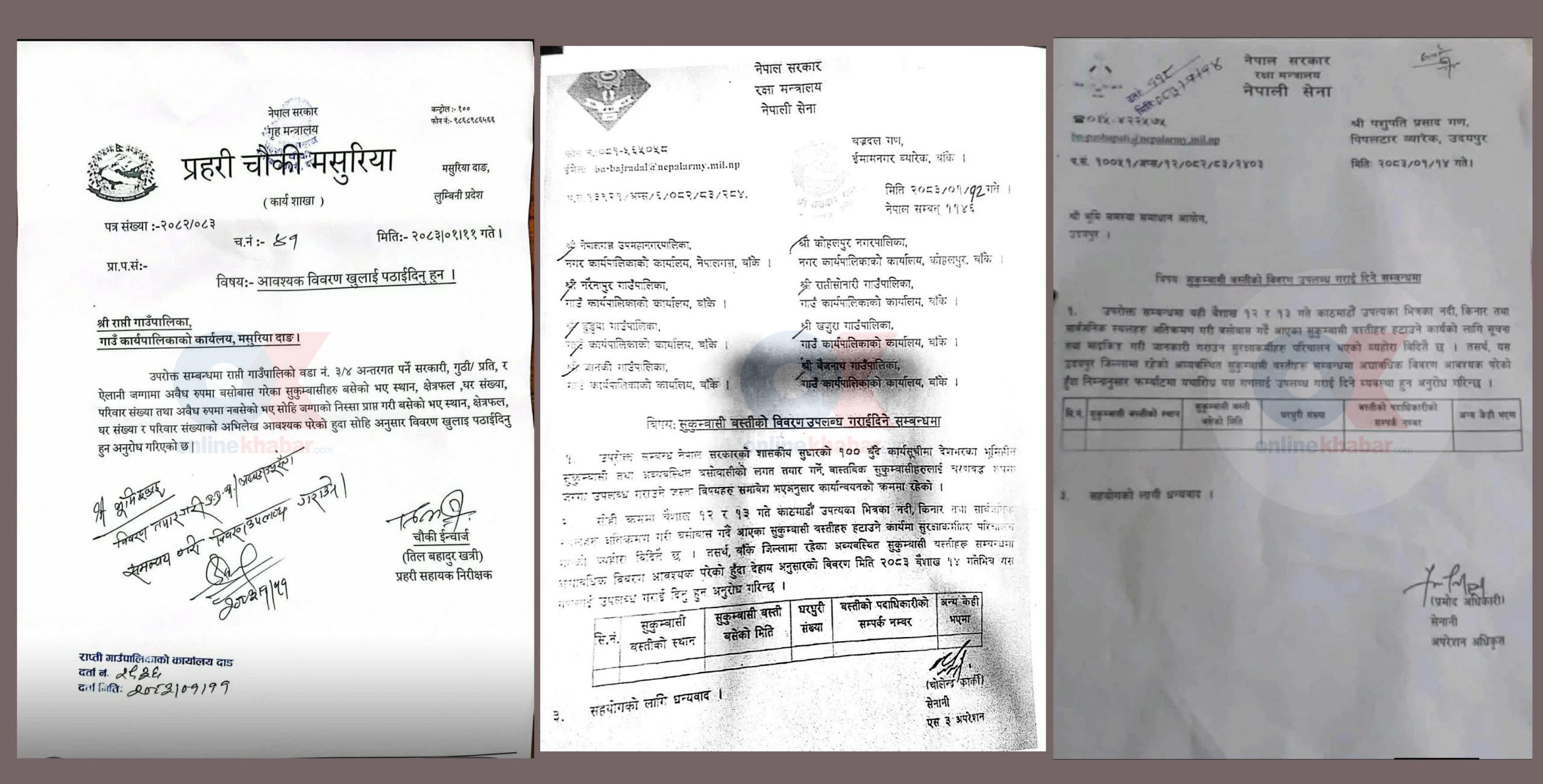
The Vajradal Battalion based at Imam Nagar Barracks in Banke district has sent letters to eight municipalities in Bardiya and Banke requesting details of the squatter settlements.
According to the letter sent by soldier Cholendra Karki, municipalities are asked to provide information such as the location of squatter settlements, date when residents began living there, number of households, and the contact details of settlement representatives.
The letter also mentions a plan under the Government’s 100-Point Agenda for State Reform to prepare data on landless squatters and informal settlers and to progressively provide land to genuine squatters.
Security personnel were deployed during the removal of squatter settlements along the riverbanks and public lands in the Kathmandu Valley on Baishakh 12 and 13, which has also led to requests for similar information from squatter communities in Banke and Bardiya districts.
Additionally, a Nepali Army major contacted Rapti Rural Municipality Chairperson Prakash Bista in Dang’s Deukhuri region over the phone seeking details about squatters.
The Masuriya police post of Nepal Police has also sent a letter to Rapti Rural Municipality requesting information on squatter residents.
The Pashupati Prasad Battalion based in Piple Tar, Udayapur, wrote to the Land Issues Resolution Commission in Udayapur on Baishakh 14 requesting data on squatter settlements.
Nepali Army spokesperson and assistant Rathi, Rajaram Basnet, stated that the requests were made in line with the agenda to update records in the District Security Committee meetings. “The District Security Committee raised record updates as an agenda item, and accordingly, information requests have been made,” Basnet said.
Nepal Police spokesperson DIG Avin Narayan Kafle explained that specific information is required for security management and the proper administration of squatter communities, which is why units have been deployed.
“While no directive has come from the central government ordering the collection of squatter data, security concerns might have prompted data gathering to understand who resides in which areas,” Kafle stated. “Effective police deployment and adherence to state directives necessitate collecting such information on squatter communities.”
Local Administration Unaware, How Are Elected Representatives Responding?
District Chief Officer of Bardiya, Gogan Bahadur Hamal, claimed he was unaware that the army had requested details about squatters. However, he confirmed that during the District Chief Officers’ meeting on Baishakh 4, a decision was taken to collect information on encroachments on government and public land.
Similarly, Banke’s District Chief Officer, Dil Kumar Tamang, stated he did not understand the reason behind the army’s demands from municipalities. He suspects the barracks are gathering this data following directives from higher authorities.
Emphasizing that removing encroachments is a priority, he added, “In a discussion with public representatives about removing encroachment in Ward No. 11 of Kohalpur Municipality, where a cricket ground is being developed, I committed to ensuring security arrangements. Beyond that, I am not aware of the army’s actions.”
Kohalpur Municipality Mayor Purna Prasad Acharya confirmed that the army asked for information on landless and squatter residents and the municipality is preparing to provide the data.
According to Mayor Acharya, encroachment has occurred over 36 bighas of land around the cricket ground in Kohalpur-11, where there were 751 households a year ago.
In Ward No. 4 of Kohalpur Municipality, out of 6 bighas of land along the East-West Highway, 4 bighas have been subdivided and allocated to 41 individuals. However, these details are not recorded in the land reform or land revenue offices, and currently, about 15 people reside there.
During former Prime Minister Prachanda’s tenure, 1,400 ghaderis (land parcels) were created and distributed in Loknagar, Kohalpur-11. Although the sale of these parcels was not permitted, some were allegedly sold secretly, a matter the municipality has decided needs investigation.
“We will provide all of this information to the army soon,” Mayor Acharya assured.
Chief Administrative Officer Krishna Prasad Jaisi of Gulariya Municipality, Bardiya, confirmed that they have submitted the requested details to the army but declined to provide further information.
Prakash Bista, Chairperson of Rapti Rural Municipality in Dang, criticized the fact that the police post sought data directly from the municipality, emphasizing that local government, not police, should be the one to request such information.
“While it is appropriate for the state to identify and manage genuine squatter residents, it is improper for the police post to demand details from the municipality,” he said.
“There is confusion where those in power exploit the identity of squatters. Public property must be protected, but prioritizing the management of genuine squatters is essential,” Bista added.
‘Abuse of Authority’
The Government of Nepal established the Land Issues Resolution Commission on October 30, 2024 (2081 Ashoj 14) under the Land Related Act, 2021, to provide land to landless Dalits and landless squatters and to manage informal settlers. As per the Commission’s data until Baishakh 14, there are 98,502 landless Dalits, 180,293 landless squatters, and 930,790 informal settlers across the country.
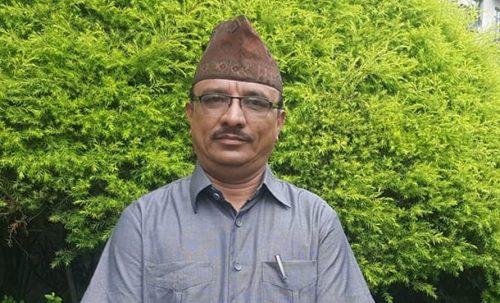
Hari Prasad Rijal, Chairperson of the Land Issues Resolution Commission, criticized the army and police for directly requesting information from municipalities, calling it illegal and an abuse of jurisdiction.
Hari Prasad Rijal
“If the army and police need such information, they must request it through the Ministry of Defence or Ministry of Home Affairs to the Ministry of Land Reform. If the ministry requests, we will provide it,” Chairperson Rijal stated. “But the way the army and police are directly demanding data from municipalities is an overreach of authority.”
Senior Advocate Raju Prasad Chapagain also expressed that the army and police should not be involved in collecting squatter details from municipalities. “This is not a security matter, and army involvement is unnecessary. Everyone should reside within their own jurisdictions,” he commented.
He further warned that unnecessary interference by security forces in matters legally managed by local bodies could undermine institutional legitimacy and public trust. “Such actions could diminish our institutions’ credibility and erode people’s confidence.”
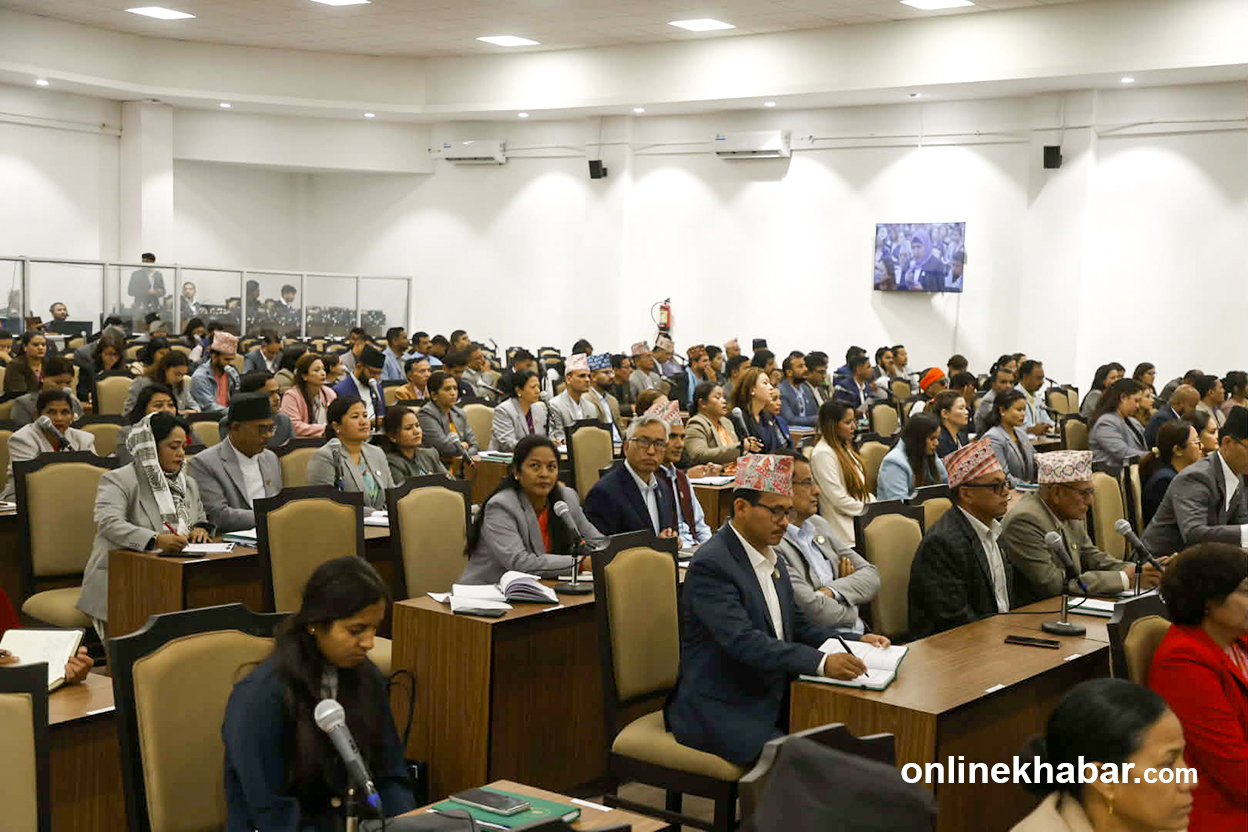
April 28, Kathmandu – Bhismraj Andembya, leader of the Congress parliamentary party, has strongly opposed the government’s move to suspend the parliamentary session and enact laws through ordinances. He accused the government, formed through democratic processes, of engaging in undemocratic practices. In a statement released on Tuesday, Andembya emphasized that democracy is not only a process but also a disposition, and described the promulgation of ordinances while parliament was in session as inappropriate.
He expressed deep concern and described as unfortunate the government’s submission of two ordinances to the President. According to him, ordinances are a constitutional mechanism intended only for situations when parliament is not functional and immediate action is necessary for the country. However, as there is no such emergency now and bills could be passed within the ongoing parliamentary session, the attempt to introduce ordinances is improper.
Andembya criticized the hurried decision without consulting the main opposition and other parties, calling it “politics of coercion.” Addressing the Prime Minister directly, he questioned why there appears to be distrust even within the ruling party’s own majority. He alleged that the dignity and essence of parliament have been undermined and affirmed his party’s clear opposition to these actions.
The statement highlighted that significant issues, such as the Constitutional Council Bill and amendments to the Cooperative Act, should be concluded through discussion and consensus in parliament. The Congress concluded that suspending the already convened parliamentary session and issuing ordinances is entirely inappropriate. Nonetheless, the party reaffirmed its readiness to offer constructive support to the government but expressed an unwavering commitment to oppose any steps contrary to democracy, public mandate, sovereign parliament, and the spirit of the constitution.
The government has decided to issue two ordinances regarding the Constitutional Council and cooperatives by bypassing Parliament.
Constitutional expert Bipin Adhikari stated, “Issuing ordinances close to a parliamentary session is not good practice.”
Constitutional scholar Tikaram Bhattarai noted that the courts have cautioned against issuing ordinances on matters of long-term significance.
April 28, Kathmandu — On August 17, 2021 (1 Bhadra 2078 BS), the then Sher Bahadur Deuba-led government introduced an ordinance allowing a party split with the support of 20 percent of lawmakers or central committee members. At that time, Ravi Lamichhane publicly opposed it on social media.
Lamichhane had criticized, “Those who opposed Oli’s ordinance yesterday are now bringing one together — a shameful and undemocratic step. Bypassing Parliament and allowing party splits with 20 percent is damaging to democracy’s reputation. Ugh… the same motives, but different faces entering and exiting Singha Durbar alternately.”
Back then, Lamichhane was a media figure. About a year later, he entered politics by forming the Rastriya Swatantra Party (RSP) to reform such systemic problems.
Later, on December 10, 2022 (Mangsir 25, 2079 BS), the government issued the first amendment ordinance to the Muluki Criminal Procedure Code, which resulted in granting amnesty to Resham Chaudhary in a criminal case.
Responding to that, Lamichhane posted, “How long will the new Parliament take to convene? One week? Two? Three? Was there an emergency that it couldn’t wait a week or two? This ordinance undermines the spirit of the new mandate. It attempts to curb the new Parliament’s authority. This is extreme political shamelessness. It must be revoked immediately.”
Lamichhane’s party had won 21 seats in the 2022 election and expanded to 182 seats by 2026, currently running nearly a two-thirds majority government.
On Monday, the government led by Balendra Shah decided to issue two ordinances, which are reportedly strongly supported by the Rastriya Swatantra Party presence in Parliament. Shah has not publicly commented on this, but sources say he supports the move.
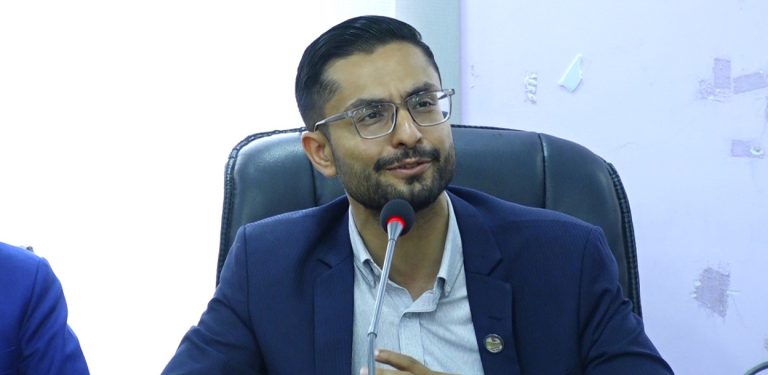
Sasmit Pokharel
Following Monday’s Cabinet meeting, government spokesperson Sasmit Pokharel announced only three official decisions: allowing private competition in the Security Printing Press, appointing Narayan Datt Paudel as the Armed Police IGP, and approving customs regulations.
However, the Cabinet also decided to issue two ordinances, which were only made public after the Cabinet submitted recommendations to the President’s Office on Tuesday.
The two ordinances recommended concern the Constitutional Council and cooperative affairs. Though the President is currently reviewing them, their specific details have not been disclosed.
Constitutional scholar Tikaram Bhattarai emphasized that courts have repeatedly warned against issuing ordinances on long-term significant issues, but the government appears to ignore this caution.
Without Parliament in session, it is unclear that any urgent matter requires ordinances. The President bears the responsibility to implement ministry recommendations, so the ordinances might be promulgated within a few days.
Issuing two ordinances without any legislation passed by a strong government formed after elections sends a negative message.
Constitutional expert Dr. Bipin Adhikari said, “Bringing ordinances this close to a parliamentary session is inappropriate. A government with such a strong mandate shouldn’t revert to old methods.”
Use of ordinances is not considered good parliamentary practice. If a government with nearly two-thirds majority uses ordinances bypassing Parliament, the concern lies not in procedure but in intent and commitment to democracy. The main opposition Nepali Congress has termed this move a dangerous sign for democracy.
While Nepal’s Constitution does not fully prohibit the issuance of ordinances, their use is strictly an exception. Dr. Bhattarai stated, “Halting regular sessions to issue ordinances is a misuse of constitutional provisions and an abuse of the people’s mandate.”
Ordinarily, ordinances serve to maintain governance only when Parliament is not functioning and no legal alternatives are available. Using ordinances for long-term policies undermines parliamentary supremacy and institutional balance.
The government could have convened Parliament and passed legislation through the fast-track process, but instead opted for ordinances. Dr. Adhikari remarked, “The fast-track parliamentary route would have been better than ordinances.”
Even though Parliament was scheduled to convene from March 30 (Chaitra 17), the session called by the President was withdrawn by the government, marking the first such incident in Nepal’s parliamentary history. Instead, the government chose to govern through ordinances, bypassing parliamentary procedures.
Dr. Bipin Adhikari added, “It is better to take the parliamentary route to enact laws from scratch rather than rely on ordinances.”
Governing by ordinances is not new in Nepal. From 2015 to 2022 under the consolidated constitutional framework, 49 ordinances have been issued.
Sensitive topics like the budget have repeatedly been enacted through ordinances despite having a 74-year tradition of parliamentary approval. Eleven budget ordinances have been passed, including on taxation and revenue collection without parliamentary debate, which signals a democratic deficit.
These trends show that political pressure and party compromises have sustained ordinance governance practices, and the current government is no exception.
Unlike before, the current government is strong with a majority in Parliament and the legislative capacity to enact laws properly. Yet, its choice of ordinances reflects a desire for power rather than actual legal necessity.
Although the government has the authority to issue ordinances, this should not distort constitutional integrity or deceive the spirit of the law.
Ordinances are intended strictly as temporary laws when Parliament is not in session; using them for long-term policymaking is inappropriate and courts have warned about this practice.
Dr. Bhattarai noted that courts have cautioned against ordinances on long-term significant issues, but the government has not heeded these warnings.
Should ordinances come with ill intent, courts may intervene, and the President has a review role in such cases.
Earlier ordinances in 2020 related to political parties and the Constitutional Council sparked controversies due to their contentious provisions and ultimately failed to pass Parliament.
The 20 percent provision for party splits and Constitutional Council appointments by three-member majority were criticized. Following the annulment of those ordinances, the older laws needed reinstatement.
Dr. Adhikari emphasized again, “It is better to legislate through Parliament than issues ordinances for laws that do not currently exist.”
Past ordinances raised questions on power balance and institutional autonomy. While they are legal documents, they have also served as political tools.
The current government is repeating past mistakes, which undermines its claim to political reform. A government with two-thirds majority bypassing Parliament shows distrust of the public mandate. Parliament is the representative institution of that mandate.
The government has the strength and capacity to legislate effectively through Parliament.
Separation of powers is a cornerstone of democracy; balance among the executive, legislature, and judiciary is crucial. Relying on ordinances disrupts this balance and increases institutional conflicts.
In 2022, the National Assembly formed a study committee that recommended ordinances be used only under urgent circumstances, approved immediately once the session starts, avoided on long-term policy, and prevented repeated use.
Democracy is strengthened not only by constitution and laws but also by practice. Undermining democratic values through abuse of constitutional provisions harms democracy in the long run.
Currently, issuing ordinances is not a literal constitutional violation, but whether the spirit of the Constitution is upheld remains questionable. Using ordinances to bypass Parliament might be easier for the government but is not the best approach for democracy.
A strong government should have exercised restraint and constitutional norms instead of taking paths typical of coalition governments in fragile parliaments, which would have been a commendable example.
April 28, Kathmandu – Nepa Student Union (Nevisangh) President Dujang Sherpa has requested the Nepali Congress party to clarify its official position regarding the government’s decision to dissolve student organizations. On Tuesday, during a meeting held at the Congress Central Office in Sanepa, chaired by General Secretary Pradeep Paudel and focused on updating membership of affiliated and friendly organizations, President Sherpa called for a clear public statement on this issue.
“There have been reports that the government is preparing to dissolve student organizations and the autonomous student body elected by students, the Free Student Union (Swaviyu). Student organizations are agitated over this,” President Sherpa said. “Our party must provide an official stance on this matter. What is the party’s position? That needs to be clarified.”
Describing the Free Student Union as a nursery that protects student rights and develops leadership, Sherpa emphasized that it is an institution not affiliated with any political party. He asserted that a democratic party like Congress should raise its voice against the government’s undemocratic actions. Additionally, Sherpa criticized the failure to provide the central committee with the new constitution of Nevisangh, which was purportedly passed two years ago, calling this omission objectionable.
President Sherpa also stressed the need for self-critical reflection within the party regarding the Genji Movement of September 8 and the subsequent evolving political situation. “It is not enough to just apologize to the Genji generation. The party is also responsible for weaknesses that created the current situation, and must acknowledge this and seek forgiveness from active members,” he said. According to Sherpa, without restructuring, Congress will not be able to resolve the ongoing crisis.
April 28, Kathmandu – After the government operated bulldozers in the Sukumbasi settlement of Thapathali on Saturday morning, 26-year-old Pravesh Pariyar, along with his family of six including his pregnant wife, relocated to an ashram in Kirtipur. “There is nowhere to go. The government did not even give us time to find a place,” he said. “My wife has an appointment on the 13th of May for delivery. She has fallen ill since we arrived here.” Due to increased pain, his wife, who was nearly nine months pregnant, was taken to a maternity home today.
“Problems have compounded one after another. I was making a living through day labor, and now the stress of having no place to live has increased,” said Pravesh. Twenty years ago, Pravesh’s mother had brought him from Udaypur to settle in the Sukumbasi settlement in Thapathali, where he grew up and recently got married. “Previously, the birth of a child was a joy, but the government has brought such dire circumstances,” said his sister Pooja, who lives with her maternal family after facing discrimination from her husband’s family due to her inter-caste marriage.
“There are six of us – mother, sister, niece, nephew, wife, and me,” Pravesh added. “We were given only one hammock to live on here in the ashram.” Carrying his underage nephew, his pregnant wife, and elderly mother, Pravesh is anxious about where they will go next. They are angered by the government’s actions, asking, “If there was nowhere to take us, why did they demolish our homes?”
Following the demolition in Sukumbasi settlements in Thapathali as well as Gairigaun, Shantinagar, and Manohara, 155 displaced families have been brought to the Radhaswami Satsang Byas Ashram. A monitoring team from an organization concluded that the ashram itself is uninhabitable. The National Network of Women Human Rights Defenders has described the ashram where the displaced reside as an open prison. According to the network, the behavior of the metropolitan municipality and Nepal Police, along with the physical conditions of the ashram, make it equivalent to an open jail.
“During the rainy season, leaking tin roofs force everyone to crowd in one open hall,” the report states. “Especially for women, there is a severe lack of privacy, with CCTV cameras installed all over the hall and no separate space for changing clothes.” When a team visited on Tuesday afternoon, the displaced residents openly shared their distress.
“Illnesses are increasing. Children, pregnant women, and the elderly are facing difficulties. Food arrangements are lacking,” said 38-year-old Sirjana Limbu. “There is strict regulation on going outside; names must be registered.” Following public exposure of the ashram’s poor conditions, journalists have been barred from taking photos or videos. “After complaints about insufficient food surfaced, now the media is not allowed in,” a young man living at the center said.
The most pressing concern for displaced residents brought to this ashram, facilitated by metropolitan police, is the uncertainty about the future. “They said children would start school from today, but I was not allowed to send my son,” said 35-year-old Sunita Tamang. Her 13-year-old son previously attended Srijansheel Secondary School in Budhanilkantha, where many children from Thapathali’s settlement also studied. According to Sunita, this school is preferred due to its affordability compared to other nearby schools.
While displaced children face uncertainties about their education, men who used to work as day laborers are now struggling to find materials near the demolished settlements. “We women are forced to remain confined here, while men go to clean others’ homes to earn money,” Sirjana explained.
Ten Thousand Displaced Following Bulldozing Kathmandu Metropolitan Police reported that demolitions of houses and structures occurred in four squatter settlements across the capital on Saturday and Sunday, affecting 2,081 families. Specifically, 144 families in Thapathali, 1,000 in Gairigaun, 131 in Manohara (toward Kathmandu), and 806 in Manohara (toward Bhaktapur) were displaced, impacting more than 10,320 people in total. Nearly half of these displaced individuals have registered at the Dashrath Rangasala stadium for temporary shelter.
As of Tuesday, 1,124 families comprising 3,584 individuals have officially applied for squatter status with the Kathmandu Metropolitan Office. Staff from the metropolitan office and the empowered Bagmati Civilization Integrated Development Committee have been handling applications. Officials noted that applications for resettlement have increased in recent days. The number of families arriving at the Rangasala holding center grew from 181 on Saturday to 373 on Monday. “We are still taking applications; the exact number to come is uncertain,” an official at the center stated.
Only a small portion of those registered at the holding center has been accommodated in religious ashrams or various guest houses around Kathmandu by the metropolitan authorities. Vimal Dhakal, Development Commissioner of the Valley Development Authority, stated that many displaced prefer to stay on their own and that the demand for temporary housing remains low. “More people are contacting us, but most want to stay by themselves,” she said.
Following the sudden demolition, many displaced people sought refuge with relatives or rented rooms elsewhere. Those who initially took shelter with relatives are increasingly arriving at Rangasala. However, no official data has been collected by any governmental body. “While the prime minister’s directive coordinated the demolition work, no coordination exists regarding the resettlement of the displaced,” an official explained. Various bodies, including the Kathmandu Metropolitan Office, Ministry of Urban Development, Ministry of Home Affairs, Ministry of Land Management, empowered Bagmati Civilization Integrated Development Committee, Valley Development Authority, and Nepal Police are involved, but leadership and coordination appear lacking.
According to Development Commissioner Dhakal, incomplete data collection has contributed to delays and confusion in the process. “We are verifying the three-generation lineage; further steps will depend on this. If individuals are found elsewhere, they won’t be recognized as genuine squatters,” she added. Displaced residents express deep frustration at Prime Minister Balendra Shah’s method of identifying squatters by demolishing their homes first. Many staying in the religious ashram in Kirtipur have voiced anger toward the Prime Minister.
“They turn off cameras before distributing food and then post on social media as though the squatters are happy here,” one displaced person said, “How can anyone be happy after their home has been destroyed?”
Rajup Prasad Chapagain, coordinator of the Accountability Monitoring Group and a human rights defender, labeled the bulldozing of squatter settlements as authoritarian and inhumane. “Without considering constitutional provisions, legal procedures, or humanitarian aspects, people were made homeless by the Prime Minister’s orders, which is unacceptable even under a hostile regime,” he said. Chapagain also criticized the approach taken when Mayor Shah demolished and verified homes without following the Supreme Court’s orders, calling it an unethical method.
The Nepal Trade Union Federation (GIFTUN) is preparing to advance the trade union movement in a new way that aligns with the changing global environment and technological advancements. GIFTUN has emphasized the necessity to link labor movements with skill development, digital transformation, and productivity. The federation has committed to ongoing dialogue with the government for labor law reforms, new agreements with employers, and the creation of an inclusive labor market. Kathmandu, April 28.
Ahead of May Day 2026, the Nepal Trade Union Federation (GIFTUN) released a manifesto declaring its plans to advance the trade union movement in line with the changing global environment, technological progress, and new political-social contexts. GIFTUN affirmed the need to redefine Nepal’s labor sector with a fresh approach. Attuned to the evolving national and global labor landscape, the federation stated clearly that future labor movements will not be limited to wage increases or compensation issues alone.
The manifesto highlights the rapid technological developments, market competition, and shifts in employment structures that define today’s labor world, calling for a “dynamic and empowered labor movement.” According to the document, labor demands must move beyond traditional concerns to directly incorporate skill enhancement, digital transformation, and productivity improvement. GIFTUN General Secretary Laxman Sharma remarked that the profound economic, social, and technological changes make it impossible to address workers’ issues through old frameworks alone. He added that these themes will form the core agenda for long-term strategic planning at the upcoming general convention.
General Secretary Sharma also noted that changes in workplaces and technology pose new challenges for workers’ skill and capacity development. “We interpret this changed context as a new social contract,” he said. “It is imperative to build workers’ capabilities in accordance with technological changes and advance in line with the country’s economic needs.” GIFTUN has identified various issues for collaboration and dialogue with the government. Sharma stated that ongoing discussions will focus on timely amendments to labor laws, novel types of agreements with employers, and resolving current worker-related challenges.
“The circumstances have changed; if we hold on to old approaches, we cannot sustain,” Sharma said. “Therefore, redefining labor laws and relations with employers in new ways is unavoidable.” GIFTUN intends this general convention to be more than just leadership selection, viewing it as a critical milestone for determining new directions and policies for the labor movement. The federation has also planned a ‘breakthrough’ initiative aimed at technology-friendly workplaces and safe labor relations. It has adopted the core slogan “Skill Enhancement and Progress with Technology,” emphasizing the importance of developing workers not merely as laborers but as skilled, techno-friendly, and competitive human resources.
The manifesto prioritizes making the social security system more effective and inclusive, creating new jobs domestically as alternatives to foreign employment, and increasing domestic production through national industry protection. It also stresses expanding the labor market inclusively by enhancing the participation of women, youth, and marginalized communities. The federation underlined that collaboration among the government, private sector, and labor organizations is essential to adapt labor policies according to current needs and foster worker-friendly environments. Central to the manifesto is the concept of inclusive prosperity, advocating for a decisive role for workers in economic development. GIFTUN believes the upcoming challenges extend beyond minimum wage increases to include quality job creation, productivity enhancement, and economic development coupled with social justice. This approach is expected to steer the labor movement toward a new direction focused on long-term transformation.
Armed Police Force Chief Raju Aryal is set to retire after completing his four-year term on April 30. During his tenure, he issued 109 procedures, directives, and standards within the force. Aryal was held accountable for security lapses during the Janajati (Janajee) movement, which tragically resulted in 19 deaths.
Kathmandu, April 28 – Raju Aryal, Chief of the Armed Police Force (APF), is stepping down after a full four-year term, despite having two more years of service eligibility based on his overall 30-year service. The government has already appointed Narayandatt Paudel as his successor. Throughout this extended tenure, Aryal avoided major controversies. While minor internal dissatisfaction arose within the organization, no significant disputes involved his leadership.
Typically, leaders of police organizations face conflicts related to operational procedures, jurisdiction, staffing, transfers, promotions, and procurement, which can become more complex during lengthy terms. Aryal successfully balanced these challenges, completing his term without major incident, and is expected to have a smooth farewell on April 30.
“The organization’s chief acts like a guardian but decisions must be made collectively,” Aryal often emphasized in meetings and briefings. Since taking command of the Armed Police on May 2, 2022, he has put this principle of collective decision-making into practice, which contributed significantly to his success.
“When youths in the organization suffer, the chief feels the pain, and when the chief is pained, everyone in the force is affected. A spirit of solidarity and mutual respect has developed in the organization,” he said. For major policy issues, he regularly consulted with Deputy Inspector Generals (DIGs) and Additional Inspector Generals (AIGs), a practice endorsed by APF officials.
Reviewing the history of former APF chiefs reveals cases involving controversy and corruption, with some facing investigations by anti-corruption authorities. Aryal, however, maintained a distance from any financial irregularities.
During Aryal’s tenure as IGP, the Home Ministry was led initially by Nepali Congress’s Bal Krishna Kha, under Home Secretary Tek Narayan Pandey’s administration. Over four years, Aryal worked with six home ministers and seven home secretaries—a first for any APF chief to handle so many leadership transitions. After Kha, he collaborated with Ravi Lamichhane, Narayan Kaji Shrestha, Ramesh Lekhak, Om Prakash Aryal, and Sudhan Gurung as home ministers, and served under secretaries from Tek Narayan Pandey to Rajkumar Shrestha.
His easygoing nature helped maintain continuity despite frequent leadership changes. Following the tumultuous Janajati movement, the APF played a critical role in ensuring successful elections. As force chief, Aryal took responsibility for this task, addressing challenges related to weapons and detainees.
“Most prisoners are wanted criminals whom we arrest as soon as we find them. We had no fear of the elections being disrupted. Any lost weapons were likely hidden by criminals, but those weapons posed no operational threat,” Aryal said. Under his leadership, elections held in Falgun, as well as local body elections in April 2022 and parliamentary elections in December 2022, proceeded smoothly.
Upon becoming IGP, Aryal had vowed to make transfers and promotions just and predictable, introducing policy-based organizational management and standards. During his tenure, 109 procedural documents—including directives, standards, permanent orders, and work plans—streamlined APF operations, according to spokesperson Shailendra Thapa.
External administrative offices also conducted organizational and management surveys for employee career development and promotion. True to his commitment, Aryal began publishing forecast lists for transfers and promotions to increase transparency, although some complaints about these processes persisted.
He prioritized digitalizing institutional knowledge and leave management systems and emphasized financial transparency, stating these efforts during last Friday’s meeting with security reporters at the APF headquarters in Halchowk.
Aryal noted, “I have submitted my leave request to the ministry. If approved, this will be my final meeting with you in uniform.” While awaiting leave approval, he remarked, “The Home Ministry has not yet made a decision; I am monitoring the situation.” Historically, some IGPs have delayed retirement by extending service terms, causing challenges for both ministry staff and the police. Aryal, however, planned to take leave a month in advance and even submitted leave forms a week ago, though they remain unapproved. Traditionally, outgoing IGPs take leave well before retirement; Aryal sought to institutionalize this practice.
During his term, the previously disbanded Border Security Division was restructured and reinstated by adding an AIG position to underscore border security’s importance. In this period, 3,757 border pillars were constructed, repaired, and painted. Surveillance improved with the installation of 388 CC cameras at 110 border locations. Thirty-two border outposts were established, and 45 proposed border security posts were upgraded to permanent status.
Under the “One Soldier, One Skill” policy, 2,219 personnel received skill-based training. Additionally, 134 divers were trained and deployed across provinces. Specialized training on insurgency and terrorism was initiated within the force. The APF hospital’s bed capacity rose from 110 to 218 of the planned 300 beds.
Despite a controversy-free tenure, Aryal’s record is marred by security failures during the Janajati movement. On September 8, 2022, protesters demanding the lifting of social media restrictions, addressing corruption and irregularities, held demonstrations in Kathmandu. Security agencies appeared unprepared, and protesters breached barriers to enter restricted zones. Security personnel fired shots, resulting in 19 deaths in Kathmandu on September 9. This event created a de facto lawlessness situation, with all security forces failing to contain the crisis effectively. Analyzing and strategizing to avoid such failures required commitment from all security bodies, including the APF. Responsibility for the security failure during the Janajati movement rests partly with Aryal as the force chief, who was the commanding officer responsible for both sides.
April 28, Kathmandu – The retrofitting work of the Gallery Meeting Building inside Singha Durbar is progressing at a rapid pace. Lalitpur-based Prera Nirman Seva Pvt. Ltd. is carrying out the retrofitting of the building. The Gallery Meeting Building was damaged during the 2015 earthquake.
The Special Building Construction Project Implementation Office under the Ministry of Urban Development signed an agreement with the construction company on May 20, 2024. The construction company is required to complete the retrofitting work by mid-December 2024. The estimated cost of the project is approximately NPR 390 million.
The conflict in West Asia has plunged the global economy into uncertainty, resulting in fuel price hikes and supply issues in Nepal. Within Nepal’s domestic market, middlemen have artificially driven up inflation and increased price volatility, placing consumers under dual pressure. The Department of Commerce has formed a committee to establish market level determinations and pricing standards and is preparing to submit the final report to the ministry.
The escalating conflict and tensions in West Asia—the center of global politics—have intensified economic uncertainty worldwide. Disruptions at major oil production centers and key trade routes have caused delays and price surges in international fuel markets, directly impacting import-dependent countries like Nepal. This situation has inflicted a double burden on consumers.
Data released by the Department of Commerce, Supply and Consumer Protection reveals that inflation posed significant challenges for Nepali consumers during the month of Chaitra. According to the report, the highest price increases were recorded in the vegetable market. Based on price data from Kalimati Fruit and Vegetable Market, prices of certain vegetables surged by more than 300 percent.
The root cause of inflation lies in weak regulation and the unresolved issue of ‘market level determination.’ Although the government has highlighted the problem of market level determination for years, the proposed plans remain confined to paper. Consumer rights activists have accused the government committee formed to address irregularities and dismantle middlemen networks in the market of failing to convene a meeting for the past 8 to 9 months.
Heavy rainfall has caused a complete blockage of traffic on the BP Highway in Kavrepalanchok district. The police have stated that the highway will only be reopened once the weather conditions improve. Kathmandu, April 28 – Intense rain in various parts of Kavrepalanchok has forced authorities to close the highway, according to police sources. Travel on the highway will resume only after the weather clears. Notifications regarding the reopening of the highway will be issued once conditions stabilize, and travelers are advised to contact emergency numbers 100 and 103 before making their journeys.
Nepal Red emerged victorious by a narrow margin of 4 runs in the opening match of the one-day series against Nepal Blue. Chasing a target of 277 set by Nepal Red, Nepal Blue managed 272 runs for the loss of 7 wickets in their allotted 50 overs. Arjun Gharti led the batting with a top score of 59 runs, while Vishal Patel and Abhishes Gautam each took 2 wickets. Kathmandu, 14 Baishakh – The first encounter between Nepal Red and Nepal Blue in the one-day series concluded with a thrilling win for Nepal Red at the Upper Mulpani Cricket Ground.
Nepal Blue, tasked with chasing a target of 277, managed only 272 runs in 50 overs, losing seven wickets in the process. Alongside Arjun Gharti’s 59 runs, Mayan Yadav contributed 49 runs, Narayan Joshi 46, and Pawan Sarraf 44, making significant contributions to their innings. Sandeep Jhora contributed an unbeaten 35 runs. On the bowling front, Nepal Red’s Vishal Patel and Abhishes Gautam picked up 2 wickets each, while Sher Mall and Rashid Khan supported with one wicket apiece.
Earlier, Nepal Red won the toss and elected to bat, posting a total of 276 runs for 9 wickets in their 50 overs. Opener Arjun Kumal retired after scoring 73 runs. Captain Anil Sah added 35 runs, while Shankar Rana and Deepak Dumre each chipped in with 33 runs. Rashid Khan contributed 26 runs, and both Kushal Malla and Tritraj Das scored 16 runs apiece. For Nepal Blue, Prakash Jaisi, Bipin Khatri, Shahab Alam, and Pawan Sarraf each took 2 wickets, with Rupesh Singh securing 1 wicket.
Prior to this series, Nepal Red played a two-match series against Oman, where they recorded one win and one loss.
The National Sports Council (NSC) has proposed a direct meeting with the International Federation of Association Football (FIFA) and the Asian Football Confederation (AFC) to resolve the ongoing dispute involving the All Nepal Football Association (ANFA). NSC Member Secretary Ramcharitra Mehta made the proposal during discussions with ANFA General Secretary Kiran Rai. Mehta informed that a letter will be sent to FIFA and AFC on Wednesday to arrange a joint meeting. He stated, “ANFA has agreed to facilitate this meeting.”
Previously, a virtual discussion had taken place between FIFA, AFC, ANFA, and NSC. Due to the early election dispute, the NSC suspended ANFA for three months on March 24. FIFA and AFC have issued a warning via letter, stating that if the issues with ANFA are not resolved by May 4, suspension procedures will proceed. Meanwhile, the NSC has proposed holding the joint discussion before May 4. ANFA spokesperson Suresh Shah has also confirmed that talks with the NSC are ongoing.