Author: space4knews

Rastriya Swatantra Party MP Ganesh Karki: Enacting Ordinances by a Nearly Two-Thirds Majority Government Is Not an Act of Courage

Rastriya Swatantra Party MP Ganesh Karki stated that a government with nearly a two-thirds majority enacting ordinances is not an act of courage. He emphasized that issuing ordinances based solely on the letter of the constitution, without upholding its spirit, is wrong. Karki pointed out that questions previously raised by opposition parties regarding ordinances are now being questioned within his own government. Kathmandu, 16 Baisakh.

Criticizing the government’s ordinance, Karki also condemned his own party’s government for bypassing parliament to introduce ordinances. He said, “For a party holding nearly a two-thirds majority, whether postponing sessions to pass ordinances is a ‘necessity’ or something else will become clear later, but this is not an act of courage.”

He further explained that ordinances should be introduced by exercising the rights and procedures granted by the constitution. He highlighted problems arising from disregarding the constitution’s spirit. He said, “This time too, the ordinance is based on the literal wording of the constitution, not its spirit. The constitution is not a document to live by letters alone; it remains alive by upholding its spirit. The literal interpretation should not limit the constitution’s essence.”

Karki recalled that opposition parties had previously raised questions when ordinances were enacted before, and now those same questions are being raised about his own government’s ordinance.

Donald Trump and James Comey: Former FBI Director Indicted for ‘Death Threat’ Against US President

James Comey, former director of the Federal Bureau of Investigation (FBI) in the United States, has been accused of issuing a ‘death threat’ against President Donald Trump. The allegations stem from a photograph Comey posted on Instagram last year that contained numbers forming the initials CP. Government agencies claim the image incited calls to assassinate Trump. Comey, asserting his innocence, stated in a press release that he is not afraid.

Prosecutors have filed this indictment against Comey for the second time. Last year, he was also charged with lying under oath before Congress and obstructing a congressional process related to his September 2020 testimony. That case was brought shortly after Trump ordered intensified investigations into his political adversaries. Comey appeared in court denying all charges. Ultimately, the court dismissed the case due to procedural errors by prosecutors, but the possibility of new charges remained.

The latest accusation is based on a photograph Comey posted and later deleted on Instagram. The image displayed the numbers ’86 47′ arranged in a pattern. In American slang, ’86’ means to remove or get rid of something, often referred to as ‘ATsix.’ Comey claims he did not understand the message’s meaning; however, Trump and other officials in his administration interpret it as a threat to assassinate the 47th President of the United States.

During the announcement of the charges, FBI Director Kashyap Patel said Comey, as a former director, is fully aware of the attention and possible consequences generated by such a post. “James Comey posted on Instagram a message that shamefully and reprehensibly endangered President Trump’s life by making it publicly visible worldwide,” Patel stated. Comey was dismissed during Trump’s first term after investigating Russian interference in the 2016 presidential election. Since then, Trump has repeatedly demanded legal action against Comey. The charges filed on Tuesday mark the second legal effort against him.

पुनर्निमाणको पर्खाइमा प्राकृतिक गन्तव्य – Online Khabar

Namaste Waterfall Awaits Reconstruction as Tourist Visits Decline

Tourist arrivals at Namaste Waterfall in Dhankuta have dwindled due to infrastructure damage caused by last year’s floods. The local government and Koshi Province have allocated NPR 1 million and NPR 1.5 million respectively for the waterfall’s reconstruction. Sangurigadhi Rural Municipality has built a temporary bridge and staircase to improve access, but a permanent truss bridge is still needed. (April 29, Dhankuta)

Namaste Waterfall, located in Dhankuta district of the Eastern Hills, was once a prime destination popular among domestic and Indian tourists. Each summer, visitors would flock here to swim in the cold waters and enjoy the natural pools formed beneath the waterfall, making the area vibrant with families and friends. However, despite its natural beauty, the site now appears deserted.

The primary reason for this decline is the damage to essential infrastructure caused by last year’s floods, which has created safety concerns. Although the natural allure remains intact, the risky access route has discouraged tourists from visiting. The local authorities and community have constructed temporary structures using bamboo and wood, but these are not sustainable solutions. Jeevan Subba, secretary of the Namaste Waterfall Management Committee, confirmed that tourist activity has notably decreased.

“The hustle and bustle of tourists is nowhere near what it used to be. People are still afraid,” he said. “When floods come from above making it impossible to reach the waterfall, why would visitors come if they cannot actually get there?” Limbu noted that this situation has made the area uncomfortable for visitors to the waterfall and nearby attractions. Nevertheless, efforts for the waterfall’s revival have begun, with Sangurigadhi Rural Municipality allocating NPR 1 million and Koshi Province providing NPR 1.5 million towards its management and reconstruction.

National Nutrition Assessment Campaign Launched in Siraha, Nutritional Status of 60,000 Children to be Evaluated

April 29, Siraha – A ‘National Nutrition Assessment Campaign’ has been launched in Siraha to identify the nutritional status of children. This campaign is being conducted across all 17 municipalities in Siraha district as part of a nationwide initiative, aiming primarily to improve child nutrition.

The campaign has been initiated by the Dalit Development Forum Golbazar with financial support from Helen Keller International and in collaboration with local municipalities under the ‘Nutrition for Life Program’.

The campaign focuses on assessing the nutrition of mothers in the crucial ‘golden thousand days’ as well as their children. According to the executive director of the forum, the assessment involves measuring children’s height, weight, and mid-upper arm circumference to determine their nutritional status. The target is to screen the nutrition of approximately 60,000 children aged between around 6 months to 59 months, along with about 14,000 mothers.

Scheduled to run from April 28 to May 13, the campaign aims to promptly identify malnutrition and facilitate timely treatment. During this period, female community health volunteers, in coordination with nearby health institutions, will visit homes to measure children’s arm circumference. Additionally, severely malnourished children will be provided with free ready-to-use therapeutic food through outpatient services.

As per the Government of Nepal’s plan, the campaign will also be implemented at health facilities, immunization centers, community clinics, ward offices, community buildings, and early childhood development centers.

९ गोलको थ्रिलरमा पीएसजीले बायर्नलाई हरायो – Online Khabar

PSG Defeats Bayern Munich 5-4 in Thrilling Champions League Semi-Final First Leg

Paris Saint-Germain secured an exhilarating 5-4 victory over Bayern Munich in the first leg of the UEFA Champions League semi-final. Bayern took an early lead in the 17th minute with a penalty converted by Harry Kane. However, PSG responded strongly by scoring five consecutive goals to regain control of the match. The second leg will take place at Bayern’s home ground, where the finalist will be decided.

On April 29, in Kathmandu, during the Champions League semi-final first leg, Paris Saint-Germain (PSG) overcame German club Bayern Munich 5-4 in a spectacular encounter. The home side established a 3-2 lead by halftime in a highly competitive match that featured a total of nine goals as both teams played aggressive football.

Bayern’s Harry Kane opened the scoring with a penalty in the 17th minute, giving Bayern an early advantage. PSG quickly fought back with two goals, taking control of the game. Vicha Bhartskhelia equalized in the 24th minute, followed by João Neves scoring in the 33rd minute to put PSG ahead. Bayern restored parity at 3-3 with a stunning goal from Michael Olise in the 41st minute. In added time of the first half, PSG’s Ousmane Dembélé converted a penalty to restore their 3-2 lead.

PSG increased their attacking intensity in the second half. Bhartskhelia scored his second personal goal in the 56th minute, and Dembélé added another goal in the 58th minute, extending PSG’s lead to 5-2. Bayern attempted a comeback with goals from Dayot Upamecano in the 65th minute and Luis Díaz in the 68th minute, narrowing the margin to 5-4. However, no further goals were scored. This result gives PSG a slight advantage heading into the second leg, which will be played at Bayern’s stadium, where the finalist will be determined.

Road Safety Works Progressing Rapidly on Narayangadh-Butwal Highway Expansion

April 29, Triveni (Nawalparasi) – As part of the Narayangadh–Butwal road expansion project, road safety measures have begun in areas where road construction has been completed. According to Shiv Khanal, Information Officer for the Eastern Section of the project, road safety-related work is currently underway at locations with finished construction in the Eastern Section.

The safety work includes painting white and yellow lane markings, coloring the central divider, installing cement barriers between the main and service roads, and placing speed limit signs. Additionally, railing installation, W-beam guardrails, and delineator poles are being set up along the road edges.

Khanal noted that since the road construction is in its final phase, road safety efforts are being prioritized. “Many construction tasks have reached their final stages, so we are giving precedence to road safety work,” he said. Of the 65 kilometers of road in the Nawalparasi Eastern Section, only about seven kilometers remain unpaved, while the rest have been blacktopped and formal roads are operational. The current physical progress of the Eastern Section stands at 81 percent.

Travel conditions are smooth across the Eastern Section except in the Daunne area. The contract for the Narayangadh–Butwal road expansion project was signed on January 7, 2019, with a target completion date of August 7, 2022. The China State Construction Corporation Pvt. Ltd. commenced this work, which is divided into two sections spanning a total of 113 kilometers. Due to delays, the deadline has been extended four times, with the latest extension carrying the deadline to August 2024.

Funded through a loan from the Asian Development Bank (ADB), the total cost of both sections is NPR 1.699 billion. Of the 113 kilometers, 70 kilometers will feature four lanes, 29 kilometers will have four lanes plus dual three-to-six-meter-wide service lanes, and the 14-kilometer Daunne segment will be constructed with three lanes.

Government Begins Verification Process Following Demolition of Squatter Settlements to Identify Genuine and Fake Residents

After bulldozing ‘squatter settlements’ built on public land in the Kathmandu Valley, the government has initiated a process to distinguish between genuine and fake squatters. Officials have stated that the identification work is based on existing records once displaced individuals register as landless and move into temporary shelters provided by the government. Ganesh Prasad Bhatt, spokesperson for the Ministry of Land Management, Cooperatives and Poverty Alleviation, confirmed that an initial process to manage squatters within the Kathmandu Valley is underway.

An agency under the Ministry of Urban Development, citing a previous study, reported that approximately 3,500 families are landless squatters and reside in unplanned settlements. “We are conducting verification. Since not all details can be retrieved from citizenship numbers, we are attempting verification based on three generations of documentation,” Deputy Secretary Bhatt explained. For this purpose, the government has assigned responsibility to the Department of Land Management and Records. According to the department, by Tuesday, around 500 out of 3,500 families have been identified as not being genuine landless squatters.

Girish Kumar Jha, Director of the Geoinformatics Division at the Land Department, stated, “Based on registered land under individuals’ names or those who have sold land after 2019, approximately 490 fake squatters have been identified.” This number is expected to rise. Officials note that the data used for verification is outdated, so not all displaced persons may be eligible or currently registered. Information from the Land Problem Solving Commission corroborates this. According to Sant Kumar Karki, Vice-Chairman and spokesperson of the Commission, 5,856 people have applied for land across the three districts of the capital.

Squatter Settlement Issue: Government Begins Verification Efforts to Distinguish Genuine from Fake After Bulldozing Colonies

Woman crying after squatter settlement demolition

Photo source, EPA

Following the bulldozing of squatter settlements built on public land in Kathmandu Valley, the government has initiated a process to differentiate genuine squatters from fake ones.

Officials informed that as displaced people are registered as landless and moved into temporary shelters provided by the government, identification is being based on older data.

According to Ganesh Prasad Bhatt, spokesperson for the Ministry of Land Management, Cooperatives, and Poverty Alleviation, the government is carrying out initial procedures related to managing squatters within Kathmandu Valley.

A body affiliated with the Ministry of Urban Development has reported that approximately 3,500 families in the valley are landless squatters or living in unplanned settlements, based on prior studies.

“We are conducting verification. Since citizenship numbers alone are insufficient for complete details, we are attempting verification based on information spanning three generations,” shared Joint Secretary Bhatt.

दाङका अतिक्रमित जग्गा फिर्ता ल्याउने तयारी, विश्वविद्यालयदेखि प्रहरीकै जग्गा कब्जा

Preparation Underway to Recover Encroached Government Land in Dang, Campaign to Remove Occupations from University to Police Office

The federal government has initiated procedures to remove encroachments on government and public lands in Dang as per its directives. The Nepal Sanskrit University’s 1,326 bighas and Swargadwari Ashram’s 958 bighas of land have long been under encroachment. Chief District Officer Bishwaprakash Aryal informed that digital records will be prepared and a special campaign launched to control these encroachments. Kathmandu, 16 Baisakh.

Preparations are underway in Dang to clear encroachments on government and public lands. Similar to other parts of the country, the process to remove illegal occupations on government land in Dang has been accelerated. For many years, landless people, squatters, and informal settlements have occupied various government and public lands in Dang. Chief District Officer Bishwaprakash Aryal confirmed that the work to clear all such encroachments has now begun.

On Tuesday, discussions were held at the District Administration Office with stakeholders to immediately remove illegal occupations on public land. According to Aryal, this initiative is being advanced following instructions from the federal government. Land assessments have been completed in many encroached areas. “We have completed assessments in some locations to determine where encroachments exist, the extent of the land involved, and the number of residents,” he explained, “Assessments in some areas are still pending. Encroachments in the assessed areas will soon be removed.”

In Dang, thousands of bighas of land belonging to institutions such as Nepal Sanskrit University, Rapti Health Science Institute Ghorahi, District Administration Office, Nepal Police School, Area Police Office Tulsipur, and Rapti Provincial Hospital Tulsipur, as well as various campuses and schools, are currently under encroachment. Landless individuals, squatters, and informal settlers have constructed homes and established communities on these lands. Chief District Officer Aryal also noted that the process of creating digital records for the protection and control of public land encroachments is progressing.

Today’s Foreign Currency Exchange Rates

April 29, Kathmandu – Nepal Rastra Bank has set the foreign currency exchange rates for Wednesday. According to the established rates, the buying rate for one US dollar is NPR 150.97, and the selling rate is NPR 151.57. Similarly, the buying rate for one Euro is NPR 176.57, with a selling rate of NPR 177.27; the British Pound Sterling’s buying rate is NPR 203.55, and the selling rate NPR 204.36; and the Swiss Franc’s buying rate is NPR 191.16, with a selling rate of NPR 191.92.

The Australian dollar’s buying rate is NPR 108.13, and selling rate NPR 108.56; Canadian dollar buying rate is NPR 110.46, selling rate NPR 110.90; Singapore dollar buying rate NPR 118.18 and selling rate NPR 118.65. The Japanese yen for 10 units has a buying rate of NPR 9.45 and selling rate of NPR 9.49; Chinese yuan one unit’s buying rate is NPR 22.08, selling rate NPR 22.17; Saudi Arabian riyal one unit’s buying rate is NPR 40.25, selling rate NPR 40.41; and Qatari riyal one unit is bought at NPR 41.41 and sold at NPR 41.58.

According to the central bank, the Thai baht’s buying rate is NPR 4.64 and selling rate NPR 4.66; UAE dirham one unit’s buying rate is NPR 41.10 and selling NPR 41.26; Malaysian ringgit’s buying rate NPR 38.20 and selling NPR 38.35; South Korean won (per 100 units) has a buying rate of NPR 10.23, selling rate NPR 10.27; Swedish krona’s buying rate is NPR 16.28, selling rate NPR 16.34; and Danish krone’s buying rate is NPR 23.63 with a selling rate of NPR 23.72.

Nepal Rastra Bank has also set the buying rate for one Hong Kong dollar at NPR 19.26 and selling rate at NPR 19.34; Kuwaiti dinar buying rate at NPR 492.72, selling rate NPR 494.68; Bahraini dinar buying rate NPR 400.19 and selling NPR 401.78; Omani riyal buying rate NPR 392.12, selling NPR 393.68. Likewise, the buying rate for 100 Indian rupees is NPR 160, and the selling rate NPR 160.15.

The central bank has stated that these exchange rates may be adjusted at any time as necessary. Exchange rates offered by commercial banks may differ, and the updated rates will be available on the central bank’s official website.

Trump Claims Iran Is on the Brink of Collapse, Rejects Iran’s Three Preconditions

US President Donald Trump has claimed that Iran is on the verge of collapse and emphasized the urgent need to reopen the Strait of Hormuz as soon as possible. Iran, in turn, has insisted on three conditions for negotiations, demanding that the US lift its blockade. However, Trump has taken a firm stance that he will not reopen the Strait without resolving issues related to Iran’s nuclear program. Kathmandu, April 29. Trump stated on social media that Iran is on the brink of collapse and wants to reopen the Strait of Hormuz quickly to normalize maritime traffic. According to him, Iran is attempting to seize control of its leadership to emerge from the current crisis.

Meanwhile, Iran has rejected Trump’s pressure. Reza Talaei-Nik, spokesperson for Iran’s Ministry of Defense, stated that the United States is not in a position to dictate terms to other countries and must abandon its unreasonable demands. Although a ceasefire currently exists between the US, Iran, and Israel, talks aiming to end the conflict have so far failed to produce any decisive outcomes. Maritime transport of fuel through the Strait of Hormuz remains hindered. This waterway is one of the world’s primary maritime routes, crucial for the large-scale supply of oil and gas, and increased tension here impacts global markets.

Iran has outlined three key preconditions to the US for talks, calling for the immediate removal of the American blockade at the Strait of Hormuz. According to The New York Times, Iran sent a new proposal to the US on Sunday with three primary conditions: 1. The end of war between the US and Israel, with guarantees of no future attacks; 2. Subsequently, the US must lift the maritime blockade and reopen the Strait of Hormuz, resuming ship movements; 3. Only after that should discussions begin on contentious issues such as Iran’s nuclear program and uranium enrichment. However, Trump has refused to accept these conditions.

CNN reports that the Trump administration believes that reopening the Strait of Hormuz without resolving nuclear program concerns could weaken the United States’ negotiating position, so all these issues must be addressed concurrently. Trump has rejected Iran’s proposal for the second time in recent days. For weeks, proposals have been exchanged between Iran and the US through Pakistan, but no agreement has been reached on critical nuclear-related matters. The US has requested that Iran suspend its nuclear program for 20 years and hand over 440 kilograms of enriched uranium in its possession. Iran has rejected these demands as excessive and unreasonable.

Cloud Seeding: Claims of ‘Weather Warfare’ and ‘Cloud Theft’ Spreading in the Middle East Amid Iran Conflict

View of droplets falling from an aircraft flying near clouds. BBC Verify logo above

False claims have circulated widely on social media that activities of ‘cloud theft’ in the Middle East have been disrupted due to the war between Iran, the US, and Israel.

About a week ago, Iranian parliamentarian Abdullah Al-Khaikani stated in an interview with Al-Rasheed Television that Turkey and Iran have filed complaints after the US attempted to “fragment and steal clouds.”

Without presenting any evidence, he claimed that since the US became preoccupied with the war, rainfall has resumed in Iraq after a period of dryness.

However, scientists state that technology capable of stealing clouds has not yet been developed.

Amir Al-Jabiri, spokesperson for the Iraqi Meteorological Authority, described the claims as “neither scientific nor logical.” He added that rainfall forecasts had already been made for Iraq months before the war began, last September.

आज हावाहुरी चल्ने सम्भावना, सकेसम्म घरबाहिर हिँडडुल नगर्न सुझाव

Strong Winds Expected Today; Authorities Advise Staying Indoors

Based on thorough analysis, the Department of Hydrology and Meteorology has forecasted strong winds from 5:45 PM on 16th Baishakh until 7:45 AM on 17th Baishakh in the Sudurpashchim, Lumbini, Madhesh, and Koshi provinces. The National Disaster Risk Reduction and Management Authority has urged people to avoid going outside, to keep windows and doors securely closed, and to stay away from weak structures as a precaution.

The Department has also warned of thunderstorms, lightning, hail, and rainfall across the country and has called for heightened vigilance nationwide. The warning issued on 16th Baishakh in Kathmandu specifies that strong winds are expected in several districts including Dadeldhura and Doti in Sudurpashchim Province; Bardiya, Banke, Dang, and Arghakhanchi in Lumbini Province; Dhanusha and Bara in Madhesh Province; and Morang in Koshi Province.

The Department has provided a precise timeline for the strong winds to commence at 5:45 PM on 16th Baishakh and conclude by 7:45 AM on 17th Baishakh, advising residents to take necessary safety measures during this period.

In response, the National Disaster Risk Reduction and Management Authority issued an alert Tuesday evening, emphasizing the importance of staying indoors, securing windows and doors properly, reinforcing the roofs, particularly those made with corrugated sheets, and avoiding open fires outside the home.

Furthermore, the authority has recommended avoiding proximity to unstable structures, tall trees, electric poles, and overhead power lines. It specifically advised not to touch any fallen or hanging electric wires to prevent accidents.

Given the ongoing possibility of thunderstorm events accompanied by lightning, hail, and rainfall today, which could affect many parts of the country, the Department of Hydrology and Meteorology appeals to everyone to remain cautious and prepared.

72% of Deaths in Custody Are from Marginalized Communities: Is This State Silence or Structural Crime?

News Summary

Reviewed.

  • Of the 39 reported mysterious deaths in detention cells in Nepal, 72% are from Dalit and marginalized communities, reflecting structural violence.
  • Following the death in custody of Shrikrishna Bik from Sindhuli, a high-level investigation committee was formed, with the National Dalit Commission prioritizing the issue with the Home Ministry and police.
  • Reports of investigations into custodial deaths remain confidential, allowing perpetrators to evade punishment and highlighting impunity within the justice system.

Nepal’s constitution guarantees every citizen the right to live with dignity. However, numerous individuals taken into custody for investigation die mysteriously in detention cells, raising serious concerns about full state control and security mechanisms. The recent case of 23-year-old Shrikrishna Bik from Sunakoshi Rural Municipality–3 in Sindhuli is a prominent example.

During the Panchayat era, police custody was known as “kalakothari” (dark rooms). Many people brought in for routine questioning lost their lives there. Even during the decade-long conflict, detention cells were referred to by the same term, and this grim reality has remained unchanged to this day.

Similarly, most of those who mysteriously die in custody belong to Dalit and other marginalized communities, pointing to serious concerns of structural crimes by the state.

Recent incidents indicate that deaths in custody are not merely technical accidents but are consequences of deep social prejudices and systemic violence. Below are details of five major custodial death cases:

“Insecure Victims at the Boundary of Security”

1. Shrikrishna Bik (Sindhuli, Date: 7 Baishakh 2083):

23-year-old Shrikrishna Bik, from Sunakoshi Rural Municipality–3, Sindhuli, was a vehicle driver who had a love relationship with an upper-caste teenage girl. Despite marrying on 28 Chaitra 2082, the girl’s family filed a rape complaint citing her young age. Arrested at Satdobato, Lalitpur, he was handed over to Khurkot Police in Sindhuli. On 4 Baishakh, he was placed in custody at Khurkot; police declared his death by suicide on 7 Baishakh around 6 pm.

Suspicion surrounds this supposed ‘honor killing’ as he was found hanging on a three-foot measuring window with bodily injuries, and police delayed showing CCTV footage.

2. Bijayram Mahara (Rautahat, Date: 10 Bhadra 2077):

19-year-old Bijayram Mahara from Garuda, Rautahat, was arrested for investigation in a murder case. During custody, he was tortured so severely that both kidneys failed. While undergoing treatment in Birgunj, he died on 10 Bhadra 2077. Before death, via a video message from the treatment room, he revealed being tortured with pipes and boots by the police. Police tried to erase evidence but under pressure, some officers faced legal action.

3. Shambhu Sada Musahar (Dhanusha, Date: 28 Jestha 2077):

23-year-old Shambhu Sada Musahar was found dead in custody at the Sabaila Area Police Office, Dhanusha, on 28 Jestha 2077. Police said he hanged himself in the detention toilet, but the height of the hanging spot didn’t match his stature. This incident sparked large protests in the Madhesh region. Although the family alleged police torture leading to murder, the truth never emerged.

4. Rajkumar Chepang (Chitwan, Date: 7 Shrawan 2077):

24-year-old Rajkumar Chepang from Rapti Municipality, Chitwan, died due to brutal police torture. Arrested on 1 Shrawan, he died on 7 Shrawan during treatment. Activists reported severe torture inflicted upon him.

5. Paltu Ravidas (Dhanusha, Date: 15 Shrawan 2078):

40-year-old Paltu Ravidas from Lakshminiya Rural Municipality–2, Dhanusha, highlights the state’s lack of sensitivity. Released on bail of Rs. 200,000 on 11 Shrawan 2078 for a murder charge, he was held in custody due to delays in raising bail money. On the morning of 15 Shrawan, he was found hanging in the police station’s toilet. The family claimed murder and refused to accept the body. Following suspension of a police constable, an investigation team was formed; however, reports have not been made public and justice remains elusive. This case exemplifies how caste arrogance and police violence kill innocent people in custody.

Statistics of Deaths in Custody: 72% from Marginalized Groups

Data from Advocacy Forum collected between 2018 and 2022 shows that 72% of 39 custody deaths were Dalits, Janajatis, Madhesis, and other historically marginalized communities.

Table 1: Ethnic Breakdown of Deaths in Custody (2018–2022)

The table clearly indicates the majority of victims belong to marginalized communities.

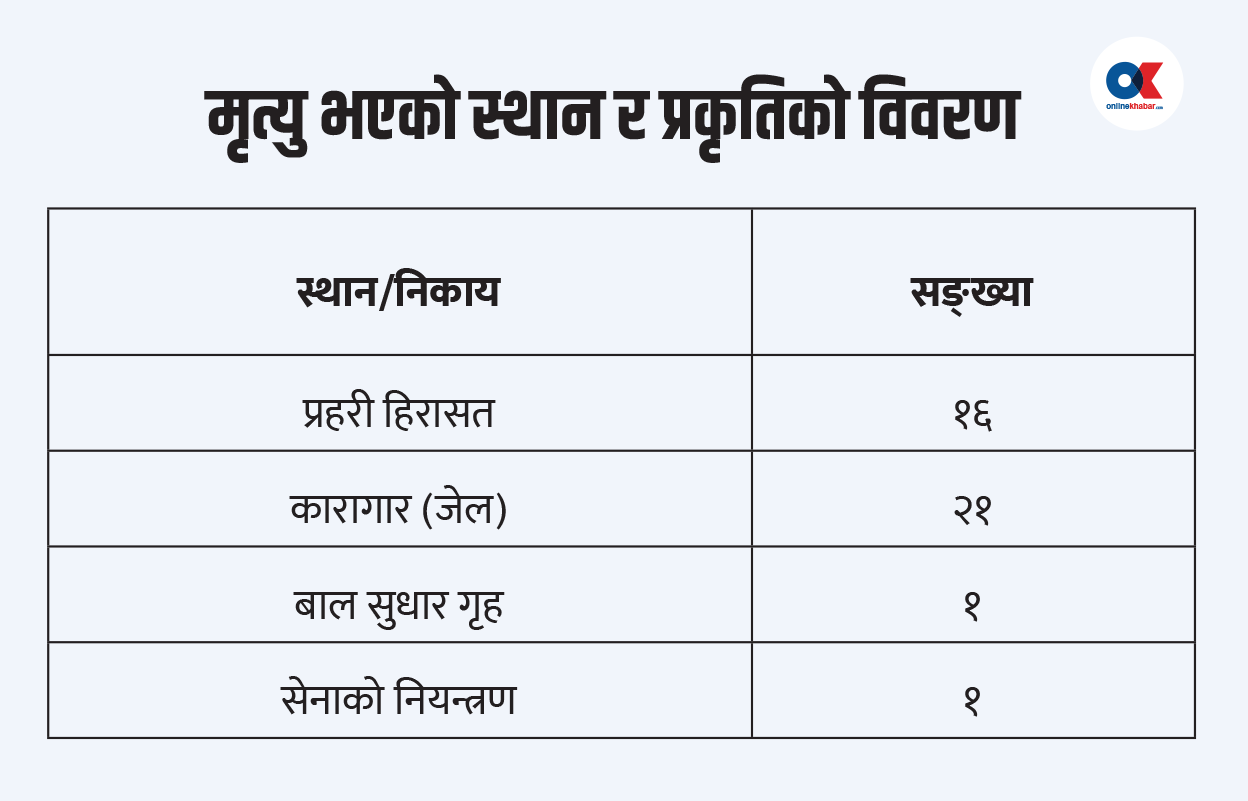
Table 2: Location and Nature of Deaths

Reports show that out of 39 deaths, 16 were caused directly by police. Many incidents involve hanging in toilets, a factor closely linked to caste and social disparities.
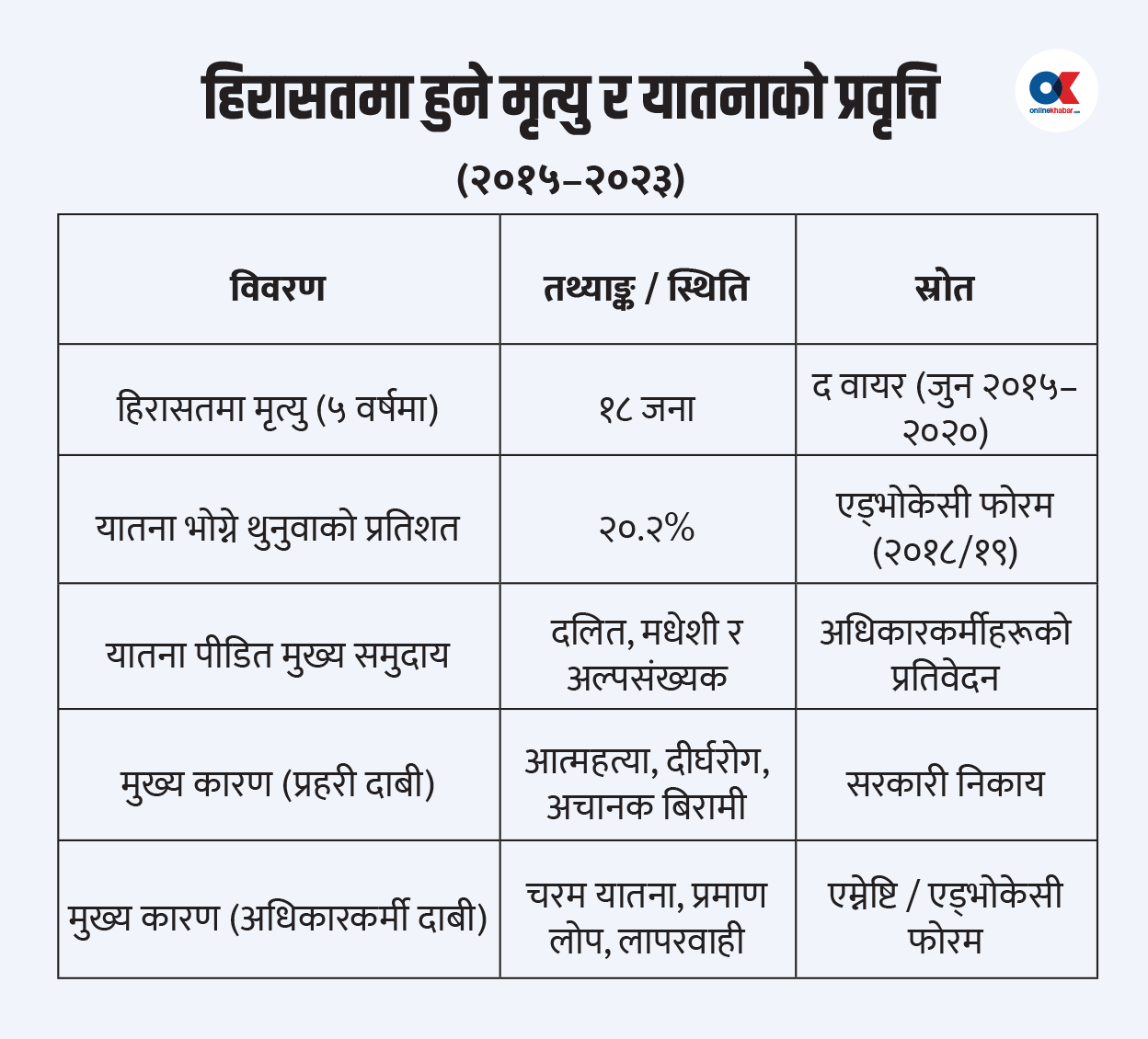
Advocacy Forum’s 2018 report “Rise of Torture” and others demonstrate that deaths and torture in custody are directed along ethnic and class lines.
Investigation Committee Outcomes: Protection for the Culprits

The state rarely forms investigation committees after custodial deaths. When formed, these committees frequently serve only to shield the guilty from legal accountability.

According to Advocacy Forum’s 2022 report “Custodial Deaths in Nepal,” investigation committees habitually exonerate the perpetrators, confirming the impunity prevalent in the justice system.

Accused Also the Investigator: According to principles of fair justice, one cannot investigate their own case. Yet, in Nepal, police departments themselves investigate incidents that occurred under their own supervision.

In Bijayram Mahara’s case, police refused to collect evidence and attempted to protect colleagues by erasing evidence and fabricating false ones.

Low-Level Staff Blamed, Higher-Ups Protected: Custodial deaths usually happen under orders or tacit consent from senior officials. However, only lower-ranking staff are suspended or penalized, serving as scapegoats, while senior officials face no consequences.

Example 1 (Paltu Ravidas): After his death, 30-year-old police constable Jayprakash Yadav was suspended for six months, yet no action was taken against commanders or station chiefs.

Example 2 (Bijayram Mahara): Despite complaints filed against SP Raviraj Khadka, DSP Gyankumar Mahto, Inspector Nabin Kumar Singh, and Sub-Inspector Birendra Yadav, only some lower and mid-level officials were suspended or transferred in what appeared to be damage control.

Investigation Reports Remain Confidential: Non-disclosure of committee findings fosters impunity, as reports remain shelved in the Home Ministry.

Despite recommendations from the National Human Rights Commission, the Dalit Death Investigation Committee formed by the Madhesh government remained only on paper, citing COVID-19 as a reason.

Obstacles in Filing Cases: Filing complaints against police is difficult. In Shambhu Sada Musahar’s case, a complaint against Inspector Chandrabhushan Yadav was rejected, and later the Attorney General’s Office decided not to proceed, confirming police impunity.

Activists note police reluctance to register complaints against themselves and exclusion of senior officials from investigations institutionalizes impunity, increasing abuse by higher-ups and fear among lower rank officers.

Failure by the National Dalit Commission and Human Rights Commission to enforce recommendations perpetuates custodial deaths among Dalits.

“Apologies from the Podium, Handcuffs in Custody”

How personal freedoms like love and marriage transform into structural violence due to caste arrogance.

On 13 Chaitra 2078, the Cabinet acknowledged injustices against Dalit and marginalized communities and decided on corrective measures. However, before the Prime Minister’s government could implement programs, Shrikrishna Bik died mysteriously, mocking governmental commitments.

One month prior to his death, Rajpa had repeatedly apologized to Dalits and promised to end caste-based injustice. Yet, just days later, Shrikrishna’s love marriage collapsed, and he died in custody. None of the apologizing parties have formally responded to this tragedy.

No major political party has officially addressed the issue, and caste violence remains largely confined to “Dalit issues.” Shrikrishna’s death and investigation reports reveal the state’s structural mindset. Unless these reports are disclosed and culprits punished, calls for justice will remain mere promises deceiving the Dalit community.

Inter-Caste Love: Some Die, Others Are Imprisoned

The suffering of Dalits in Nepalese society is profound and inhumane. The cases of Jyoti Paswan from Saptari and a 19-year-old in Sarlahi show that although laws outlaw caste discrimination, medieval social attitudes persist.

Jyoti Paswan married Krishna Mishra in a love marriage in Falgun 2077, but family pressure due to caste differences caused Krishna to sever ties. Unable to bear the rejection, she committed suicide in Shrawan 2078.

In Sarlahi, a Dalit girl was sexually exploited under the guise of marriage and then kept imprisoned like livestock for 23 days because she was considered “untouchable.” These cases illustrate how love and marriage issues become structural massacres.

Nepal’s caste structures cruelly punish Dalit youth: Dalit men are killed in custody for loving non-Dalit women, while Dalit women face social scorn and familial rejection forcing them to end their own lives.

The Shrikrishna Case: A Test of State Justice Commitment

The state has policies to encourage inter-caste marriage, but silent tolerance of murders or fatal conditions for Dalit partners reveals the real problem.

Previous investigation committees into the deaths of Bijayram Mahara and Shambhu Sada limited themselves to shielding culprits. In Shrikrishna Bik’s case, the current urgency must not merely pacify public outrage but must ensure justice. Failure to do so will severely damage not only democracy and human rights but also the moral standing of a government that has apologized to Dalits.

As long as Dalit youth face death or imprisonment for love and marriage, the state’s claims of inclusivity and citizen rights will remain hollow slogans. Shrikrishna’s death cannot be closed as suicide; it must become a test case to punish offenders. Otherwise, detention centers will become slaughterhouses for marginalized communities, and laws will mirror the ugly face of impunity.

The caste prejudice surrounding love in Nepalese society is so harsh that Dalit men die in custody for loving, while Dalit women end their lives. Although policies promote inter-caste marriage, silence over Dalit deaths is the greatest manifestation of structural crime.

अध्यादेश ल्याउने सीमाको व्याख्या गर्न किन चुकिरहेको छ अदालत ?

Why Is the Court Faltering on the Issue of Ordinance Promulgation?

April 28, Kathmandu – The government holds a clear two-thirds majority. There is little possibility of opposition when undertaking people-centric initiatives. This government has the opportunity to enact laws without succumbing to any group’s pressure or influence.

Amid this opportunity, the government has postponed the parliamentary session dates to issue ordinances. Drafts of ordinances, passed through Cabinet decisions not made public, have reportedly reached the President’s office.

Instead of submitting new bills to the House of Representatives, the government has recommended two ordinances concerning cooperatives and the Constitutional Council to the President.

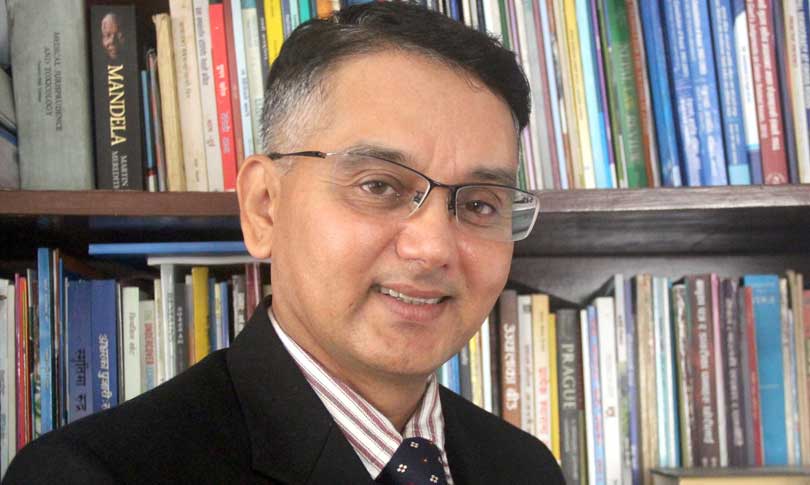
Senior Advocate Dr. Surendra Bhandari has commented that unlike past governments, the current administration is not compelled to issue ordinances. He states that avoiding debate and pushing forward through ordinances signals the onset of an authoritarian style.

“Earlier governments faced certain compulsions forcing them to violate the constitution, but this government faces no blockage from Parliament to pass laws,” Bhandari states. “Bringing ordinances when laws should be passed by Parliament undermines the legislative authority.”

Senior Advocate Dr. Surendra Bhandari

In parliamentary democracies, the executive is authorized to issue ordinances only when there is an urgent necessity or when Parliament is not in session.

Nepal’s interim constitutions of 1990 and 2007 and the current 2015 Constitution contain provisions for such ordinances. However, many administrations have misused this provision.

In 2017, the Communist Party of Nepal (CPN) with a two-thirds majority, issued multiple ordinances related to the Constitutional Council. Prime Minister KP Sharma Oli led the council and appointed 52 constitutional officials through these ordinances.

After the Supreme Court’s order removed Oli from his post, the government under Sher Bahadur Deuba introduced political party-related ordinances, which facilitated the split of UML and formation of the CPN (Unified Socialist).

Some ordinances amended existing laws contrary to established acts. Provisions of criminal law were altered without debate, granting unusual privileges to some and imposing harsher detention on others.

Advocate Om Prakash Aryal challenged such ordinance-based amendments as unconstitutional in the Supreme Court, but his petition was dismissed in mid-July.

Aryal argued, “Laws cannot be amended by ordinance; it disrespects Parliament and interferes with the legislature’s authority.”

He noted that even the interim government had submitted ordinances related to the Constitutional Council to the President’s office, but the then President Ram Chandra Paudel left them pending without approval.

What Does the Constitution Say?

Article 114 of Nepal’s Constitution authorizes the President, upon the Council of Ministers’ recommendation, to issue ordinances when Parliament is not in session and in urgent circumstances. Such ordinances must be ratified by Parliament within 60 days of its next session or else they automatically lapse.

Yet in recent years, ruling parties have routinely misused ordinances for their own advantage. The previous governments led by Oli, Deuba, and Prachanda used ordinances arbitrarily, and now there are indications the current Balendra government may follow suit.

Governments have habitually relied on ordinances for self-serving purposes. For instance, in 2022, the Deuba administration issued an ordinance on Nepal Police that placed police structures of three districts of Kathmandu Valley under federal control, attempting to resolve federalism and power-sharing issues via ordinance.

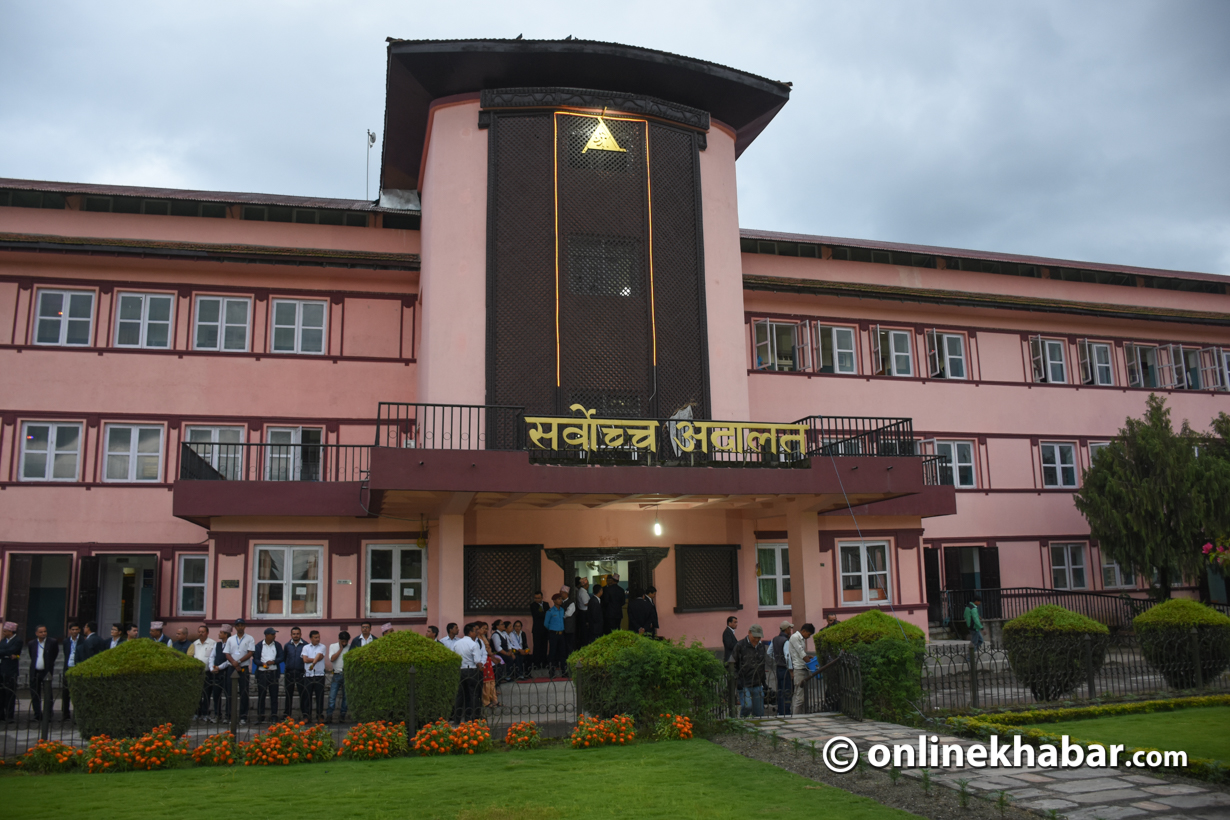
Despite continuous litigation on cases like the 52 constitutional officials’ appointments and the political party ordinance amid UML’s division, the Supreme Court has generally refrained from delivering clear, conclusive interpretations regarding ordinances.

Since ordinances have a set limited duration, the courts rarely hear disputes once an ordinance becomes invalidated and the Supreme Court often states there is no need to interpret an ordinance that no longer exists. This practice grants ongoing opportunities for the rulers to exploit ordinances.

The Supreme Court’s Silence

While the Supreme Court initially questioned the legitimacy of ordinances, its final interpretation appears to have shifted. When the Oli government introduced an ordinance amending citizenship law, the Supreme Court issued a temporary order.

At that time, the Court referred to such practices as “colorful legislation” and ruled that ordinances lack constitutional validity.

It stated, “If this practice becomes accepted as normal, it would interfere with legislative authority and could adversely affect the constitutional principle of separation of powers.”

Constitutional and governmental practice require that ordinances meet basic criteria, such as being issued only when Parliament is not in session. Nonetheless, governments have repeatedly delayed parliamentary sessions while issuing ordinances.

Senior Advocate Bhandari views this authoritarian tendency of the government as disrespectful to the rule of law and the legislature.

Another critical condition for issuing ordinances is the ‘urgency’ of the matter. Article 114 of the Constitution indicates ordinances are justified only when a task cannot be accomplished otherwise.

Although the Supreme Court initially gave clear directions regarding the citizenship ordinance, it remained silent in its final ruling where a bench tacitly accepted that the ordinance’s urgent necessity had ended.

The case concerning the 52 constitutional officials follows a similar pattern. Repeated issuance of the same ordinance has prevented the Supreme Court from providing an interpretation on the ordinance’s broader impact on the country’s governance.

In late July, the Supreme Court had an opportunity to assess the ordinance’s justification, but judges in the Constitutional Bench appeared reluctant.

Judges Dr. Manojkumar Sharma and Dr. Kumar Chudal explained at length the scope of the President’s power to issue ordinances but refrained from discussing conditions or limits.

They relied on precedents that the constitutionality of invalidated laws could not be tested, concluding that since ordinances issued by the Oli government had lapsed, they could not be adjudicated.

It is unclear from the ruling whether Chief Justice Prakash Man Singh Raut and Judge Dr. Nahakul Subedi agreed with this position. Senior Judge Sapana Pradhan Malla dissented by remaining silent. The full text of that nearly ten-month-old decision has yet to be published.

Senior Advocate Bhandari remarks that the country’s judiciary is overly traditional and inactive in constitutional dispute interpretation.

“In precedent cases related to ordinances and significant issues like interim government formation, the Supreme Court has not shown prompt, necessary initiative,” Bhandari says. “The Court is missing opportunities to interpret constitutional conflicts and thereby enliven the Constitution.”