
Author: space4knews

Expensive Fuel in South Asia: Why Has Nepal Not Provided Relief?

Nepal Oil Corporation has increased the price of diesel by NPR 30 per liter, releasing a new price list that sets the diesel price at NPR 237 per liter. A significant price disparity between Nepal and India in petroleum products has raised concerns about fuel smuggling and illegal trade. Consumer rights activists have accused the government of raising prices despite offering a 50 percent tax exemption without spending NPR 20-22 billion from the Price Stabilization Fund. Kathmandu, April 4 — On September 30, 2080 BS (effective from September 31), Nepal Oil Corporation issued a new price schedule. According to this decision, petrol was increased by NPR 2 per liter, diesel and kerosene by NPR 6 per liter, and cooking LPG by NPR 215 per cylinder, bringing the LPG price to NPR 2,110. Aviation fuel prices also rose by NPR 8 per liter. At that time, the government was led by Pushpa Kamal Dahal ‘Prachanda’. The Oil Corporation claimed the price hike was due to increased costs from Indian Oil Corporation (IOC) and was adjusted according to the ‘automatic pricing mechanism.’ However, widespread opposition forced the government to retract the increase.

In the House of Representatives meeting on October 14, 2080 BS, National Independent Party (RASWA) chairman Ravi Lamichhane strongly opposed the petroleum price hike and questioned both the government and Oil Corporation. ‘The Oil Corporation engages in trade, imports, and regulation all by itself; it also distributes bonuses to employees,’ Lamichhane stated. ‘Yet, it claims constant losses. What exactly are these losses? If the automatic system bases prices on increases in the international market, then why doesn’t it reduce prices when international prices fall? Why does it take two to three days to lower prices?’ At that time, Lamichhane vocally resisted the petroleum price rise and questioned the corporation. Now, under Lamichhane’s leadership, RASWA holds nearly two-thirds of the majority in the government, with senior RASWA leader Balendra Shah serving as Prime Minister. Since the formation of the RASWA government, petroleum prices have been raised five times. Despite tense conditions in West Asia pushing international prices upward, and India increasing prices accordingly, Lamichhane has remained silent during this recent large price hike over the past month. Moreover, no other RASWA parliamentarians have publicly addressed the issue. While Lamichhane was in opposition, he was vocal about common citizens’ concerns; however, now as part of the government, he has been criticized for not providing relief and instead imposing successive price hikes that burden the public further.

Santosh Narayan Shrestha Resigns as Chairman of Nepal Securities Board

April 17, Kathmandu – Santosh Narayan Shrestha, Chairman of Nepal’s Securities Board, has submitted his resignation. He announced his decision during the board’s executive committee meeting held on Friday. According to the Securities Act, the board chairman must formally submit their resignation to the government. Following this procedure, Shrestha handed over his resignation to the Finance Minister on Friday evening, as confirmed by sources within the Ministry of Finance.

After Friday’s board meeting, Shrestha informed the directors that he made the decision to resign in order to support the government. The directors shared this information. The government had appointed him as Executive Chairman of the Securities Board on November 25, 2024. Following his involvement in the investigation concerning asset cleansing linked to Deepak Bhatt, the government requested Shrestha to step down and cooperate. In line with this request, he tendered his resignation.

*An earlier version of this report contained inaccuracies in some facts and has been corrected – Editor.

European Nations Propose a ‘Third Way’ to Resolve the Hormuz Strait Crisis

Excluding the United States, Israel, and Iran, France and the United Kingdom have initiated efforts to form a powerful coalition of over 30 countries aimed at reopening the Strait of Hormuz. At a special summit held in Paris on Friday, European powers proposed a new

Farewell Ceremony Held for Three International Taekwondo Teams Departing for Competitions

The International Open Friendship Taekwondo Championship (IOFTIC) Nepal Chapter has bid farewell to three international taekwondo teams. Pravin Shrestha, Sandesh Adhikari, and Ganesh Bahadur Khadka will compete at the Wata Open in Japan, with team leader Giribahadur Sunar accompanying them. Nepali players and officials will also participate in the Open Championships held in Malaysia and China. Patan, 4 Baisakh.

IOFTIC hosted a ceremony on Friday to send off the three teams, presenting them with Kelmi brand tracksuits. The Wata Open Taekwondo Championship will take place in Japan from April 24 to 26, where Nepal’s Pravin Shrestha, Sandesh Adhikari, and Ganesh Bahadur Khadka will compete. Team leader Giribahadur Sunar, who also serves as IOFTIC Nepal’s General Secretary, will accompany the team.

Additionally, the Malaysia Open Taekwondo between May 2 and 3 will see Sandip Nyaupane participating as a player, with Divakar KC attending as an official. The Hainan International Open Championship in China, scheduled from May 2 to 5, will feature Nepalese athletes Vijan Tamang, Sandip Basnet, and Ayush Bohara competing, with Indraraj Khadka serving as an official. IOFTIC President Min Prasad Khanal and other office bearers formally bid farewell to all players and officials during the event on Friday.

Headquartered in the United States, IOFTIC celebrated its 25th anniversary last January by hosting the 15th edition of its competition in Nepal. The organization has announced plans to hold the 16th edition in Melbourne, Australia, this coming November.

कस्तो छ मिनी संसद् हाँक्नेहरूको पृष्ठभूमि ? – Online Khabar

What Are the Backgrounds of the Chairpersons Managing the Mini-Parliament?

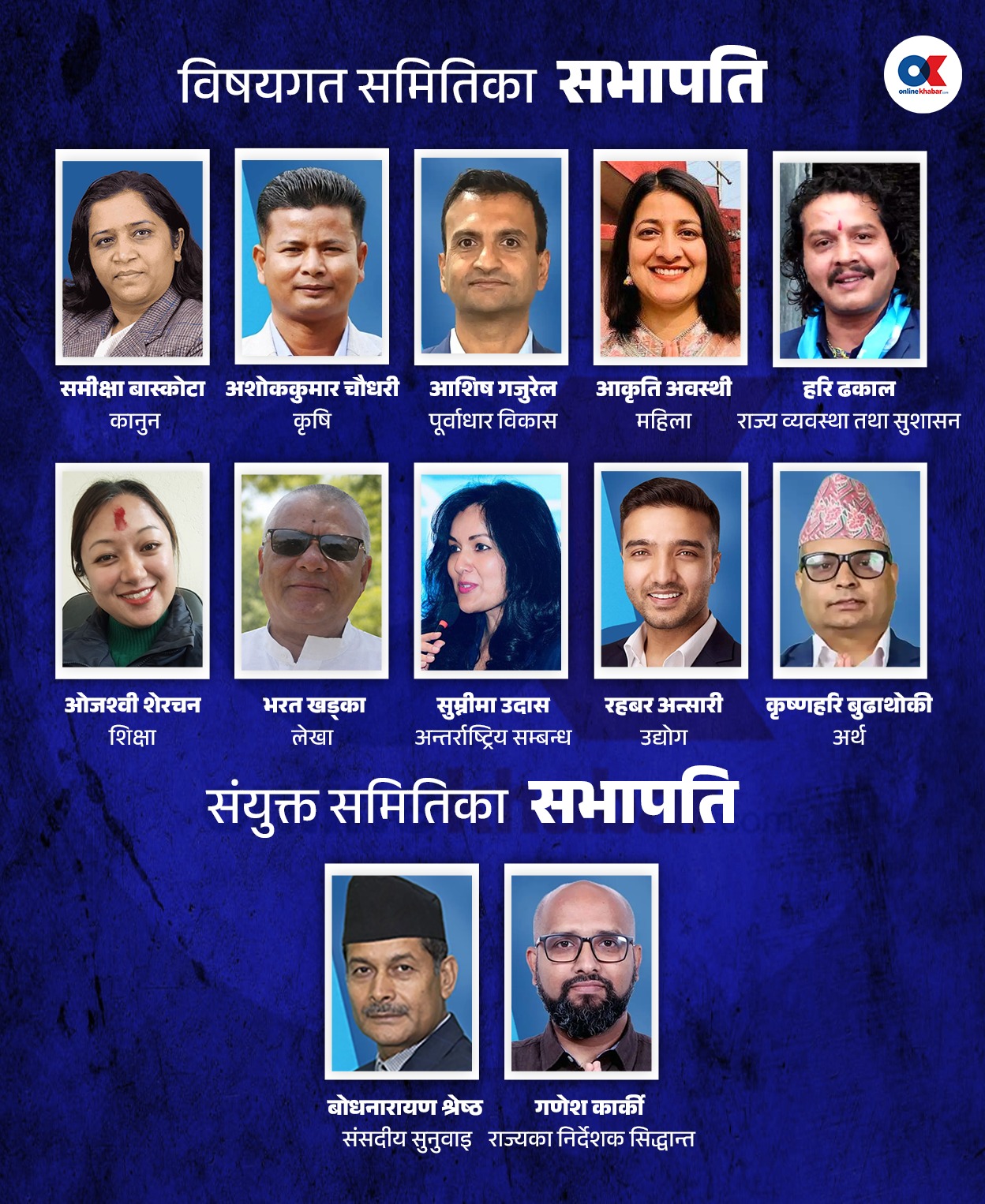
April 17, Kathmandu – On Friday, twelve parliamentary committees appointed their chairpersons. Among the new chairpersons of the parliamentary committees, often referred to as the mini-parliament, nine are first-time members of parliament while three have prior parliamentary experience.

Hari Dhakal of the State Affairs and Good Governance Committee, Ashokkumar Chaudhary of the Agriculture, Cooperatives and Natural Resources Committee, and Bharat Bahadur Khadka of the Public Accounts Committee have all previously served on various committees in the earlier parliament.

The other nine chairpersons are entering the federal parliament for the first time. These include Samiksha Baskota, chairperson of the Law, Justice and Human Rights Committee; Ashish Gajurel, chairperson of the Infrastructure Development Committee; and Aakriti Awasthi, chairperson of the Women and Social Affairs Committee. Bodhnarayan Shrestha is the chairperson of the Parliamentary Hearing Committee, while Sumnima Udas leads the International Relations and Tourism Committee and Krishnahari Budhathoki chairs the Finance Committee.

Ganesh Karki chairs the State Directive Principles, Policy and Duties Implementation Monitoring and Evaluation Committee; Ojaswi Sherchan leads the Education, Health and Information Technology Committee; and Rahbar Ansari is chairperson of the Industry, Commerce, Labor and Consumer Interests Committee.

Ansari, the chairperson of the Industry, Commerce, Labor and Consumer Interests Committee, was previously a member of the Madhesh Province Assembly and has now been directly elected to the House of Representatives.

Leadership of the Public Accounts Committee with Over Four Decades of Political Experience

The Public Accounts Committee is one of the most vital subject committees of the parliament. It audits whether government spending is necessary, economical, and effective. It plays a critical role in providing checks and balances on the government.

Traditionally, the chairpersonship of the Public Accounts Committee is given to the main opposition party. This time, Bharat Bahadur Khadka of the Nepali Congress was unanimously appointed chairperson.

Born in 2016 BS (1959/60 AD) in Khirsain Village Development Committee of Doti, Khadka has been active in politics since 2032 BS (1975/76 AD). He initiated his political journey in 2039 BS (1982/83) as the chief of Khirsain Village Panchayat.

He served as deputy chairperson of Doti District Panchayat in 2043 BS, chairperson of the same Panchayat in 2044 BS, and deputy chairperson of the District Development Committee after the 2049 BS local elections. In 2054 BS, he was re-elected as chairperson of the District Development Committee.

After the establishment of the republican system in 2062/2063 BS (2005/2006), Khadka remained politically strong. He became a member of parliament through the 2070 BS (2013/14) Constituent Assembly election and then secured membership in the Sudurpaschim Province Assembly in the 2074 BS (2017) provincial elections.

In 2082 BS (2025/26), Khadka was directly elected as a member of the House of Representatives from Doti, and the Nepali Congress entrusted him with the role of chairperson of the Public Accounts Committee.

Experienced Young Leaders Entrusted with Key Roles

The State Affairs and Good Governance Committee includes top party leaders and works to hold the government accountable to parliament.

This committee is chaired by Hari Dhakal of the Rastriya Swatantra Party (RSP). He gained prominence in the 2079 BS (2022) election by defeating prominent leaders such as Dr. Bishwapaudel of the Nepali Congress and Surendra Pandey of the UML from Chitwan-1.
Dhakal now faces the challenge of leading this committee which includes senior leaders such as RSP Chairperson Ravi Lamichhane, CPN-UML coordinator and former Prime Minister Pushpa Kamal Dahal ‘Prachanda’, Labor Culture Party Chairman Harkraj Rai, and National Democratic Party parliamentary leader Gyanbahadur Shahi.

The committee also counts experienced young parliamentarians like Amaresh Kumar Singh, Arjun Narasingh KC, Padmakumari Aryal, Bhishma Raj Angdembe, Mohammad Ishtiyak Rai, and Yuvraj Dulal.

Additional members include Kavindra Burlakoti, Kamal Subedi, Karishma Kathariya, Gajala Shamim Mikrani, Nishkal Rai, Purushottam Suprabhat Yadav, Afsana Banu, Bishwaraj Pokharel, Ramesh Prasain, Rabindra Patel, Ram Lama, Rubina Acharya, Rekha Kumari Yadav, Vishnumaya Bik, and Shraddha Kuwar Kshetri.

At 42 years old, Dhakal is a youth leader with a background in the UML. During his school and college years, he was a member and secretary of the All Nepal National Free Students Union (ANNFSU), the student wing of UML.

After some ups and downs in business, he turned towards a spiritual path and became active in yoga, meditation, and ascetic activities.

Active in the RSP since 2079 BS, Dhakal has earned the trust of senior leaders and now has the responsibility to make the government accountable to parliament.

Besides lawmaking at the highest level, this committee advises and guides the government on good governance, peace and security, and legal affairs.

Its jurisdiction includes the Office of the Prime Minister and Council of Ministers, Ministry of Home Affairs, Ministry of Defence, Ministry of Federal Affairs and General Administration, Commission for the Investigation of Abuse of Authority, Public Service Commission, Election Commission, among others.

Another experienced young parliamentarian, Ashokkumar Chaudhary, chairs the Agriculture, Cooperatives and Natural Resources Committee.

Chaudhary, who became a proportional representation member in 2079 BS and was directly elected from Sunsari-3 this term, triumphed over major competitors including Vijay Kumar Gachhadar of the Congress and Bhagwati Chaudhary of UML to win the committee leadership.

This committee was also previously led by the Nepali Congress. It oversees the Ministry of Agriculture, Livestock, Land Management, Cooperatives, Poverty Alleviation, Forestry, Environment, and associated agencies.

Due to its direct impact on people’s lives, experienced leaders contest for its leadership. This time, the 42-year-old Chaudhary was chosen.

Prior to politics, Chaudhary was active in sports and is an international player in the ancient sport of tug-of-war. He represented Nepal in the 14th Asian Tug of War Championship in 2019.

He also serves as an advisor to the Nepal Tug of War Association and has continuously advocated for players’ rights, infrastructure, and expanded opportunities. In the previous parliament, he prioritized fertilizer, seeds, and irrigation as agricultural improvements.

Chaudhary pledged to ensure minimum support prices and market guarantees for agricultural products, gaining popularity among farmers.

Challenging Questioners of the Parliament

Ganesh Karki, chairperson of the State Directive Principles, Policy and Duties Implementation Monitoring Committee, is known as a strong questioner. He has even questioned his own party coordinator, Ravi Lamichhane, earning a reputation as a rebellious leader. He will continue to hold the government accountable regarding parliament’s responsibilities.

Part 4 of Nepal’s Constitution specifies state directive principles, policies, and duties as guidelines for state operations. Karki’s committee is responsible for evaluating the government’s implementation of these.

Karki, 40, elected from Morang-3, is also a film writer.

Krishnahari Budhathoki, chairperson of the Finance Committee, is an economic expert active in research for over two decades.

He has offered policy recommendations suitable for Nepal’s economy in public forums and now has parliamentary responsibilities. Budhathoki will review the effectiveness of government economic reforms and recommend improvements where necessary.

Ashish Gajurel chairs the Infrastructure Development Committee. He served as a government investment board advisor for over 11 years.

With a background in traffic engineering and transport management, Gajurel is an advocate for sustainable transport, road safety, infrastructure integrity, and policy implementation.

Holding a master’s degree in transport systems from Germany, he is expected to contribute significantly to modern, scientific infrastructure development.

Bodhnarayan Shrestha, chairperson of the Parliamentary Hearing Committee, is known for supporting development policy reform and result-oriented politics.

He advises the government to ensure efficiency, capacity, and integrity in appointments to constitutional bodies and will sound necessary alarms when required.

His committee oversees recommendations and decisions on appointments of the Chief Justice, Supreme Court justices, Judicial Council members, heads of constitutional bodies, and ambassadors.

Shrestha, 56, holds a bachelor’s in political science and a master’s in rural development. He will play a crucial role in ensuring the right people are appointed to the right positions.

Activists of Street Movements Now Leading Parliamentary Committees

Samiksha Baskota, chairperson of the Law, Justice and Human Rights Committee, is a leader of the Bibeksheel Sajha Party. She earned a master’s degree in law from the USA and entered parliament after the merger of Bibeksheel Sajha and RSP in the last Mangsir (Nepali calendar) election.

Previously, she raised demands for fundamental rights on the streets and will now pursue these through parliamentary channels.

Active in legal, human rights, and judicial reforms, Baskota will provide recommendations for positive governmental changes. Her committee also leads on international treaties, peace processes, and supervises the Ministry of Law, Justice and Parliamentary Affairs, Judicial Council, Judicial Service Commission, and the Attorney General’s Office.

Sumnima Udas chairs the International Relations and Tourism Committee. A former CNN journalist with decades of experience reporting from conflict zones, she now has the opportunity to lead debates on Nepal’s foreign policy.

Ojaswi Sherchan, chairperson of the Education, Health, and Information Technology Committee, is a parliamentarian with a medical background, having specialized in biochemistry at BP Koirala Institute of Health Sciences, Dharan.

Her committee will lead policy formation on medical education, research, health system improvements, and epidemic management.

Women Leaders Championing the New Generation Take Charge of Social Affairs Committee

Aakriti Awasthi, chairperson of the Women and Social Affairs Committee, is the sister of Mukesh Awasthi, a victim of the Janajati (Ethnic) movement. A proportional representation member, she plays a strong role.

Her committee focuses on inclusion and rights, monitoring the ministries and commissions related to women, children, senior citizens, national women’s commission, Dalit commission, inclusive commission, and other ethnic and community commissions.

It is expected that the new leadership will channel the voices raised by the Janajati movement on the streets into meaningful parliamentary responses by the government.

A Mother, Daughter, and the Memory of 100 Rupees

Amid a society deeply entrenched in capitalism, a mother and daughter reunited after two decades. In a distant corner of Kathmandu, in her daughter’s room, an old drawer holds a clutter of worn clothes along with her purses. These purses are filled to the brim with ATM cards, student IDs, journalist, lawyer, and dental cards. In one bundle lies 100 rupees, on which “Mother” is written in black ink. When they parted, it was the money her mother had given her. With tearful eyes, a heavy heart, and weary hands, the daughter inscribed her mother’s blessing onto that note.

Though only 100 rupees from her mother, she has walked countless kilometers by foot until midnight many times over. She was never driven by thirst for water or the aroma of tea. Time and again, she journeyed empty-handed but survived. The note bears the guarantee of the Government of Nepal, stating: “If payment is requested, the Nepal Rastra Bank will immediately pay 100 rupees.” Against the backdrop of capitalist glitter, another innocent father and son will someday meet again. At parting, the son will receive the 100-rupee blessing given by his father, remaining unnamed in the backdrop—somewhere here among us, somewhere here among us.

Home Minister Sudhan Gurung Discusses Cross-Border Smuggling Control with MPs

Home Minister Sudhan Gurung held extensive discussions with members of the House of Representatives from the Madhesh and Lumbini provinces regarding cross-border smuggling control. The MPs proposed recommendations such as improving the customs system, reviewing customs duties, and developing effective monitoring and surveillance mechanisms. Minister Gurung expressed his commitment to implementing relevant measures under the Home Ministry and coordinating further with the Ministry of Finance.

April 17, Kathmandu — Home Minister Sudhan Gurung engaged in talks with representatives from Madhesh and Lumbini provinces about controlling cross-border smuggling. During the discussions, MPs highlighted the need to improve the existing customs system, review customs rates, establish effective monitoring and surveillance systems in border areas, simplify customs procedures for agricultural products and fertilizers, and grant certain customs exemptions on daily essential imports for residents living near the border. Minister Gurung stated that Home Ministry-related issues will be implemented by the Home Ministry, while matters concerning the Finance Ministry will be further discussed and coordinated for resolution.

Hormuz Strait Fully Reopened; Trump Thanks Iran

April 17, Kathmandu — Iran’s Foreign Minister Abbas Araghchi announced that the Strait of Hormuz will remain fully open during the ceasefire period agreed upon with the United States. Through a statement, he committed to allowing all vessels to transit through the Strait of Hormuz for the remainder of the ceasefire period. ‘‘Following the ceasefire in Lebanon, all commercial ships will be able to navigate the Strait of Hormuz, and this route will remain completely open for the rest of the ceasefire period,’’ Foreign Minister Araghchi stated. The ceasefire between the US and Iran is set to continue until April 22.

Previously, Iran had maintained a firm stance that the Strait of Hormuz would not be opened until a ceasefire was established throughout the Middle East, including Lebanon. However, following Araghchi’s announcement regarding reopening the Strait of Hormuz, US President Donald Trump expressed his gratitude to Iran. Via social media platform Twitter, Trump extended his appreciation to Iran, writing, ‘‘Iran has recently announced it will fully open the Strait of Hormuz and prepare for maritime traffic—thank you for that.’’ Despite this, Trump clarified that the US blockade at Hormuz will remain in place. ‘‘The Strait of Hormuz is open and ready for trade and navigation, but the naval blockade, with associated power and influence, will continue,’’ he explained. He emphasized that the US blockade is targeted solely at Iran.

Nepal’s Girls Team Secures Second Place to Qualify for Asian Finals

Nepal’s girls team secured second place at the ITF Asia 12 and Under Tennis Championship, earning qualification for the Asian finals scheduled to be held in Singapore. In the competition, India finished first, with Nepal coming in second. Sri Lanka took third place, Maldives fourth, and Pakistan last. In the boys category, India claimed first place by defeating Pakistan 3–0, while Nepal finished fourth. Kathmandu, 4 Baisakh.

On Friday, Nepal’s girls team achieved second place at the ITF Asia 12 and Under Tennis Championship. Five nations participated in the tournament, where Nepal secured second place in the round-robin league stage, earning a spot at the Asian finals to be held in Singapore from September 15 to 20. India won all four of their matches, while Nepal claimed victory in three, losing only to India. Nepal defeated Sri Lanka, Maldives, and Pakistan.

In the final day’s match, Nepal defeated Maldives 2–1 in sets. In the first singles match, Nepal’s Arya Paudel triumphed over Laira Ushama Ali with scores of 6–0 and 6–2. In the second singles, Maldives’ Ishra Ibrahim overcame Nepal’s Sara Pant 6–3, 6–3, leveling the overall score to 1–1. In the doubles, the pair of Naira Ghale and Sara defeated Laira and Ishra 6–3, 6–1, clinching the match and securing Nepal’s qualification for Singapore.

In the girls category, India defeated Sri Lanka 3–0. The tournament took place at the Tennis Complex in Satdobato. In the boys category, India and Pakistan had already secured their places for the Asian finals by Thursday. In the final match, India beat Pakistan 3–0 to claim the top position. Aside from Bangladesh, six South Asian countries participated in the boys category, with Sri Lanka in third, Nepal fourth, Bhutan fifth, and Maldives sixth. In the playoff for third place, Sri Lanka defeated Nepal 2–1 in sets. Winners were awarded their prizes during a ceremony on Friday by Nepal Tennis Association President Manohardas Mul and ITF Development Officer Jonathan Stubbs.

विशेष महाधिवेशन वैधानिक छ – Online Khabar

Supreme Court Hears Claim by Bishwprakash Sharma that Special General Convention is Legitimate

The Supreme Court has concluded hearings in the writ petition concerning the official status of the Nepali Congress. Deputy Chairman of the Nepali Congress, Bishwprakash Sharma, asserted that the special general convention is legitimate and holds the authority to select leadership. He urged the court to accept the Election Commission’s decision and dismiss the writ petition, emphasizing the need to pave the way for the progress of the Congress. Kathmandu, 18 April.

The discussion surrounding the writ petition on the legitimacy dispute within the Nepali Congress was held before a bench comprising Supreme Court Justices Sharanga Subedi and Nripdhwaj Niraula. On Friday, both the petitioners’ and respondents’ lawyers presented their arguments. Representing the opposition, Deputy Chairman Bishwprakash Sharma affirmed the validity of the special general convention during his final statement. He stated, “According to Article 17(2) of the Congress statute, when a special general convention is called with reasons submitted in writing to the central committee, the matters include leadership change and leadership selection. Therefore, the special general convention has full authority to select leadership.”

Addressing the bench, Bishwprakash Sharma requested, “May the writ petition be dismissed, Sir. We will advance respectfully alongside all senior leaders.” He presented several arguments supporting the necessity and legality of the special general convention. He emphasized, “There is no ambiguity on whether the special general convention can or cannot select leadership. As per Article 17(2) of the Congress statute, when reasons are clarified and written requests are made to the central committee, leadership change and selection are included within those reasons.”

विशेष महाधिवेशन वैधानिक छ – Online Khabar

Special General Convention Is Legal, Affirms Nepali Congress Vice President Bishwaprakar Sharma

News Summary

Editorially Reviewed.

  • The Supreme Court has concluded the hearing on the writ petition regarding the Nepali Congress’s official status dispute.
  • Congress Vice President Bishwaprakar Sharma stated that the special general convention is legal and that the authority to elect leadership lies with the convention delegates.
  • They have urged upholding the Election Commission’s decision and dismissing the writ to pave the way for Congress’s progress.

April 17, Kathmandu – The hearing on the writ petition concerning the official status dispute of the Nepali Congress has concluded. The case was heard by a bench of Supreme Court Justices Sharanga Subedi and Nripdhwaj Niraula. On Friday, lawyers representing both the petitioner and respondent sides presented their arguments, with Congress Vice President Bishwaprakar Sharma delivering the final address on behalf of the opposition.

During the hearing, Sharma affirmed the legitimacy of the special general convention. He stated, “According to Article 17(2) of the Congress constitution, a special general convention is convened on written request submitted to the central committee citing reasons, which include leadership change and election. Therefore, electing leadership through a special general convention is entirely legitimate. The convention delegates retain the sovereign authority of the party. They are the creators of the central committee and the general assembly; just as they establish leadership, they have the power to change it.”

He supported the Election Commission’s decision to recognize the committee elected by the special general convention and requested the dismissal of the writ filed by the then acting president, Purnabahadur Khadka, and others. “We respectfully urge the dismissal of the writ so that we can move forward together with senior party members,” he said in court.

What Did Bishwaprakar Say in the Court?

1) The relevance of the special general convention will remain unaffected by the announcement of the regular general convention. This was a necessary measure.

I wish to present a precedent set by the Supreme Court on Magh 21, 2007 BS. In Poush 2007 BS, the Supreme Court deliberated on a significant case where the king had sought the court’s advice.
The primary questions were:

• Whether the House of Representatives can be dissolved based on the Prime Minister’s recommendation as per Article 53, Subsection 4 of the then Constitution.
• Or whether the House should be convened upon a written request from 96 members as per Article 53, Subsection 3?
(After extensive debate, the court advised that the call for convening the assembly upon written request cannot be rendered meaningless for any reason.)
Based on that precedent, the written request by the Nepali Congress general convention delegates must be acknowledged and considered.

2) Once a landowner is present, the official heir’s rights cease. The dissolution of parliament following the people’s insurgency during the civil war was because citizens rebelled to prevent official heirs from becoming MPs. A similar scenario unfolded in Congress. The special general convention was a rebellion by the convention delegates, but it was also a responsibility taken on by the then General Secretary Gagan Thapa and myself.

3) Can a special general convention elect leadership?
* According to Article 17(2) of the Congress constitution, leadership change and selection fall within the reasons cited in the written request submitted to the central committee, making the leadership election through a special general convention fully legitimate.
* The general convention delegates possess the party’s sovereign rights. They are the creators of the central committee and the general assembly – able to both appoint and replace leadership.

4) This is not a dispute under Section 44. This is an interim process under Section 51 of the Political Parties Act. Therefore, the Election Commission’s decision is both constitutional and in full compliance with party rules.

5) Within any party, a principal party member ranks higher than a leader – this is the essence of democratic consciousness, power, and beauty. The message of the Nepali Congress special general convention embodies this principle. It should inspire transformation in all parties and the broader political landscape.

6) Situations have changed since the special general convention.

* Five days after the removal of Gagan Thapa and Bishwaprakar Sharma from general membership, candidates opposing the special general convention were nominated on Falgun 21 without any resentment.
* The Nepali Congress is now moving forward to hold a regular general convention by Ashwin. We will advance together with respected senior leaders who have been part of politics as long as Gagan Thapa and myself. This is both our responsibility and duty.
* Hence, I urge the dismissal of the writ and the facilitation of the Congress’s progress.

Donald Trump Calls for ‘Kill Switch’ to Control AI Development

Former U.S. President Donald Trump has highlighted the need for a “kill switch” to address the risks posed by the rapid advancement of artificial intelligence (AI), warning that unchecked AI development could threaten human life. Trump’s concerns reflect growing unease about the swift expansion of AI technologies.

In an interview aired on Fox News Network, Trump remarked that AI is advancing at an unprecedented pace, raising the possibility that it could jeopardize humanity’s future—a risk that cannot be ignored. He acknowledged that AI can enhance security and efficiency in sectors like banking but emphasized that serious risks are also involved. Trump has consistently called for stringent government oversight of AI progress and urged serious consideration of measures such as a kill switch to regulate advanced AI systems.

A “kill switch” refers to a safety mechanism designed to immediately shut down a system in emergencies. In the context of AI, it would allow for the prompt deactivation of any AI system that becomes uncontrollable or dangerous. However, Trump has not clarified how such a kill switch would operate or who would hold authority over its control.

This statement from Trump emerges amid cybersecurity experts expressing concerns about Cloud Mytho$, a new AI model developed by AI company Anthropic. Experts warn that this AI model could potentially enable more sophisticated and powerful cyberattacks. Nevertheless, Anthropic has confirmed that it will not make the preview version of its Cloud Mytho$ model publicly available to general users.

New Chairpersons Elected for 12 Parliamentary Committees

April 17, Kathmandu – The parliamentary committees under the Federal Parliament are now fully constituted. On Friday, 12 parliamentary committees elected their chairpersons, marking the completion of the committees. In the elections held on Friday, chairpersons were unanimously elected in 10 committees, while competitive elections took place in two committees.

Hari Dhakal of the Rastriya Swatantra Party was unanimously elected as chairperson of the State Affairs and Good Governance Committee. Similarly, parliamentarian Samikshya Baskota from the Rastriya Swatantra Party was unanimously elected chairperson of the Law, Justice, and Human Rights Committee.

Ashokkumar Chaudhary of the Rastriya Swatantra Party was unanimously elected chairperson of the Agriculture, Cooperatives, and Natural Resources Committee. Ashish Gajurel was unanimously chosen for the Infrastructure Development Committee, and Aakriti Awasthi was unanimously elected to chair the Women and Social Affairs Committee. Bodh Narayan Shrestha, Rahbar Ansari, Sumnima Udas, and Krishnahari Budhathoki were also unanimously elected chairpersons of the Parliamentary Hearing Committee, Industry, Commerce, Labor and Consumer Protection Committee, International Relations and Tourism Committee, and the Finance Committee, respectively.

In addition, Bharat Khadka of the main opposition party, Nepali Congress, was unanimously elected as chairperson of the Public Accounts Committee. After gaining support from the Rastriya Swatantra Party, Khadka stood as the sole candidate. The remaining two committees witnessed contests with multiple candidates.

For the chairpersonship of the State Directive Principles, Policies, and Responsibility Implementation Monitoring and Evaluation Committee, Ganesh Karki of the Rastriya Swatantra Party competed against Madan Kumari Shah (Garima) of the Nepal Communist Party. Due to the clear majority of the Rastriya Swatantra Party, Karki was elected.

Similarly, two candidates contested for chairperson of the Education, Health, and Information Technology Committee under the House of Representatives. Ojaswi Sherchan of the Rastriya Swatantra Party faced Gurup Prasad Baral of the CPN-UML. Sherchan was elected owing to the clear majority held by the Rastriya Swatantra Party.

Netflix Announces TikTok-Style Video Feed for Mobile App

Netflix plans to introduce a TikTok-like vertical video feed along with a new design for its mobile app by the end of this month. This new feature aims to make it easier for users to discover new movies and series. Netflix has also stated that it is utilizing generative AI technology to recommend appropriate content to members at the right time.

Reed Hastings, co-founder of Netflix, announced that he will resign from his position as a board member after his term ends next June. Hastings played a pivotal role in transforming Netflix from a DVD-by-mail service to a streaming giant. He is now expected to focus more on philanthropic efforts.

Last month, Netflix raised its subscription fees. The ad-supported plan now costs $8.99 per month, and the ad-free standard plan is priced at $19.99 monthly. After updating the TV app design last year, Netflix is now preparing for a significant update to its mobile app.

भीआईपी पक्राउमा सरकारको कमजोरी, अदालतले उठाइरहेछ प्रश्न – Online Khabar

Government’s Weakness in VIP Arrests Raises Questions from the Court

Kathmandu, 6 Chaitra — Former Minister Deepak Khadka was arrested on 15 Chaitra 2082 (Nepali calendar) on charges of money laundering. The Supreme Court ordered his release after granting bail on the grounds that the arrest was illegal following a habeas corpus petition. Around 20 months ago, during the formation of the new government, Lumbini Province MP Rekha Kumari Sharma was also arrested for allegedly keeping child labor at home. However, the District Court ordered her release.

Within 24 hours of the government’s formation, former Prime Minister KP Sharma Oli and former Home Minister Ramesh Lal Thakuri were arrested as well. Although the Kathmandu District Court repeatedly extended their detention periods, the Supreme Court ultimately ordered their release. The Supreme Court emphasized Oli’s health condition and cited humanitarian reasons in its decision to release both Oli and Thakuri.

Meanwhile, some individuals arrested during investigations remain in custody, while courts have raised procedural concerns and ordered the release of others.

Following the formation of the government, there was a continuous wave of arrests of VIP individuals, but this trend has diminished in recent days. Addressing media inquiries about this, Home Minister Sudan Gurung said, “Initially, when we acted hastily, the judiciary halted our actions. I am currently conducting a detailed study of the laws and regulations. Afterward, I plan to provide a clarification to the judiciary.”