Author: space4knews

New Documents Mandatory for Foreign Employment; Business Community Expresses Discontent

From Chaitra 29 onwards, the Department of Foreign Employment has mandated the presentation of airline tickets, bills, and service fee receipts. The Nepal Foreign Employment Entrepreneurs Association has requested Minister Sah to refrain from enforcing compulsory receipts for tickets and service fees until policy reforms are implemented. Labor Minister Sah has warned that anyone charging more than NPR 10,000 as service fees will face penalties. Kathmandu, Chaitra 25 — Workers traveling abroad for employment will now be required to produce additional documents at the airport. The Department of Foreign Employment has made it mandatory to present airline tickets, their bills and receipts, as well as official receipts of service fees paid to manpower companies, effective from Chaitra 29.

The department requires workers to carry the airline ticket to the destination country along with both institutional and personal bills/receipts. In addition, workers using manpower companies must provide official receipts for the service fees paid to these companies. The department has also requested manpower entrepreneurs to issue mandatory vouchers/receipts to workers for service fees collected related to foreign employment.

Manpower entrepreneurs have expressed that this decision is impractical to implement immediately and have suggested it only be enforced following policy reforms. The Nepal Foreign Employment Entrepreneurs Association has formally requested Labor, Employment and Social Security Minister Deepak Kumar Sah to reconsider this decision urgently. Submitting a seven-point proposal, the association argued that receipts for service fees and airline bill invoices will not be effective unless backed by policy improvements. According to the association, only after policy reforms can such measures be effectively implemented.

The Ministry of Labor has also issued a warning that those charging fees exceeding NPR 10,000 for foreign employment will be punished. Minister Sah released a video message explaining that actions will be taken under the Foreign Employment Act against anyone exceeding this limit. However, manpower entrepreneurs have voiced dissatisfaction with the department’s regulations, arguing that implementing such measures without policy reforms could put workers at a disadvantage.

Mahesh Basnet, General Secretary of the Entrepreneurs Association, emphasized that the Foreign Employment Act is currently under amendment and such decisions should only follow policy reforms. He insisted that additional administrative hurdles should not be introduced without policy improvements, stating: “There are many flaws in the current Act; many practical issues remain unresolved. Adding new complications prematurely is inappropriate.”

Basnet also criticized the requirement to present tickets and bills as impractical. “In most cases, tickets are issued by the employer company, so bills are unavailable,” he said. “In some cases, tickets are purchased within Nepal, but managing bills remains difficult.” He pointed out that the current system is out of sync with the digital age. “The world has advanced technologically, yet we still burden workers with excessive paperwork,” he noted. Basnet further highlighted complications arising from the so-called ‘Free Visa, Free Ticket’ policy. Although the law prohibits workers and manpower companies from purchasing tickets, in practice workers often bear ticket costs themselves. “The gap between law and practice means mandating bills will cause additional hardship for workers,” he stated.

According to Basnet, the government’s focus should principally be on worker protection. “Checking the validity of passports, visas, and tickets is important, but unnecessary paperwork should not discourage both workers and entrepreneurs,” he added. Basnet stressed the need for policy reforms related to service fees as well. The ministry has formed a task force led by a joint secretary to address these issues. Based on the task force’s recommendations, the ministry plans to correct errors in the Act, rules, and standards.

Previously, the Ministry of Labor has conducted multiple task force studies addressing issues in the foreign employment sector and proposed improvements. Former Labor Minister Rajendra Singh Bhandari had also recommended setting up a task force. The task force completed its study and submitted suggestions accordingly. Minister Sah has assured that necessary reforms will be made based on the task force’s reports in response to concerns raised by entrepreneurs. During a discussion with association representatives on Tuesday, Minister Sah stated that he does not intend to introduce new policies but aims to effectively implement existing decisions.

When Will the Constitutional Council Achieve Full Composition?

Summary: The Constitutional Council has indicated that it will take some more time to reach full composition to appoint the Chief Justice and officials of constitutional bodies. The Nepali Congress’s delay in selecting the parliamentary party leader and the absence of the election process for the Deputy Speaker have prevented the council from becoming complete. According to constitutional expert Dr. Chandrakant Gyawali, the council’s incompleteness is causing delays in filling vacancies in the Supreme Court and the Election Commission and impeding good governance.
March 9, Kathmandu. The Constitutional Council, responsible for recommending appointments of the Chief Justice and heads or officials of constitutional bodies, is yet to attain full composition. The main opposition party, Nepali Congress, has delayed selecting its parliamentary party leader, and the election process for choosing the Deputy Speaker has not yet begun, further prolonging the council’s incompleteness.

Constituted under Article 284 of the Constitution, the Constitutional Council is chaired by the Prime Minister and includes members such as the Chief Justice, Speaker of the House of Representatives, Chairperson of the National Assembly, leader of the main opposition party, and the Deputy Speaker of the House of Representatives. The council recommends appointments for key positions in various constitutional bodies including the Commission for the Investigation of Abuse of Authority, Public Service Commission, Election Commission, and National Human Rights Commission. Until the council is complete, the appointment processes for these bodies cannot proceed.

More than a month has passed since the House of Representatives election, yet the main opposition Nepali Congress has not finalized its parliamentary party leader. Discussions are ongoing among the top leadership regarding selecting either Arjun Narasingh KC or Bhismraj Angdembe, both proportional representation members of parliament, by consensus. On Monday, attempts were made to reach an agreement among the party chairman, deputy chairman, and general secretaries. However, since the 2008 election, no parliamentary party leader has been chosen unanimously in Congress. Internal factionalism peaked after the last general convention leadership election, making it more likely that the leader will be selected through a vote this time.

Congress General Secretary Pradeep Paudel has stated that the party’s parliamentary leader will be selected within March. He remarked, “Discussions to select the leader by consensus are ongoing. The Congress will decide on the parliamentary party leader within this month.” Congress co-general secretary Prakash Rasaili ‘Snehi’ expressed hope that the parliamentary party leader will be selected by the New Year, stating, “Talks are underway, and the Congress will have its parliamentary leader by the New Year.”

Similarly, delays in electing the Deputy Speaker of the House of Representatives have also contributed to the Constitutional Council’s incompleteness. As a result, the appointment process for the Chief Justice is expected to face further delays. Currently, the Supreme Court’s Chief Justice position is vacant, and the Election Commission also lacks a chairperson. These delays in selecting the opposition party leader and the Deputy Speaker will inevitably postpone filling vacancies in the Supreme Court, the Election Commission, and other constitutional commissions.

According to the Constitution, if the Chief Justice’s position becomes vacant, the government’s law minister serves as a member of the Constitutional Council to recommend appointments. The council must recommend appointments for the Chief Justice or other constitutional body heads at least one month before the position becomes vacant. However, in cases of death or resignation, the council has a constitutional provision to recommend appointments within one month from the vacancy date.

Constitutional expert Dr. Chandrakant Gyawali has stated that delays in selecting the opposition party leader and Deputy Speaker have prevented the Constitutional Council from reaching full membership. The council’s incompleteness weakens the functioning of the judiciary and other commissions, thereby affecting good governance. “Vacant posts such as the Chief Justice of the Supreme Court and those within constitutional commissions remain unfilled, hampering their effective functioning,” Gyawali said. “It is certain that incomplete membership adversely impacts these institutions.” He further added, “The council’s recommendations are the first and most crucial step towards full composition of the Supreme Court and constitutional commissions. Only after the council makes its recommendations can parliamentary hearings become active.”

पाटनमा चक्कु प्रहारबाट दाजुभाइको हत्या, दुई जना पक्राउ

Brothers Murdered by Stabbing in Patan; Two Arrested

March 25, Kathmandu – Two brothers were fatally stabbed near Krishna Mandir in Patan, Lalitpur. The victims, 33-year-old Sumit Nembang and his 26-year-old brother Sirjan Nembang, were attacked with a knife by Sanjeev Nepali. Both were seriously injured and taken to B and B Hospital, where they succumbed to their injuries, according to Lalitpur Police Chief SSP Hobindra Bogati.

Police apprehended two suspects while they were attempting to flee the scene. The incident reportedly began on Wednesday evening when the Nembang brothers received a phone call from Sanjeev. Though the parties did not know each other, a brief conversation ensued after the call from an unknown number, which soon escalated into a dispute. Following the rising tensions over the phone, Sanjeev invited the brothers to meet him in Patan. When the brothers, who reside in Imadol, arrived, Sanjeev, who works at a butcher shop, attacked them with a meat-cutting knife.

Energy Minister Proposes Making IPPAN a Partner Organization

Energy, Water Resources and Irrigation Minister Biraj Bhakta Shrestha has announced plans to advance the Independent Power Producers’ Association Nepal (IPPAN) from a stakeholder body to a partner organization. He also proposed implementing a multiple buyer system and introducing a Research and Development (R&D) policy.

IPPAN Chairman Ganesh Karki stated that the government aims to resolve energy sector problems within a timeframe ranging from one month to one year. Minister Shrestha highlighted that the private sector contributes more to Nepal’s energy infrastructure than the state and emphasized that operating with only a single purchaser is no longer feasible.

Minister Shrestha pointed out that local-level disruptions in hydropower projects and transmission line construction primarily stem from a lack of public awareness. He stressed the need for the government to collaborate with the private sector to run awareness campaigns. “If energy infrastructure is not constructed on time, not only businesses but the entire country will face risks,” he said.

Chairman Karki expressed optimism with the current single-party government led by the Rastriya Swatantra Party. He mentioned that, based on the party’s manifesto and 100-point agenda, the government has distinguished tasks to be completed within 1 month, 3 months, 6 months, and 1 year, and there is an expectation to resolve all issues within the energy sector accordingly.

15 Indian Pilgrims Injured in Collision Between Bus and Truck in Myagdi

March 8, Myagdi – A collision between a bus and a truck on Wednesday evening in Jaleshwor, ward number 9 of Beni Municipality, Myagdi district, left 15 Indian pilgrims injured. The bus, bearing registration number Ga 2 Kha 1457, was traveling from Mustang to Pokhara, while the truck, with registration Ga Pra 01001 Kha 0012, was heading from Bhairahawa toward Dana Rupse when the accident occurred. According to Inspector Sagar Timilsina of the Myagdi District Police Office, the front sections of both vehicles were completely damaged.

Out of 24 passengers aboard the bus, nine, including the driver and assistant driver, were reported safe. The injured are Indian pilgrims returning from completing the Muktinath pilgrimage in Mustang, Inspector Timilsina informed. The injured include 62-year-old Deepakraj Mittal and 63-year-old Shankar Lal Keshwani from Uttar Pradesh; 42-year-old Kriti Sharma and 38-year-old Gaurav Saini; 72-year-old Raj Adolia from Gujarat; 20-year-old Simran Sahay; 67-year-old Prema Sharma from Haryana; 53-year-old Alka Gupta from Uttar Pradesh; 58-year-old Arvind Bhatt from Jaipur, Rajasthan; 69-year-old Ramgopal Sharma and 48-year-old Bandhana Sharma from Delhi; 37-year-old Richa Kaushik and 39-year-old Gaurav Kaushik from Madhya Pradesh; as well as 48-year-old Vinit Goyal and 42-year-old Niru Chaudhary from Gujarat, according to police records.

Hospital reports indicate that the majority of the injured sustained injuries to their faces, hands, and legs. The bus driver, 31-year-old Vikas Jisi from Lahachok, Machhapuchchhre Rural Municipality-4 in Kaski, is involved in assisting with the treatment of the injured. Meanwhile, the truck driver, 28-year-old Narayan Prasad Sharma from Dhairing, Jaljala Rural Municipality-7 in Parbat, remains in contact with the police, according to authorities.

Why Has India Urged Its Citizens to Immediately Leave Iran?

The Indian Embassy in Iran has urged its citizens to leave Iran immediately in light of the current security situation. Following US President Donald Trump’s announcement of a two-week ceasefire with Iran, the Indian government has instructed its nationals to coordinate their safe return. Iran has presented a 10-point proposal demanding control over the Strait of Hormuz without US interference and the lifting of sanctions related to its nuclear program. Kathmandu, 24 Chaitra.

The Indian Embassy has strongly advised its citizens in Iran not to attempt to cross international borders without prior consultation and coordination. It has made emergency contact numbers public to facilitate the safe and smooth evacuation of nationals. This advisory was issued after President Trump declared a two-week ceasefire based on Iran’s 10-point proposal, prompting India to take measures to ensure the secure repatriation of its citizens.

Trump has announced a temporary halt to bombing and assault operations against Iran. Iran’s 10-point proposal emphasizes its continuous control over the Strait of Hormuz—one of the world’s most crucial oil export routes—free from US intervention. The proposal’s most critical aspect concerns Iran’s nuclear program, which has long been a focal point of conflict between the two nations and the international community.

Tehran demands the removal of all sanctions imposed on its nuclear program and immediate economic relief. Years of US sanctions have severely impacted Iran’s economy. Iran also insists that the US must pay financial reparations for damages caused during the conflict. Additionally, Iran demands the full withdrawal of US combat troops from the region and the end of ongoing wars in the Middle East, including Lebanon. Due to this sensitive geopolitical situation and the uncertainty following the ceasefire, India has directed its citizens to leave Iran to protect them from potential risks.

विदेशी राजदूत र नियोग प्रमुखहरूलाई प्रधानमन्त्रीका १२ सन्देश

Prime Minister’s 12 Key Messages to Foreign Ambassadors and Diplomatic Heads in Nepal

News Summary

Prepared after editorial review.

  • Prime Minister Balen Shah provided a detailed joint briefing to foreign ambassadors and heads of diplomatic missions in Nepal outlining the government’s priorities for the first time.
  • Reaffirming Nepal’s balanced and pragmatic foreign policy, PM Shah emphasized commitment to deepening relations with neighbors, friendly nations, and development partners.
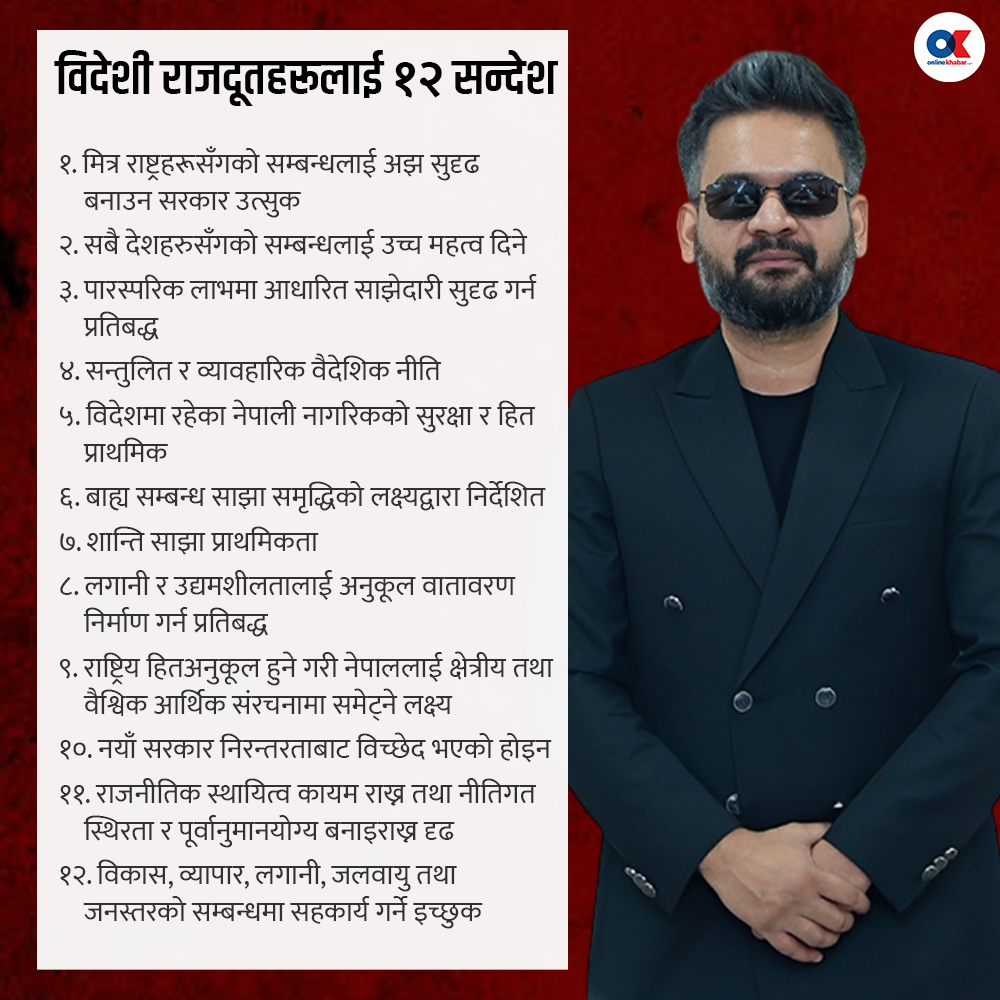
  • The twelve key messages include strengthening ties with friendly countries, prioritizing the safety of Nepali citizens, shared peace objectives, and maintaining political stability.

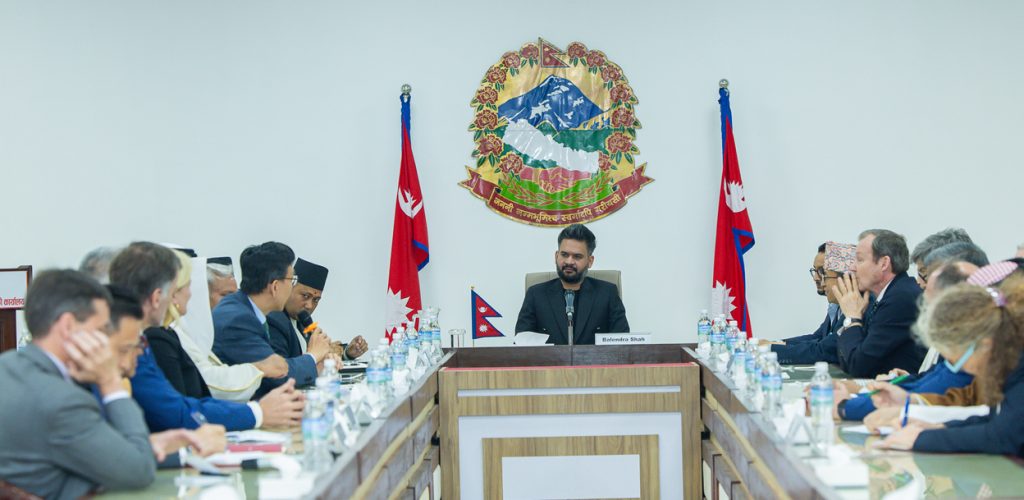
March 27, Kathmandu – Prime Minister Balen Shah briefed foreign ambassadors and heads of diplomatic missions based in Nepal’s capital on the government’s key priorities. Emphasizing a balanced and pragmatic diplomatic approach and prioritizing peace as a shared goal, he clearly laid out twelve major messages.

Following his appointment as prime minister, this marked the first joint briefing PM Shah gave to various country ambassadors and mission chiefs stationed in Nepal.

The briefing, held at the Prime Minister’s Office, provided detailed insights into Nepal’s foreign policy priorities.

Attending the meeting were envoys and diplomatic heads from India, Pakistan, the Republic of Korea, the United Kingdom, Qatar, Switzerland, France, Israel, Japan, Bangladesh, Germany, Egypt, Sri Lanka, Saudi Arabia, China, the United States, and the United Nations.

According to the Prime Minister’s Secretariat, PM Shah reiterated Nepal’s balanced and practical foreign policy approach and expressed a commitment to further deepen relationships with neighboring countries, friendly nations, and development partners based on trust, mutual respect, and shared prosperity.

Nepalis on Visit Visas in Oman Fall Victim to Fraud Schemes

The Nepalese Embassy has reported a rising number of scams targeting Nepalis who have arrived in Oman on visit visas with false promises of job placements. The embassy clarified that individuals entering Oman on a visit visa cannot convert it into a work visa, and overstaying may result in fines. Nepalis planning to travel to Oman are advised not to come on a visit visa for employment purposes and to contact the embassy immediately if they encounter any irregularities or fraudulent activities. – March 8, Kathmandu.

Incidents of Nepalis being defrauded after arriving in Oman on visit visas are increasingly common. According to the embassy, fraudsters are luring individuals by promising job opportunities, often collecting large sums of money upfront with no valid evidence. These scammers assure jobs with attractive salaries and benefits, leading many into deception.

Currently, numerous Nepalis stranded in Oman have contacted the embassy seeking assistance. Most report having paid significant amounts without receiving proof or the promised employment. The embassy has emphasized that arriving on a visit visa does not permit conversion to a work visa. It also warned that overstaying a visit visa complicates rescue operations and incurs a daily fine of 10 Omani Riyals.

The embassy urges Nepalis intending to travel to Oman not to use visit visas for employment purposes and to reach out promptly to the embassy if they face any difficulties or fraud.

Nepal Electricity Authority to Employ Eight More Members of Gen-Z Martyr Families

The Nepal Electricity Authority’s Board of Directors has decided to provide employment to an additional eight members of Gen-Z martyr families. The decision was made during a meeting chaired by Minister of Energy, Water Resources and Irrigation Biraj Bhakta Shrestha, aimed at offering jobs to overlooked members of the martyr families. Previously, the authority had initiated the employment process for 27 members of martyr families. Kathmandu, Chaitra 25.

In Wednesday’s meeting, it was decided to employ Rozit Shrestha from Kathmandu Bansthali, Ambika Bishwakarma from Udaypur, Sumitra Mahat and Shital Paudel from Sindhupalchok, Mausam Kulung from Sankhuwasabha, Parvati Adhikari from Sarlahi, Hemanti Bist from Bajhang, and Manju Paudel from Lamjung. Additionally, Executive Director Hitendra Dev Shakya briefed the board on his performance evaluation.

रवि भन्थे– सिंहदरबार खोलौं, बालेनले गरे थप कडाइ – Online Khabar

Ravi Lamichhane Proposes Opening Singha Durbar to All, Balen Enforces Stricter Entry Rules

Rastriya Swatantra Samajbadi Party (Raswapa) Chairman Ravi Lamichhane proposed opening Singha Durbar to everyone in Jestha 2081 (May-June 2024). However, the government led by Prime Minister Balen Shah has tightened entry regulations, barring access for journalists and legal professionals. Both the Nepal Bar Association and the Federation of Nepali Journalists have expressed opposition to these restrictions and are calling for easier access. (25 Chaitra, Kathmandu)

When he was Home Minister, Ravi Lamichhane had put forward a proposal to open Singha Durbar to all. He stated, “No one should need acquaintance to enter Singha Durbar. The practice of granting passes only to those known or allowing entry only through personal contacts is being ended.” Despite the announcement made in Jestha 2081, the policy has not been implemented and instances of blocking easy access using various excuses have been observed.

On Wednesday, CPN-UML lawmaker Suhang Nembang visited the Office of the Prime Minister and Council of Ministers to voice dissatisfaction with the new entry regulations at Singha Durbar. He demanded the removal of restrictions imposed on legal professionals’ access. On Tuesday, the Administrative Court ordered that legal professionals must obtain permission via a citizen app before entry. Previously, they could enter by presenting identity cards issued by the Nepal Bar Council and Nepal Bar Association.

The Nepal Bar Association issued a statement opposing these measures. In a release by General Secretary Kedar Prasad Koirala, it was stated, “The Bar Association has repeatedly verbally alerted concerned authorities about recent obstructions to legal professionals’ access to the Administrative Court within the Singha Durbar premises, but no action has been taken.” Meanwhile, Federation of Nepali Journalists President Nirmala Sharma criticized the government for denying journalists entry, calling it a violation of the constitutionally guaranteed democratic right and the public’s right to information.

Spokesperson for the Office of the Prime Minister and Council of Ministers, Hemraj Aryal, asserted, “Pass arrangements have been made for entry to the Prime Minister’s Office; this is not a matter of strictness.” Raswapa Co-spokesperson Ramesh Prasain stated there is no policy of denying access or withholding information. The Nepal Bar demands unfettered access to Singha Durbar for legal professionals based on their identity cards.

President Sharma emphasized that Singha Durbar should be open not only to journalists but to all citizens. In 2016 (2073 BS), the National Information Commission directed public bodies within Singha Durbar to facilitate straightforward and easy access to information for citizens, in accordance with the constitution and law.

UML Responds to Constitution Amendment Proposal: Chairman in Custody, Agenda Discussion not Possible

The Communist Party of Nepal (UML) has stated that due to their chairman, KP Sharma Oli, being in police custody, discussions on the constitution amendment agenda could not proceed. At a meeting of the committee formed under the leadership of Asim Shah, Dr. Bhishma Adhikari, a UML central member, expressed that the agenda would only be prepared after the chairman’s release. Adhikari argued that the topic of constitutional amendment cannot be left open-ended; it requires thorough discussions and consensus among all parties. March 25, Kathmandu.

The UML clarified that as their party chairman KP Sharma Oli remains in police custody, discussions on the constitution amendment agenda have stalled. During the committee meeting chaired by Asim Shah—established to prepare proposals for debating constitutional amendments—the UML representative responded accordingly. “Our party chairman has been kept in police custody. As long as he remains detained, no discussions on constitutional amendments are taking place,” said central member Dr. Bhishma Adhikari at the meeting. “Once he is released, we will convene meetings and prepare the agenda; currently, we cannot comment further.”

While indicating that the party will make decisions regarding the concrete agenda for constitutional amendments, Adhikari clarified that they do not oppose the constitution. “The issue of constitution amendment cannot merely be kept open; it must involve discussions with all parties and obtaining consensus,” he stated. He emphasized that any constitutional amendment should proceed only after intensive consultations with provincial and local governments, experts, and stakeholders.

Qatar Welcomes US-Iran Ceasefire, Calls for Halt to Hostilities

The Cabinet of Qatar has welcomed the ceasefire agreement between the United States and Iran, emphasizing the importance of regional stability and the security of maritime routes. US President Donald Trump declared a two-week ceasefire based on a 10-point proposal submitted by Iran. Iran has demanded the lifting of sanctions related to its nuclear program, economic relief, financial compensation, and the withdrawal of US combat forces.

The US-Iran ceasefire, announced early Wednesday morning through mediation by Pakistan, was welcomed by Qatar’s Cabinet. In an official statement, the Cabinet stressed the urgent need to immediately halt all forms of hostile actions and activities that undermine regional stability. It highlighted respect for state sovereignty, and the importance of securing maritime routes, ensuring freedom of navigation, and protecting international trade.

Qatar’s statement came just hours after the ceasefire announcement, while attacks on Bahrain, the United Arab Emirates, and Kuwait continued on Wednesday. President Donald Trump, invoking Iran’s 10-point proposal, declared a two-week ceasefire and temporarily suspended bombing and attack campaigns against Iran.

Iran’s 10-point proposal includes a key condition that Iran maintains uninterrupted control over the Strait of Hormuz—one of the world’s most vital oil export points—without US interference. The most significant aspect of the proposal concerns Iran’s nuclear program, which has long been at the center of disputes between the two nations and the international community. Tehran demands the removal of all sanctions related to its nuclear program and immediate economic relief, citing the severe impact of years-long US sanctions on its economy. Iran also insists that the US pay financial compensation for damages caused during the conflict, that all US combat forces withdraw completely from its region, and that ongoing wars in the Middle East, including Lebanon, come to an end.

March 9, Kathmandu

संविधान संशोधनको बहस, दलहरूले राखे पहिलो बैठकमै अडान

Political Parties Maintain Positions in First Meeting on Constitution Amendment Debate

March 25, Kathmandu – The Constitution Amendment Discussion Committee, formed under the leadership of political advisor Asim Shah by Prime Minister Balendra Shah, has commenced its deliberations. The committee began discussions by summoning representatives from parties represented in the House of Representatives and National Assembly to the Prime Minister’s Office at Singha Durbar.

“Since it was the first day, today’s session was more of an introductory meeting,” said Mohanlal Acharya, leader of the Rashtriya Swatantra Party (RSP), who participated in the meeting on behalf of his party. At this initial meeting, committee coordinator Shah outlined the mandate to prepare the constitution amendment discussion paper within 60 days. “A discussion paper should be prepared within 7 days, followed by consultations leading to completion of the work within 60 days,” he explained.

Following this, detailed information was provided concerning the amendable and non-amendable provisions of the constitution. Legal Secretary Pushkar Sapkota from the Prime Minister’s Office and Secretary Indira Dahal from the Ministry of Law delivered briefings. Subsequently, party representatives shared their respective views.

RSP leader Acharya emphasized that the constitution amendment debate aligns with his party’s manifesto and expressed support for the committee’s work. “The committee should establish necessary subcommittees and consult all stakeholders,” he added.

Dr. Bhishma Adhikari, representing the Communist Party of Nepal (Unified Marxist-Leninist), stated that although there is no disagreement over the proposal to amend the constitution, complications have arisen due to the party’s chairman being held in police custody. “Our party chairman is currently in police custody, so no discussions on constitutional amendments have taken place yet,” he said. “Once he is released, meetings will be held and we will prepare the agenda. For now, I cannot comment further.” He also recommended sufficient dialogue given the complexity of the subject. “The issue of constitutional amendment should not be handled in a closed manner; it requires discussion with all parties and consensus,” he stressed.

Dev Gurung of the Nepal Communist Party affirmed his party’s commitment to support constitutional amendments but highlighted the importance of making them acceptable to all. “He spoke extensively about procedural matters and stated that there is no disagreement on the constitution amendment,” sources from the meeting revealed.

Representatives from the Labour Culture Party, Rashtriya Prajatantra Party (RPP), Janata Samajwadi Party (JSP), Loktantrik Socialist Party (LSP), and Rastriya Janamorcha presented their respective agendas for constitutional amendments. “They submitted agendas that their parties intend to advance during the amendment process,” meeting sources said.

Labour Culture Party lawmaker Dhurvraj Rai called for serious discussions on controlling corruption, developing soil-friendly national policies, and national identity. “Measures to eliminate corruption must be clearly specified,” he insisted. “Attention should be given to formulating soil-appropriate policies.”

RPP’s Gyanendra Shahi raised issues concerning establishing a Hindu state and the monarchy. “He brought up the topics of a Hindu state and monarchy,” according to sources.

Representatives from Madhesi parties recalled their longstanding disagreement with the current constitution. JSP’s Surendra Kumar Jha and LSP’s Abhas Lal expressed opposition to the constitution since its promulgation. Rastriya Janamorcha’s Durga Paudel also raised the issue of abolishing federalism. Paudel’s demand to dissolve provinces received support from RPP’s Shahi. “They agreed that constitutional amendments should be made to abolish the provinces,” meeting participants confirmed.

No representatives from the Nepali Congress attended the discussion. Party leaders explained that delays in selecting representatives caused Congress’s absence at the meeting.

Nepal Securities Board Decides to Deny IPO Approval to Companies Receiving Adverse or Disclaimer Audit Opinions

The Nepal Securities Board has issued regulation 2082 stating that companies receiving adverse or disclaimer opinions from auditors will not be granted permission to conduct Initial Public Offerings (IPOs). The regulation requires appointing audit experts to review financial statements along with due diligence certificates, subject to the Board’s approval. These audit experts must submit their reports within 30 days to the Board, with necessary cooperation provided by the issue manager and the company, as specified in the standards.
Kathmandu, Chaitra 25.

The Board has ruled that companies whose financial statements receive adverse or disclaimer opinions from auditors will be disqualified from issuing ordinary shares through IPOs. This is part of the standards for financial statement reviews submitted for IPOs issued in 2082. According to these standards, if the latest audited financial report of an organized institution applying for an IPO contains an adverse opinion or disclaimer by the auditor, the IPO application is considered ineligible.

Furthermore, the Board has emphasized increased responsibility for issue managers in reviewing and scrutinizing financial statements. When submitting an application for a public issuance to the Board, the issue manager must provide a due diligence certificate, verifying a detailed examination of the company’s financial condition based on prescribed criteria, and submit this certified information to the Board.

When it is determined that financial statements require review or due diligence along with the due diligence certificate from the issue manager, the Board’s approval must be obtained to appoint an audit expert listed with the Nepal Chartered Accountant Institute. The issue manager is required to recommend three audit experts’ names and submit an application to the Board. The Board, according to qualifications, scope of work, and terms of service, will then appoint one of the recommended experts as stipulated in the standards.

The appointed audit expert must personally submit the review or due diligence report to the Board within 30 days from the approval date, as per the regulation. If unable to meet the deadline, the expert must notify the Board in advance, and an extension of up to 10 additional days may be granted for report submission. Expenses related to the audit expert’s fees and other costs are to be borne by the concerned organization. The standards also mandate that the issue manager and the organized institution provide necessary assistance, including documentation, data, and on-site inspections, to the audit expert during the financial statement review or due diligence process.

Six Arrested for Manipulating Online Contract System Records

Six individuals have been arrested for unauthorized access and manipulation of contract details in the government’s online project management system. Those arrested include Divakar Deuja, Bharat Dhami, Sanjay Bhatt, Bhaskar Raj Aryal, Sagar Kutuwal, and Jeevan Kumar Das. A joint team from the Police Headquarters, Cyber Bureau, and Central Investigation Bureau apprehended them and is investigating under the Organized Crime Control Act, 2070 BS. The incident was reported on Chaitra 25 in Kathmandu.

According to the police, the six suspects manipulated data on various project contracts by gaining unauthorized access to the online procurement monitoring office’s system. The arrests were made based on complaints regarding tampering with contract information. The joint task force of the Police Headquarters, Cyber Bureau, and Central Investigation Bureau conducted the arrests and the investigation is ongoing under the Organized Crime Control Act, 2070 BS, as informed by police sources.