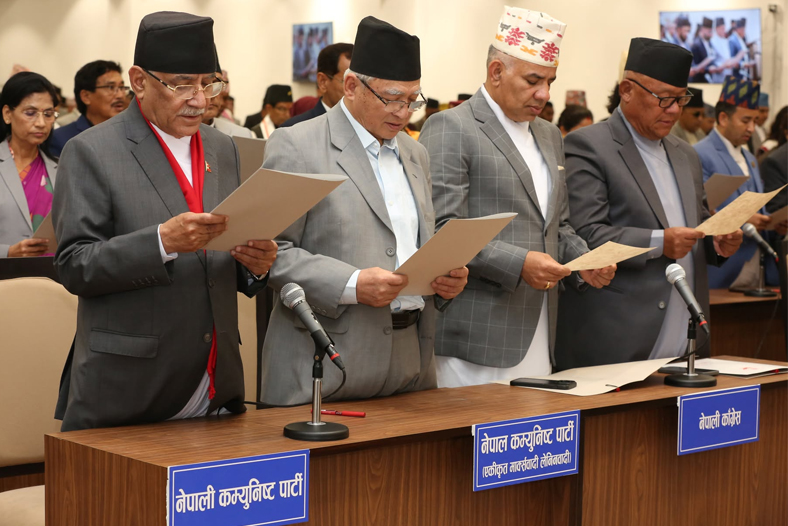
President Ramchandra Paudel, following the recommendation of the Council of Ministers, has decided to conclude the sessions of both houses of the Federal Parliament from midnight of Chaitra 27. This decision was based on the Council of Ministers’ recommendation dated Chaitra 24, according to the President’s Office. The move to conclude the session has been made in accordance with Article 93, Clause 2 of the Constitution of Nepal.
The sessions of both houses of the Federal Parliament will officially end starting tomorrow. Following the Council of Ministers’ recommendation on Chaitra 24, President Paudel has formally closed the sessions. The decision to conclude the session will take effect at 12 midnight on Friday, as confirmed by the President’s Office.
President Paudel is scheduled to address the joint meeting of the Federal Parliament tomorrow. This meeting marks the first session of the Federal Parliament following the recent elections, and it is customary for the President to deliver the opening address.
Prime Minister Balen Shah has decided to take direct responsibility for the vacant Ministry of Labour, Employment and Social Security. This decision follows the removal of Deepak Kumar Sah from his ministerial position and subsequent changes in the Cabinet’s division of portfolios. The President’s Office has been officially informed about this development.
Kathmandu, 26 Chaitra – Prime Minister Balen Shah will temporarily oversee the Ministry of Labour, Employment and Social Security after Deepak Kumar Sah was dismissed from his ministerial post. This resulted in a revised division of duties within the Cabinet, which has been communicated to the President’s Office, prompting the President to formalize the new portfolio allocations.
Prime Minister Shah relieved Deepak Kumar Sah of his duties today, Thursday. The dismissal reportedly came on the recommendation of the Rastriya Swatantra Party (Raswap) chairperson and was based on allegations of breaches of ministerial conduct and violation of position norms.
Madan Bhujel, Secretary of the Ministry of Land Management, Cooperatives, and Poverty Alleviation, emphasized the need for the federal, provincial, and local governments to establish separate funds to reimburse savings lost by cooperative victims. He stated that while a fund has been set up at the central level to start refunding small cooperative savers, provincial and local bodies should similarly create funds from their respective budgets.
Secretary Bhujel pointed out the severity of issues in the cooperative sector, noting that the federal government alone cannot resolve the problem. He clarified, “We have already initiated a fund at the center to refund cooperative savings. If our modality proves effective, provinces and local levels must adopt it as well.” He also shared that the federal government plans to allocate additional funds to this refund mechanism in the upcoming fiscal year’s budget.
Highlighting that procedures have been formulated to distribute refunds to cooperative victims, Secretary Bhujel mentioned that provincial and local governments may develop similar guidelines. Stressing that cooperative challenges are a national concern, he urged for it to be given special priority. During the meeting, Secretary Bhujel also announced that services related to land registry and surveying would be initiated from local levels starting next year.
On only his second week in office, Prime Minister Valendra Shah ‘Balen’ has dismissed a member of his Cabinet.
Prime Minister and the Cabinet Office announced that Minister of Labour, Employment and Social Security Deepak Kumar Sah has been removed from the Council of Ministers. Additionally, Prime Minister Shah has warned Health Minister Nisha Mehta over a controversy regarding appointments to the Health Insurance Board.
Prime Minister Shah’s Press and Research Officer Deepa Dahal stated that Minister Sah was dismissed based on the recommendation of the Rastriya Swatantra Party (Raswapa).
“Prime Minister has dismissed Minister Sah. This decision was made based on Raswapa’s recommendation, which was received today. The party’s Discipline Commission conducted an investigation and advised the party leadership. The party president then recommended this to the Prime Minister, who approved the dismissal,” Dahal explained.
The recommendation letter addressed to the Prime Minister bears the signature of Raswapa President Ravi Lamichhane, proposing the disciplinary action.
The letter states that Minister Sah abused the dignity of his position by engaging a previously inactive member of the Health Insurance Board in regular work, as revealed by the party’s Discipline Commission investigation.
It further states that Sah’s actions have “detrimentally affected the party’s image, ideals, principles, and dignity,” which led to the recommendation for his removal from responsibility.
Efforts to seek a response from Minister Sah were unsuccessful. He was elected from Mahottari-2 in the House of Representatives election held in Falgun.
Prime Minister’s Office Statement
Image Source, Ministry of Labour
Raswapa Chairman Ravi Lamichhane recommended disciplinary action against Minister Sah on Thursday accusing him of misusing his official position.
The Prime Minister’s Office said, “While serving as Labour Minister, Minister Sah abused his office by involving his wife, who was a long-inactive member of the Health Insurance Board, in regular work. Based on this, the party recommended action to the Prime Minister. Such conduct seriously damages the party’s image, ideals, principles, and dignity. Therefore, Raswapa Chairman Lamichhane submitted this recommendation with the commission’s report to the Prime Minister.”
Earlier, on Wednesday, the Raswapa Central Discipline Commission conducted a comprehensive study and submitted a report suggesting that disciplinary action against Sah was necessary.
Raswapa states that under Party Constitution section 25(4)(a), the party president is empowered to ensure that the party’s ideals, principles, and dignity are preserved.
Use of Right to Recall
Image Source, RSS
Image caption, Health Minister Nisha Mehta
Raswapa’s constitution provides the party the right to recall members from their duties in cases of misuse of position. Accordingly, immediate removal of Minister Sah from his responsibilities was recommended.
Similarly, Health and Population Minister Nisha Mehta was cautioned by Prime Minister Shah following Raswapa Chairman Lamichhane’s recommendation that she has not shown the expected level of seriousness in her responsibilities, according to the Prime Minister and Cabinet Office.
“Based on this recommendation, Prime Minister has also issued a warning to Minister Mehta,” the statement said.
Minister Mehta was elected through the proportional representation system.
Neither the dismissed Minister Sah nor the cautioned Minister Mehta have responded to the allegations against them.
News is also available on Nepali YouTube channels. To subscribe and watch the published videos, click here. You can also follow our content on Facebook, Facebook, Instagram and Twitter. Additionally, the Nepali service programs air on radio at 8:45 pm Monday through Friday.
The Nepali Communist Party has decided to support Ruby Kumari Thakur from the Labor Culture Party for the position of Deputy Speaker. Candidates for the Deputy Speaker post include Ruby Kumari Thakur and Saraswati Lama from the Rastriya Prajatantra Party (RPP). With RPP backing Ruby Kumari, her election as Deputy Speaker is assured. Kathmandu, 26 Chaitra.
For the Deputy Speaker post, Ruby Kumari Thakur and Saraswati Lama of the RPP have filed their candidacies. Both nominations were submitted within the designated timeframe from 11 AM to 2 PM. The election for Deputy Speaker will be held tomorrow, Friday. The ruling party RPP has extended its support to Ruby Kumari Thakur of the Labor Culture Party.
A provision exists for the Speaker and Deputy Speaker to be elected from different parties and genders. DP Aryal from RPP has already been elected as Speaker. There are six parties in the House of Representatives, including RPP. Out of the 275 members, RPP holds 182 MPs, Nepali Congress 38, CPN-UML 25, Nepali Communist Party 17, Labor Culture Party 7, and Rastriya Prajatantra Party (RPP) 5 MPs. With RPP’s support, it is certain that Ruby Kumari Thakur of the Labor Culture Party will be elected Deputy Speaker. The decision to support the Labor Culture Party’s candidate was communicated by Nepali Communist Party MP Yubaraj Dulal.
The cuttlefish is a deep-sea creature capable of rapidly changing its color, pattern, and skin texture. Known as a unique and intelligent inhabitant of the ocean depths, the cuttlefish, despite having ‘fish’ in its name, is not a true fish but rather a marine animal closely related to octopuses and squids. Its most remarkable trait is the ability to instantly alter its coloration, pattern, and texture, earning it the nickname ‘the chameleon of the sea.’ With over 100 species found worldwide, cuttlefish typically inhabit warm or temperate coastal waters. Although their lifespan is short, their lifestyle is highly active, intelligent, and intriguing.
One of the most unusual features of the cuttlefish is its three hearts. While most animals have a single heart, the cuttlefish uses three hearts for different functions. This unique circulatory system enables it to remain active underwater continuously, aiding in hunting and rapid escape. Life in the ocean demands constant vigilance, as the cuttlefish must be aware of nearby prey or predators. Its eyes are one of its main strengths; their distinctive shape allows the cuttlefish to perceive its surroundings clearly even in low-light marine environments.
The cuttlefish is also referred to as the marine chameleon because of its incredible ability to change its color and skin texture. It can quickly modify its appearance to resemble sand, rocks, seaweed, or coral formations. Worldwide, there are between 100 and 120 species. Some species measure just 2-3 inches, while the largest, such as the Australian cuttlefish, can exceed half a meter in length and weigh over 10 kilograms. Cuttlefish have eight arms and two long tentacles, primarily used for capturing prey.
Despite being an intelligent and extraordinary creature, the cuttlefish generally has a lifespan of only 1 to 2 years. Though short-lived, every moment of its life is lived at a fast pace. Its movement is graceful and flexible, with fin-like extensions along the body edges that flutter as it swims, giving the appearance of gently gliding through the water. Its most famous defense mechanism is the black ink it releases when threatened, which spreads in the water to confuse predators. Even when color changes are not visible, cuttlefish can perceive light direction, shadows, and subtle variations with remarkable clarity.
Following the February 21 elections, Nepal’s communist parties face ideological vacuum with no clear direction or future plans.
Communist parties have secured 44 seats in the House of Representatives; a united left could potentially become the main opposition.
In the local and provincial elections scheduled for 2084 BS, the left will confront policy pressures and political challenges, necessitating strategic planning.
When anyone is unclear about their direction or purpose, confusion sets in, marking the onset of a void. Nepal’s communist parties find themselves trapped in such ideological emptiness following the February 21 elections. Questions like “Where to go now?” and “What to do?” lack clear answers among communist leaders. They are bewildered, confronting a yawning ‘black hole’ ahead.
The Communist Party of Nepal (Unified Marxist-Leninist), led by KP Sharma Oli, has expressed intentions to mobilize a movement for the release of their detained chairman. However, after the court extended the deadline, the case has become “subject-judiced.” Past experiences, particularly the weakening of judicial ethics after Ravi Lamichhane’s arrest, have shown that such movements only undermine the judiciary’s standing. Earlier, the Rashtriya Swatantra Party (Raswapa) attempted to protest against the court but later withdrew.
Opposing Oli’s arrest is considered “reactionary politics.” It is natural for supporters to defend their chairman. Yet, UML leaders must now clarify their stance and strategies in the new political landscape post-February 21. What is UML’s forthcoming agenda? What will UML undertake over the next five years? What opportunities will it provide its cadres? These questions are crucial for the party’s survival.
Meanwhile, the party led by Pushpa Kamal Dahal (Prachanda) is presently in a weakened state. After unification with Madhav Kumar Nepal’s faction, the “Maoist” name was dropped, but poor election results on February 21 have cast a shadow of disappointment from the top ranks to the grassroots. Activists are disheartened and unemployed; leaders are demoralized. Dissension within, led by figures like CP Gajurel, Janardan Sharma, and Ram Karki, has debilitated Prachanda’s leadership.
Given the dire situation of Oli and Prachanda’s parties, one may wonder about the conditions of smaller communist factions. Groups such as the Revolutionary Party led by Mohan Baidya, Janamorcha headed by Chitra Bahadur KC, the Pralopa faction of Baburam Bhattarai and Janardan Sharma, Narayanman Bijukchhe’s NEMKIPA, Netra Bikram Chand (Biplav) and other fragmented leftist groups each carry their own narratives of struggle.
A Tribe Never United with Its Own
Civilized societies typically maintain cordial personal relations despite ideological differences, but Nepalese communists show the opposite. Even when their ideas align, they fail to unite and often conspire against one another when they do.
Among the communists exists a form of tribalism — the tradition of mutual mistrust. Labeling each other with various accusations is a longstanding issue. Using ideological differences as an excuse, divergent factions established separate groups, a hereditary pattern in Nepal’s communist history.
Distinct groups exist for CP Mainali, Rishi Kattel, Mohan Bikram, and Mohan Baidya. Those who parted ways with Biplav, like Dharmendra Bastola’s group called “CPN Majority,” further fragment the movement. Ghanshyam Bhusal, Ram Karki, and Janardan Sharma lack coordination; Sudhan Kirati belongs to another faction. Baburam Bhattarai also heads his own group, prioritizing the “Populists.” Tensions have escalated between KP Oli and Bidya Devi Bhandari factions within UML, and the relationship between Prachanda and Oli is now more strained. Oli even criticizes Madhav Kumar Nepal merely by name. Jhulanath Khanal’s stance differs as well.
This communist leadership, draping conflicting views like twin garments, can neither unite nor move forward independently. Their predicament resembles the poetic image of a frog half-swallowed by a snake, yet enjoying the day by catching flies.
The fundamental psychological question remains: why have communists been unable or unwilling to unite and serve the people collectively? This question is challenging to resolve. Nepal’s communist leaders bear a future laden with discord. Even where ideas and practices align, personal relationships deteriorate, marked by insults and hostility.
Ideological Vacuum and Cultural Deviation
Regardless of the party name—UML, Maoist, or others—the common issue confronting Nepal’s communist parties today is ideological emptiness. They are seriously confused and vacant on the question of future directions.
UML leaders still harbor egos and animosities. Madan Bhandari’s principles remain nominal, while feudalistic and Stalinist practices persist in behavior. Maoist leaders, alienated from the masses, have weakened their parties.
Party leaders live lifestyles marked by corruption and brokerage. Nepotism, factionalism, and favoritism plague the parties. Accusations of involvement in violence against women have increased. A culture of punishing critics has emerged. Leaders colluding with intermediaries risk jail time.
In summary, Nepal’s communist leaders have grown corrupt not only in words but also in conduct. They lack solid ideology, appropriate behavior, or coherent plans—mere emptiness prevails.
Historically, leftist leaders contributed significantly to the nation. Yet, history alone doesn’t propel progress. Without answers to “What next?” winning public trust is impossible by mere historical narration.
So, What Next?
Looking ahead, here are brief recommendations for Nepal’s leftist forces:
First— The Balen government is investigating the assets of post-2046 leaders, aiming to punish corrupt brokers. Leftist parties must cooperate in this effort. They should remain vigilant against attempts to shield Raswapa affiliates or to practice selective prosecution.
Corrupt communist leaders and cadres must be removed from parties—like skimming flies from milk. Those implicated in polygamy or violence against women should not be protected. The left should align as partners in governance reform campaigns and stand for justice.
Second— The left must consolidate and advance united. UML, Maoists, and other parties should merge into a single “Socialist Party” (SOPA). The communist label is unnecessary. Second-tier leaders must prepare internally and announce SOPA and a five-year plan within three months.
Third— Parties cannot be maintained by elder leaders indefinitely. A “Senior Communist Advisory Council” should be created for veteran leaders such as Oli, Bidya, Prachanda, Madhav, Jhala Nath, Mohan Bikram, Chitra Bahadur, CP, and Bamdev. They should step away from active politics and live personal lives. Those who refuse should be gently encouraged to retire. This task falls to second-tier leaders.
Fourth— Many second-generation communist leaders are irrelevant; the new generation must emerge. Elders should be honored with institutional roles while the youth engage directly with citizens. The second generation should actively facilitate this transition and withdraw from politics.
Fifth— Nepal has many communist leaders but lacks policies and programs. Without clarity on grassroots activities, efforts will flounder. SOPA must prepare clear policy agendas and action plans similar to the Balen government’s 100-point plans. Progress isn’t possible without a work plan.
Sixth— The leftist agenda must center on village issues. They should launch campaigns addressing rising social problems like alcohol abuse, gambling, and the increased burdens on women. The left’s role here is crucial.
Seventh— Raswapa represents an anti-communist force and opposition party. Its government likely serves the wealthy, suppresses critics, and applies city-centered policies.
Therefore, the left must champion village concerns and marginalized, oppressed groups—farmers, laborers, and minorities. Mere criticism on social media or political circles around Singha Durbar won’t suffice. Only by forming a new, united left can revival be achieved; otherwise, the leftist movement will end alongside figures like Oli and Prachanda.
Though communists in Nepal have been discredited, the justification for leftism remains. As long as exploitation and discrimination persist, the left’s existence continues. Internationally too, such as in the US, protests against leaders like Trump show ongoing leftist relevance.
Attention must also be given to leftist status in parliamentary fronts, federal parliament, provincial assemblies, and local levels.
Potential for Leftist Main Opposition in the House of Representatives
Leaders Prachanda (CPN) and Badal (UML) in Parliament (from left first and second).
In the House of Representatives elections, Raswapa secured nearly a two-thirds majority (182 seats) and formed the government for five years. The Nepali Congress became the second largest party and main opposition.
UML won 25 seats, while Prachanda’s CPN secured 17 seats. There are only six parties in Parliament: the Labour Culture Party holds 7 seats, Rastriya Prajatantra Party (RPP) has 5 seats, and independent Mahavir Pun won one seat. Combined, the communist parties have 42 seats.
If UML and CPN unite, the left could select the Leader of the Opposition, gaining membership in the Constitutional Council and influencing constitutional appointments. Otherwise, the left will remain marginalized.
As main opposition, the left could pose strong warnings to the government and be seen by the public as the principal opposition group. Congress would remain the third force. Even if unable to run the government, the left’s opposition role would be significant. Remaining the second largest power would maintain their relevance for five years.
Opportunity to Become the Largest Party in the National Assembly
The National Assembly consists of 24 members from Congress, 11 from UML (including nominated members), and 17 from Prachanda’s CPN. Other parties have smaller numbers. Raswapa may nominate one member soon.
With a total of 59 seats, 30 are required for a majority. UML, CPN, and Janamorcha together have 29 seats; if supporting JASPA’s two members, the left can form a majority.
Conversely, if UML and Congress form an alliance in the National Assembly, they would reach 35 seats. Whether the left aligns or competes with Congress on key issues remains to be seen. At least for the next two years, the left is expected to have significant presence in the National Assembly.
However, it currently seems unlikely that UML and CPN leaders will capitalize on the chance to be opposition leader in the House and largest party in the National Assembly.
Mission 2084: The Next Challenge
Local and provincial elections are slated for 2084 BS. The left’s presence will continue until then. However, the federal government is showing signs of increasing policy pressure and interference at provincial and local levels.
For example, the government has banned advertisements at the local level. Policy interventions from Singha Durbar (the administrative center) are expected to increase.
The political pressure from Raswapa’s popularity in the House elections will confront leftist and Congress parties in the upcoming elections.
Raswapa plans to conduct independent local elections and has proposed banning political party-affiliated organizations. If local elections are independent, parties’ influence will be confined to provincial and central levels.
Raswapa also intends to amend the provincial assembly structure, allowing direct election of Chief Ministers and automatic membership for heads, potentially eliminating the election of 550 provincial members. This would leave many leaders without positions.
How will the left survive policy pressure from Raswapa-led governments and ruling parties at provincial and local levels? What is the Mission 2084 strategy? Leaders like Oli, Prachanda, and others have little time to contemplate; their disputes and personal attacks on figures like Balen and Ravi have fragmented the communists.
In conclusion, a prayer: May God grant wisdom to Nepal’s communists!
The ITF Asia U-12 Tennis Tournament will be held in Nepal from Chaitra 30 to Baishakh 4 at the Tennis Complex in Satdobato. A total of 33 players from six South Asian countries, excluding Bangladesh, will compete in two singles and one doubles events. The top two teams in both categories will qualify to participate in the Asian finals scheduled in Singapore from September 15 to 20, 2026.
On Chaitra 26 in Kathmandu, Manohar Das Mul, President of the Nepal Tennis Association, announced that 33 players will take part in the competition. The two teams finishing first and second in each category will advance to the Asian final tournament to be held in Singapore in September 2026.
Tournament Director Ajay Bisht shared that Nepal will be represented by Aarit Mall, Sabhya Jung Karki, and Sahansh Basnet in the boys’ category, while Sara Pant, Arya Paudel, and Naira C. Ghale will represent Nepal in the girls’ category. Surya Bhushan Bajracharya will serve as coach for the boys’ team, and Kancha Khadge will coach the girls’ team.
This will be the fifth time Nepal is hosting the tournament. Previously, Nepal hosted this event in 2017, 2018, 2022, and 2024.
Chandra Prasad Dhakal, President of the Nepal Chamber of Commerce and Industry (FNCCI), has stated that his three-year tenure achieved success in resolving economic crises and creating an investment-friendly environment. Under the Chamber’s initiative, a national economic debate was organized, and a high-level Economic Reform Recommendation Commission was established. The private sector has been officially declared a zone of peace. The Chamber also drafted bilateral investment agreements and held investment conferences with various countries, alongside amending its constitution for institutional transformation. – March 26, Kathmandu.
President Dhakal acknowledged that the country’s economy was in an extremely challenging state when he took office. Despite adverse conditions caused by the COVID-19 pandemic, international conflicts, high interest rates, liquidity shortages, investment disappointments, and frequent government changes generating policy uncertainty, his leadership succeeded in maintaining private sector morale, sustaining economic activities, and fostering an investment-friendly environment.
During an event in the capital, he outlined successes over the three years, including resolving economic crisis issues, fostering domestic and foreign investment environments, strengthening public-private partnerships, producing skilled manpower, creating employment, and advancing businesspeople’s respect and security. He highlighted that the FNCCI’s initiative led to the national economic debate, the formation of the high-level Economic Reform Recommendation Commission, the declaration of the private sector as a peace zone, and recent government approval of a strategy for private sector protection and promotion.
Furthermore, drafts of bilateral investment agreements (BIAs) have been prepared and advanced with multiple countries. The culture of conflict between the state and private sector has shifted towards cooperation and partnership. The Chamber mediated in disputes over dedicated feeder and trunk line fees and established Nepal Development Public Limited with capital of 1 billion Nepalese rupees. Investment conferences have also been held with countries including India, China, UAE, Qatar, and the UK.
President Dhakal emphasized: “The Chamber has achieved new heights in policy reform and intervention. Moving beyond the traditional role of just advocating demands, we have actively participated in policymaking processes. Organizing the national economic debate brought government, political parties, regulatory bodies, and the private sector onto a single platform. As a result, the high-level Economic Reform Recommendation Commission was created, which proposed reforms to more than 30 laws and laid the foundation for improving the investment climate. Industries, trades, businesses, and factories of the private sector have also been declared as peace zones.”
Regarding institutional transformation, he noted that the Chamber’s constitution was unanimously amended to make leadership selection more inclusive, transparent, and competitive. Additionally, for the first time, research on the private sector’s contributions was conducted and reported.
Ruby Kumari Thakur, a 25-year-old member of the Labor Culture Party, has been nominated for the position of Deputy Speaker of the House of Representatives. The ruling party, Rastriya Swatantra Samajbadi Party (RSWP), has decided to support her candidacy. This information was confirmed by RSWP General Secretary Kavindra Burlakoti on March 26 in Kathmandu.
RSWP General Secretary Kavindra Burlakoti stated, “RSWP has resolved to support the Labor Culture Party’s candidate for the Deputy Speaker position. According to the current public expectation, emerging parties need to unite. This decision was made from the perspective that it is necessary to align with public sentiment.”
RSWP has also expressed support for Member of Parliament Ashok Kumar Chaudhary for the Deputy Speaker role. Another candidate for the Deputy Speaker position comes from the Rastriya Prajatantra Party (RPP). The RPP has fielded Saraswati Lama as their candidate, who was proposed by party leader Gyanendra Shahi. Additionally, Tahir Ali, Khushbu Oli, and Bharat Giri have also endorsed her candidacy.
Ruby Kumari Thakur of the Labour Culture Party has officially registered her candidacy for the position of Deputy Speaker. Saraswati Lama from the Rastriya Prajatantra Party has also filed her nomination for this post. The registration for Deputy Speaker candidacy was scheduled from 11 AM to 2 PM today. In Kathmandu, nominations for the Deputy Speaker position have been submitted, including from the Labour Culture Party. Ruby Kumari Thakur is a 25-year-old young woman who secured her parliamentary seat through proportional representation technology. According to the prescribed deadline, both she and Saraswati Lama completed their registration by 2 PM today.
Three prominent YouTube creators have filed a copyright infringement lawsuit against Apple in a California court. According to their allegations, Apple unlawfully used millions of YouTube video contents to train its artificial intelligence (AI) tools, violating YouTube’s security systems. The creators involved — Ted Entertainment, Matt Fischer, and Gulfholic — accuse Apple of breaching copyright laws.
They claim that Apple illegally utilized YouTube video material to train its generative AI model. The creators assert that Apple bypassed YouTube’s technical protection measures (TPM), gaining unauthorized access to over 3 million video clips through a dataset named “Panda-70M.” They are seeking the court’s intervention to halt this unauthorized use of YouTube content and seek damages.
Apple is also accused of circumventing YouTube’s security protocols such as CAPTCHAs and rate limits by employing automated tools to collect extensive data. Furthermore, it is alleged that Apple manipulated IP addresses and forged legitimate requests to extract data, actions which constitute violations of the Digital Millennium Copyright Act (DMCA) based in the United States. At the heart of the case lies the Panda-70M dataset, which references approximately 3 million YouTube videos.
The creators emphasize that once YouTube content is incorporated into AI models, it cannot be withdrawn, raising serious concerns over loss of control of creators’ intellectual property. They are therefore requesting the court to block Apple’s AI products developed using YouTube content and to award appropriate compensation for the unauthorized use of their materials.
The Nepal Gold and Silver Business Federation announced on Thursday that the price of gold is set at NPR 294,700 per tola. This reflects a decrease of NPR 4,300 compared to the previous day. Similarly, the price of silver fell by NPR 150 to NPR 4,875 per tola. (26 Chaitra, Kathmandu)
On Thursday, the price of gold dropped by NPR 4,300 per tola. The Nepal Gold and Silver Business Federation fixed the gold price at NPR 294,700 per tola for the day. The previous day, gold was traded at NPR 299,000 per tola. Over the past week, the overall gold price has increased by NPR 700. Last Thursday, gold was traded at NPR 294,000 per tola.
Today, the price of silver also declined. Compared to the previous day, silver fell by NPR 150 per tola. Yesterday, silver was traded at NPR 5,025 per tola, while today it dropped to NPR 4,875 per tola. Last Thursday, silver was traded at NPR 4,780 per tola.
The four-kilometer road from Kathekhola Municipality center to Resh has finally been blacktopped after five years. The road project was a joint effort between the federal government and the municipality, but delays led the municipality to invest four crore rupees to complete the work. Following the blacktopping, travel to Resh has become much more convenient, reducing the commute time from the municipality center to just 15 minutes.
Baglung, 26 Chaitra — The long-neglected road from the center of Kathekhola Municipality to Resh, Baglung, has now been blacktopped. Initially planned to be completed within two years, the project took five years to finish. This is the first lengthy blacktopped road within the municipality.
The project was initially contracted to be completed at a cost of 6.71 crore rupees, covering four kilometers from Ward No. 7 of Kathekhola Municipality to Resh. However, due to delays, the deadline was extended six times. Currently, construction workers are actively engaged in the blacktopping process, according to Rajju Thapa, the chairperson of Kathekhola Municipality.
Since the federal government’s involvement and the contracted company faced delays, the municipality assumed responsibility and invested four crore rupees to complete the road construction. Chairperson Thapa revealed this project has the highest cost of blacktopping undertaken by the municipality to date. Previously, during rainy and winter seasons, residents faced significant difficulties traveling on the muddy and dusty road. Now, after blacktopping, local residents of Resh experience much easier travel, with commute time from the municipality center to Resh brought down to just 15 minutes.
The Nirmala Foundation is organizing ‘Amputee Runway Nepal 2026’ on Baishakh 28 at Club Platinum, Darbarmarg. This event offers individuals who use prosthetic limbs a chance to showcase their talent, resilience, and determination. The theme for this year is ‘From Sidelines to Spotlight,’ reflecting a focus on confidence, capability, and identity, positioning the event as an empowering platform.
The program will commence at 6:30 PM on Saturday. According to the organizers, participants will undergo two weeks of training that includes grooming and personality development sessions. The event will also provide information on the care and management of prosthetic limbs. This initiative aims to raise awareness, coinciding with April being observed globally as Limb Loss Awareness Month.
Men, women, and other participants from diverse professions and backgrounds will take to the runway. Organizers emphasize that beauty is not limited to a flawless body but is grounded in confidence, struggle, and personal identity. Participants will wear designer attire while presenting their prosthetics not as a weakness but as a symbol of strength and individuality. The Nirmala Foundation views this event as a campaign to promote equal rights, self-confidence, and inspiration.