Author: space4knews

Nepal Election 2082: What Role Will the Shrinking Opposition Play in the New Parliament?

(From left) Nepali Congress Chair Gagan Thapa, CPN-UML Chairman KP Sharma Oli, and CPN Coordinator Pushpa Kamal Dahal 'Prachanda'

Image source, Reuters/BBC

Image caption, Leaders of the second and third largest parties will not be seen in this term’s parliament

Questions are emerging on how strong the opposition parties can be in the newly elected parliament where the ruling party holds almost a two-thirds majority.

The Rastriya Swatantra Party (RSP) alone has secured a dominant position in the 182-member House of Representatives, followed by the main opposition Nepali Congress with only 38 seats, CPN-UML with 25, Nepali Communist Party with 17, Labour Culture Party with 7, Rastriya Prajatantra Party (RPP) with 4, and one independent member.

In a democracy, the role of the opposition is as crucial as that of the ruling side. Analysts have noted that the composition of the new parliament raises many questions in this regard.

What Do Opposition Parties Say?

Arjunanarsingh KC, a proportional representation MP from Nepali Congress, believes their party has a defined role as the main opposition.

“We will fully support every government step aimed at rule of law, corruption-free society, and good governance. We will be a constructive partner. Respecting the people’s mandate is our political duty, culture, and democratic ideal,” KC said.

वर्षाका कारण दाउन्ने सडकखण्ड पूर्ण रुपमा अवरुद्ध – Online Khabar

Heavy Rainfall Completely Blocks Daunne Road Section in East Nawalparasi

March 20, East Nawalparasi – The Daunne road section in East Nawalparasi has been completely blocked due to heavy rainfall.

The road, under repair near 64 Modi at Daunne Bazaar, Ward No. 2 of Binayi Triveni Rural Municipality, became muddy and slippery from the rainfall, causing the highway to be obstructed.

Since Friday, traffic movement on the Daunne section has been affected. According to Deputy Superintendent of Police Yubaraj Khadka from East Nawalparasi District Police Office, the highway in both directions has been blocked from early morning due to continuous rainfall.

Nighttime Ban on Heavy Cargo Vehicles Imposed

A ban has been imposed on operating heavy cargo vehicles at night along the Narayanghat–Butwal road section.

According to a notice from the Narayanghat-Butwal Road Project Office, from Friday until March 22, heavy cargo vehicles will be prohibited from operating between 7 PM and 5 AM on the Dumkibas-Daunne-Bardaghat stretch.

The office has arranged for the heavy cargo vehicles to halt at Triveni Chowk and Dumkibas Bazaar areas heading towards Bardaghat.

Passenger vehicles and emergency service vehicles will be allowed to operate based on priority.

This decision was made because the ongoing road widening and repair work on the Daunne road section has resulted in slippery roads and blockage of heavy cargo vehicles during the rains, the road project office stated.

Following the blockage of the Daunne road section, vehicles coming from the west were diverted towards the Siddhartha Highway. However, today that highway was also blocked in Siddhababa area due to a landslide.

Iran Prepares to Allow Japanese Ships to Transit Through the Hormuz Strait

Iranian Foreign Minister Abbas Araghchi.


March 21, Kathmandu – Iranian Foreign Minister Abbas Araghchi stated that Iran is preparing to allow ships affiliated with Japan to pass through the Strait of Hormuz.

In an interview with Japanese news agency Kyodo News, Araghchi expressed Iran’s readiness to permit Japanese-related vessels to transit the Hormuz Strait.

According to Kyodo News, Araghchi also revealed that dialogue with the Japanese side has already started to temporarily lift certain sanctions.

Following Araghchi’s comments, a Japanese government official told Kyodo News that “The most effective way to lift sanctions is to engage in direct dialogue with the Iranian side.”

The official additionally emphasized the need for extreme caution to avoid provocation from the United States.

‘We Rescued People Crushed Under the Helicopter by Lifting It’

7 Chaitra, Khotang – Manlakshmi, wife of Bhupu UK Gurkha Dakmani Rai, passed away in the UK on Falgun 7. Following a family agreement to conduct the funeral in their native village, Dakmani was returning to the village with his children and relatives.

News spread that brothers, neighbors, and close relatives were arriving by helicopter for the funeral. Dakmani’s village is Balabesi of Khotang’s Kepilasgadhi Rural Municipality–2, Khartamcha. On Chaitra 4, Dakmani was preparing to land by helicopter near his home along with his children.

The landing site was a field near Dakmani’s house, marked with a white English letter ‘H’ on the ground. By around 12 noon, the sound of the helicopter was heard. Relatives and neighbors gathered around the landing site.

The approaching helicopter, operated by Air Dynasties, stirred dust with its rotor blades, prompting some locals to step back, while others covered their faces and started recording videos and photos on their phones.

As the helicopter was settling onto the field, it abruptly tilted its tail upwards and took off again, crashing onto the higher ground instead of the intended lower field. It was initially landed beside the field’s edge but overturned when moved closer to the wall, according to eyewitness Prakash Rai.

The pilot was Savin Thapa from Bamrang, Diktel Rupakot Majhuwagadhi Municipality–3 in Khotang. Passengers included Dakmani, his son Balkumar Rai, daughter Laxmi Rai, relative Samla Rai, and Pastor Kajibahadur Rai.

Despite the severity of the accident, all passengers except Pastor Kajibahadur escaped unharmed. Kajibahadur was rescued after being pinned under the helicopter wreckage.

Kepilasgadhi Ward Chairperson Milan Rai stated that since the helicopter did not catch fire, the pilot and all passengers survived. The pilot turned off the engine immediately after the incident, preventing a fire.

The plan was to transport Manlakshmi’s body to the village by helicopter; however, the coffin could not fit inside. Arrangements were made to bring the coffin via ambulance while the family traveled by helicopter.

The accident occurred at 11:51 am. Locals were stunned witnesses to the unexpected crash. The helicopter’s rotor blades struck a Patmero tree, breaking in the process. Subsequently, the helicopter overturned and came to rest upside down.

Relatives waiting for Dakmani’s family scattered in shock. Crying and shouting ensued at the scene. Pilot Thapa, Dakmani, his son Balkumar, daughter Laxmi, and relative Samla Rai unfastened their seatbelts and exited the helicopter with ease.

Fifteen to twenty people lifted the damaged helicopter to pull out Pastor Kajibahadur, who was trapped and screaming. “We were fainted at that moment. The helicopter risked exploding, but we lifted it to save the person,” Rai said. “Smoke was coming from the silencer section; the pilot had shut down the engine, so no fire broke out.” The helicopter is currently covered with a tarpaulin.

Eyewitnesses stated that the helicopter initially landed on the lower field but the accident occurred while attempting to move it to the marked ‘H’ landing spot.

Pastor Rai and pilot Thapa, injured in the crash, were immediately flown to Kathmandu by another helicopter. Dakmani’s family has since conducted the funeral of the deceased Manlakshmi.

How Passenger Flights Are Managed During Wartime

Air Traffic Control Room

Photo credit, Getty Images

In the past 15 days, drones have been active in Iran and the Gulf airspace, prompting air traffic controllers to guide passenger planes safely through narrow and secure air corridors away from conflict zones.

Flight tracker maps clearly reveal how busy the skies over Egypt and Georgia have become.

Air traffic controllers monitor different sections of these maps to identify which aircraft are adhering to their assigned routes and which have deviated.

Under normal conditions, one controller can manage six aircraft simultaneously; however, during wartime, the number of planes requiring attention can double.

“Our brains can sustain this level of intense focus only for about 20 to 30 minutes,” explains retired air traffic controller Brian Roth.

India’s Oldest News Agency UNI’s Office Sealed by Authorities


March 20, Kathmandu – The office of United News of India (UNI), India’s oldest news agency located in New Delhi, has been sealed. According to reports from PTI, Delhi Police sealed the office on Friday following an order from the High Court.

A senior UNI employee told PTI, “In the evening, officials from the Central Government’s property department arrived. They informed us that our lease has expired and demanded we vacate the premises immediately. They forcibly entered our newsroom and dragged us out.”

UNI announced the sealing of its office via the social media platform X. Numerous videos shared on social media show a large number of security personnel present inside the UNI compound. In the videos, the security forces can be heard urging journalists and staff to vacate the premises.

In a post on X, UNI expressed grave concern over press freedom, stating, “The sealing of United News of India, one of the country’s oldest and most respected news agencies, has raised serious alarms about freedom of the press.”

UNI has accused authorities of forcibly evicting its staff without allowing them to take personal belongings and reported that employees faced mistreatment during the clearance process.

The agency also shared a video showing a heavy presence of security forces, with employees describing being pushed and shoved during the eviction.

The English daily ‘The Statesman’ posted on X, describing the event as “an unprecedented assault and crackdown on media freedom in India.” The report highlights that the police raided the UNI office on Rafi Marg without even providing staff adequate time to pack their belongings or make arrangements.

Premonsoon Rain and Snowfall Cause Road Disruptions: ‘Travel with Caution Until Sunday’

Daunne Section
Photo Caption, Rain has caused slippery conditions leading to disruptions on the Daunne section of the Mahendra Highway

Reading time: 3 minutes

Officials have reported significant disruptions on major road sections across the country since Friday due to the seasonal weather system bringing rainfall to many areas.

According to a midday Saturday update from the National Disaster Risk Reduction and Management Authority, snowfall has caused blockages on the Rukum East to Baglung section of the Mid-Hill Highway, while slippery roads due to rain have completely blocked both directions on the Daunne section of the Mahendra Highway.

The Authority’s spokesperson, Shanti Mahat, reported that although the Kantipath and BP Highway, which were blocked due to Friday’s rainfall, have reopened, the ongoing rain means travelers should exercise caution and verify travel conditions carefully until Sunday.

Police and reporters note that other major and minor roads also face blockages, with clearance operations underway, resulting in some sections remaining fully or partially closed.

Meteorologists say the combined effect of the western low-pressure system and local weather patterns, which have been active since Saturday night, might weaken somewhat, but rainfall is expected to continue until Sunday.

लागुऔषधसहित एक भारतीयसहित पाँच जना पक्राउ – Online Khabar

Five Individuals Including an Indian National Arrested with Illegal Drugs


March 20, Kathmandu – The Narcotics Control Bureau of the Nepal Police has arrested five individuals in connection with several cases involving brown heroin and cannabis. According to the bureau, these arrests were made across two separate incidents.

Durga Raj Regmi, spokesperson for the bureau, stated that in the first case, following information that drugs were being sold to students in schools and colleges in Kathmandu, a woman was apprehended in Lalitpur.

The arrested individual is Kalpana Tamang, a 38-year-old woman originally from Thaha Municipality-11 in Makwanpur district. Authorities confiscated 2 kilograms and 300 grams of cannabis and a digital scale from her possession, according to the bureau.

In another incident, after receiving intelligence about the smuggling and sale of brown heroin brought from India in Kathmandu, a task force arrested three men from Factory Chowk, Kathmandu Metropolitan City-15. The arrested individuals are 31-year-old Vishal Shrestha from Sindhupalchok Sunkoshi-5, 39-year-old Arjun Thapa from Chautara-7, and 30-year-old Sagar Tamang from Kavre Temal-8. The police recovered 37 grams and 400 milligrams of brown heroin and a digital scale from them.

Further investigation linked these suspects to Vipul Barma, a 25-year-old from Forbesganj, Araria, Bihar, India, who was arrested by the bureau for supplying the brown heroin. Authorities seized 100 grams of brown heroin from his possession.

Two Indian Citizens Killed in Bus Collision at Bhotebahal


March 20, Kathmandu. Two Indian nationals lost their lives after being hit by a bus in the Bhotebahal area of Kathmandu.

The victims, 45-year-old Padam Upadhyay and 37-year-old Satishkumar Kuswaha, were struck by an Om Janata Transport bus traveling from Kalimati towards Tripureshwor in Kathmandu Metropolitan City Ward No. 12, Bhotebahal, according to Nareshraj Subedi, spokesperson and Superintendent of the Valley Traffic Police Office.

The bus, bearing the registration number Bagmati Province 3-01-005 Kh 9298, severely injured the victims, who were rushed to the National Trauma Center Friday night for treatment. Both succumbed to their injuries during the course of treatment, Superintendent Subedi confirmed.

The bus driver, 35-year-old Man Bahadur Basnet, originally from Dolakha and residing in Kapan, has been taken into police custody. The police station at Kalimati is currently investigating the incident, the spokesperson added.

-RASAS

Iranian Attacks Cause Nearly $80 Million in Damage to US Military Bases: Analysis

Damage at Al Saddar and Al Ruwais radar sites in UAE

Image source, Planet labs PBC and Airbus

Image caption, Damage at Al Saddar and Al Ruwais radar sites in UAE

A new analysis shows that Iranian attacks on US military bases in the Middle East have caused approximately $80 million (equivalent to over ten billion Nepali rupees) in damage during the first two weeks of the conflict.

The substantial damage occurred during a week of Iranian retaliation following strikes by Israel and the United States, according to a report and analysis by the Center for Strategic and International Studies (CSIS).

Full details of the damage inflicted by Iran on US facilities in the region have yet to be fully clarified.

Damage Exceeds Previous Estimates

The estimated damage to American military infrastructure, approximately $80 million, is higher than previously understood, indicating a more costly toll for the US in this ongoing war.

“The assessment of damage to US bases in the region has been underestimated,” said Mark Cancian, senior adviser and co-author of the CSIS study.

प्रतिनिधिसभामा राई, लिम्बूको प्रतिनिधित्व ४.३६ प्रतिशत

Rai and Limbu Communities Represented at 4.36% in the House of Representatives

News Summary

  • The representation of the Rai and Limbu communities in the House of Representatives stands at 4.36%.
  • Eight candidates were elected directly and four through proportional representation from the Rai and Limbu communities.
  • Ravi Lamichhane, chairman of Rastriya Swatantra Party, apologized for the lack of Rai and Limbu representation in the House of Representatives from his party.

March 19 (Chaitra 6), Kathmandu: The Rai and Limbu communities hold 4.36% representation in the House of Representatives.

In the elections held on February 21 (Falgun 21), eight candidates from the Rai and Limbu communities were elected directly, and four were elected through proportional representation. In the 275-member House, this constitutes 4.36% of the total seats.

Directly elected candidates from the Nepali Congress include Narendra Kumar Kerung and Nishkal Rai, while from the Communist Party of Nepal (Unified Marxist-Leninist), Suhang Nembang, Rajendra Kumar Rai, and Kshitij Thebe secured seats.

From the Labour Culture Party, Harkraj Rai, Dhruvraj Rai, and Aron Rai were elected directly.

Through proportional representation, Congress candidates Bhishmaraj Andembe and Geeta Kumari Sendang were elected.

From the UML, Bhumikha Limbu Subba and from the Labour Culture Party, Purnaprasad Limbu were elected through proportional representation.

Out of the 275 members, 165 are elected directly and 110 through proportional representation.

Following the February 21 election, six political parties were recognized as national parties. The Rastriya Swatantra Party (Raswapa) emerged as the largest party with 182 seats. The Nepali Congress is second with 38 seats, followed by the CPN-UML with 25 seats and the Nepal Communist Party with 17 seats sharing the third position.

The newly established Labour Culture Party secured seven seats, ranking as the fifth largest party, while the Rastriya Prajatantra Party (RPR) holds six seats as the sixth party. There is also one independent candidate.

Ravi Lamichhane Apologizes for Lack of Rai and Limbu Representation in Raswapa

Despite being the largest party, Rastriya Swatantra Party does not have any representatives from the Rai and Limbu communities. On this matter, Raswapa chairman Ravi Lamichhane has issued an apology.

While addressing the newly elected members at the party orientation program, Chairman Lamichhane expressed regret that Raswapa could not secure representation from the Rai and Limbu communities in this House of Representatives.

“I express my deepest apologies, as our party was unable to secure representation for the Rai and Limbu communities in this parliamentary term,” Lamichhane stated. “As chairman, I apologize and assure that moving forward, I will prioritize inclusion efforts as an essential component of our agenda.”

United States Initiates Release of Crude Oil from Strategic Petroleum Reserve

News Summary

Generated by AI. Editorially reviewed.

  • The United States has allocated 42.5 million barrels of crude oil from its Strategic Petroleum Reserve to various companies in the first phase.
  • The U.S. Department of Energy has commenced the initial phase of releasing 42.5 million barrels of crude oil, with deliveries starting last Friday.
  • According to the Department of Energy, companies receiving the oil in this initial phase are expected to return a total of 55 million barrels later to replenish the reserve.

Agency – The United States has allocated 42.5 million barrels of crude oil from its Strategic Petroleum Reserve to companies in the first phase of release.

According to a statement published on the U.S. Department of Energy website, this initial distribution is part of a planned total release of 172 million barrels of crude oil.

The statement confirmed that the U.S. has begun the first phase process of releasing 42.5 million barrels from its Strategic Reserve.

This supply started last Friday.

The Department of Energy has indicated that companies receiving oil under this first phase are expected to return a total of 55 million barrels later to replenish the reserve.

Earlier on March 12, the Department of Energy announced that the U.S. administration plans to release a total of 172 million barrels of crude oil from the national Strategic Petroleum Reserve over 120 days.

Japan Claims Women’s Asian Cup Football Title by Defeating Australia

News Summary

Including editorial review.

  • Japan secured its third Women’s Asian Cup football title in 2026 by defeating host Australia 1–0 in the final.
  • Maika Hamano scored the decisive goal in the first half from approximately 18 meters out.
  • Japan won its first title under new coach Nils Nielsen, while Australia lost to Japan in the final for the third time.

March 20, Kathmandu – Japan has successfully claimed the 2026 Women’s Asian Cup football title. In the final held in Sydney, Japan defeated host Australia 1–0 to secure the championship for the third time.

During the first half, Maika Hamano scored an outstanding goal from around 18 meters, giving Japan the lead with her powerful strike that proved to be the match-winner.

Japan displayed an exceptional overall performance throughout the tournament, netting 29 goals while conceding only 2. This victory marked the first title for Japan under the leadership of new coach Nils Nielsen.

Australia suffered their third defeat to Japan in the final, having previously lost to them in the 2014 and 2018 finals as well.

Australian players appeared stunned following the home defeat.

Japan’s coach Nielsen expressed a sense of great relief after the win. He noted that the match was evenly contested and that the outcome was as predicted.

“It is tough to beat Australia here, but the team performed well and we were fortunate in some key moments,” he said.

Highlighting the challenging atmosphere due to enthusiastic home supporters, Nielsen stated, “Playing amid such passionate fans is difficult. Even small mistakes draw strong reactions from the crowd. We still need to improve on creating chances.”

Nonetheless, he expressed pride in the team and emphasized that it was time to celebrate. “I don’t want to analyze too much right now; it’s time to enjoy this. This is Japan’s third title and we won all six matches, so the victory is well deserved,” he added.

नेविसंघले खोज्यो स्वायत्तता, कांग्रेस महामन्त्रीको टिप्पणी- अनुशासन बाहिरको काम

Nepal Student Union Demands Operational Autonomy; Congress General Secretary Calls It an Unlawful Step

News Summary

Prepared after editorial review.

  • The Nepal Student Union, a sister organization of the Nepali Congress, has demanded operational autonomy and decided it will no longer function as a sister organization.
  • Congress General Secretary Gururaj Ghimire has deemed this move inappropriate and stated that such decisions should not be made without party approval.

March 20, Kathmandu – During the Panchayat regime, political parties were banned. Emerging from this challenging period, the Nepali Congress established the Nepal Student Union (NSU) in 1970 BS to advance the democratic movement.

Founded during a political crisis, the NSU played a leading role in the democratic movement and built a distinguished history by leading decisive movements across the country from its inception through the 2006 People’s Movement.

The history of the Nepali Congress’s sister organization, NSU, is closely tied to the struggle for democracy, the development of student movements, and the rise of youth leadership.

However, the NSU, Nepal’s oldest student organization with a history spanning approximately five and a half decades, unexpectedly resolved on Friday to demand operational autonomy and to cease being a sister organization of the Congress.

NSU spokesperson Suraj Sejuwal stated, “The demand made by NSU is for operational autonomy. While functioning as a sister organization, all decisions had to be made under party directives, which hindered an effective student movement. Therefore, the NSU’s empowered Senate meeting passed this resolution.”

NSU President Dujang Sherpa explained that due to the lack of autonomy, it was even challenging to conduct timely general conventions, prompting this decision. “Without party directives, we cannot implement initiatives; from the outside, it might appear that we do not want to hold a convention,” he said. “When we submitted a timetable per Sinha’s guidelines, it wasn’t approved, and there was resistance to amending the constitution. For these reasons, we demand autonomy.”

However, the Nepali Congress has regarded this decision by NSU as inappropriate. According to Congress General Secretary Gururaj Ghimire, the NSU’s Senate does not have the authority to make such a decision.

“This decision is neither rational nor appropriate from any perspective,” he said. “The authority to maintain or dissolve any institution lies with the Nepali Congress. The entire Senate does not have such jurisdiction.”

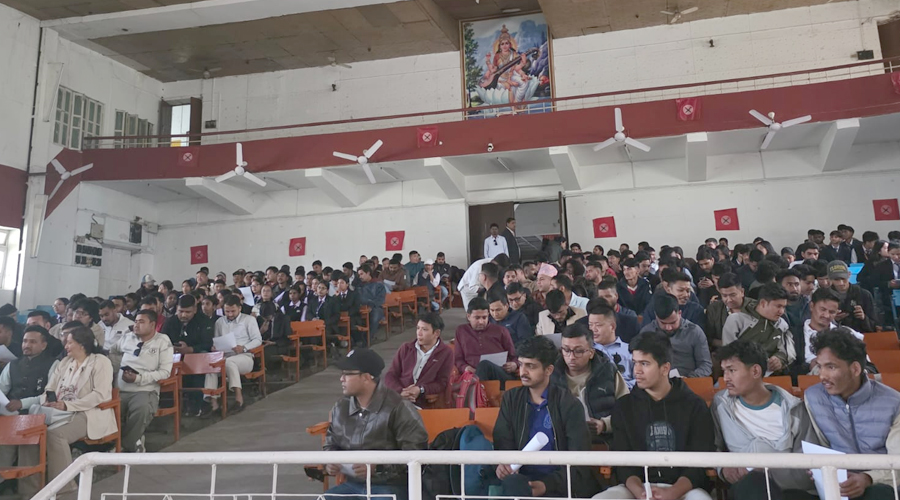
NSU Senate Meeting

General Secretary Ghimire emphasized that full rights over sister and affiliated organizations rest with the Congress. “The Congress holds the authority to decide how many sister organizations to have and which to dissolve,” he said.

He clarified that only the party granting sister organization status can designate the NSU as a sister organization or withdraw that status. “Only the granting party can maintain or separate such an institution,” he explained. “This is not a matter to be declared independently. The decision taken by NSU is a disciplinary violation.”

Although individual NSU members may leave the organization, the entire body cannot decide to cease being a sister organization, he clarified. “Institutionally, there is no room for indiscipline,” he said.

“A sister organization is like a child of the party. Just as citizenship is granted based on descent in a family, the relationship between the Nepali Congress and NSU reflects this. Thus, NSU does not have the authority to make such a decision.”

– General Secretary Gururaj Ghimire

The NSU has stated that it remains grounded in the values of the Congress and continues to follow the principles laid out by the late leader B.P. Koirala, affirming that this decision does not signify rejection of the party and its trust, according to spokesperson Sejuwal.

“We are no different from Congress and fully embrace the party’s values,” he said. “The principles advocated by B.P. Koirala will continue to guide us.”

However, General Secretary Ghimire reiterated that since the NSU is considered a child of the Congress, “Just as a human granted citizenship by descent cannot renounce their identity, a sister organization is the party’s child, and decisions on such matters fall under the party’s authority. Therefore, NSU has no right to make such a decision.”

The Congress plans to discuss the NSU Senate’s decision in the upcoming Central Working Committee meeting. This meeting will also conduct an initial review of the resignation of party president Gagan Kumar Thapa and discuss upcoming elections along with the NSU issue.

“This matter will be raised in tomorrow’s meeting. The NSU is a historic institution and serves as the party’s backbone,” said General Secretary Ghimire. “Separating it would render the party’s history incomplete.”

He recalled that the NSU was established to organize university students and select leaders for the democratic movement during the Panchayat era.

“The founding leaders established this institution with the advice of party leaders at that time, and it has played a historic role,” he said. “It cannot be separated from the history of the Congress party.”