
Author: space4knews

Today’s Foreign Currency Exchange Rates Announced

22 Chaitra, Kathmandu: Nepal Rastra Bank has determined the foreign currency exchange rates for today (Sunday). The buying rate for the US dollar is set at NPR 148.67 and the selling rate at NPR 149.27. The European Euro is priced at a buying rate of NPR 171.62 and a selling rate of NPR 172.31; the UK Pound Sterling has a buying rate of NPR 196.76 and a selling rate of NPR 197.55, while the Swiss Franc’s buying rate stands at NPR 186.22 and selling rate at NPR 186.97.

The Australian Dollar buying rate is NPR 102.71 with a selling rate of NPR 103.12, the Canadian Dollar is priced at NPR 106.76 for buying and NPR 107.19 for selling, and the Singapore Dollar’s rates are NPR 115.65 for buying and NPR 116.11 for selling. The Japanese Yen (per 10 units) has a buying rate of NPR 9.32 and selling rate of NPR 9.36, the Chinese Yuan is at NPR 21.61 buying and NPR 21.69 selling, the Saudi Arabian Riyal is NPR 39.59 for buying and NPR 39.75 for selling, and the Qatari Riyal rates are NPR 40.78 buying and NPR 40.94 selling.

According to the central bank, the Thai Baht’s buying rate is NPR 4.57 with a selling rate of NPR 4.58, the UAE Dirham stands at NPR 40.48 buying and NPR 40.64 selling, and the Malaysian Ringgit is priced at NPR 36.88 buying and NPR 37.03 selling. The South Korean Won (per 100 units) is NPR 9.85 for buying and NPR 9.89 for selling, the Swedish Krona rates are NPR 15.76 buying and NPR 15.82 selling, and the Danish Kroner is NPR 22.96 buying and NPR 23.06 selling.

Nepal Rastra Bank has set the Hong Kong Dollar buying rate at NPR 18.97 and selling at NPR 19.05, the Kuwaiti Dinar at NPR 484.50 buying and NPR 486.46 selling, and the Bahraini Dinar at NPR 393.83 buying and NPR 395.42 selling. The Omani Riyal is valued at NPR 386.21 for buying and NPR 387.76 for selling. Similarly, 100 Indian Rupees are set at NPR 160 for buying and NPR 160.15 for selling. The Rastra Bank has stated that these exchange rates are subject to change at any time as per necessity. It has also noted that commercial banks may set different exchange rates, and updated rates will be available on the central bank’s official website.

Conflict Between Iran, the US, and Israel: Are We Heading Towards World War III or Just Growing Fears?

Woman in black hijab raising hands in front of a bombed building

Image source, Getty Images

The conflict initiated by the US and Israel in Iran has persisted for over a month, fueling concerns that this Middle Eastern dispute could escalate further.

This conflict is impacting not only Iran but also dozens of countries including the United Arab Emirates, Iraq, Bahrain, Kuwait, Saudi Arabia, Oman, Azerbaijan, the West Bank, Cyprus, Syria, Qatar, and Lebanon.

Many are alarmed by the possibility of a Third World War, fearing that this confrontation might extend beyond regional boundaries.

When Can a War Become a World War?

“People tend to think that wars are fully planned and everyone knows exactly what they are doing,” said Margaret MacMillan, Emeritus Professor of International History at Oxford University. Speaking on a global podcast, she explained:

“However, studies of the past, especially World War I, reveal that most wars have started due to accidents and miscalculations by opponents,” MacMillan elaborated. “Sometimes, it can be understood as a simple schoolyard fight.”

MacMillan recalls that World War I began in 1914 after the assassination of Archduke Franz Ferdinand of Austria-Hungary.

Within weeks, alliances plunged Europe into war: Austria-Hungary acted against Serbia; Germany supported Austria; Russia backed Serbia; France supported Russia; and Britain entered the war.

Every subsequent action led to global destruction, she notes.

Fire and smoke after Israeli attack on Shahran oil depot, Tehran, 2025

Image source, Stringer/Getty Images

Caption, US and Israel have targeted many Iranian oil and gas facilities connected to its nuclear program

Professor Jo Maiolo of King’s College London defines world wars as full-scale conflicts involving all major powers.

“In World War I, European imperial powers were involved. World War II included the US, Japan, and China,” he said.

Many now consider Middle Eastern tensions as regional. Could they, however, expand extensively?

In an interview in February, Ukrainian President Volodymyr Zelensky expressed his belief that Russian President Vladimir Putin has already started a third world war. He said only aggressive military and economic pressures could force Putin to withdraw.

“I believe Putin has already started it. The question is how much territory they can seize and how to stop them… Russia is trying to impose a way of life on the world that people have not chosen,” Zelensky stated.

An internally displaced infant sleeping in a parking area in Beirut

Image source, AFP via Getty Images

Caption, The US-Israel conflict has deeply impacted Lebanon and other countries in the Middle East, displacing millions of people

So, how real is the threat of a third world war at present?

“I believe the risk could increase due to Iran or allies like the Houthis in Yemen,” MacMillan said.

Iran may take measures such as targeting shipping routes or closing the Strait of Hormuz, which would disrupt global energy supplies and draw in major powers.

US involvement has escalated risks; even nations not directly engaged are feeling economic and strategic effects.

Another danger is that a regional conflict could profoundly impact other areas.

While Western countries are entangled, China could attack Taiwan, or Russia might intensify operations in Ukraine.

“There is always the possibility of conflict spreading beyond this region because conflicts create opportunities elsewhere, and involved parties are often too occupied to prevent it,” MacMillan added.

According to Professor Maiolo, the conflict will remain limited to the Middle East and Gulf Cooperation Council regions. However, China and Russia will not be directly involved in this war.

“It’s unlikely China will launch an attack on Taiwan in the near future. That is entirely improbable.

Regarding a world or third world war, I don’t think China or Russia will become directly involved, especially not in Europe,” he said.

He analyzed China’s diplomatic approach as distinct from US President Donald Trump’s strategy: “When your competitor is making major strategic mistakes, you should let them continue.”

Despite fluctuations in oil prices, Maiolo considers China’s choice to avoid diplomatic engagement in its own interests.

He added, “Strategically, the US being occupied in the Middle East is far more interesting for China than the region’s oil resources.”

The Role of Leaders

Russian President Vladimir Putin and Iranian President Masoud Pezeshkian signing a strategic partnership

Image source, Getty Images

Caption, While Moscow discusses partnerships with Iran, it does not desire Russian intervention for military aid

History shows wars often arise from pride, honor, and fear of opponents, according to MacMillan.

She adds that history also demonstrates that leaders can alter the course of events.

“France’s Prime Minister Georges Clemenceau once said that maintaining peace was harder than going to war during World War I.”

MacMillan explains that when people endure great sacrifices and losses, leaders often decide that “the war must continue to be won.”

Pride also plays a role in leaders’ policies and decisions. Referring to Putin, she says, “The invasion of Ukraine was a clear mistake.”

Russia launched a full-scale invasion four years ago but has not achieved its military objectives in Ukraine since then.

The UK Ministry of Defence estimates Russian casualties at 1.25 million, exceeding the number of American deaths in World War II.

MacMillan warns that those refusing to accept failure or prolong the conflict deepen the crisis further.

Historically, leaders like Adolf Hitler fought on despite inevitable defeat due to ideology and pride.

Such decisions can escalate a limited conflict into a widespread war.

Ways to Reduce Tensions

Smoke plume following Israeli airstrike in South Beirut

Image source, AFP via Getty Images

Caption, The conflict initiated by the US and Israel in Iran has been ongoing for over a month

MacMillan emphasizes the critical importance of diplomatic efforts to halt the war: “You need to understand the other side… and maintain contact with them.”

She recalls that towards the end of the Cold War, NATO’s involvement helped improve communication between opposing parties.

“There are many cases where people exercised patience despite uncertainty, recognizing the need to ease tensions.”

Maiolo concurs, stating: “Tel Aviv, Washington, and Tehran must realize the outcomes achievable within their means.”

He points out that continued war cannot yield satisfactory results for all parties involved.

“Arrangements relieving sanctions, security measures, and a clear understanding of Iran’s role in global politics are necessary,” he said.

Maiolo concludes that only mediation can bring warring parties to a ceasefire and help manage long-term peace.

Arsenal Eliminated from FA Cup Quarterfinals by Southampton

Arsenal was defeated 2-1 by Southampton, resulting in their exit from the FA Cup quarterfinals. Ross Stewart and Che Adams scored for Southampton, securing a victory for the home team. Meanwhile, Chelsea advanced to the semifinals with a commanding 7-0 win over Port Vale. Kathmandu, 5 April — Arsenal, one of the top teams in the Premier League, was knocked out of the FA Cup quarterfinals following last night’s 2-1 loss to Southampton. Southampton took the lead in the 35th minute with a goal from Ross Stewart. Although Arsenal maintained ball possession throughout the first half, they failed to create clear scoring opportunities. In the second half, Arsenal equalized through Victor Gyokeres in the 68th minute, leveling the game at 1-1. However, near the end of the match, substitute Che Adams scored the decisive goal, securing a vital victory for the home side. This win marks Southampton’s first FA Cup semifinal appearance since 2021. On the same night, Chelsea secured their place in the semifinals with a comprehensive 7-0 victory over Port Vale.

लिस्बनमा गोर्खा–११ को नयाँ जर्सी सार्वजनिक, राष्ट्रिय लिगका लागि तयारी तीव्र

New Jersey Unveiled for Gorkha-11 in Lisbon as Preparations for National League Accelerate

Gorkha-11 Cricket Club has revealed its new jersey in Lisbon, intensifying preparations for the upcoming Portugal National Cricket League scheduled to start on April 18 in Lisbon. The team will be captained by Manjit Singh, who will lead the club that was the runner-up in the previous national cricket league.

The jersey unveiling ceremony was held at Ola Nepal House Restaurant in Lisbon. The event was attended by notable players including World Cup participant cricketer Rahul Bishwakarma and Madhukar Thapa. Established in 2016 under the leadership of Madhukar Thapa, Gorkha-11 is recognized as a popular team within the Nepalese community in Portugal.

For this season, the club aims to deliver an outstanding performance under Manjit Singh’s captaincy and secure the championship title. The new jerseys are sponsored by Breeze International and the British Gurkha Cricket League, with additional financial support from various businesses based in Portugal. Other distinguished attendees of the event included BGCL Chief Executive Officer Gam Gurung, Portugal national cricket team player Saidur Rahman, former ICC member and NRNA official Rajkumar Thapa, and Senior Vice President of NRNA Portugal Suraj Bist.

Four Injured in Bahrain from Iranian Drone Debris, Damage Reported at Two Buildings in Dubai

As Iran intensifies attacks on neighboring Gulf countries, drone debris has caused minor injuries to four people in Bahrain. US President Donald Trump issued a 48-hour ultimatum to Iran to keep the Strait of Hormuz open, which Iran dismissed as ‘irrational and foolish.’ Iran claims to have downed a US F-15E Strike Eagle jet, with pilot search ongoing, while Pakistan is mediating a ceasefire. Kathmandu, 5 April. On Saturday, amid escalating Iranian attacks in the Gulf region, debris from a downed drone fell in the Sitra area of Bahrain, injuring four civilians with minor wounds.

Bahrain’s Interior Ministry posted on social media platform X, stating, ‘Due to Iranian attacks, debris from a downed drone fell in Sitra, resulting in four individuals sustaining minor injuries and some damage to buildings.’ Rescue and ambulance teams were dispatched to the scene, the ministry added.

Meanwhile, in the United Arab Emirates’ Dubai, debris from interception efforts fell onto two buildings. One of these buildings houses the offices of Oracle Corporation, an American cloud computing company. Dubai authorities reported that although a fire broke out in one building, no casualties occurred.

The Dubai Media Office stated, ‘The incident at Oracle’s building in Dubai Internet City was caused by debris falling during an airborne interception. There were no human casualties.’ Similarly, debris also struck another building in the Dubai Marina area, with no reported injuries.

Earlier this week, Iran’s Revolutionary Guard warned of targeting American technology companies in the Gulf. Since the joint US-Israel attack on February 28, the conflict in the Middle East has escalated, with Iran consistently targeting Gulf states. Allegations include attacks on military, energy, and civilian infrastructure.

On Friday, debris from drones or missiles at the Hubson gas complex in Abu Dhabi caused one death and injured four others. A similar incident in Abu Dhabi’s Al Reem area also resulted in injuries, including to Nepalese nationals.

Why Is Controlling Gambling Linked to Online Betting and Crypto Transactions Challenging?

Despite the government’s directive to shut down online betting apps and websites within 24 hours, resulting in the closure of thousands of platforms, officials acknowledge that fully implementing this decision remains challenging. Gambling, including betting and participation in games of chance, is legally banned in Nepal.

After Valendra Shah assumed office, the Ministry of Information and Communications Technology directed the Nepal Telecommunications Authority to immediately block all types of online gambling apps and websites. Following this order, internet service providers were instructed to shut down more than 711 websites and platforms, as confirmed by Nepal Telecommunications Authority officials. Meanwhile, the Nepal Rastra Bank has stated it is monitoring suspicious online betting transactions, but many remain difficult to detect due to employee-based transaction systems.

Pradeep Paudyal, Deputy Director of the Nepal Telecommunications Authority, stated that over 711 websites, including more than 50 reported by users, have been sent to internet service providers for closure. He said, “Various local service providers have reported blocking between 4,300 and 7,000 unique domains so far, and the process is ongoing.” The authority is also collecting data from multiple providers and reviewing technical challenges.

Officials from the Ministry of Information and Communications have warned of strict action against users of unauthorized apps and websites. According to Section 125, Subsection 4 of the Criminal Code 2074, engaging in or facilitating betting is illegal, punishable by up to one year in prison and a fine of up to NPR 10,000. Officials recognize that with the rise of online gambling incidents in Nepal, controlling it remains a significant challenge.

राष्ट्रनीतिबारे वैकल्पिक दृष्टिकोण

An Alternative Perspective is Essential for National Policy

Clarity in national interest is a crucial foundation for foreign policy formulation. This matter is not exclusive to any particular party or group but is a shared concern. However, so far, the Nepali leadership has been unable to develop a common understanding of the national interest.

काठमाडौंका खोला किनारमा ढकमक्क फूल (तस्वीरहरू) – Online Khabar

Colorful Flowers Bloom Along the Banks of Kathmandu’s Bagmati River

March 21, Kathmandu – Once regarded as a symbol of stench and pollution, the corridors along the Bagmati River are now transforming into visually appealing spaces. The blooming flowers and dense greenery along the riverbanks have greatly enhanced Kathmandu’s urban aesthetics. Particularly along the Bagmati corridor, vibrant ‘Bagnabeli’ flowers in shades of pink, white, and yellow are flourishing. These blossoms, cascading over red railings and brick walls by the river, captivate the hearts of passersby.

A few years ago, the riverbanks were cluttered with bushes and garbage, but today they resemble well-maintained gardens. The current flow of the Bagmati is calm, and the embankments are kept clean. Artistic stone walls and orderly sidewalks contribute to making the area safer and more attractive. Nevertheless, some unpleasant odors persist in the water. The presence of the general public along the riverbanks has increased significantly, with youth and visitors enjoying leisurely walks in this clean riverside environment.

Traffic along the corridor’s roads is also well regulated. Serving as a peaceful retreat from the city’s hustle and bustle and a favored spot for photography, this area has become an attractive destination. The balance between urban development and nature is evident here, with modern buildings complemented by lush greenery in the foreground, underscoring Kathmandu’s efforts to harmonize modernization with environmental preservation. Well-organized electric poles and road infrastructure further reflect the positive facets of urban development. The Bagmati cleaning campaigns and governmental initiatives have meaningfully transformed this area. It is believed that with continued commitment to cleanliness and beautification, the Bagmati River will regain its former glory and cultural significance. With determination, neglected urban corners can be transformed into paradisiacal spaces.

Photos by: Anup Pradhan/News Agency Nepal

एमालेमा विशेष महाधिवेशन माग्न हस्ताक्षर अभियान – Online Khabar

Campaign Launched to Collect Signatures Demanding Special Congress in UML

News Summary

  • After suffering defeat in the House of Representatives election, Nepal Communist Party (UML) intensifies calls for leadership change and a special congress.
  • As per UML’s party statutes, two-thirds of district committees or majority of representatives can formally demand a special congress.
  • The secretariat meeting has initiated an election review and congratulated the new Prime Minister Balendra Shah.

March 4 (Chaitra 21), Kathmandu – Following a historic defeat in the House of Representatives election, leaders of the Nepal Communist Party (UML) have increased pressure for leadership change. Alongside expressions on social media and public forums calling for party restructuring, demands for a special congress have also escalated.

According to sources, over a month after the election, no formal review has taken place within the party, which has prompted the launch of a signature campaign demanding a special congress.

“Considering some of the post-election decisions and the obstinacy of certain leaders, the only option to save the party is a special congress,” said a leader involved in the signature campaign.

According to Article 73 of the UML Party Statute (2049), a special congress must be held within six months if two-thirds of district committees or a majority of national congress representatives formally request it in writing. The leaders involved said the signature campaign is being conducted because such a congress is urgently needed.

The petition prepared to demand the special congress cites the election defeat as the main reason. It states, “In parliamentary politics, from 2048 to 2082 (Nepali calendar), this is the weakest result – winning only 9 out of 165 seats (5.45%) in the first-past-the-post system and securing only 13.43% votes in proportional representation is a reflection of public dissatisfaction with UML’s current committee system and leadership.” It further notes that “losing deposit of candidacies in 11 out of 15 constituencies in the Kathmandu Valley is a serious situation for the UML.”

The petition draws attention to the need for a special congress given that the crisis cannot be resolved solely by reviews from the central secretariat and central committee. It says, “In such a critical historic moment, it is difficult to find a resolution only through secretariat and committee reviews.”

If a demand comes from the majority of elected representatives or two-thirds of district committees, the central committee is required to call the special congress; if it does not, the congress itself can make official decisions, as per party rules.

“The special congress will be empowered to execute all powers and duties related to the election,” states Article 73 (g) of the statute.
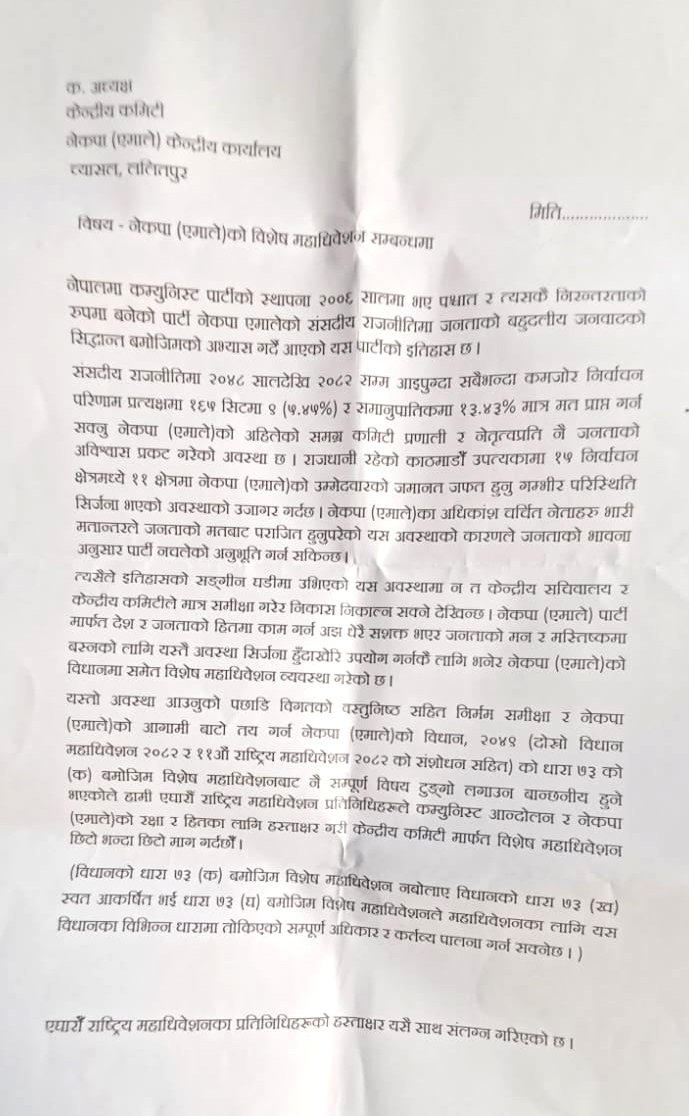
Reliable sources indicate that junior-level leaders are primarily organizing the signature campaign calling for a special congress. “There is little likelihood that leaders at the office-bearer level will openly join this movement, but grassroots cadres are pushing it forward,” said an official.

The official also pointed out that with party Chairman KP Sharma Oli in police custody, the process to advance a special congress is not yet appropriate.

“Broad public support exists for leadership change, but it is necessary to adopt a proper process, which requires extensive discussion,” the official added.

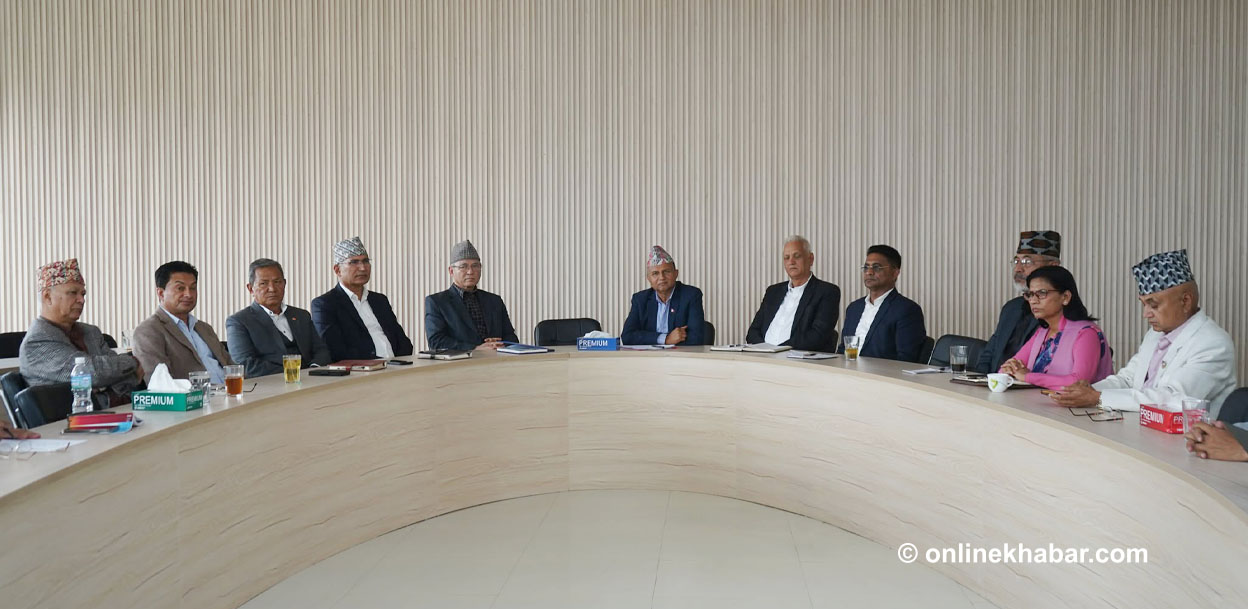
The secretariat meeting held on Friday reportedly included open discussions on the party’s crisis and contemporary political issues. The meeting lasted six hours at the central party office in Chyasal, held one month after the election.

The meeting initiated a review of the House of Representatives election and congratulated Prime Minister Balendra Shah, according to secretariat sources. In a statement issued by General Secretary Shankar Pokharel it said, “…the meeting conducted a brief review of the February 21, 2022 election and, respecting public opinion, extended congratulations to all winners.”
Newly elected Prime Minister Balendra Shah was also formally congratulated. The statement said, “We congratulate Honorable Prime Minister Balendra Shah and his cabinet on forming the government with an overwhelming majority.”

The meeting also expressed gratitude to voters, the Election Commission, security agencies, officials, election police, observers, media personnel, and civil society for their roles in the election.

Prior to this meeting, UML had not issued any formal stance on the election results. Instead, parliamentary party leader Ram Bahadur Thapa had publicly implicated the Nepali Army, government led by Sushila Karki, employees, and foreign powers for the election defeat.

Those remarks were opposed by party leaders on Thursday, and subsequently corrected during the secretariat meeting after the issue was raised.

Though there has been no official review, leaders started calling for restructuring soon after the election. Vice Chairman Bishnu Prasad Paudel, Deputy General Secretary Yogesh Kumar Bhattarai, and several others have openly discussed leadership change. Some office-bearers appear to support it.

However, no clarity on timing or method of leadership change has been provided, which led the younger leaders to start the signature campaign demanding a special congress, sources reveal.

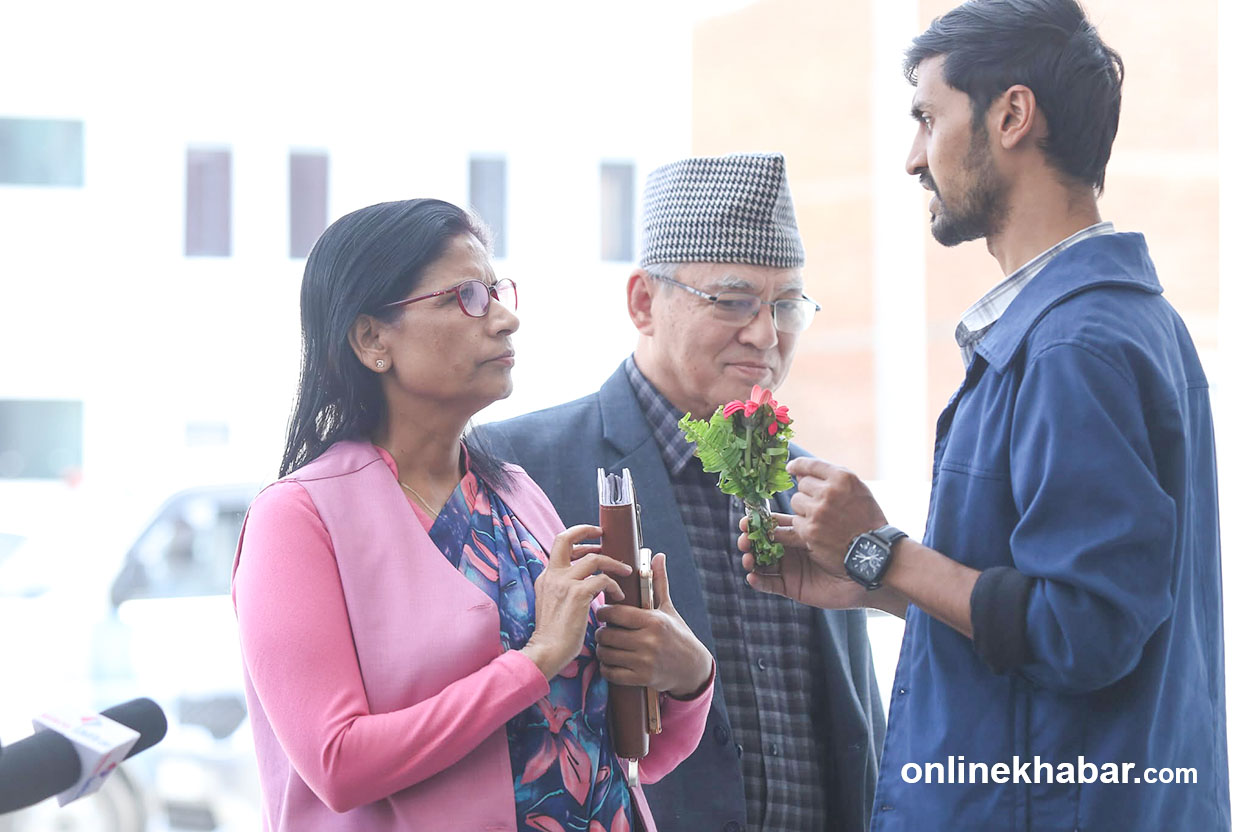
Following the blockade of Suhang Nembang’s leadership as parliamentary party leader, UML youth have been staging protests at the party headquarters demanding leadership change. They have demonstrated through street protests, placard displays, and by offering roses to leaders.
Six of Seven Nepalis Injured by Drone Debris in UAE Released from Hospital

Six out of seven Nepalis injured by falling drone debris in Abu Dhabi have been discharged from the hospital. The Nepali Embassy in Abu Dhabi has been in contact with all seven injured individuals to monitor their condition. The debris fell in the Ajban area of Abu Dhabi after a drone, launched by Iran, was intercepted by the UAE air defense system. Kathmandu, 21 Chaitra.

In the United Arab Emirates (UAE), six of the seven Nepalis injured by falling drone debris in Abu Dhabi have been discharged from hospital. The Nepali Embassy in Abu Dhabi conveyed updates on the condition of the Nepalis and confirmed that six have been released. Embassy staff have maintained communication with all seven injured individuals.

One injured person remains hospitalized but is reported to be in a stable condition, according to the Nepali Embassy in Abu Dhabi. Following reports from UAE government media confirming seven Nepalis injured, the embassy expressed concern and sought updates on their condition. On Friday, after the UAE’s air defense system intercepted a drone launched by Iran using missiles, debris fell in the Ajban area of Abu Dhabi. This incident resulted in a total of 12 injuries, including seven Nepalis and five Indian nationals.

ढुङ्गे औजारबाट प्रागैतिहासिक मानवको खोज – Online Khabar

The Role of Stone Tools in the Search for Prehistoric Humans

In rural areas, a fascinating legend still circulates today: “When lightning strikes the sky, stone axes fall to the earth.” In some places, these stone axes, known as ‘lightning stones,’ are carefully preserved. As a child, such stories seemed mysterious. Each year, lightning claims the lives of tens of thousands of people worldwide. In Nepal, Makwanpur district is considered the most affected, with Jhapa, Udayapur, Ilam, Morang, and several other districts also significantly impacted. Lightning often damages tall trees, splitting branches, causing them to fall or suddenly wither. If stone tools fell alongside lightning, such objects would be found abundantly in those areas. However, these tools are mostly discovered in remote or ancient settlements and are often kept at home across many generations. In reality, these stone axes are prehistoric stone tools made by early humans. Viewed in this light, while folklore adds mystery, these objects reveal a crucial chapter in human history.

Against this background, this article discusses prehistoric stone tools and, based on them, the early history of human activity in Nepal. The Stone Age is also referred to as the ‘Paleolithic Age,’ marking an early phase of human civilization. During this period, humans primarily used stone tools to meet their daily needs. This use of tools distinguished humans from other living beings. Stone axes, spears, arrows, and similar implements were commonly used for hunting. Determining when stone tool production began globally was difficult without knowing their age.

In the mid-20th century, scientists developed the ‘Radiocarbon Dating’ method. During the 1950s and 1960s, advanced techniques like ‘Potassium-Argon Dating’ were introduced, enabling accurate dating of stone tools that are millions of years old. Subsequently, researchers discovered that human-made stone tools date back up to 2.5 million years. The majority of these weapons and tools have been found primarily in African countries such as Kenya, Ethiopia, and South Africa. Similar findings have been made in Asian countries like China and India, and stone tools have also been uncovered in Nepal.

Tiger Forest Hotel Opens in Tilottama with Investment Exceeding One Billion Rupees

March 21, Butwal – Tiger Forest Hotel, featuring the first beer garden in Lumbini Province, has commenced operations in Chilhiya 13, Tilottama, Rupandehi. Entrepreneur Minraj Bhusal of Tilottama established the hotel with a vision to bring a new and unique identity to the region across five bighas of land. The investment in the hotel has surpassed one billion rupees, with financial backing from Shine Resunga Development Bank, according to reports.

According to Bhusal, the hotel is integrated with lush forest surroundings, and the rooms—referred to as “flying villas”—are entirely constructed from pine wood. Additionally, fresh draft beer from Bhusal’s own brewery, which is not bottled but served directly, is available on site. Bhusal is also the owner of the “Baahrsinge” beer brand.

The hotel, connected to the five-star Tiger Palace Resort, is currently operational in the southern section. The first phase includes a beer garden, 20 flying villas, a hall accommodating 50 guests, a Chautari bar, a dance club, and a spa, Bhusal said. The flying villa designs were crafted by Austrian engineers. Bhusal emphasized that apart from Baahrsinge Beer Industry in Kurintar by the Trishuli riverbank, no other place offers this combination of flying villas and draft beer garden.

Construction is nearing completion on a Chinese restaurant with a capacity of around 200 guests and a banquet hall that can accommodate 1,000 guests. Bhusal announced that the official opening of the hotel is planned for the Nepali New Year.

In the near future, plans include adding 40 more rooms, a swimming pool, and a mini-casino to obtain four-star hotel certification. “The purpose of this investment is to provide new and unique hospitality services targeting domestic and Indian tourists,” Bhusal stated. “We present an unprecedented experience in the region where guests can enjoy fresh beer amid a green environment under the open sky.” He also noted that tourists visiting Lumbini, the birthplace of the Buddha, are among the primary target guests for the resort.

Bhusal revealed plans to further invest NPR 1.5 billion in the coming years to upgrade the hotel to a five-star facility, expanding services and amenities aimed at Indian tourists, contingent on political stability and a favorable business environment in the country. “This resort, located away from urban areas amidst serene greenery, will establish a distinct identity for the province’s tourism sector,” he added. “The combination of natural surroundings, open spaces, and authentic architectural style differentiates this resort from conventional hotels. Our goal is to transform it into an exemplary wellness and entertainment tourism destination in Nepal.”

General Manager Kshitiz Khanal stated that the resort currently provides direct employment to around 70 locals. The hotel, developed with the objective of offering unique experiences to domestic and international tourists visiting Lumbini, is expected to become a model tourism destination not only for Tilottama but for the entire province, said Mayor Ram Krishna Khanal.

ओली-लेखकको बन्दीप्रत्यक्षीकरण रिटमा भोलि सुनुवाइ हुने, विपक्षीबाट जवाफ आयो

Hearing Scheduled Tomorrow for the Habeas Corpus Petitions of Oli and Lekhak; Written Response Received from Opposition

March 21, Kathmandu – The Supreme Court is set to hear the habeas corpus petitions of former Prime Minister KP Sharma Oli and former Home Minister Ramesh Lekhak tomorrow (Sunday). According to sources, after the previously issued show-cause order by the Supreme Court, a written response has been received from the opposition. With all parties now aligned, both petitioners are expected to attend the hearing.
The police arrested both individuals on March 14 under a decision to implement the recommendations of the Gauri Bahadur Karki Commission, which was established to investigate incidents related to the JNU movement. Claiming the arrests were unlawful, Oli and Lekhak filed habeas corpus petitions at the Supreme Court on March 15. Separate benches considered these petitions on March 16, issuing show-cause orders directed to the government. Following receipt of the government’s written response, the court will conduct debates during tomorrow’s hearing, sources informed.

Pension Slip Distribution Process Launched in Sankhuwasabha

March 21, Sankhuwasabha — The Office of the Controller of Accounts (Colenika) has initiated the distribution process of pension slips for retired employees. This marks the first time pension slips have been distributed at the district level, eliminating the need for retired employees to travel to Kathmandu. Chiranjivi Adhikari, the office chief, handed over the pension slip to Rudra Budhathoki as the first beneficiary.

Previously, employees who had retired or resigned from the civil service had to visit the National Treasury at Pulchok and the Pension Office at Tripureshwor to obtain their pension slips, a process that typically took 2 to 4 days and incurred additional costs. However, according to the official, the introduction of the ‘e-Pension Service’ now allows the procedure to be completed within the district, making it more convenient. Pension slips for employees whose retirement or resignation has been approved will be prepared digitally.

After retirement, employees submit the necessary documents to the Colenika office, where their information is uploaded to the online system. Subsequently, the authorized pension slip signed by the relevant office is sent to Colenika and handed over to the beneficiary. Expressing satisfaction with the new system, Rudra Budhathoki, a retired employee from the Irrigation Office, said, “I no longer have to go to Kathmandu, which also saves the expenses incurred by staying there.” This new system is expected to facilitate faster, more cost-effective, and efficient service delivery at the district level.