March 4, Khotang – The Physical Infrastructure Development Office has directed 19 construction companies that have not started construction work even two months after signing contracts to submit written explanations. These companies had signed contracts for 26 projects but failed to commence work within the stipulated timeframe, prompting the office to demand written clarifications within seven days.
The office has sent notices to the following companies: Yunan Construction Service Udayapur, Vishwashikhar Construction Service Udayapur, Arjun Point Engineer Developers Pvt. Ltd. Kathmandu, Right Brother RTD JV, Imo Builders Pvt. Ltd., Shilanyas Engineering Consulting Pvt. Ltd. Dhading, Shantibhoomi Construction Pvt. Ltd. Khotang, Ansubi-Nepal-Phulbari-Pingla JV, SR Construction Khotang, Nirma Construction and Suppliers Pvt. Ltd. Khotang, Ranasampang Construction Pvt. Ltd. Khotang, Bhishanhang Construction Pvt. Ltd. Bhojpur, Barahpokhari Construction and Suppliers Pvt. Ltd. Kathmandu, Pathibhara Construction Service Udayapur, Dhansuna Construction, B and B Construction Service Udayapur, Khokchilipa-Salme RTD JV, DB Construction Udayapur, and Digi Construction Service Khotang.
Shantibhoomi Construction Pvt. Ltd. Khotang has contracts for three projects, while Vishwashikhar Construction Service Udayapur, Pathibhara Construction Service Udayapur, B and B Construction Service Udayapur, DB Construction Udayapur, and Arjun Point Engineer Developers Pvt. Ltd. Kathmandu each have contracts for two projects. Chief Engineer Binam Dahal of the Physical Infrastructure Development Office stated that the companies have been asked to provide a detailed written explanation within seven days, including the reasons for not initiating work as per the agreements.
“When work does not start on time, the rainy season begins, which affects construction quality, especially for projects started towards the end of the fiscal year,” he explained. “Failure to commence work promptly results in incomplete projects. Moreover, the budget allocated for these projects risks being frozen. Therefore, we have requested written responses within seven days.” The office also warned the contractors to immediately begin work, highlighting that project delays cause hardships for local consumers and the general public.
Construction companies have been instructed to complete all work according to quality and volume standards within the specified timeframe under the direct supervision of technical staff deployed by the office. Accounting Officer Sitaram Raut added that if work is not started by the deadline, the office will forfeit bank guarantees without granting unnecessary extensions, as per the law. “Initially, we will request written answers. If satisfactory replies are not received, further legal action will be initiated,” he said.
This year, the Koshi Province Government, through the Ministry of Physical Infrastructure Development and the Infrastructure Development Directorate via the Physical Infrastructure Development Office, has signed contracts for 123 projects in the district. Apart from the 26 projects with delayed work starts, the remaining projects are progressing rapidly, according to Chief Engineer Dahal.
March 21, Kathmandu – The Nepali Congress has initiated the preparation process for its 15th General Convention by holding a dialogue with central representatives assigned to all 77 districts. On Saturday, the party conducted an interaction program in Sanepa with the central representatives who will be deployed to the districts starting from the month of Baisakh (mid-April).
“We have held an informative session at the central office today to clarify to our representative leaders their responsibilities and the tasks they need to perform once they are in the districts,” said General Secretary Pradeep Paudel.
According to the General Secretary, the central representatives will oversee the organization of the membership distribution campaign throughout Baisakh, update existing memberships, implement the regulations prescribed by the party statute for issuing new memberships, and fulfill other assigned duties.
For the General Convention, the Congress has prepared a schedule to actively distribute and update memberships from wards across the country starting from Baisakh 1 until the end of the month. The party plans to run a one-month membership update campaign during Baisakh.
Following the month-long membership update drive, wards are expected to submit the updated active membership lists to the House of Representatives’ electoral constituencies and districts by Jestha 15 (late May). Subsequently, the constituencies and districts must enter the membership data and forward it to the central level by Jestha 25, as per the party’s regulations.
The central committee has set June 29 (Asar 15) as the deadline for conducting the necessary verification of memberships and making the final decisions. The party plans to submit the finalized list of updated active members to the central election committee by the end of Asar (mid-July).
Following the House of Representatives election, the central working committee meeting held on Chaitra 10–11 agreed on a timetable to hold the 15th General Convention in Aswin (October 2–5).
As per the schedule, from Chaitra 21 until the end of the month, membership forms will be distributed from the central level down to the ward level, with representatives deployed across all 165 electoral constituencies.
March 21, Kathmandu – Iran has claimed to have shot down two American fighter jets. Following this claim, US media outlet CNN reported that a war with Iran is becoming increasingly unpopular among the American public. President Trump had already faced criticism regarding the prospect of a conflict with Iran.
CNN noted, “In a war where military superiority favors the US, this incident highlights the dangers of an asymmetric conflict. The American people have already rejected the potential costs and risks involved.”
Another US media outlet, NBC News, analyzed that America’s initial claims about the conflict have proven incorrect. “The downing of a US aircraft inside Iranian territory suggests that the notion of full American control over Iranian airspace is mistaken,” NBC News stated.
These events unfolded while President Trump, promising victory in a war with Iran, was facing increasing pressure to end the conflict. NBC News reported, “He has deployed new troops to the Middle East, stating that if Iran closes the Strait of Hormuz, tensions in the region will escalate further.”
Another American news organization, Fox News, citing experts, pointed out that controlling the skies over a war zone does not imply immunity from regional risks, even using irony when discussing what that control truly means.
“After Iran shot down an F-15 fighter jet, the Trump administration’s claim of air dominance has come into question,” Fox News wrote.
Image caption, F-15E fighter jet seen at the 2025 Paris Air Show (file photo)Article Information
Just four days ago, US Secretary of Defense Pete Hegseth claimed that America had achieved air superiority over Iran and that now the US’s large B-52 bombers could fly there with ease.
However, before these bombers could take flight, Iran secured its biggest victory against the US so far – by shooting down an American fighter jet in its own airspace.
The downed aircraft was not a large bomber but a smaller, more agile and faster fighter jet.
One crew member of the F-15 jet was rescued, but another remains missing. If Iran has taken him captive, the situation could become serious for the US.
It is likely that Iran will showcase the missing crew member on television, an act that may harden American public opinion against the war with Iran. Amid rising fuel prices and the recent deaths of 13 US soldiers, public sentiment in America is already tense.
US President Donald Trump has not managed to clarify the ongoing conflict within the US and worldwide, and his announced goals of regime change remain unachieved.
Trump has stated that despite the downed fighter jet, ongoing negotiations with Tehran will not be affected.
However, if the missing crew members are captured, the situation could change instantly. Even though militarily weakened, Iran remains a significant military and political headache for Trump.
Search and Rescue Operations Are Risky
BBC’s chief international correspondent Liz Dusset describes the current situation as risky.
Despite years of training, any American operation to rescue missing personnel in such conditions would be perilous, she says.
She also points out that the associated political risks are equally significant.
If Iran captures those individuals and puts them on television, Tehran will score a major propaganda victory, causing political embarrassment and concern in the US.
“This would give Tehran a wartime prisoner, which would be a powerful tool strengthening it while efforts to prevent war are stalling.”
Any US retaliation will not be without risks for Iran, the broader region, and the world.
Within the past five to seven weeks, the US and Israel have seriously degraded Iran’s military capabilities.
However, Secretary of Defense Pete Hegseth’s frequent claims of full air superiority have yet to be proven conclusively.
Nuclear Threat
Image source, EPA
Iranian Foreign Minister Abbas Araqchi has warned that any radioactive leakage would end life in the Gulf region.
He made these comments concerning recent attacks near the Bushehr nuclear power plant.
On social media, he said, “Remember the outrage shown by Western countries when fighting broke out near Ukraine’s Zaporizhzhia nuclear power plant? Israel and the US have bombed our Bushehr facility four times already.”
“If radioactive contamination occurs there, there will be no life in the Gulf Cooperation Council (GCC) capitals, not only in Tehran. The attack on our petrochemical industry also reveals clear intentions.”
The GCC includes Bahrain, Kuwait, Oman, Qatar, Saudi Arabia, and the United Arab Emirates (UAE).
The US and Israel have not confirmed responsibility for these attacks.
The International Atomic Energy Agency (IAEA), the global nuclear oversight body, has acknowledged awareness of the Bushehr attacks and expressed “grave concern.”
So far, no increase in radioactivity levels has been detected.
The IAEA has called for “no attacks under any circumstances” at the nuclear facilities and surrounding areas and urged maximum military caution.
Our Nepalese news channel is also on YouTube. To subscribe to our channel and watch published videos, click here. You can also follow our content on Facebook, Instagram, and Twitter. Our BBC Nepali Service program is also broadcast on radio every evening from Monday through Friday at 8:45 PM.
The new House of Representatives convened its first session on Chaitra 20, marking the start of duties for the new government and parliament.
The government plans to draft a federal Civil Service Bill within 45 days to free the administration from political interference.
Even after a decade since the constitution was promulgated, federal laws, police integration, and education bills have yet to be enacted.
Chaitra 20, Kathmandu – Following the electoral mandate, the new government and the House of Representatives have commenced their responsibilities. The House held its first session on Thursday, where members reminded everyone of their duties toward the newly formed government and parliament.
“The new parliament carries not only the achievements of the past but also the responsibilities left undone,” said Communist Party of Nepal (CPN) leader Barshaman Pun. “There remain several unfinished peace agreements and transitional justice issues for which the new government must take ownership.”
It has been two decades since the peace process began in the country; however, transitional justice remains incomplete. Cases from the conflict period are still unresolved, and victims have not received justice.
After the dissolution of the previous House, laws were enacted for investigating disappeared persons and for the Truth and Reconciliation Commission, which is now operational. The responsibility of completing transitional justice now rests with the new parliament.
Apart from transitional justice, many tasks intensively debated but left undecided in the previous parliament must be addressed by the new legislature.
More than a decade after the constitution was promulgated, federal laws remain unpassed. Issues such as the structure of employees across the three tiers of government, police management, and fiscal powers have been contentious due to the absence of federal legislation.
Priority Given to Civil Service Act
The government has set priorities and deadlines, including drafting the federal Civil Service Bill within 45 days.
As part of the 100-point governance reform agenda, the government has pledged to prepare the federal Civil Service Bill within this timeframe.
The goal is to make government administration completely free from political interference, impartial, and accountable to citizens. Civil servants, including administrative personnel, teachers, professors, and other public servants, should not maintain ties with any political party or interest group.
Failure to comply will result in strict actions under the proposed Civil Service Bill. Additionally, political trade unions in public administration are to be abolished to eliminate undue pressures.
The government is preparing the necessary legal provisions within the federal Civil Service Bill, which is expected to be ready within 45 days.
The constitution mandates that each of the three government levels has its own employees, yet without the Civil Service Bill, administrative federalism has not been implemented effectively.
Employee arrangements were primarily made during the previous term. However, consensus on where employees should be placed—whether at federal, provincial, or local levels—has not been reached. Though Provincial Public Service Commissions exist, employees remain under federal control.
Disputes over whether chief secretaries at provinces, secretaries of ministries, and chief administrative and accounting officers at local levels should be under federal authority prevented previous parliaments from passing the Civil Service Bill. This responsibility now shifts to the new parliament.
Police Act Passed but Integration Pending
Despite a decade passing, the federal arrangement of security agencies has yet to be implemented. Although discussed in previous parliaments, practical progress remained stalled. The country still operates a centralized security system.
Two police integration bills were passed in 2076 BS (2019 AD). They were certified by the President on Magh 28 (mid-February 2020).
According to the police integration, 24,816 personnel are to be integrated into central police, and 54,720 into seven provincial police forces. However, implementation has not progressed.
Education Bill Remains a Major Public Concern
Another major expectation from the new government among citizens is the Education Bill. The constitution grants education rights to the three tiers of government, but no federal Education Act has been enacted.
This issue saw extensive debates in the dissolved House of Representatives. Though the bill was ready for passage, parliamentary dissolution halted the process. The new parliament is expected to take it forward.
On Bhadra 27, 2080 BS (September 11, 2023), the School Education Bill was presented and discussed by the parliamentary committee and submitted to the House, but no further progress was made.
As a result, local governments have yet to exercise their education rights effectively. Secondary education falls solely under local government jurisdiction but has not been implemented efficiently.
The National Independent Student Union demanded making education more practical and proposed three points of divergence: teachers’ rights, reproductive health, and special priority for women’s leave and transfers.
The 2075 BS (2018 AD) Compulsory and Free Education Act includes some mandatory fees, though effective implementation remains pending.
Article 31 of the Constitution guarantees the right of every citizen to basic education, yet after a decade, citizens have not fully realized this right.
The student union has continuously advocated for special priorities concerning women’s issues, reproductive health, leave, and transfers.
Moreover, Article 38(5) of the constitution requires positive discrimination in favor of women.
This time, the student union’s presence in the House with a two-thirds majority suggests smoother passage of the bill.
Limited Progress on Fundamental Rights
Implementation of fundamental rights as mandated by the constitution has seen little progress. Laws compatible with the constitution were to be passed within three years but remain incomplete.
Necessary regulations for fundamental rights have not yet been formulated. The constitution recognizes 16 rights, including housing, education, clean environment, and employment, as fundamental rights.
The new government has pledged to accelerate law-making and adhere to strict timelines.
Minister for Law, Justice and Parliamentary Affairs Sobita Gautam stated the government’s readiness to move the legislative process quickly.
RSWP Chairperson Ravi Lamichhane also expressed hope in the new parliament and a commitment to rectify past mistakes and advance lawmaking.
Lamichhane clarified that the parliament should be a platform for debate, not revenge, and vowed to prevent the entry of vested interest groups.
Nepali Congress MP Bhishmaraj Aangdembe emphasized the need for a stable government and policies and urged the new government to work toward mutual harmony, good governance, and prosperity.
March 21, Kathmandu – Nine drivers caught operating vehicles under the influence of alcohol were taken into custody. The Kathmandu Valley Traffic Police conducted surprise checks this morning at various locations, leading to the arrests.
According to Nareshraj Subedi, spokesperson for the traffic police office, those detained were drivers of public transportation vehicles. He stated, “This morning, as part of a special campaign, we conducted sudden checks at different points across the valley. Nine public transport drivers have been apprehended for driving under the influence of intoxicating substances.”
Iran’s Mahshahr Petrochemical Complex and Bandar Imam Petrochemical Company have been targeted in an attack. Iran alleges that the United States and Israel are involved in the incident. The Petrochemical Special Economic Zone Organization has confirmed that employees were safely evacuated.
March 21, Kathmandu – These two locations, considered vital to Iran’s petrochemical industry, have been attacked. Valiullah Hayati, the Deputy Governor (Security) of the Mahshahr Petrochemical Complex, confirmed the attack. He also reported that the Bandar Imam Petrochemical Company was targeted.
According to Iranian media, five people have been injured so far. These plants operate in the production of oil and gas-related products and are located in the southern region of the country, playing a significant role in both production and export. The Petrochemical Special Economic Zone Organization stated that the industrial area’s workforce has been safely evacuated. The Israeli Defense Forces (IDF) have declined to comment on the incidents.
The BBC World Question program will be recorded at the Mandala Theatre in Kathmandu on April 7 and broadcast worldwide starting April 11. The panel includes Nepal’s Foreign Minister Shishir Khanal, Rakhsa Bam of the Genji Front, Dr. Prakash Man Mahat from the Nepali Congress, and legal expert Dr. Mandira Sharma. The show will prioritize audience questions, highlighting Nepal’s youth movement and comparing it with those in other countries, emphasizing the unique peaceful constitutional process in Nepal. Currently, Nepal’s politics stand at a historic turning point. Since the Genji movement last September and the recent elections, the world’s attention has increasingly focused on Nepal. In this context, the famous BBC program ‘BBC World Question’ is being hosted in Kathmandu this time.
Broadcast in more than 60 countries worldwide, the program will be recorded on Tuesday, April 7 at Kathmandu’s Mandala Theatre. It will then be broadcast globally from April 11 via BBC World Service radio, YouTube, and podcasts. Audience questions will specifically guide the program’s direction, rather than the panelists themselves. Audience members attending the event will participate in selecting the questions, a process facilitated by hosts Johnny Diamond and Malle Mile.
This edition features four panelists. The first is Shishir Khanal, Nepal’s Foreign Minister. The second is Rakhsa Bam, leader of the Nepal Genji Front. The third panelist is Dr. Prakash Man Mahat, leader of the Nepali Congress and former Finance Minister. The fourth is Dr. Mandira Sharma. The panel was selected considering diverse perspectives, expertise, age, and gender balance, comprising two men and two women this time.
When asked how Nepal’s Genji movement differs from similar movements in other countries, it was noted that Nepal is the first nation where elections were held peacefully through constitutional processes following such movements. This has made Nepal an example and a point of curiosity worldwide. BBC World Question originated from the UK’s ‘Any Questions’ program, providing a platform for people around the world to engage in dialogue.
In Siraha, a cyclist named Rabin Sadaya sustained serious injuries after being hit by a car. Following initial treatment at the local R.K. Medicity, he was referred to Biratnagar for further medical care. The car driver, Akash Chaudhary, has been taken into police custody. The incident occurred on 21 Chait.
The accident took place at Aamchowk, Sirha Municipality-10, where a car collided with a cyclist, critically injuring a young man. Rabin Sadaya, approximately 25 years old from Dhangadhimai Municipality-11, was injured during the incident. The vehicle involved, bearing license plate Province 3-01-024 Cha 7527, was traveling westward when the collision occurred.
Following the accident, Sadaya, who was in serious condition, was immediately transported to R.K. Medicity Hospital for treatment. However, due to the extent of his injuries, he was referred to Biratnagar for advanced care, according to Salikram Timilsina, Chief of the District Traffic Police Office in Lahan. The police report that Sadaya suffered severe injuries to his head, arms, and legs. The car driver has been identified as 26-year-old Akash Chaudhary from Itahari Sub-Metropolitan City-17, Sunsari. He remains in police custody.
A high-quality, ‘stunning’ photograph of Earth taken halfway to the Moon by the Artemis 2 astronauts has been released by NASA. After reaching the path toward Earth’s closest celestial neighbor, the space mission’s commander, Reid Wiseman, captured the photo, according to NASA. At approximately 11:45 AM Nepal time on Saturday, NASA’s dashboard showed the Orion spacecraft had traveled 228,500 kilometers from Earth and was around 212,400 kilometers from the Moon.
Astronaut Christina Koch shared that they had reached the halfway point after 2 days, 5 hours, and 24 minutes of travel from Earth, and everyone onboard expressed joy upon receiving the news.
The first image, titled “Hello, World,” prominently features the vast blue region of the Indian Ocean. The photo shows Earth’s atmosphere glowing brightly as it blocks the Sun’s rays, with green auroras visible near the poles. The Earth appears upside down in the image, with Western Sahara and the Iberian Peninsula on the left and the eastern part of South America on the right. A bright planet visible near the bottom right was identified by NASA as Mercury. These photos were captured shortly after the crew successfully completed the Trans-Lunar Injection burn on Friday.
This maneuver propelled the Orion spacecraft out of Earth’s orbit, carrying the four astronauts toward the Moon. Artemis 2 will take the crew to the Moon’s far side and back, marking the first time in 50 years—since 1972—that humans will travel beyond Earth’s orbit. Launched from the Kennedy Space Center in Florida, the spacecraft will fly by the Moon’s far side on April 6 and splash down in the Pacific Ocean on April 10.
In Kathmandu, the National Gen Z Citizens’ Campaign and the Anti-Misgovernance Grand Campaign organized a protest against the rise in petroleum product prices. Demonstrators displayed placards bearing slogans such as “Stop the Burden of Inflation,” “Reduce Petrol Tax,” “Lower Prices to Provide Relief to the People,” and “Abolish Petrol Taxes.” They emphasized the need to remove various taxes on petrol in order to bring down prices. (21 Chaitra, Kathmandu)
Youth have voiced their opposition by staging a protest in Kathmandu against the hike in petroleum prices. Concerned that the cost of daily essential goods may also increase, they expressed their dissent. During the demonstration, they displayed placards with slogans including “Stop the Burden of Inflation,” “Reduce Petrol Tax,” “Lower Prices to Provide Relief to the People,” and “Abolish Petrol Taxes.” Participants, organized by the National Gen Z Citizens’ Campaign and the Anti-Misgovernance Grand Campaign, urged authorities to eliminate current taxes imposed on petrol to reduce its cost.
Kaji Abhiman Singh Basnet fought various battles from 1819 BS onwards during the expansion of the Gorkha Kingdom.
In 1830 BS, Abhiman Singh successfully incorporated Majh Kirat into the Gorkhali Kingdom and served as its administrator in Vijaypur.
In the 1848 BS war between Nepal and Tibet, Abhiman Singh was assigned the responsibility to lead an attack towards Kerung.
Serving the then Gorkha Kingdom, warriors from various prominent regional clans earned immortal names in history. During the Gorkha kingdom’s expansion campaign, groups such as Thapa, Basnet, Pandey, Kunwar, along with Magar warriors, displayed great prowess in battle, shaping history.
Basnets traditionally worship the family deity Masht, distinguishing them from the Khas regional clans. The Basnet clan includes subgroups like Shripali, Khulal, and Khaptadi. The Shripali Basnets are believed to have originated from the Saipal Himal region of Bajhang district, carrying the name Shripal. The region still houses Shripal Kot, once the seat of the Shripal kingdom.
At that time, the kingdom of King Nagaraj spanned Shripal, Khaptadi, Kalikot, Khulal, and Sinja. Later, the residents of Shripal kingdom became known as the Shripali clan. Until 900 BS, this kingdom stretched from eastern Mansarowar to Gandaki (Dr. Binod Thapa, ‘Contribution of Shripali Basnets in Nation Building, Nepal’–2074:29–30).
According to author Purnaprakash Sharma ‘Yatri’, when new settlements were established, conflicts and legal matters frequently arose, requiring the appointment of a judge called ‘Basnyarthi.’ Over time, the word evolved into Basnyat, Basnyat, or Basnet. The settlements inhabited by these groups—Shripal, Khaptad, and Khulal—were named accordingly, with the residents called Shripali, Khaptadi, and Khulali respectively (Thapa, 2074:31–32).
Kaji Abhiman Singh Basnet (Source: Contribution of Shripali Basnyat in Nation Building)
Madan Singh Raja was a notable figure in the Shripali Basnet lineage. During the time of his clan member Bharat Singh, the Khas kingdom was divided. The children of this lineage settled in different regions. For example, Shivram Singh Basnet, son of Jayaraj Singh, was active during King Narbhupal Shah’s reign and became a famed military leader during Prithvi Narayan Shah’s era (Thapa, 2074:32–34). Shivram Singh had four sons—Naharsingh, Keharsingh, Abhiman Singh, and Dhaukalsingh—who gained prominence during Prithvi Narayan Shah’s rule. Several battles were led under Shivram Singh’s command.
At the time of Shivram Singh’s death, Kaji Abhiman Singh Basnet was only 1.5 years old. His upbringing was carefully overseen by his mother, Suraprabha, with King Prithvi Narayan Shah allocating lands to support their care (Tulsiram Vaidya et al., ‘Military History of Nepal’–2049:460).
Abhiman Singh Basnet showcased his military talents in numerous battles during the Gorkha Kingdom’s territorial expansion campaigns. He fought across fronts from Kathmandu to the east, west, north, and south. He gained fame under the reigns of Kings Prithvi Narayan, Pratap Singh, and Ran Bahadur Shah. Below is a brief overview of the battles he fought.
First Battle in Teenage Years
Abhiman Singh began demonstrating his military capabilities from 1819 BS. Under King Prithvi Narayan Shah’s direction, Keharsingh Basnet led the fight against Makwanpur, with Abhiman Singh present on the frontlines. Following Makwanpur’s annexation, he was active in the campaigns to capture seven villages in 1920 BS.
He displayed valor during the captures of Kathmandu in 1825 BS and Bhaktapur in 1826 BS (Thapa, 2074:85). This marked the beginning of Kaji Abhiman Singh’s military career.
War and Treaty with the Limbu
After concluding conflicts in the central region, King Prithvi Narayan Shah ordered Abhiman Singh to advance eastwards. Efforts began to incorporate Majh Kirat into the Gorkha Kingdom. Coordinating with priests from Chaudandi, Abhiman Singh deployed Bange Basnet there.
The Gorkhali army, led by Sardar Ram Krishna Kunwar and deputy leader Amar Singh Thapa, was sent towards Majh Kirat. On Bhadra 13, 1829 BS, they crossed the Dudh Koshi River by boat. Meanwhile, Abhiman Singh remained delayed in Makwanpur (Baburam Acharya, ‘Brief Biography of His Majesty King Prithvi Narayan Shah’–417–418).
Later, Abhiman Singh moved with ally Parath Bhandari towards Chaudandi, and by Saun 1830 BS, Chaudandi was annexed to the Gorkha Kingdom. Historical sources mention severe atrocities imposed on local Limbu communities in the hilly Majh Kirat region, affecting men, children, and even pregnant women under harsh conditions (Dr. Ramesh Dhungel, ‘Himal’ 15:22, Fagun 2062:61).
At that time, Harinanda Pokharel also provided financial support to the Gorkhali army. Letters have been found indicating that Abhiman Singh and his associates sent funds during this period (Imansingh Chemjong, ‘Brief History of Kirat-era Vijaypur’–2059:78–79).
After Majh Kirat, Abhiman Singh advanced toward Vijaypur, where internal conflicts among ministers were rampant. Minister Buddhikarna Rai had already assassinated King Kamdatt Sen. When Gorkhali forces entered Vijaypur, 85 Limbu soldiers were killed (Acharya, 2061:421–422).
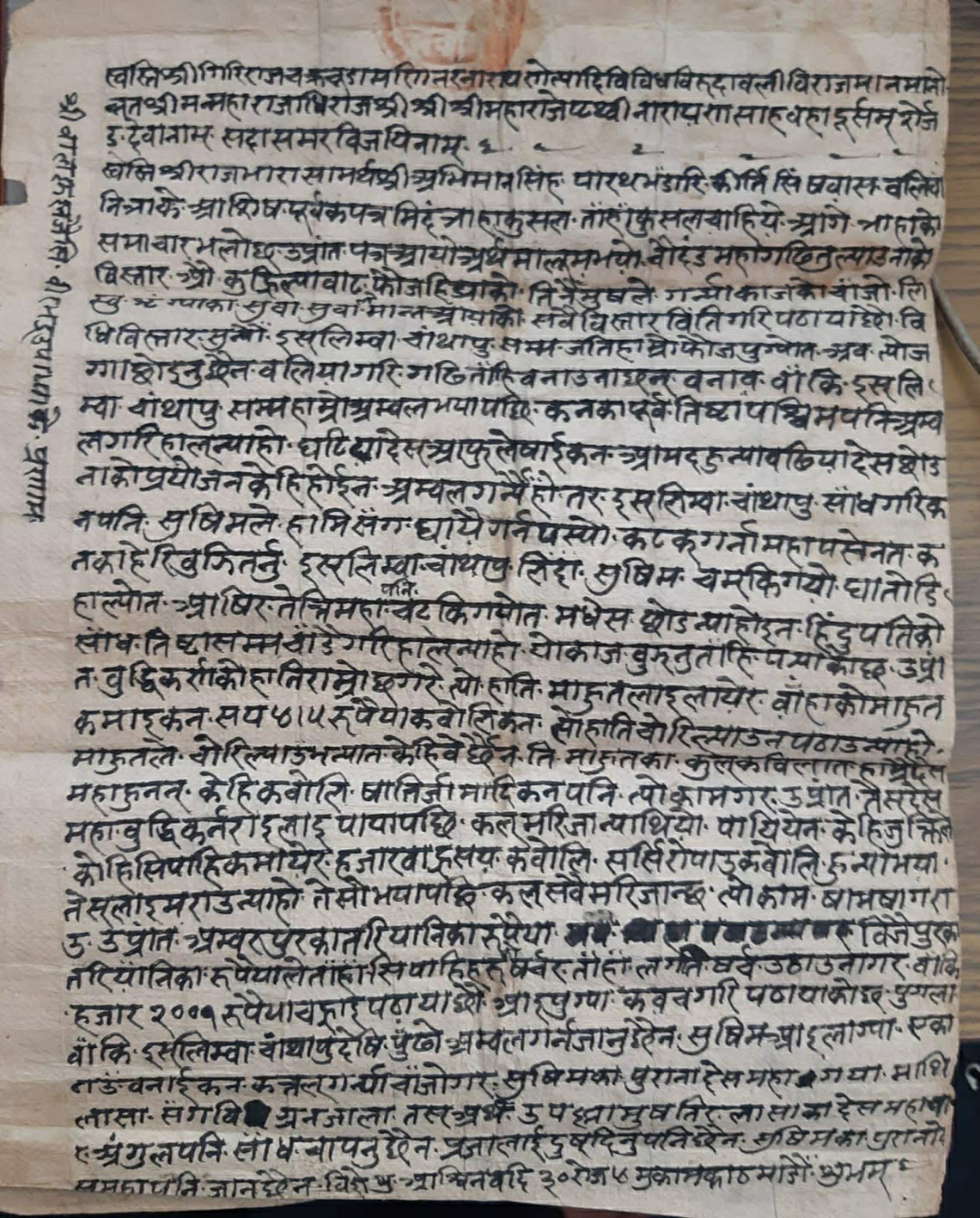
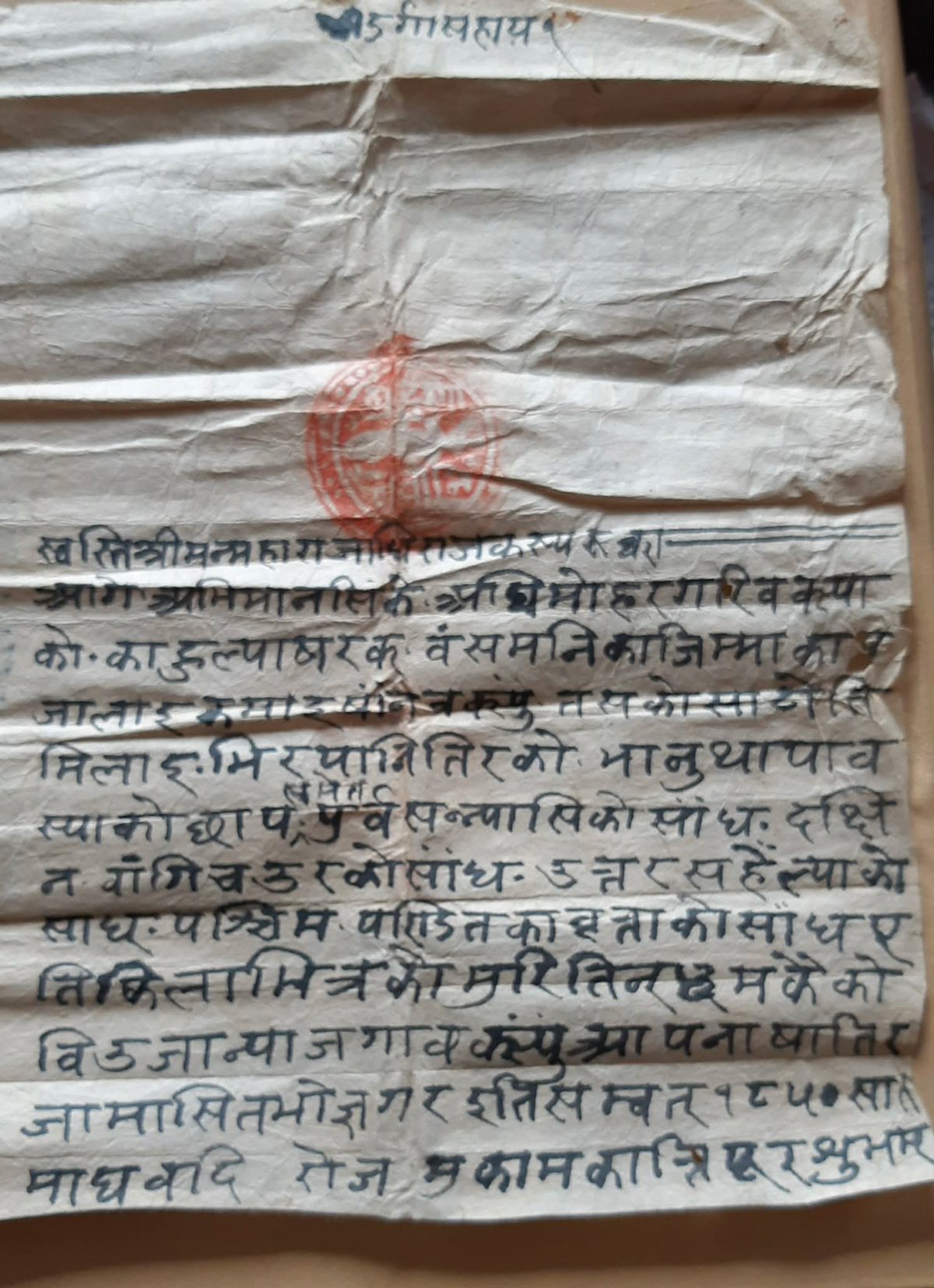
However, the Limbu did not easily accept Gorkhali supremacy. Amid rising tensions, Abhiman Singh and others compelled them to take a salt-water oath to accept Gorkhali rule. Consequently, King Prithvi Narayan Shah issued red seals (lal mohar) in the names of the Limbu leaders (Chemjong, 2059:94–96).
Red seal sent by King Prithvi Narayan Shah to Abhiman Singh Basnet and others leading the eastern front.
This red seal issued on the 1st and 2nd of Saun by King Prithvi Narayan Shah was documented by historian Shankarman Rajbanshi in the journal ‘Prachin Nepal’ (Issue 3, Baisakh 2025:29–30).
After subduing the Limbu, Abhiman Singh advanced through Kurlegadhi towards Isilimba and Chyangthapu regions of Panchthar. According to a red seal issued on Ashwin 30 by King Prithvi Narayan Shah, forces were dispatched to build the Chaudandi Mahagadhi fortification, preserved by Abhiman Singh’s descendants.
During the Gorkha expansion campaign, Abhiman Singh served as administrator of Vijaypur until 1834 AD. He received orders to arrest and execute the former minister Buddhikarna Rai, after the death of King Prithvi Narayan Shah.
Following Buddhikarna Rai’s assassination, peace prevailed among the Gorkhali. King Pratap Singh Shah expressed his gratitude in a letter to Abhiman Singh Basnet, who was subsequently rewarded generously, including grants of land and jagir.
Victory in Chitwan
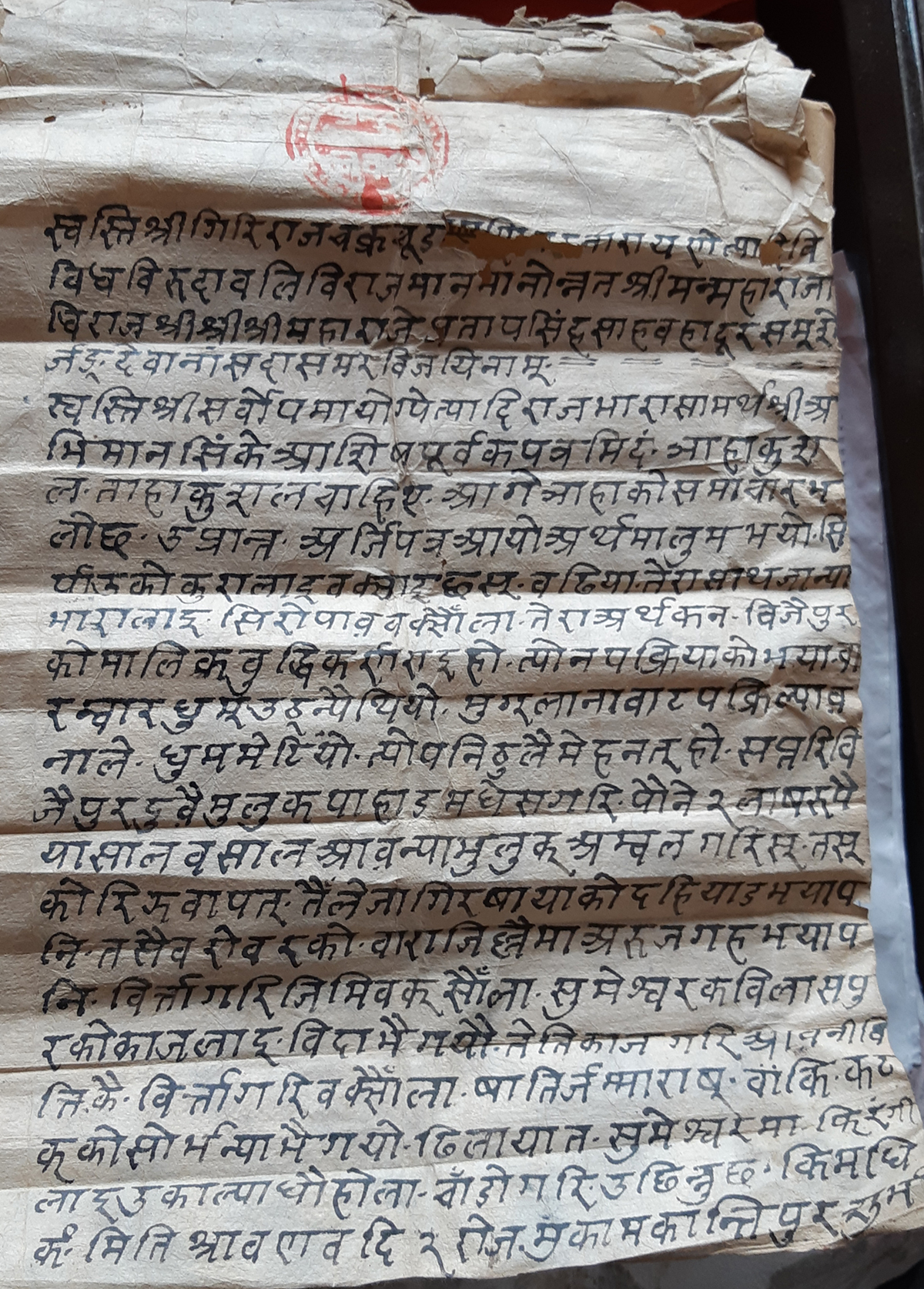
The present-day Chitwan (Sumeshwar) was under Tanahun Kingdom at the time. With British observers watching closely, King Pratap Singh Shah appointed administrator Abhiman Singh for the eastern front. He was also specifically directed towards Chitwan in the red seal letters.
Red seal from King Pratap Singh Shah calling Abhiman Singh Basnet from Vijaypur for the Sumeshwar (Chitwan) campaign.
During the campaign to capture Chitwan, Kaji Swarup Singh Karki was sent from Kathmandu. The then Tanahun King Harakumar Datt Sen had his forces stationed at Sumeshwar and Kavilasgarh. Fierce battles took place as the Gorkhali encircled Kavilaspur, eventually forcing Tanahun forces to retreat. Among Abhiman Singh’s forces were Swarup Singh Karki, Ram Krishna Kunwar, and Parath Bhandari. On Saun 6, Kavilaspur was captured followed by Sumeshwargarhi on the 26th. Chitwan was annexed to the Gorkha Kingdom. Examples of the southern front campaigns include battles in Saptari, Chaudandi, and Chitwan.
Leadership on the Western Front
Abhiman Singh also distinguished himself in battles on the western front. He participated in battles for Palpa and Lamjung. During the war with the Parvat kingdom, commander Ganesh Malla was captured. While Abhiman Singh remained in Tanahun, Swarup Singh returned to Kathmandu. They secured victories in Rishing, Ghiring, Charikot, and Paitu. During Bahadur Shah’s deputyship, when Kaji Damodar Pandey advanced toward the Kaligandaki region, Abhiman Singh also fought alongside him (Vaidya et al., 2049:434).
Abhiman Singh in the Northern Campaign
In 1848 BS, a war broke out between Nepal and Tibet over conflicts related to mosque management in Khasa. Abhiman Singh Basnet and Ranjit Kunwar were tasked with leading an attack from Kerung. They departed the battlefield on Saun 30 and fought on Bhadra 26. However, the Nepali side was defeated and forced to retreat to Keraubari (Baburam Acharya, ‘China Tibet and Nepal’–2059:152).
Red seal given by King Ranbahadur Shah granting land to Abhiman Singh Basnet in recognition of his service.
Following the looting of a monastery by the Nepali forces in Ditcharga town, China entered the war. Facing the massive Chinese army proved difficult. Tibetan-Chinese troops advanced as far as the Betrawati River. Despite the outcome, the Nepali army displayed significant valor and inflicted heavy damage on the opposing forces.
Eventually, both sides reached a peace agreement, signing a treaty on Bhadra 11, 1849 BS. A farewell feast was held for the Chinese forces, the necessary provisions for which were arranged by Abhiman Singh (Acharya, 2059:172–177).
Kaji Abhiman Singh Basnet’s extensive experience on the central, eastern, western, northern, and southern fronts has immortalized him in history as a brave warrior.
Abhiman Singh’s Residence
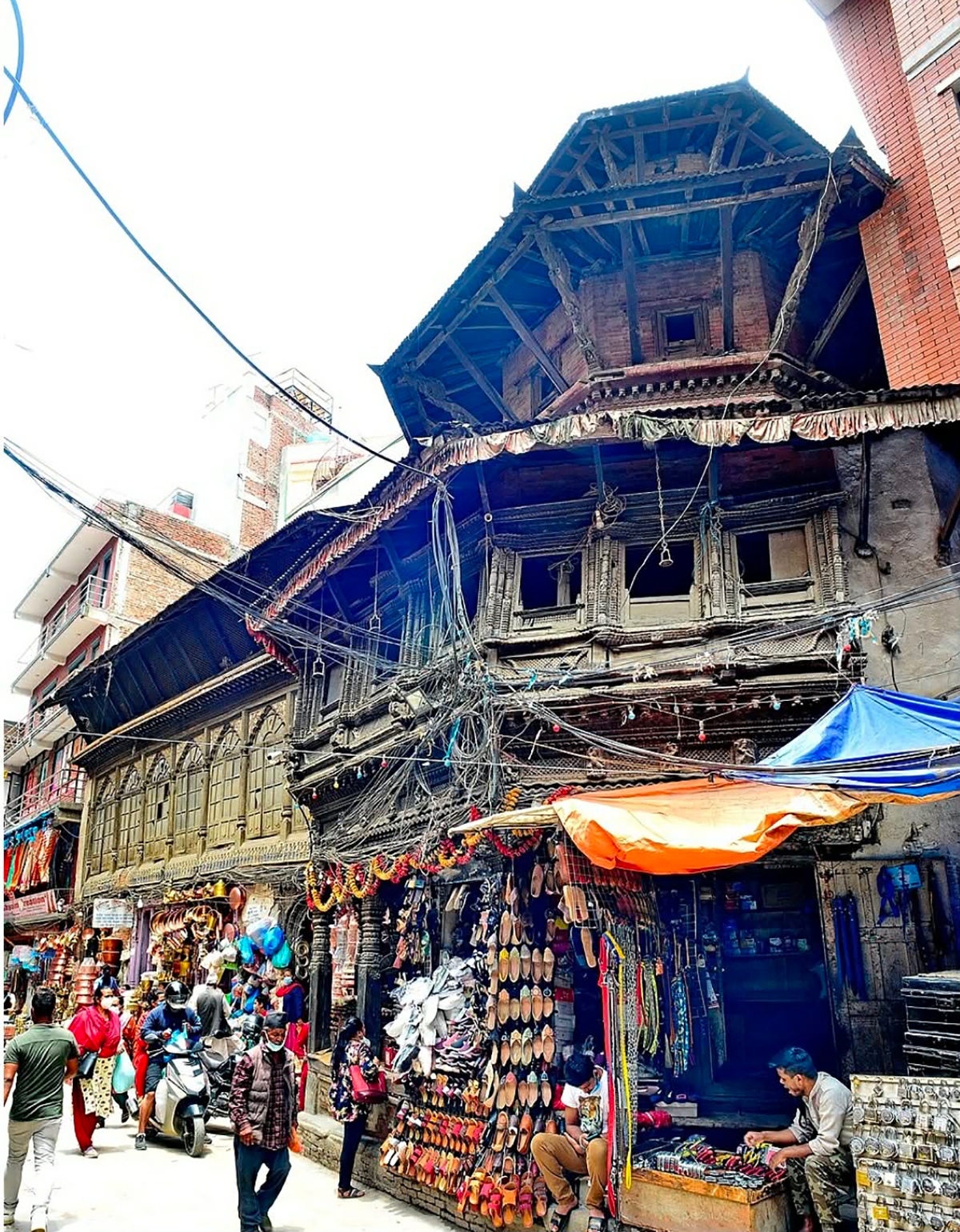
In Kathmandu’s Kel Tol area of Bal Kumari, an old palace showcasing exquisite Malla-era artistry still stands. Known as Tilanga House or Paltan House, its original name was ‘Man Mandir.’ This was the private residence of Kaji Abhiman Singh Basnet. In the then Narayanhiti complex, Abhiman Singh’s younger brother Dhaukalsingh Basnet had a separate residence.
Private residence of Abhiman Singh Basnet located in Kel Tol.
On Poush 10, 1833 BS, Abhiman Singh placed an inscription in the house complex, detailing its beauty, religious activities, and economic prosperity (Dhanvajra Bajracharya and Tek Bahadur Shrestha, ‘Inscriptions of the Shah Period’–2037:127–128).
The house originally belonged to Bhajudev Brahmin, the priest of Jayaprakash Malla. After the conquest of Kathmandu, it was confiscated and later granted to Abhiman Singh. In 1832 BS, King Pratap Singh Shah deposited one-sixth of the agreed sum and officially handed the house to Abhiman Singh. Old records bearing his name have been found there. Today, the house remains in ruins and is divided among the descendants of Abhiman Singh’s younger brother Dhaukalsingh.
Scientists at the University of Geneva have developed a ‘smart’ drug system that operates like a tiny computer inside the body. Made from synthetic DNA, this drug specifically destroys cancer cells while protecting healthy cells. This research was recently published in the prestigious scientific journal Nature Biotechnology.
The system works based on the concept of computer “logic gates.” Similar to two-factor authentication used in digital banking, this drug activates through a dual-switch mechanism. The drug contains different DNA strands, and it only activates when it detects two specific markers on the surface of cancer cells. If it finds only one marker or none at all, the drug remains inactive, thereby safeguarding healthy cells that are free of cancer.
Upon detecting cancer cells, the drug initiates a chain reaction that increases the concentration of the drug at the tumor site, enhancing treatment effectiveness. Unlike conventional chemotherapy, which destroys both cancerous and healthy cells, this smart drug does not harm healthy tissues. Furthermore, it can carry multiple kinds of drugs simultaneously, helping to overcome the resistance that cancer cells often develop against medication.
According to lead author Professor Nicolas Winssinger, the complexity of designing new drugs with the aid of computers and artificial intelligence is now a thing of the past. This drug has the capability to understand biological signals and respond intelligently based on them. The technology is poised to open new doors for personalized medicine. Researchers are currently working to refine this approach further and develop even more complex “smart” drugs that can make decisions autonomously within the body.
March 21, Kathmandu – The Election Commission has decided to resume the voter registration and updating process starting tomorrow, Sunday. This decision was made during a meeting held on March 18.
Nepali citizens possessing a national identity card number can register their names online by filling in the details contained in their identity cards.
According to Narayan Prasad Bhattarai, the spokesperson for the commission, individuals without a national identity card must fill out an online form through the commission’s pre-enrollment system, providing a photo, fingerprint, and biometric information. Additionally, provisions have been made to allow registration at provincial and district election offices.
March 21, Kathmandu – Nepali Congress leader Dr. Shekhar Koirala has attributed his party’s defeat in the recent House of Representatives election primarily to ‘swing votes.’ Speaking at the 18th Annual General Meeting of the VP Smriti Community Cooperative Hospital in Kathmandu on Saturday, he elaborated on this perspective. Koirala claimed that voters did not abandon the party outright but rather shifted their votes temporarily, and emphasized the importance of preventing such vote shifts in the future.
He identified the party’s weakened presence in parliament as largely due to a failure to understand public sentiment and the emerging political ‘storm.’ “Many wonder how we lost, what was done wrong,” Koirala said. “But it may be that such storms and political upheavals came, which we failed to comprehend.” He stressed that the next political battle will not be against leftists but against ‘liberal democrats,’ underscoring the need to strengthen the organization accordingly.
“Previously, our main contest was against the left, which was straightforward. Now, the battle is with liberal democrats,” he stated. “In this struggle, I believe we must not fall behind. We have the organization and the capability.” Koirala also recalled that from the beginning, the Central Working Committee had insisted on convening a special convention.
Regarding the special convention’s election of Gagan Thapa as party chairperson, he noted that the Supreme Court case filed by Sher Bahadur Deuba and Purna Bahadur Khadka remains pending a final verdict. Regardless of the court’s decision, Koirala reaffirmed his commitment to uniting the party. “The resolution of the case will begin tomorrow. I cannot say how long it will take,” he said. “But my final effort will be to consolidate Nepali Congress and bring everyone together.”