Advertisement1200×100-inside-1

Author: space4knews

वुमेन्स च्यालेन्ज ट्रफीमा नेपालको पहिलो जित, रुबिनाको ४ विकेट

Rubina’s Four Wickets Lead Nepal to First Victory in ICC Women’s Challenge Trophy

Summary: Nepal secured a 50-run victory over Italy in the ICC Women’s Challenge Trophy in Rwanda, propelled by Rubina Kshetri’s four wickets. Winning the toss, Nepal batted first and scored 112 runs for eight wickets, with vice-captain Puja Mahto remaining unbeaten on 48. Italy was bowled out for 62 runs in 18.4 overs, with Rubina conceding just four runs in 2.4 overs and taking four wickets, earning her the Player of the Match title. Kathmandu, 20 April.

Rubina Kshetri’s four-wicket haul was instrumental as Nepal triumphed over Italy by 50 runs in the ICC Women’s Challenge Trophy held in Rwanda on Sunday. This marks Nepal’s first win in the tournament, after a previous loss against the United States on Saturday. At the Gahanga International Cricket Stadium in Kigali, Nepal elected to bat first following the toss and posted 112 runs for eight wickets. Vice-captain Puja Mahto starred with an unbeaten 48 runs, supported by Samjhana Khadka’s 16, Bindu Rawal’s 15, and captain Indu Burma’s 10 runs. Other batters were unable to reach double figures.

For Italy, Emilia Bartram took three wickets, while Kumudu Pedric, Alexia Contopirakis, Elena Sims, Pasandi Kanakege, and Thilini Fernando claimed one wicket each. Chasing 113, Italy was all out for 62 runs in 18.4 overs. Chathurika Mahamalage top-scored for Italy with 22 runs. Nepal’s Rubina Kshetri dismantled the Italian batting line-up, conceding only four runs in her 2.4 overs while taking four crucial wickets. Her outstanding performance earned her the Player of the Match award. Additionally, Kavita Kunwar captured two wickets, while Manisha Upadhyay, Riya Sharma, and Rachana Chaudhary took one wicket each.

General Secretary Paudel: We Aim to Preserve History Digitally, Not Erase It

April 19, Kathmandu — Nepali Congress General Secretary Pradeep Paudel stated that the party’s intention is not to erase history but to preserve it securely in digital format.

Addressing an event held in Kathmandu on Sunday, he compared the process of updating party membership to filling out a bank’s Know Your Customer (KYC) documentation.

Paudel emphasized making party members accountable by having them take an oath, thereby strengthening their commitment.

“We are not trying to erase history, but rather aiming to safeguard it digitally so that it neither burns with fire nor washes away with water,” he said. “Details such as when a member joined, how long they were imprisoned, and their contributions to the party will no longer be kept in loose papers but securely stored in a digital system complete with photographs.”

He noted that internal conflicts within the party and disputes related to the special general convention have been resolved by the courts and the Election Commission. He urged party members to abandon any arrogance rooted in ‘victory or defeat’.

Looking ahead to the upcoming 15th General Convention scheduled from October 2 to 5, Paudel stated, “Our focal point now is the 15th General Convention. We will adopt maximum flexibility to include everyone.”


How did this news make you feel?
Happy

Happy

Sad

Sad

Surprised

Surprised

Excited

Excited

Angry

Angry

Comments

Newest Oldest Most Popular

Comment

Hot Properties

रित्तिएका गाउँ र जराविहीन जेनजी – Online Khabar

Vacant Villages and Alienated Generation Z in Nepal: Emerging Social Realities

The editorial review covers the shifting realities facing today’s youth, whose lifestyles starkly contrast with those of older generations. This demographic has spread across the globe in search of livelihoods, increasingly connected through mobile phones, yet showing diminishing attachment to traditional societies. This detachment, coupled with uncontrolled social media use, has contributed to current political unrest and rebellion.

This in-depth article by sociologist Mishra, published in three parts, situates the Generation Z movement within a global context and focuses on Nepal’s specific social dynamics. Professor Mishra, part of Nepal’s first generation of formal sociology educators and author of works such as Capitalism and Nepal, Changing Nepali Society, Essays on the Sociology of Nepal, and Democracy and Contemporary Marxism, examines how technological tools have fueled youth-led resistance and their wide-ranging effects.

Rapid social generational shifts have profound impacts, transforming not only individual life courses but also broader social-historical paradigms. These changes, accelerating in social, economic, political, and cultural realms, are expected to intensify in the coming decades, potentially sparking widespread conflicts, clashes, and generational rifts. These processes collectively bring forth new generations over abbreviated timespans.

The expansion of digital technology and artificial intelligence (AI) has dramatically increased access to information and knowledge, but it also opens the door to floods of disinformation and fabricated visuals, with potentially significant political, economic, and social repercussions. Projected advances in AI and robotics may elevate unemployment—particularly in repetitive jobs and lower-tier digital and clerical work.

Additionally, pandemics and wars risk devastating large segments of humanity. Climate crises threaten myriad livelihoods through irregular rainfall, resource scarcity, and population decline, potentially normalizing social instability, conflict, and displacement—which in turn creates marginalized communities. New instabilities within the capitalist global economy increase the likelihood of political and military realignments worldwide, often driven by right-wing, ethnic, and nationalist forces.

Accelerated de-ruralization is transforming villages into shadows of urban centers, exacerbating shortages of local resources and existential threats. These conditions fuel intensified generational social conflicts. Traditional political coalitions are losing relevance, while emerging social structures give rise to new identities. Individuals are also undergoing profound changes, necessitating a redefinition of generational relationships in line with societal transformations.

In Nepal, the youth, especially Generation Z, express varying degrees of rebellion through technology. The violence witnessed on September 8–9 underscores that not all Nepali youth collectively represent Gen Z. Reports indicate involvement of multiple factions in political violence during these events.

Over recent decades, Nepal’s youth have experienced significant social, economic, and cultural shifts—aggravating rural-to-urban migration and destabilizing traditional livelihoods. Declining agricultural contributions have generated unprecedented challenges for production processes, social structures, and farming lifestyles. Demographically, birth rates have plummeted and household sizes have shrunk. Migration from hill and mountain regions to the Terai and urban areas has increased notably, with the Terai’s population share rising significantly from 1971 to 2021.

Urbanization is playing out unevenly, with employment often precarious and poorly paid. Growing dependency on foreign employment and remittances has reshaped the economy, while fallow land and disrupted traditional farming pose grave challenges in rural areas. Abandoned fields, aging populations, and animal damage vividly illustrate these trends. Livelihood sources are increasingly shifting toward urban and international centers, weakening intra-community relations and cooperation in rural locales.

Traditional demarcations between city and village no longer capture reality, prompting the need for fresh cultural and political definitions. Urban lifestyles and cultures are reshaping rural areas profoundly. Understanding the origins and experiences of today’s Generation Z requires both local insights and a grasp of global trends.

The Gen Z involvement in the September 8–9 violence was neither complete nor universally accepted. Long-term economic, cultural, and work-related changes have profoundly altered social bonds and attachments. People are moving away from traditional families and communities toward shorter-term and more superficial personal relationships. Often, this increases instability and uncertainty, especially among impoverished and marginalized groups. Conversely, some groups—such as rural Madhesi women, Dalits, and agricultural laborers—have gained new freedoms and access, though they remain far from full empowerment.

Scarcity of rural production resources weakens community attachment and destabilizes livelihoods. Significant structural reform is urgently required to prevent large numbers of youth from falling into social and economic instability.

Youth engagement and social influence have grown alongside shifts in power. Although savings are limited in rural areas, urban centers offer employment and income opportunities that attract youth. Cities serve as hubs introducing youth to modern education, healthcare, and global trends. Nepali youth abroad share information and experiences that foster social and political awareness at home. Urban youth lead political and social movements, shaping political consciousness nationwide. Their votes significantly impact election outcomes, even in rural areas.

Mobile phones and social media have become unprecedented tools for connecting Nepali youth, facilitating relationships, information exchange, and global connectivity. These platforms erase geographic barriers, easing the flow of knowledge and ideas. However, social media also produces harmful effects: echo chambers, fake news surges, anonymity-driven misconduct, and dangerous behaviors proliferate. Disinformation spread online has been a key driver of political disputes and violence.

The third and final part of this article will be published on Monday.

Power and Internet Services Disrupted in Birgunj Due to Road Expansion

In Birgunj’s main market area, both electricity and internet services were disrupted from 5:00 a.m. until 4:30 p.m. today due to road expansion work. Vijay Mahto, head of the Nepal Electricity Authority’s Birgunj Distribution Center, informed that power supply irregularities may continue until April 21. Local businessman Parshuram Kalwar stated that inadequate preparation during the road expansion caused interruptions in electricity and internet services, adversely affecting daily life.

The disruption occurred when the Hetauda Road Department began demolishing unauthorized structures encroaching on the main road in Birgunj using dozers and excavators from early morning. The outage in both electricity and internet services led to difficulties in daily activities and inconvenienced residents. The affected area spans from Gandak Chowk to Miteri Bridge, where services were unavailable from 5:00 a.m. to 4:30 p.m.

Parshuram Kalwar, a local trader in Birgunj Metropolitan Ward-6, highlighted the impact of the road expansion on power and internet services. He said, “The outage from this morning disrupted daily life. The local administration failed to make adequate preparations before commencing the road expansion, causing problems for the general public during the summer season. Without electricity, motors cannot operate, and water cannot be drawn from borewells, leading to water shortages necessary for sanitation.”

Vijay Mahto of the Nepal Electricity Authority’s Birgunj Distribution Center confirmed that during the road expansion from Miteri Bridge to Gandak Canal, power supply will be irregular. He stated, “From today until April 21, power supply disruptions are expected. Due to extensive repair work outside the Kabul area, maintenance has been ongoing since early morning.” Mahto urged the public and relevant stakeholders to exercise patience given the anticipated interruptions in service.

सम्मानजनक व्यवहार नभए विकल्प खोज्ने – Online Khabar

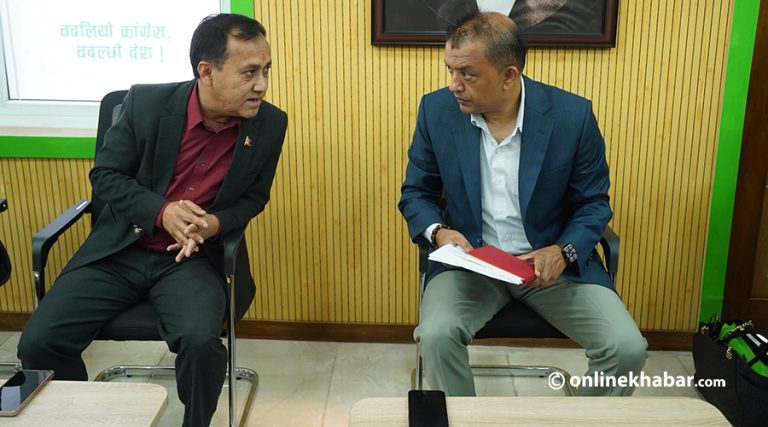
Congress Deuba Faction Adopts ‘Wait and See’ Strategy After Supreme Court Validates Gagan Thapa Leadership

Summary: Following the Supreme Court’s decision to legitimize Gagan Thapa’s leadership, the Deuba faction of the Congress Party has chosen to adopt a ‘wait and see’ strategy for a few days. The Deuba camp convened a meeting of former central members, deciding to accept the court order while continuing the political struggle. Discussions between the two factions within Congress are ongoing, with a decision to allow some time to formulate the next steps.

Kathmandu, Baisakh 6 – After the Supreme Court granted legal recognition to Gagan Thapa’s leadership, Sher Bahadur Deuba’s faction within the Congress Party took a defensive stance, adopting a multi-day ‘wait and observe’ approach. Following intensive discussions over Saturday and Sunday, the party leadership concluded that they would carefully observe the role the party will assume, subsequently determining their strategy. The establishment faction has reviewed the possibility that if the Deuba group is not treated respectfully, they may seek alternative options.

After Friday’s court order, the Deuba faction held persistent discussions and organized a meeting of former central members today. On Saturday, under the leadership of former acting president Purna Bahadur Khadka, top leaders of the Deuba group gathered, followed by today’s meeting where former central members expressed their views. These members strongly voiced their opposition to the special general convention, led by four senior leaders—Khadka, Bimalendra Nidhi, Krishna Prasad Sitaula, and Prakashman Singh.

Some leaders aligned with Dr. Shekhar Koirala did not participate in the Deuba faction’s discussions. Former General Secretary Dr. Shashank Koirala was also absent from today’s meeting. Approximately three dozen former central members took part in the discussions, while Shekhar Koirala’s faction held a separate meeting on Sunday morning. Koirala’s faction decided to accept the court ruling, reflecting their past role as mediators. Commenting on the situation, Koirala-aligned leader Jeevan Pariyar emphasized, ‘There is a shared responsibility among all to build broader interests, unity, and a stronger organization within the Congress. The Central Working Committee and the party president bear even greater responsibility. In difficult times, all members must be responsible and committed from their positions.’

According to leaders from the Deuba faction, this series of meetings will continue systematically. Former central member Guru Baral informed that meetings began on Saturday and will proceed in a series until collective decisions are reached. However, the date for the next meeting has not yet been set. Despite accepting the court order during discussions on Saturday and Sunday, participating leaders expressed reservations about its interpretation. The court had previously endorsed the leadership selected through the special general convention.

Following the court’s ruling, former acting president Khadka convened meetings of the faction yesterday and today to develop strategy. Speaking at Sunday’s meeting, former central member Baral stated, ‘We accept the court’s decision, but the political struggle will continue.’ Though the immediate possibility of forming a new party is limited, suggestions have been made to prepare for that option. Should Gagan Thapa’s faction adopt a plan to avoid pressure, participating leaders believe preparations for alternatives must be considered.

Veer Bahadur Balayar, president from Far-Western Province, commented, ‘Whether unity will be achieved or not is not entirely in our hands. The responsibility to advance inclusively lies with the leadership that the court has recognized. There are lifelong veteran leaders here, and how this faction is treated is the responsibility of the court-recognized leadership.’

Major Fire Erupts at Cafe in Chabahil Area

April 19, Kathmandu – A significant fire broke out on Sunday afternoon at the Hajipur Tea Cafe located in Chabahil, Kathmandu. The blaze completely destroyed the cafe’s structure. Upon receiving the report, the Kathmandu Metropolitan Fire Brigade promptly arrived at the scene and successfully brought the fire under control. The fire also caused damage to nearby structures. Preliminary investigations suggest that the fire may have started due to a gas leak. While there were no human casualties, authorities have reported that the fire resulted in physical damages amounting to millions of rupees.

सरकारी कर्मचारीलाई १५ दिनमै तलब खुवाउने तयारी – Online Khabar

Government Plans to Disburse Salaries to Civil Servants Every 15 Days

April 19, Kathmandu – The government has formulated a plan to provide salaries and allowances to civil service employees in installments every 15 days. The Ministry of Finance issued a ministerial-level directive last Friday, instructing the Office of the Comptroller General to make the necessary arrangements for this change. Comptroller General Shobhakant Paudel confirmed the receipt of the circular from the ministry and stated that the decision will be implemented soon. “The circular has arrived from the Ministry of Finance. The implementation will commence shortly,” he said.

According to the ministry, the decision aims to ensure timely crediting of funds into employees’ accounts and to keep the economy functioning smoothly. However, implementing this decision requires amendment of the existing legislation. Currently, government employees receive their monthly salaries and allowances once a month, with payments transferred to their bank accounts during the last week of each month. Transitioning to a bi-monthly salary payment system necessitates changes to the Federal Civil Service Act. “Under the old act, civil servants receive their salaries and allowances only after completion of the one-month payment cycle,” an official from the Ministry of Finance explained. “Therefore, to introduce salary and allowance payments every 15 days, amendments to the act are essential.”

The current administration is preparing to enact a new Federal Civil Service Act, which will include provisions for salary payments every 15 days. “Once the Federal Civil Service Act is passed, the decision can be implemented at any time. Necessary preparations are underway,” a source from the Ministry of Finance stated.

Congress Raises Concern Over Customs Duty on Items Priced Above Rs 100

The Nepali Congress has expressed serious concern over the imposition of customs duty on goods priced above Rs 100 in the Indian border areas. Congress spokesperson Devaraj Chalise criticized the decision as anti-people, impractical, and insensitive. He stated, “Such policies or government behaviors are not only anti-people and impractical but also add to the burdens on citizens amidst the current economic crisis.”

The Congress has also presented five demands to the government, emphasizing that additional charges on petroleum products will institutionalize poverty further. Chalise explained that, due to the open border, residents in the border areas have been sustaining themselves by purchasing daily necessities from India at cheaper prices. This decision has directly impacted millions of common people, daily wage workers, small farmers, and low-income families, particularly in the Madhesh Province.

Given the already high prices of petroleum products, charging extra fees on purchases ranging from Rs 200 to Rs 300 negatively affects people’s purchasing power and represents a policy that institutionalizes poverty, stated the Congress in opposition to the measure. The party stressed that the government must urgently address and fulfill these five demands.

Kunha’s Goal Secures Manchester United Victory Over Chelsea

Manchester United defeated Chelsea 1-0 to strengthen their chances of qualifying for the UEFA Champions League. Matheus Cunha’s goal in the 43rd minute proved decisive in securing the victory for United. The top five clubs in the Premier League will earn automatic qualification to the Champions League, with Europa League semifinal results also influencing qualification possibilities.

April 19, Kathmandu – In last night’s English Premier League action, Manchester United claimed a crucial victory against Chelsea, boosting their prospects for European competition next season. The match took place at Chelsea’s home ground, Stamford Bridge, where United emerged victorious with a 1-0 scoreline. Following this win, United accumulated 58 points from 33 games, maintaining their third-place position, while Chelsea remained sixth with 48 points.

The Premier League’s top five clubs will automatically qualify for the Champions League. However, clubs finishing sixth or seventh may still qualify if they win either the Europa League or the Champions League. This season, as many as six English clubs could earn Champions League berths. In the Europa League semifinals, Aston Villa will face Nottingham Forest, with the winning team having a chance to reach the final and secure Champions League qualification by winning the trophy.

Other Premier League results from last night included a 2-2 draw between Tottenham and Brighton, Leeds United’s 3-0 victory over Wolverhampton Wanderers, Bournemouth’s 2-1 win against Newcastle United, and a goalless draw between Brentford and Fulham.

आर्सनलमाथि सिटीको जितपछि घट्यो अंकदूरी, रोचक बन्दै उपाधि होड

Manchester City’s Win Narrows Point Gap with Arsenal, Intensifying Title Race

In the English Premier League, Manchester City reduced their points deficit to Arsenal by defeating them 2–1. Ryan Cherki and Erling Haaland scored for City, while Kai Havertz netted for Arsenal. City has the chance to climb to the top with a two-goal victory against Burnley.

Kathmandu, April 19 – The race for the English Premier League title has become more thrilling. In the match played on Sunday night, second-placed Manchester City defeated league leaders Arsenal 2–1, narrowing the points gap.

At their home ground, City took the lead in the 16th minute through Ryan Cherki. Just two minutes later, Kai Havertz equalized for Arsenal, and the first half ended 1–1. In the second half, Erling Haaland scored the decisive goal in the 65th minute. With no further goals, Arsenal missed the opportunity to extend their lead.

Had Arsenal won, they would have increased their lead to nine points. Currently, City has 67 points from 32 matches, while Arsenal sits on 70 points from 33 matches. City, facing a double gameweek, could move to the top if they secure a two-goal win against Burnley.

Industry Department Grants HiLife the Rights to Use ‘Kurumu Kurum’ Brand on Chewing Tobacco

The Industry Department has resolved the trademark dispute between HiLife and Sixvilla by awarding the rights to use the ‘Kurumu Kurum’ brand on chewing tobacco to HiLife. The department canceled the registration of Sixvilla Pvt. Ltd. and deemed HiLife’s brand original and established in the market. This decision underscores the importance of intellectual property protection and safeguarding consumer interests. Kathmandu, 6 Baisakh.

HiLife has been granted the rights to print the ‘Kurumu Kurum’ brand on chewing tobacco. The Industry Department ruled in favor of HiLife in the trademark dispute between HiLife and Sixvilla, affirming that the rights to the Kurumu Kurum brand belong to HiLife. This decision came after a long-standing dispute between Nepal Everest Food & Snacks Pvt. Ltd., which produces HiLife products, and Sixvilla Pvt. Ltd., with the department ultimately canceling Sixvilla’s registration.

The department reached its conclusion after reviewing evidence, arguments, and Supreme Court precedents presented by both parties, confirming that the rights to the ‘Kurumu Kurum’ brand on chewing tobacco belong to HiLife. The dispute centered on Nepal Everest Food & Snacks Pvt. Ltd.’s use of the ‘HiLife’ trademark, associated labels, design, color combinations, and overall presentation. The complainant accused Sixvilla Pvt. Ltd. of using a very similar mark in appearance, structure, and presentation.

Upon examining the claims, submitted documents, and visual evidence from both parties, the Industry Department concluded that the trademark registered by Sixvilla is strikingly similar to HiLife’s. Notably, the department highlighted significant similarities in label design, color combinations, typography, product presentation, and overall outward appearance. The decision emphasized, “The main characteristic of a trademark is distinct identity. If a mark cannot establish a distinct identity in the market or resembles a previously established mark, it cannot be considered valid.”

Courtesy Meeting Between National Assembly Chair Narayan Prasad Dahal and Australian Speaker Milton Dick

April 19, Kathmandu: A courtesy meeting took place between Narayan Prasad Dahal, Chairperson of Nepal’s National Assembly, and Milton Dick, Speaker of the Australian House of Representatives. The leaders met during the 152nd General Assembly of the Inter-Parliamentary Union, held in Istanbul, Turkey. According to the Chairperson Dahal’s secretariat, the discussion focused extensively on bilateral relations, mutual interests, and parliamentary cooperation between Nepal and Australia.

Acknowledging Australia’s longstanding support for Nepal’s development and prosperity, Chair Dahal expressed hopes for increased future collaboration and assistance. In response, Speaker Milton Dick affirmed that the relationship between Australia and Nepal has historically been very cordial, and he expressed confidence that parliamentary cooperation would further strengthen and deepen ties between the two nations. Members of the Nepali parliamentary delegation at the meeting included National Assembly members Krishna Bahadur Rokaya, Dr. Anjan Shakya, and National Assembly Secretary Tulbahadur Kandel.

Nepal and UAE Face Off in Kirtipur After Two and a Half Years in Historic Night T20 International

After a long wait, the Nepalese cricket team is finally set to play an international match on home soil, where the Kirtipur grounds will once again echo with the cheers—and hoots—of local fans. On April 20, Nepal will host the UAE in a T20 International at the Tribhuvan University Cricket Ground in Kirtipur, marking the first time an international match will be held there under floodlights at night. The Nepalese side will be led by captain Dipendra Singh Airee, with regular players Rohit Paudel, Sompal Kami, Karan KC, and Asif Sheikh absent from the squad. So far, Nepal and the UAE have faced each other 11 times in T20Is, with Nepal winning 6 matches and the UAE 5. The only match held in Kirtipur so far was won by the UAE. (April 20, Kathmandu)

Two years ago, on March 5, 2024, the Tribhuvan University Cricket Ground hosted the final match of the ICC Cricket World Cup League 2 T20I series featuring Nepal, the Netherlands, and Namibia. That game was intensely competitive until the final over, with Nepal setting a target of 185 runs for the Netherlands. Nepalese fans were disappointed by the outcome, but could not have anticipated such a long wait for another international fixture at home. Since then, the earth has completed more than two orbits around the sun, and the condition of the Tribhuvan University Cricket Ground has also evolved.

Now, after two and a half years, Nepal will have the historic opportunity to play an international match at home ground once again. While matches had previously been played only during the daytime, this will be the first time in Nepalese cricket history that an international game takes place under floodlights at night. Familiar rivals Nepal and the UAE will meet face to face in Kirtipur after 2.5 years. Notably, many regular and senior players participating in this series are absent, and the captaincy has changed. Under new captain Dipendra Singh Airee’s leadership, the young Nepalese team embarks on a fresh start in T20I cricket.

आईपीएलमा पन्जाबको अपराजित यात्रा कायमै, लखनउमाथि शानदार जित

Punjab Kings Extend Undefeated Run with Dominant Win Over Lucknow Super Giants in IPL 2026

Punjab Kings continued their unbeaten streak in IPL 2026 by defeating Lucknow Super Giants by 54 runs. Punjab set a challenging target of 254 runs, which Lucknow could not chase down, being all out for 200 runs in 20 overs. With 11 points from six matches, Punjab tops the standings, while Lucknow holds the eighth position with 4 points.

On April 19, in a match held at Mullanpur, Punjab Kings maintained their lead in the Indian Premier League (IPL) 2026 by securing an emphatic 54-run victory over Lucknow Super Giants. Punjab posted a strong total of 255 runs, a target that Lucknow failed to achieve despite their best efforts, reaching only 200 runs for 5 wickets in 20 overs.

Lucknow captain Rishabh Pant was the top scorer for his side with 43 runs, supported by Aiden Markram’s 42 runs. For Punjab, Marco Jansen claimed 2 wickets, while Arshdeep Singh, Vijaykumar Vaishak, and Yuzvendra Chahal each took one wicket. After losing the toss, Punjab elected to bat first and posted 254 runs for the loss of 7 wickets in their 20 overs, thanks to aggressive innings from Priyansh Arya and Cooper Connolly.

Arya played a brilliant innings, scoring 93 runs off 37 balls, featuring 4 fours and 9 sixes. Connolly contributed 87 runs from 46 balls, hitting 8 fours and 7 sixes. Despite both nearing centuries, they fell short but put together a formidable 182-run partnership for the second wicket, following an early loss of the first wicket for just 3 runs. Marcus Stoinis added 29 runs and Shashank Singh contributed 17. For Lucknow, Prince Yadav and Manimaran Siddharth took 2 wickets each, while Mohammad Shami and Mohsin Khan took one wicket each. With this win, Punjab recorded their fifth victory in six matches, securing 11 points to remain at the top of the table. Lucknow, on the other hand, has 4 points from six matches and is placed in eighth position.

Non-Performing Loans Surpass 10% in 21 Microfinance Institutions; Loan Defaults Rise Amid Property Market Slump

The COVID-19 pandemic and the ensuing economic downturn have further complicated loan recovery issues in the microfinance sector. According to Nepal Rastra Bank, as of the second quarter of the current fiscal year, the non-performing loan (NPL) rate in microfinance institutions has reached 9.99 percent. Among 21 microfinance institutions, the NPL rate exceeds 10 percent, with Sanjivani Microfinance recording a staggering 100 percent bad loan rate. Kathmandu, April 19.

The challenges in loan recovery within microfinance have intensified. The economic disruptions caused by the pandemic and recession have created a complex situation for the sector. Since banks and financial institutions have a significant portion of their resources directly and indirectly tied to real estate, the entire economy has been impacted. The government’s attempts to regulate the burgeoning real estate investment bubble have pushed the economy further into recession.

During fiscal year 2077/78 (2020/21), loans disbursed by banks and financial institutions to the private sector increased by 28 to 30 percent, yet economic growth remained limited to around 4 percent. The preceding fiscal year had witnessed negative growth. Subsequently, Nepal Rastra Bank tightened investment regulations in the financial sector. When signs of this move impacted the real estate market, an economic downturn ensued. Economists note that without improvements in real estate transactions, economic activities have been unable to return to pre-downturn levels.

The situation has become even more complex in the microfinance sector due to credit misuse, multiple borrowing, and a rising number of loan defaulters. Nepal Rastra Bank conducted studies to address these issues. Based on these, the bank implemented various policy measures aimed at resolving microfinance challenges and moving forward. These policies included stricter regulations on loan rescheduling and restructuring, interest rates, service charges, and loan limits. Although the central bank’s policy reforms were expected to alleviate sector problems, the situation appears to have worsened.