Author: space4knews

CPN-UML Officially Congratulates Prime Minister Balendra Shah

March 20, Kathmandu – The Communist Party of Nepal (Unified Marxist-Leninist), CPN-UML, has formally congratulated Prime Minister Balendra Shah (Balen). The party’s Central Secretariat meeting held on Friday at the party’s central office in Chyasal resolved to extend official congratulations to Balen. The party statement read, ‘‘We extend our congratulations to the honorable Prime Minister Balendra Shah and his cabinet for successfully forming the government under his leadership with an overwhelming majority.’’
Prior to this, the parliamentary party leader Ram Bahadur Thapa Badal addressed a meeting of the House of Representatives. His remarks sparked criticism from both within and outside the party. During his speech, he accused the Nepalese Army, the bureaucratic apparatus, and non-governmental organizations of contributing to the rise of the Rastriya Swatantra Party as the leading party. The CPN-UML also held extensive discussions regarding this issue.

आबुधाबीमा ड्रोन र मिसाइलको अवशेष खस्दा ७ नेपाली घाइते, एकको अवस्था गम्भीर

Seven Nepalis Injured by Drone and Missile Debris in Abu Dhabi; One in Critical Condition

In Abu Dhabi’s Al Ajban area in the United Arab Emirates, debris from drones and missiles intercepted by the air defense system injured seven Nepali nationals. Among the injured, six Nepalis are in stable to moderate condition, while one is critically injured. Additionally, debris falling in the Hubson Gas industrial area of Abu Dhabi caused a fire.

March 20, Kathmandu – According to the Abu Dhabi Media Office, six of the injured Nepalis have been reported to be in stable to moderate condition, while one remains critically injured, as reported by Gulf News. The incident also left five Indian nationals injured. The names of the injured have not been publicly disclosed.

The Al Ajban area is located north of Al Ain in Abu Dhabi, near the Dubai-Al Ain border. The United Arab Emirates Ministry of Defense stated that the air defense system successfully intercepted missiles and unmanned drones. However, debris from these interceptions caused damage across various locations in the Al Ajban area.

Following the incident, emergency rescue teams were immediately deployed, and security measures in the affected area have been intensified. The injured have been sent to hospitals for treatment, officials said. Meanwhile, a fire broke out in the Hubson Gas industrial area of Abu Dhabi due to falling debris, temporarily halting operations there. No human casualties have been reported in that incident. Government officials have urged the public to rely only on official sources for information and to avoid spreading unverified reports.

Corruption Case Filed Against Rastriya Swatantra Party Karnali Deputy General Secretary and Four Others

Chaitra 20, Surkhet – A corruption case has been filed against Hari Prasad Adhikari, Deputy General Secretary of the Rastriya Swatantra Party (RSP) Karnali Province Committee, along with four others. The Commission for the Investigation of Abuse of Authority (CIAA) lodged the case in the Special Court on charges of embezzling funds from the Malika Community Forest User Committee.

The CIAA announced on Thursday via a press release that over NPR 1.2 million was misappropriated from the Malika Community Forest User Committee located in Chaukune Rural Municipality–5, West Surkhet. The commission stated that the User Committee’s Chairperson Amar Bahadur Dani, Treasurer Savitra Adhikari, Secretary Tejendra Bahadur Bayak Kshetri, and member Hari Prasad Adhikari colluded to misuse funds.

The investigation revealed illegal financial irregularities spanning from fiscal years 2070/71 to 2075/76. “They spent funds without committee approval or invoice verification, processed payments for road construction without any approved plan and fabricated documents, and paid audit fees without conducting proper audits,” the CIAA’s statement detailed.

Additionally, the commission found that proceeds from timber sales were not deposited into the committee’s account. Large sums were embezzled without documentation under the pretexts of nursery management, legal fees for forest-related cases, and witness expenses. The public fund of the user group was used to cover case and witness expenditures amounting to NPR 285,000. It was also alleged that the forest group president personally misappropriated NPR 41,162 purportedly for relocation to Birendranagar for personal gain.

Based on the collusion among the five committee members, an embezzlement totaling NPR 1,218,512 was confirmed. Consequently, the CIAA has registered charges against them in the Special Court in Kathmandu.

ROEL and Playbox Arena Secure Victories in HJNBL 2026

In the Himalayan Java National Basketball League 2026, ROEL defeated Solo Basketball Club by a score of 78-67. Playbox Arena secured their third win by beating Kirtipur 83-71. The league’s top four teams will advance to the playoffs, with the champion earning a cash prize of 400,000 NPR. Kathmandu, 20 Chaitra.

On Friday, in HJNBL 2026, both ROEL and Playbox Arena showcased strong performances. At the Dashrath Rangashala Covered Hall in Tripureshwor, ROEL triumphed over Solo Basketball Club 78-67 in the opening game. Both teams took two quarters each, but ROEL managed an exciting win. ROEL established a commanding 25-7 lead in the first quarter. Solo clawed back in the second quarter with a 26-14 run and trailed 39-33 at halftime.

Solo continued their momentum with a 27-17 third quarter, taking a 60-56 lead heading into the final quarter. However, ROEL mounted a comeback in the fourth quarter, outscoring Solo 22-7 to secure a 78-67 victory. This marked ROEL’s second win in 13 games, accumulating 15 points overall. For Solo, it was their 11th loss.

In the second match on Friday, Playbox Arena defeated Kirtipur 83-71. Kirtipur led narrowly 22-21 in the first quarter, but Playbox Arena rallied in the second quarter, outscoring their opponents 20-16 to reach halftime leading 41-38. Sudip Karki of Playbox was named Man of the Match after scoring 16 points. The second edition of HJNBL, organized by the Nepal Basketball Association (NEBA), features competition among eight teams.

आईपीएलमा पन्जाबको लगातार दोस्रो जित, चेन्नईको दोस्रो हार

Punjab Secures Second Consecutive Win in IPL, Chennai Suffers Second Defeat

Punjab Kings have secured their second consecutive victory in IPL 2026 by defeating Chennai Super Kings by 5 wickets. Chennai, batting first, posted a total of 209 runs for the loss of 5 wickets in 20 overs. Kathmandu, March 20.

Punjab successfully chased the target of 210 runs in 18.4 overs, losing 5 wickets. Captain Shreyas Iyer scored a quick 50 runs off 29 balls, including 4 boundaries and 3 sixes. Opener Priyansh Arya provided an aggressive start with 39 runs off 11 balls. Fellow opener Prabhsimran Singh contributed 43 runs, while Cooper Connolly added 36 runs off 22 balls.

For Chennai, Matt Henry and Anshul Kambodia each took 2 wickets. Losing the toss and opting to bat first, Chennai managed 209 runs for 5 wickets in their 20 overs. Ayush Mhatre top-scored with 73 runs off 43 balls, including 7 boundaries and 5 sixes. Shivam Dube remained unbeaten on 45 runs, while Sarfaraz Khan scored 32 and captain Ruturaj Gaikwad added 28 runs.

Punjab’s Vijaykumar Vaishak claimed 2 wickets, and Xavier Bartlett, Marco Jansen, and Yuzvendra Chahal took one wicket each. With this second consecutive win, Punjab tops the standings with 4 points from 2 matches. Chennai, on the other hand, remains winless after two defeats and sits at the bottom of the table.

‘शोले’ निर्देशक भन्छन्- नेपाली फिल्मले नेपालीपन जोगाउनु अनिवार्य छ

‘Sholay’ Director Ramesh Sippy: Preserving Nepali Identity in Nepali Cinema is Essential

Summary: Indian film ‘Sholay’ director Ramesh Sippy is currently in Kathmandu as a special guest at the Nepal International Film Festival. Sippy described ‘Sholay’ not just as a successful film but as a cultural milestone that added a new dimension to the Indian film industry. He expressed optimism about the future of the Nepali film industry and emphasized the necessity for Nepali filmmakers to preserve their cultural identity.

Kathmandu – Renowned Indian filmmaker Ramesh Sippy, the director of the influential and acclaimed film ‘Sholay,’ is presently in Nepal’s capital, Kathmandu. He has been invited as a special guest to the Nepal International Film Festival (NIF). This visit marks Sippy’s third trip to Nepal. He elevated ‘Sholay’ beyond a simple narrative, presenting it as an immersive experience. By innovatively developing his storytelling style, he was able to portray each character with depth. Presenting Bollywood through a Westernized lens, Sippy achieved a balance between the significance of ‘larger than life’ elements and the impact of shorter scenes.

Sippy’s direction transformed ‘Sholay’ into not only a commercial success but a cultural phenomenon that redefined standards in Indian cinema. The 79-year-old director engaged in a discussion with journalist Bishnu Sharma about ‘Sholay,’ Bollywood, emerging narrative techniques, and the dynamics of Nepali cinema.

Sippy stated, “For me, ‘Sholay’ is a unique film I made only once—it was the final one of its kind. I do not wish to recreate it. If I had to make it today, I am uncertain how I would cast it because the actors I had back then were themselves a rare occurrence. Even today there are excellent actors, but considering the current circumstances, casting the characters properly would be very challenging.”

श्यान्टु र एरिका वर्षको सर्वोत्कृष्ट खेलाडी – Online Khabar

Shyantu and Erica Named Players of the Year at 20th NNIPA Sports Awards

Karateka Erica Gurung and table tennis player Shyantu Shrestha were honored with the Player of the Year awards at the 20th NNIPA Sports Awards. Shyantu made history by becoming the first Nepali table tennis player to qualify for the Olympics, representing Nepal at the Paris Games. Twenty-six athletes were recognized as Players of the Year during the event, each receiving a cash prize of 15,000 NPR. The awards ceremony was held on 20 Chaitra in Kathmandu.

Organized by the Nepal National and International Players Association, the award ceremony took place in the premises of Chandeswari Temple in Banepa Municipality, Kavrepalanchok. Shyantu earned the Olympic spot by winning the South Asian qualifiers in table tennis, becoming Nepal’s first Olympic qualifier in this discipline and subsequently representing the country at the Paris Olympics. Based on this significant achievement, he was presented with the Player of the Year award.

Star karate athlete Erica Gurung made history by winning a silver medal at the World Karate 1 Youth League and securing a gold medal at the Australian Open Karate Championship. Having consistently won international medals in karate, Erica was named Player of the Year for the second consecutive year. Both Erica and Shyantu also received an additional prize of 100,000 NPR along with their awards. The male athlete of the year award went to taekwondo player Abhishek Baral, while the female athlete of the year honor was given to boxer Swastika Tiruwa.

Abhishek earned a silver medal at the 6th KASAD Asian Taekwondo Championship. Swastika won a gold medal at the ISF Gymnasiade Summer Games and also secured a bronze at the 2021 Asian Junior Boxing Championships held in Dubai. In the para-athlete category, athlete Pravah Angdambe was recognized for her remarkable accomplishments within a year of entering competitive sports. Making her international debut at the Dubai Grand Prix, she won a silver medal in the T-47 long jump at New Delhi with a jump of 3.96 meters, marking the highest medal achievement in Nepali para athletics.

Volleyball coach Kumar Rai was honored with the Gajaraj Joshi Ideal Sports Personality Award, receiving a certificate and a cash prize of 35,000 NPR. Senior photojournalist Udip Singh Kshetri was awarded the NNIPA Journalism Prize along with 35,000 NPR and a certificate for his two decades of experience covering sports photography. Previously, athletes from 26 sports disciplines were recognized under the Player of the Year 2082 awards.

The awards were jointly presented by Ramcharitra Mehta, Member Secretary of the National Sports Council; Kamal Bahadur Bhattarai, Executive Committee Member of RAKEP; Subarna Shrestha; Bhan Bahadur Chand; RAKEP member Jagat Singh Dhami; Jagat Tamta; Banepa Municipality Mayor Shantiratna Shakya; Deputy Mayor Vimala Sapkota Dahal; Players Association President Deepak Shrestha; and Honorary President Deepak Bista. Member Secretary Mehta praised the commendable effort of bringing outstanding athletes from various sports onto one stage for recognition. This was the first time the awards were held outside the Kathmandu Valley.

गोरखा सहकारीमा ४ अर्ब १२ करोड अपचलन, गैरसदस्यका नाममा ७८ करोड हिनामिना

Embezzlement Exceeding NPR 412 Crore Uncovered at Gorkha Cooperative; NPR 78 Crore Loan Recovered in Non-Members’ Names

The board members of Gorkha Saving and Credit Cooperative have been involved in embezzlement exceeding NPR 412 crore. The government has arrested four individuals linked to the cooperative fraud case, including Chairman Imansingh Rai and Chief Executive Officer Lalbahadur Kshetri. The committee reports that the cooperative’s loan investments amount to NPR 1.524 billion with a membership count of 31,800.

According to the oversight committee of the troubled cooperative, directors such as Tejbahadur Tamang and DB Bamjan have misappropriated significant funds. Following the people’s movement, the newly mandated government under Balendra Sah arrested four individuals connected with the Gorkha cooperative on Friday on charges of cooperative fraud. Those arrested include 61-year-old cooperative chairman Imansingh Rai, CEO Lalbahadur Kshetri, Avin Kumar Rai, and former accounting member Karnbahadur Rai.

The committee states that the Gorkha cooperative’s total savings, including interest, amount to NPR 414.13 million, while total loans, including interest and penalties, reach NPR 446.4 million. Persistent non-repayment of loans taken by board members and their families has precipitated institutional challenges. DB Bamjan and his elder sibling Tejbahadur Bamjan, who are not cooperative members, have failed to repay loans taken over several years, exacerbating the issues.

More than 70 percent of the total loans attributed to dummy borrowers have been utilized, with no regular loan repayments being made. The committee’s report highlights long-standing problems due to non-payment of both principal and interest amounts.

Why the ‘One Municipality, One Cold Storage Center’ Initiative Remains Ineffective in Idle Farmlands

Summary: Despite investing billions in constructing cold storage facilities to reduce agricultural production losses and ensure fair prices for farmers, many centers remain unused. Of the ten cold storage units in Bagmati Province, only two are operational, while the rest are stalled due to partner agencies failing to release funds despite the infrastructure being completed. The Agriculture Department is preparing to compile an integrated database by collecting details of small and large cold stores across all local levels. Kathmandu, 20 Chaitra.

The cold storage centers, established to minimize production losses in agriculture and provide fair prices to farmers, have for years only been a drain on government payrolls. Although the government allocated billions in grants over the last decade to construct these facilities, much of the funding remains underutilized. The joint federal, provincial, and local government funding model, where partner bodies receive grants based on fixed proportions, has led to favored agencies acquiring projects but abandoning work and misusing funds, resulting in significant setbacks in agricultural infrastructure.

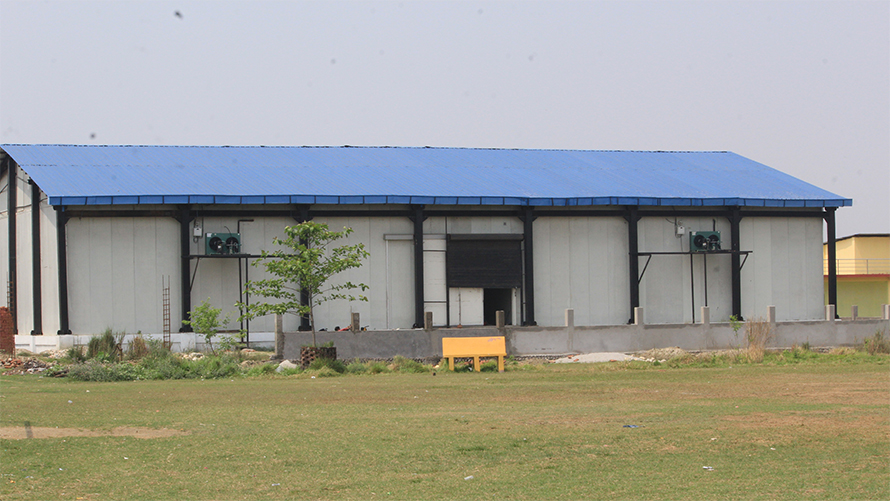
In some instances, buildings have been completed but remain non-functional, whereas in others, grant-received foundations have deteriorated into overgrown plots. For example, the 500-ton capacity cold storage center built under joint investment by Manthali Municipality and the provincial government has remained unused for three years. Although the main structure was finished by Shrawan 2080, it has not been operationalized to avoid becoming unnecessary infrastructure. Out of the ten cold storage centers initiated by Bagmati Province with an investment of nearly 800 million NPR, only two are currently fully operational.

This issue is not confined to Bagmati Province; all seven provinces face similar challenges. Some centers are completed but unused, while others are left incomplete and stalled. The resurgence of discussions around cold storage centers is due to the government’s decision to initiate the ‘One Municipality, One Cold Storage Center’ program aimed at improving agricultural production storage and market systems. Senior leader Balendra Sah of the Rastriya Swatantra Party (Raswapa) has publicly announced 100 governance reforms, including plans to conduct feasibility studies within 10 days for establishing cold storage centers in every district under public-private partnerships.

Why the ‘One Municipality, One Cold Storage Center’ Initiative Remains Ineffective in Idle Fields

Summary

  • Despite billions spent on building cold storage facilities to reduce agricultural production losses and ensure fair prices for farmers, many centers remain unused.
  • Only 2 out of 10 cold storage centers in Bagmati Province are operational; the rest sit idle due to partners withholding funds despite completed structures.
  • The Department of Agriculture plans to compile integrated data by collecting details of all small and large cold storages in every local government.

March 20, Kathmandu – Cold storage centers, established to reduce agricultural production losses and provide fair prices to farmers, have for years become little more than entities consuming state salaries without real impact.

Despite billions in government grants for building cold storage over the past decade, much of this investment has not been effectively utilized.

Policies requiring proportional grants from federal, provincial, and local governments have resulted in agencies with access to funds winning bids but then abandoning projects or engaging in corrupt practices, severely affecting agricultural infrastructure.

In some locations, only the building structure exists without operations, while in others, just land excavation was done and structures now lie abandoned in overgrown fields.

For example, the 500-ton cold storage jointly constructed by the provincial government and Manthali Municipality has been unused for three years despite the main structure being completed by July 2023, delayed further to avoid creating unnecessary infrastructure.

Out of 10 cold storage centers initiated by Bagmati Province with an investment close to 800 million NPR, only two are fully operational; the remaining centers remain stalled due to partners not remitting funds or management issues.

This issue is not confined to Bagmati Province alone; all seven provinces face similar challenges. Some facilities remain unused despite completion, while others are caught in construction limbo.

The cold storage topic has resurfaced recently because the government has decided to launch a ‘One Municipality, One Cold Storage Center’ program aimed at improving agricultural produce storage and market systems.

Senior leader Balendra Sah of the Rastriya Swatantra Party (Raswapa) publicized 100 government reform initiatives, including conducting feasibility studies within 10 days to establish cold storage centers in each district through public-private partnerships.

The prior government provided customs exemptions and up to 70% grants to keep agricultural products fresh and ensure competitive prices.

However, these benefits have failed to reach genuine farmer groups and communities, instead falling under the control of private entities and middlemen.

The Office of the Auditor General has also reported major negligence in grant distribution.

A lack of integrated records specifying which agencies have invested in which cold storage centers means many projects stalled due to budget distribution without comprehensive study and sustainable planning.

In several locations, lack of technical expertise has caused stored produce to rot and be wasted.

How Many Cold Storage Centers Exist Nationwide?

The Department of Agriculture has started collecting data on large and small cold storage centers across the country. Currently, data on 66 large cold storage centers exists, but details of smaller units in local governments are absent.

Out of these 66, only 60 are operational; these are mostly those receiving subsidies from the Electricity Authority and in contact with the department. Storage capacities range from 500 to 16,000 tons but many operate below half capacity due to reduced agricultural output.

Information on small cold rooms constructed by provincial and local governments is not yet compiled.

Director General Prakash Sanjel states that data collection is ongoing with coordination across seven provinces and local governments, aiming soon to prepare integrated statistics.

Lack of Technology and Uneven Distribution

Cold storage centers across the country are geographically unevenly distributed. Many are located far from production sites, limiting access to storage facilities.

Operational centers mostly use outdated technology, requiring all types of produce to be stored at the same temperature, which compromises the quality of items needing different conditions.

Though multi-chamber technology exists, it remains expensive and beyond the reach of small-scale farmers.

Power irregularities and high electricity costs increase operational expenses, resulting in costly storage fees that ultimately burden farmers.
Despite massive investments, the government has failed to develop an integrated cold chain system. The lack of refrigerated transport linking farms, storage facilities, and markets has degraded product quality.

Middlemen purchase produce cheaply from farmers for their own storage and sell it at higher prices during scarcity, undermining farmers’ profits.

‘One Municipality, One Cold Storage’ Policy: An Impractical Declaration Ignoring Production Challenges

Agricultural expert Krishna Prasad Paudel warns that prioritizing cold storage construction on barren land, despite youth migration, irrigation shortage, and fertilizer scarcity leading to unproductive fields, risks storing mostly imported vegetables and fruits rather than boosting local production.

He says this policy will fail and be a misuse of state resources because storage alone will not solve the fundamental issue of declining agricultural output.

“The government has failed to grasp the core problems of agriculture,” Paudel states. “Cold storage demand should arise from increased production; otherwise, focusing on storage is impractical.”

He criticizes the announcement of new projects without rehabilitating dysfunctional or underutilized existing storage, calling it wasteful public expenditure.

Paudel emphasizes that local governments are responsible for development implementation and cautions against centralizing all work at the national level.

“If local governments are not permitted to act, then who will?” he questions.

Who Will Benefit from New Cold Storage Facilities?

Paudel warns that new cold storage centers may primarily benefit imported foreign produce rather than local farmers.

“Since most vegetables are imported from India, this plan will not be objectionable if aimed at storing those imports,” he notes.
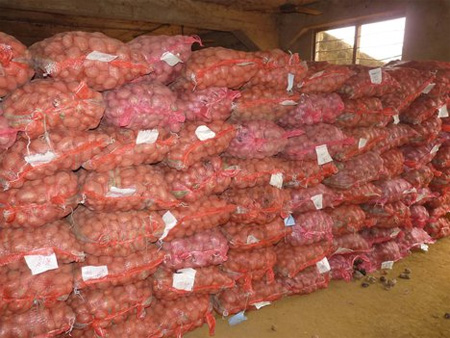
Flaws in the Minimum Support Price Concept

Paudel indicates that the government’s minimum support price (MSP) policy, set uniformly at the national level without considering regional cost differences, is flawed.

“Farming costs differ between Kathmandu and the Terai, so a single price isn’t scientifically justified,” he explains.

He suggests devolving the authority to set support prices to local governments to implement tailored approaches.

‘One Municipality, One Cold Storage’ Ineffective Without Production and Market Networks

Agricultural expert Uddhav Adhikari emphasizes that without solid production bases, market linkages, and farmer trust, this policy cannot succeed.

Given many existing cold stores are ineffective, adding new ones will not solve fundamental problems.

Adhikari calls for a serious review of why prior public cold storage centers failed and identification of locations best suited for new construction.

He notes most government cold storages are built far from roads and farmers, a factor contributing to their failure.

Private operators, by contrast, run facilities closer to markets, resulting in underutilization of public infrastructure.

He recommends adopting an integrated, practical model in coordination with local governments to enhance policy effectiveness.

Priority should be to repair and bring old, inactive cold storage centers back into operation first.

“Constructing storage where production doesn’t exist won’t work, so removing such facilities might also be necessary,” he adds.

Connecting cold storage centers to local markets is also essential, according to Adhikari.

Strong cooperation with local governments is crucial for the program’s success.

He also critiques a lack of thorough consultation with farmer organizations and stakeholders, which frequently causes promising initiatives to fail.

He warns that planning solely within ministry meetings without understanding farmers’ realities could doom such projects.
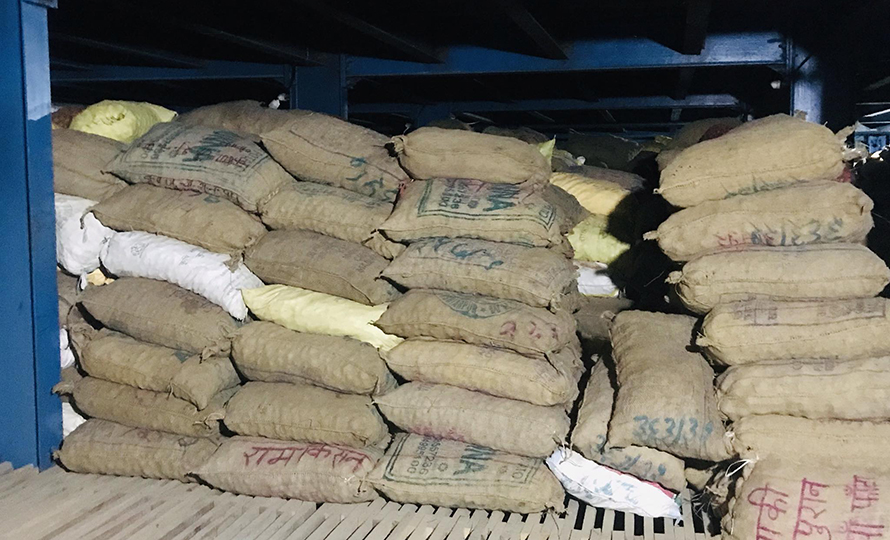
Prioritizing Non-operational Facilities

Director General Prakash Sanjel of the Department of Agriculture states that operationalizing unused cold storage centers will be prioritized before building new ones.

“Efforts are underway to repair and provide technical and management support to inactive centers to bring them back online,” Sanjel said.

Investigations will also be conducted where centers are not operating at full capacity to identify causes.

New Facilities to Be Based on Need and Production Flow

Sanjel clarified that cold storage centers will not be built indiscriminately in every municipality, but only where needed based on production levels and supply flow.

“Construction will proceed only where there is need and good production flow; building storage in non-productive areas serves no purpose,” he explained.

The department will prepare a ‘One Municipality, One Cold Storage Center’ modality after data collection and analysis to determine future plans, Sanjel added.

Ravi Lamichhane: Should the Apology to the Dalit Community Come from the Party or the State?

Ravi Lamichhane

Photo Source, RSS

Ravi Lamichhane, Chairman of the Rastriya Swatantra Party and newly elected Member of Parliament, has apologized to the Dalit community during his first address in the House of Representatives for the discrimination they have faced. While this apology has been welcomed as a positive step, some Dalit rights activists and scholars emphasize that it should not be considered a formal state apology.

In Thursday’s parliamentary session, MP Lamichhane stated that the apology was given “on behalf of the entire party, Prime Minister [Balendra Shah], and the government” to the Dalit community.

The party’s election manifesto included a commitment to apologize to the Dalit community in the first address by the leader of the new government. According to the government’s 100-day working plan, “a formal state apology will be issued within 15 days and transformative programs will be announced.”

“He also mentioned that a formal state apology would be issued. The apology by the party leader represents the party’s commitment but is not the state’s official apology,” said Man Bahadur Bishwakarma, former Secretary of the Nepal government and a scholar. “A formal state apology is usually issued by the Head of State—the President—though the Prime Minister can recommend it.”

“The Prime Minister must bring a motion in Parliament, it must be discussed and passed, then the President has to issue the apology via an address in the Parliament or a public statement. Unless published in the government gazette, it cannot be regarded as an apology issued on behalf of the state,” he added.

क्षेत्राधिकार नाघेर जाँचबुझ आयोगको सिफारिस, ऐन मिचेर प्रधानमन्त्रीको निर्णय

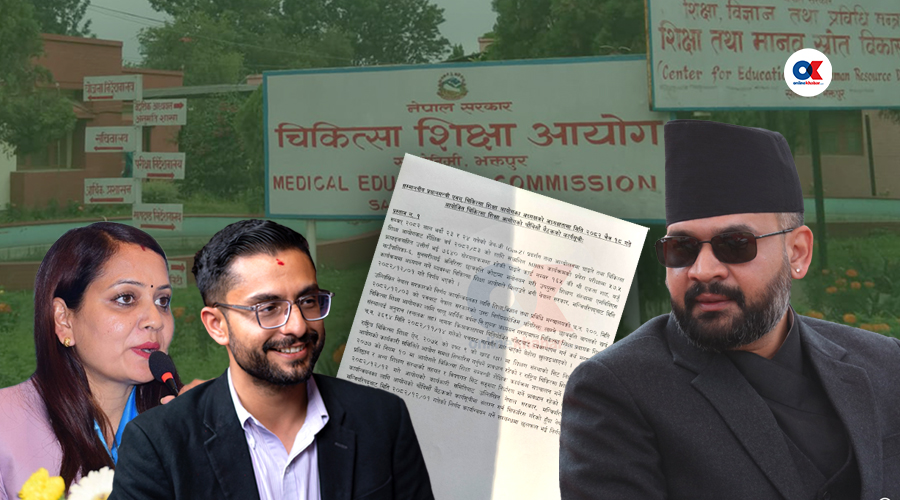
Prime Minister Overrides Inquiry Commission’s Recommendations, Breaching Jurisdiction in Medical Education Decision

Summary

Prepared based on interviews. Editorially reviewed.

  • Prime Minister Balen Shah has decided to award additional scholarships to Ekta Shah, who was injured during the Janajati (JENJI) movement, violating the Medical Education Act.
  • The commission led by Gauri Bahadur Karki, which investigated the Janajati movement incidents, had recommended Ekta for MBBS studies.
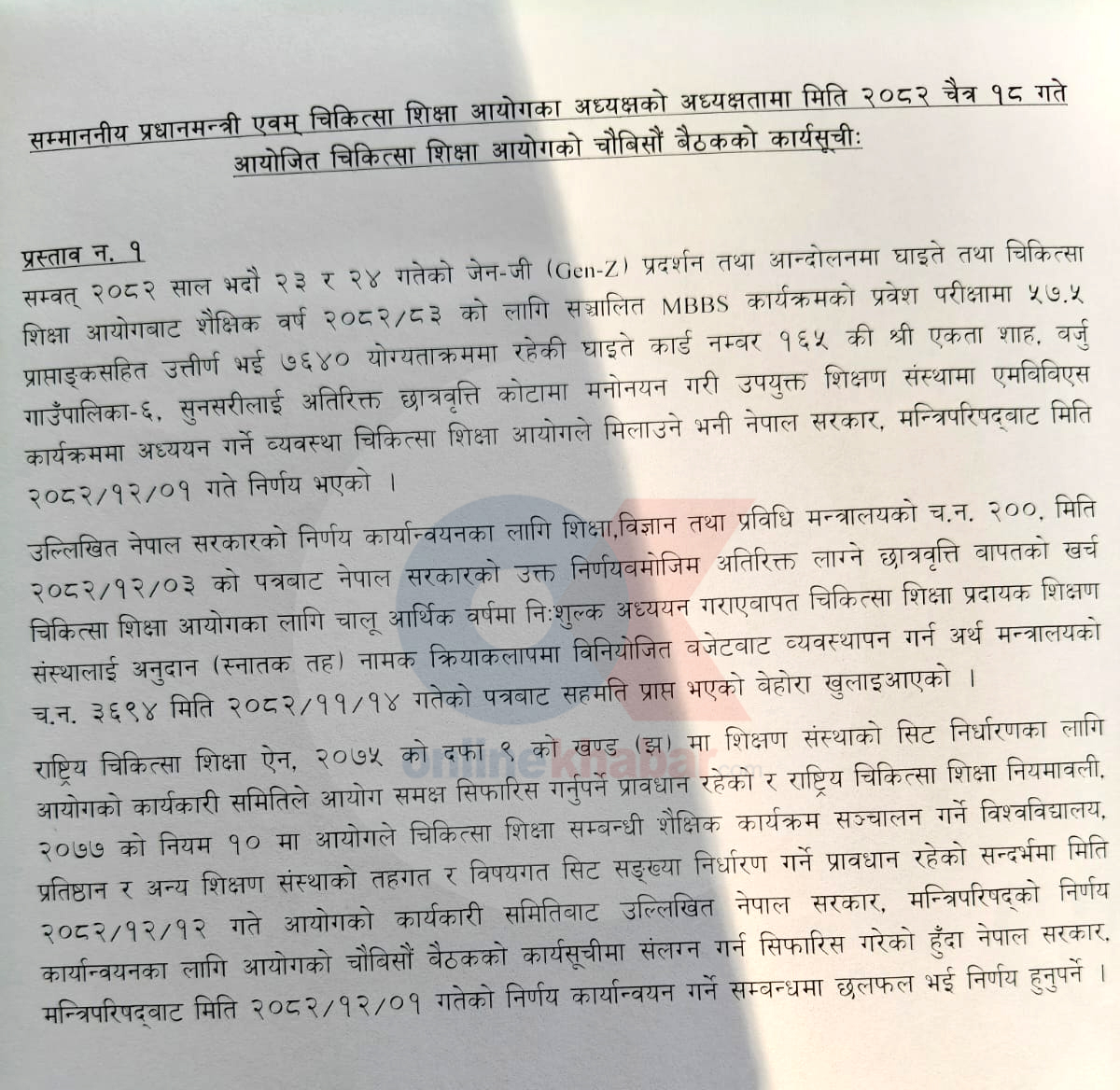
  • At the Medical Education Commission meeting, the proposal to enroll Ekta in MBBS under an additional scholarship quota was presented under the Prime Minister’s directive.

March 20, Kathmandu – Prime Minister and Chairman of the Medical Education Commission, Balen Shah, has approved awarding extra scholarships to Ekta Shah, injured in the Janajati (JENJI) movement, in clear violation of the Medical Education Act.

This decision is based on recommendations made in mid-January by the Gauri Bahadur Karki-led inquiry commission that investigated the Janajati movement incidents.

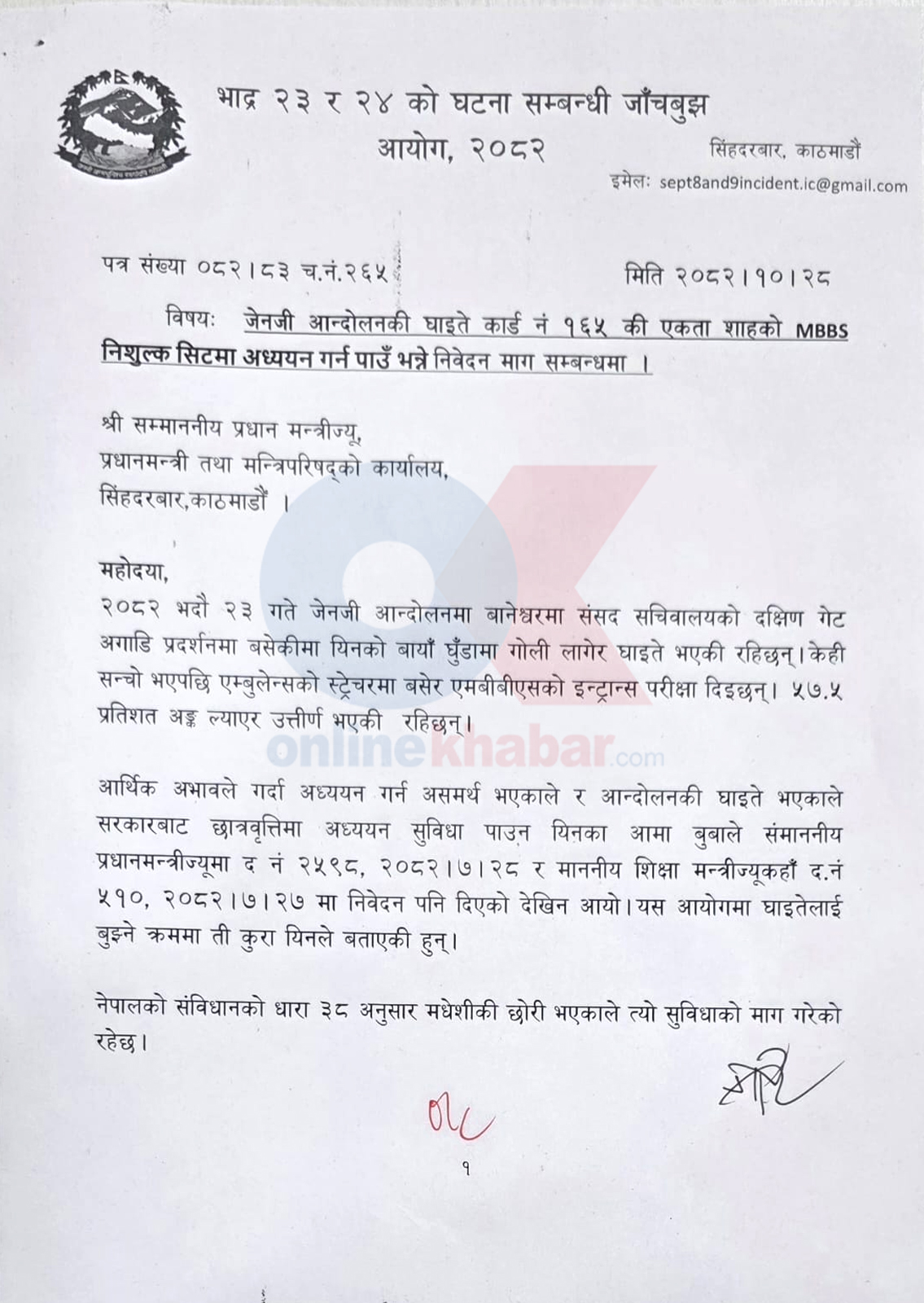
The commission’s scope is limited to investigating and studying the event. However, the commission sent a letter to the then Sushila Karki-led government recommending arrangements to enroll Ekta in MBBS studies.

The letter informed both the Ministry of Home Affairs and the Ministry of Education. Following this, the Sushila Karki government issued a cabinet decision on March 14, directing the commission accordingly. Now, PM Balen Shah has directed the Medical Education Commission meeting to implement that decision.

According to the Medical Education Act 2075 BS, there is no provision for enrolling candidates outside the merit list. While the government is responsible for assisting those wounded during the Janajati movement, overriding the merit system raises significant concerns.

Dr. Govind K.C., a longstanding advocate for meritocracy in medical education, warns that such a move could undermine good governance and the merit system.

On Thursday, during the commission’s 24th meeting, a proposal was presented to grant Ekta an MBBS seat under an additional scholarship quota. This decision violates both political and legal frameworks.

The MBBS admission process encompasses seat allocation, entrance examinations, result publication, and selection strictly according to merit. All these procedures had concluded for the current academic year, and students had been selected. However, by violating the act, a route was opened for Ekta to pursue MBBS under an additional scholarship seat.

A commission member indicated questions about the Prime Minister’s role, although PM Balen Shah was not present during the meeting. The Deputy Chairperson, Education Minister Sasmita Pokharel, chaired the session.

On Wednesday, the Prime Minister’s Office sent instructions to the commission’s members to hold the meeting. A commission member stated, ‘The proposal was tabled following direct orders from the Chairperson.’

Another member claimed that the decision was made under pressure from the Prime Minister.

“The meeting would not have been convened without the Chairperson’s directive. The letter clearly states the Chairperson’s orders. The proposal arrived due to pressure from the Prime Minister himself,” members said.

The Health Minister and Deputy Chairperson of the commission, Nisha Mehta, confirmed that the Sushila Karki-led cabinet had previously made this decision.

“That decision was already taken by the previous government; the proposal was only presented to the commission meeting,” Minister Mehta added.

When asked why the proposal was brought despite violating the law, she declined to provide an immediate answer, saying, “I will respond after understanding the issue.”

Deputy Chairperson Dr. Anjani Kumar Jha also revealed that the cabinet decision was placed on the agenda, but refrained from commenting on why an unlawful proposal was presented.

Commission members noted that if the previous government truly intended to implement the decision, the commission would have proceeded earlier.

“We were not obliged to automatically follow the earlier decision. It could have been stopped or reviewed,” they explained.

“Decisions Outside the Law Are Unacceptable”

The scholarship distribution must comply strictly with merit and legal requirements according to the commission’s act. Granting an additional seat based solely on being wounded in the Janajati movement raises integrity issues.

Under the National Medical Education Act, 2075, the commission has exclusive authority to determine seat numbers. Section 17 specifies that the commission will allocate seats to universities and institutions per standards, and subsection (3) requires admission to follow the merit-based matching system.

Former Deputy Chairperson Dr. Shrikrishna Giri criticized the granting of MBBS scholarships in violation of the law.

“The medical education law is clear, and it is the commission’s duty to enforce it. Decisions contrary to the law should not occur under external pressure,” he stated.

He emphasized that strict adherence to merit is essential to ensure equal opportunities in medical education. “If the government attempts to violate the law, the commission’s deputy chairman must intervene,” Dr. Giri added, warning that such actions compromise the system and create recurring problems.

The Medical Education Act was implemented in 2018 (2075 BS) to end previous malpractices in this sector.

Transparency, meritocracy, and adherence to legal procedures are viewed as the long-term solutions.

Medical education reform advocate Dr. Govind K.C. said the decision undermines the established system, stressing that the legal provision requires admissions across all subjects, including MBBS, to be strictly merit-based. He added that any illegal decision contradicts the principles of the rule of law.

They urge the Prime Minister to respect the law and refrain from violating legal provisions.

Inquiry Commission’s Recommendation Explained

Ekta Shah from Sunsari was injured by a bullet in her left knee during the September 8 Janajati protest in New Baneshwor, Kathmandu. Despite her injury, she took the MBBS entrance exam and secured a 57.5% score, subsequently registering her name.

The commission’s MBBS entrance exam is mandatory, and only those who pass are admitted according to the merit list and seat allocations made by the commission.

Although she passed the exam, Ekta’s name was not included in the allocated seats, barring her enrollment. Her father later appealed to the Prime Minister on November 12, citing financial hardship, to facilitate her scholarship-based study.

The Gauri Bahadur Karki-led commission conducted interviews with Ekta’s family on September 8 and 9 regarding the incident. During this, her father expressed her educational aspirations and requested government assistance. Based on this, the commission made its recommendation to the government.

The inquiry commission submitted its recommendation letter to the Prime Minister and Cabinet Office on January 12, stating: “Although Ekta’s classes at Nepal Medical College have already begun, the government must arrange her admission.”

The commission exceeded its investigative mandate by recommending the Prime Minister to enroll Ekta in MBBS.

Highlighting the commission’s recommendation, the cabinet on March 14 directed arrangements for Ekta’s medical education.

The Ministry of Education corresponded with the Ministry of Finance on March 16 to secure funds for the scholarship, which were approved on February 26.

On March 31, the commission recommended granting a scholarship for Ekta’s studies during its 24th meeting.

A source revealed, “The recommendation by the previous Prime Minister Sushila Karki was improper, and now Prime Minister Balen Shah is proceeding with it.”

Bustle in Bhaktapur as Lichchhavi-era Bisket Jatra Preparations Advance

The world-renowned Bisket Jatra in Bhaktapur is set to be celebrated with tantric rituals over nine days and eight nights starting from Chaitra 27. The Guthi Sansthan Bhaktapur has reported rapid progress in the construction of the Bhairav and Bhadrakali chariots. On the final day of the festival, Baisakh 5, the chariot is placed at the five-tiered temple where tantric worship is performed to conclude the festivities. (March 20, Bhaktapur)

Every new year, residents of Bhaktapur observe the traditional tantric Bisket (Biska) Jatra for nine days and eight nights, which this year begins on Friday, Chaitra 27. The festival starts almost four days before the new year with the pulling of Bhairav’s chariot. The main events include erecting an Indradhwaja-adorned linggo (pole) at the end of Chaitra, followed by a full day of the linggo festival at Lyasingkhel on Baisakh 1, which concludes in the evening with the lowering of the linggo.

The Guthi Sansthan Bhaktapur office has announced that the construction of the Bhairav and Bhadrakali chariots, essential for the Jatra, is progressing swiftly. Anand Prasad Karmacharya, head of the Guthi Sansthan Bhaktapur, shared that the three-tiered pagoda-style chariot is being built at the Taumadhi five-tiered temple courtyard. He added that once the Bhairav chariot’s construction is completed, work on the Bhadrakali chariot will immediately commence. So far, the team has been engaged in preparing various wooden components, assembling wheels, repairing damaged materials and poles, replacing ropes, installing new pulleys, performing roof repairs, and continuing intensive construction work on the chariots.

By Chaitra 26, painting and decorative work will be done on the chariots. On Chaitra 27, government ceremonial worship is scheduled for 11 a.m., followed by public worship until 3 p.m., after which the chariot pulling will begin. Karmacharya mentioned, “We have instructed the contractor to provide a very strong, tightly woven rope approximately 90 haathlong for pulling the chariot. A Jatra management committee team will also test the rope. Two linggos have been prepared: one 55 haath long and another as broad as a thong.” He added, “We are preparing to start the festival on Chaitra 27 by pulling Bhairav’s chariot at 3 p.m.”

Newly Elected Speaker Dolprasad Aryal to Take Oath on Sunday

20 Chaitra, Kathmandu – Dolprasad Aryal (DP), the newly elected Speaker of the House of Representatives, is set to take the oath of office and secrecy on Sunday (Chaitra 22). According to information received from the President’s Office, Sheetal Niwas, his oath-taking ceremony is scheduled for 2:30 PM on Sunday afternoon.

The oath ceremony for Speaker Aryal will be held at the President’s residence, Sheetal Niwas. President Ramchandra Paudel will administer the oath of office and secrecy. Aryal was the sole candidate during the nomination process for the Speaker position held on Friday, resulting in his unopposed election.

प्रधानमन्त्री शाहको प्रेस विज्ञमा दाहाल नियुक्त – Online Khabar

Dipa Dahal Appointed as Press and Research Advisor to Prime Minister Balendra Shah

March 20, Kathmandu – Journalist and author Dipa Dahal has been appointed as the Press and Research Advisor to Prime Minister Balendra Shah (Balen). This responsibility was assigned to her on Friday in accordance with the Prime Minister’s Advisor and Secretariat Management Procedures, 2074 BS. Dahal, who has been active in journalism and academia for over two decades, officially assumed her duties starting Friday.

Dahal is expected to play a key role in shaping Prime Minister Shah’s communication strategy, media relations, and research activities. Her extensive experience in reporting on issues such as anti-corruption, good governance, and social justice is a significant asset that the government aims to integrate into its core agenda through this appointment. She brings more than 20 years of professional experience across radio, television, print, and online media organizations.

Recently, Dahal served as a senior correspondent at Ukalo.com, where she specialized in investigative journalism. She has also been teaching journalism at Padmakanya Multiple Campus under Tribhuvan University for the past seven years. Additionally, she works as a trainer in journalism, communication skills, and authentic leadership. Dahal is the author of the investigative book titled “COVID: An Unanticipated, Unexperienced Crisis.”