Advertisement1200×100-inside-1

Author: space4knews

Three Injured in Car Accident Involving Indian-Registered Vehicle in Baitadi

April 14, Baitadi – Three individuals were injured in a car accident involving an Indian-registered vehicle in Baitadi. The car bearing the Indian license plate HR 55 A AH 9833, traveling from Kanchanpur to Shivnath in Baitadi, crashed on Tuesday afternoon around 4:30 PM.

The injured include the driver, 27-year-old Bharat Dayal from Shivnath Rural Municipality Ward No. 6, along with 28-year-old Mahesh Sutar and 26-year-old Jayraj Dulal, both also from the same locality, according to DSP Deepakkumar Rai, Chief of Baitadi District Police Office. Sutar sustained injuries to his head and eyes, while Dulal suffered injuries to his head and chest. All three are currently receiving treatment at the Primary Health Care Center in Melouli, the police confirmed.

Trump and Modi Discuss Security of Hormuz Strait in Phone Call

April 14, Kathmandu — US President Donald Trump and Indian Prime Minister Narendra Modi held a phone conversation on Tuesday. Prime Minister Modi confirmed the call and stated, “My friend President Donald Trump called me. We reviewed various important developments in our bilateral cooperation.”

Modi expressed a commitment to strengthening all aspects of their comprehensive global strategic partnership. Additionally, he shared that they had an extensive discussion about the situation in West Asia. He said, “We discussed the situation in West Asia and emphasized keeping the Strait of Hormuz open and secure.”

इरानी राष्ट्रपति भन्छन्- अमेरिकासँग शान्ति वार्ता जारी राख्न तयार छौं

Iranian President Affirms Readiness to Continue Peace Talks with the United States

April 14, Kathmandu – Iranian President Masoud Pezeshkian has expressed his readiness to continue peace negotiations with the United States. During a discussion with French President Emmanuel Macron, he emphasized that pursuing diplomatic means to resolve disputes remains his foremost priority.

According to various Iranian media outlets, the Iranian president highlighted that threats, pressure, and military actions are not effective in resolving issues. In his conversation with Macron, he also asserted that the United States itself has created and escalated the problem.

Additionally, Pezeshkian stressed the need for the European Union to encourage the United States to adhere to international laws and regulations.

Labor Reform Task Forces Established but Implementation Remains Weak

Over the past two years, despite changes in ministers at the Ministry of Labor, each new minister has formed a task force aimed at reform. However, the lack of implementation of the task forces’ recommendations has slowed progress in the foreign employment sector. Experts emphasize the need to focus on implementing existing reports and political will rather than conducting new studies. Kathmandu, 1 Baishakh.

During the past two years, as the Ministry of Labor, Employment and Social Security experienced constant changes in leadership, a consistent pattern has emerged – every new minister promises reforms and establishes new task forces to achieve them. However, the reports provided by these task forces have suffered from significant shortcomings in implementation. From Sharatsingh Bhandari in 2079 BS to Deepakkumar Sah and Ramji Yadav by 2082 BS, all ministers have formed task forces aimed at improving labor and foreign employment sectors.

Instead of one minister building upon the conclusions of the previous task force, there has been a trend of reversing earlier decisions, which has hindered reform momentum. For instance, Sharatsingh Bhandari, appointed labor minister for the 13th time in 2079 BS, declared an initiative to reform the foreign employment sector and formed a task force for this purpose. His successor, DP Aryal, annulled Bhandari’s decisions and formed a new task force.

Experts argue that the problem lies not in the formation of task forces but in the lack of “implementation will.” According to labor and migration expert Rameshwar Nepal, the pressing need now is to implement existing reports rather than conduct new studies on foreign employment reform. “Numerous studies have already been done, and reviewing those reports reveals many solutions,” he said.

Nepal emphasized that the priority should no longer be to “add more task forces” but rather to “implement the recommendations of existing reports.” In particular, delays have been critical in taking concrete steps to reduce workers’ costs, control fraud, regulate agents, and improve service delivery. He noted that the tradition of forming new task forces with each new minister has created an illusion of reform, while actual progress depends on rigorous implementation.

Two Killed in Collision Between Hiace Van and Motorcycle in Kailali

Two individuals lost their lives following a collision between a Hiace van and a motorcycle in Gulara, Ward No. 7 of Lamkichuha Municipality, Kailali. The deceased have been identified as 33-year-old Gagan Rana and 24-year-old Pushpa Sunar, both residents of Ward No. 8 of the same municipality. Police are conducting further investigations into the accident.

On the evening of Tuesday, 1st Baisakh, at around 6:15 PM, the incident occurred on the East-West Highway in Ward No. 7, Gulara. The vehicles involved were a Hiace van bearing the registration number Supapra 01001 J 1421 and a motorcycle registered as Supapra 01013 P 5439, which collided head-on, according to police reports.

District Police Office spokesperson, Deputy Superintendent of Police (DSP) Yogendra Timilsina, confirmed that the occupants of the motorcycle, Gagan Rana and Pushpa Sunar, were critically injured in the crash. They were immediately admitted to Bardagoriya Hospital for treatment, where medical professionals later declared them dead. Authorities continue to investigate the circumstances surrounding the accident for further details.

Explosion at Energy Plant in Chhattisgarh, India, Kills 9 Workers

April 14, Kathmandu – An explosion at an energy plant in Chhattisgarh, India, claimed the lives of nine workers. According to Indian media reports, the blast occurred on Tuesday afternoon at the Vedanta Power Plant located in the Sakti district of Chhattisgarh. A large number of workers were injured in the incident.

Local police officials confirmed that four workers died at the site, while five more succumbed to their injuries during treatment at hospitals. Eyewitnesses reported that the explosion happened around 2 p.m. local time when routine work was underway at the power plant. It is believed that the explosion resulted from a boiler rupture.

The number of injured has been reported to be between 30 and 40. They have suffered serious burns and are currently receiving treatment at various hospitals, according to local authorities.

काठमाडौं उपत्यकामा सुरु भयो रात्रिकालीन बस सेवा (तस्वीरहरू)

Night Bus Service Launched in Kathmandu Valley

April 14, Kathmandu – Under the coordination of the Kathmandu Metropolitan City, a night bus service has been launched in the Kathmandu Valley starting today. This service is the result of a collaborative effort between various municipalities of the valley and Sajha Yatayat, initiated by the metropolitan city. Buses will now operate between 8 PM and 11 PM.

Sajha Yatayat buses will serve a route from Lagankhel in Lalitpur, passing through Patan Hospital, Alka, Norvic, Maternity Hospital, Trauma Center, Bir Hospital, Kanti Hospital, Teaching Hospital, Gangajal Heart Center, and extending up to Budhanilkantha. This 16-kilometer route runs north to south in one direction. Additionally, another route covering the east-west direction will operate from Thankot, through Satungal, Kalanki, Kalimati, Tripureshwor, Thapathali, Maiti Bhawan Mandala, Baneshwor, Minbhawan, and Tinkune, extending to the International Airport.

This east-west corridor covers 20 kilometers in one direction. A total of four electric buses will be deployed across these two night routes. According to plans, buses will be available every 20 minutes at designated stops. The inauguration event of the night bus service was attended by Sunita Dangol, the acting mayor of Kathmandu Metropolitan City.

No Limits on Gold Purchases; High-Level Officials Possess Significant Shares of Gold

In the asset declarations of the Prime Minister and ministers, real estate, shares, and gold are the top priorities. Guru Paudel, spokesperson for Nepal Rastra Bank, stated that there are no restrictions on gold purchases but the source of funds must be verified. Arjun Rasaili, president of the Gold and Silver Traders Federation, mentioned that only gold jewelry can be purchased and held.

Kathmandu, 1 Baisakh – Gold ranks highly among the assets accumulated by “high profile” individuals. Senior officials tend to invest in gold after real estate and shares. When public office holders disclose their wealth, real estate tops the list, followed by gold and shares.

Even after securing nearly two-thirds of the mandate following the Janandolan movement, the Prime Minister and ministers of the government chiefly hold real estate, shares, and gold in their portfolios. While legal limits exist for buying real estate and shares, no such cap applies to gold. This explains the sizable gold holdings of senior officials. Stakeholders note that gold investments have increased because even large amounts of money are represented by relatively small quantities of gold.

There are limits on real estate ownership, and buying shares is subject to restrictions based on sector and liquidity. However, daily purchases of gold jewelry up to NPR 999,000 are possible, leading to greater investment in gold. Traders also point out that investments fluctuate depending on market conditions for real estate, shares, and gold.

The Land Act 2021 caps ownership to a maximum of 10 bighas. In the secondary securities market, banks, financial institutions, insurance, and microfinance regulators limit share quantities. While companies in hydropower and other sectors face no such restrictions, market liquidity is controlled.

Although there are regulations for gold bullion, no restrictions apply when buying in the form of jewelry. The source of funds may be investigated, with the Asset Laundering Prevention Department conducting source verification. Nepal Rastra Bank spokesperson Guru Paudel confirmed that there are no limits on gold purchases.

According to the asset disclosures of the current government’s Prime Minister and ministers, the quantities of gold held are significant. Prime Minister Balen Shah owns 190 tolas, Home Minister Sudan Gurung 89 tolas, Finance Minister Dr. Swarnim Wagle 45 tolas, Foreign Minister Shisir Khanal 22 tolas, and Energy Minister Virajbhakta Shrestha 15 tolas of gold.

Physical Infrastructure Minister Sunil Lamsal holds 30 tolas, Law Minister Sobita Gautam 15, Women’s Minister Sita Wadi 18, General Administration Minister Pratibha Rawal 25, Health Minister Nisha Mehta 30, Education Minister Sasmit Pokhrel 25, Tourism Minister Khadkaraj Paudel 11, Communication Minister Dr. Bikram Timilsina 19.5, and Agriculture Minister Geeta Chaudhary 9 tolas of gold.

Industry Minister Gaurikumar Yadav possesses 180 tolas, while Labor Minister Ramji Yadav holds 80 tolas of gold.

Arjun Rasaili, president of the Gold and Silver Traders Federation, emphasized that the source of funds must be transparent to hold gold. “Gold jewelry can be held only as an outcome; there is no policy to increase or limit holdings,” Rasaili said. “Only purchases exceeding NPR 1 million in a single day are scrutinized. However, daily purchases just below NPR 1 million are allowed.” He advised that gold must be bought as jewelry—rings or earrings, for example.

According to Nepal Rastra Bank regulations, individuals without a PAN number are prohibited from buying gold bullion. Rasaili added, “With limits on real estate and slow transactions, investments shifted to gold. When gold prices increase, sales rise; when prices fall, demand increases again, only to fall once more.” The practice of holding gold as jewelry has driven gold investment.

Spokesperson Paudel confirmed that gold bullion purchases are prohibited. In the past, Nepal Rastra Bank sold 50-gram coins commonly bought and held by the public. Currently, small coins are sold during occasions like Dashain, depending on gold stock. Additionally, Nepalese returning from abroad may bring gold jewelry up to 50 grams for women and 25 grams for men, which encourages ordinary citizens to hold gold at home.

Paudel noted there is no limit on buying jewelry. Gold is an investment area with prices highly volatile on global markets. “Gold combines investment, wealth, and culture because of our social values and traditions,” he stated. “Phones may depreciate in value, but gold investments contribute to wealth accumulation.”

He suggested that financial resources should be focused on productive sectors that create employment. While there is a quota system for gold imports nationwide, there is no limit on holding gold for personal use. “Daily imports total 25 kilograms, with an annual volume of 9,000 kilograms, yet daily market demand is 40 kilograms,” Paudel said. “10 kilograms are supplied daily from buying and selling old jewelry, but there remains a shortfall of 5-7 kilograms.”

There is no limit on gold exports, allowing unrestricted shipment. No limits exist on individual accumulation given no import restrictions. When selling old gold, buyers must issue receipts, which can be accepted as proof of source.

Ashish Memorial Journalism Award 2083 Presented to Sudip Shrestha of OnlineKhabar

The Ilam branch of the Nepal Journalists Federation has awarded the Ashish Memorial Journalism Award 2083 to Sudip Shrestha of OnlineKhabar. Shrestha received a certificate of honor along with a cash prize of 10,000 rupees. The branch also conferred the Active Women Journalists Award to Buddha Songmi.

1 Baisakh, Ilam – Today, the Ilam branch of the Nepal Journalists Federation presented the award to Sudip Shrestha. The award ceremony featured district coordination committee chair Jayaprakash Rai, Ilam Municipality Chief Kedar Thapa, and Chief District Officer Laxman Dhakal honoring Shrestha by draping him with a traditional shawl.

Shrestha began his journalism career in 2060 BS with the weekly publication Aankha from Ilam. He has worked as a correspondent and program host for Saptakoshi FM, Radio Nepalvani FM, Sagarmatha Television, Udgosh Daily, and Ilam Express Daily. He is currently serving as Ilam correspondent for OnlineKhabar.

The award is named in memory of Ashish Rai, the then Ilam reporter for Radio Nepal, who tragically died after drowning while swimming in Maikhola, Ilam on 1 Baisakh 2059. Each new year, this award is given to a journalist from the Mechi region who has made significant contributions to local journalism. Several journalists have been honored with this award in previous years.

How Bihar Transformed During Nitish Kumar’s 21 Years as Chief Minister


Farida Khatun, who works at an NGO in Phulwari Sharif, Patna, is the most educated member of her family. She has completed her postgraduate studies.

Her family, who worked as laborers, enrolled her in 2007 at the Kasturba Gandhi Residential School in Araria.

Farida is originally from Araria, a Muslim-majority district where over 40% of the population is Muslim.

She says, ‘We live in an area where girls were traditionally given only Islamic education, but I got enrolled in this school. I benefited from school uniforms, sanitary pads, bicycles, and many schemes under the Girl Empowerment Program, eventually earning my postgraduate degree from Patna University.’

‘At that time, it seemed Nitish Kumar was a leader for girls, but in recent years, it feels he has become just a political figure and has engaged in religion-based politics as well.’

Farida’s observation aptly encapsulates Nitish Kumar’s political journey.

Recently, Nitish Kumar resigned as Bihar’s Chief Minister. He submitted his resignation at the Lok Bhawan to Governor Lt. Gen. (Retd.) Syed Ata Hasnain.

He first became Chief Minister in 2000 for seven days, but his continuous tenure began in November 2005.

Nitish earned the nickname ‘Sushasan Babu’ (Mr. Good Governance), but in recent years he has been known as ‘the party-hopper.’ He has been the subject of many memes and analysts have questioned his ideological commitment.

‘There Is No One Like Nitish’

When Nitish decided to move to the Rajya Sabha, his son Nishant Kumar began visiting the JDU office in Veerchand Patel Nagar, Patna, causing quite a stir.

However, JDU workers do not see him as the ‘second Nitish.’

Ashok Kumar, who has supported Nitish since his first election in 1977, says, ‘There is no one like Nitish Kumar.’

One of Nitish’s first major challenges was modernizing government offices from typewriters to computers, where BJP leader Sushil Kumar Modi was a key aide, famously always carrying a tablet.

Modi served as Deputy Chief Minister and handled important responsibilities in the Finance Ministry.

IAS officer Vyas Ji, from the 1982 batch and now retired, remarks, ‘Both Nitish and Sushil Modi had sharp temperaments. I also witnessed Lalu Prasad Yadav’s tenure. The key difference was – Lalu was a leader, Nitish was an exceptional administrator.’

‘He welcomed new ideas in meetings and reviewed previous directives at every departmental meeting. He had a strong desire to progress Bihar.’

Socialist Nitish’s ‘Vote Engineering’

After taking power, Nitish Kumar released a white paper stating that Bihar ranked the worst on all development indicators.

The Nitish government faced huge challenges in law and order, roads, electricity, and infrastructure.

Coming from the Kurmi caste, Nitish had to practice vote engineering to remain in power for years.

For his strategy, he targeted women and the most backward classes.

Senior journalist Santosh Singh writes in his book ‘Kitna Raaj, Kitna Kaaj,’ ‘Nitish granted women 50 percent reservation and provided 20 percent reservation to extremely backward classes (EBC) Hindus and Muslims in panchayat and local bodies.’

‘This drew criticism from his own caste, who claimed he sacrificed them to benefit other groups. But Nitish recognized women, even by caste, as backward.’

Later, the Mahadalit Commission was formed in 2007.

His ‘Love-Kush’ (Kurmi-Koeri) equation is said to fetch him about 20% votes, although their population is roughly 7%.

‘Complacent in Himself’

Upon coming to power, his two flagship schemes—school uniforms and bicycles—were seen as symbols of change.

Girls in rural areas riding bicycles to school symbolized this transformation.

Initially, this reflected the welfare-oriented socialist Nitish and improvements in law and order.

Later, however, accusations emerged that the government focused more on publicity than effective implementation of these schemes.
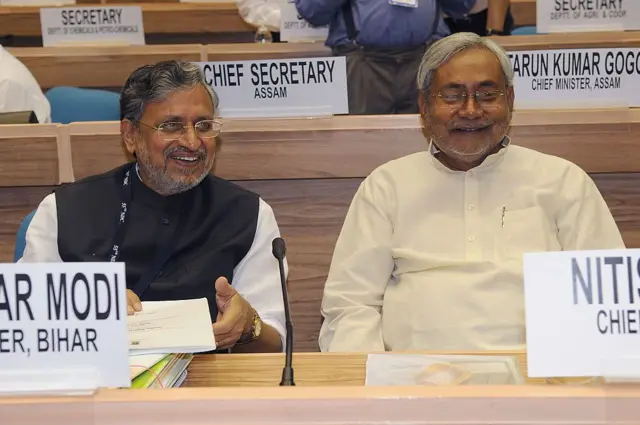
Nitish Kumar and Sushil Kumar Modi

Social activist Shahina Parveen says, ‘During Nitish’s early tenure there were diligent employees and good initiatives for women, but later stability was lost.’

‘Nitish himself seemed to enjoy his work, but in later days, it became more about show. Publicity increased but sustainability decreased.’

‘Reservations were given to women in panchayats, but few became ministers or MLAs. The initiatives reinforced traditional roles, like distributing sewing machines and organizing papad-making trainings.’

Before the 2025 Assembly elections, ‘Jeevika Didi’ was given Rs 10,000 to start employment, but even then questions arose about changes in Nitish’s politics.

JDU leaders say, ‘Earlier our leaders brought change through policies; now they resort to election gimmicks.’

Crime, Corruption, and Communalism — Nitish’s ‘Three Cs’

Nitish repeatedly asserted that he would not compromise on the ‘Three Cs’: crime, corruption, and communalism.

In 2005, Bihar Police ADG Abhayanand recalls, ‘When Nitish became CM, he called me and said we need rule of law.’

‘Work was done on the Arms Act, speedy trials, and witness protection processes. SAP (Special Auxiliary Police) was created and police modernization was initiated.’

Yet in recent years, there were incidents against the Nitish government—for example, in 2015, a journalist was held hostage at the home of MLA Anant Singh in Mokama.

After the killing of Ranveer Sena chief Brahmeshwar Mukhiya, his supporters sparked violence in Patna, including arson at Dak Bangla Chowk.

Advocate Manilal says, ‘At that time, it seemed like the state could descend into 1990s-style caste violence, but it did not happen.’

‘Still, riots occurred in Aurangabad, Chapra, and Biharsharif. Corruption became widespread; nothing progressed without bribery. Nitish’s grip was not as strong as before.’

Many New Schemes but Limited Ground Success

Nitish launched the ‘CM public court’ program to make the government accountable.

Programs such as the Information Call Center, ‘Your Government Your Doorstep,’ and Bihar Public Service Rights started enthusiastically but later weakened.

The Information Call Center was established in 2007.

RTI activist Shivprakash Rai states, ‘It started well but is now closed. Accountability has ended. Activists have been threatened, attacked, or falsely charged.’

Shahina Parveen notes, ‘There was progress in education and health infrastructure, but poor quality of teachers and doctors made benefits negligible. The PPP model increased privatization, diverging from earlier approaches.’

Improvements in Electricity and Roads

According to a 2006 white paper, Bihar’s average electricity consumption was 60 kilowatts, which increased to 134 kilowatts in 2011–12 and 374 kilowatts by 2025–26.

Road construction in 2005–06 stood at 835 kilometers, now reaching 119,067 kilometers. Bridges and flyovers have made travel faster.

However, the claim that all areas in Bihar can reach Patna within five hours remains unmet.

Progress in land reforms, education, health, and industry was limited under Nitish’s government.

Committees led by D. Bandopadhyay and the commission headed by Muchukund Dubey were formed for land reforms and the Common School System respectively.

Former director D.M. Diwakar says, ‘Nitish had good intentions but joint reports were not implemented. Private institutions grew but public ones weakened.’

‘At the panchayat level, unregulated teacher appointments further deteriorated education quality.’

Senior journalist Arun Srivastava comments, ‘Bihar’s government has become one of contractors. Flyovers only serve middle-class needs. What about the marginalized communities?’

‘Documents talk about development, but the state lags in industry, employment, and migration.’

Nitish’s Changing Political Loyalties

In the 2010 Bihar Assembly elections, the NDA alliance won 206 of 243 seats, with JDU securing 115 and RJD 22 seats.

However, disagreeing with Modi’s rise nationally, Nitish left BJP and allied with RJD and Congress for the 2015 elections.

In 2015, Nitish symbolically sent the DNA samples of Biharis to Delhi to express dissent.
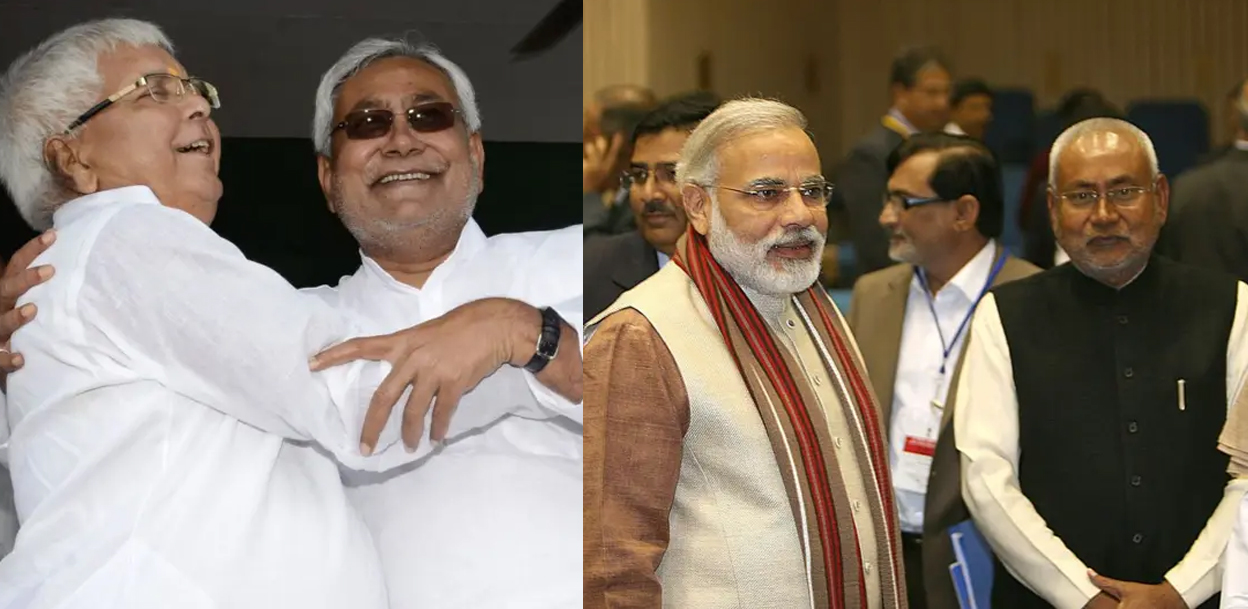
He returned to the BJP alliance in 2017, again allied with RJD and Congress in 2022, but broke that alliance in 2024.

Currently, Nitish’s JDU and BJP are united. In recent elections, Nitish repeatedly admitted that allying with RJD was a mistake and that he would not switch sides again.

Once a fighter for special state status for Bihar, Nitish now appears satisfied with special packages.

Previously, he proudly celebrated Bihar Day, promoting Bihari identity, but now his influence has waned. He assumed office at 54, and is now 75 years old.

(Translation based on original Hindi content)

श्रीमान्‌लाई फोन गरेर ‘मर्न’ लागेको बताएकी महिलाको सकुशल उद्धार

Woman Who Called Husband Saying She Was About to Die Safely Rescued from Forest

A 43-year-old woman from Sunakothi, Lalitpur Metropolitan City ward 27, was safely rescued from the forest by a police team. The woman’s husband had informed the police via a video call that she was about to die. Immediately, a team from the District Police Office, Lalitpur, was dispatched to search for her. During the search operation, the woman was found in the forest of Sunakothi and has now been handed over to her relatives, police stated. April 14, Kathmandu.

New Government Presents New Poem on New Year’s Occasion

The cycle of rise and fall in life offers lessons quite different from what one expects, often disrupting everything like a house of cards. The Nepalese people provide alternating opportunities to bring good governance, peace, and prosperity, while society continually evaluates an individual’s profile, intentions, and actions. The public anticipates that good governance, accountability, and transparency will eradicate corruption, and it remains to be seen whether noble deeds will fulfill the promises made to the electorate.

The cycle of life’s ups and downs imparts unexpected lessons. Without even informing those who proclaim “I am here,” it can scatter everything as if a deck of cards. Before even starting to shift to the left, ‘I’ and ‘we’ are quick to rush forward—this seems to be our habitual way. Consequently, survival in the market requires regular maintenance aligned with the pace of time. Pure intentions and omniscient individuals are scarce in the world.

Those around us, newcomers, and encounters in between often inflict the deepest wounds. What seems clean and impartial to ‘us’ may appear corrupt and opportunistic to others. Failure to act when opportunities arise or pass by causes tension in every individual. The Nepalese people are genuinely passionate yet quick to calm down by nature.

The public grants occasional chances to establish good governance, peace, and prosperity in the country. Society and the people continuously scrutinize a person’s profile, intent, and deeds. Those unable to adapt to the tsunami of time face ruin and are left behind everywhere. The desire to become successful, wealthy, and well-known grows in every heart.

Positions, money, power, and requests from close friends cause upheaval in everyone’s mind. The pursuit of quick happiness and yielding to momentary self-interest erodes a strong foundation. If the time is right, two guiding principles or slogans will spread like wildfire.

There is curiosity, Balen Ji, as the people now seek understanding, knowledge, and results. The people now say that with good governance, accountability, and transparency, corruption will be eliminated. Given the country’s situation, mindset, and circumstances, a clear majority has been granted. Whether noble deeds will fulfill the public’s pledge or the will is absorbed by self-interest remains to be witnessed.

Rabi’s ‘Mixed Farming’ Cultivates 27 Cash Crop Varieties

Rabi Nepal, a farmer from Mechinagar Municipality-4, Bahundangi, has become a pioneer in modern mixed farming by cultivating 27 different species of cash crops on 12 bighas of land. Nepal grows a variety of cash crops such as tea, rubber, agarwood, amla, jackfruit, and bay leaves all within the same land. He plans to introduce coconut farming as an intercropped species within his tea gardens, aiming to add a new dimension to agricultural tourism and production.
April 13, Jhapa. Rabi Nepal of Mechinagar Municipality-4, Bahundangi, has set an example in modern mixed farming by planting 27 species of cash crops together on a single plot of land. Engaged in commercial agriculture for 13 years, he has optimized every inch of his 12 bighas through diverse intercropping methods.

Starting his agricultural journey with tea cultivation, Nepal now simultaneously cultivates tea, rubber, agarwood, amla, jackfruit, bay leaves, among dozens of other cash crops in the same field. He explained that tea was planted first, followed by intercropping of the other cash crops within the tea garden.

Tea began yielding produce after three years, amla after five years, jackfruit after four years, rubber in its fifth year, and bay leaves starting from the third year, Nepal informed. “Initially, investment and labor are significant; from soil preparation to grafting and nurturing saplings takes time,” he said. “Returns begin after three years, and by seven years, all crops start generating income.”

Currently, the garden hosts 27 varieties of cash crops. Nepal is producing everything from medicinal plants like Arjun, Moringa, and Rudraksha to daily kitchen essentials such as cinnamon and lemon. His cultivation style is innovative and captivating; for example, pepper vines grow luxuriantly intertwined with large areca nut palms in his garden.

Recently, he has initiated coconut farming within the tea gardens on the advice of agricultural experts. He started removing two tea bushes at a time to plant coconut saplings within the tea plantation. “This is the first time coconut farming is being practiced as an intercropped species inside tea gardens here,” he stated, “and it is expected to introduce a new dimension to agricultural tourism and production in Jhapa.”

Farmers in Bahundangi often face challenges from wild animals such as elephants, leopards, and monkeys. Nepal explained that crops like tea and coconut are less affected by elephants and monkeys, so farmers are adopting these as alternative crops. Soil testing also indicates that coconut farming is suitable in areas along the East-West Highway including Bahundangi, Shanischare, and Budhabare.

He estimates that a single coconut tree can generate annual income of 17,000 to 18,000 NPR. He began planting coconuts within areca nut plantations last year and plans to plant a thousand saplings in total. “I planted 300 saplings last year and will plant 700 more this year,” Nepal added. Since the sap extracted from coconuts is sold unripe, he sees no shortage of market demand. Demand for coconut water in the market is also increasing.

With 13 years of mixed farming experience, Nepal reports no market issues with cash crops. Areca nuts and bay leaves sell while extensive processing industries for tea and rubber have already been established in Jhapa. “One must be proactive in finding and creating markets. Producing in the field and just resting at home is not enough,” he emphasized. “With well-managed mixed farming on one bigha, earning eight to nine lakh NPR annually is achievable.”

His successful agricultural work sets an example that if one is willing to work hard on their own land, there is no need to migrate to Europe or America for income. He urged the government to develop policies and programs to motivate the youth toward mixed farming. “Those who want quick returns can grow vegetables for three months, those who want grain can wait six months, and those who can wait a year can cultivate medicinal herbs. But with patience and persistence over three to four years, mixed farming can provide continuous income for 50 years,” he explained about the income prospects from farming.

Scientists Uncover Mystery of Quantum Systems That Simultaneously Forget and Remember in Quantum Physics

Scientists at the University of Turku in Finland have discovered that quantum systems possess the unique ability to simultaneously forget the past while covertly retaining memories. By reinterpreting the foundational principles of Schrödinger and Heisenberg, they have revealed the multidimensional nature of quantum memory. According to Professor Jyrki Piilo, this new understanding is expected to significantly influence quantum computing and information technology. Kathmandu, April 14.

An international team of scientists from the University of Turku, Finland, has uncovered a remarkable new insight into the memory capabilities of quantum systems. Published in the journal ‘PRX Quantum,’ their research demonstrates that quantum systems can both forget their past instantaneously and yet keep those memories hidden in an extremely subtle manner. The scientists emphasize that the method used to observe any quantum system critically determines whether its memory is detected, meaning that a system appearing to have no memory from one perspective may reveal clear memories when analyzed from another angle.

This breakthrough reinterprets two principal historic frameworks of quantum mechanics, developed by Schrödinger and Heisenberg, from a fresh perspective. Schrödinger’s approach monitors changes in quantum states over time, whereas Heisenberg’s focuses on measurable properties. The research team found that although these perspectives complement each other, they provide different results regarding memory: certain memory effects become apparent only through analysis of the quantum states, while others emerge solely from measurable properties. This demonstrates that quantum systems can conceal historical information from all external viewpoints.

The scientific achievement is expected to have a profound impact on future quantum technologies. Professor Jyrki Piilo noted that this new insight will be critical for managing disturbances or ‘noise’ caused by the external environment in quantum devices and leveraging such effects for technological advantage. It promises to open new dimensions in quantum computing and information technologies, and will further aid in understanding the intricate workings of subatomic particles in the universe. The multidimensional nature of quantum memory paves the way for developing relevant and powerful quantum devices.

Why Donald Trump Removed the Image of Himself Resembling Jesus Christ

Former U.S. President Donald Trump faced intense criticism after posting an image on his ‘Truth Social’ platform that depicted him resembling Jesus Christ. The AI-generated image showed Trump receiving medical treatment while lying in a hospital bed.

The image was shared shortly after Trump published a lengthy post harshly criticizing Pope Leo XIV. He later claimed that he intended to appear dressed as a doctor rather than as a religious figure. BBC journalist Sara Smith provided insights into the conflict between Trump and the Pope and discussed the perspectives held by Trump’s supporters regarding this incident.
