Author: space4knews

ती सुकी, यी माया – Online Khabar

Suki and Maya – Stories of Trauma and Pain

A summary of recent news reveals that Suki Buduwal from Dailekh, suffering from domestic violence, jumped into the Karnali River with her children, leading to her husband’s sentencing to one and a half years in jail. Similarly, Maya Kathayat from Surkhet, also a victim of severe domestic abuse, took her children and jumped into the Bheri River; a case of attempted suicide incitement has been registered. The Karnali Province Police Office reported that out of 1,375 suicide cases in the past five years, 372 were caused by family disputes and domestic violence. (Date: 9 Chaitra, Surkhet)

On 23rd Falgun, 2077 BS (March 6, 2021), as the world commemorated International Women’s Day, Suki Buduwal (35) from Dailekh suddenly left her home with her four children while her husband was drinking at home. After about one and a half hours of travel, they reached Jaksi, where relatives lived, but instead of staying there, they went straight to the Karnali River bank by evening. According to police, Suki tied her two daughters’ hands with a single rope and pushed them into the river first, followed by her son, youngest daughter, and herself, all bound together by the same rope. Police investigations revealed that Suki deliberately chose to leap into the Karnali River, ready to die, while intending to take her children away from her husband’s cruelty.

The news of Suki’s suicide with her children in Karnali attracted national and international media attention. The unanimous question was: why was Suki compelled to end her and her children’s lives in the river they had grown up near? Police concluded that her husband’s abuse forced her into this collective death. Following this, Suki’s brother, Bajir Bahadur Thapa, filed a case of incitement to suicide against his brother-in-law, Manasingh Buduwal (43). The case was lodged at Dailekh District Police Office as a homicide matter. One year later, on 16th Falgun 2078 BS (March 1, 2022), the Dailekh District Court sentenced Manasingh to one and a half years imprisonment and a fine of NPR 15,000, under Section 185(2) of the Criminal Code 2074 BS, as delivered by Judge Dandapani Lamichhane’s bench.

Maya Shared a Similar Fate

Five years after Suki’s tragic incident, another mother from Surkhet jumped into the Bheri River with her children, stirring significant public and media attention again. On 1st Chaitra 2082 BS (March 15, 2026), 38-year-old Maya Kathayat from Gurbhakot-12 Piple jumped into the Bheri River with her 11-year-old daughter and 5-year-old son. Maya had left her house on 29th Falgun with her children to seek shelter at her maternal home. She and her children were staying at her youngest father’s house in Gurbhakot-12. Maya had reportedly returned there after four years, revealing she was struggling with substance addiction and receiving treatment in Nepalgunj. However, her husband, Bhupendra Kathayat, came to the maternal home late that night and physically assaulted her. According to Maya’s youngest father, Amardev Giri, “She had come back not from Nepalgunj but to escape her husband’s torture. When her husband assaulted her right in front of us, she shared the terrible abuse she endured.”

Changing Dynamics and Abuse

Up until just before Dashain, Maya and Bhupendra’s relationship had seemed normal. Bhupendra, working as a laborer in India, visited home only during festivals. Maya managed the household entirely. Last Dashain, Bhupendra had decided not to return to India but to run an auto-rickshaw business in the village. However, after a month or two, his behavior changed drastically as he developed addictions to alcohol and drugs. He began returning home late at night (midnight to 1 a.m.) and spent hours on video calls with other women in front of Maya. Whenever Maya questioned him, he would assault her. Even a head injury she sustained three months earlier still pained her. Maya shared with her family that her husband kept a knife at home, threatened to kill her daily, humiliated her by stripping her naked, and beat her every two or three days. After taking refuge at her maternal home for two nights, Maya decided to end her life along with her children in the Bheri River rather than return to her husband’s home. Maya’s father Amardev Giri and her brother filed a case of incitement to suicide. The complaint indicates that her husband’s extreme abuse led her to this tragic decision. Her father revealed that Maya had to take this final step as her husband’s daily drinking and torture extended to both her and the grandchildren.

000

If it were not for the extreme abuse by their husbands, social stigma, and overwhelming responsibility toward their children, women like Suki and Maya would have lived peaceful lives with their families. Despite jumping into the Karnali and Bheri Rivers due to their husbands’ cruelty and lack of support from their families, their stories are no less dramatic than any film. In Maya Kathayat’s case, compelled by lack of options, she took her children with her to the river. Suki also ended her life with the four children she had nurtured with blood and sweat. In such incidents, the state remains inactive, and neighbors and families tend to stay silent. When a husband abuses his wife, often families and neighbors consider it a private matter, and even the maternal family remains quiet. In Maya’s village, people were unwilling to discuss the matter. When a woman tried to speak, her husband stopped her by saying, “Mind your own business.” There is no data on whether mothers who reached riverbanks with their children either return or disappear into the currents of Bheri or Karnali. It is impossible to live a normal life carrying the pain of domestic violence and humiliation.

Rachana Sunar, a sexual rights activist, says, “What choice does a desperate woman have besides death? Maya and Suki’s conditions are exactly that. When they see no other option, death seems like the only way out. Campaigns only start after mothers enter the rivers, but nobody wants to understand or address the reasons before that. Society’s pain inflicts deeper wounds than the river’s waves. Mothers do not come to riverbanks carrying their children on their own; the behavior of their families and society pushes them there. Now is the time to not only react after death but also to review the causes and prevent such tragedies.”

000

According to Dr. Sushil Samdarshi, a psychiatrist, the women like Suki and Maya, victims of severe domestic violence, become mentally disturbed and choose collective death. “When psychologically disturbed, individuals want to take with them the precious beings they hold dear. Severe domestic violence produces such thoughts,” he says. Sometimes these individuals even harm others before attempting suicide. Dr. Samdarshi referred to a similar incident two years ago in Dailekh where a man attempted to kill family members before trying to commit suicide; his attempt failed, and he is now imprisoned. Dr. Samdarshi further stated, “Maya found jumping into the Bheri River easier than seeking refuge at her maternal home, and it was not an impulsive act. The torment she endured was so great she lacked the strength to cope.”

In the last five years in Karnali Province, out of 1,375 suicides, 372 were caused by family conflicts and domestic violence, according to the Province Police Office. The number of such incidents increased between 2078 BS and 2082/83 BS. Since 2078 BS, 852 rape cases and eight cases of rape followed by murder have been reported worldwide in the province. Incidents related to alcohol, substance abuse, and domestic violence are rapidly increasing in Karnali.

Psychologist Dr. Navaraj KC, in his book Swasparsh, in the chapter “Sani Nani,” explores the psychological causes behind such tragedies. He references Martin Seligman’s 1967 study. In the first stage, Seligman placed two groups of dogs in a box where they received electric shocks. One group was trained to press a button to stop the shock and could easily avoid harm. The second group was not given any escape method, repeatedly shocked, and eventually became helpless. This experiment demonstrated that living beings respond differently to prolonged suffering.

In the second stage, both groups were placed in a new box divided into two sections: one half receiving shocks and the other half safe. The first group, upon seeing the shock, immediately moved to the safe side, protecting themselves. The second group made no effort to escape, collapsing helplessly on the floor. (Excerpt from the book Swasparsh, pages 151-153, reproduced with author’s permission.)

According to Dr. KC, continuous suffering produces stress hormones in the body that hinder the parts of the brain responsible for positive thinking, preventing individuals from making efforts to escape problems. This behavior is known as “learned helplessness,” which affects humans as well as animals. Women like Suki and Maya experiencing domestic violence and torture go through this mental condition.

Everest Bank Conducts Financial Literacy Program for Global Money Week

News Summary

Prepared after editorial review.

  • Under the coordination of Nepal Rastra Bank, Everest Bank conducted a weeklong financial literacy program from Chaitra 2 to 8.
  • The bank delivered financial literacy messages to over 3,000 students through branches across all seven provinces.
  • Everest Bank currently operates 133 branches, 4 extension counters, 7 provincial offices, and 163 ATMs nationwide.

Chaitra 9, Kathmandu – In coordination with Nepal Rastra Bank, Everest Bank has once again organized various programs on the occasion of Global Money Week, similar to previous years. The bank announced that a weeklong financial literacy campaign was held nationwide from Chaitra 2 to 8.

As part of this initiative, the bank’s branches in all seven provinces conducted financial literacy programs in various schools and campuses.

According to the bank, more than 3,000 students received financial literacy messages during the program. “Some students were also given practical exposure by visiting bank branches to learn about banking services firsthand,” the bank stated in a press release.

Carried out under the slogan “Smart Money Talks,” the programs aimed to raise awareness among youth on crucial topics such as financial knowledge, skills, attitudes, financial inclusion, secure digital transactions, banking services, and precautions to be taken.

Everest Bank currently serves over 1.4 million customers and operates a nationwide network of 133 branches, 4 extension counters, 7 provincial offices, and 163 ATMs.

Thai National Arrested at Tribhuvan Airport with Over 3.4 Kg of Cannabis


March 22, Kathmandu – Police apprehended a Thai national at Tribhuvan International Airport on Monday, seizing 3.435 kilograms of cannabis.

The detained individual is 39-year-old Yongyut Thuaion from Bangkok, according to Deputy Superintendent of Police Dhundhiraj Neupane of the Tribhuvan International Airport Security Office.

Thuaion arrived on Thai Airlines flight TG 309 from Bangkok to Kathmandu, where cannabis was recovered from his suitcase, Neupane stated. The total seized weight, including plastic packaging, amounted to 3.435 kilograms of cannabis.

Thuaion has been transferred to the Narcotics Control Bureau in Koteshwor for further legal proceedings.

जो वृद्ध भत्ता र ‘आफ्नो गाउँ आफैं बनाऊँ’ का एक परिकल्पनाकार थिए

Keshav Acharya: The Economist Behind Nepal’s Senior Citizen Allowance and ‘Build Our Own Village’ Policies


March 22, Kathmandu – Renowned Nepali economist Keshav Acharya passed away on Monday. Acharya was widely recognized for his ability to translate complex economic issues into accessible language for the general public.

Perhaps most significant among his contributions were two major policies designed by him and his team, which have left a lasting impact on Nepal’s economy and the lives of its people.

In 1995, when the Communist Party of Nepal (Unified Marxist-Leninist) formed a short-lived nine-month minority government, three leading economists were at the forefront of shaping the government’s economic policies—Dr. Dilliraj Khanal, Keshav Acharya, and Dr. Govind Bahadur Thapa. Under Prime Minister Manmohan Adhikari and Finance Minister Bharat Mohan Adhikari, the government launched the policy of directly transferring budgets to local bodies under the slogan “Build Our Own Village.”

This government also initiated the provision of senior citizen allowances to citizens over the age of 75. Acharya, who was part of the Ministry of Finance specialist team from the beginning, played a crucial role in formulating these policies, according to Dr. Khanal, then a member of the National Planning Commission and Chief Economic Advisor at the Ministry.

“I was initially the Chief Economic Advisor of the ministry, and after moving to the National Planning Commission, Keshav Ji took that position. At that time, we worked together to develop the budget and introduce these policies,” Khanal recalled.

Dr. Khanal also reminisces that the team prepared a long-term vision for the government. Acharya assisted in policy formulation while working at Nepal Rastra Bank.

Acharya devoted more than three decades to Nepal Rastra Bank. Born on November 17, 1896 BS (December 1, 1939 AD) in Bohoretar, Sindhuli, he entered government service in 1977 BS after passing open competitive exams to become an officer at the central bank. Most of his career was spent at the bank’s Economic Research Department. He was appointed Executive Director in 2001 and retired from the central bank in 2009.

Acharya earned his postgraduate degree in economics from Tribhuvan University and the University of the Philippines, and completed an MSc in Finance in the UK.

He spent much of his time in the research department, which was regarded as the most prestigious division within Nepal Rastra Bank. “He did work in other departments occasionally, but mostly remained in research,” said his colleague and former governor Deependra Bahadur Kshetri.

Acharya was among the few bank employees who were transferred outside the Kathmandu valley, as the bank deemed his expertise essential at the central office, which he confirmed.

Kshetri noted Acharya’s habit of staying up-to-date with cutting-edge global economic information and bringing important issues to discussions at the bank.

Beyond Nepal Rastra Bank, Acharya contributed significantly as a chief economic advisor to the government and as an advisor to the International Monetary Fund. He also co-authored the aggregate chapter on long-term agricultural development strategies.

“He was part of the core economist team in the UML government’s first tenure, and played a major role in implementing two important policies—the senior citizen allowance and the ‘Build Our Own Village’ program,” Kshetri said.

Acharya was widely respected not only for his strong grasp of economics but also for his personable and humble nature.

“Although he was part of the UML government’s economic expert team, he was not a committed political activist,” Kshetri noted.

After 2009, Acharya served as the chief economic advisor under Finance Minister Surendra Pandey and Prime Minister Madhav Kumar Nepal. Pandey remembers him less as a politically partisan figure and more as a pragmatic economist.

“Perhaps due to his interest in progressive movements since college, he worked as an expert during the UML government but was not an active party member,” Pandey said. “As a senior official from Nepal Rastra Bank, involvement in party organization was not feasible.”

Despite advising communist governments repeatedly, Acharya consistently advanced an agenda of economic reform.

Pandey recalled that Acharya never engaged in political controversies during his work. “Many people talk a lot about ideology but fail to deliver results, but he was an economist who translated principles into policy and implementation,” Pandey said.

His hallmark was honest and strategic economic advice, and he provided excellent support for the implementation of the plans he proposed, according to Pandey.

Acharya was college classmates with former Chief Secretary Dr. Womol Koirala.

“We studied together at Mahendra Morang Campus in Biratnagar; he was 15 and I was 13. He studied arts, and I took science. Our friendship has continued ever since,” Dr. Koirala shared.

Koirala describes Acharya as a sharp, precise, diligent economist with a progressive mindset. “He had no negative feelings; he always sought solutions for improvement and development,” he emphasized. “After the overwhelming majority of Raswapas (Rastriya Swatantra Party), Acharya believed that the new government could deliver the reforms that the people expected.”

Acharya’s scholarly pursuits extended beyond economics to literature as well.

After working for about 18 months in the Ministry of Finance, he took part in advocating for economic policy. He contributed articles to various research and media outlets and during his tenure at Nepal Rastra Bank, he regularly provided economic insights to journalists and encouraged simplified writing.

In 2014 BS (2017 AD), he was a member of the High-Level Tax System Review Commission. Acharya was also chairman of Laxmi Laghubitta Bittiya Sanstha, a microfinance institution established in 2012 BS, leading it until 2021 BS.

In recent years, he worked with the Economic Policy Incubator supported by UKAid.

Dr. Shankar Sharma, team leader and current Nepali ambassador to India, recalled Acharya as a forthright and dedicated professional. “He had a cheerful presence in the office; without him, the workplace felt empty,” Dr. Sharma said.

He never allowed political bias to influence his work, Dr. Sharma remembered.

“Initially, he might have leaned left politically, but he worked under both Manmohan Adhikari and Madhav Nepal governments. Later, he emphasized reform, remaining steadfast that the government must serve the people. He contributed significantly to reforms in many economic laws,” Dr. Sharma added.

Stock Broker Association Chair Sagar Dhakal Announces Candidacy in FNCCI Election

News Summary

Prepared after editorial review.

  • Sagar Dhakal, Chairperson of the Nepal Stock Broker Association, has filed his candidacy for central membership in the Federation of Nepalese Chambers of Commerce and Industry (FNCCI) election.
  • The association’s executive committee unanimously approved Chairperson Dhakal’s candidacy for central membership.
  • Dhakal stated he aims to strengthen the capital market and vigorously present business challenges to the new government for resolution.

March 22, Kathmandu – Sagar Dhakal, Chairperson of the Nepal Stock Broker Association, has submitted his candidacy for the position of central member in the upcoming election of the Federation of Nepalese Chambers of Commerce and Industry (FNCCI). He declared his candidacy under the objective category.

The association’s executive committee unanimously decided to endorse Chairperson Dhakal’s candidacy for central membership. Dhakal emphasized that over 7.2 million investors participate in Nepal’s capital market, and his candidacy aims to empower the capital market as the backbone of the country’s economy.

With nearly two years of involvement in Nepal’s capital market, Dhakal has also expanded investments into hydropower, hotel, tourism, and agriculture sectors. Following the citizens’ movement and the impending formation of a two-thirds majority government, Dhakal pledged to actively advocate for resolving business community challenges with the new administration.


183 Tuberculosis Patients Treated in Tanahun Over Eight Months


March 22, Damauli (Tanahun) – A total of 183 tuberculosis patients have sought treatment in Tanahun district during the current fiscal year. These patients were detected and registered within the district over the past eight months.

According to Sudip Kandel, the Information Officer at the Provincial Public Health Office, tuberculosis cases were identified across ten local units within the district. In the previous fiscal year 2081/82 (2024/2025), 318 tuberculosis cases were reported, with 13 deaths recorded among them. Kandel noted that adherence to regular medication results in a 91 percent cure rate for tuberculosis.

Furthermore, in fiscal year 2080/81, 325 tuberculosis patients were identified in the district, while 285 cases received treatment in 2079/80. Treatment services are being provided by 111 health institutions across Tanahun.

Kandel also stated that 14 health institutions are equipped to conduct sputum tests for tuberculosis identification. – Rasas

‘मलाई थाहै थिएन’ भन्ने बयानबाट दुई मन्त्रीहरुलाई उन्मुक्ति

Two Former Ministers Cleared of Corruption Charges in Pokhara International Airport Case Based on ‘I Had No Knowledge’ Statements

News Summary

Editorially Reviewed.

  • The Commission for the Investigation of Abuse of Authority (CIAA) has cleared two former ministers in the corruption case related to the construction of Pokhara International Airport.
  • The CIAA has filed a corruption case against Tourism Secretary Kedar Bahadur Adhikari involving Rs. 461.5 million.
  • Former Ministers Jeevan Bahadur Shahi and Jitendra Dev testified that they had no knowledge of the budget, leading to their exoneration by the CIAA.

March 22, Kathmandu – The Commission for the Investigation of Abuse of Authority (CIAA) has reportedly cleared two former ministers from corruption charges in the Pokhara International Airport construction case based on their statements saying, ‘I had no knowledge about the budget.’

Although former Ministers Jeevan Bahadur Shahi and Jitendra Dev, who were responsible for the Ministry of Civil Aviation, were interrogated, the CIAA disclosed that no action has been taken against them. The Tourism Minister chairs the board of directors of the Civil Aviation Authority of Nepal (CAAN), and no budget is approved without decisions from this board.

However, the CIAA has filed a corruption case against Tourism Secretary Kedar Bahadur Adhikari, who reportedly had no role in the CAAN’s board of directors. He is accused of failing to properly monitor and oversee the financial operations of subordinate bodies and colluding in corruption.

The Nepal government had signed a loan agreement with the Export-Import Bank of China for the construction of Pokhara Airport. Under this agreement, CAAN signed a building contract with the Chinese firm CAMC.

Although the contract specified that the contractor should appoint consultants, the CIAA alleges that CAAN appointed consultants using its own budget, which constituted corrupt practice and led to legal action.

The CIAA has filed cases against 23 individuals—including Tourism Secretary Adhikari, former director generals and employees of CAAN, contractors, and their representatives—accusing them of causing a loss of Rs. 461.5 million through appointing consultants using the authority’s budget.

‘I Had No Knowledge’

Former Tourism Minister Jeevan Bahadur Shahi stated that the subcommittee was formed and the budget allocated before he assumed office as minister. He explained that since the Civil Aviation Authority and its subcommittee had already allocated the budget, he was not aware of these details.

The CAAN budget only takes effect after approval by the board of directors, which is chaired by the minister. Although the budgeting process is led by the decision-makers, no charges have been filed against them; instead, legal action was taken against those involved in budget planning.

However, in his statement to the CIAA, Minister Shahi indicated that the budget was submitted as a lump sum to the board and there was no separate allocation, so he lacked detailed knowledge.

“The entire budget was submitted to the board in one lump sum, and the board of directors did not make separate allocations. I had no knowledge about the procurement contract details,” he said. “Since I was not knowledgeable about the technical aspects, I was unaware of this matter.”

He also mentioned he had no awareness of budget provisions for consultancy services related to the Pokhara Airport construction or any notifications regarding consultancy services. Minister Shahi served for seven months, from mid-November to mid-February.

“I had no information that the authority’s director general had decided to purchase consultancy services from the authority’s budget or that an invitation for bids had been published,” he told the CIAA.

He further explained he had recently joined CAAN as chairman and lacked technical knowledge. He even provided his technical opinion during the inquiry, stating:

“The Engineering Procurement Construction (EPC) contract should finance the consultancy services from funds allocated for that purpose.”

Jitendra Dev’s Statement: ‘The Director General Did Not Inform Me’

Minister Jitendra Dev similarly told the CIAA that he had no knowledge of the budget for consultancy services related to the Pokhara Airport construction. He added that detailed budgetary matters are known to the authority’s director general, who did not share relevant information with him.

“Neither the director general nor anyone else presented discussions in the board of directors’ meetings, so I was unaware,” he stated. “No one informed me about issues related to the airport construction contract.”

The CAAN had allocated about Rs. 500 million for consultancy services, included in the annual budget. According to the CIAA, the authority incorrectly spent this amount from its annual budget instead of the contract funds.

Although corruption charges were filed against the authority’s director generals, the CIAA did not record statements from the board chairpersons after accepting document authenticity. Other members who gave statements are not being prosecuted.

Secretary, Who Does Not Attend Authority Meetings, Faces Charges

According to Section 13 of the Nepal Civil Aviation Act 1996, the CAAN board is formed to operate, manage, and oversee all activities of the authority. The board is chaired by the Tourism Minister or State Minister and includes representatives from other stakeholders.

However, the Tourism Secretary does not participate in the board meetings, while the authority’s director general serves as the board’s secretary.

Despite not playing any role in the budget allocation, decisions, or implementation of the authority, Tourism Secretary Kedar Bahadur Adhikari has been charged by the CIAA with corruption. He is also accused of authenticating documents of the authority improperly. The commission alleges he failed to supervise his subordinate offices and was complicit in corruption, demanding recovery of Rs. 461.5 million from him.

Secretary Adhikari admitted in his statement that his role was limited to certifying letters and files received from the authority and forwarding them to the Ministry of Finance. He maintained that, as the authority is an autonomous body, he could not intervene in its operations.

“It is incorrect to assume that I approved sending government documents received by the ministry to the Ministry of Finance,” he said, “The law assigns responsibility to the autonomous body itself.”

However, the CIAA’s charge sheet accuses him of abusing his position to authorize documents that benefited contractors and caused damage to Nepal Government and CAAN assets.

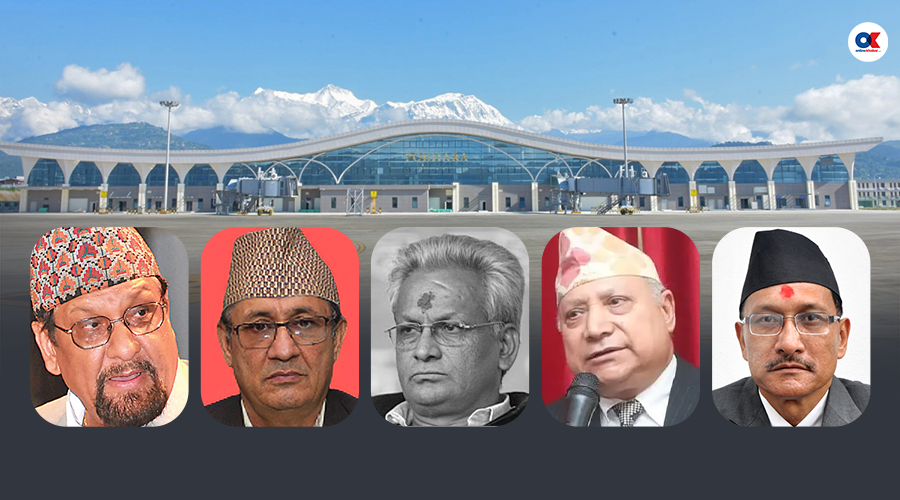
On December 7 last year, the CIAA filed cases against five former ministers and a Chinese company along with a total of 56 individuals, alleging corruption worth Rs. 836 million in the Pokhara airport construction project.

The accused included Ram Kumar Shrestha, Bhim Prasad Acharya, Dipak Chandra Amatya, Dr. Ram Sharan Mahat, and the late Post Bahadur Botgya’s widow Ram Maya Bogti. Former tourism secretaries Sushil Ghimire and Sureshman Shrestha, Finance Secretary Suman Prasad Sharma, and Law Secretary Bheshraj Sharma were also charged.

According to the special court’s charge sheet, the corruption involved inflating the construction cost of Pokhara International Airport. The initial estimate was USD 169.69 million, including 13% VAT and 3% contingency.

However, after cost escalations, the contract value rose to USD 244.04 million, an increase of USD 74.34 million. The CIAA alleges that this amount—equivalent to Rs. 836 million based on the then exchange rate of Rs. 112.55 per dollar—is the basis for the corruption allegations.

The latest case concerns amounts spent outside the loan agreement with the Chinese bank. The CIAA claims that instead of the contractor spending the allocated funds on consultants as per the contract, CAAN spent its own budget, constituting corrupt practice.

New Criteria Being Developed for Hotel Classification in Nepal; Department Seeks Suggestions

News Summary

Collected and editorially reviewed.

  • The Department of Tourism has solicited suggestions from stakeholders to develop new criteria for hotel classification in Nepal.
  • The current criteria established in 2019 (2076 BS) are in effect but are undergoing revision.
  • The new standards will incorporate green hospitality along with the physical infrastructure and service quality of hotels.

March 22, Kathmandu – Nepal is set to develop new standards for classifying hotels. Presently, the classification criteria from 2076 BS (2019 AD) are in use. According to the Department of Tourism, preparations to update these standards to reflect current needs are underway.

In line with this, the Department has invited opinions and suggestions from relevant stakeholders. Announcing this, the Department has called for inputs on aspects needing improvement in the existing 2076 standards, including required indicators related to green hospitality, as well as classification criteria concerning the physical infrastructure and quality of service in hotels.

Considering the growing global emphasis on environmental awareness and sustainable development within the tourism sector, the government aims to incorporate green hospitality principles into the revised standards, the Department stated.

Former Minister Bhim Acharya Released on Bail of NPR 250,000 in Pokhara Airport Corruption Case

News Summary

Prepared after editorial review.

  • UML leader and former minister Bhim Acharya was released on bail of NPR 250,000 in the Pokhara International Airport corruption case.
  • Acharya appeared at the Special Court on Monday, where judges Narayan Prasad Paudel, Hemant Rawal, and Umesh Koirala ordered the bail amount.
  • The Commission for the Investigation of Abuse of Authority accused Acharya of inflating the airport construction costs during his tenure as Tourism Minister.

March 22, Kathmandu: Former minister and CPN-UML leader Bhim Acharya was released on bail after paying NPR 250,000 in the corruption case involving Pokhara International Airport. Acharya appeared before the Special Court on Monday. The bench comprising judges Narayan Prasad Paudel, Hemant Rawal, and Umesh Koirala had ordered the bail amount.

Court information officer Yagyraj Regmi confirmed that Acharya has been released after depositing the bail amount.

“He was required to submit NPR 250,000 as bail. After paying that amount, he has been released,” Regmi stated.

The Commission for the Investigation of Abuse of Authority (CIAA) alleged that Acharya, during his tenure as Tourism Minister, irregularly increased the airport construction expenses. The CIAA filed the case against him and other accused individuals at the Special Court on December 6 last year.


आफ्नै उम्मेदवारसँग लड्यो कांग्रेस – Online Khabar

Congress Faces Internal Rivalries Running Against Its Own Candidates

News Summary

  • Nepali Congress secured victories in only 18 of the 165 constituencies, marking the weakest electoral performance in the party’s parliamentary history.
  • The party’s Central Working Committee attributed internal conflicts as the primary reason for defeats in about 20 to 21 constituencies.
  • Election Commission data shows Congress lost by margins of fewer than 5,000 votes in 20 constituencies across Koshi, Sudurpashchim, Bagmati, Karnali, Gandaki, Madhesh, and Lumbini provinces.

March 22, Kathmandu – Recently, the Nepali Congress has been more noted for its internal disputes than external competition. The factionalism within the party, which has a long political history, has increasingly damaged its reputation.

The competition between the party’s establishment and other groups has long existed, but now it appears to have shifted more towards factional power struggles than political debates.

During the elections, dissatisfied leaders have increasingly sided with independent candidacies or withheld campaign support, undermining the party’s success even when official candidates are fielded.

This trend was clearly visible in the House of Representatives election held on March 6, where Congress managed to win only 18 out of 165 constituencies.

This represents the weakest parliamentary outcome in the history of Nepali Congress. Following the results, the establishment and former leadership factions have been blaming each other for the defeat.

The Central Working Committee met for two days to review the election and concluded that internal party conflicts were responsible for losses in at least 21 constituencies.

Party spokesperson Devraj Chalise, discussing the findings, said that losses by less than 5,000 votes were primarily due to internal issues.

“Our assessment shows that losses by 3,000 to 5,000 votes were caused by problems within the party,” Chalise stated on Sunday, “these constituencies number around 20 to 21.”

Devraj Chalise / File photo

According to Chalise, analyzing the results shows Congress lost by less than 5,000 votes in five constituencies each in Koshi and Sudurpashchim provinces; three each in Bagmati and Karnali; two in Gandaki; and one each in Madhesh and Lumbini provinces.

Election Commission data indicates that in Koshi Province, Congress was narrowly defeated in Taplejung, Sankhuwasabha, Dhankuta, Khotang, and Okhaldhunga constituencies.

In Sudurpashchim Province, Congress candidates lost by less than 5,000 votes in Darchula, Bajhang, Baitadi, Achham-2, and Kailali-1.

Bagmati Province saw narrow defeats in Sindhuli-1, Nuwakot-1, and Sindhupalchok-2; Gandaki Province in Syangja-2 and Baglung-2; Karnali Province in Dolpa, Dailekh-2, and Western Rukum; Lumbini Province in Gulmi-2; and in Madhesh Province, Congress lost by a narrow margin in Dhanusha-1.

In Taplejung, Congress candidate Gajendra Prasad Tumyang Limbu lost to UML’s Khitij Thebe by 2,251 votes. Thebe won with 13,962 votes, while Limbu received 11,711.

In Sankhuwasabha, Congress candidate Dipan Kumar Shrestha was defeated by UML’s Arjun Kumar Karki by 2,365 votes. Karki secured 15,636 votes, with Shrestha obtaining 13,271.

In Dhankuta, Congress’ Dinesh Rai lost by 3,875 votes to UML’s Rajendra Kumar Rai. UML won with 18,132 votes; Congress received 14,257.

In Khotang, Congress candidate Bir Kaji Rai trailed Labour Culture Party’s Aren Rai by 4,655 votes. Aren secured 16,612 votes and was elected, while Bir Kaji received 11,957 votes, placing third.

In Okhaldhunga, Kumar Luitel of Congress narrowly lost to Rashtriya Swatantra Party (Rastriya Swatantra Party) candidate Bishwaraj Pokharel by just five votes. Pokharel won with 13,953 votes; Luitel had 13,948 votes.

In Madhesh Province’s 32 constituencies, Congress was narrowly defeated in Dhanusha-1, where candidate Rampalton Sah lost by 928 votes to Nepali Communist Party leader Matrika Prasad Yadav, who received 10,430 votes; Sah got 9,502 votes.

In Bagmati Province, in Sindhuli-1, Congress leader Ujjwal Prasad Baral lost by 1,089 votes to Rastriya Swatantra Party’s Dhanendra Karki, who won with 16,659 votes; Baral finished third with 15,570 votes.

In Nuwakot-1, Congress leader Dr. Prakash Sharan Mahat was defeated by 4,012 votes. Vikram Timilsina of Rastriya Swatantra Party won with 22,609 votes; Mahat received 18,597 votes.

In Sindhupalchok-2, Congress candidate Banshalal Tamang lost by more than 2,500 votes to Nepali Communist Party’s Yuvraj Dulal, who won with 21,699 votes; Tamang obtained 19,146 votes.

In Gandaki Province’s Syangja-2, Congress candidate Bhagwat Prakash Malla lost to Rastriya Swatantra Party’s Jhavilal Dumre by 4,500 votes. Dumre received 25,354 votes; Malla secured 20,840.

Baglung-2 also saw close competition, with Congress candidate Tekraj Paudel losing by 779 votes. Rastriya Swatantra Party’s Som Sharma won with 12,647 votes; Paudel had 11,868 votes.

In Lumbini Province’s Gulmi-2, Congress candidate Bhuvan Prasad Shrestha was defeated by 2,533 votes by Rastriya Swatantra Party’s Govind Panthi, who won with 16,967 votes; Shrestha placed third with 14,434 votes.

In Karnali Province’s Dolpa, Congress co-general secretary Karn Bahadur Budha lost by 3,855 votes. Nepali Communist Party’s Dhan Bahadur Budha won with 6,802 votes, while Karn Bahadur Budha received 2,947 votes, taking third place. The two candidates are brothers.

In Dailekh-2, Congress candidate Dikpal Kumar Shahi was defeated by UML’s Laxmi Prasad Pokharel by 4,337 votes. Pokharel was elected with 13,889 votes while Shahi was runner-up with 9,552 votes.

In Western Rukum of Karnali Province, Congress candidate Raju KC lost by nearly 5,000 votes. Nepali Communist Party’s Gopal Sharma was elected with 21,609 votes; KC garnered 16,661 votes.

In Sudurpashchim Province’s Darchula, Congress candidate Dharanand Joshi trailed UML’s Ganesh Singh Thagunna by 3,065 votes. Thagunna secured 18,891 votes; Joshi had 15,836 votes.

In Baitadi, Congress candidate Chatur Bahadur Chand lost by 2,940 votes. Rastriya Swatantra Party’s Harimohan Bhandari won with 22,134 votes; Chand earned 18,194 votes.

In Bajhang, Congress co-general secretary Prakash Rasaily ‘Snehi’ lost to UML’s Ain Singh Mahar by 2,239 votes. Mahar was elected with 18,543 votes; Rasaily received 16,304 votes.

In Achham-2, UML’s Yagn Bahadur Bogati defeated Congress candidate Pushpa Bahadur Shah by 472 votes. Bogati won with 9,518 votes; Shah had 9,046 votes.

According to the Election Commission, in Kailali-1, Congress candidate Jankaraj Chaudhary lost by 4,959 votes. Rastriya Swatantra Party’s Komal Gyawali won with 17,826 votes; Chaudhary received 12,867 votes.

Shivprasad Ghimire Announces Candidate Panel for Object-Oriented Vice Presidency

News Summary

Prepared through editorial review.

  • Shivprasad Ghimire has officially announced his candidacy with a 16-member panel for the position of Vice President under the object-oriented category in the upcoming Nepal Federation of Chambers of Commerce and Industry (FNCCI) election.
  • Ghimire’s candidacy has received support from Anjan Shrestha, who aims to lead the Federation’s future.
  • Ghimire has expressed commitment to strengthening and making the role of object-oriented associations within the Federation more effective.

9 Chaitra, Kathmandu – Shivprasad Ghimire has formally announced his candidacy for the Vice President position under the object-oriented category in the upcoming election of the Nepal Federation of Chambers of Commerce and Industry (FNCCI).

At an event held in the capital on Monday, Ghimire introduced a group of candidates along with a 16-member panel. His candidacy has been endorsed by Anjan Shrestha, who is poised to lead the Federation’s future initiatives. A prominent businessman in the energy and LPG sectors, Ghimire has assembled an inclusive team representing various industries and trade sectors.

Ghimire is a former president of the Nepal LPG Industry Association and has played a significant role in policy reforms in the petroleum and energy sectors. He has been actively engaged long-term in bringing issues faced by small and medium industries to the policy-making level.

Exceptional Coordination Capability: Ghimire’s key strength lies in his clear and fearless presentation in dialogues between the government and private sector. During his candidacy announcement, he reiterated his commitment to making the role of object-oriented associations within the Federation stronger and more impactful.

Candidates for Object-Oriented Membership Panel led by Ghimire:

Aruniko Rajbhandari, Rabin Puri, Rajkumar Karki, Basantchandra Marhatta, Sunita Nhemfuki, Sangharsha Bista, Raghunandan Maru, Rajeshbhakta Shrestha, Hom Prasad Ghimire, Dhan Prasad Lamichhane, Dharmaraj Sapkota, Krishnaprasad Awale, AB Bahadur Thapa, Vishwanath Khanal, Naniraj Ghimire, Dhruv Bahadur Gautam.

Bishwprakash Sharma Visits Gundu to Offer Condolences to KP Oli with Two General Secretaries

News Summary

  • Bishwprakash Sharma, Vice President of Nepali Congress, visited KP Sharma Oli, Chairman of CPN-UML, at his residence in Gundu, Bhaktapur to offer condolences on his bereavement.
  • Sharma was accompanied by party General Secretaries Gurruraj Ghimire and Pradeep Paudel during the visit.
  • KP Oli’s father, Mohan Prasad Oli, passed away at the age of 97 on 29th of Falgun.

9th Chaitra, Kathmandu – Bishwprakash Sharma, Vice President of the Nepali Congress, visited KP Sharma Oli, Chairman of CPN-UML, at his residence in Gundu, Bhaktapur to express condolences following the bereavement.

Sharma arrived at Oli’s residence accompanied by party General Secretaries Gurruraj Ghimire and Pradeep Paudel.

KP Oli’s father, Mohan Prasad Oli, passed away at the age of 97 on the 29th of Falgun.

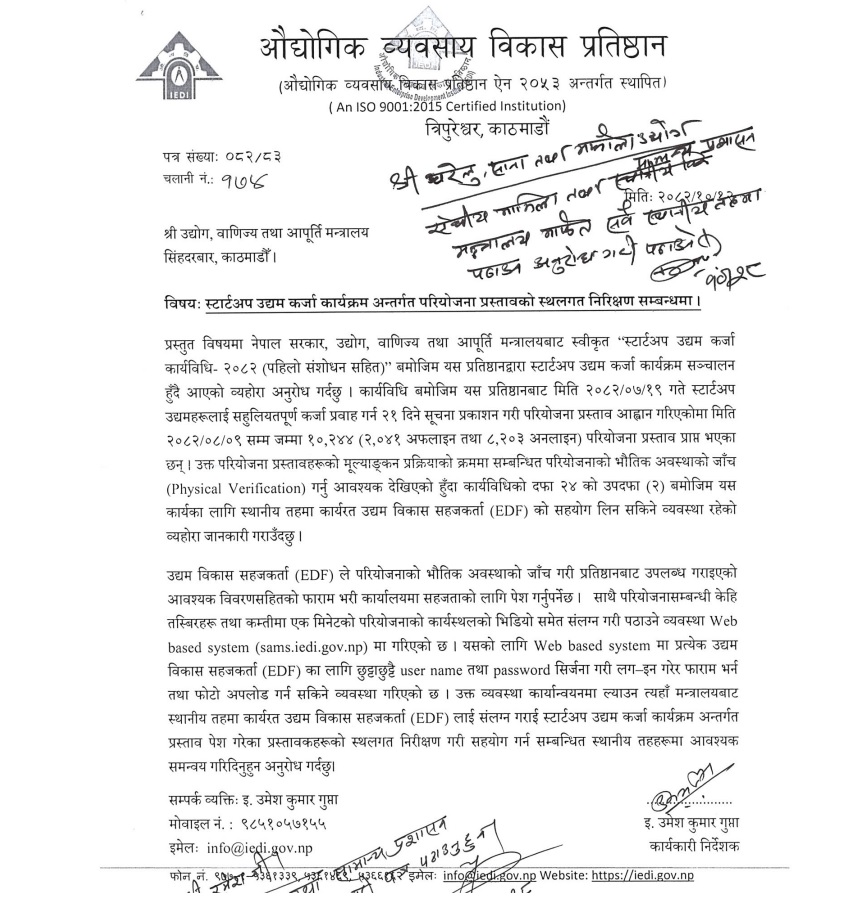
Addition of New Subsection in Procedure Provides Relief to Over 10,000 Young Entrepreneurs

News Summary

  • The Ministry of Industry, Commerce and Supplies has added a new subsection to the Startup Enterprise Loan Operation Procedure 2082, eliminating the need for over 10,000 young entrepreneurs to travel to Kathmandu for loan presentations.
  • In the current fiscal year 2082/83, 10,244 project proposals have been submitted for startup loans, doubling the number from the previous year.
  • Instead of presentations, evaluation committees will now select entrepreneurs based on local inspection reports, photos, videos, and documents provided by local-level enterprise development facilitators.

March 22, Kathmandu – The inclusion of a new subsection in the procedure has simultaneously benefited more than 10,000 young entrepreneurs. Thanks to the revisions made by the Ministry of Industry, Commerce and Supplies to the Startup Enterprise Loan Operation Procedure 2082, entrepreneurs are no longer required to come to Kathmandu for presentations.

According to the ministry’s spokesperson, Netra Prasad Suvedi, this fiscal year has seen 10,244 project proposals submitted for startup enterprise loans. Under the procedure until 2081, every applicant was required to present in person for 10 minutes in Kathmandu. The recent amendments have lifted this obligation, easing the process for entrepreneurs.

The updated procedure for 2082 added subsection 2 under clause 24, allowing the inclusion of support from provincial governments and local-level enterprise development facilitators for loan applicants.

New provision added in the 2082 procedure.

On this basis, the Industrial Enterprise Development Institute, under the ministry, collaborated with local governments to conduct site inspections of project proposals under the startup loan program this year.

Spokesperson Suvedi explained that evaluation committees will score entrepreneurs based on inspection details, photos, videos, and documents submitted in the format prescribed by the institute, all collected by local enterprise development facilitators.

Although presentations carried a scoring weight in the procedure, the assessment will now be based solely on submitted details and documents. Entrepreneurs scoring above 50 percent in the preliminary list will be prioritized for credit checks through banks and recommended for loans.

Clause 23 of the 2081 procedure mentioned cost-sharing arrangements can be made among the institute, provincial governments, local authorities, private sector, academia, and universities.

Provision under the 2081 procedure

This year, the provision was clarified and expanded by adding the subsection stating, “The institute may seek assistance from provincial government entities registering industries and local-level enterprise development facilitators, coordinated through the provincial government, to enhance loan recommendation and program implementation effectiveness, necessary data collection, loan disbursement monitoring, and evaluation.”

To facilitate the implementation of this provision, Executive Director E. Umesh Kumar Gupta of the Industrial Enterprise Development Institute wrote a letter to the ministry in Magh last year. Based on this letter, on Magh 28, 2082, the Ministry of Industry wrote to the Ministry of Federal Affairs and General Administration requesting facilitation.

The Ministry of Federal Affairs notified all municipalities and rural municipalities on Magh 29, instructing them to implement the institute’s request. The site inspection form for startup loan 2082 project proposals was also made available during this process.

Proposals Double Compared to Last Year

During the current fiscal year 2082/83, 10,244 entrepreneurs submitted proposals for startup loans, which is double the 5,158 proposals submitted during fiscal year 2081/82. The government has been providing startup loans annually to encourage youth to transform innovative knowledge, ideas, skills, and capacities into businesses.

According to the Ministry of Industry, Commerce and Supplies, a budget of 860 million NPR has been allocated for this program this year. Eligible entrepreneurs will receive loans without collateral at a 3% interest rate, with loan amounts ranging from a minimum of 500,000 NPR to a maximum of 2 million NPR per entrepreneur, according to the Startup Enterprise Loan Procedure 2082.

The Industrial Enterprise Development Institute had requested submission of proposals related to easy loan disbursement for startups by Kartik 19.

The ministry reported that a total of 10,244 project proposals were received within the deadline; 2,041 physically and 8,203 electronically. Enterprise development facilitators conducted physical site monitoring and submitted detailed forms including photos and one-minute videos showing entrepreneurs’ operations or products for each proposal. Evaluation committees will now select entrepreneurs based on these details and submitted documents instead of presentations. Proposals came from 77 districts and 713 local units this year.

Preliminary Screening Supported by Artificial Intelligence

The ministry stated that the projects submitted through the institute are being evaluated by an expert panel. Simultaneously, artificial intelligence-based screening software is conducting preliminary evaluations, which is believed to provide approximately 80% accuracy. The institute will publish a preliminary list including projects that meet procedural criteria.

Selected proposals, which typically require business presentations, entail higher costs, complex procedures, and longer durations that may affect program completion within the fiscal year. Therefore, this year the evaluation will rely on inspection reports, photos, videos, and official documents submitted by enterprise facilitators, as explained by spokesperson Suvedi.

Child Dies During Pilgrimage to Pathibhara Temple

News Summary

Editorially reviewed.

  • A two-and-a-half-year-old boy from Panchthar fell ill on the way and died while visiting Pathibhara Temple in Taplejung.
  • District Police Office Chief Ved Prasad Gautam confirmed the child was suffering from pneumonia.
  • The boy had traveled with his guardians and relatives and passed away during the return journey.

March 22, Taplejung – A two-and-a-half-year-old boy visiting the renowned pilgrimage site, Pathibhara Temple in Taplejung, died today.

Ved Prasad Gautam, Deputy Superintendent of Police and Chief of the District Police Office, stated that the boy was Sohan, son of Hari Shrestha from Hillihang Rural Municipality -2 of Panchthar District.

According to Gautam, the child was traveling with his guardians and relatives for the temple visit and became suddenly ill while returning. He was immediately taken to the district hospital, where he died during treatment.

Police reports indicate that the boy suffered from pneumonia.

ट्रम्पको नयाँ बयानपछि विश्व बजारमा कच्चा तेलको मूल्य १३ प्रतिशतले घट्यो

Global Crude Oil Prices Drop 13% Following Trump’s Latest Statement


March 22, Kathmandu – Following a recent statement by US President Donald Trump, global crude oil prices have fallen by 13 percent. On Monday, Trump announced ongoing talks with Iran and stated that no attacks would be launched against Iran for the next five days.

In a post on ‘TruthSocial’ written in all capital letters, he said, “I am pleased to inform you that over the past two days, the United States and Iran have had very good and productive discussions regarding the full and comprehensive resolution of our adversaries in the Middle East.”

He added, “Based on the intent and tone of these intensive, detailed, and constructive talks—which will continue throughout the week—I have directed the Department of Defense to suspend any and all military strikes against Iranian energy sites and energy infrastructure for a period of five days, contingent on the success of the ongoing meetings and discussions. Thank you for your attention. President Donald J. Trump.”

Following Trump’s statement, the price of Brent crude oil declined by 13 percent, dropping to $96 per barrel.

Similarly, gas prices fell from 159 pence per therm to 139 pence, according to reports from the BBC.