Shortly after taking charge as Chief Justice on Ashadha 23, 2072 Vikram Samvat, Kalyan Shrestha expressed dissatisfaction during an interview with the structure of the Judicial Council responsible for appointing judges.
“The most capable individuals who can deliver justice, uphold judicial conduct steadfastly, must come as judges; they should be attracted and requested,” he said. “Although discussions were held about restructuring the Judicial Council to facilitate easier judicial appointments with a majority of judges on the council, these suggestions were not heeded.”
He implicitly criticized the provision where politically affiliated members dominate the Judicial Council responsible for appointing judges, leaving judges in the minority.
Image source, Nepal Photo Library
According to the current 2072 Constitution, the Judicial Council chaired by the Chief Justice includes the Minister of Law and Justice, the most senior judge, a legal expert appointed by the President upon the Prime Minister’s recommendation, and a senior advocate appointed by the President on the recommendation of the Nepal Bar Association, totaling five members.
However, the 2047 Constitution, established after the restoration of multi-party democracy, provided for a Judicial Council dominated by judges.
Under that structure, chaired by the Chief Justice, the council included the Minister of Justice, two judges based on seniority, and distinguished legal experts appointed by the monarchy.
The interim Constitution of 2063, following the “Second People’s Movement,” reduced the number of judges by one and introduced a member recommended by the Nepal Bar Association representing senior advocates or advocates.
Khimlal Devkota, a member of the interim constitution drafting committee, recalls, “I opposed including a representative of the Bar in the judge-appointing body on the grounds that if judges accept bribes, the Bar should bear responsibility too. However, I was alone in this opposition.”
Is the Problem Within the Judicial Council or the Intent of Its Leadership?
Image source, JCN
Devkota states that whether the system exacerbated corruption or not is uncertain, but it was not able to prevent it.
This raises the question: does the structure of the Judicial Council cause controversy in judicial appointments?
Former Supreme Court Justice B. N. Upadhyay does not entirely blame the council’s structure. He observes, “Neither the Bar Association is satisfied with judge appointments, nor do other judges or court staff. Hence, the Chief Justice must be strong and firm in his position because true power lies with the Chief Justice. However, they often reach compromises to bring judges aboard.”
Law professor Bipin Adhikari from Kathmandu University believes that disputes arise due to a lack of confidence and pride in the Chief Justice to exercise power effectively.
He argues that just as the executive branch is headed by the Prime Minister, the judiciary should be led by the Chief Justice.
“There may be structural issues, but the root problem lies in leadership. If leadership were strong, independent, and impartial, no one could interfere,” he says. “The Chief Justice should clearly assert his forum within the Judicial Council. There are no signs of the Chief Justice standing firm to appoint judges based on the highest merit rather than minimum criteria.”
Legal expert Devkota also points out that the problem is less in the structure and more in the culture.
He notes that many judges appointed by the historically judge-dominated Judicial Council later became controversial Chief Justices.
“I worry less about making courts respectable and more about judges’ quotas being allocated. Thus, I think changing the structure without changing the culture will not solve the problem,” Devkota says. “Now, the intention is to centralize appointments not only of the Chief Justice but for all judicial posts.”
The Source of Confusion: Direct Appointment as Chief Justice Without Serving as a Judge?
Image source, Reuters
Caption, Former female Chief Justice Sushila Karki
Karki pointed out a trend where lawyers are being appointed directly as Supreme Court judges without progressing through the ranks to become Chief Justice.
According to experts, since the 2046 political changes, no one entered the Supreme Court and immediately became Chief Justice.
After the establishment of the republic, senior advocate Anup Raj Sharma joined the Supreme Court and served as Chief Justice for approximately three months. Sushila Karki, with a background in legal profession, served nearly one year, and Harikrishna Karki around one and a half months as Chief Justice.
Eight judges from judicial or High Court service backgrounds, from Sharma to Karki, have served as Chief Justice.
After Harikrishna Karki, it was the turn of ‘Cadre Judge’ Vishwambhar Shrestha.
Alongside Shrestha, permanent officers such as Balendra Rupakheti, Mohan Bahadur Karki, Premraj Dhakal, Gunraj Dhungel, and Gopal Bhattarai retired without serving as chief justice of the High Court.
Experts suggest that the rapid appointments of those going directly from lawyer to the Supreme Court and the pressure exerted by judges jumping administrative posts to the High and Supreme Courts have contributed to this situation.
Following Shrestha, over a decade has passed without a ‘Cadre Judge’ becoming Chief Justice, during which four judges from the legal profession entered the Supreme Court directly.
Current Chief Justices Manoj Kumar Sharma and Hari Phuyal also entered the Supreme Court before turning 50 years old without being senior advocates.
Post-changes, the practice of chief registrars becoming senior judges in High Courts or ascending to Supreme Court judges has accelerated. Some view this as a measure taken to counteract the lawyers directly jumping to the Supreme Court.
For about one and a half decades, this pattern of Supreme Court appointments during such intervals persisted, creating tensions within the Nepal Bar Association, leading to proposals limiting Supreme Court judges’ tenure to seven years.
The annual general assembly of the Bar in Surkhet concluded that tenure-based appointments have increased judicial disorder.
Constitutionalist Bipin Adhikari states, “There is a mentality that the incompetent should be considered senior and authoritative.”
Former Justice B.N. Upadhyay notes that the appointment of many junior individuals as judges has caused disappointment and dissatisfaction in the judiciary. Rules that assign positions below retired seniors for district judges have increased discontent among staff regarding seniority.
“Experienced district judges became inactive in reaching High Court postings while others rushed to the Supreme Court quickly. During this time, all chief justices retired—there were good and capable judges,” he said. “Dissatisfaction exists among judges, staff, and lawyers alike.”
Image source, RSS
How to Resolve the Issue?
Former Chief Justice Kalyan Shrestha says judges should be appointed not just by passing tests but based on experience, ethics, and personality. “Even if thousands of judicial positions are created, judges cannot be produced overnight. Judges must be nurtured,” he said.
Similarly, former Justice Upadhyay believes lawyers should not be directly appointed as Supreme Court judges without prior judicial experience. He suggests courts should appoint judges based on their personality when the need arises to interpret new constitutions or laws.
“However, now lawyers declare, ‘I am on the path to becoming Chief Justice; only that is why I am coming.’ Not all appointed are bad; many fit within accepted limits,” he noted. “But it would be better if candidates did not enter the Supreme Court directly at the same time, because they lack judicial experience.”
Law professor Bipin Adhikari comments that the most qualified individuals lack open and free access to the judiciary. Due to unfavorable promotion conditions, the number of judges able to rise from district courts to High Courts and Supreme Court is decreasing.
“There is no vision to bring top officers from law and government attorney groups into the judiciary. Nor is there a system to channel talented legal minds from universities into the courts,” Adhikari says. “The Judicial Council lacks a list of the country’s best minds. Appointments are not transparent, and there is no trust that selections are clean.”
However, legal expert Devkota, with a political background, believes the influence is more political than structural.
He says he raised the issue of judge reappointments during the drafting of the interim constitution and now sees contradictions as a result. “Some arrange for themselves to become Chief Justice until 2090-92 BS, while others break that system to make their own path,” he observes.
“Thus, no good track record has been established,” Devkota suggests. “Arrangements for reappointments and independent competition could make a difference.”
Special general assemblies are scheduled at two different locations on Sunday to discuss the vote of no confidence lodged against the leadership of the All Nepal Intellectual Federation. The no-confidence motion raises concerns regarding President Herakaji Maharjan’s working style, financial opacity, and decision-making processes. Allegations also highlight that the federation’s idle funds have exceeded NPR 5.4 million, and there are claims of bias in budget allocations. (10 Jestha, Kathmandu)
Due to escalating internal disputes, a vote of no confidence was filed against the federation’s leadership, prompting the call for a special assembly. The internal friction has intensified to the point that separate special general assemblies will be held simultaneously at two different venues. President Herakaji Maharjan’s faction has scheduled their special assembly in Hetauda, Makwanpur, while the group opposing Maharjan and General Secretary Dharambahadur Lama has organized theirs at Swayambhu Peace Hotel in Kathmandu.
President Herakaji Maharjan’s team is preparing to face the no-confidence motion in Hetauda, whereas a group led by Senior Vice President Dipen Rai is preparing for the assembly in Kathmandu. According to federation spokesperson Raju Tamrakar, as per the executive committee’s decision, the special general assembly will take place on Jestha 10 at Club Hetauda, Hetauda-4, Makwanpur. Meanwhile, the opposing group has also announced plans to hold a special assembly in Kathmandu.
On Baisakh 12, Senior Vice President Dipen Rai submitted the no-confidence motion against President Herakaji Maharjan and General Secretary Dharambahadur Lama, supported by the signatures of 40 representatives. Following the motion, a meeting held on Baisakh 30 decided that under Article 7, Clause 22, Sub-clause 2 of the federation’s bylaws, the relevant executive committee must convene a special general assembly within 35 days to discuss and decide the matter. FIDE representative Amit Khanna Nepal conveyed that the central executive committee has resolved by majority to hold the special general assembly in Hetauda, Makwanpur, to address the vote of no confidence, as noted by spokesperson Tamrakar.
However, Tamrakar also mentioned that some members have submitted written objections to the venue. For impartial oversight of the special general assemblies, formal notifications have been sent to the World Chess Federation and the National Sports Council, and FIDE representative Amit Khanna Nepal has already arrived. Since the submission of the no-confidence motion against the leadership, internal dissatisfaction and distrust have become apparent within the federation. The opposing faction has seriously challenged President Maharjan’s working methods, financial transparency, and decision-making procedures.
Senior Vice President Dipen Rai and others have accused the federation of financial irregularities, non-transparent expenditures, and dereliction of responsibilities. According to Treasurer Tarabahadur Ranabhat, the federation currently holds idle funds amounting to over NPR 5.4 million. Allegations include delayed disbursement of budgets from the Regional Association for the Development of Educational and Cultural Programs (RAKEP), failure to account for funds received from international support, and increasing systemic issues. Furthermore, accusations of bias have been raised concerning player selection, participation in competitions, and budget allocation.
Nepal will compete against the Maldives in their third group B match of the ongoing KAAVHA Women’s Volleyball Championship being held in Kathmandu. The match is scheduled for 5 PM today at the Dashrath Rangashala Covered Hall. Nepal currently holds second place in Group B with 4 points from two matches and aims to secure a semifinal spot by defeating the Maldives. The game will be broadcast live on the Himalaya Sports channel, featuring six new players in the Nepali squad.
On June 23, Kathmandu – As part of the KAAVHA Women’s Volleyball Championship underway in Kathmandu, Nepal will take on the Maldives today in their third and final Group B match. The encounter between Nepal and the Maldives will kick off at 5 PM at the Dashrath Rangashala Covered Hall in Tripureshwor. The match will be televised live on Himalaya Sports. Nepal has recorded one win and one loss in the first two games. In Group B, Nepal stands second with 4 points from two matches, while the Maldives have lost both their matches and have been eliminated from the group stage.
Viewed as comparatively weaker, the Maldives are considered a team Nepal aims to defeat to advance to the semifinals. Despite a challenging five-set loss to familiar rival India in their first match, Nepal strengthened their semifinal prospects by straight-setting Kyrgyzstan in their second game. Group B currently sees India leading with 5 points, followed by Nepal with 4 points in second and Kyrgyzstan with 3 points in third place. A straight-set victory over the Maldives would take Nepal’s total to 7 points, ensuring semifinal qualification without relying on other results.
The Nepali team, captained by newly appointed Niruta Thagunna, features a youthful lineup with six debutants, of whom five have already made their national team debut. Additionally, at noon today, Iran will face Sri Lanka, and at 2:30 PM Kazakhstan will compete against Bangladesh in Group B matches. All matches in the KAAVHA Women’s Championship are being broadcast live on Himalaya Sports Television.
Hyatrung Waterfall, located in Fedaap Rural Municipality of Tehrathum, is facing a crisis due to water scarcity. Locals emphasize the urgent need for protection of water sources above the waterfall and for scientific management. Approximately NPR 80 million has already been spent by local, provincial, and federal governments on tourism infrastructure development. (May 23, Tehrathum)
The sight of water cascading like a white curtain from the hills, surrounded by lush green forests and the sweet sounds of birds, captivates all visitors to Hyatrung Waterfall, a renowned tourist destination in eastern Nepal. Situated at an elevation of about 1,500 meters above sea level, Hyatrung lies on the border between Samdu of Ward No. 4 and Isibu of Ward No. 5 in Fedaap Rural Municipality. The waterfall plunges approximately 365 meters from the top and is recognized as Nepal’s second highest and Asia’s fourth highest waterfall.
However, in recent years, water scarcity has endangered this popular site. While it gushes heavily during the rainy season, the flow dwindles significantly during the dry months. Locals point to drying water sources upstream, irregular rainfall patterns, climate change, and increasing pressure on forest areas as factors severely impacting the waterfall’s water flow.
Devi Regmi, a local from Fedaap Rural Municipality-4, states, “Earlier, water flowed abundantly year-round. Now, during the dry season, the water flow at the waterfall has reduced noticeably.” She warns that without proper conservation of water sources, Hyatrung’s natural beauty could be at risk in the future. The dwindling water threatens not only this natural attraction but also one of eastern Nepal’s emerging tourism centers.
Joint efforts by local, provincial, and federal governments have so far invested nearly NPR 80 million in infrastructure development. Stairs, railings, resting platforms, and pathways have been built to facilitate tourist access, and safety measures installed at hazardous spots. A suspension bridge approximately 350 meters long is under construction to enhance visitor experience. However, concerns arise as to how these facilities will sustain tourism if the waterfall itself continues to lose water.
Tourism experts stress that sustainable tourism must prioritize the conservation of natural resources. They conclude that merely improving infrastructure cannot ensure long-term tourism viability. Reaching Hyatrung is itself an exhilarating journey, involving uphill and downhill paths through forests, steps, and trails from the main road, with the final descent taking about 15 minutes. The approaching roar of the waterfall helps visitors shed their travel fatigue, as shared by Tulsi Sitoula from Atharai-1, who says, “The true beauty of the waterfall can only be appreciated in person. It makes you realize how wonderfully nature has crafted this place.” However, locals note that in recent years, the waterfall’s appearance changes during the dry season, raising concerns about the impact on visitors’ experience.
The crisis is not limited to tourism; it is affecting local livelihoods as well. Water scarcity impacts farming, animal husbandry, and daily household needs, according to residents. They report that as water sources weaken, their way of life is changing. Locals stress the immediate need for conservation of upstream water sources, reforestation, forest protection, and scientific management.
Hyatrung Waterfall has also created new economic opportunities locally. With increasing tourist arrivals, sales of local products, tea shops, small hotels, and homestays have grown. Young people are beginning to see potential in the tourism sector. According to Bheshraj Chongbang, chair of Ward No. 4 of Fedaap Rural Municipality, plans are underway to develop Hyatrung as a sustainable tourist destination. The aim is not just to have tourists visit the waterfall briefly but to encourage longer stays by promoting homestays, local cuisine, and cultural tourism.
The concern that Hyatrung Waterfall, so vibrant during the rainy season, will dry up during the dry months is worrying locals. The pressing question now is whether this unique natural gift can be preserved or if it will be lost forever.
The Bethanchok Narayanthan area in Kavrepalanchok is increasingly becoming a highly attractive destination for tourists due to its religious, cultural, and natural significance. There are three routes to reach here, and it takes about three hours on foot to reach the summit. Bethanchok emphasizes the cultivation of pesticide-free vegetables and also produces dairy products such as khuwa, cheese, and ghee. This area of Kavrepalanchok district is growing more popular with visitors each day. Located only two to three hours from Kathmandu, it offers a unique blend of religious, cultural, and natural beauty, attracting a steadily increasing number of tourists.
Situated at an altitude of 3,018 meters above sea level, the Bethanchok Narayan Peak along with Gajram Thumko at 3,012 meters and Chaubas Danda at 2,311 meters are the main tourist highlights of the region. Other scenic spots include Batase Danda, Kami Danda, Ghodabandhe, and the Tintale Waterfall. One of the main attractions here is the panoramic view of the Mahabharat Himalayan range stretching from east to west. From a religious perspective, the Bethanchok Narayan Temple, located at a high point near Mahabharat Lake, holds great importance. Other prominent Hindu pilgrimage sites in the area are the Mahankal Temple, Jhinge Bhairav Temple, Chakreshwor Mahadev Temple of Chamrangbesi, and Baghabhairav Temple of Kalang Singh.
Spending a day or two in Bethanchok allows visitors to fully appreciate its religious, cultural, and natural splendors. Being only about two and a half hours from Kathmandu by road makes it convenient to explore the area within a day and return to the city. Bethanchok offers comfortable hotels and resorts for dining and overnight stays. The village is known for its pesticide-free vegetables and a specialty dish of khuwa prepared over a traditional charcoal fire. Overall, Bethanchok is a village municipality rich in religious, cultural, and natural heritage.
The House of Representatives has prioritized constitutional amendment bills, with the Rules Drafting Committee proposing special provisions accordingly. According to Article 274 of the Constitution, any amendment bill must be published within 30 days of submission. The new rules of the House include requirements that constitutional amendment bills must secure a two-thirds majority in both houses and provide for a joint session if necessary. Kathmandu, 23 May.
The House of Representatives has placed constitutional amendments as a top priority. The Rules Drafting Committee has incorporated essential special regulations in the proposed rules. Rule 140 of the submitted rules addresses the management of constitutional amendment bills. Per Article 274 of the Constitution, any constitutional amendment bill presented to Parliament must be publicly published by the Secretary-General or, in their absence, the Secretary within 30 days to inform the public. Such a bill may then be presented at any session held at least seven days after the publication.
Article 274 contains explicit provisions related to constitutional amendments. Subsection (1) stipulates that amendments cannot contradict Nepal’s sovereignty, territorial integrity, independence, or the sovereign authority vested in the people. Apart from this stipulation, bills proposing amendments or repeals of other articles can be submitted to either house of the Federal Parliament. Bills submitted must be publicly published for public information within 30 days in the relevant house.
According to Article 274, subsection (4), if a bill concerns changes in provincial boundaries or matters listed in Schedule 6, the Speaker or Chairperson must send the bill to the concerned provincial assembly for consent within 30 days of the house’s operation. This provision is also included in the House of Representatives’ new rules. If a majority of the provincial assembly rejects the bill and notifies the house within the 30-day period, the bill becomes inactive, and no further action on it will be taken.
May 23, Kathmandu – The two-day provincial consultation workshop organized by Nepali Congress in Laukihi, Sunsari, has concluded with the release of the 28-point ‘Koshi Resolution’. Hosted by the party’s Central Policy, Research, and Training Institute, the workshop presented various resolutions addressing national and party political issues.
The resolution document expresses pride in the identity, prestige, culture, civilization, language, arts, literature, agriculture, tourism, natural resources, and cultural excellence of Koshi Province, which spans from the origin of the Kirat civilization to the foot of Kechanakawal and the summit of Mount Everest. It commits to steadfastly preserving and promoting these aspects, reflecting the sentiments of the province’s residents.
Full Text of the Resolution:
‘Koshi Resolution‘
Originating from the Kirat civilization, from the peak of Mt. Everest to the foothills of Kechanakawal, the identity and prestige of Koshi Province, its culture and civilization, language, art, and literature, agriculture and tourism, natural resources and cultural heritage are a source of pride. In alignment with the feelings of its residents, the province is firmly committed to their protection and promotion.
The natural resources, religious and social identity-linked cultural richness form the complete identity of Koshi Province, emphasizing inclusive and proportional representation, equal opportunities, just access to state power, and maintaining the province’s self-respect. The resolution pledges active efforts towards the prosperity of Koshi.
Recognizing that the prosperity of villages and municipalities constitutes the primary foundation of a progressive Nepal as envisioned by Nepali Congress, and acknowledging the constitutional responsibility of local governments to deliver immediate services on issues of direct public concern,
Nepal’s Constitution, Local Government Operation Act, and the commitments and pledges of the Nepali Congress, guided by principles of good governance and accountability, empower Congress-led local governments to implement policies making local activities more citizen-friendly, transparent, well-governed, and result-oriented.
This resolution, formulated during a dialogue, thematic discussions, and extensive interactions among Koshi Province and local government representatives, as well as party leadership from central, provincial, district, and local levels, convened by the Nepali Congress Central Policy Research and Training Institute on May 21-22, 2026, in Laukihi, Sunsari, presents these 28 commitments:
1. Following the naming of the province, the assembly highlights the necessity of addressing reactions and sentiments through inclusive dialogue and multisectoral participation. The provincial workshop pledges to take necessary initiatives in this regard.
2. Citizen-centric accountable governance: Protecting citizens’ freedoms, rights, and entitlements as enshrined in the constitution, effectively operating with policies that are responsive and accountable to the people.
3. Rule of law: Upholding decisions based on law, while urging the federal government to act in accordance with the constitution’s spirit, legal processes, and respect for citizens’ dignity.
4. Adoption of best practices: Local governments led by Congress will mutually adopt successful practices and innovative campaigns.
5. Provincial structural and administrative reforms: Eliminating or adjusting redundant structures, transforming the provincial government’s structure, implementing administrative reforms, and advancing tasks at the local level in cooperation with local governments.
6. Online and doorstep services: Enhancing “home-yard services” to deliver vital services such as birth and death registration, health insurance registration and renewal online or at home. Basic health checks for disabled, chronically ill, senior citizens, pregnant and postpartum women will be provided at home.
7. Financial discipline: All local governments must submit budgets by mid-July, adhering strictly to all stages of plan formulation. Special focus will be placed on creating “zero arrears” local governments and enforcing rigorous spending standards.
8. Plan bank: Planning will be conducted strictly through a plan bank, avoiding opaque or irresponsible decisions or investments beyond designated plans and allocated resources. Investments in unproductive sectors will be firmly avoided. The resolution calls on provincial and federal governments to harmonize plan banks across all three tiers.
9. Special tax benefits for local raw-material-based industries and youth-oriented innovations. Establish integrated agricultural zones for cash crops including cardamom, tea, ginger, avocado, lemon, apple, and mango. Establish collection centers and agricultural ambulances to connect farmers’ produce directly to consumers.
10. ‘Entrepreneur Mother’ Program: Transform women’s traditional skills into enterprises through the implementation of the “Entrepreneur Mother” initiative.
11. Revitalizing the Biratnagar-Itahari industrial corridor by fully operating it as a Special Economic Zone (SEZ).
12. Development of a “spiritual tourism trail” connecting religious pilgrimage sites such as Barahkshetra, Pathibhara, and Halesi.
13. Promoting water tourism, adventurous mountain climbing in Sagarmatha, Kanchenjunga, and Makalu regions, developing sports infrastructure recognizing the athletic talent of Koshi’s youth, expanding “one-door service” to encourage private sector participation. Promote homestays at trekking destinations.
14. Health insurance branding: Building on initiatives started by Congress, increase enrollment with the principle “health insurance for all—local governments supporting the vulnerable.” Raise awareness and facilitate insurance at the local level.
15. Implement an integrated social security program from pregnancy through end-of-life support: the “From Womb to Mourning” initiative.
16. Strengthen B.P. Koirala Institute of Health Sciences in Dharan and develop it as a specialized service center for Koshi Province.
17. Increase investment in education. Develop and implement local curricula reflecting arts, language, culture, civilization, and distinct local traits. Promote quality, research-oriented, skill-based education systems rooted in local production.
18. Organize and systematize effective health initiatives such as school nurses, community nurses, urban health promotion centers, “I am healthy, my community is healthy” campaigns, digital health profiles, nutrition, non-communicable disease screening, mental health counseling, and public health fairs.
19. Accelerate the completion of the Koshi Highway (Jogbani–Kima Thangka) to connect the north-south regions. Upgrade Biratnagar Airport to a regional international airport. Link infrastructure such as roads, electricity, and internet with improved living standards. Study feasibility for opening internal waterway services on the Koshi River for transportation.
20. Ensure social justice and inclusive resettlement for landless Dalit and squatters in dignified locations, making “squatter-free local levels.”
21. Protect the language, culture, and traditional occupations of endangered and marginalized communities in Koshi Province, and launch special social transformation programs to eliminate caste-based untouchability, child labor, and gender-based violence for a discrimination-free society.
22. Implement the “Birthplace Prosperity” special campaign to link the skills of returning migrant workers from abroad from labor to entrepreneurship.
24. Establish an early warning system for disaster risk reduction by creating youth rescue teams and fostering resilient communities.
25. Conserve wildlife habitats and environments, and take initiatives to control wildlife such as nilgai, elephants, monkeys, and langurs that damage crops. Urge the federal government to regulate human-wildlife conflicts through legal and structural management. Also, implement the “Green City–Healthy City” special campaign.
26. Promote coordination, cooperation, and coexistence between federal, provincial, and local governments. Request equitable, just, and needs-based budget allocation systems from provincial and federal governments.
27. Form a party-government coordination mechanism promptly, making it effective and establishing a system for regular monthly dialogue.
28. Accelerate the “Root Campaign” to strengthen party organizations by maintaining digital records of active members.
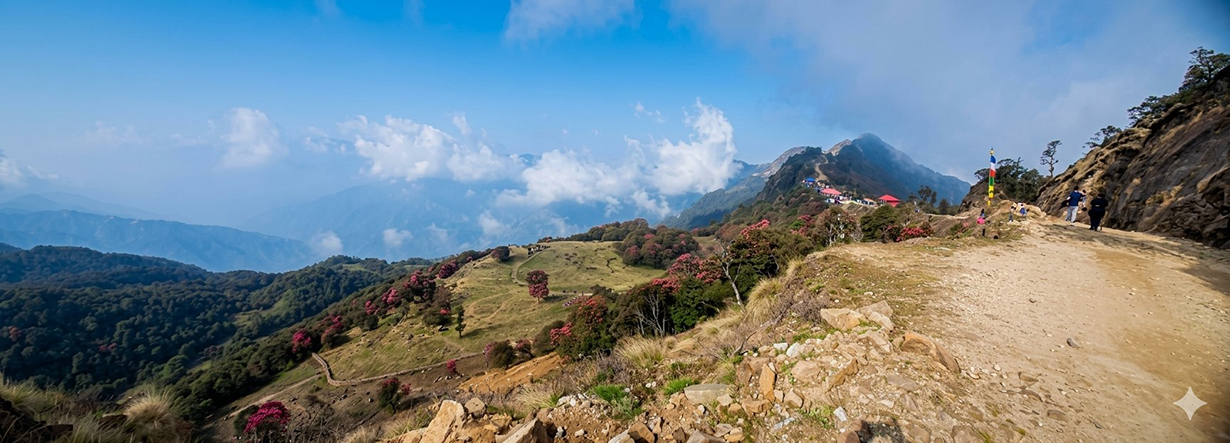
The primary reasons for the Rhododendron flowers blooming in various colors during the month of Baisakh in Tinjure, Tehrathum, are genetic diversity and environmental variations.
The scientific name of this rhododendron is Rhododendron arboreum, and Nepal hosts two subspecies and two varieties of it.
The government is preparing to allocate a budget in the upcoming fiscal year for road improvement and eco-friendly trail construction in Tinjure.
On Baisakh 11, I participated in a discussion at Chotlung Park in Basantapur, Tehrathum, on the topic “Impact of Climate Change on Rhododendron.” The participants included students from 10+2 level and community forest members. After the program, we proceeded towards Panchpokhari in Tinjure.
The distance was approximately 10 kilometers. The vehicle was a four-wheel drive with a ground clearance of 190 mm. Due to the rough, uneven road with potholes and large stones, vehicles with lower ground clearance face difficulty traveling this route.
This route has been trenched for over 25 years. According to government records, no matter what its official name is, locals refer to it as the “Tinjure-Gurans Route That Can Never Be Paved.” Electric vehicles were stirring up dust as they drove along. This road is challenging for domestic tourists, though the section to Rock and Rhododendron Park is paved.
Rhododendrons were in full bloom in a variety of colors. Asking my companion Seeta Rana and son Shubhang why flowers of the same species bloom in different colors, I drove to Panchpokhari. We stayed at the homestay of Umesh Budhathoki, a Tinjure rhododendron conservationist.
On Saturday, Baisakh 12, we reached the Tinjure summit and returned to Basantapur. The forest along the road was filled with rhododendrons, making it difficult for the vehicle to move forward, leaving only space for people and motorcycles.
During the rhododendron blooming season, tourists flock to various parts of Nepal. Not only in Tinjure, but I had not imagined Nepal draws so many to see rhododendrons. Locals say, “Today, there are over a thousand four-wheel vehicles in Tinjure.” The number of motorcycles appeared two to three times greater.
Tourists were marveling at rhododendrons blooming in diverse colors. There was a large crowd making TikTok videos. We also got off the vehicle at some points to take photographs of the rhododendrons.
Last year, on Chaitra 2080, we also tried to reach Panchpokhari but had to turn back halfway due to poor road conditions; vehicles couldn’t pass. At that time, KP Sharma Oli was Prime Minister and it seemed the road would never be paved.
Now Balendra Shah is in discussion. We hoped that the road would be paved soon and continued. If the road improves, one can visit not only Tinjure but also Lampokhari, Khorunga Shir, and Gufapokhari to Milkedanda in a single day and witness diverse rhododendron species.
Misunderstandings in Perception
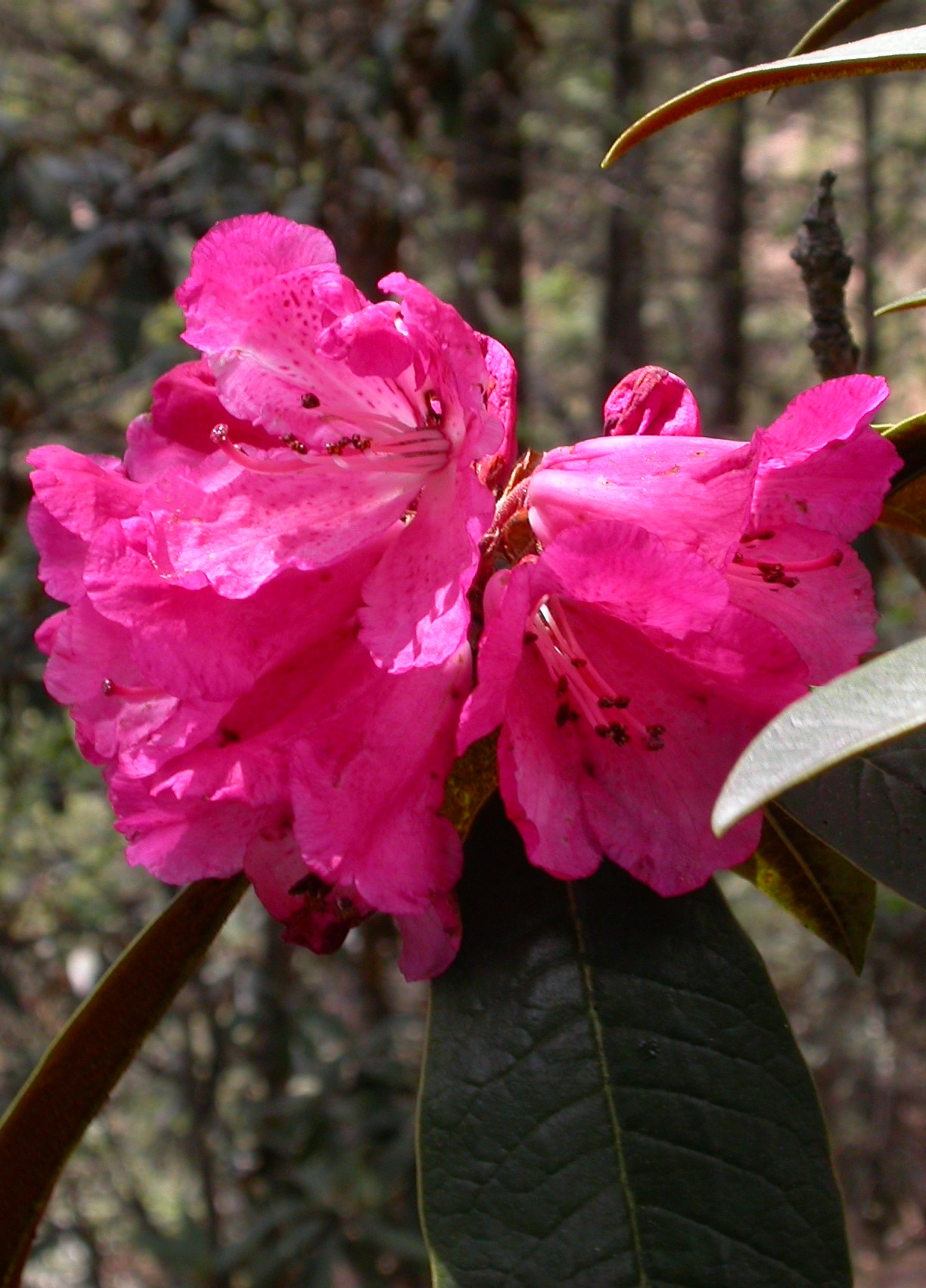
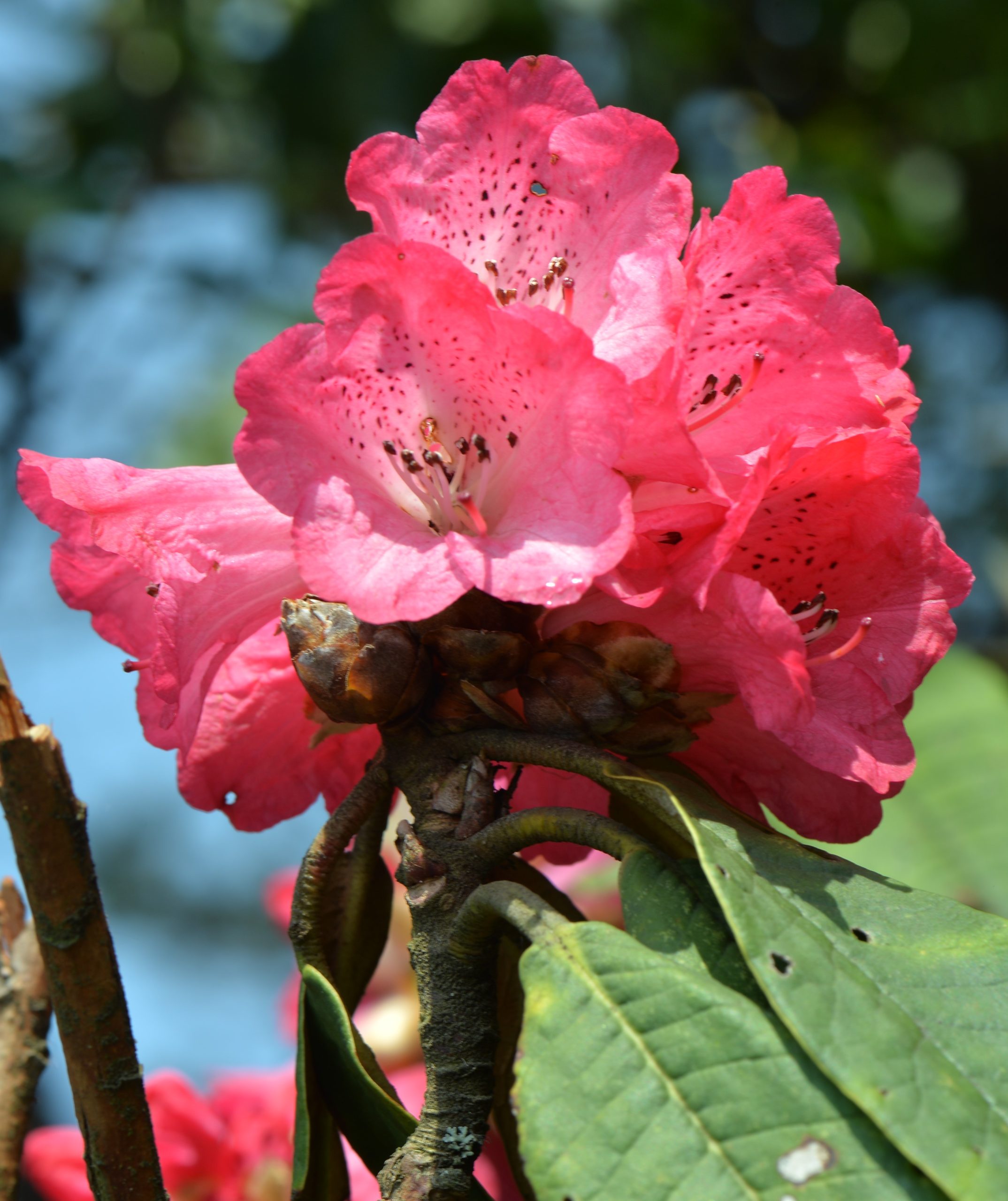
Photographers at Tinjure often exclaim, “Wow! So many rhododendron species are blooming here!” They mistake the red, white, pink, pale red, and pale pink flowers as different species.
But the reality is different. Only one species of rhododendron blooms in various colors in Tinjure during Baisakh. Apart from Rhododendron arboreum, another species named ‘Red Chimala’ blooms in red around Tinjure, but only a few exist toward Panchpokhari and were already in decline.
Tinjure area. Photo: Kamal Maden
Nepalis’ limited knowledge about their national flower, the rhododendron, reflects a general lack of understanding about it. The education system of Nepal is also partly responsible. Even many postgraduate botanists cannot accurately identify rhododendron species. Therefore, it is understandable that the general public is unaware of distinct rhododendron species.
In Tinjure, other rhododendron species bloom during Jestha and Asar months, mostly around Milke Danda and Gufapokhari. In this article, I explain why Rhododendron arboreum blooms in different colors.
Rhododendron arboreum
To understand why Rhododendron blooms in various colors, it’s important to know the botanical classification of this genus and species. Scientific names derive from ancient Greek and Latin.
The English and scientific genus name for rhododendron is ‘Rhododendron.’ In 1753, Swedish scientist Carl Linnaeus coined the name from two Greek words: ‘rhodo’ (rose-like flower) and ‘dendron’ (tree).
Globally, the genus Rhododendron includes 1,096 species. Among them, Rhododendron arboreum refers to the large tree species known as the rhododendron.
British botanist James Edward Smith gave this species its scientific name in 1805, likely based on specimens collected from Nepal.
Relating to Nepal, Francis Buchanan Hamilton, an employee of the British East India Company, visited in 1802 for diplomatic reasons and gathered plant specimens in the Kathmandu Valley that were sent to India and Britain. Smith then named Rhododendron arboreum based on these samples.
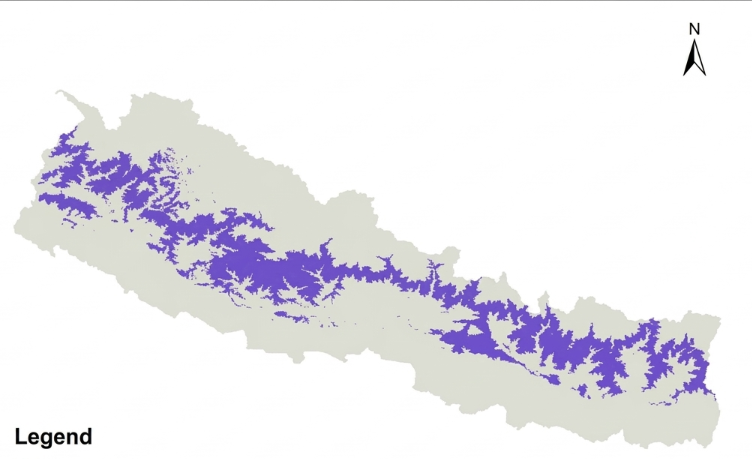
A 2023 study revealed that Rhododendron arboreum in Nepal ranges from Mechi to Mahakali across hilly and Himalayan districts.
In Eastern Nepal, dense Rhododendron forests are found in Tehrathum’s Tinjure region, as well as abundant subspecies in Milke Danda, Sankhuwasabha, and Taplejung.
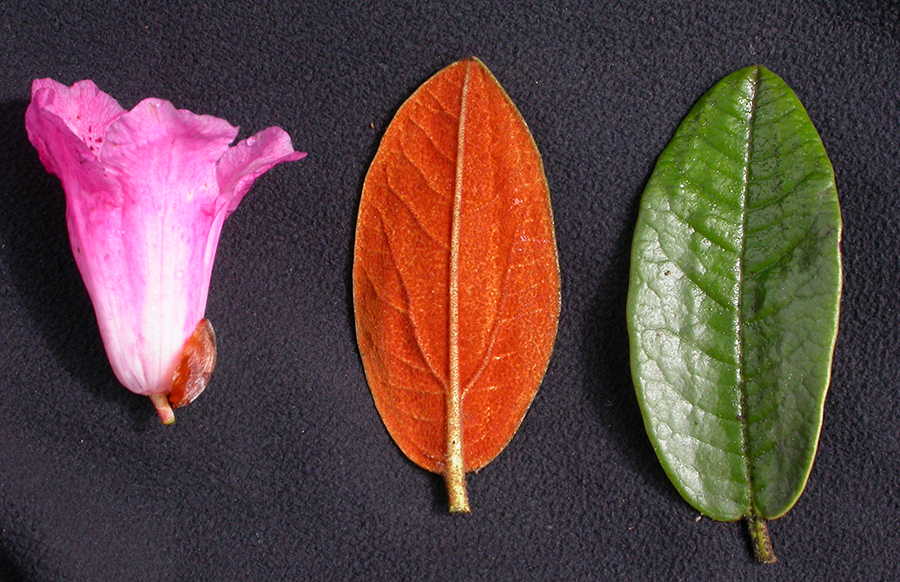
Rhododendron arboreum subspecies cinnamomeum features blackish and brownish spots on flowers and its undersides of leaves are covered with brownish compounds. This subspecies also grows in Sagarmatha National Park.
Rhododendron in Various Colors
Tinjure lies within Laligurans Municipality in Tehrathum. To get there, the route passes through Basantapur, which sits at 2,290 meters above sea level. From there, one must reach Tutedeuralai at roughly 2,510 meters, where the road splits west toward Sankhuwasabha and north to Tinjure.
At 2,540 meters, rhododendron forests begin, sometimes mixed with large oaks. In some uphill sections, rhododendron is dominant, with flowers exhibiting red, pink, pale pink, and white hues mixed together.
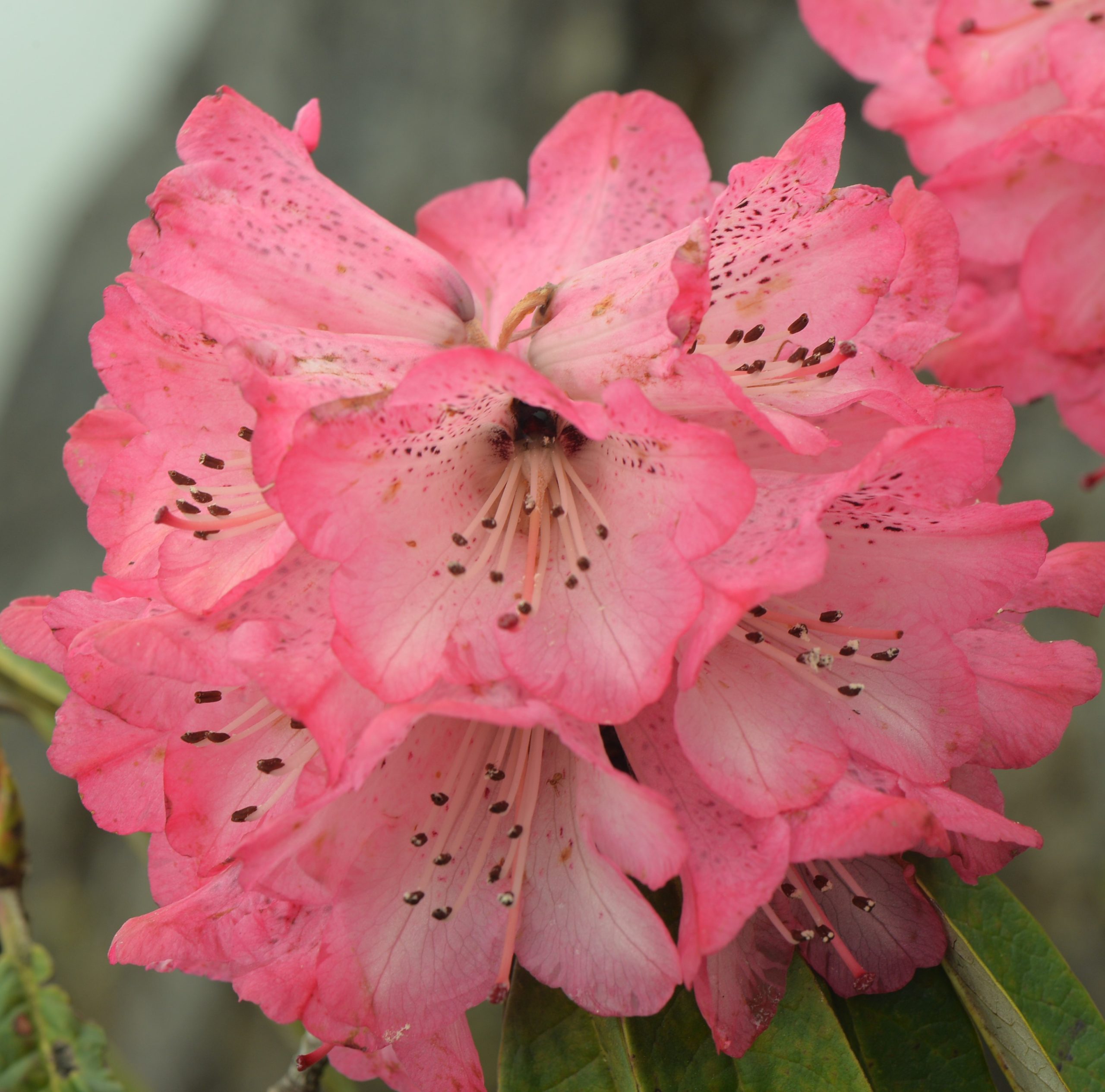
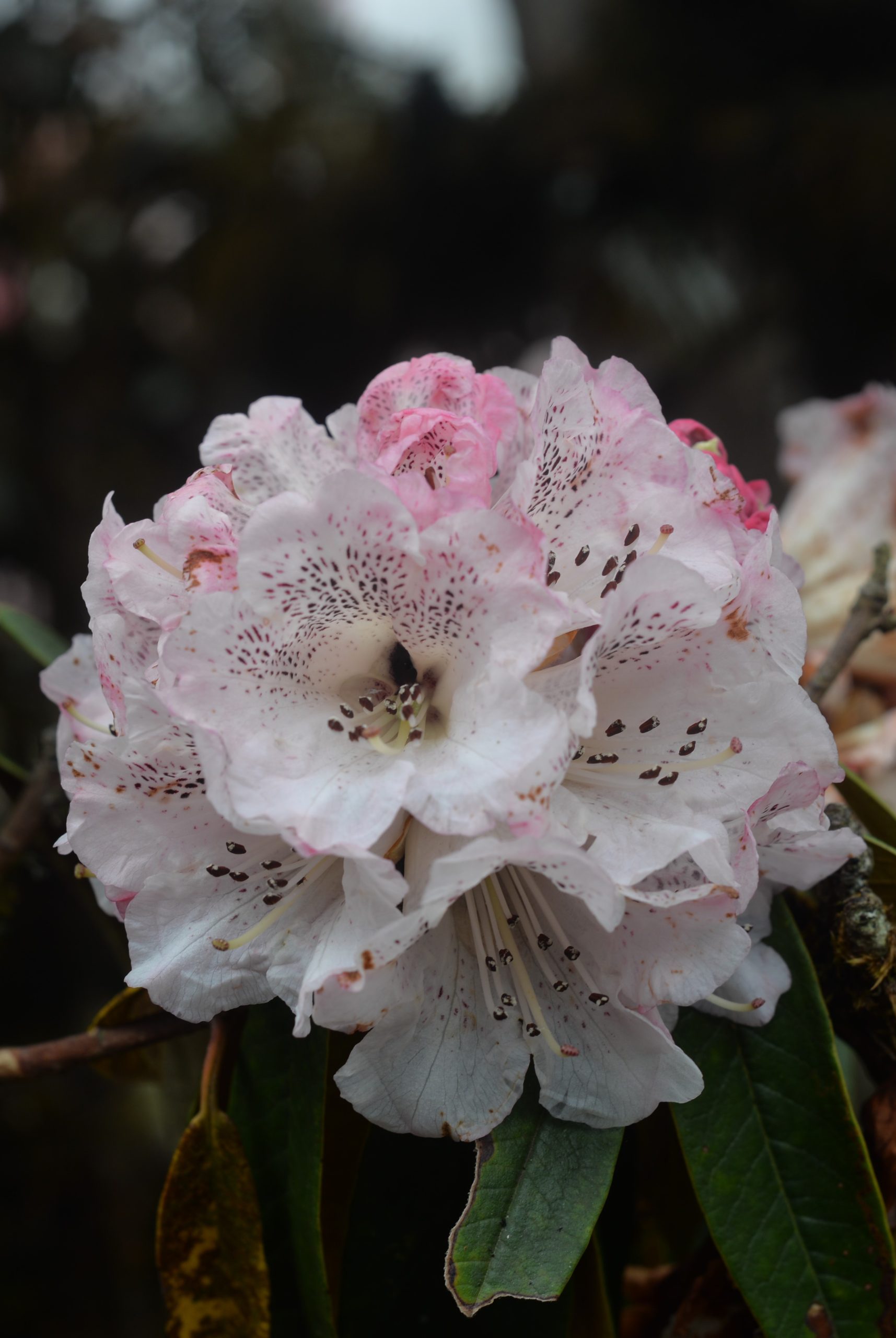
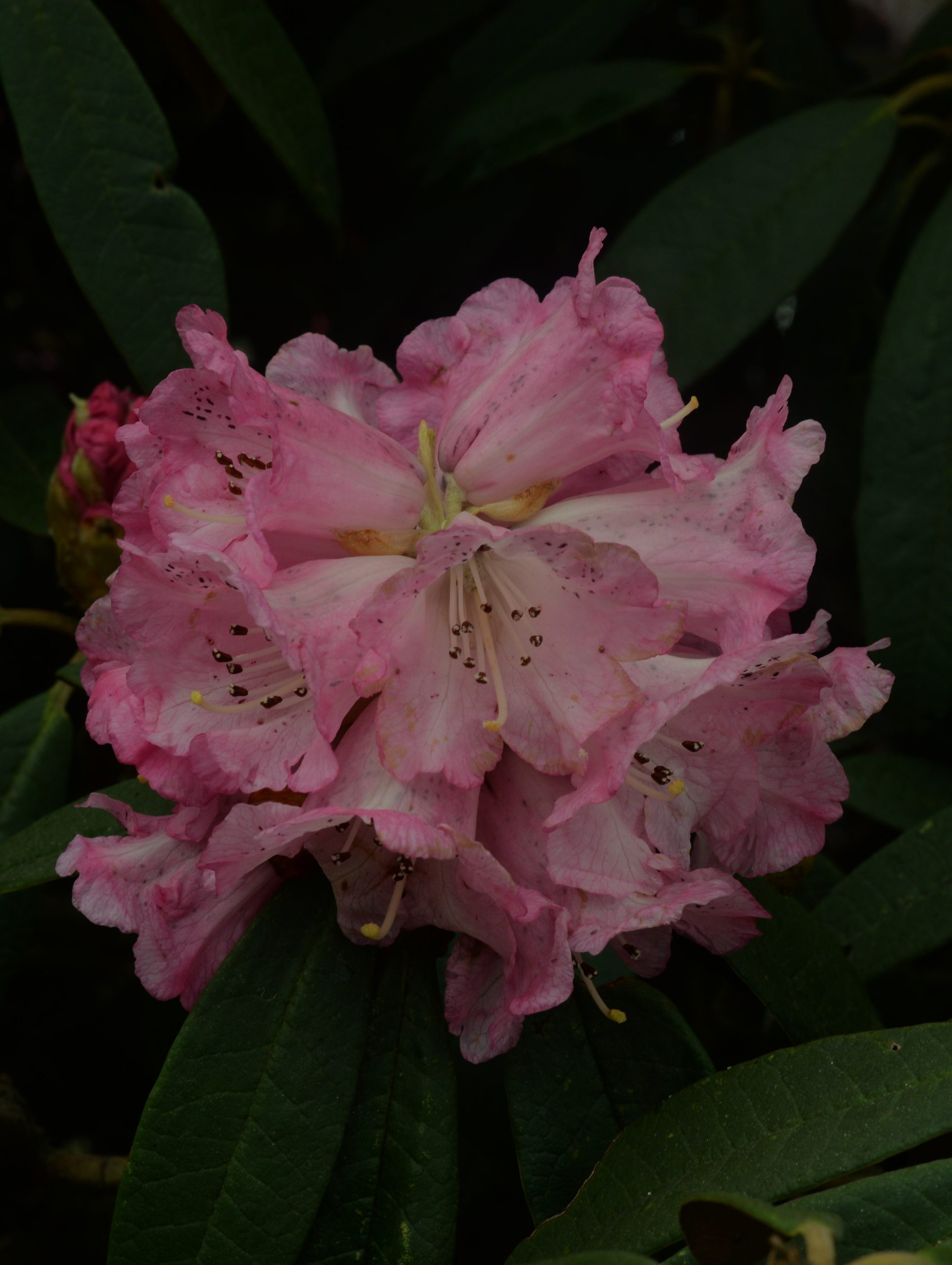
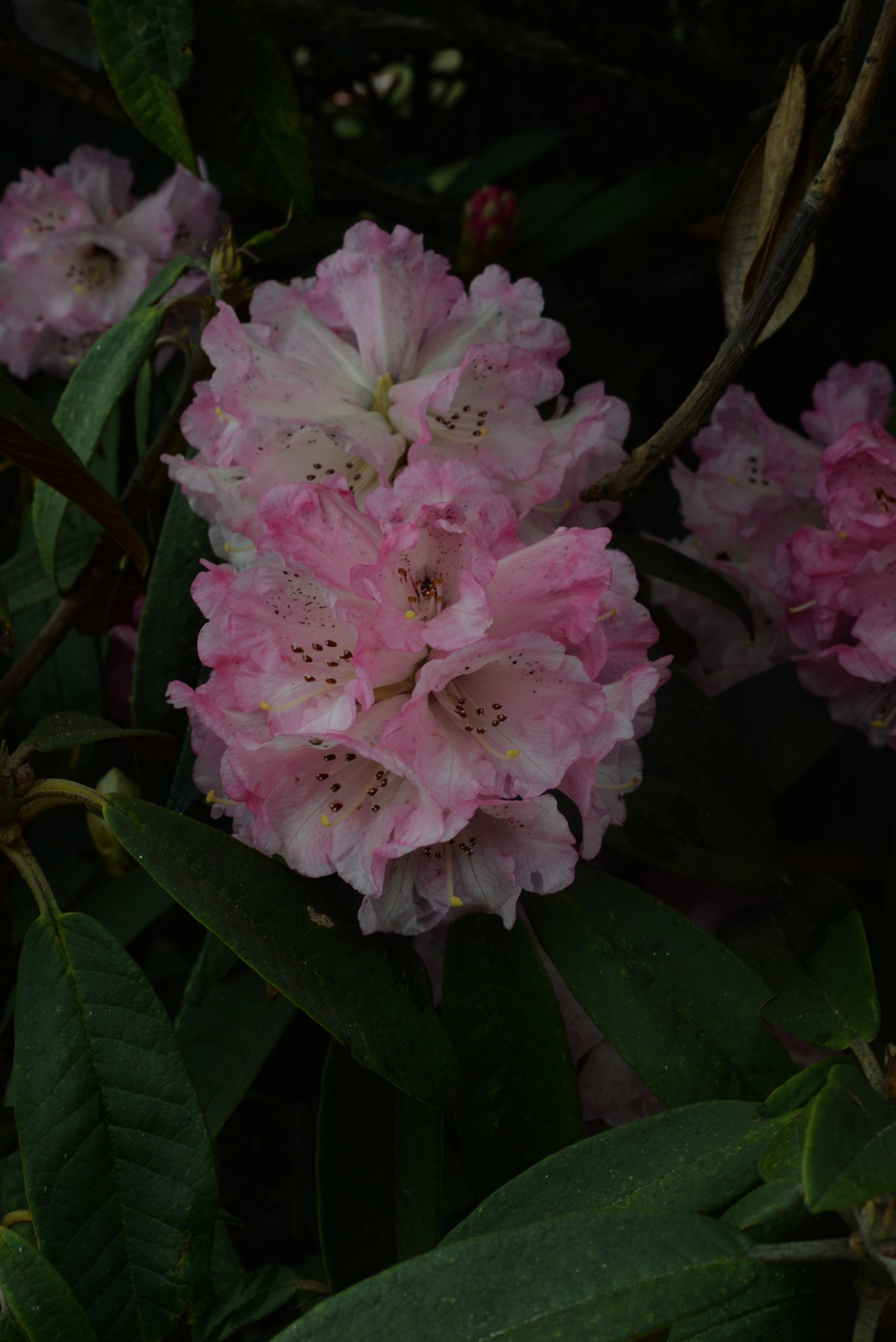
Pink flowers often blend pale pink and white tones. The petals show small brown and black spots. Pale pink and white flowers have darker brown or black spots inside.
Some flowers sport a light pink color with white or pale interiors and few brown or black spots.
Pink flowers also appear mixed with pale pink and white inner parts.
In 1979, French mountaineer and author René de Millville photographed yellow-pink rhododendrons north of Tinjure, featured in his book ‘The Rhododendrons of Nepal.’
In 1993, Americans observed yellow rhododendrons at Tinjure checkpoint and Milke Danda, though I have yet to see that color myself.
In Sagarmatha National Park, researchers from the Royal Botanic Garden of Scotland photographed dark pink rhododendrons in 2004, also referred to as ‘Queen Pink.’
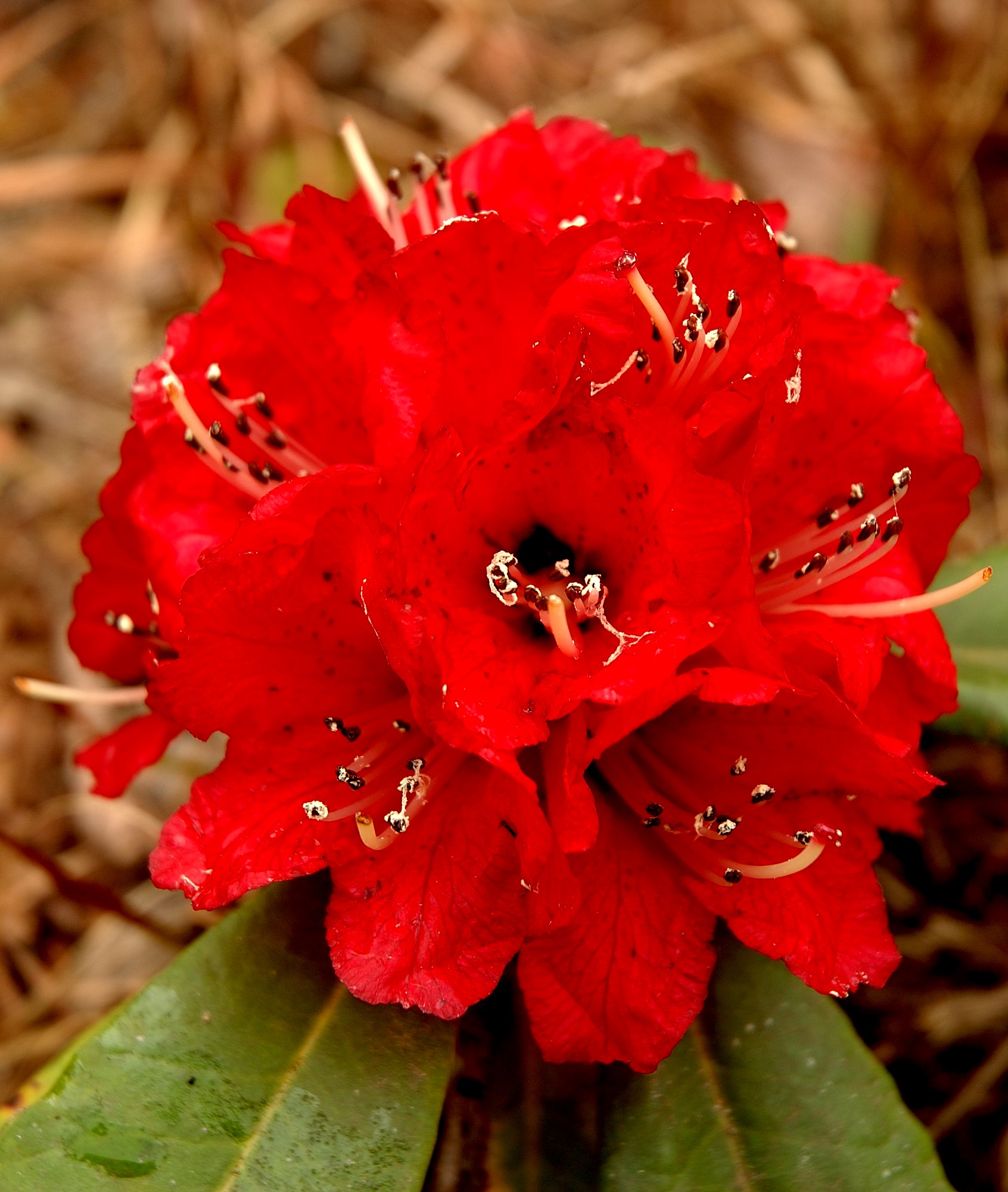
I personally photographed a dark red rhododendron at Phulchoki in Lalitpur in 2007, whose petals are bright red and resemble Rhododendron delavayi in appearance.
The inner parts of this flower show dark brown or black shadows that help attract pollinating insects.
In Basantapur’s Chotlung Park, roughly 10 to 12 rhododendron species are planted, but not all bloom simultaneously. Their leaves and colors vary, indicating different subspecies and varieties.
Rhododendrons such as Rhododendron dhahalhosi, grande, and lindleyi thrive at lower altitudes than Chotlung Park, preferring cool and shaded environments.
Unfortunately, some species there are poorly conserved due to insufficient fertilizer and water. Some rhododendron species found at 3,000 to 4,000 meters survive only in cool, shaded areas.
North of Tutedeuralai in Tinjure, deep pink rhododendrons bloom with darker outer petals and lighter pink-to-white inner petals featuring black dots, attracting pollinators.
Chemical Influences
Rhododendrons thrive in acidic soil, which is prevalent in Tinjure, leading to their extensive growth there. Anthocyanins and other chemical compounds play a dominant role in flower coloration.
Variations in anthocyanin levels explain different flower colors within the same species. The soil’s acidity influences anthocyanin production; if acidity decreases or soil neutrality increases, flower colors may shift to purple. Weak genes can result in white flowers.
Flavonoids and other chemical substances also contribute to color determination.
Geographical Factors
Rhododendron arboreum is found from approximately 1,100 to 4,400 meters above sea level, contributing to diverse subspecies, varieties, and local populations that exhibit notable genetic variation.
At lower altitudes, rhododendrons tolerate higher temperatures and grow in dense forests, while those in high Himalayan regions adapt to cold and ultraviolet light.
Around Bhedetar north of Dharan, rhododendrons mainly bloom red, and red rhododendrons are also abundant in the Dhankuta and Tehrathum regions.
Above 2,500 meters, lighter white or pale pink rhododendrons emerge. The varied colors in Tinjure result from its unique geography and environment.
Different environmental conditions affect the biochemical processes responsible for flower pigment synthesis, leading to color variations within flowers even in a single location.
Crossbreeding and Pollination
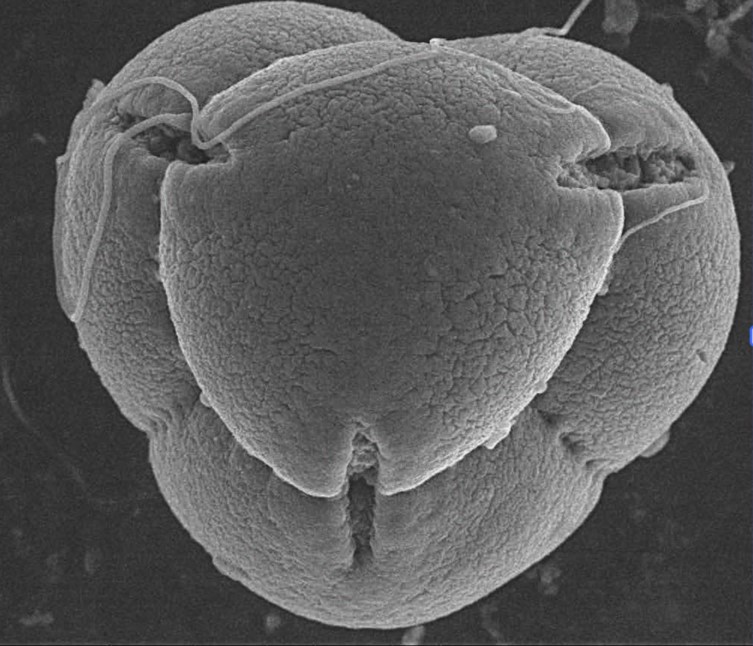
Male reproductive organ (pollen grains) of rhododendron viewed through an electron microscope.
Rhododendron flowers possess both male and female reproductive organs. The female stigma is long and prominent, while there are ten ridged stamens.
Pollen grains on the stamens adhere to bees, bumblebees, and small birds when they visit the flower for nectar, transporting the pollen to the stigma.
When pollen grains reach the stigma and then the ovary during fertilization—a process called pollination—it results in crossbred plants that may produce flowers of varied colors.
A 2016 study captured images of rhododendron pollen grains using scanning electron microscopes.
Pollen grains have thread-like, sticky structures easily attaching to bees and insects. The stigma contains a sticky substance covering pollen grains to promote pollen tube growth.
The pollen tube reaches the ovary and develops the embryo and seed.
The pollen’s outer layer is very tough, containing sporopollenin, a durable organic material allowing long-term preservation as fossils.
In Nepal, excavations have uncovered rhododendron pollen fossils dating from 2.5 to 1 million years ago around the Kathmandu Valley, indicating ancient rhododendron presence. Tinjure’s rhododendrons likely expanded from southeastern China.
Subspecies and Varieties
Rhododendron arboreum is native to India, Myanmar, Nepal, Pakistan, Sri Lanka, and Tibet. Globally, it has five subspecies and two varieties, but only two subspecies and two varieties are found in Nepal.
Nepal’s subspecies include Rhododendron arboreum subsp. cinnamomeum and Rhododendron arboreum subsp. arboreum. The varieties are Rhododendron arboreum var. album and var. rosium.
Table: Rhododendron arboreum Taxa
Subspecies
Variety
Rhododendron arboreum subsp. cinnamomeum
Rhododendron arboreum var. album
Rhododendron arboreum subsp. arboreum
Rhododendron arboreum var. rosium
These taxa differ in flower color, leaf texture, height, and microenvironment adaptations. For example, var. album has white or pale pink flowers, while var. rosium bears flowers with pink shading.
Evolution and Distribution
Fossil evidence suggests that the rhododendron genus originated around 60.5 million years ago in Alaska, USA. Subsequently, it spread from Siberia into Asia.
Rhododendron remains are also found in Europe, related to Himalayan plant expansion. Via the Bering Land Bridge, humans also migrated from Asia to America.
In the Himalayan-Hengduan mountain range, rhododendron diversification and expansion have been ongoing from 23 million to 5 million years ago.
Rhododendron arboreum likely originated about 5 million years ago in the Hengduan range and expanded into the Himalayas about 2.5 million years ago.
Expansion of Rhododendron arboreum from Hengduan Mountains to the Himalayas
Currently, 32 rhododendron species are recorded in Nepal, but not all are closely related genetically to Rhododendron arboreum. Molecular and phylogenetic studies place Rhododendron and Rhododendron delavayi as closely related evolutionary clades.
Rhododendron delavayi has not yet been found in Nepal but is present in India, China, Myanmar, Thailand, Tibet, and Vietnam. Its distribution near the eastern Himalayas suggests it might be found in parts of eastern Nepal.
In conclusion, the diversity of Rhododendron arboreum in Tinjure and Milke arises from genetic variety, micro-environmental factors, and indigenous populations that have evolved over time.
Other parts of Nepal show less diversity due to lower variation in these elements and less favorable environmental differences. In Tinjure, Rhododendron arboreum has evolved in multiple environments, ranging from 2,200 to 3,000 meters above sea level over 1.5 to 2 million years. This long evolutionary process prevents uniform flower color, leading to reds, pinks, whites, and purples blooming together.
This area is the most favorable habitat for rhododendron diversity. Nearly 30 of Nepal’s 32 recorded species are found here; the remaining two native species occur only in central and western Nepal.
Tinjure stands proven as a region of exceptional, colorful rhododendron abundance. Despite the variety of flower colors, only two subspecies and two varieties occur here.
Rhododendron cinnabarinum in Tinjure also blooms in three to four colors.
Detailed microscopic studies of Tinjure rhododendrons might uncover new varieties including Rhododendron arboreum subsp. nilgiricum. Overall, Tinjure’s rhododendron color diversity makes it a key global biodiversity hotspot.
The government should prioritize tourism development in this region. The central government must include budgets for road improvements and eco-friendly trail construction in Tinjure.
The Hindu Volunteer Sangh Nepal is running a national-level ‘Sangh Shiksha Class–2083’ in Dhulikhel, Kavre.
The 15-day ‘Sangh Shiksha Class’ instructs participants in yoga, Surya Namaskar, exercise, and self-defense techniques.
Kanchan Kumar Bade, Minister of Social Development of Bagmati Province, was the chief guest at the inauguration, with trainees attending from various districts.
May 23, Kathmandu – Hindu Volunteer Sangh Nepal has launched a national-level ‘Sangh Shiksha Class–2083’ in Dhulikhel, Kavre.
The inauguration ceremony was held at the Makaju Social Welfare Association in Dhulikhel.
The 15-day program aims to physically prepare participants by offering daily sessions in yoga, Surya Namaskar, exercises, and the art of self-defense (Niyuddha).
Through sports and physical training, volunteers are encouraged to develop mutual camaraderie, cooperation, and social harmony, which is expected to break down artificial barriers of caste and regional divisions and unite everyone under a single bond.
The organization stated that the residential training is highly organized and disciplined to achieve comprehensive development of the volunteers.
Kanchan Kumar Bade, Minister of Social Development of Bagmati Province, was the chief guest at the opening ceremony, attended by National Director Kalyan Kumar Timilsina of Hindu Volunteer Sangh Nepal and other participants.
Leaders of Sanatan Dharma, representatives of civil society, senior Sangh officials, and eminent personalities from various fields also participated in the opening event.
Volunteers from multiple districts across Nepal have gathered in Dhulikhel to participate in the residential training class.
The Sangh declared that trainees are given intensive intellectual discussions and lectures focusing on religion, Sanatan culture, glorious history, profiles of great personalities, and current relevant topics to foster national consciousness and ideological clarity.
This ‘Sangh Shiksha Class,’ conducted with the training, is aimed at awakening patriotism and cultivating disciplined, dedicated, and skilled citizens committed to the progress of the nation and society.
Chairman of Nepali Congress UML, KP Sharma Oli, made it clear during the Secretariat meeting that he will not step down. Deputy General Secretary Yogesh Bhattarai openly urged Oli to pave the way forward. However, Oli stated that the issue will be taken to the Central Committee meeting for a decision. 9 Jestha, Kathmandu.
After most leaders requested clarity and direction during the Secretariat meeting, Oli himself declared he will not retreat. The UML Central Secretariat meeting, ongoing since Friday, has seen leaders present their views continuously. On Friday, five vice-chairpersons shared their opinions, and on Saturday, General Secretary Shankar Pokharel along with three deputy general secretaries and five secretaries gave their views.
Among those speaking on Saturday, Deputy General Secretary Yogesh Bhattarai openly requested Oli to clear the path forward. General Secretary Pokharel, in contrast, used indirect language to express that the party cannot progress under the current circumstances. According to Deputy General Secretary Bhattarai, Oli listened to leaders patiently during the meeting and also provided guidelines.
As pressure on the leaders for party transformation and resignation increased, Oli expressed that he is not in a mindset to comply. Quoting Oli’s statement from Saturday’s meeting, a leader said, “I cannot be convinced this way. I will not yield. I will not resign in this manner.” While leaders were requesting a clear path during the Secretariat meeting, Oli began to argue that he still holds strong support within the Central Committee. He said the matter will be taken to the Central Committee for a decision. Four secretaries remain to present their views. After hearing these four, the proposed agenda will proceed and necessary decisions will be made, according to leaders.
May 23, Lumbini – The Lumbini Provincial Assembly has concluded its discussion on the principles and priorities of the Appropriation Bill for the upcoming fiscal year 2083/84 (2026/27).
In the session held on Saturday, participating Members of Parliament recommended that the government focus the budget on agriculture, local production, enterprise development, marketing, and self-reliance programs, prioritizing these sectors.
The MPs emphasized that the budget introduced by the provincial government should be implementable, result-oriented, and foster hope and trust among citizens. They also stressed the importance of prioritizing programs aimed at youth, including job creation, skill development, and the promotion of entrepreneurship.
The discussion was carried out under Subsection (3) of Rule 135 of the Lumbini Provincial Assembly Rules, 2079 (2022), addressing the principles and priorities of the Lumbini Provincial Government’s Appropriation Bill, 2083. Speaker Tularam Ghartimagar allocated a total of three hours (180 minutes) for this discussion.
Assembly members who participated in the debate included Dipendra Kumar Pun, Yamuna Roka Tamang, Tulsiram Sharma, Krishna Kushma Tharu, Rekha Sharma, Dhan Bahadur KC, Indrakumari Ghataraj, Navaraj Lamichhane, Rajkumar Chaudhary, and Tulsiprasad Chaudhary. – RASAS
India has increased petrol and diesel prices for the third time within nine days, with petrol in Delhi now priced at 99.51 Indian Rupees per litre and diesel at 92.49 Indian Rupees per litre. As Nepal imports petroleum products from India, this price hike could have repercussions for Nepal as well. Rising crude oil prices in the international market have caused losses for Indian oil companies, necessitating the price increases.
9 Jestha, Kathmandu – India has once again raised fuel prices. Petrol prices in Delhi have risen by 87 paise to 99.51 Indian Rupees per litre, while diesel prices increased by 91 paise to 92.49 Rupees per litre. According to Indian media reports, this is the third price hike in just nine days. Previously, petrol and diesel prices were raised by an average of 90 paise per litre on May 19 and increased by 3 Rupees per litre on May 15.
Potential Effects in Nepal Nepal imports petroleum products from India, with Nepal Oil Corporation purchasing petrol, diesel, and other fuels from Indian Oil Corporation (IOC). Therefore, fluctuations in fuel prices in India can affect Nepal’s market. A member of the Nepal Oil Corporation’s board noted, “If the purchase price from India rises substantially, Nepal Oil Corporation’s costs will increase, which may necessitate price adjustments in the domestic market.” However, there is no certainty regarding immediate changes in Nepal’s fuel prices.
Nepal Oil Corporation’s board adjusts prices approximately every 15 days through an automated system based on international market conditions. Prolonged high crude oil prices are likely to increase pressure on fuel prices in Nepal. In response, the government has declared public holidays on Saturdays and Sundays to reduce fuel consumption.
Reasons Behind Fuel Price Increases in India The primary factor driving these price hikes is volatility in international crude oil markets. Prior to the conflict between Iran and the United States, crude oil was priced at around 70 USD per barrel; now it has surpassed 100 USD per barrel. As oil prices rose, Indian oil companies faced financial pressures and had to increase prices to cover losses. If crude oil prices remain high for an extended period, petrol and diesel prices may continue to climb.
Fuel prices in India are set based on crude oil prices on the international market and the exchange rate of the Indian Rupee against the US Dollar. Government-owned oil companies publish new prices daily at 6 a.m. under the “Daily Price Revision” or “Dynamic Pricing System.” The final prices consumers pay are higher than the base price due to additional taxes and charges.
Price Stability Since 2024 Since March 2024, petrol and diesel prices in India had remained stable. Ahead of the 2024 Lok Sabha elections, the government reduced prices by 2 Rupees per litre to provide relief to consumers. Despite political sensitivities, the government maintains a system of adjusting prices periodically—approximately every 15 days—based on the average international crude price.
Indian government oil companies—Indian Oil, Bharat Petroleum, and Hindustan Petroleum—had been operating at a loss due to rising international oil prices. Joint Secretary of the Petroleum Ministry, Sujata Sharma, stated that these companies were incurring monthly losses of about 30,000 crore Indian Rupees from petrol, diesel, and LPG sales. To mitigate this, the government reduced special excise duties, cutting petrol duties from 13 Rupees to 3 Rupees per litre and diesel duties from 10 Rupees to zero.
On Sunday, Indian Prime Minister Narendra Modi, speaking at an event in Telangana, urged careful and restrained use of petroleum products, considering the geopolitical situation in West Asia. He emphasized the importance of cautious consumption of petrol, gas, and diesel to save foreign currency and minimize adverse effects from the ongoing conflict.
The Far-Western Police have recovered jewelry and cash worth 210 million Nepali Rupees stolen in Delhi, India. Three individuals have been arrested, and alongside diamonds, pearls, and gold and silver ornaments, currencies from various countries were also seized. The recovered items have been handed over to the victims through the Indian Embassy, while the search for other suspects involved in the theft continues. Dhangadhi, May 23.
The Far-Western Police successfully seized a large cache of stolen jewelry and cash from India following an extensive investigation by a joint team from the Provincial Police Office and the Kailali District Police Office. The recovered items include diamonds, pearls, gold and silver ornaments, wristwatches from various companies, and currencies from Nepal and other countries, with a total estimated value exceeding 210 million rupees.
According to the Kailali District Police Office, the theft occurred on February 25 at the residence of Sanjay Kumar Makhija in Rajendra Nagar, Delhi. It was discovered that the theft was committed by a group led by Upendra Rawat from Budhiganga Municipality-10 in Bajura, who had been working in Makhija’s home. Indian police filed a complaint with the Nepal Police, prompting the investigation, which led to the arrest of Rawat and two others.
The detained individuals include Lokesh Dhami from Khaptadchededah Rural Municipality-3 in Bajura and Arjun Sunar from Safebagar Municipality-4 in Achham, who reportedly purchased the stolen goods. During the arrests, police recovered merchandise worth approximately 207 million rupees, including jewelry.
Deputy Inspector General (DIG) Om Bahadur Rana, chief of Far-Western Police, disclosed that the operation recovered stolen items including 12 watches valued at 13.4 million Nepali rupees, various gold ornaments worth 4.33 million rupees, diamond and gold rings worth 1.56 million rupees, silver ornaments valued at about 215,530 rupees, and gold worth about 300,000 rupees.
The cash and currencies seized have been returned to the rightful owners. On Friday, the victims, accompanied by Nepalese representatives through the Indian Embassy, visited Kailali to receive their recovered belongings. The Provincial Police Office stated they handed over the items to the affected parties through the District Police Office. Kailali Superintendent of Police Narendra Chand confirmed that the recovered jewelry and cash were delivered to the owners under the supervision of local representatives and concerned authorities.
Sanjay Kumar Makhija, the Indian citizen whose residence was burgled, expressed appreciation for the Nepal Police’s efforts in recovering the stolen goods. “Some of the items stolen from my home are still missing. I believe in the support of the Nepal Police,” he said. “I sincerely thank all the Nepal Police officers who played an active role in recovering the stolen items.” Police confirmed that not all of the stolen goods from Makhija’s home have been recovered yet. While the arrested individuals have named other suspects, those persons remain at large, and the search is ongoing.
Recently, there has been a rising trend of domestic workers traveling to India gaining the trust of their employers and smuggling stolen jewelry and cash into Nepal. However, law enforcement faces challenges in taking further action beyond prosecuting the cases publicly due to unclear legal frameworks, police officials noted.
Delays in construction have added economic burdens to the province. Approximately three billion rupees over the initial project cost have already been spent.
Rastriya Swatantra Party MP Chandan Singh described the rumors circulating on social media as highly exaggerated during an extended meeting held in Bara. Following the instigation by former party chairperson Chandan Swarnakar, five party workers have been recommended for disciplinary action. The meeting also decided to form an interim district committee including five representatives each from the four parliamentary constituencies of Bara.
On 23 May, at the extended meeting held in Bara, MP Singh clarified that the rumors spreading on social media were greatly exaggerated. According to Singh, the five party workers subjected to disciplinary recommendation were influenced by the calculated provocation of expelled former chairperson Chandan Swarnakar. “We were aware of their plans early in the day and accordingly had devised a strategic program,” he stated.
MP Singh expressed distress over the false propaganda claiming that the MPs had been removed, emphasizing that the meeting was still ongoing at the venue. “We are still at the meeting place, and the agenda for which the meeting was called has been fulfilled as planned,” he said. The extended meeting took place on Saturday at the Karanraj Party Palace in Kailaya, where Singh dismissed the unnecessary social media hype related to the provocations arranged by the dissolved district chairperson Swarnakar.
Elected from Bara-2, MP Singh confirmed that they remain at the venue and have completed the meeting. “We have concluded the meeting and are in the process of publicly announcing the decisions right here at the event site,” he added. According to Singh, the meeting resolved to form an interim district committee comprising five representatives from each of the four parliamentary constituencies in Bara. “The interim committee was formed to facilitate the upcoming ward and municipal conferences across Bara district,” he explained.













%20-%20Copy.jpg "4 BHK House for Rent at Bhaisepati")
.jpg "Land for Sale in Lubhu")
.jpg "Residential Land for Sale at Imadol")



Comments 4