Author: space4knews

संवादको ढोका खोल्ने अवसर – Online Khabar

A Golden Opportunity to Open the Door for Dialogue

On April 3, the Government of Nepal sent diplomatic notes to India and China raising the issue of border disputes in the Lipulekh area. India claims that the route through Lipulekh Pass has been an old path for the Kailash Mansarovar pilgrimage since 1954. Nepal, having issued a new map including Limpiyadhura in 2020, has clearly asserted its territorial claim and expressed readiness for negotiations.

April 4, Kathmandu – After India opened the Kailash Mansarovar pilgrimage route through Lipulekh, Nepal sent diplomatic notes to both neighbors on April 3. Soon after the notes were made public, India responded. Indian Foreign Ministry spokesperson Randeep Jazwal claimed that the Kailash Mansarovar pilgrimage route via Lipulekh has been continuously used since 1954 and is an established path, dismissing it as not a new issue.

Provisions related to pilgrimage travel were included in the 1954 Sino-Indian Agreement between India and China, allowing pilgrims and traders to use routes including Lipulekh Pass. However, at the time of that agreement, Nepal and China had not yet established bilateral relations, which officially began in August 1955.

According to the 1816 Sugauli Treaty between Nepal and India, the territory up to Limpiyadhura, not just Lipulekh Pass, is Nepali land. The treaty specifies that all territory east of the Kali (Mahakali) River belongs to Nepal. Experts in diplomatic affairs suggest emphasizing details about Nepali territory. Former Ambassador Neelambar Acharya states, “It is unnecessary for other countries to claim past agreements on the use of Nepali land. The key point is facts and evidence — if Lipulekh belongs to Nepal, then it is Nepali land.”

Even if Indian Foreign Ministry claims pilgrims used the route earlier, that does not justify another country’s ownership of Nepali land. Since no entry permission was required at that time, Indians could easily enter Nepali territory. Nepal asserts that areas such as Kalapani, where Indian security forces have been stationed, are Nepali. Former Ambassador Acharya has emphasized that mere usage does not justify foreign claims over Nepali land.

It is not new for each party to present its arguments in a border dispute. Both Nepal and India have mutually acknowledged that a border dispute exists in Kalapani of Darchula and Susta of Nawalparasi. Because there is a dispute, a solution must be sought.

Before considering whether the diplomatic notes Nepal sent on Sunday and the Indian Foreign Ministry’s response reflect progress toward a solution, it is important to understand the background of Nepal’s recently released so-called “false” map. The origin of Nepal’s 2020 map, which includes Limpiyadhura, appears to be India’s own actions.

On November 1, 2019, Survey of India released its eighth political map, violating the provisions of the Sugauli Treaty, by including Nepali territories such as Lipulekh, Kalapani, Limpiyadhura, and areas east of the Mahakali River as part of India. Nepal’s Ministry of Foreign Affairs issued a statement on November 5, 2019, rejecting the unilateral map. Then-Prime Minister KP Sharma Oli convened an all-party meeting and concluded that the river originating from Limpiyadhura marked as Kali (Mahakali) in the Sugauli Treaty.

Following the all-party meeting, on November 10, 2019, the Parliamentary State Affairs and Good Governance Committee directed the government to release a new map including Limpiyadhura. PM Oli supported an attempt at a bilateral agreement rather than issuing the map unilaterally. Nepal sent three diplomatic notes to India within November 2019. Despite efforts including sending special envoys, success was not achieved due to Indian non-cooperation.

Meanwhile, Indian Defense Minister Rajnath Singh publicly inaugurated the road to Kailash Mansarovar, constructed by encroaching on Nepali territory. In protest, the Indian Embassy in Kathmandu was surrounded by demonstrators. Nepal repeatedly sought dialogue and negotiations, but India neglected these citing the COVID-19 pandemic.

Despite protests, Parliament, under pressure, issued the new map. The situation worsened after the Indian Army Chief attributed protests in Nepal to “Chinese instigation.” On May 15, 2020, the ruling Nepal Communist Party’s secretariat decided to issue the map. Thereafter, the President incorporated the map into the government’s policy and programs presented in Parliament. The government issued the map based on the Sugauli Treaty and other historical facts. Parliament also amended the constitution to endorse the government’s position.

The plan to use Lipulekh as a route for trade and pilgrims was agreed upon between India and China in 2015. Both countries consented to reopen the border post, closed due to the COVID-19 pandemic, in 2024. Last August, both also announced restarting pilgrim travel via Lipulekh.

Although Nepal has sought to resolve the issue through talks and dialogue, both neighboring countries appear to have given it little priority. However, India’s Foreign Ministry’s response includes a positive element. In a press note issued by spokesperson Jazwal, India expresses not only a unilateral claim but also its willingness for dialogue. He stated that India is open to constructive engagement and diplomatic interaction with Nepal on border dispute resolution and improving bilateral relations.

India seems internally prepared for dialogue, which is a positive sign. Experts suggest Nepal, India, and China should use this opportunity to resolve the matter via diplomatic dialogue. Former Ambassador Neelambar Acharya regards Nepal’s firm stance as positive and emphasizes turning it into a chance for dialogue. He says, “We have friendly relations with our neighbors; Nepal’s correspondences can be used to open a channel for dialogue and problem-solving.”

Diplomat Jayaraj Acharya points out that although India had shown little interest in dialogue after Nepal issued the new map, India’s recent response can be utilized as a point to start discussions. He says, “Since this issue has emerged, it should be approached positively and used as an opportunity for resolution through dialogue.”

Rescue Operations Ongoing for Passengers of Four Microbuses Stuck on BP Highway

Four microbuses have become stranded in the Roshi River along the BP Highway, and rescue efforts are currently underway. According to District Police Chief SP Komal Shah, the water flow in the river is increasing, and darkness is creating difficulties for the rescue operations. On 21st Baishakh in Kavrepalanchok, personnel from the Armed Police Force’s 15th Battalion successfully rescued 35 students trapped in a submerged bus in Shreekhandapur.

During the rescue, the police confirmed that the number of passengers stuck between Roshi-7 Laskot and Ghumaune remains unverified. Both the Nepal Police and Armed Police Force are employing ropes to assist in the ongoing rescue efforts at the scene. District Police Chief Shah, Armed Police Force 15th Battalion Chief SP Madhav Regmi, the Nepal Army, and other teams and officials are present at the site.

This evening, heavy rainfall in Banepa, Panauti, and Dhulikhel caused blockages on the BP Highway. Following intense rainfall in various areas of Kavrepalanchok, students were rescued from a submerged bus in Shreekhandapur.

सशस्त्रका नयाँ आईजीपी पौडेलसामु चुनौतीका चाङ – Online Khabar

Challenges Ahead for New Armed Police Chief Narayan Datt Poudel

Newly appointed Armed Police Chief Narayan Datt Poudel will face the challenge of making transfers, promotions, and organizational functions more transparent. Former IGP Raju Aryal implemented 109 procedures and introduced the digital border security concept during his four-year tenure. According to former AIG Raviraj Thapa, given the current absence of major security threats, it is essential for the new IGP to focus on continuing Aryal’s successes and strengthening border security.

During Raju Aryal’s leadership, significant internal organizational issues were evident. Complaints about transfers and promotions had nearly ceased, but this also weakened the organization. Aryal managed to steer the organization back on the right track during his term. It is now the responsibility of the new IGP Poudel to maintain this progress.

Ensuring transparency and predictability within the organization remains a key challenge. The implementation of online leave systems and digital attendance is intended to help identify individuals involved in financial irregularities. Border security has been further tightened by expanding monitoring systems, with the primary responsibility of the Armed Police Force remaining the prevention of illegal activities.

IGP Poudel will also need to address the challenge of clarifying responsibilities between the Armed Police and Nepal Police to improve operational efficiency. The process of drafting a new Armed Police Act is underway, and it is crucial to avoid controversies related to public procurement. Former AIG Thapa has advised that efforts initiated by former IGP Aryal should continue, with special emphasis on border security.

Kathmandu Administration Orders Suspension of Nepal Red Cross Society Elections

April 21, Kathmandu – The District Administration Office of Kathmandu has issued a directive to halt the upcoming elections of the Nepal Red Cross Society. These elections were originally scheduled to be held in the upcoming Ashad month. However, Chief District Officer of Kathmandu, Ishwar Raj Paudel, addressed a letter on Monday to Nepal Red Cross President Vinod Kumar Sharma, urging the suspension of the election process.

The letter states that, according to a government decision dated Shrawan 9, 2082 BS, Sharma was appointed as the chairperson of the ad hoc committee and instructed to form a new committee within three months. Additionally, it was noted that a discussion took place on Monday with the Ministry of Women, Children and Senior Citizens involving President Sharma and other officials.

The letter emphasizes the need to end longstanding irregular activities in this ambassador-level institution and stresses the importance of ensuring transformation and generational transition within Nepal Red Cross. Hence, it calls for an immediate suspension of the elections. The full details of the letter are presented below:

कसरी हुँदैछ ५०० विद्यार्थीको पठनपाठन ? – Online Khabar

Study Conditions of 500 Students Following Demolition of School by Government

The government demolished Manohara’s Shri Saraswati Primary School during the eviction of informal settlements along the riverbanks. Buddha Jyoti Udyan and Bal Kalyan Primary Schools, located in Balaju, have been relocated to Tarun and Yuvak Secondary Schools, respectively. Kathmandu Metropolitan City is preparing to merge these schools and considers the relocations temporary arrangements. (21 Baishakh, Kathmandu).

On Monday morning at 10 AM, students and teachers of Shri Saraswati Primary School gathered at the community hall in Madhyapur Thimi Municipality-1. Among the students, the question “Why was our school demolished?” circulated with no definitive answers. After the demolition, they assembled in the community hall to continue their studies. According to the government’s decision, enrollment started on Baishakh 15, and classes were to begin from Baishakh 21; however, no classrooms were available for study.

Monday morning found teachers busy organizing the space. Some were hanging tents, others arranging desks and benches, while students carried desks themselves. Many parents had come to enroll their children at the community hall. Parent Tikmaya Shrestha said, “We cannot afford private schools; since this school was nearby, we intended to send our children here. My children are in grades 6 and 7; it’s not feasible to send them far away.”

Headteacher Indira Mahat coordinated with the municipality to run two multi-shift classes. “The students’ education has not halted. Even with shifts, we are continuing classes,” she stated. “I am still in communication with the municipality and ward chairperson.” The school has 275 students, but currently, only 170 have enrolled. There are 15 teachers. After the demolition, teachers, parents, and students are struggling to maintain the learning environment.

“There was no prior notice before the demolition. We thought there would be no issue since it was a government building. We only learned the demolition would happen after the police removed the property,” the headteacher explained. Currently, textbooks are stored in the ward office near the community hall. Parent Meenkumari Magar had come to pick up her son, who studies in grade 3. She commented, “Since my workplace is close to the school, it is convenient to bring and take him.” The school building, constructed in 2005 BS, was demolished by government bulldozers, disrupting education.

Buddha Jyoti Udyan Primary School building in Balaju was also demolished with bulldozers. This school has been relocated to Tarun Secondary School. Originally there were 120 students, with 110 enrolled for the new session, but after demolition, students have dispersed. “We have started classes at Tarun Secondary. The Metropolitan Office has sent an official transfer letter,” said Headteacher Shantaram Shrestha. Bal Kalyan Primary School in Balaju, also demolished, has been transferred to Yuvak Secondary School, where 120 students studied. “All school materials are kept at Yuvak Secondary, and teachers and staff report there,” explained Headteacher Arjun Mudbhari.

Kathmandu Metropolitan City has announced plans to merge these schools. “We have arranged one school at Tarun and the other at Yuvak Secondary, and now we will proceed with the merging process,” said the metropolitan spokesperson, Naveen Mandhar.

President Paudel Issues Ordinance Amending 17 Nepal Acts

Acting on the government’s recommendation, President Ram Chandra Paudel has promulgated Ordinance 2083, which introduces amendments to 17 various Nepal-related acts. The amended legislation includes the Employees Provident Fund Act, Land (Measurement) Act, Land-related Act, Education Act, Land Revenue Act, among others. Additionally, the Technical Education and Vocational Training Council Act, Health Services Act, Foreign Employment Act, National Medical Education Act, and Forest Act have also been modified.

Kathmandu, 21 Baisakh – The government has carried out a comprehensive revision of 17 laws through an ordinance that amends several Nepalese acts simultaneously. President Ram Chandra Paudel has issued the ordinance, which encompasses diverse amendments across these various statutes. The list of amended acts is as follows: 1. Employees Provident Fund Act, 2019 2. Land (Measurement) Act, 2019 3. Land-related Act, 2021 4. Education Act, 2028 5. Land Revenue Act, 2034 6. Technical Education and Vocational Training Council Act, 2045 7. Citizen Investment Fund Act, 2047 8. Nepal Academy of Science and Technology Act, 2048 9. Civil Service Act, 2049 10. University Grants Commission Act, 2050 11. Health Services Act, 2053 12. Foreign Employment Act, 2064 13. Federal Parliament Secretariat Act, 2064 14. Contribution-based Social Security Act, 2074 15. National Medical Education Act, 2075 16. Land Use Act, 2076 17. Forest Act, 2076.

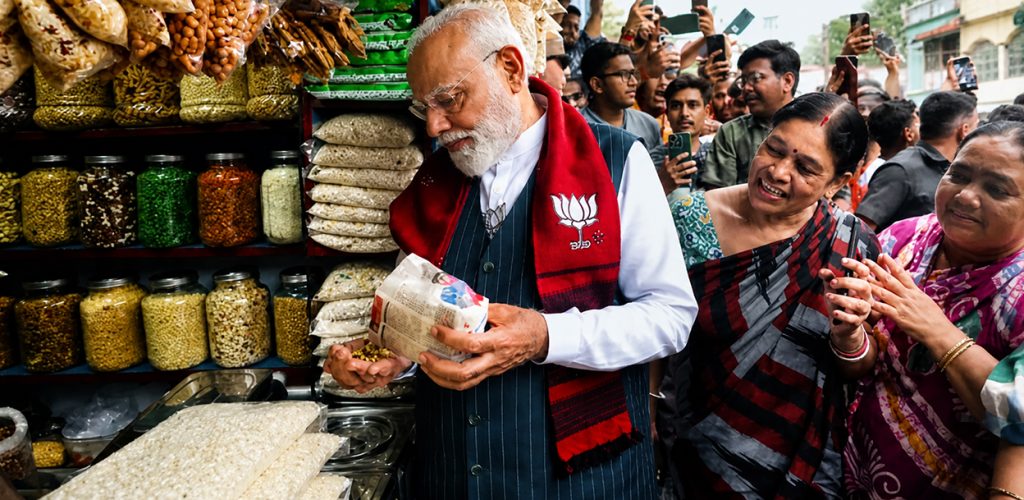
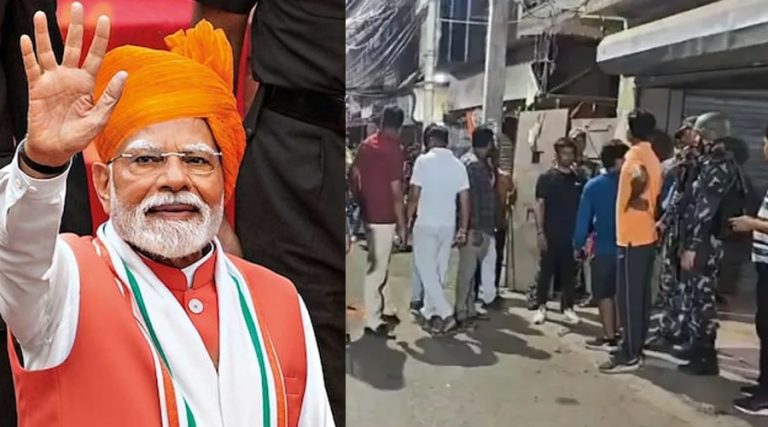
BJP Strengthens Lead in Jhargram, Where Prime Minister Modi Made Headlines Eating Jhalmuri

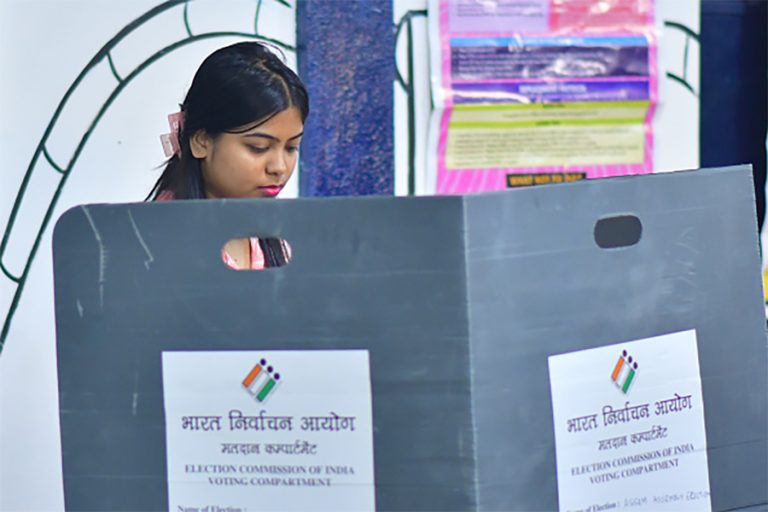
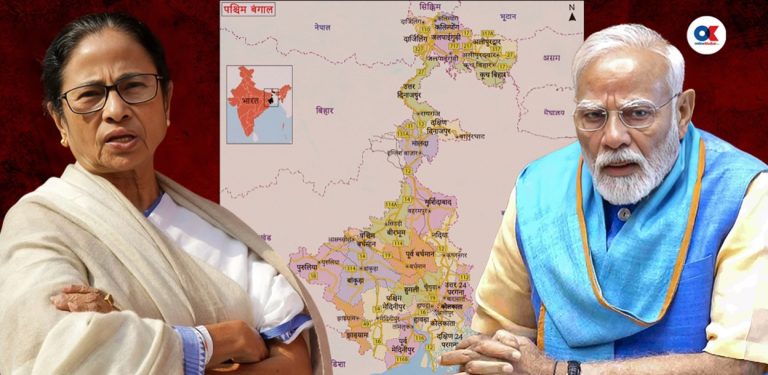
April 21, Kathmandu – During the ongoing vote counting of the West Bengal Assembly elections, initial trends show the Bharatiya Janata Party (BJP) leading ahead of the ruling All India Trinamool Congress (TMC).

In the Jhargram constituency, where Prime Minister Narendra Modi gained attention for eating jhalmuri (a popular street snack) during election campaigning, BJP candidate Laxmi Kant Saha is currently ahead by approximately 8,000 votes.

Saha has secured 29,882 votes, while TMC’s Mangal Saren trails behind him. Of the 294 seats, BJP holds an initial advantage in the majority of constituencies; however, as other counting phases remain, the final outcome may still see changes.


How did this news make you feel?
Happy

Happy

Sad

Sad

Surprised

Surprised

Excited

Excited

Angry

Angry

Comments

Newest Oldest Popular

Comment

Popular Properties for Summer

मन्त्रीको दाबीलाई मन्त्रालयकै छानबिनले ठहर्‍यायो गलत

Health Ministry Inquiry Contradicts Minister’s Fuel Misuse Allegation

News Summary

Created by AI, editorial review completed.

  • The Health Ministry’s secretariat had circulated allegations of fuel misuse under the names of burnt vehicles, but an internal investigation committee found those claims to be false.
  • The ministry has reaffirmed its commitment to transparency and accountability, while assistant secretary Mitraprasad Ghimire, accused on social media, has been declared innocent.
  • Health Minister Nisha Mehta has faced criticism within her first month for administrative decisions and weaknesses in appointment processes.

April 22, Kathmandu – On the morning of April 15 around 10:30 am, Niraj Katuwal, a member of Health Minister Nisha Mehta’s secretariat, disseminated a notice via the secretariat’s WhatsApp group accusing misuse of fuel under the names of burnt vehicles. The notice implicated employees of the Ministry of Health itself.

Based on this allegation, the Ministry of Health and Population formed an investigation committee. After a week-long inquiry, the committee concluded that the information from the minister’s secretariat was incorrect.

The WhatsApp group of Minister Mehta’s secretariat had circulated the news with the headline: ‘Fuel Misuse Under the Name of Burnt Vehicles: Minister Mehta Directs Investigation and Action‘.

This message quickly spread through various media and social platforms, conveying a strong impression of serious irregularities among government staff within the ministry.

Following the dissemination of this secretariat notice, Assistant Secretary Mitraprasad Ghimire of the ministry’s administrative division became the focus of accusations. He was alleged to have misused fuel coupons under the names of burnt vehicles and faced intense criticism on social media.

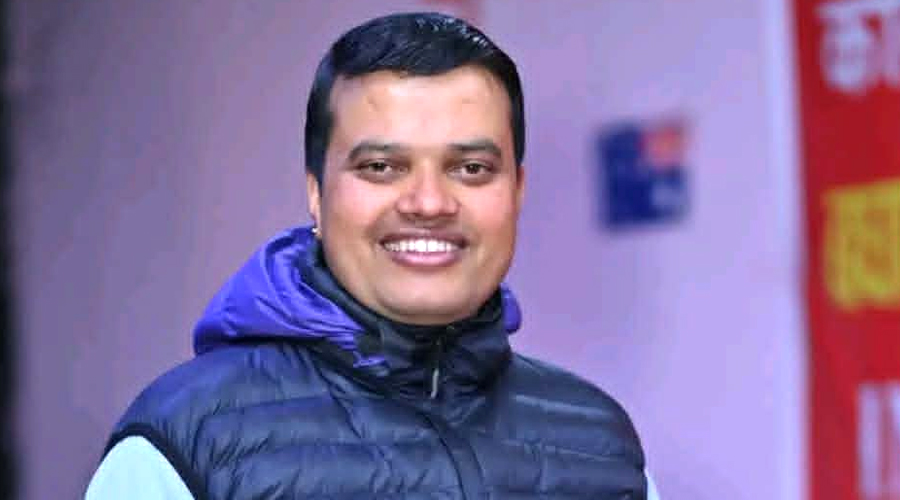
Ghimire, known for preparing study materials for the Public Service Commission and serving as a trainer, was suddenly accused of corruption. These unverified allegations originating from the minister’s secretariat made him a subject of controversy and widespread commentary.
These allegations were connected to the protests on September 9 and 10. On the night of September 10, an unruly group set fire to the Ministry of Health and Population premises on Ramshah Path, Kathmandu. During this event, 18 ministry vehicles and 6 from subordinate agencies, totaling 24 vehicles, were destroyed by fire.

Government employees reportedly claimed fuel benefits using the records of these completely destroyed vehicles.

The arson severely damaged the main building of the key agency responsible for monitoring and coordinating health programs nationwide.

The ministry’s building, known internationally for its architectural significance, was reduced to a ruin. Numerous government vehicles parked within the compound were burned and destroyed. Since then, the ministry’s operations have moved to the new building of Nepal Health Research Council.

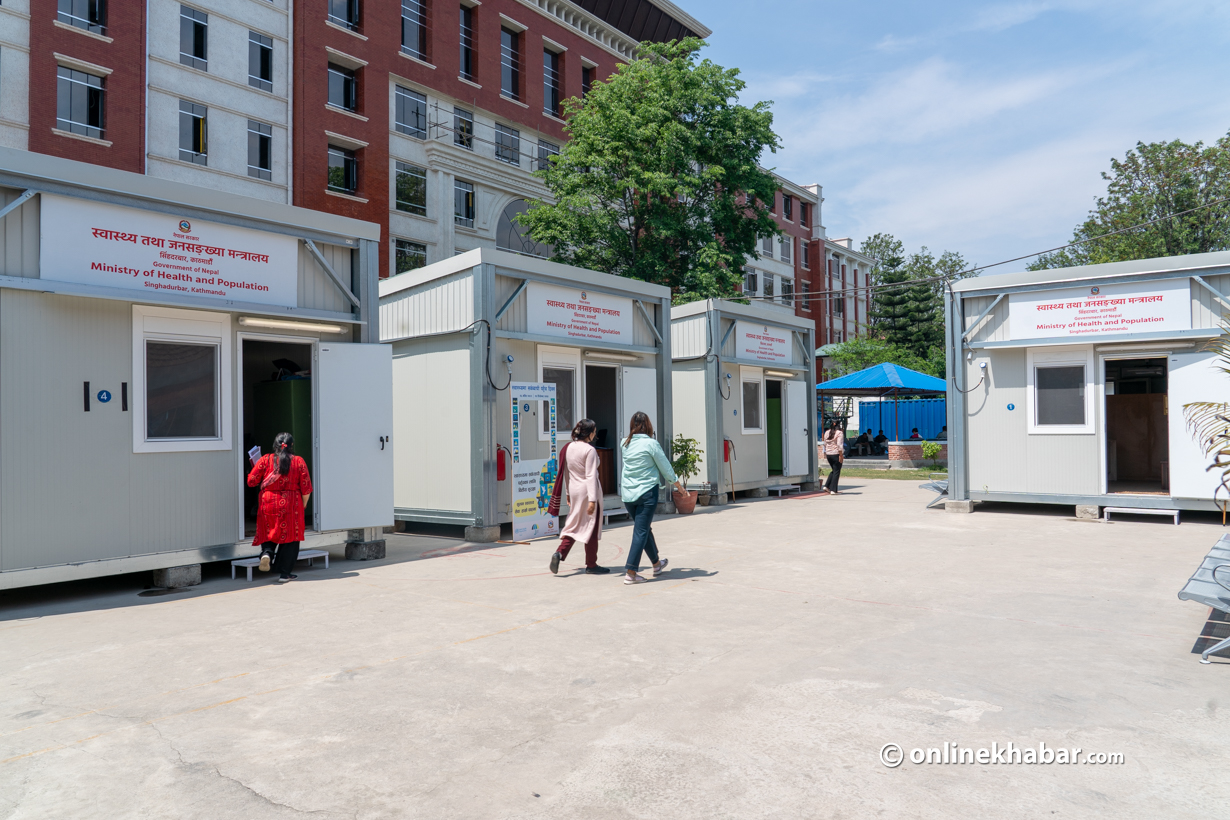
In December, the ministry found a vacant site and building in the southwest region of Singha Durbar, previously used by the Nepal Army’s Narsingh Dal Company. Subsequently, the Health Ministry relocated to Singha Durbar, currently operating out of a temporary tin-shed structure, with some functions still conducted from the council’s premises.

Inquiry Clears Allegations

According to Dr. Sameer Kumar Adhikari, ministry’s deputy spokesperson, an investigation committee was formed on April 15 under the leadership of a joint secretary-level official to uncover the truth.

The committee found the claims of fuel being issued under the names of burnt vehicles to be false.

Dr. Adhikari explained that after reviewing police reports, semi-annual fuel issuance records, payment documents, and other related paperwork, they reached this conclusion.

“The committee concluded there was no fuel misuse under the names of burnt vehicles,” Dr. Adhikari stated.

However, the ministry has remained silent regarding the public allegations that originated from the minister’s secretariat and appeared to have attempted to shift blame onto the media.
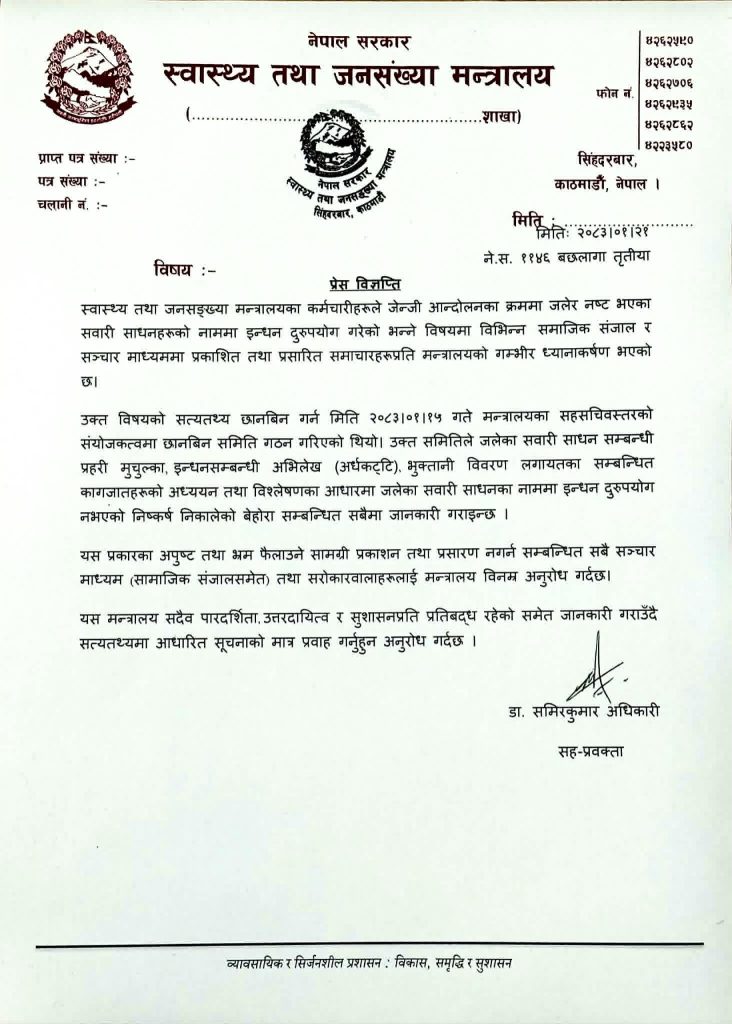
In his statement, Dr. Adhikari urged media outlets not to publish or broadcast unverified and misleading material, and requested all stakeholders to refrain from spreading such claims on social platforms and in the news.

The ministry reaffirmed its commitment to transparency, accountability, and good governance.

After facing accusations and criticism on social media for a full week, Ghimire issued a detailed response online.

He expressed that the allegations caused profound suffering for him and his family. “Sometimes life brings moments where despite being truthful, one must prove oneself,” he wrote. “Amidst despair, pain, and numerous questions, I never lost faith in the truth.”

Upon being cleared by the investigation, Ghimire said he feels relieved and is more determined to proceed with integrity, transparency, and dedicated service.

Questions Arise Over Minister Mehta’s Actions

Within her first month as health minister, Nisha Mehta has repeatedly been involved in controversies. She reappointed June Shrestha as a member of the Health Insurance Board, but when the reappointment became contentious, the appointment letter went missing. Labour, Employment and Social Security Minister Deepak Kumar Sah was dismissed within 14 days as a result.

Sah was accused of abusing his authority by unlawfully appointing his wife, June Shrestha, to the Health Insurance Board. The anti-corruption body (RASWAP) removed Sah from office and issued a warning to Minister Mehta regarding the serious issues in the affiliated agency.

Ministry officials note that since Mehta assumed leadership, she has focused more on minor administrative decisions than on long-term health system reforms.

Her first month’s activities reveal a pattern of making swift decisions, followed by subsequent reversals. From granting health staff two days off to reassignments and transfers, these reversals have brought criticism.
When the government declared two weekly public holidays, the health ministry initially decided to keep Sunday services operational. However, under pressure from doctors’ associations and other health worker groups, Minister Mehta reversed that decision and ordered OPD services closed on Sundays. This caused significant disarray in central hospitals including Bir and Teaching hospitals.

Questions have also been raised regarding decisions related to drug management. Narayan Dhakal, director general of the Department of Drug Administration, was accused of unnaturally increasing prices of 50 medicines, resulting in his transfer to the ministry. Despite the establishment of an investigation committee, procedural flaws hampered effective inquiry.

Due to consultants’ refusals to join the initially formed committee, a new committee was formed but it has yet to produce results.

While Dhakal served as director general, Bharat Bhattarai, an 11th-level officer, was the director of the National Medicine Laboratory. However, Minister Mehta, lacking understanding of departmental structures, appointed 10th-level officer Shivani Khadgi as acting director of the laboratory, treating it as an equivalent division.

This decision raised serious administrative and hierarchical concerns. Senior 11th-level employees were expected to follow directions from junior 10th-level officers, causing dissatisfaction among staff. Once the controversy intensified, the minister acknowledged the misstep and briskly reinstated Bhattarai to the ministry.

6-Year-Old Cricketer Aaron Considers Deependra His Idol

Aaron Vikram Malla, who has been watching the Indian Premier League (IPL) since he was very young, is a fan of Mahendra Singh Dhoni. In Nepal, he considers Deependra Singh Airee his idol. Having already met Sandeep Lamichhane and Binod Bhandari, Aaron hopes to meet Deependra as well.

The 6-year-old cricketer is currently playing for Royal Cricket Academy ‘B’ in the ongoing U-14 Academy-level National Cricket Tournament in Nawalpur, where he has scored 4 runs in 3 matches. Aaron has been learning cricket at the Royal Cricket Academy since he was 4 years old and travels 16 kilometers daily to practice for 3 hours.

Aaron’s father, Vikal, initially wanted him to become a footballer, but Aaron chose cricket, and Vikal dreams of making his son a great cricketer. On April 21 in Kathmandu, a video of Aaron’s batting has been widely discussed on social media, earning praise for his impressive performance in the U-14 Academy-level national tournament held in Nawalpur.

The tournament features players from 20 academies across the country, and Aaron represents Royal Cricket Academy ‘B.’ While he didn’t score many runs in his three matches, he has shown the ability to hold his crease for prolonged periods. Against One Day Cricket Academy, he faced 17 balls and scored 2 runs. He also played 17 balls against Nepathya Tilottama Cricket Academy, scoring only 1 run before returning to the pavilion. In the third match against Cricket Excellence Center (CEC) in Bhaktapur, he scored 1 run off 28 balls but retired hurt due to a ball hitting his hand.

“He can’t score many runs yet and lacks power, but he plays confidently and is not afraid of pace bowling,” says Vikal Vikram, Aaron’s father. While other players struggled to stay at the crease, Aaron showed a defensive technique, effectively facing balls even from much older bowlers. According to Vikal, Aaron has already played 20-25 matches. Last January, he participated in the U-12 Boys Open Cricket Tournament organized by Rising Star Cricket Academy in Kathmandu. However, due to pitch and ground conditions, he could only play one match, where he scored an unbeaten 0 after facing two balls.

Initially, Vikal wanted Aaron to be a footballer and even brought him a football to encourage that. However, Aaron was drawn to cricket from an early age. “I asked him what he wanted to play, and when he said cricket, he began focusing on it,” recalls Vikal. Two years ago, they tried to enroll Aaron at the Royal Cricket Academy in Nawalpur, Devchuli Municipality-10, but his age was too young. After observing his potential, the academy later accepted him, and he has been learning cricket there for the past 4 years.

Since childhood, Aaron has been an avid IPL viewer and a big fan of Mahendra Singh Dhoni. Deependra Singh Airee is his cricketing idol in Nepal. Having already met cricketers like Sandeep Lamichhane and Binod Bhandari, Aaron hopes to meet Deependra soon. According to his father, Aaron’s batting and fielding style resemble Deependra’s. Vikal takes Aaron to the academy located 16 kilometers away every day, where Aaron trains for about three hours. Despite his young age, Aaron’s passion for cricket is immense. “He practices from morning till evening on holidays,” says Vikal, who dreams of seeing his son become a great cricketer.

America’s Isolation in Europe and the Uncertain Future of NATO

The news summary has been reviewed. German Chancellor Friedrich Merz stated that the United States lacks a credible war strategy against Iran. In response, U.S. President Donald Trump has threatened to withdraw American troops from Germany, Italy, and Spain. NATO, at 75 years old, now faces an existential crisis with an uncertain future. April 4, Kathmandu. In a television interview, German Chancellor Friedrich Merz said, ‘The United States has no credible strategy; starting a war is not the biggest issue, but knowing the way out is essential.’ This statement highlights rising tensions between America and Europe regarding the Iran conflict. Merz’s sharp criticism prompted a fierce response from President Donald Trump, who warned of withdrawing thousands of longstanding American troops stationed in Germany, Italy, and Spain. This situation has brought NATO’s future into a state of turmoil.

Established in 1949, this powerful military alliance is now grappling with questions about its survival. Labeling it as an ‘insult from America,’ Chancellor Merz harshly criticized the American-initiated ‘Operation Epic Fury’ against Iran, launched on February 28, 2023, recalling the failures of previous wars. According to Merz, “We have endured tragic experiences in Afghanistan for 20 years and in Iraq as well; now America is confronting Iran without a clear plan or a safe exit strategy.” He further explained that diplomatically, Iran has effectively resisted U.S. pressure and that America’s global credibility has taken a serious hit. This has heightened dissatisfaction among European nations and worsened relations with the Trump administration.

A senior Berlin diplomat noted, “Merz has voiced concerns shared by many European leaders.” Following Merz’s criticism, Trump warned on the social media platform Truth Social that American troops could be withdrawn from Germany. When asked by journalists, he also hinted at potential withdrawals from Italy and Spain. This approach is nothing new for Trump, who since the 2016 election has criticized European countries for insufficient defense spending. However, this threat during a sensitive moment in the Iran conflict has raised concerns about America’s security commitments.

रोहित र रिकेल्टनको शानदार ब्याटिङमा मुम्बईको जित – Online Khabar

Mumbai Clinches Victory Over Lucknow with Stellar Batting from Rohit and Rickelton

Mumbai Indians secured a 6-wicket victory against Lucknow Super Giants in IPL 2026. Mumbai successfully chased down the target of 229 runs in 18.4 overs, losing 4 wickets in the process. Openers Rohit Sharma and Ryan Rickelton delivered an outstanding batting performance. Rohit Sharma scored 84 runs off 44 balls, while Rickelton contributed 83 runs off 32 balls. Together, they put on a crucial 143-run partnership for the first wicket. Naman Dhiran remained unbeaten with 23 runs.

For Lucknow, Manimaran Siddharth claimed 2 wickets, while Mohammad Shami and Mohsin Khan took 1 wicket each. Batting first after losing the toss, Lucknow scored 228 runs for the loss of 5 wickets in their 20 overs. They made 141 runs for 1 wicket in the initial 10 overs but struggled to maintain the pace in the latter half. Nicholas Pooran was the top scorer for Lucknow with 63 runs. He reached his half-century in just 16 balls, striking 1 four and 8 sixes over 21 balls. Mitchell Marsh and Aiden Markram added 44 and an unbeaten 31 runs respectively. For Mumbai, Kervin Bosch took 2 wickets, while Raghu Sharma and Will Jacks took 1 wicket each. With this win, Mumbai has moved up to ninth place with 6 points from 10 matches, while Lucknow remains in tenth place with 4 points from 9 matches.

Nine Janamat Party MPs Withdraw Support from Madhesh Province Chief Minister

Chandan Singh, General Secretary of Janamat Party, Kathmandu, April 21 – A majority of Janamat Party MPs have withdrawn their support for the Madhesh Province government led by Krishna Yadav of the Nepali Congress. Nine party MPs have submitted letters retracting their backing. According to General Secretary Chandan Singh, in consultation with the party’s national president Sike Raut, the majority of the parliamentary party members decided to withdraw their support from the Madhesh government.
“Since the formation of the government, the Chief Minister’s actions in Madhesh Province have been inappropriate; therefore, we have decided to retract our party’s support,” Singh said.
The Janamat Party holds the parliamentary party leadership in the Madhesh government, with Mahesh Yadav serving as Finance Minister and Basanta Kushwaha as Minister for Youth and Social Welfare. The party currently has 12 members in the Provincial Assembly, including Babita Kumari Raut, who serves as Deputy Speaker. The Madhesh Province government was formed by a coalition of all parties except the UML. This move by Janamat Party MPs indicates a potential new alliance emerging as an alternative to the Congress-led government.
The 107-member Provincial Assembly requires 54 members for a majority. Currently, the assembly is composed of 24 UML members, 22 Nepali Congress, 18 JSP Nepal, 12 Janamat, 9 CPN (Maoist Centre), 8 Loktantrik Samajwadi Party, 7 CPN Unified Socialist MPs, and one seat each for Rastriya Prajatantra Party Nepal, Nagrik Unmukti Party, and Nepal Federal Socialist Party.

Mamata Banerjee Accuses Election Commission and Central Security Forces of Manipulation

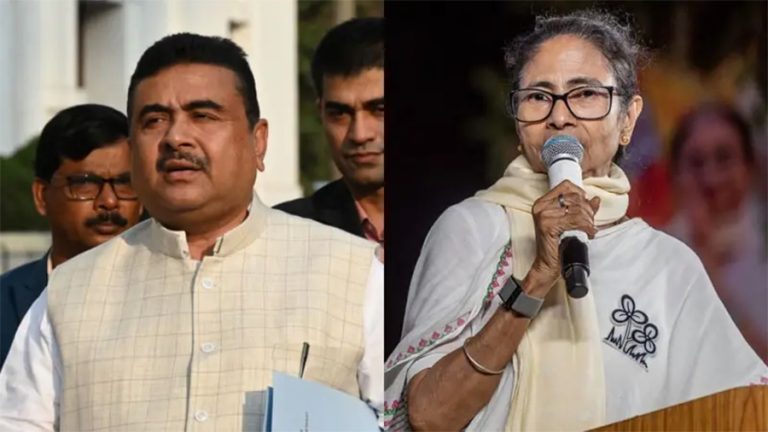
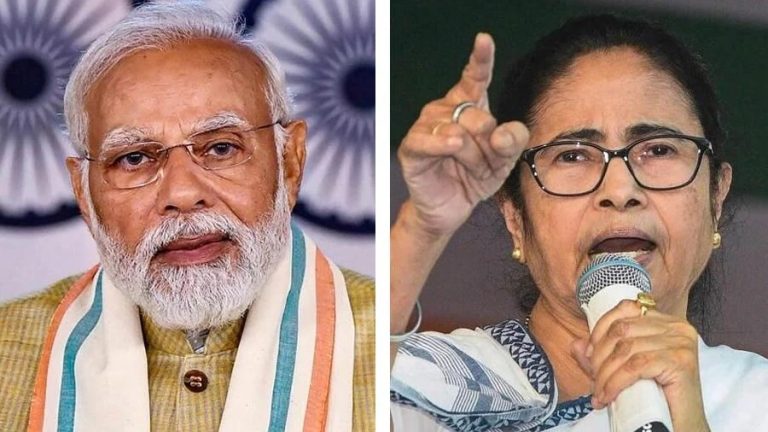
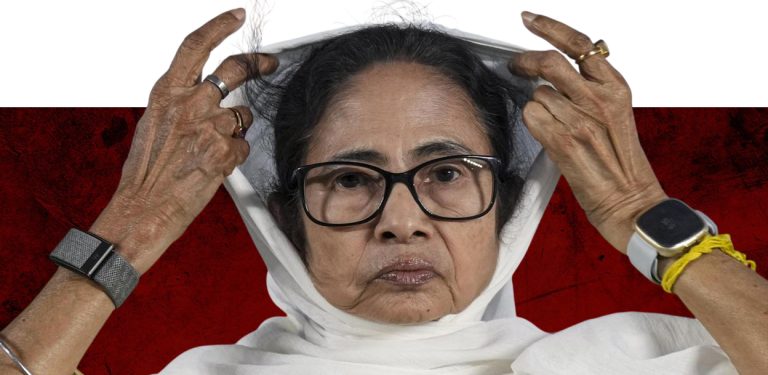
April 21, Kathmandu – Following the significant lead secured by the Bharatiya Janata Party (BJP) in the West Bengal Assembly election vote count, Chief Minister Mamata Banerjee has leveled serious allegations against the Election Commission and the central security forces. In a video message shared on social media, she urged her party agents not to leave the counting centers under any circumstances. With BJP reportedly leading in 192 seats, while her party, the Trinamool Congress (TMC), is limited to just 96 seats, Banerjee claimed this was part of a “BJP plan.” She accused the Election Commission of intentionally displaying results from areas won by the BJP while suppressing the TMC’s leads.

“I earnestly request all agents not to leave the counting centers,” she said. “The Election Commission is colluding with the central security forces to carry out wrongful activities. At places like Kalyani, machines that have not been counted have been found, and counting has been obstructed in various areas.” Encouraging her party workers, she added, “People are forcibly attempting to enter and seize our offices, and the central security forces are perpetrating atrocities. But this is not the time to lose hope.” Banerjee mentioned that TMC still holds a lead in between 70 to 100 seats, countering the false propaganda regarding their performance. She emphasized that only partial counting is complete, and after results from phases 14 to 18, they will be victorious. “We will continue to fight fiercely, like tigers,” she asserted.

The Chief Minister also expressed dissatisfaction with her state police, alleging they are working in coordination with the central government. Despite the initial trends showing BJP crossing the majority threshold, Banerjee continues to assert that the final results will be in her party’s favor. The Election Commission has yet to formally respond to these allegations.

सरकारले स्वीकारेन राष्ट्रपतिको सन्देश, अध्यादेश फेरि शीतलनिवासको कोर्टमा

Government Rejects President’s Message Again, Sends Ordinance Back to Sheetal Niwas

April 21, Kathmandu – Within 24 hours of President Ramchandra Paudel sending the ordinance back with a message requesting reconsideration, the government has once again recommended the same ordinance to the President. Rejecting the President’s move to return the ordinance with a message, the government has resubmitted it. Now, the President appears to have no option but to issue the ordinance. The Constitution allows a bill passed by both houses of Parliament to be sent back once for reconsideration, but there is no clear provision for returning an ordinance recommended by the Council of Ministers for reconsideration.

The President returned the ordinance citing the need to uphold the spirit of the Constitution and the majority decision-making process within the Constitutional Council. Dr. Vijay Mishra, President of the Nepal Bar Association and a law professor, responded on Sunday stating that the government must respect the President’s message; however, once the ordinance is resubmitted, the President cannot block it. He said, ‘If the government resubmits the ordinance, the President cannot reject it—they must issue it.’ On Monday, the Cabinet meeting decided to once again recommend the Constitution Council (First Amendment) Ordinance 2083, government spokesperson Sashmit Pokharel confirmed.

According to Pokharel, the ordinance was sent back without any amendments. While seven of the eight ordinances recommended by the government were promulgated, President Paudel did not issue the ordinance concerning the Constitutional Council. Without addressing the President’s message, the government has resubmitted essentially the same ordinance, signaling a disregard for the President’s concerns. The President had previously returned ordinances as well.

Following that, the government had been less attentive to the ordinance; however, this time it acted promptly to demonstrate its position. What is the President’s concern? While the government has framed it as a matter of ‘ego,’ analysts argue that the President’s return of the ordinance was a defense of democratic values and power balance. According to officials at Sheetal Niwas, the President’s letter mainly questioned the principle of the requisite quorum and the multiparty system.

The ordinance proposes that meetings of the Constitutional Council would only be valid with 50 percent member attendance, including the Chairman (Prime Minister), and decisions would be based on a majority of that quorum. The President concluded that this provision would undermine the very foundation of the Constitutional Council. The letter reminded that the Supreme Court’s full bench had previously ruled that the multiparty system in the Constitutional Council must be preserved and recommended revising the ordinance to safeguard power balance. What is the Prime Minister’s interest?

Ignoring the President’s suggestion, the government’s reason for resubmitting the ordinance without amendments remains unclear—whether it reflects a policy stance or is a shortcut sought by Singha Durbar (the government complex). Even though the new election gave the Rastriya Swatantra Party nearly a two-thirds majority, it is understandable that the Prime Minister is concerned about the Constitutional Council’s structure potentially affecting its decision-making capacity. The Constitutional Council recommends key appointments from agencies like the Commission for the Investigation of Abuse of Authority, the Election Commission, and the Supreme Court. Under current law, appointments cannot proceed without the consent of the opposition leader or the Chief Justice.

Therefore, there are suspicions that this ordinance seeks to reshape the Council’s structure to favor the government and allow it to place preferred individuals in sensitive positions. However, the government and the Prime Minister’s Secretariat argue that this measure is essential to relieve the Council’s prolonged deadlock. They claim that important constitutional bodies have remained vacant for extended periods due to the absence of opposition leaders or the Speaker, adversely affecting state operations.

Defending its move as a necessity to break an impasse, the government argues that ‘the current arrangement is necessary because consensus or old quorum numbers hinder progress.’ These issues have now been sent back to Sheetal Niwas for further consideration. According to Article 113(4) of the Constitution, if the President returns a bill once, Parliament must certify it within 15 days if it is resubmitted unchanged. However, Article 114(1) treats ordinances with some ambiguity and difference.

The President does not enjoy such discretion. Legal experts say that although there is a tradition for the President to promulgate ordinances recommended by the Cabinet, there is no clear legal obligation to reissue ordinances that may violate the Constitution or conflict with Supreme Court rulings. If the President, as the guardian of the Constitution, chooses to withhold or reject the ordinance again at Sheetal Niwas, it would mark a pivotal turning point in politics. This could be interpreted as the beginning of a new cold war between the Executive and the Presidency.

When Will the MRP Dispute Be Resolved?

Following the government’s strict enforcement of mandatory Maximum Retail Price (MRP) labeling on imported goods at customs points, cargo vehicles have come to a halt at major trade checkpoints. With the implementation of MRP, traders have stopped importing goods, raising concerns about shortages and price hikes of daily consumer products in the market. While consumer rights activists have labeled the traders’ opposition as “reckless,” the government insists on firmly upholding this regulation. Kathmandu, May 3.

The government’s decision to strictly implement compulsory MRP labeling on goods imported at customs has led to confusion and stagnation at key trade borders across the country. The Department of Commerce, Supply and Consumer Protection introduced this measure to prevent consumer fraud; however, due to practical challenges in enforcement, long queues of cargo vehicles have formed at customs points in Birgunj, Bhairahawa, Nepalgunj, Rasuwa, and Mechi. Traders are refusing to clear goods without MRP indicated at customs.

The slowdown in imports through major checkpoints such as Birgunj, Bhairahawa, and Rasuwagadhi could lead to shortages of daily consumer goods and potential inflation in the local markets. Nevertheless, customs authorities report that the supply of industrial raw materials and perishable items has not been completely disrupted. Traders have criticized the policy as “impractical” and unfeasible for implementation.

According to Uday Singh Bista, Information Officer at the Customs Office, approximately 1,400 to 1,500 vehicles are currently held up in customs areas. While around 1,200 trucks were detained as of May 1, the number of held cargo trucks is increasing by roughly 100 daily. Although correspondence has been made through the department to the ministry to resolve the issue, no positive developments or solutions have emerged so far.