
Author: space4knews

Pre-Budget Discussion in Parliament Faces Risk of Becoming Mere Formality Again

Summary: Although the government is constitutionally required to present the budget for the upcoming fiscal year on Jestha 15 in Parliament, the pre-budget discussion has not taken place on time. Legal provisions mandate submitting the pre-budget discussion proposal 15 days in advance, but opposition parties claim the government has not allotted sufficient time. Lawmakers from the CPN-UML have urged the government to convene a parliamentary session immediately to avoid reducing the pre-budget discussion to a mere ritual.

Kathmandu, 19 Baisakh – The government is preparing to present the budget for the next fiscal year, yet no parliamentary discussion on the budget has been held so far. According to the constitution, the budget must be presented on Jestha 15. Article 119, Subsection 3 explicitly states that the Finance Minister shall present the revenue and expenditure estimates to the Federal Parliament by the fifteenth day of Jestha each year.

Before introducing the budget, the government usually presents a policy and program. More importantly, parliamentary practice and legal provisions require a pre-budget discussion in Parliament before the policy and program. According to Ekram Giri, Joint Secretary and spokesperson of the Federal Parliamentary Secretariat, the Finance Minister must submit a proposal for the pre-budget discussion in Parliament at least 15 days before the budget presentation. “As per prevailing law, the proposal must be submitted 15 days in advance, and Parliament must send suggestions seven days before,” said Deputy Secretary Giri.

The Public Financial Procedure and Financial Accountability Act 2076 contains such legal requirements. However, the Finance Minister often brings the pre-budget discussion proposal to Parliament at the last minute, forcing the secretariat to rush consultations and send feedback hastily. Since this practice did not yield the desired results, the government led by Pushpa Kamal Dahal amended the act in Falgun 2080 to strengthen the pre-budget discussion process. Nonetheless, the subsequent government under KP Sharma Oli reverted the act to its previous version through an ordinance.

In line with the current law, the Finance Minister is expected to present the pre-budget discussion proposal 15 days before presenting the budget this year as well. However, time is becoming increasingly limited. The current government plans to submit the pre-budget discussion proposal during the last week of Baisakh and conduct discussions in the first week of Jestha to send suggestions. Meanwhile, opposition parties have expressed concern that the recommendations given may not be incorporated into the policy and program.

According to CPN-UML Chief Whip Yubaraj Dulal, pre-budget discussion is a process where the government informs Parliament about budget priorities and principles. “During the pre-budget discussion, lawmakers provide suggestions regarding policies, plans, and budgets based on the country’s needs. Subsequently, the government formulates policies, programs, and the budget,” Dulal said. He added that limited time for discussions likely limits the inclusion of suggestions, thereby reducing the process’s effectiveness.

“Whether the pre-budget discussion is merely a formality or held earnestly, the avenue for lawmakers’ suggestions to be heard is weakened. This undermines democratic processes,” he noted. “The government’s tendency is simply to present policies and programs in its own format and push them through with unnecessary majorities.”

CPN-UML lawmaker Rajendra Kumar Rai expressed concerns that if new parties continue the old practices and fail to improve governance, public disappointment will grow. “Though we are a new party, we have not demonstrated the ability to govern effectively,” he said. Rai emphasized that a lack of sufficient time prevents lawmakers from fully embracing the government’s policies and programs. “The government postponed the parliamentary session after calling for it urgently, which suggests that the discussion in Parliament is only meant to fulfill procedural requirements,” he added.

“The House was convened but then adjourned without sitting; such an event is unprecedented in Nepal’s history,” Rai remarked.

CPN-UML lawmaker Guruprasad Baral called on the government to immediately convene the Federal Parliament. “We are firm in demanding an immediate convening of Parliament. After that, the pre-budget discussion and presentation of policies and programs should take place with full debate,” he stated. However, Baral criticized the government for bypassing Parliament and continuing with its work unilaterally. “The government depends on ordinances and abandons rule of law, making parliamentary discussions ineffective. There is a risk that Parliament will become only a body to carry out formalities regarding the budget and other matters,” he warned.

संवैधानिक पदाधिकारी नियुक्तिको बाटो खुल्यो, प्रधानन्यायाधीश सिफारिस कहिले ?

Path Cleared for Constitutional Officer Appointments: When Will the Chief Justice Recommendation Be Made?

News Summary

Reviewed and concise.

  • President Ramchandra Paudel has issued an ordinance related to the Constitutional Council, opening the path for appointments of vacant constitutional offices including the Chief Justice.
  • The ordinance states that decisions of the Constitutional Council will be considered valid when four members including the Chairperson are present.
  • The position of Chief Justice is vacant, and the standard practice is for the Judicial Council to recommend a qualified judge based on seniority.

April 5, Kathmandu – Following the issuance of an ordinance concerning the Constitutional Council by President Ramchandra Paudel, the way has been cleared for the appointment of the Chief Justice and other vacant constitutional officeholders. The government resubmitted the bill after the President returned it once, and on Tuesday, the Presidential Secretariat published a notification announcing the ordinance.

The ordinance stipulates that in the six-member Constitutional Council, a quorum will be met if four members, including the chairperson, are present for decision-making. Furthermore, it establishes that decisions will be valid if made by at least three members, including the Prime Minister.

Article 284 of Nepal’s Constitution provides the framework for the Constitutional Council. Chaired by the Prime Minister, the council includes the Chief Justice, Speaker of the House, Chairperson of the National Assembly, Leader of the Opposition, and Deputy Speaker as members. When recommending the Chief Justice, the law minister also participates as a member.

Currently, according to this structure, Prime Minister Balendra Shah serves as the council chairperson, while Acting Chief Justice Sapana Pradhan Malla, Speaker Dev Raj Aryal, National Assembly Chairperson Narayan Dahal, Leader of the Opposition Bhishma Raj Angdembe, and Deputy Speaker Rubi Kumari are members. For the upcoming Chief Justice recommendation meeting, Law Minister Sobita Gautam will attend in place of Sapana Pradhan Malla.

In the present Constitutional Council, National Assembly Chairperson Dahal, Leader of the Opposition Angdembe, and Deputy Speaker Kumari represent the opposition. The Prime Minister’s proposal will require approval from Speaker Aryal and support from the Chief Justice. In the selection of the Chief Justice, the backing of Speaker Aryal and Law Minister Gautam is essential for the Prime Minister.

Who Will Become Chief Justice?

Since Prakash Man Singh Raut retired on March 31, the Chief Justice position has remained vacant. The Constitutional Council is expected to recommend a candidate soon. Constitutionally, judges who have served as Supreme Court judges for at least three years qualify to become Chief Justice.

Based on this criterion, the Judicial Council has forwarded a roster to the Constitutional Council that includes Acting Chief Justice Sapana Pradhan Malla, Kumar Regmi, Hari Phuyal, Dr. Manoj Sharma, Dr. Nahakul Subedi, and Til Prasad Shrestha — all of whom have served as Supreme Court judges for more than three years.

Since the Supreme Court’s establishment in 1940 BS, appointments of Chief Justices (Judge General) have consistently followed the seniority order, except on two occasions.

Therefore, the tradition is for the Judicial Council to recommend names taking seniority into account when appointing judges.

This time, however, there are speculations within the judiciary regarding seniority. Some anticipate that the tradition will remain intact, ultimately recommending Acting Chief Justice Sapana Pradhan Malla. Others fear that the government, which enjoys nearly two-thirds majority led by Rastriya Swatantra Samajwadi Party, may not adhere to past customs.

Two members of the Constitutional Council have informally stated that discussions about the Chief Justice recommendation have yet to begin. One member said, “The first meeting did not reach any conclusion; after the ordinance was discussed, everyone’s attention shifted there. The ordinance was only issued today; discussions will start now.”

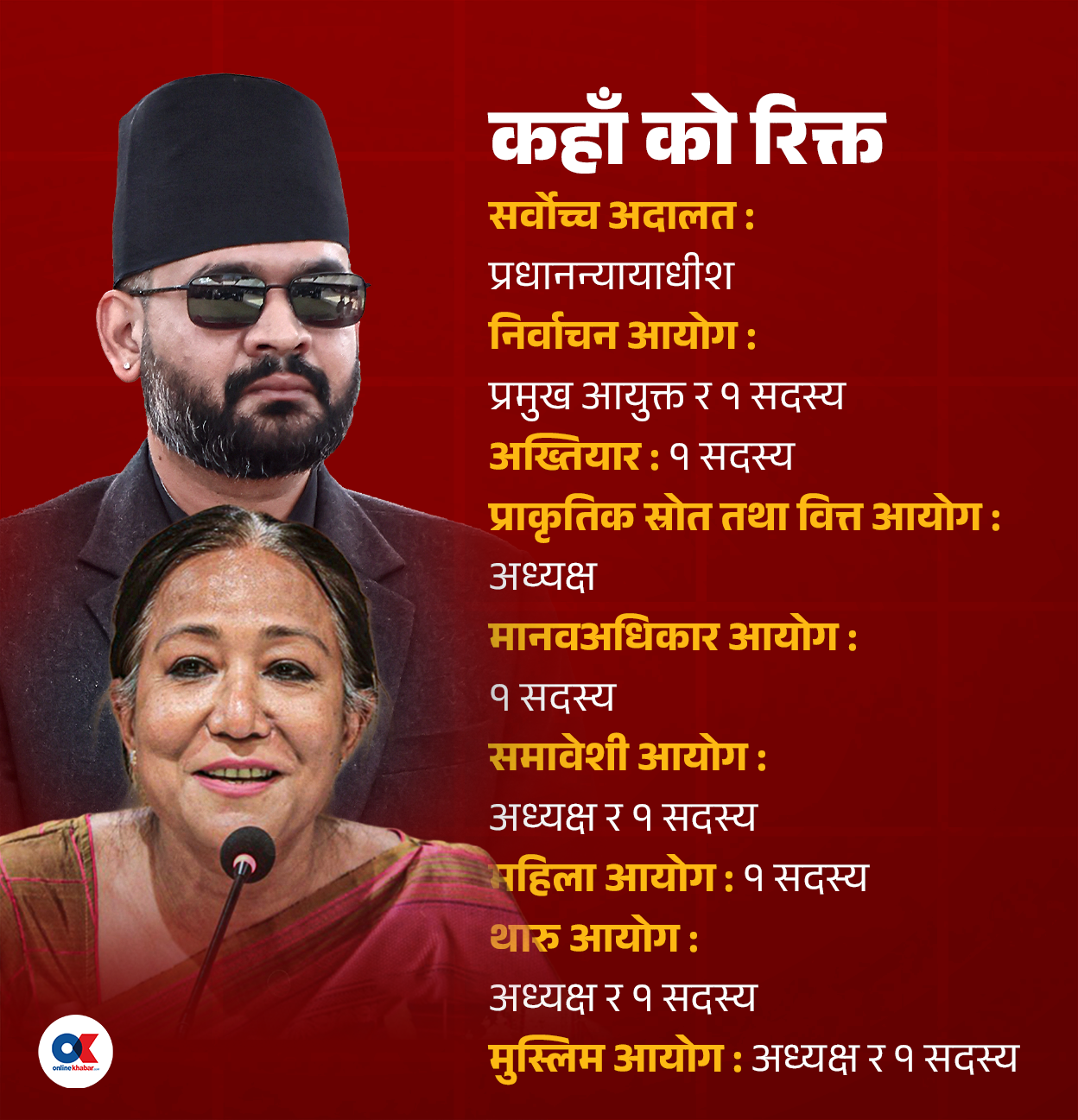
Which Other Positions Are Vacant?

The position of Chief Election Commissioner is vacant after Dinesh Kumar Thapaliya’s retirement. The Election Commission, led by Acting Chief Election Commissioner Ram Prasad Bhandari, noted two vacancies during the elections held last February.

The Chairperson position of the National Natural Resources and Fiscal Commission is vacant, and there are no members except one. The Commission for the Investigation of Abuse of Authority also has one membership vacant. The Commission for Inclusion has vacancies for both the Chairperson and another member, while the Women’s Commission has one vacant post. Additionally, vacancies exist in the Muslim and Tharu Commissions.

Where Are the Vacancies?

Online Vehicle Registration System Launched for Tourists Arriving via Land Routes

The government has introduced an online system allowing tourists from India and other third countries entering via land routes to submit vehicle details and pay duties online. Finance Minister Dr. Swarnim Wagle announced that this new online system will eliminate the difficulties faced by tourists at border points. The Customs Department will issue a QR code after verifying the online submissions, enabling vehicles to enter Nepal smoothly. Kathmandu, 22 Baisakh.

Under the Ministry of Finance, the Customs Department has developed and implemented a new online platform for foreign vehicles entering Nepal by land to register details and pay duties. With this system, tourists from India and other third countries can now complete vehicle registration and fee payments online. Previously, vehicles had to obtain a temporary permit physically at customs points and return to border posts once the travel period ended.

With the launch of the online system, tourists can now apply for vehicle permits, pay fees, and conveniently travel to Nepal from their homes. Minister Wagle stated, “The government has initiated this service as part of its commitment to provide good governance and efficient, high-quality public services.” Customs Department Director General Shyam Prasad Mainali noted that the vehicle permits for tourists entering from abroad are now fully digital.

According to him, travelers and tourists entering Nepal can declare their foreign vehicle details online themselves, enhancing transparency and efficiency in the process. The revenue collected by the government can also be paid online or at bank counters. After payment, the issued QR code will allow vehicles to enter Nepal. The department confirmed that this service has been developed under the Nepal National Single Window System through the Temporary Import Vehicle (TIV) module. Currently, the service applies only to vehicles used by Indian and third-country tourists entering Nepal by land.

Government Closely Monitors: Potential Action Against Employees Conducting Activities Under Trade Union Names

The government has already annulled trade unions of civil servants through an ordinance, yet employee organizations continue to carry out organized activities. The Ministry of Federal Affairs and General Administration has taken notice of these activities and is preparing to take necessary action. Six employee organizations have warned of protests demanding the reinstatement of trade unions and have stated that if the government does not reverse its decision, they will launch phased protests. On 22 Baishakh in Kathmandu, despite the government’s ordinance nullifying civil servants’ trade unions, these organizations remain active.

The Ministry of Federal Affairs and General Administration, paying close attention to these events, has issued notices. Following the President Ram Chandra Paudel’s promulgation of an ordinance amending several acts on government recommendation, the trade union system for employees was officially abolished from last Sunday. Although the amended Civil Servants Act leaves no room for any employee organizations, several party-affiliated employee groups issued a joint statement on Monday.

After government employees issued statements in the capacity of organizations, the ministry expressed concern. A ministry official stated, “According to the Civil Servants Act 2049 (1992), trade unions for employees are not allowed as per the ordinance. Employees should focus on providing services to citizens, not engage in partisan politics. If such activities continue, the ministry will take necessary measures.” Since the ordinance has dissolved all forms of employee organizations, issuing statements in the name of employees will prompt the ministry to demand clarifications and take awareness-raising steps, according to sources within the ministry.

The chairpersons of various employee organizations—including Bhawani Nyaupane Dahal of Nepal Civil Servants Organization, Uttam Kumar Kutwal of Nepal Civil Servants Union, Ambadatta Bhatt of Nepal National Civil Servants Organization, Yam Bahadur Khatri of Unified Government Employees Organization, Vijay Kumar Yadav, acting chairperson of Nepal Madhesi Civil Servants Forum, and Sita Gurung of Independent National Service Employee Organization—jointly issued a statement demanding the restoration of the trade union system. On Tuesday morning, Prime Minister Balen Shah released a statement clarifying that the abolition of trade unions is not a fight against political parties.

He explained that the government’s decision aims to preserve the system amid protests from student organizations and trade unions. On Facebook, the Prime Minister wrote, “This is not a fight against any party. This is an effort to save the system. It is an attempt to protect the future and remove the country from partisan dominance, ushering it into an institutional path. It is an effort to free educational institutions and the civil service from partisan infection.” On Monday, six employee organizations convened and warned that if trade union provisions are not reinstated, they will be compelled to launch protests. Following these threats of protests against the government, the ministry is treating the matter seriously. A ministry source noted, “We are monitoring activities conducted under the name of employee organizations. The ministry has already held preliminary discussions on these activities.” Given the ordinance abolishing employee trade unions, the ministry confirmed that it will take necessary steps against those organizing such activities under any employee name.

The six employee groups warned that if the government does not revoke the trade union abolition decision, they will be forced to proceed with phased protests. They issued statements opposing the government’s decision and demanding the restoration of trade union rights. The statement also emphasized that if the government ignores employee demands, they will have no choice but to pursue legal battles and phased protests with the support of all concerned parties.

गुल्सनको गर्जन – Online Khabar

Gulshan Jha’s Outstanding Bowling Secures Victory for Nepal

At the TU ground, after taking five wickets against Oman, Gulshan Jha’s celebration notably attracted attention. He performed a bold celebration by pointing both index fingers towards the pitch in a ‘This is my territory’ style. Gulshan claimed his best bowling performance by taking five wickets for the second time in his ODI career, playing a crucial role in securing a commanding 81-run victory for Nepal. Nepal has won three out of four home matches in League Two and currently holds seventh place with six points. Kathmandu, 22 Baisakh.

Gulshan’s bowling completely dismantled Oman’s innings. He took five wickets while conceding just 38 runs in 9 overs. This five-wicket haul proved decisive in Nepal’s triumph. After the match, Gulshan said to the media, “I am happy. It feels great to contribute to the team.”

This was the second time in his ODI career that Gulshan took five wickets in a single innings. Previously, he had bowled 10 overs with 2 maidens, conceding 47 runs. However, in today’s performance, he managed 5 wickets for just 38 runs in 9 overs. Nepal has played six series in League Two so far, gathering 18 points from 24 matches. The team is preparing to host another League Two series on home soil one week from now.

Troubled Cooperative Returns Savings to Small Depositors While Clamping Down on Large Debtors

Summary

  • The management committee of the distressed cooperative plans to begin refunding up to 50% of savings to small depositors starting the first week of Jestha.
  • The government prioritizes loan recovery, intends to publicly disclose defaulters, and plans strict actions against those who fail to repay loans.
  • There are 76,444 depositors in the troubled cooperative, holding total savings of NPR 4.505 billion.

April 22, Kathmandu – The Office of the Distressed Cooperative Management Committee is preparing to begin refunding savings to small depositors starting the first week of Jestha. The office plans to refund savings without exceeding 50% of each small depositor’s total amount.

The government intends to refund savings from funds provided by the government and from recovered amounts collected by the troubled institution. Loan recovery is given the highest priority before focusing on returning depositors’ savings. Minister for Land Management, Cooperatives, and Poverty Alleviation, Pratibha Rawal, emphasized ensuring fairness to all depositors, large and small, by making sure no depositor is neglected during the refund process.

“The government is committed to resolving cooperative issues, focusing on loan recovery and the repayment of depositors’ savings,” Minister Rawal stated. She added that the refund process will advance only after loan recovery is complete.

The government has granted a 15-day period for the directors, employees, and borrowers of distressed cooperatives to repay their loans and cooperate with the committee. Minister Rawal also mentioned plans to publicly disclose the names of defaulters.

In cases where loans are not repaid, strict measures will be taken including suspending public services, blacklisting, investigations in cooperation with police and the National Investigation Department, and initiating legal action based on the committee’s recommendation. “Refunding of savings will begin from the first week of Jestha,” the minister confirmed.

Dilli Raj Acharya, Chairman of the Distressed Cooperative Management Committee, informed that starting from the first week of Jestha, savings will be returned to depositors with amounts of NPR 10,000 or less, and arrangements are in place to refund up to NPR 50,000 for small depositors.

Govind Prasad Rizal, Joint Secretary at the ministry, said efforts are ongoing to make the refund process efficient, straightforward, and swift. Records have been compiled for 76,444 depositors from 20 distressed cooperatives that have contacted the committee.

Among them, 58,141 depositors have savings up to NPR 500,000, while only 18,000 have savings exceeding that amount. The total savings in these troubled cooperatives amount to NPR 4.505 billion.

The total savings of small depositors reach approximately NPR 666 million. There are 36,522 depositors with savings up to NPR 100,000, totaling about NPR 135 million.

Similarly, those with savings up to NPR 500,000 hold a combined total of NPR 531 million. Out of these, 17,000 depositors have savings under NPR 25,000, and 9,000 depositors hold up to NPR 50,000, collectively amounting to NPR 58 million.

To address misappropriation and irregularities, the Cooperative Act has been amended to identify and strictly prosecute individuals involved. The amendment allows legal action not only against individuals but also their families, relatives, and employees implicated in mismanagement of cooperative funds.

Chairman Acharya reiterated that his team is focused on loan recovery first and aims to begin refunding small depositors’ amounts from the first week of Jestha.

The committee currently holds NPR 25 million released by the government to the revolving fund for savings refunds, along with about NPR 35 million recovered from distressed cooperatives.

Using these funds, the committee will commence refunding savings starting the first week of Jestha. The government has amended the Cooperative Act through an ordinance, empowering provincial and local governments to declare cooperatives as distressed, facilitate savings refunds, establish revolving funds, and execute loan recovery.

Nepali Congress Appoints 39 Members to Central Policy, Research, and Training Institute

Vice-Chairman Bishwaprakash Sharma of the Nepali Congress has appointed 39 members to the Central Policy, Research, and Training Institute. This appointment was carried out in accordance with Article 36(1)(g) of the party’s 2017 statute (amended). Acting General Secretary Krishnaprasad Dulal provided this update on April 22 from Kathmandu.

The appointment process for members of the Nepali Congress’s Central Policy, Research, and Training Institute has been completed. Vice-Chairman Sharma, who also serves as the head of the institute, appointed the 39 members following the provisions of Article 36(1)(g) of the party statute, informed acting General Secretary Krishnaprasad Dulal.

The appointed members are as follows: 1. Mr. Madhu Acharya — Kavrepalanchok 2. Dr. Gopal Dahit Tharu — Bardiya 3. Mr. Anju Jha — Rautahat 4. Mr. Umesh Shrestha — Lalitpur 5. Prof. Dr. Govindraj Pokharel — Pyuthan 6. Mr. Min Bham — Mugu 7. Dr. Anjanikumar Jha — Mahottari 8. Dr. Yadav Pandit — Abroad 9. Mr. Badri Sigdel — Bardiya 10. Mr. Gopal Prasad Pokharel — Sunsari 11. Mr. Shravan Mukarung — Bhojpur 12. Mr. Mohana Ansari — Banke 13. Mr. Mahendra Prasad Yadav — Saptari 14. Mr. Shriprasad Bhalami Magar — Gulmi 15. Mr. Vinod Das — Bara 16. Er. Dipesh Bista — Kathmandu 17. Dr. Krishnaprasad Paudel — Kaski 18. Mr. Prakash Lamichhane — Surkhet 19. Mr. Suryamaraj Rai — Morang 20. Mr. Manbahadur Thapa — Chitwan 21. Mr. Vimala Rai — Khotang 22. Mr. Rakesh Singh — Parsa 23. Mr. Narendra Paswan — Rautahat 24. Mr. Daksh Paudel — Kathmandu 25. Mr. Kanchan Jha — Parsa 26. Mr. Sumit Sharma ‘Sameer’ — Dhanusha 27. Mr. Khagendra Acharya — Kathmandu 28. Dr. D.B. Sunar — Achham 29. Mr. Roshni Giri — Kathmandu 30. Mr. Janak Chatout — Darchula 31. Mr. Dolraj Bhusal — Syangja 32. Mr. Amrit Gyawali — Gulmi 33. Mr. Elija Dhakal — Tanahun 34. Mr. Prakriti Bhattarai — Kathmandu 35. Mr. Kailash K.C. — Solukhumbu 36. Mr. Swikrati Paudel — Kathmandu 37. Mr. Umang Lohani — Chitwan 38. Mr. Gokul Limbu — Taplejung 39. Mr. Pramesh Khanal — Kathmandu

बागमतीमा ८ वटा मन्त्रालय मात्रै कायम, नयाँ आर्थिक वर्षबाट मात्रै लागू हुने

Bagmati Province Government Decides to Maintain 8 Ministries, Effective from New Fiscal Year

The Bagmati Province government has decided to maintain eight ministries, including the Chief Minister’s Office. Government spokesperson Prabhat Tamang informed that the reduction in the number of ministries will take effect from the start of the upcoming fiscal year. A team of former secretaries recommended cutting 701 staff positions as part of the ministry restructuring.

April 5, Hetauda – In a cabinet meeting held today, the Bagmati Province government resolved to maintain eight ministries, including the Chief Minister’s Office. Currently, there are 14 ministries in Bagmati Province. Due to differing views within the cabinet regarding whether to revise the number of ministries after the budget presentation for fiscal year 2083/84 or prior to the budget, the government decided to establish eight ministries. The distribution of departmental responsibilities has undergone significant revisions.

The Ministry of Forests and Environment has been merged into the Ministry of Agriculture, the Ministry of Cooperatives into the Ministry of Law, and the Ministry of Transport into the Ministry of Industry. According to government spokesperson and Minister for Economic Affairs and Planning Prabhat Tamang, the cabinet decided to maintain the offices of the Chief Minister and Council of Ministers; the Ministry of Internal Affairs, Law, and Cooperatives; the Ministry of Economic Affairs and Planning; the Ministry of Drinking Water, Energy, and Irrigation; and the Ministry of Physical Infrastructure Development. Additionally, the ministries of Agriculture, Livestock, Forests and Environment; Health and Social Development; and Industry, Tourism, Labor, and Transport will also be maintained.

Before finalizing the changes in the number of ministries, the government provided a 15-day period to ministries, provincial assembly committees, and other relevant bodies to submit suggestions. The decision to reduce the number of ministries will be implemented from the new fiscal year starting on 1st Shrawan, as confirmed by Prabhat Tamang. The existing 14 ministries will complete the budget implementation for the current fiscal year. Meanwhile, preparations are underway for the budget of the next fiscal year. Moving forward, the Ministry of Economic Affairs and Planning will establish new codes to determine the budget limits for the eight ministries.

Ministry of Finance Officials Dismissed Following Implementation of Ordinance on Public Office Removal

Following the implementation of the Special Ordinance on the Removal of Public Officials 2083, over two dozen officials under the Ministry of Finance have been dismissed from their positions. Although Bhupal Baral, Chairperson of the Employees’ Provident Fund, and member Dhaniram Sharma were relieved from their posts, they will continue to hold their permanent positions.

Tulsi Prasad Shrestha, Chairperson of the Citizens Investment Trust, senior director Hemantaraj Ramali, and executive director Parbat Kumar Karki were also dismissed. On 22 Baishakh in Kathmandu, the enforcement of the Special Ordinance on Public Officials’ Removal 2083 led to changes in the positions of secretaries, joint secretaries, directors, and members across various entities under the Ministry of Finance. However, incumbent joint secretaries will continue to serve in their permanent roles.

According to the ministry, Bhupal Baral was removed from the post of Chairperson of the Employees’ Provident Fund; he is currently serving as the Revenue Secretary. Similarly, Dhaniram Sharma, also a member of the same fund, was dismissed but is presently performing the duties of a joint secretary. Other officials dismissed include administrator Jitendra Dhital and members Ishwar Karki, Vinod Thapa, Professor Dr. Taraprasad Bhusal, and Devendra Raman Khanal, the Ministry of Finance stated.

Dujang Sherpa Resigns as President of Nepal Student Union

April 22, Kathmandu – Dujang Sherpa has announced his resignation from the position of President of the Nepal Student Union (Nevisangh). In an official statement, Sherpa noted that his term has formally ended. Although he is stepping down, he emphasized that his responsibility towards society and change will never cease.

While acknowledging that he was entrusted with the primary responsibility to successfully conduct the 12th General Convention, he expressed regret over being unable to accomplish it, stating it will remain a lifelong burden. ‘Today, without any excuses or blaming others, I take full responsibility for this failure,’ he stated in the release.

Shubhendhu Adhikari Defeats Mamata Banerjee by Joining BJP, Ending 15-Year TMC Rule in West Bengal

In the 2026 West Bengal Assembly elections, the Bharatiya Janata Party (BJP) secured a historic victory by winning 206 seats and forming the government with a two-thirds majority for the first time in the state’s history. Shubhendhu Adhikari emerged as a central figure in this unprecedented triumph. He defeated Chief Minister Mamata Banerjee in the traditionally stronghold constituency of Bhabanipur by a margin of 15,105 votes, bringing an end to 15 years of Trinamool Congress rule in Bengal.

Shubhendhu Adhikari not only won decisively in Bhabanipur but also retained the prominent Nandigram constituency, which he had won in 2021, by a large margin. Formerly considered a trusted protégé of Mamata Banerjee, Adhikari’s defection from the TMC to BJP played a pivotal role in dismantling the party’s long-standing dominance in the state.

Having succeeded in toppling “Didi’s” fortress, Shubhendhu Adhikari has established himself as the most powerful political leader in West Bengal’s current landscape.

Political Legacy and Family Background

Born in 1970 in Karakuli, East Medinipur, Shubhendhu Adhikari hails from a politically influential family. His father, Shishir Adhikari, is a prominent leader in the region. Shubhendhu was first elected to the Lok Sabha in 2009 and served as a Minister of State under then-Prime Minister Manmohan Singh from 2009 to 2012. Among his two brothers, Divyendu is a Member of Parliament, while the other brother holds significant influence in local government politics. Shubhendhu pursued studies in Political Science and History at the University of Kolkata.

On April 22 in Kathmandu, this political shift marks a transformational moment in West Bengal’s governance as the BJP’s historic mandate reshapes the state’s political narrative.

Nepal Team Triumphs at the 7th Asian Carrom Championship

News Summary

  • Nepal team clinched the championship title at the 7th Asian Carrom Championship held in Dhulikhel, Kavre.
  • India finished second, Indonesia secured third place, while Nepal’s Amrita Tamang received the Fair Play Award.
  • International Carrom Federation President Gil Duigue praised Nepal for successfully hosting the event.

April 5, Kathmandu – The Nepal team emerged victorious at the 7th Asian Carrom Championship held in Dhulikhel, Kavre.

Organized by the Nepal Carrom Association with technical and official support from the International Carrom Federation and the Asian Carrom Confederation, Nepal secured the team champion title by winning the highest tally of 31 gold, 20 silver, and 30 bronze medals, according to Nepal Carrom Association President Laxman Basnet.

India claimed second place with 18 gold, 27 silver, and 22 bronze medals, while Indonesia finished third with 3 gold, 4 silver, and 1 bronze medal.

In individual recognitions, Nepal’s Amrita Tamang was awarded the Fair Play Award. Masrpov Omidillo from Uzbekistan was named the best male player, and Vatanpai from India was declared the best female player.

Additionally, the Himalayan International Open Carrom Championship honored New Zealand’s 58-year-old Barney Vacky and 54-year-old Francis Vesetulu with the Versetans Excellence Award, Basnet added.

The event was inaugurated by Ram Charitra Mehta, Member-Secretary of the National Sports Council, and Gil Duigue, Vice President of the International Carrom Federation from France, while President Laxman Basnet of Nepal Carrom Association delivered the welcome address.

The championship featured around 300 players from nine Asian countries. However, players from Thailand, Iran, Bangladesh, and Japan could not attend due to various reasons, organizers said.

Medals, trophies, and certificates were presented to the winners by former State Minister Biraj Bista, International Carrom Federation Vice President Gil Duigue, Nepal Carrom Association President Laxman Basnet, and General Secretary Siddhi Byanjankar.

At the closing ceremony, International Carrom Federation President Duigue commended Nepal for successfully organizing the championship, earning the trust of all participating nations, and affirmed Nepal’s capability to host future international-level competitions.

President Basnet thanked all participants for demonstrating outstanding skills and expressed gratitude to everyone who contributed to the event’s success.

Basnet also announced that Indonesia has submitted a proposal to host the 8th Asian Carrom Championship.

कर्मचारीलाई सरकारको निर्देशन- ट्रेड युनियन कार्यालयहरू बन्द गर्नू, तोकिएको जिम्मेवारीमा तत्काल फर्कनू

Government Directs Closure of Trade Union Offices; Employees to Return to Duty

The government has instructed all ministries, departments, commissions, secretariats, and other bodies to immediately close all trade union offices. Through a circular, the Ministry of Federal Affairs and General Administration has requested trade union employees to return to their designated posts as per the authorized staffing structures. The circular further mandates the recovery of office buildings, vehicles, and other government properties used by the trade unions, and directs authorities to ensure that the employees are assigned their official duties accordingly.

Kathmandu, 22 Baisakh — The government has issued a directive to shut down all offices of trade unions. On Tuesday evening, a circular distributed to ministries, departments, commissions, secretariats, and agencies ordered the closure of all trade union offices. According to the circular released by the Ministry of Federal Affairs and General Administration on Tuesday evening, employees associated with various trade union committees are instructed to return to their designated responsibilities as per their authorized posts.

“All departmental and other committee offices related to trade unions affiliated with the civil service are to be closed. If these committees have polluted or misused office buildings, workspaces, vehicles, and other government assets for trade union purposes, the concerned office must reclaim these properties. Furthermore, arrangements must be made to assign the employees affiliated with the trade union committees to their duties as per their authorized staffing structure, as per the secretary-level decision dated 2083/01/22,” the ministry’s circular states.

Climate and Agriculture Information Center Established for Farmers in Myagde, Tanahun

An agreement has been signed to establish an Agriculture and Climate Information Center in Myagde Rural Municipality, Tanahun. This center will provide weather forecasts, agricultural advice, and information on climate risk reduction. The rural municipality will manage infrastructure and human resources, while Children-Nepal will contribute NPR 200,000. May 5, Damauli (Tanahun).

The center aims to support local communities, especially farmers, by providing timely weather and climate-related information to facilitate climate change mitigation, adaptation, and coping strategies. To implement this, a memorandum of understanding was signed between Myagde Rural Municipality and the Social Integration Forum for Working Children (Children-Nepal). The signatories were Myagde Rural Municipality Chairperson Shriprasad Shrestha and Children-Nepal Executive Director Dilliprasad Sharma.

Through the established center, citizens will receive information on weather forecasts and seasonal events such as rainfall, droughts, storms, and hailstorms. Additionally, agricultural advice, awareness messages, and climate risk reduction information will be regularly disseminated, said Narayan Prasad Adhikari, Chief Administrative Officer of the rural municipality. The center will also provide farmers with knowledge on climate-resilient agricultural techniques such as drip irrigation, greenhouses, tunnel farming, and mulching. This initiative is expected to improve agricultural productivity, food self-sufficiency, and living standards.

The rural municipality will be responsible for the necessary infrastructure, manpower, and information management, while Children-Nepal will fund NPR 200,000 under the ‘Climate Resilient Community Project.’ Technical assistance, awareness material preparation, and promotional support will also be provided. Weather and climate data from the Department of Hydrology and Meteorology, Ministry of Agriculture and Livestock Development, Agriculture Department, and local agricultural and environment offices will be shared with farmers through the center. Information dissemination will be facilitated via digital boards, mobile messages, Facebook, and WhatsApp groups. The center is expected to start operations within a month. For smooth running, the municipality will allocate a room for the center and assign staff to regularly update the information.

Task Force Engages Former Leaders and Administrators in Discussions on Constitutional Amendment

The task force established for constitutional amendment held discussions with former heads of constitutional bodies, former chief secretaries, foreign affairs experts, and former administrators. The task force emphasized advancing the constitutional amendment through national consensus and proceeding carefully with sensitive issues that will have long-term impacts. Suggestions discussed included governmental structure, federalism, electoral system, reforms of constitutional bodies, and empowering local levels. April 5, Kathmandu.

The task force, formed to prepare a discussion paper on constitutional amendment, consulted with former heads of constitutional bodies, former chief secretaries, foreign affairs experts, and former administrators. The consultation, which lasted around three hours at the Office of the Prime Minister and Council of Ministers, involved in-depth discussions on topics ranging from governmental structure to federalism, the electoral system, and constitutional bodies. The task force, chaired by the Prime Minister’s political advisor Asim Shah, clarified its commitment to advancing the constitutional amendment through national consensus.

Chairman Shah noted that the constitutional amendment meets both public expectations and current necessities, emphasizing the need for sensitive handling of issues with long-term consequences. Experts participating in the discussion offered various suggestions for improvements concerning governmental form, electoral system, federalism, the rights of provinces and local levels, independent judiciary, and the structure of constitutional bodies. Former administrators and experts such as Bimal Koirala, Umesh Mainali, Tankmani Sharma Dangal, Madhuraman Acharya, Manbahadur Bik, Yamakumari Khatiwada, Bhanu Acharya, Somlal Subedi, Jayaraj Acharya, Krishnahari Baskota, and Ganesh Josheel presented their respective views and recommendations.

Former Chief Secretary Bimal Koirala suggested implementing a mixed electoral system combining direct election and proportional representation, reducing the number of members in the National Assembly, and appointing the Vice President as the chairperson of the National Assembly. He emphasized clarifying the distribution of powers among federal, provincial, and local levels while empowering local governments further. Former civil servant Umesh Mainali highlighted that lawmakers’ desire to become ministers has negatively influenced policy-making and proposed restricting lawmakers solely to lawmaking roles while introducing directly elected executive heads.

Additionally, the task force stated that the suggestions received will be incorporated into the discussion paper, and further consultations will be conducted in the coming phases.