March 8, Biratnagar – The winter and eighth session of the Koshi Provincial Assembly concluded with the passage of three bills. The session was adjourned by Provincial Chief Parsuram Khapung on Monday night, effective from midnight. This decision followed the Provincial Cabinet’s recommendation made earlier on Monday to terminate the session.
The session faced disruptions after the provincial assembly building and secretariat were set on fire during the Janajati Aandolan protests, creating uncertainty. Subsequently, the assembly meetings were relocated to the Virendra Sabha Hall in Biratnagar, where the session was convened from January 8. According to Niroj Dhakal, the Information Officer at the Koshi Provincial Assembly Secretariat, the two-month-long session successfully passed three bills.
The bills enacted include amendments to the “Provincial Research and Training Institute Act, 2069,” legislation regarding “Provincial Legislative Procedures,” and provisions for the “Management of Public Communication in Koshi Province.” Due to the destruction of the assembly building and secretariat during the protests, the session was held in the rented Virendra Sabha Hall, comprising a total of 15 meetings. During the zero hour of the session, 83 members spoke, while 19 members presented remarks under special time.
Summary: Prime Minister Balen Shah plans to reduce the number of ministries from 22 to 17. Alongside this, the government is preparing to cut the number of secretary posts. A Restructuring Management Secretariat will be established to oversee staff management and ensure uninterrupted service through a transition roadmap. 23 Chaitra, Kathmandu.
Shortly after his appointment as Prime Minister, Balen Shah formed a 15-member cabinet about one and a half weeks ago. Currently, there are 22 ministries, but the government plans to assign some ministers responsibility for two ministries whose functions overlap, effectively consolidating ministries. Soon after the government was formed, the cabinet prepared a 100-point action plan that included a target to reduce ministries to 17 under the theme of ‘Administrative Reform, Restructuring, and Economy’.
With the Ministry of Industry, Commerce and Supplies and the Office of the Prime Minister and Council of Ministers holding ministry-like roles, the government is proposing to merge such ministries and assign ministers accordingly. A plan to reduce the number of ministries within a month also includes managing secretary posts. To facilitate this, the government will establish a Restructuring Management Secretariat within the Office of the Prime Minister and Council of Ministers. This secretariat will have two primary functions: first, to manage staff promotions to avoid any disruption in service; and second, to prepare a transition roadmap to ensure service continuity. As the number of ministries decreases, a significant reduction in secretaries is expected. Currently, besides the Chief Secretary, four secretaries serve in the Prime Minister and Council of Ministers’ office.
Secretarial posts have also been designated in smaller agencies under the Prime Minister’s Office, including Nepal Trust, Public Procurement Monitoring Office, and Vigilance Center. Even these small entities have secretary-level positions. The Ministry of Finance has two secretaries overseeing economic and revenue matters, while the Office of the Auditor General also has a dedicated secretary. The Ministry of Health allocates secretaries according to health and administrative responsibilities. Beyond ministries, multiple commissions, agencies, and constitutional bodies have more than one secretary. Secretarial slots exist in bodies such as the Water and Energy Commission, the Commission for Investigation of Abuse of Authority, the Election Commission, and the Public Service Commission. The offices of the Auditor General, Attorney General, and Federal Parliament Secretariat each have four secretaries. According to an Under-Secretary from the Prime Minister’s office, secretarial posts in executive agencies will be prioritized for review. With upcoming cuts, ministries that are merged will retain only one secretary out of the previous two. Secretarial numbers will definitely decrease in ministries with two or more secretaries. Positions in bodies where secretaries are deemed unnecessary will also be reviewed.
Sudip Dhakal, Policy, Administration and Good Governance Advisor to Prime Minister Balen Shah, confirms that a committee has already been formed to reduce the number of ministries. He said, “The committee has been formed and is likely working. No further information is available at this time.”
Background on Ministry Reduction: On 7 Mangsir 2078 (November 2021), the government amended the Work Division Regulations to establish 22 ministries, all with secretarial posts. After reducing five ministries, at least five secretary positions will be automatically removed. However, sources in the Prime Minister and Council of Ministers’ office indicate no immediate cuts in secretary numbers. According to the source, four secretaries are expected to retire by the end of Ashad (mid-July). The strategy for reducing secretaries relies on not replacing vacant posts. Some under-secretaries awaiting promotion may experience delays, and some will retire at age 58 without becoming secretaries.
Structural Changes to Come: At the federal level there are currently 63 secretarial posts, plus 7 chief secretaries at the provincial level, totaling 70 secretaries. Chief secretaries stationed in provinces are part of the federal civil service. In the health sector, at the 12th level (equivalent to secretary), there are four officers. The number of under-secretaries is approximately 650. The government has yet to finalize the allocation of posts from chief secretary to secretary. According to the 100-point plan, the Restructuring Management Secretariat will determine the remaining organizational framework. In a few months, a regulatory bill will be presented to the federal parliament that will establish various standards and forms for staff management.
Previous Report May Prove Useful: Questions have repeatedly arisen about the federal civil service having surplus staff. Complaints have surfaced alleging selfish interests have influenced the increase in secretary posts. Three years ago, a similar question about secretary numbers led the government to form a review committee. Chaired by then-Secretary Laxman Aryal, the committee recommended reducing the number of secretaries in 2079 (2023) and broadening management for secretaries and under-secretaries in several areas. The report advised reducing secretaries from ministries with two secretaries, such as Industry, Agriculture and Livestock, Health, Education, Science and Technology, and Energy ministries. It recommended limiting secretaries to 50, creating 80 additional secretary-level posts, and capping under-secretaries at 628. The committee suggested cutting secretarial posts in some commissions deemed unnecessary and reallocating them as additional secretaries. They also recommended appointing additional secretaries to constitutional bodies and agencies with more than two under-secretaries. For promotion to secretary, the report stressed prioritizing candidates under 50 years old, with a clean record and good reputation, backed by legal and policy provisions. It also proposed cluster-based staff deployments for the highest-ranking gazetted officers and setting the number of provincial ministries accordingly.
Dr. Prakashchandra Lohani’s resignation from the position of Chairperson of the Rastriya Prajatantra Party’s Directorate Committee, submitted on Chaitra 8, has been accepted by the party chairman, Rajendra Lingden. Lohani expressed shock at the results of the recent House of Representatives election and emphasized the need to hold the party general convention before continuing in his position. In his resignation letter, he urged the party leadership to immediately clear the path for necessary processes. (Chaitra 24, Kathmandu)
The resignation submitted by Dr. Lohani, Chairperson of the Rastriya Prajatantra Party (RPP) Directorate Committee, has been officially accepted. Party sources confirmed that Rajendra Lingden approved the resignation on Tuesday, twelve days after Lohani tendered it on Chaitra 8.
Following the election outcome of the House of Representatives, Lohani expressed his astonishment and insisted on convening a party general convention through a temporary committee. He clarified that he would only continue in his role after the convention has been held. Additionally, he specified in his resignation letter that the party leadership must immediately proceed with the necessary formalities.
Rajasthan Royals achieved their third consecutive victory in IPL cricket by defeating Mumbai by 27 runs. Due to rain, the match was shortened to 11 overs, with Rajasthan setting a target of 151 runs. Rajasthan climbed to the top of the points table with 6 points from 3 matches, while Mumbai remains in seventh place with 2 points. Kathmandu, 25 Chaitra.
In the Indian Premier League (IPL) cricket, Rajasthan Royals secured their third straight win by beating Mumbai by 27 runs in a match that started late on Tuesday night and concluded after midnight. Rain delayed the toss, and the game was reduced to 11 overs per side. Chasing the target of 151 set by Rajasthan, Mumbai managed 123 runs for nine wickets. Naman Dhir and Sherfane Rutherford scored the highest for Mumbai with 25 runs each. Tilak Varma contributed 14 runs, while other batsmen failed to reach double figures.
For Rajasthan, Nandre Burger, Ravi Bishnoi, and Sandeep Sharma took 2 wickets each, while Jofra Archer and Tushar Deshpande claimed one wicket apiece. After losing the toss, Rajasthan batted first and scored 150 runs for the loss of 3 wickets in the allotted 11 overs. Openers Yashasvi Jaiswal and Vaibhav Surevanshi provided an excellent start. Jaiswal remained unbeaten on 79 runs off 32 balls, including 10 fours and 4 sixes. Vaibhav scored 39 runs off 14 balls before being dismissed. Captain Riyan Parag added 20 runs. For Mumbai, Allah Gaffar took 2 wickets, while Shardul Thakur took one. With this third consecutive win, Rajasthan Royals have collected 6 points from 3 matches, occupying the top position, while Mumbai, with 2 points from 3 matches, sits in seventh place.
24 Chaitra, London – According to data from the Home Office, the number of Nepali nationals seeking asylum in the United Kingdom reached 475 in the past year. By the end of December 2025, a total of 162,500 individuals had applied for asylum in the UK, among whom 475 were Nepali citizens.
The statistics indicate that three individuals entered the UK illegally via small boats, while 472 applied for asylum after arriving in the country. Of these applicants, 328 were male and 147 female. The group comprised 448 principal applicants and 27 dependents. Regarding age distribution, 11 applicants were under 18 years old, 406 (85%) were between 18 and 29, 52 (11%) were aged 30 to 49, and 6 (1%) were between 50 and 69 years. Notably, 85% of applicants aged 18 to 29 were students.
Over the past five years, asylum applications by Nepali nationals have fluctuated as follows: 104 in 2020, 182 in 2021, a peak of 1,263 during the COVID-19 pandemic in 2022, 704 in 2023, and 718 in 2024. Although the number of asylum seekers decreased last year compared to 2023, it remained higher than in 2021. According to figures up to December 2025, a total of 162,500 individuals filed asylum claims, representing a 4% decrease compared to December 2024 but double the number compared to December 2019. Among the total applicants, 12,578 were students.
Additionally, 13,557 individuals entered the UK on work visas, and 7,521 arrived on visit visas during the same period. The top ten countries of origin for asylum seekers last year included Pakistan, Eritrea, Iran, Afghanistan, Bangladesh, Sudan, India, Somalia, Nigeria, and Vietnam. The government introduced a new policy on March 2, stipulating that asylum seekers will be granted temporary residence only and will not receive permanent settlement. Under this new rule, every adult asylum seeker’s status will be reviewed every 30 months.
Times Basketball Club secured their spot in the second qualifier of the HJNB League by defeating KVC Hounds 76-68. On Thursday, Times will face GoldenGate Basketball Club for a place in the final. Times’ Shreyas Bahadur Thapa scored 23 points, while Manish KC was named Man of the Match.
24 Chaitra, Kathmandu – In the Eliminator match held Tuesday as part of the Himalayan Java National Basketball League (HJNB League) 2026, Times Basketball Club overcame KVC Hounds 76-68 to advance to the second qualifier. The match took place at the Dasarath Rangashala Covered Hall in Tripureshwor, where Times emerged victorious against Hounds.
On Thursday, Times will compete against GoldenGate Basketball Club in the second qualifier, aiming for a spot in the final. GoldenGate earned another chance to reach the final after losing to Tribhuvan Army Club in the first qualifier on Tuesday. Meanwhile, Hounds have been eliminated from the league.
Times started strong in the first quarter with a 24-18 lead. The Hounds responded in the second quarter with an 18-12 run to tie the game at 36-36 by halftime. However, Times dominated the third quarter, scoring 21-12, to take a 57-48 lead heading into the final quarter. Despite the Hounds outscoring Times 20-19 in the last quarter, they could not prevent Times from clinching the win. During the league phase, Times finished third and Hounds fourth. The two teams split their head-to-head games, each winning once.
The government has imposed a strict ban on the production, import, sale, distribution, and use of plastic bags thinner than 40 microns, and has called for strict implementation of this ban once again. The Department of Commerce, Supplies and Consumer Protection reminded that the implementation of the “Plastic Bag Ban Action Plan 2078,” approved by the Council of Ministers on Magh 17, 2078, continues.
This ban was issued with the aim of reducing environmental pollution and is set to be enforced from Mangsir 1, 2082. Since the use of plastic bags persists in the market despite the ban, a renewed public notice has been issued. Through a public announcement on Tuesday, the government informed that the production, import, sale, distribution, and use of plastic bags thinner than 40 microns have been strictly prohibited.
The department has once again requested all concerned parties not to produce, import, sell, distribute, or use banned plastic bags in daily activities through the renewed notice. Although the ban was initially enforced, the fact that these bags remain in use in markets has compelled the government to reissue the notification to raise awareness among stakeholders.
The Janak Educational Materials Center has completed printing 17 million textbooks for the new academic session. Following the government’s decision to commence the academic year from 15th Baisakh, plans are underway to distribute the books to students by that date. According to Yadunath Paudel, the center’s manager, 1,260 authorized vendors from provincial offices will deliver the textbooks to the respective municipalities. Kathmandu, 24th Chaitra.
Providing details, Yadunath Paudel stated, “Based on student numbers, sufficient textbooks have arrived at the provincial offices. Approximately 14 to 15 million books have been distributed province-wise.” He added that the elections held on 21st Falgun had no impact on the printing process. The center prints textbooks for all grades except 1, 2, and 4, for which the private sector handles printing. Paudel assured, “Textbooks will be in the hands of students when classes begin. There will be no shortage.”
Kathmandu, March 24 – Following the announcement by Harka Sampang, chairman of the Labour Culture Party and Member of the House of Representatives, to collect donations for replacing a suspension bridge in Darchula, many expressed concerns about constructing a unilateral bridge on the international border. Ganesh Thagunna, also a Member of Parliament elected from Darchula, criticized Sampang’s move as “stuntmanship and mere rhetoric.” Former Nepal government secretary Bhim Upadhyay emphasized that building a bridge on an international river requires careful consideration of diplomacy, border security, and geography. Upadhyay wrote on Facebook, “I see some rushing into impossible tasks and others emotionally following them blindly.”
On Tuesday, Sampang laid the foundation stone for a suspension bridge in Darchula. Anil Paudel, Chief District Officer of Darchula, clarified, “The honorable MP inaugurated the bridge in Dumlingkatha, Ward No. 2 of Byas Rural Municipality, which is not on the Nepal-India boundary river.” Mangalsingh Dhami, chairperson of Byas Rural Municipality, informed that the bridge will be constructed over the Ghatte Khola, not the Mahakali River. Ashok Byasi, ward chairperson of Byas-1, added, “It is wrong for those unfamiliar with the local geography to spread rumors suggesting the bridge will be built on the Mahakali River.”
Ganesh Thagunna acknowledged that a suspension bridge is indeed needed in the area but said Sampang’s efforts involved unnecessary publicity. “His initiative is positive; however, claiming he will build a bridge over the Mahakali River and replace the rope bridge is just a stunt,” Thagunna stated. Aren Rai, general secretary of the Labour Culture Party, mentioned that the plan is to build the suspension bridge by voluntarily soliciting cooperation from the local people to ease their access. Sampang himself affirmed he has no political agenda behind the project, posting on Facebook, “I have no political motives in constructing the bridge in Darchula.”
Krisnananda Badu, acting Chief Administrative Officer of Byas Rural Municipality, estimated the cost of the approximately 120-meter-long bridge at around NPR 10 million. According to Badu, Sampang has already obtained the necessary permissions from the municipality to proceed with the construction.
InDrive has announced that it will provide fuel assistance worth NPR 2.2 million to its partner drivers. The company stated that this fuel support program will begin on Baishakh 2 (April 15). It also acknowledged that the recent increase in fuel prices has raised operational costs for drivers and adversely affected their earnings.
According to the company’s statement, “InDrive’s peer-to-peer model allows both passengers and drivers to directly determine the fare. This helps to set fair prices based on real market conditions and operational costs.” Through this initiative, the company aims to alleviate the financial pressure on drivers and help stabilize their income.
The expansion of ride-hailing services in Nepal has created employment opportunities for many drivers. Passengers have also benefited by accessing convenient and affordable transportation options. However, the ongoing rise in fuel prices has increased the drivers’ operational expenses, directly impacting their daily earnings.
The company emphasized that it takes the concerns and complaints of the driver community seriously and supports ongoing efforts to address structural issues within the transportation sector.
Suman Khadgi, the Vice President of the All Nepal Table Tennis Association, has resigned from his position. In a Facebook post, he announced his decision to step down due to principled reasons. Khadgi claimed that factional influence and informal practices have been on the rise. Kathmandu, 24 Chaitra.
On Tuesday, Khadgi wrote on Facebook that he was dissatisfied with the growing governance crisis within the organization, its lack of transparency, and procedural weaknesses, which led him to decide to resign on principle. He emphasized the need for transparent and participatory institutional decision-making processes, and expressed that he could no longer remain silent on the increasing factional influence and informal practices. Khadgi conveyed his belief that the institution stands above any individual and expressed hope that reforms within the organization are still possible.
In response to the conflict in West Asia and its impact on dollar reserves, the government has decided to implement an odd-even system to control fuel consumption and grant public holidays. The Council of Ministers has approved a 50 percent reduction in customs duty and infrastructure development tax on petroleum products. The Nepal Transport Entrepreneurs Federation has recommended that the odd-even system be initially applied to private vehicles without affecting public transportation. Kathmandu, 24 Chaitra.
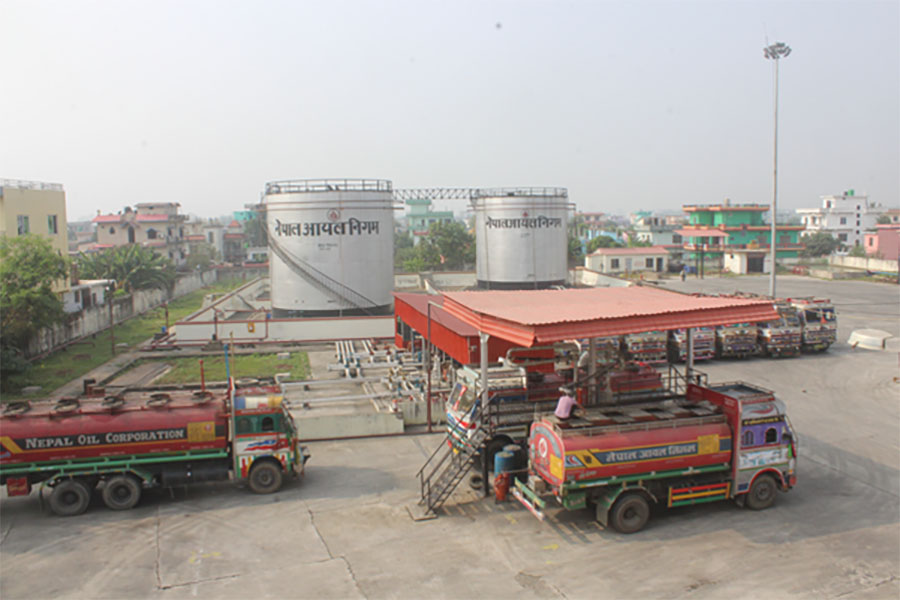
Amid escalating conflict in West Asia, increased import pressure, and a decline in dollar reserves, the government has begun adopting various strategies to manage fuel consumption. After the escalation of conflict in West Asia led to rising petroleum prices, the Nepal Oil Corporation, the monopoly distributor of fuel, proposed suitable alternatives to the government. Facing growing financial deficits, the corporation has formally appealed to the public to reduce fuel consumption by practicing conservation.
When losses became unsustainable, the corporation suggested several measures to the government to reduce petroleum consumption. These included implementing an odd-even system for vehicles, granting two public holidays during office hours, closing schools and colleges, and imposing a quota system (rationing). Alongside efforts to curb consumption, the corporation also urged the government to offer tax reliefs for better economic management.
Minister Rawal, who announced the decision following the Council of Ministers meeting, stated that the government has proposed multiple options to manage the fuel crisis. She said, ‘We have already taken some steps to control the consumption of petroleum products,’ adding, ‘If the situation remains unmanageable despite these measures, the government will implement the odd-even system for transportation as well.’
Kiran Pandit, the newly appointed Deputy Governor of Nepal Rastra Bank, took the oath of office and secrecy before Governor Prof. Dr. Bishwanath Paudel on 24 Chaitra in Kathmandu. Pandit was appointed as Deputy Governor by the Cabinet meeting. During the oath-taking ceremony, Governor Paudel extended his best wishes for a successful tenure.
Pandit began his service as Assistant Director on 2 Magh 2062 BS. He was promoted to Deputy Director in 2068 BS, Director in 2074 BS, and elevated to Executive Director on 1 Falgun 2081 BS. During his tenure as Executive Director, he led the Payment Systems Department and Foreign Exchange Management Department. He had also served as the spokesperson for the Nepal Rastra Bank for some time.
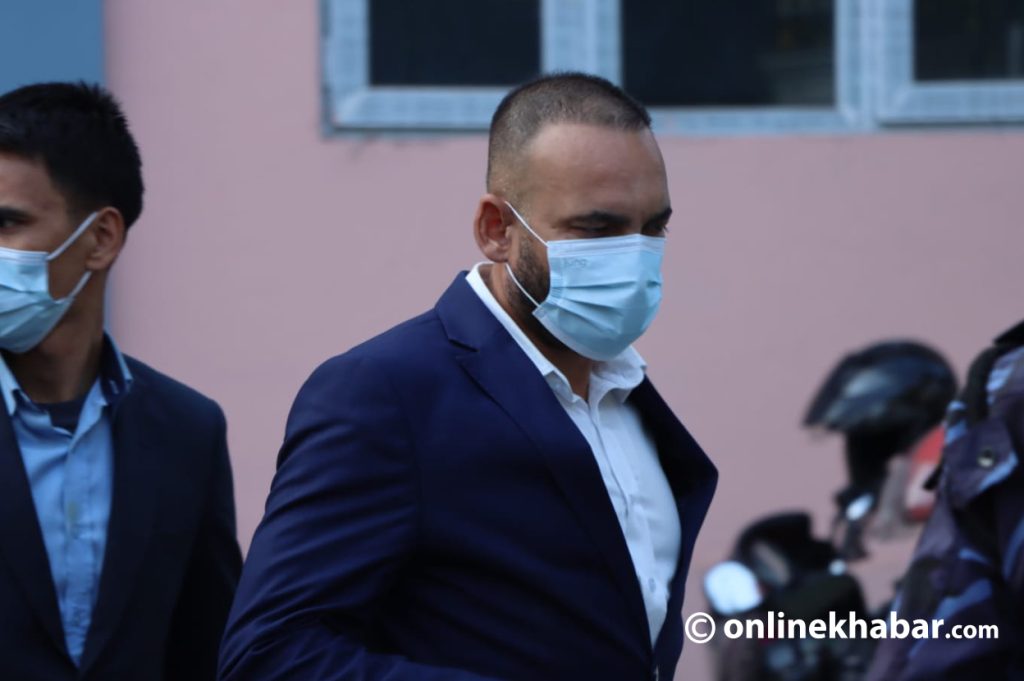
March 8, Kathmandu – The Commission for the Investigation of Abuse of Authority (CIAA) arrested Pradeep Adhikari, Director General of the Civil Aviation Authority of Nepal (CAAN), on December 2, 2025.
Adhikari was apprehended for alleged irregularities in the construction of a heliport in Nalinchok, Bhaktapur, and was sent to Dillibazar prison for pretrial detention on December 6, 2025. Subsequently, a corruption case related to the Pokhara International Airport was filed against him while he was in custody.
Currently, the Kathmandu District Police Office is investigating three cases against Adhikari—namely, attempt to cause death, organized crime, and money laundering—all connected to the Nalinchok heliport and Pokhara airport corruption cases.
During these investigations, authorities uncovered new details linking Adhikari to an individual named Nabinraj Basnet.
Basnet’s Attempts to Slow Down and Settle Cases
The CIAA had been investigating Adhikari in relation to corruption allegations concerning both the Nalinchok heliport and the Pokhara airport for a long time. Despite efforts to influence the commission and hamper the inquiry, Adhikari could not succeed in stopping the investigation.
Records suggest these attempts to manipulate the investigation were channeled through Nabinraj Basnet, who had a longstanding association with Adhikari and was working closely with him.
Basnet previously undertook contracts including taxiway and apron work at Gautam Buddha International Airport in Bhairahawa three years ago. The contract was awarded to Ashish-Kshmadevi-Buddha Himalaya JV, in which Basnet was affiliated with Kshmadevi at the time.
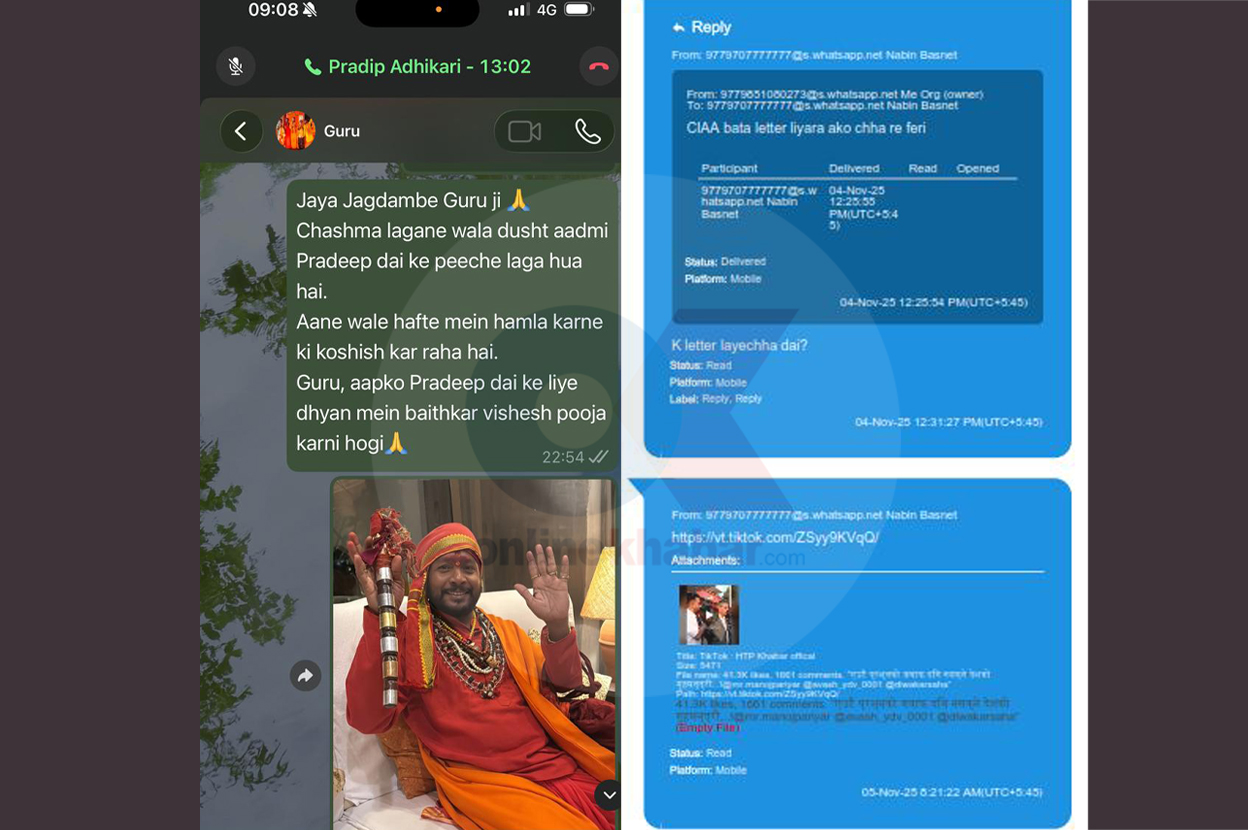
WhatsApp chat logs between Adhikari and Basnet reveal explicit communication about settling cases with the CIAA. Basnet assured Adhikari that through Rajesh Bajracharya, a person codenamed ‘Ba’, they could resolve the corruption case amicably.
Pradeep Adhikari
On the night of November 23, 2025, at 11:07 p.m., Adhikari messaged Basnet referencing a conversation with Rajesh, stating, “Basnet replied at 11:10 p.m., saying they were waiting in the kitchen. Basnet also sent another message: ‘I will meet Ba too. Brother, we are together.’”
Earlier, on November 22, Adhikari had inquired about progress, to which Basnet responded that ‘Ba’ had to handle it and that ‘RM is involved in this matter.’
On November 17, Basnet reassured Adhikari via message, stating, “Why so much pressure? It will stop, do not worry.”
Basnet appeared to assure Adhikari that the case with the CIAA would be halted. On November 4, at 12:24 p.m., Adhikari messaged Basnet about the situation, mentioning files and locations related to the investigation.
Further messaging shows a dialogue regarding letters received from CIAA. Basnet questioned what kind of letters these were, and a 1 minute 38 seconds audio conversation followed.
On the night of November 25, 2025, at 11:10 p.m., Basnet messaged Adhikari, “Although slow, I will do it, brother. Do not be tense,” to which Adhikari responded affirmatively.
The efforts to settle cases with the CIAA seem to have been coordinated from their homes located in Bhaktapur’s Suryabinayak-2 area, where Basnet and Rajesh Bajracharya are neighbors.
Though Adhikari and Basnet’s chats mention Rajesh Bajracharya and ‘Ba’, investigators have not yet found evidence that Basnet reached the highest levels to secure case dismissals.
“Basnet reportedly invoked names of senior officials to reassure Adhikari about settling cases; however, there is no proof that Basnet extended this reach that far,” said an investigative official.
Inquiries regarding the WhatsApp chats have been met with denials from Basnet, who claimed, “I am an honest worker, and I still operate in Bhairahawa. What you mentioned is not true.”
Threats via Militant Group and Attempts to Resign CIAA Chief
After failing to manipulate the CIAA investigation, Adhikari and associates reportedly resorted to various activities, including issuing death threats through a militant group, forcing the CIAA chief, Prem Rai, to resign, and using tantric rituals.
Basnet even created a letterhead of the militant organization and sent it to Adhikari via WhatsApp. Digital forensic lab reports confirm that this letterhead was transmitted from Basnet’s phone number ending in 7777.
The original letterhead was part of a PDF file later converted into a JPG image. Basnet, in his police statement, claimed no knowledge of sending this letterhead from his WhatsApp.
Through the letterhead, Prakash Pathak threatened the CIAA chief and nine others with death, demanding immediate resignation; a video also circulated supporting these threats.
It was confirmed that Pathak was paid a contract fee of NPR 20 million for the threats. Initially, the amount was NPR 100 million but later settled at NPR 20 million through bargaining.
Pathak and Adhikari are acquaintances from before. Adhikari employed a Chinese citizen to remit money to Pathak in the Philippines through hundi channels.
Pathak revealed that upon receiving the funds, he purchased an apartment worth NPR 16 million in the Philippines. He claimed to have been manipulated and entrapped by both Basnet and Adhikari due to financial temptation.
Interpol issued a Red Notice for Pathak’s arrest in the Philippines, and he was brought back to Nepal on January 11, 2026. Investigations are ongoing.
Recent probes include taking statements from Basnet, who denied any acquaintance with Prakash Pathak.
Basnet admitted knowing Adhikari and confirmed WhatsApp communication with him but claimed ignorance of evidence and chats implicating him in the allegations.
Use of Tantric Rituals
Following the failure of other strategies, Adhikari apparently resorted to using tantric rites for protection. A 43-year-old tantric guru known as Baba Saraya Kinnera (Jay Jagadambe) from Kamakhya Devi Temple in Guwahati, Assam, India, was involved.
Adhikari reportedly sent a photo of CIAA Chief Prem Rai to Jay Jagadambe, instructing him to perform tantric rituals intended to harm the chief. The tantric then crafted an idol of Rai and conducted rites culminating in stabbing the idol with weapons and burning it, sending the video to Adhikari.
Basnet stated in his police testimony that he requested Jay Jagadambe to conduct rituals to protect Adhikari. “I came to know from Pradeep Adhikari about the ongoing CIAA investigation, and I called the guru via WhatsApp to perform protective prayers,” Basnet stated.
When contacted, Basnet denied introducing the tantric baba to Adhikari, stating, “I have not introduced the tantric baba to Adhikari.”
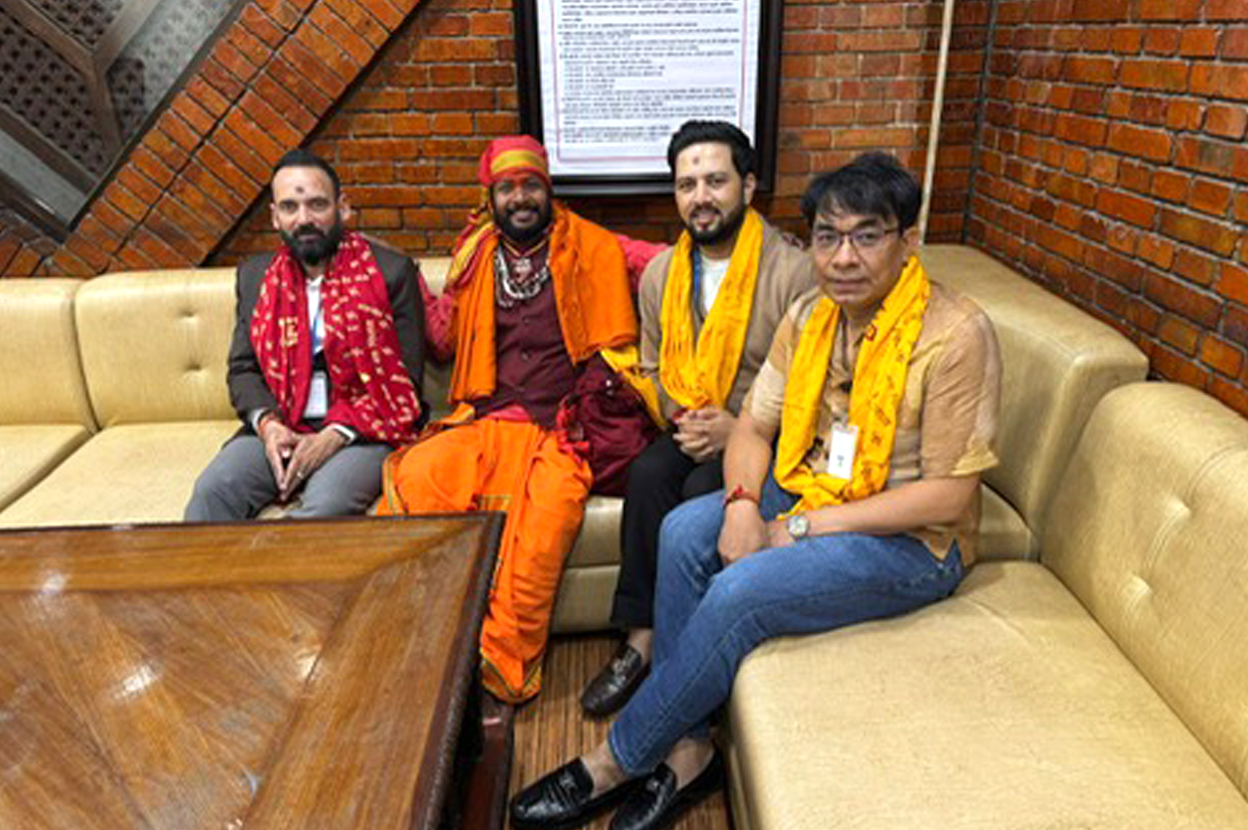
Adhikari and Basnet reportedly welcomed Jay Jagadambe at the airport when he was brought from Nepal to perform rituals intended to harm CIAA Chief Rai.
Basnet Changed Six Mobile Phones Within Seven Months
Authorities intensified investigations focusing on Basnet after his activities appeared suspicious. Technical analysis revealed detailed mobile phone records.
Within seven months, Basnet changed six different mobile devices. On June 20, 2025, he used an iPhone 16 Pro Max, model A3297; on September 30, he switched to an iPhone 17 Pro Max, model A3526, which he continued to use on November 17, 2025.
On January 24, 2026, he used an iPhone 14 Pro Max, model A2894, and changed again on January 25 to iPhone 17 Pro Max, model A3526.
Just five days later, on January 30, he used another iPhone 17 Pro Max, model A3525.
“The frequent changes in mobile devices add to the evidence against him,” said an investigating official. “Switching phones multiple times within days is not a good sign. These developments provide additional leads in our ongoing investigation.”
Various evidences have brought Basnet under the investigative spotlight, and his statement has already been recorded by law enforcement.
The government has decided to grant a 50 percent reduction in customs duties and infrastructure development tax on petroleum products.
The tax burden on petrol will reduce by NPR 17 and on diesel by NPR 11 per litre, though the corporation will continue to incur losses.
The government’s tax relief will provide Nepal Oil Corporation with NPR 149 crore in support, but immediate price adjustments are unlikely.
24 Chaitra, Kathmandu – To mitigate the impact of rising petroleum prices on the public, the government has approved a 50 percent reduction in customs duties and infrastructure development tax on imported petroleum products.
Announcing the decision from Tuesday’s Cabinet meeting, Minister for Federal Affairs and General Administration Pratibha Rawal informed that the government has taken significant measures—from tax cuts to consumption control—to manage the increasing deficit and crisis in the fuel sector.
Minister Rawal also highlighted that the government has been incurring substantial financial losses from fuel imports. Currently, under the existing pricing structure, Nepal Oil Corporation (NOC) has suffered a loss of NPR 1.172 billion within just 15 days of fuel sales.
“This is not a small amount,” Minister Rawal stated. “Therefore, the issue is not only about prices but a combined challenge related to supply chains, taxes, costs, consumption, and management, which the government is addressing with several decisions.”
In the past 15 days, minimum consumption volumes were approximately 34,000 kilolitres of petrol, 83,000 kilolitres of diesel, 865 kilolitres of kerosene, 2,615 kilolitres of domestic aviation fuel, 5,892 kilolitres of international aviation fuel, and 1,522,444 cylinders of LPG sold, the minister provided with detailed data.
Will Consumers Get Cheaper Fuel?
Following the government’s decision to cut fuel import taxes by half, interest has increased regarding the scale of tax reductions on different types of fuel.
With Cabinet approval, the infrastructure development tax of NPR 10 per litre on petrol and diesel will be reduced to NPR 5 per litre, lowering the tax burden by NPR 5 per litre.
Additionally, the government has granted a 50 percent concession on customs duties at the point of entry. Currently, customs duties are NPR 25 per litre for petrol and NPR 12 per litre for diesel.
Import taxes on cooking LPG cylinders will also decrease from NPR 90 to NPR 45 per cylinder.
How Much Tax Will Be Reduced on Each Fuel?
Once the new arrangement is implemented, total tax on petrol will decrease by NPR 17 per litre (NPR 12 customs and NPR 5 infrastructure tax).
Diesel will see a reduction of NPR 11 per litre in total tax (NPR 6 customs and NPR 5 infrastructure tax). LPG import duty will drop to NPR 45 per cylinder from NPR 90.
However, these decisions have not yet been put into effect. Nepal Oil Corporation spokesman Manoj Thakur said, “Details of the tax reductions will be officially released only after the Cabinet decisions are published in the government gazette and instructions are issued.”
“We have heard about the government’s tax relief decision through the news but have not yet received official information on which items will receive what reductions or when the changes will take effect,” he added.
What Impact Will This Have on Market Prices?
Despite the significant tax reductions, consumers are unlikely to see immediate fuel price decreases. According to the corporation, global market price increases and other factors currently cause losses of NPR 34 per litre on petrol and NPR 120 per litre on diesel.
Following government tax relief, NOC is still projected to face losses of NPR 17 per litre on petrol and NPR 109 per litre on diesel. LPG losses amount to NPR 416 per cylinder, meaning tax cuts alone cannot make the corporation profitable.
An official from NOC noted that while some relief is expected, conditions are still difficult for immediate price adjustments.
“Due to the depth of the losses, prices cannot be reduced immediately after tax cuts,” the official said. “However, fuel may be offered at lower prices if the corporation’s board or the prime minister and supply secretary give direct orders.”
How Much Relief Will the Corporation Receive?
The government’s 50 percent concession on customs and infrastructure tax will provide the Nepal Oil Corporation approximately NPR 149 crore in relief. However, total losses will still exceed NPR 1.023 billion.
Despite heavy losses, the corporation has ensured smooth supply of petroleum products. Spokesman Thakur confirmed there are no supply issues.
“We are regularly receiving the necessary quantities of fuel,” Thakur stated. “Despite losses, we have succeeded in accelerating the supply momentum.”
The government has adjusted taxes to ease the crisis caused by rising crude oil prices internationally, but for a long-term solution, reduced consumption and economic use remain the best options, said the corporation.
Fuel Tax Cut Welcomed; Benefits Should Be Passed Quickly to Consumers
Consumer rights activist Madhav Timalsina welcomed the tax cut on petroleum products and urged the government to immediately transfer the benefits to consumers.
He emphasized that the corporation should not delay price reductions by using losses as an excuse and insisted that the Cabinet decision must be implemented without delay.
“The government has fulfilled the long-standing demand of consumers. Excessive customs and tax impositions previously caused unnatural price surges,” Timalsina said. “Following the government’s decision, the corporation must promptly reduce diesel and petrol prices to provide relief.”
“Though the corporation may delay citing losses, it will be compelled to follow government decisions,” he added.
“Cabinet decisions are final and should be published in the gazette and implemented immediately,” Timalsina stressed.
How Will the Government’s Tax Break Help Curb Price Increases?
Former Commerce Secretary Purushottam Ojha called the government’s tax reduction a positive step. While immediate price decreases are unlikely, he said this measure will help stabilize prices and provide relief to the corporation.
According to his analysis, with global crude oil prices constantly rising, the corporation is selling fuel at a loss. Nonetheless, the government’s tax relief will help prevent further price hikes and provide some financial respite to the corporation.
“Since the corporation is still facing heavy losses, the tax cut is unlikely to immediately reduce prices but will help offset the deficit,” Ojha explained. “Thus, expecting instant price drops is unrealistic, but it will assist in stabilizing prices.”
He reiterated that the government’s move is a positive effort aimed at preventing additional burdens on consumers and should be viewed constructively.
Current Tax Paid by Consumers
Currently, consumers pay approximately NPR 66.98 in various taxes per litre of petrol, including customs, road maintenance, pollution control, infrastructure development, and value-added tax (VAT).
Similarly, diesel carries a tax burden of about NPR 49.28 per litre.
The government has clearly stated the necessity for price adjustments. Minister Rawal remarked, “There is an obligation to adjust prices, and the government will not conceal this.”
Minister Rawal emphasized that the government is seeking public support during this fuel crisis.
“The government wants everyone to know that it is transparent and does not hide the truth, yet understands the public’s hardships,” she said. “Let’s save energy, be prudent, and stand together.”