Sprinkling cool water on the roof and hanging a wet curtain on the balcony after sunset can significantly help reduce the indoor temperature. During intense heat, your room may become sweaty and uncomfortable. If you have an air conditioner (AC), running it can quickly cool down the room. However, not everyone can afford to install an AC. Before air conditioners were common, people used various methods to avoid the heat. While many rely on fans or coolers nowadays, there are also several traditional home remedies that can help keep your room cool without using an AC or cooler.
1. Hang a wet towel inside the room: Soak a towel in cold water—ideally water chilled in the refrigerator. Wring it out and hang it by the window. This cools the incoming hot air, keeping the room temperature lower. This method is particularly effective at night as the wet towel dries slowly, maintaining a cooler environment for a longer period.
2. Prevent sunlight from entering the room: Blocking the sun’s heat is essential to keep the room cool. Use dark-colored curtains to block sunlight from entering through the windows. Hanging thick fabric outside the window further prevents heat from penetrating indoors. If you moisten this fabric with cold water, it will absorb the outside heat effectively.
3. Allow air circulation: While blocking sunlight is important, keeping windows completely closed throughout the day is not advisable, as poor ventilation can make the room feel stuffy. If your room has windows on opposite sides, open them both to create a cross breeze, which helps keep the air fresh.
4. Paint the roof white: One major reason rooms become warm is the heat absorbed by the roof. Rooms located on lower floors often feel hotter. Since roofs absorb a significant amount of sunlight, painting them white reflects solar radiation, significantly reducing heat indoors.
5. Ensure proper ventilation: Adequate ventilation is necessary to release hot air trapped inside the room. Having a good ventilation system makes a noticeable difference in maintaining cooler indoor temperatures.
6. Use curtains on balconies: Hanging curtains on balconies and sprinkling them with cold water prevents hot outdoor air from entering the room. This traditional, eco-friendly method effectively keeps the home cooler.
7. Sprinkle cold water on the roof: The roof absorbs intense heat during the day, which increases indoor warmth. Sprinkling cool water on the roof after sunset gradually cools it down, which in turn cools the room over the next few hours.
Video caption begins, Fans to Receive $50,000 for Watching Every Match of the World Cup
Fans Earning $50,000 for Watching Every Match of the World Cup
Published
In New York’s Times Square, two football fans have been seated in small cubicles to watch every match of the 2026 FIFA World Cup.
They are also earning $50,000 for watching each game.
But why and how?
Watch this video to find out.
Our content is also available on YouTube. To subscribe to our channel and watch published videos, click here. You can also follow our content on Facebook, Instagram, and Twitter. You can also listen to the Nepali service program on the radio at 8:45 PM from Monday to Friday.
In a dramatic penalty shootout, Morocco defeated the Netherlands 3-2. Morocco’s goalkeeper Yassine Bono played a pivotal role with a brilliant save, becoming the hero of the match. After a 1-1 draw in regulation and extra time, the FIFA World Cup 2026 Round of 16 spot was decided by penalties.
Kathmandu, June 16 – Morocco secured their place in the Round of 16 of the FIFA World Cup 2026 by overcoming the Netherlands 3-2 in a tense penalty shootout. The Moroccan goalkeeper Yassine Bono made a crucial save to help seal the victory. Both teams had two players each who missed their penalties.
Morocco, who made history by reaching the semifinals of the 2022 World Cup, will face co-host Canada in the next round. The match remained tied 1-1 after regular and extra time before the winner was decided through spots kicks. Moroccan scorers Saouaf Rahimi, Chemseddine Talbi, and Ismaila Sabyri converted their penalties. However, Neil Al Ainawi’s shot went wide, and captain Achraf Hakimi’s strike hit the post and bounced out.
On the Dutch side, only Tyun Koopmeiners and Wout Weghorst managed to score from the spot. Justin Kluivert’s penalty hit the post, while Quinten Timber’s attempt went wide. Cresencio Summerhill’s effort was successfully saved by Morocco’s Yassine Bono.
During regular play at Guadalajara Stadium, Cody Gakpo put the Netherlands ahead in the 72nd minute, scoring from a Cresencio Summerhill pass. However, the Dutch failed to hold on to their lead, as Morocco equalized in injury time. Iza Diop scored in the first minute of added time following an assist from Chemseddine Talbi, bringing the score to 1-1 and sending the match into extra time and ultimately, penalties.
Caption, Fans reacting to Germany’s defeatArticle Information
Four-time World Cup champion Germany was defeated by Paraguay in this tournament and was surprisingly eliminated.
After the match ended in a 1-1 draw following extra time, the outcome was decided by a penalty shootout.
This marks the first time Germany has lost a penalty shootout in a World Cup competition.
How Did the Penalty Shootout Unfold?
English Premier League winner Arsenal’s forward Kai Havertz and Newcastle’s Nick Woltemade both failed to score during the shootout.
After two Paraguayan players also missed their attempts, Germany’s Jonathan Tah struck the ball over the post on the sixth penalty, allowing Paraguay’s Jose Canales to convert his chance successfully.
During regular play, Paraguay’s Julio Enciso scored in the 42nd minute to take the lead.
However, Germany showed improved performance in the second half with Kai Havertz equalizing in the 54th minute.
Paraguay remained defensively strong, pushing the match into extra time.
With the score still tied after extra time, the shootout began with Havertz missing his first attempt.
Paraguay will now face either France or Sweden in the Round of 16 on Saturday.
Underestimated Team Causes Germany’s Exit
Germany has won the World Cup four times, in 1954, 1974, 1990, and 2014.
However, the team has failed to secure the title in the last three tournaments.
Image credit, Reuters
In both 2018 and 2022, Germany failed to advance beyond the group stage.
This time, they progressed from the group stage but lost in the Round of 32 to Paraguay, who are 31 places lower in the FIFA rankings.
Paraguay had beaten the United States 4-1 in their opening group match and finished third in Group D, advancing to the knockout stage.
This is Germany’s first loss in a World Cup penalty shootout.
Previously, Germany’s only major tournament penalty shootout defeat was to Czechoslovakia in the 1976 European Championship final.
Brazil Triumphs
In another match on Monday night, Brazil defeated Japan.
A goal by Gabriel Martinelli in the 95th minute secured Brazil’s 2-1 win over Japan.
Japan had shown strong performance in the first half with Kaishu Sano scoring in the 29th minute.
However, Brazil’s Casemiro equalized in the 56th minute of the second half.
Brazil has previously won the World Cup five times: 1958, 1962, 1970, 1994, and 2002.
Now Brazil will face the winner of the match between Norway and Ivory Coast in the Round of 16.
Our news channel is also available on YouTube. Please subscribe to the channel to watch our videos. Additionally, you can follow updates on Facebook, Instagram, and Twitter.
June 16, Kathmandu — India has strongly condemned the airstrikes conducted by Pakistan on Afghanistan, expressing deep condolences to the families of those who lost their lives. India described the actions as a blatant attack on Afghanistan’s sovereignty, stating that they pose a direct threat to regional peace and stability. “India strongly condemns the airstrikes carried out by Pakistan on Afghan soil,” said a statement released by the Ministry of External Affairs. “These attacks have resulted in the deaths of many innocent civilians, including women and children.”
The ministry characterized Pakistan’s actions as a display of “reckless behavior” and accused it of conducting such operations to divert attention from its internal failures. India reiterated its unwavering support for Afghanistan’s sovereignty and territorial integrity. Earlier, Pakistan reported conducting ground and air military operations inside Afghanistan around midnight on Sunday and Monday. According to the Pakistani government, 29 militants were killed during these operations. However, Afghanistan’s Taliban administration claimed that dozens of civilians, including children and women, were killed in the attacks.
Although certain aspects of the 100-point administrative reform agenda, announced to be implemented within 100 days of Prime Minister Valendra Shah’s cabinet taking oath, have shown positive progress, various legal and procedural questions have been raised regarding their execution.
Government officials report that most agenda items are either implemented or underway, including the commitment to establish a high-level investigation committee within one week to probe the incidents of September 9 (Bhadau 24).
The agenda includes forming a task force to draft a constitutional amendment discussion paper, creating shared commitments based on party manifestos, and making public service free from political interference.
While discussions on constitutional and legal amendments are ongoing, the government has deregistered trade unions from the civil service and formed a commission to investigate assets of former prime ministers and current senior officials.
As the government nears completion of 100 days, criticism has emerged that these commitments are being advanced opaquely, and the morale within the civil service has weakened amid the active involvement of advisory groups.
However, the Prime Minister’s Office spokesperson stated that everyone is working according to their responsibilities, and there is a plan to regularly collect updates and publish progress reports on administrative reforms.
Expert Views
Narayan Adhikari, a member of the Good Governance Roadmap drafting taskforce, said, “This government emerged on the basis of opposing nepotism, corruption, and exploitation. Yet, it remains difficult to understand how they are progressing in reforms and who is involved.”
“The entire process appears opaque. Even with good intentions, its lack of transparency makes it hard to claim complete success.”
He emphasized the necessity of clear deadlines and formal procedures to implement reforms and observed the government’s failure to manage squatter settlements without alternative arrangements.
Image source, EPA
Image caption, The government’s bulldozer eviction of riverside squatter settlements faced widespread opposition
The 100-point agenda had included digital data collection within 60 days and provision of land or housing in phases to genuine squatters within 1000 days.
Government officials mentioned, “The laws and procedures are complex and sometimes burdensome. Everyone knows what types of processes cause obstacles. Identification of these can allow for streamlined legal reforms via parliament. Without it, government decisions may fail or have to be reversed.”
They further noted, “Sometimes the government appears defensive, which undermines its credibility. A loss of public trust inherently hampers positive changes in governance.”
Controversies have also arisen regarding the jurisdiction of the commission set up to investigate assets of individuals from former prime ministers to former Supreme Court justices and constitutional body chairs.
Despite commitments by various ministries to adopt results-oriented governance with 10 key action points, there remains opacity about which ministries and officials are leading specific tasks.
Former Secretary’s Perspective on Administrative Reforms
Former Secretary Gopinath Mainali acknowledged positive progress after 100 days but stressed the government still needs to mature further.
He stated, “I am unsure if this government has been irregular, but the start looks promising. However, sophistication is still needed in budget preparation, implementation, and public institution development.”
While the elimination of trade unions reduced political interference, he warned of new types of interference by secretariat members and advisors entering Singha Durbar.
“People managing meetings from ministers’ homes should not be institutionalized into laws or placed inside Singha Durbar. Having many advisors can begin a new political influence.”
Image source, Getty Images
Image caption, Main demands of the Gen Z movement are good governance and an end to corruption
The reform agenda emphasized rendering public administration completely free from political interference and ensuring unelected employees, teachers, and civil servants deliver services without party or vested group affiliation.
Although the government pledged to introduce a federal civil service bill within 45 days, it later chose to amend laws through ordinances.
The agenda also included points to encourage investment and the private sector.
Mainali noted that investors have begun to feel insecure.
“I am not implying we should avoid taking action, but reforms must be gradual, not abrupt. Measures must also target intermediaries. If investors become fearful, it could negatively impact our progress towards prosperity and good governance,” he added.
At his party convention, Prime Minister Valendra Shah likened his government to a vehicle running on an expressway and said investigations regarding misuse of government property would be conducted in collaboration with the Commission for the Investigation of Abuse of Authority (CIAA).
Specifically addressing allegations that secretariat officials pressured the CIAA regarding passport printing issues, the Prime Minister stated, “If any irregularities or misuse of government assets occurred in recent times, it is necessary to find the root cause. We will undertake that task. If questioning and consulting the CIAA is required, we will do so for not just five hours, but even five years.”
Nevertheless, experts criticized the Prime Minister’s remark that constitutional body officials accountable to Parliament do not have the right to ‘disobey’ work directives.
Response from the Prime Minister’s Office
Prime Minister’s Office spokesperson Hemraj Aryal said a report has been compiled based on progress information collected from various ministries.
He stated, “Many projects have already started. Some have been completed, others have recently begun and seem near completion. Not all project outcomes are visible yet.
The policy is to continue the work initiated by the previous government and maintain focus on reforms moving forward.”
He added that the government has progressed certain tasks through numerous ordinances and has prepared a list of proposed laws for next year through consultations with the Ministry of Law.
Government officials did not provide numerical details on implemented action points but acknowledged the committee promised to investigate the September 9 arson and vandalism incident is yet to be formed. Aryal stated, “That is a political matter, I cannot comment. I will only talk about committees that are formed and progressing.”
Image source, PM Secretariat
The compiled report from all ministries reportedly details the progress made on each agenda item.
The agenda promised to deliver government documents like passports, citizenship copies, and licenses to citizens’ doorsteps within 100 days. Aryal confirmed, “Work is underway to develop an online tracking system between the Passport Department and postal service.”
Commitments such as issuing a national anti-corruption action plan within 15 days and legally reclaiming funds from bank accounts inactive for over 10 years have yet to be executed.
Aryal added, “The action plan has already been prepared and is under discussion in Cabinet committees. Efforts to recover funds from inactive accounts are ongoing but not completed, according to the Ministry of Finance.”
Regarding allegations that individuals within the Prime Minister and Ministers’ Secretariat have taken control over civil administration, the spokesperson affirmed that everyone is working according to their roles.
Additional information can be accessed through news services and social media platforms. Various channels are available to watch and listen to related programs and videos.
In Germany, a 45-year-old individual opened fire at a welfare center, resulting in the deaths of six employees. According to Interior Minister Daniela Behrens, the incident stemmed from a child custody dispute involving a three-month-old daughter. Police have arrested three people, including the suspect, and reported that there is no further threat.
On June 30, Kathmandu. German authorities confirmed that the shooting erupted during an argument over custody of the three-month-old baby, killing four women and two men, all employees of the welfare center. At the time of the shooting, the infant and her mother were inside the office but were unharmed, officials said.
According to police, the first report of gunfire at the youth welfare center came at 12:10 p.m. local time. Four women and one man were shot and killed inside the center, while another man later died during treatment at the hospital. Lüneburg Police Chief Kathrin Schul identified the suspect as a 45-year-old of Turkish descent, born and living in Hanover, Germany.
On Monday, the individual had come to the welfare center for discussions regarding custody of his daughter, with several meetings scheduled with the victims. Schul noted that although the suspect was under police supervision due to prior threats, he had not been considered violent. Following the incident, the suspect fled the scene in a car driven by a woman.
Julio Enciso scored in the 42nd minute, giving Paraguay the lead. In the ongoing 2026 World Cup match at Boston Stadium, Paraguay has taken the first lead against Germany. Enciso found the net with an assist from Mathias Galarza in the 42nd minute, putting Paraguay ahead.
Kathmandu, 16 Ashad — In the Round of 32 match of the FIFA World Cup 2026, Paraguay has gained the first lead against Germany. Julio Enciso scored in the 42nd minute at Boston Stadium in the United States, marking Paraguay’s first goal in the knockout stages of the World Cup. Previously, Paraguay had failed to score in five knockout games.
Maintaining the lead in the first half, Paraguay has put pressure on four-time knockout champions Germany. Since winning the World Cup title in Brazil in 2014, this is Germany’s first appearance in the knockout stage. In the last two tournaments, Germany was eliminated in the group stage.
On Tuesday morning at Boston Stadium in the United States, South American nation Paraguay stunned Germany by winning 4-3 in a sudden death penalty shootout during the Round of 32 match.
Summary
Editorial review completed.
In the FIFA World Cup 2026 Round of 32 match, Paraguay defeated Germany 4-3 on penalties to advance to the Round of 16.
The match was tied 1-1 after regulation and extra time, leading to a sudden death penalty shootout to decide the winner.
Paraguay’s Jose Canale scored the decisive penalty, securing a historic victory while marking Germany’s exit at this stage.
June 16, Kathmandu – Four-time World Cup champions Germany were eliminated after losing to Paraguay on penalties, as the South American side advanced to the Round of 16 in the FIFA World Cup 2026.
The Round of 32 match held Tuesday morning at Boston Stadium ended in a 4-3 sudden death penalty shootout victory for Paraguay.
Jose Canale of Paraguay scored the winning penalty. This marked Germany’s first loss in a World Cup penalty shootout.
The game ended in a 1-1 draw after 90 minutes of regulation and 30 minutes of extra time, leading to a penalty shootout – this being the first match decided by penalties in the ongoing World Cup.
Paraguay will now face the winner of the France vs. Sweden match in the Round of 16. Germany became the second former champion to be knocked out at this World Cup, after Uruguay exited during the group stage.
During the shootout, Paraguay’s Mauricio, Gustavo Gomez, Mathias Galarza, and Jose Canale successfully converted their penalties.
Germany’s captain Joshua Kimmich, Jamal Musiala, and Nadiem Amiri scored for their side.
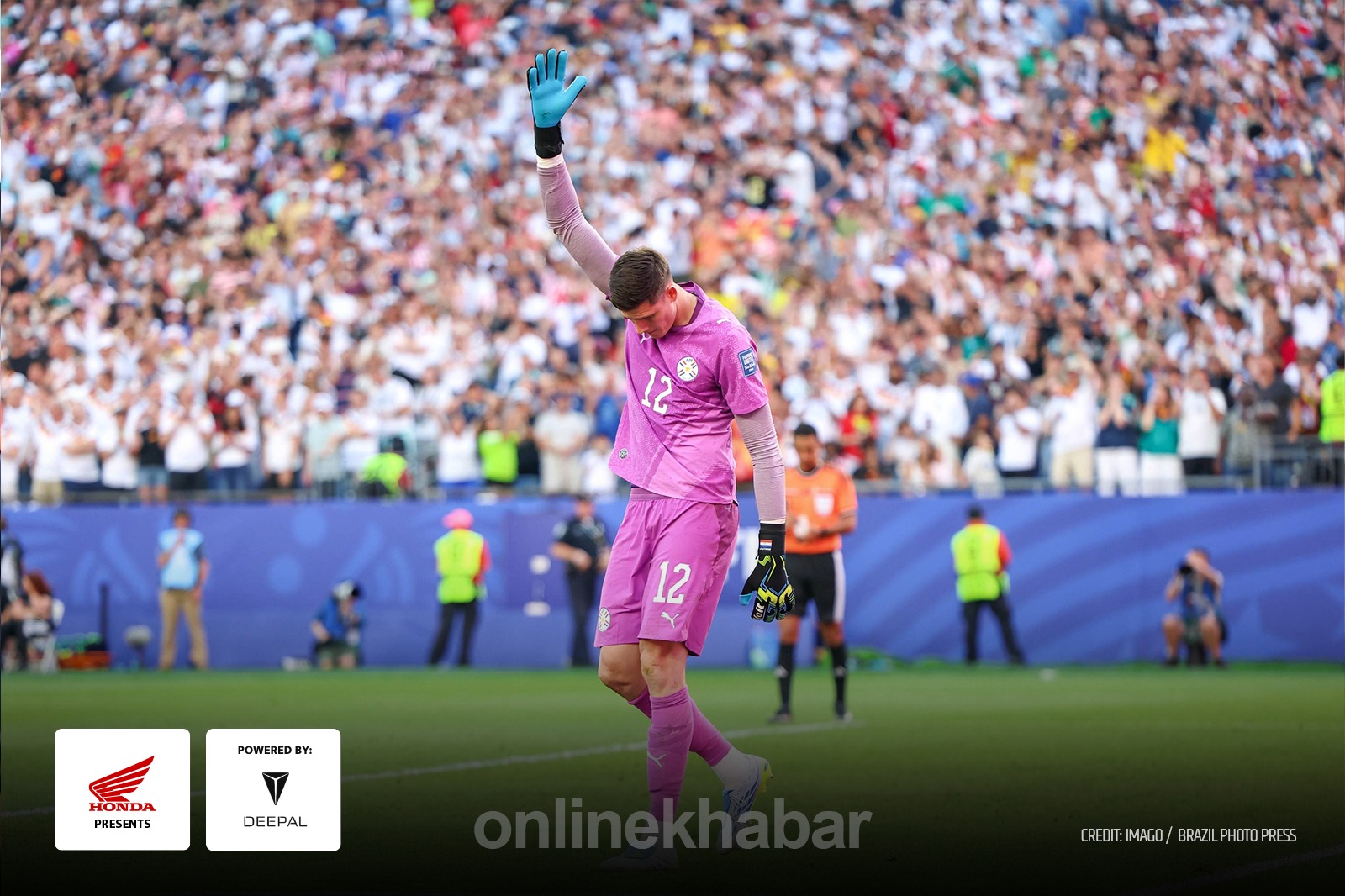
Paraguay’s goalkeeper Orlando Gille saved penalties from Kai Havertz and Nik Waltemade, while Jonathan Tah’s shot hit the post.
After the first five penalties, the score was tied 3-3, with both goalkeepers saving two shots each. In the sixth round, Germany’s Jonathan Tah missed narrowly over the post, and Jose Canale then scored the decisive penalty for Paraguay.
Julio Insuso scored first for Paraguay in the 42nd minute to give his team the lead, while Kai Havertz equalized for Germany in the 54th minute. Jonathan Tah’s goal during the 102nd minute of extra time was disallowed after VAR review due to a foul on an opposing player.
Since winning the 2014 Brazil World Cup, Germany has not won any knockout stage matches. Having been eliminated in the group stage in the last two World Cups, this marked Germany’s return to the knockout round after 12 years, but they were ousted in their first match.
This is Paraguay’s second win in a World Cup knockout match. In the 2010 Africa World Cup, Paraguay defeated Japan on penalties in the Round of 16, advancing to the quarterfinals where they lost to Spain. This time, Paraguay progresses by defeating a former champion in their first knockout match.
Japan has taken a one-goal lead against Brazil. In the 29th minute of the match, Kaisu Sano scored the goal for Japan. He advanced alone from the center of the field and successfully netted an excellent goal. June 29, Kathmandu.
In the Round of 32 match of the FIFA World Cup 2026, Japan has established a lead against Brazil. The game is being held at the Houston Stadium in the United States, where Sano has scored his first goal. Sano currently plays for the German club Mainz 05.
Nepal Rastra Bank has swiftly taken corrective action against half a dozen microfinance institutions, including Arambha Chautari, Ganpati, Samudayik, Nerude, and CYCS, for failing to maintain the minimum capital fund ratio. The central bank has cautioned the chief executive officers of these microfinance institutions for incorrectly showing loan loss provisions as income, which violates regulations.
The bank also warned the board of directors of Dhaulagiri Microfinance for non-compliance with financial regulations in vehicle purchases and errors in employee reinstatement. Kathmandu, 15th Ashar — Nepal Rastra Bank has implemented swift corrective measures against six microfinance financial institutions. Those under scrutiny include Arambha Chautari, Ganpati, Samudayik, Nerude, and CYCS microfinance institutions.
According to the bank, Arambha Chautari maintained a minimum capital fund ratio of only 7.77 percent as of the end of Ashar 2082. Since this ratio falls below the regulatory requirement, the institution has been subjected to action under the Bank and Financial Institution (Swift Corrective Action) Regulations, 2074. Microfinance institutions are mandated to maintain an 8 percent capital fund.
Similarly, Ganpati Microfinance Financial Institution faced sanctions for failing to maintain the capital fund requirement. By the end of Ashoj 2082, the institution maintained a capital fund ratio of merely 6.06 percent, resulting in corrective action. Samudayik Microfinance Financial Institution was also penalized after maintaining only 6.12 percent capital fund ratio as of the end of Ashar 2082.
In the Round of 32 match of the FIFA World Cup 2026, Japan has taken a 1-0 lead over Brazil by the end of the first half. Japan’s Kaisu Sano scored the solitary goal in the 29th minute by advancing the ball alone. He intercepted a missed pass in the midfield by Brazilian players and pushed forward to net the goal. Sano’s long-range strike was unstoppable for Brazil’s goalkeeper Alisson Becker.
The five-time world champions Brazil are striving to equalize the score but have been unsuccessful up to the halfway mark. Japan’s goalkeeper Zion Suzuki has delivered an outstanding defensive performance in the first half. June 29, Kathmandu.
The government aims to complete the cost estimation and tender preparation for the upcoming fiscal year 2078/84’s budget and programs by the end of Ashad.
A meeting chaired by Chief Secretary Suman Raj Aryal instructed all ministries to complete organizational and management surveys within the designated timeframe.
Decisions were made to promptly proceed with the auction of government materials damaged during the protests in Bhadra and to advance the audit process of entities pending examination, in accordance with the law.
June 29, Kathmandu — The government has set a target to finalize the budget, cost estimates, and tender preparations for the upcoming fiscal year 2078/84 by the end of Ashad (mid-June).
This decision was made during the secretaries’ meeting held on June 16. According to the Office of the Prime Minister and Council of Ministers, the meeting chaired by Chief Secretary Suman Raj Aryal agreed on this to ensure effective implementation of the budget and programs.
The meeting also directed all ministries to complete organizational and management surveys of their subordinate bodies within the specified deadlines.
The secretaries’ meeting decided that government vehicles, furniture, and equipment damaged by arson or other means during the protests on September 8 and 9 must be either auctioned or disposed of according to existing laws. Responsible entities must complete this process and remove such items from the office premises by June 29.
All ministries, departments, and institutions are instructed to give high priority to the prompt resolution of outstanding audit-related cases highlighted in the Office of the Auditor General’s 63rd annual report. Mandatory weekly progress reports must be submitted to the Office of the Prime Minister and Council of Ministers and the Outstanding Case Follow-up Committee.
The meeting further resolved that entities affected by arson during the September protests and those yet to be audited will coordinate with the Audit Office to complete audits swiftly, in accordance with the law. Additionally, the government will expedite the registration of bills for drafting and amending laws listed in the 100-point governance reform agenda with the federal parliament.
Midfielder Casemiro scored a header in the 56th minute to level the match.
News Summary
Reviewed Content.
In the FIFA World Cup 2026 Round of 32 match, Brazil equalized against Japan.
Midfielder Casemiro scored a header in the 56th minute to bring the game level.
Earlier, Japan’s Kaisu Sano had scored in the 29th minute to give his team the lead.
June 28, Kathmandu – In the FIFA World Cup 2026 Round of 32 match, Brazil fought back to equalize against Japan in the second half.
The match, held at Houston Stadium in the United States, saw Brazilian midfielder Casemiro score a headed goal in the 56th minute. Casemiro connected with a cross from Gabriel Magalhães to level the score.
Brazil trailed by one goal after the first half but applied continuous pressure on Japan from the start of the second half. However, Japan’s goalkeeper Zion Suzuki made several outstanding saves to deny Brazil an earlier equalizer.
Casemiro’s goal not only equalized the match but also made him the second oldest Brazilian player to score in a World Cup. He was 34 years and 126 days old when he scored. The previous record was held by Bebeto, who scored against Denmark in 1998 at 34 years and 137 days.
Earlier, Brazilian player Danilo assisted Bruno Guimarães, whose header in the 52nd minute was brilliantly saved by Japan’s Suzuki.
Additionally, in the 54th minute, a shot by Casemiro was cleared off the goal line by a Japanese defender.
Japan’s lead came earlier, in the 29th minute, when Kaisu Sano capitalized on a misplaced pass by a Brazilian player in midfield. Sano advanced the ball alone towards the goal and scored with a powerful shot that Brazilian goalkeeper Alisson Becker could not stop.
This was Sano’s first international goal for Japan, and he currently plays for the German club Mainz 05.
A recent operational review reveals that total savings in the cooperative sector have decreased by nearly one trillion Nepali rupees, limiting the amount to NPR 1.029 trillion as of Falgun in the current fiscal year. The Cooperative Department and COPOMIS data inconsistencies have made it difficult for the commission to ascertain the official number and details of cooperative institutions. Alongside declines in savings and loan investments, the department noted a reduction of approximately 800,000 cooperative members over eight months.
June 29, Kathmandu – Total savings in the cooperative sector dropped by nearly NPR 100 billion by Falgun this fiscal year. As of last Ashad (mid-July), total savings stood at NPR 1.1 trillion but fell by roughly NPR 100 billion in eight months. The Cooperative Department reported that total savings at the end of Ashad of the previous fiscal year were NPR 1.125 trillion, while by the end of Falgun in the current fiscal year, it declined to NPR 1.029 trillion.
However, the reliability of data available in the Cooperative and Poverty-related Information System (COPOMIS) is diminishing. The commission examining irregularities in the cooperative sector clarified that COPOMIS does not provide dependable and credible data.
“About eight years have passed since the operation of COPOMIS began, yet it has failed to provide reliable and trustworthy data,” the commission’s report states. “If one relies on COPOMIS data, even the exact number of cooperative institutions cannot be confirmed.”
Officials highlighted discrepancies within the Cooperative Department’s provided figures as well. According to the department, the number of cooperatives registered by province each fiscal year totals 36,942. However, files submitted to various federal and provincial entities after federalism implementation indicate 34,710 cooperatives, while COPOMIS shows 41,187 as of fiscal year 2081/82.
The report concludes, “This shows there is no verified figure available for the number of cooperative institutions. It is necessary to manage data to ensure accuracy.”