Author: space4knews

अनलाइनखबर ‘५० प्रभावशाली महिला २०८२’ को सूची सार्वजनिक

OnlineKhabar Releases List of ’50 Influential Women 2026′ in Nepal

Summary

Reviewed.

  • OnlineKhabar has released the list of ’50 Influential Women 2026′, featuring women from politics, society, arts, youth, science, entrepreneurship, and diaspora.
  • The selection panel, led by former Supreme Court Justice Mira Khadka, chose 50 women on January 22 from over 700 nominations.
  • Editor-in-Chief Basanta Basnet highlighted the list as recognition of women not only for their beauty but as creators of struggle and success.

March 6, Kathmandu – OnlineKhabar.com has published Nepal’s “50 Influential Women 2026” list. Traditionally released ahead of International Women’s Day (March 8), this year’s launch was slightly delayed due to the recent general elections (February 21) and national commitments, Editor-in-Chief Basanta Basnet noted.

The list represents 50 determined and hardworking women from diverse fields including Nepali politics, society, arts and literature, culture, youth and sports, knowledge and science, entrepreneurship, and the diaspora.

Selection Process Explained

Prior to finalizing the list, OnlineKhabar issued a public call for nominations. Over 700 names were received from the central news desk in Kathmandu, correspondents across all seven provinces, experts from various sectors, and other sources.

From these submissions, a preliminary list of more than 460 candidates was compiled. Considering geographic and social diversity, the news desk prudently narrowed this to 200 names, and then further to 116 women based on their contributions, influence, and inspiration. This refined list was presented to the selection panel.

The final selection jury was chaired by former Supreme Court Justice Mira Khadka. Other jury members included Barsha Shrestha, Business Head of ICRA Nepal and banking expert; Shiv Gaunle, former president of the Nepal Federation of Journalists and former Editor-in-Chief of OnlineKhabar; and Basanta Basnet, Editor-in-Chief of OnlineKhabar. The entire coordination was managed by Associate Editor Sudarshan Khatri from the news desk.

On January 22, the jury convened and selected 50 women primarily based on their individual contributions and social impact. Alternative candidates were prepared in case some nominees could not be contacted or their information was found inaccurate. In the final list, 3 women from this alternate list replaced 3 others due to these issues.

“Success Measured by Distance Traveled, Not the Destination”

Chairman of OnlineKhabar Pvt. Ltd., Dharma Raj Bhusal, explained the main goal of the ’50 Influential Women’ selection is to recognize and honor the contributions of women active in various social fields and preserve their distinct leadership as a national achievement in the public record.

Bhusal emphasized that today’s media responsibility extends beyond revolving around power centers to highlighting stories of common people’s sweat, struggle, and dedication in the mainstream.

He clarified that the women chosen are not those who shone through power but those who broke barriers with intellect and struggle, adding, ‘Our society has long tried to portray women merely as victims, but these 50 faces have completely overturned that notion.’

“Symbols of Dedication and Struggle”

Editor-in-Chief Basnet said it is incorrect to confine women to mere symbols of beauty.

“This is the third time OnlineKhabar has published the list of 50 influential women. Women are often portrayed only as icons of beauty and subjects of songs and poetry,” he said. “However, these 50 influential women have proven that women represent dedication and struggle and are true creators of success.”

He added, “As a jury member, I can say that among the 700-plus nominations, at least 400 names genuinely deserve respect.”

While congratulating all women active in social transformation but not included in the list, Basnet affirmed the commitment to include new faces in future editions.

Referring to the recently concluded elections, he noted, “An exceptional aspect this year was that many newly elected parliamentarians had applied for the 50 Influential Women list. Those applications remain safely preserved.”

He added, “But you deserve congratulations because the nation has honored you as representatives of the people.”

This is the third edition of OnlineKhabar’s ’50 Influential Women’. Additionally, the outlet annually publishes lists of ’40 Under 40′ young achievers across various fields on International Youth Day.

Also See—

Why 50 Influential Women?

Stock Market Rises by 83 Points, Hydropower Sector Sees Highest Gains

The stock market rose by 83.33 points on Monday, bringing the NEPSE index to 2,760 points. Finance Minister Swarnim Wagle urged the public not to spread unnecessary panic in the market and assured that the government is committed to making the upcoming budget transformative. Share prices of 264 companies increased, with all sectoral indices showing growth. The hydropower group recorded the highest surge of 4.59 percent.

Kathmandu, 23 Chaitra – After falling by 105 points the previous day, the stock market rebounded with an increase of 83.33 points on Monday. This recovery brought the NEPSE index back to 2,760 points. At 2:30 PM, the index hit its peak for the day, rising 98 points to reach 2,775. Following the significant decline the previous day, Finance Minister Swarnim Wagle spoke with officials from the Stock Brokers Association of Nepal, emphasizing that unnecessary fear had spread through the market.

The Finance Minister reiterated the government’s commitment to making the upcoming budget transformative and assured that necessary steps will be taken to ensure transparency among market stakeholders. This message was intended to alleviate excessive market concerns. During a meeting with officials from the Economic Journalists Society (SEJAN), he clarified that market reforms are underway in accordance with the manifesto of the Rashtriya Swatantra Party (RASWAP) and that progress is being made in the NEPSE restructuring. The minister’s confidence appears to have positively influenced market sentiments. However, trading volume declined somewhat, with turnover dropping from NPR 1.238 billion the previous day to NPR 1.092 billion on Monday.

Prices increased for shares of 264 companies on Monday, while three to four companies saw declines, and one remained unchanged. All sector indices rose, with the hydropower sector leading at a 4.59 percent increase. Other notable gains included the finance sector by 4.03 percent, banking by 3.18 percent, development banks by 3.63 percent, hotel and tourism by 3.24 percent, investment by 3.33 percent, life insurance by 2.66 percent, manufacturing and processing by 1.53 percent, microfinance by 2.43 percent, non-life insurance by 2.94 percent, others by 2.36 percent, and trade by 2.40 percent. Eight companies recorded share price increases of up to 10 percent. These include Upakar Laghubitta, Ridi Power, National Hydropower, Bhujung Hydropower, Super Khudi Hydropower, Rizline Energy, Suryakund Hydro Electric, and Hotel Forest. Corporate Development Bank’s shares rose by 9.88 percent, Shivshree Hydropower by 9.55 percent, and Himal Dolakha Hydropower by 9.18 percent.

Despite Reliance Spinning Mills having surged by 10 percent the previous day, increased selling pressure caused its price to fall by 1.60 percent on Monday. The most actively traded companies included Reliance Spinning Mills, Himalayan Reinsurance, NRN Infrastructure, AP Power, and Ridi Power.

44 Climbers Granted Permits for Dhaulagiri and Annapurna Mountain Expeditions

March 6 (23 Chaitra), Myagdi. This spring season, 44 climbers have been granted permits to scale the Dhaulagiri and Annapurna mountain ranges. They have received official permission to ascend Dhaulagiri, which stands at 8,167 meters in Dhaulagiri Rural Municipality-4, Myagdi, and Annapurna, which is 8,091 meters tall, located in Annapurna Rural Municipality-4.

According to the Department of Tourism, 17 climbers, including 8 women divided into two groups, have obtained permits to climb Dhaulagiri. For Annapurna, four groups comprising 27 individuals, including 8 women, have secured climbing permits as per the latest official report. Sharmaila Banjade, Branch Officer of the department, stated that the revenue generated from Dhaulagiri climbing permits amounts to NPR 7,564,650, while Annapurna climbing permits have generated NPR 12,049,175.

She further explained that during the spring season, 170 climbers across 24 groups obtained permission to ascend 12 mountains, including Annapurna and Dhaulagiri, generating a total revenue of NPR 108,730,000. The number of climbers applying daily is increasing steadily. In the previous autumn season, 36 climbers received permits for Dhaulagiri, while no permits were issued for Annapurna. Last spring, two groups totaling 15 climbers obtained permits for Dhaulagiri, and 66 climbers had permits for Annapurna expeditions and were in preparation. Climbing teams have already reached the base camps of Annapurna and Dhaulagiri and are actively preparing for their ascents. –Rastriya Samachar Samiti

ओली र लेखकमाथि बिहीबारसम्म अनुसन्धान सक्न सर्वोच्चको आदेश, अन्यथा थुनामुक्त गर्नू

Supreme Court Orders Completion of Investigation Against Oli and Lekhak by Thursday

Chaitra 23, Kathmandu: The Supreme Court has directed that the investigation against former Prime Minister KP Sharma Oli and then Home Minister Ramesh Lekhak be completed by Chaitra 26 (Thursday). The bench comprising Justice Binod Sharma and Justice Sunil Kumar Pokharel rejected the demand to keep Oli and Lekhak in custody. However, the Supreme Court ordered their release from custody until the investigation is completed by Chaitra 26.

The court stated, “Oli and Lekhak shall be released from detention according to criminal procedure to complete further investigation and carry out any necessary subsequent actions.”

Oli and Lekhak were arrested on Chaitra 14 in connection with allegations of excessive use of force resulting in 19 deaths during the Janajivi Movement on Bhadra 23. They have been held in custody under a murder case with permission from the Kathmandu District Court.

Finance Minister Dr. Swarnim Wagle Unveils Book ‘Perspective: Years of Debate on Prosperity, Inequality, and Reform’

The Nepal Economic Journalists’ Society (SEJAN) has released a book by Finance Minister Dr. Swarnim Wagle titled Perspective: Years of Debate on Prosperity, Inequality, and Reform. The book was launched by Minister Wagle during an event held on Monday at the Ministry of Finance. It features eight in-depth essays highlighting debates supporting past economic reforms.

The book covers Nepal’s economic landscape from 2014 to 2025 (Bikram Sambat 2071 to 2082), focusing on structural reforms, digitalization, clean energy, and tourism as key growth drivers. Finance Minister Wagle remarked, “The agendas for economic reform raised in the past are captured in this book. Many ideas previously proposed by experts for reform went unheard.” He expressed commitment to advancing reforms and said, “Now, having entered politics, I am in an executive role to implement those very agendas.”

Serious topics explored in the book include trade costs among South Asian countries, economic empowerment under federalism, the end of patronage-based capitalism, and the changing nature of international aid. It also addresses Nepal’s productivity challenges, emphasizing that “piecemeal changes are insufficient; broad structural reforms are essential.”

SEJAN President Bhagwat Bhattarai stated that the main objective of publishing this book is to convey the Finance Minister’s vision and approach toward Nepal’s economy to the general public and stakeholders. Furthermore, he noted that this work will assist journalists in evaluating the minister’s policies and performance.

Committee Formed to Study Land Status Within Four Forts of Phewa Lake

The government has established a five-member investigation committee under the Ministry of Land Management to clarify the current condition of land within the four forts of Phewa Lake. The committee will collect accurate records of all land parcels in the Phewa Lake area and submit a report within seven days. March 23, Kathmandu.

The Ministry of Land Management, Cooperatives and Poverty Alleviation formed the five-member committee chaired by the Director General of the Department of Land Management and Records. The committee will study the present condition of land and existing structures within the boundaries of the four forts of Phewa Lake and undertake detailed documentation of all land parcels within the lake area.

The ministry stated that a comprehensive study will be conducted on the status, registration, and utilization of both private and government land within the lake area. The committee is formed to enhance the protection and management of the Phewa Lake region. It has been given seven days to prepare and submit a detailed report including verified information on all land plots within the lake’s domain. Recently, after Prime Minister Balen Shah expressed concern for the conservation of Phewa Lake, Pokhara Metropolitan City launched a campaign to clear encroachments from the Phewa Lake area.

कामु प्रधानन्यायाधीश मल्ल – Online Khabar

Acting Chief Justice Sapana Pradhan Malla Highlights the Importance of Women’s History and Inclusion

March 6, Kathmandu – Acting Chief Justice of the Supreme Court, Sapana Pradhan Malla, emphasized that although women have made history, they have not been accorded their rightful place in it. Speaking at the ’50 Influential Women 2082′ event organized by OnlineKhabar, she noted that such programs break the silence surrounding these overlooked contributions. “For many years, women have contributed to our society, yet history has not recognized their place,” she said. “Their voices and contributions have never been sufficiently acknowledged. Events like this shatter the silence that history tends to maintain.”

Furthermore, she asserted that inclusion is not a favor or a gift but a constitutional right for all. “Inclusion is not a gift; it is a provision guaranteed by our Constitution that acknowledges the existence of equality,” she added. “However, change is only possible through courageous steps, and this initiative serves as a prime example.” She expressed gratitude for the event organized by OnlineKhabar for playing a significant role in bringing to light the courageous stories of women.

Labor Ministry Warns of Action Against Employers Denying Minimum Wage and Benefits to Trained Workers

The Ministry of Labor, Employment and Social Security has urged employers to provide minimum wage and social security benefits to trained workers as per the Labor Act 2074. Following complaints that trained workers in various hospitals, schools, and institutions are being denied these facilities, the ministry has issued a warning to employers. Strict action and penalties will be imposed if the law is violated, and all stakeholders are urged to fully comply with legal provisions. Kathmandu, 23 Chaitra.

The ministry’s statement notes that complaints have been received regarding trained workers in hospitals, health institutions, private and institutional schools, and other establishments not receiving minimum wage and other benefits. Employers have been cautioned accordingly. Section 18, Subsection (3) of the Labor Act 2074 clearly mandates that trained workers must be provided with minimum wage, sick leave, allowances, provident fund, insurance, and other social security benefits.

However, complaints continue to be registered with the ministry from trained workers such as healthcare professionals, nursing staff, teachers, and employees in various institutions, who report not receiving these benefits. The ministry has expressed serious concern over this issue. Employers have been warned to strictly adhere to minimum wage and social security provisions in accordance with the law. The ministry has also made it clear that penalties will be imposed if benefits are denied in violation of the law. All related institutions, organizations, and stakeholders are urged to fully comply with legal requirements.

Bagmati Chief Minister Baniya Says He Has No Information About Power-Sharing Deal with UML

March 6, Hetauda – Bagmati Province Chief Minister Indrabahadur Baniya has stated that he has no knowledge of any power-sharing arrangement previously made between the Nepali Congress and the Communist Party of Nepal (UML) regarding the alternating chief ministership. While the UML, a coalition partner, has recently raised the issue of leadership transfer based on an earlier agreement with Congress, Chief Minister Baniya expressed his unfamiliarity with the matter.

“I am not aware of any power-sharing deal. The party leadership is also unaware of such information,” Baniya stated during an interaction with journalists at the Chief Minister’s office on Monday. “Here we have ministers from both Congress and UML, but even they do not have knowledge of this.”

Last year in Shrawan (July-August), when the Congress and UML formed a joint government, an agreement was made to alternate the chief ministership every 20 months. At that time, Bahadur Singh Lama, a leader from Congress supported by UML, was appointed Chief Minister. According to Congress MPs aligned with Lama, there was an understanding that UML parliamentary party leader Jagannath Thapaliya would assume leadership after Lama. Thapaliya has been advocating for a leadership transfer after Falgun (February-March) in line with this prior agreement.

However, one year into Lama’s tenure, Indrabahadur Baniya, who had secured majority support within the Congress parliamentary party, filed a no-confidence motion to remove him. Following internal party disputes during the fiscal year 2081/82 budget, Baniya gained majority support among other MPs and with backing from then party chairman Sher Bahadur Deuba, displaced Lama and assumed the chief minister position himself. Baniya took office on Shrawan 20, 2082 (early August 2025).

On Shrawan 9, 2082, 21 MPs led by Baniya filed a no-confidence motion against Lama. On Shrawan 13, the vote resulted in 22 in favor and 15 against the motion, causing Lama to lose his position as parliamentary party leader. Subsequently, on Shrawan 14, Baniya won the party leadership election, paving the way for him to become chief minister. Previously, on Poush 13, 2079 (late December 2022), Baniya had been defeated by Lama by 5 votes in the party leader election.

दुई दिने सार्वजनिक बिदाको तेस्रो प्रयास कति प्रभावकारी होला ?

Evaluating the Effectiveness of the Third Attempt to Implement a Two-Day Public Holiday

March 23, Kathmandu – Due to the conflict between the United States and Iran and the resulting fuel crisis, the government has declared a two-day public holiday. As part of a strategy to extend office hours and reduce working days from six to five per week, the government announced a change in office hours starting today (Monday). According to government spokesperson and Education Minister Sasmita Pokharel, offices except educational institutions will operate from 9:00 AM to 5:00 PM. She stated, “Office hours except for educational institutions are set from 9 AM to 5 PM.”

In Nepal, the standard workweek in public and service sectors is 40 hours, previously allocated as 7 hours daily with 5 hours on Friday. The new policy mandates 8 hours per day for five days a week. Following the government’s decision, courts nationwide have also announced opening hours from 9:00 AM starting Monday. Security agencies and other official services will adjust their schedules accordingly. The private sector has committed to revising their schedules as well, though clear directives for educational institutions and informal sector workers remain pending.

This is the second time in three decades that such an initiative has been attempted. Historical records show that this is Nepal’s third attempt at instituting a two-day public holiday, with prior efforts being unsuccessful for various reasons. In 1991, the Administrative Reform Commission recommended adopting a five-day workweek to improve employee productivity and manage traffic. The government led by Congress leader Krishna Prasad Bhattarai introduced this system in 1999, initially limited to the Kathmandu Valley, and it lasted approximately two years to enhance service delivery and facilitate citizens.

Again, in 2022, under Prime Minister Sher Bahadur Deuba, the two-day holiday was reinstated with offices operating from 9:30 AM to 5:30 PM starting May 15. It was introduced amid trade deficits and foreign currency shortages, aiming primarily to reduce fuel consumption. However, this arrangement proved ineffective within a month. While many countries have maintained a two-day weekly holiday for years, Nepal typically adopts it as a crisis response measure.

The government’s current implementation of a two-day public holiday appears directly linked to ongoing fuel shortages and traffic congestion. Earlier in 2020, the Ministry of Tourism had studied the possibility of introducing two-day public holidays to revive the economy and boost domestic tourism post the COVID-19 pandemic. Led by Joint Secretary Kamal Prasad Bhattarai, the working group prepared a report revealing that out of 127 countries, 115 observe a two-day weekend, and 91% of these maintain a 40-hour or lower weekly work schedule.

Previously, Nepal’s centralized system forced citizens from remote areas to travel to administrative centers to access services, which has since decentralized, allowing most services to be available locally. The committee concluded that introducing a two-day public holiday would not disrupt service accessibility as it once might have.

Based on the 2020/21 budget, the committee estimated annual savings of approximately NPR 165 million from reduced expenditures due to two-day holidays. Their study also suggested that such holidays help reduce family stress, provide adequate rest and entertainment, increase productivity, and encourage domestic tourism. Approximately 500,000 public service, military, police, and private school employees and their dependent families, totaling about 2.5 million people, would benefit from increased family time. The report also forecasted that if around 800,000 people took short trips locally, it would positively impact internal tourism and the economy.

The committee claimed that two-day public holidays would have three main positive effects: enhanced productivity among employees and offices, cost savings, and support for domestic tourism. Furthermore, the study highlighted that two-day holidays could promote gender equality and facilitate balanced family life. It recommended that public sector organizations implement a two-day workweek and encouraged the private sector to adopt similar practices.

Nepali Workers in Saudi Arabia Face Wage Withholding and Denial of Repatriation

Summary

Prepared for review.

  • Over 50 Nepali workers employed at Hussein Bin Ali Ateef in Riyadh, Saudi Arabia, have reported not receiving wages for five to six months and are seeking rescue.
  • The victims have stated that the company has denied them food, accommodation, and even water, imposed irregular work schedules, and issued threats.
  • Complaints lodged with Nepal’s manpower agencies, local agents, and the embassy have not resolved the issues, prompting the workers to post videos on social media to raise awareness.

March 6, Kathmandu – Nepali workers employed at Hussein Bin Ali Ateef in Riyadh, Saudi Arabia, are currently facing severe difficulties. These workers, recruited through manpower companies including Nepal Life Recruitment based in Gaushala, Kathmandu, arrived in Saudi Arabia almost two years ago but are now encountering significant problems.

They have been demanding assistance due to the company’s consistent failure to provide wages, food, and accommodation. Over 50 Nepalis, engaged under two-year labor contracts to work in building construction, have been enduring these hardships.

Despite working in temperatures reaching 50 degrees Celsius, the contractor has withheld their wages, barred them from work, and failed to provide even basic necessities like food and water. The workers report not being paid for five to six months. Those affected told the media that both the manpower agencies and the contracting company, present in Nepal and Saudi Arabia, have exacerbated the issues.

One victim said the company has not paid wages for five to six months and has provided no food or lodging. “Some individuals are owed three months’ wages, others four, and some six months. Although we repeatedly pressured the company to pay, they only promised to do so but never delivered. They assign work but do not pay,” he explained.

The workers reported that the company often assigns work for only one month, then suspends them from work the following month, and deducts wages during such leave periods. “We are told not to report to work and are placed on leave, yet when on leave, our wages are cut,” they stated. While some workers receive 400 or 600 Riyals monthly, they are supposed to be paid 1500 Riyals per month. “How can one feed oneself or support family with only 600 Riyals?” they questioned.

The company claims to have provided free visas, but the workers have incurred expenses exceeding 200,000 Nepali Rupees. „We came with debts as high as NPR 225,000, yet the company claims the visas are free,” the victims disclosed.

Before departure, manpower agencies and local agents in Nepal promised a 10-hour workday, including 9 hours of work and 1 hour of rest. However, the workers revealed that on workdays they often work the full 10 hours without any overtime payment.

“No matter how much overtime we complete, no payment is made. The commute between living quarters and the worksite takes 2 to 3 hours, so on workdays, we often spend 12 to 16 hours including travel,” one worker reported.

The victims stated they have not received any response to their complaints filed with manpower companies in Nepal and Saudi Arabia, local agents, or the Nepali embassy. Frustrated, they posted videos on social media to expose their situation, after which the company allegedly increased pressure on them.

“Unable to get attention otherwise, we were forced to make a video and post it on social media. For over a month, not even breakfast has been provided,” they said.

They have not been assigned work for the past 15 days, and despite asking to be sent home, were threatened they could not leave before completing the full two years of their contract. “We are threatened with beatings or worse and forced to complete the two years at all costs,” the workers said. All Nepali employees in the company reportedly face similar problems and threats when they try to voice concerns.

“We have not been given breakfast for over a month. When work stopped, both breakfast and meals were discontinued,” they added.

Some victims have not been paid for five months, while others have gone four to six months without wages. “We are forced to use the mosque restroom because the company has locked the toilets with tablets,” they claimed.

Another victim from Itahari, who arrived through Mobira Overseas, said manpower and agents have ignored their pleas. Coming with debt and leaving family behind for work, they face threats and punishments when seeking fair wages and conditions.

“The idea was to send money back to support our children’s education and provide good food and clothes, but instead, we face penalties. After working two days, we get four days leave,” he stated.

Additionally, the workers reported that sick employees are denied treatment and that promises of health insurance have yet to be fulfilled.

Nepali Congress UML Instructs Committees to Actively Collect Voter Lists

Chaitra 23, Kathmandu – The Communist Party of Nepal (Unified Marxist-Leninist) has directed its subordinate committees to remain active in the collection and updating of voter lists as part of preparations for the upcoming local and provincial assembly elections. The Election Commission announced that the voter list collection process resumed from Chaitra 22. Additionally, the Election Office has issued official letters to all municipal and ward committees, instructing them to undertake the necessary actions regarding this matter.

Artemis II: Communication Blackout for Astronauts Orbiting the Moon

New image of Earth taken last week from the Orion capsule

Photo source, Nasa/Reid Wiseman

Photo caption, New photo of Earth taken last week from the Orion capsule

Astronauts on the Artemis mission will travel farther from Earth than ever before.

They are millions of miles away and see Earth as a small sphere. Although they have been in constant contact with the control center in Houston, Texas, the NASA team’s communication has not felt like the warmth of home to them.

However, this communication will soon be disrupted.

On Monday night at 23:47 BST (Tuesday 04:32 Nepal time), when the spacecraft orbits behind the Moon’s surface, communication between the spacecraft and Earth will be interrupted.

The Moon will block radio and laser signals for about 40 minutes. The four members of the Artemis crew will spend roughly 40 minutes alone in the darkness of space.

संसद्‌मा सभामुख र सांसदहरूलाई समान कुर्सी – Online Khabar

Equal Seating Arrangements for Speaker and MPs in Parliament

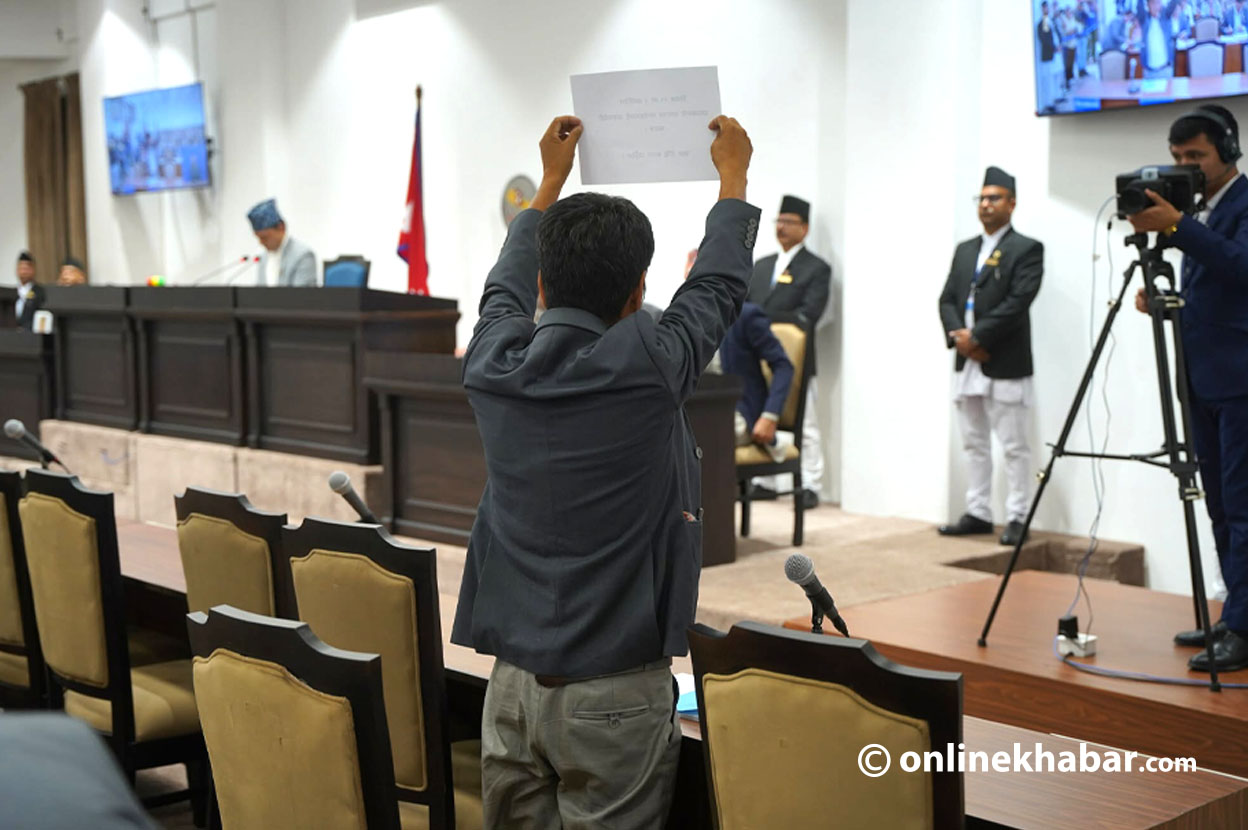
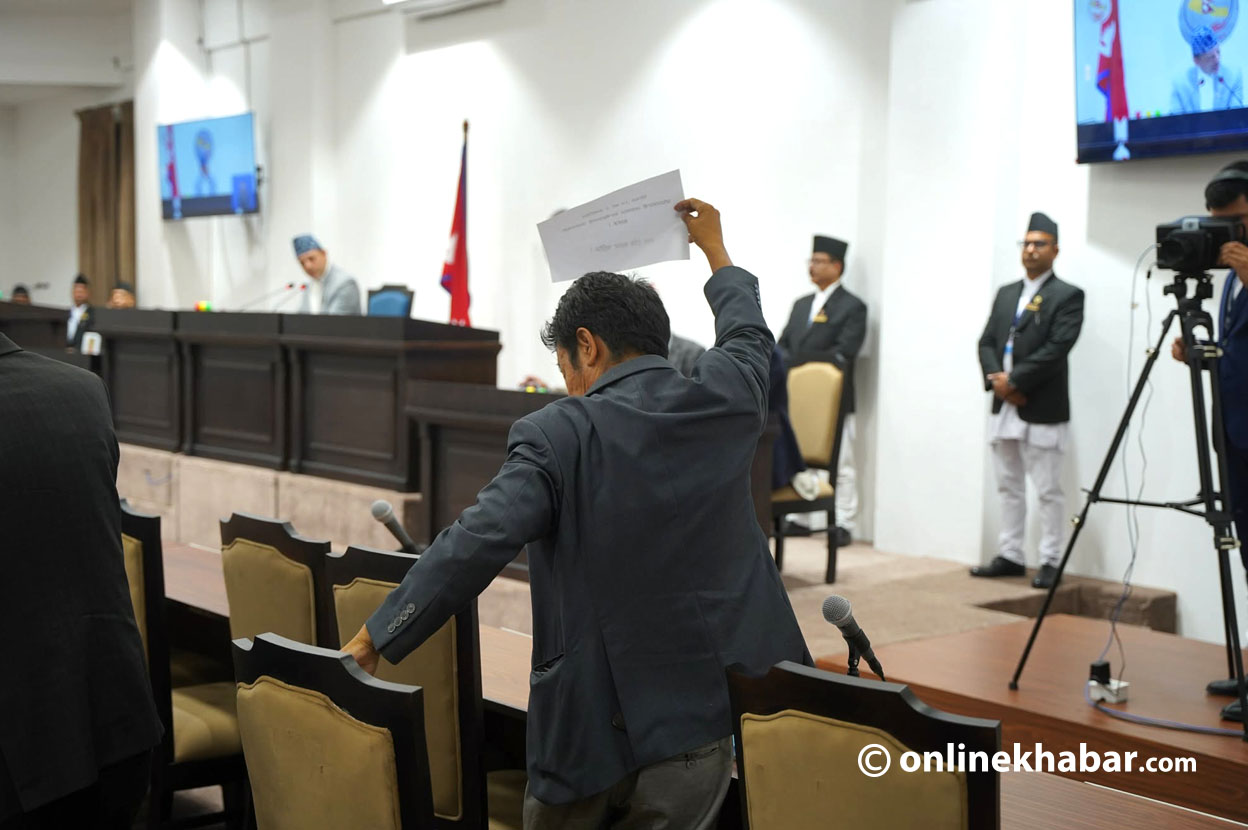
Summary prepared after an academic review. Following the suggestion of Speaker Dol Prasad Aryal, the House of Representatives has arranged identical chairs for the Speaker and members of parliament (MPs) in the assembly hall. During Monday’s session of the House of Representatives, a 21-member Parliamentary Procedure Advisory Committee was formed. Additionally, a 15-member House Rules Drafting Committee was established under the chairmanship of Rastriya Swatantra Party MP Ganesh Parajuli. Kathmandu, 23 Chaitra.

Previously, the Speaker was provided with a distinctive type of chair in the House of Representatives hall. Before the recent Speaker election, different types of chairs were again placed for the Speaker and MPs. However, with the arrival of Speaker Dol Prasad Aryal, identical chairs have been provided for both the Speaker and MPs. According to Ekram Giri, Deputy Secretary and spokesperson of the Federal Parliament Secretariat, “After the Speaker requested arrangements for uniform chairs, chairs of the same type but with different colors were arranged for the Speaker and the MPs.”

During the Monday session, the House of Representatives formed two separate committees. A 21-member Parliamentary Procedure Advisory Committee was constituted, including Achutam Lamichhane, Apsana Banu, Aren Rai, KP Khanal, Kamini Chaudhary, Krantishikha Dhital, Khushbu Oli, Ganesh Singh Thagunna, Guru Prasad Baral, Gangalaxmi Awal, Tapeshwar Yadav, Devaraj Pathak, Narendra Kumar Kerung, Prakash Chandra Pariyar, Nisha Dangi, Bodhnarayan Shrestha, Meena Kumari Yadav, Yuvraj Dulal, Rajan Gautam, Dr. Ram Lama, and Bipinkumar Acharya as members. Additionally, the House also formed the House Rules Drafting Committee consisting of 15 members under the chairmanship of Rastriya Swatantra Party MP Ganesh Parajuli. Committee members include Dr. Ojashwi Sherchan, Ain Mahar, Khushbu Oli, Khagendra Sunar, Gazala Samim Mishrani, Tapeshwar Yadav, Dhuruvraj Rai, Nisha Dangi, Nishkal Rai, Balawati Sharma, Madhu Chaulagain, Rekha Kumari Yadav, Yagnmani Nyaupane, and Sulabh Kharel. The committee’s term has been set at 14 days.

Foreign Hunters Actively Hunting 14 Naur and 10 Jharal at Dhorpatan Hunting Reserve

News Summary

  • During the second hunting season from Falgun to Baisakh at Dhorpatan Hunting Reserve, foreign hunters are actively hunting naur, jharal, and bandel.
  • This year, hunting permits have been granted for 14 naur, 10 jharal, and 13 bandel, awarded to foreign hunters through a competitive process.
  • Since 2016, the Nepal Army has been responsible for reserve security, with hunters typically spending between 3 to 3.5 million Nepali rupees.

Chaitra 23, Baglung – The second hunting season is currently underway in Dhorpatan, Baglung, with active participation from foreign tourists.

Dhorpatan is Nepal’s only hunting reserve, where foreigners focus on hunting in the high mountain blocks. This year, 14 naur and 10 jharal hunting permits have been issued, according to ranger Sagar Subedi of the Dhorpatan Hunting Reserve.

During the second hunting season from Falgun to Baisakh, many hunters are busy pursuing game in Dhorpatan, while some foreign hunters are preparing to arrive.

Ranger Subedi added that permissions have also been granted to hunt 13 bandel this season. The reserve issues permits for hunting in different blocks based on approval from the Department of Wildlife.

American citizens arriving through Global Safari Pvt. Ltd. have already hunted a naur and a jharal, and other American and Danish hunters through Himalayan Safari Nepal are currently active in the reserve, Subedi said.

Foreign hunters obtain their permits through a competitive bidding process, paying revenue to hunt naur and jharal. With the season ongoing, reserve staff and the Nepal Army are actively present alongside hunters in the hunting blocks.

During the current season, a Danish citizen arranged through Himalayan Wildlife Outfitter has received permission to hunt one naur, one jharal, and one bandel in the Fagune block.

Similarly, American, Belgian, and French nationals through Open Nepal Wildlife Safari and Trek Pvt. Ltd. have obtained permits for hunting three naur, two jharal, and one bandel in the Sundah and Seng blocks.

Likewise, Russian, African, and French hunters preparing to arrive via Nepal Travel Expedition Pvt. Ltd. have permits to hunt three naur, three jharal, and three bandel in the Ghustung block.

According to the Department of National Parks and Wildlife Conservation, organized hunting takes place in two phases annually: the first between Ashoj and Mangsir, and the second between Falgun and Baisakh. Groups including foreign hunters must complete their hunting within a specified 15-day period in their assigned blocks.

Hunters residing within the forest area are only allowed to hunt during the designated timeframe after entering the reserve. Dhorpatan has become a popular destination among foreign tourists for adventurous travel and thrilling hunting experiences.

The Department determines hunting quotas and revenue rates through electronic auctions each season.

Individuals through Global Safaris Pvt. Ltd. have received permits to hunt four naur, two jharal, and four bandel in the Sundah and Dogadi blocks for American and Danish hunters.

American hunters via Himalayan Safaris Nepal Pvt. Ltd. were permitted two naur, one jharal, and two bandel, of which one naur and one jharal have already been hunted. Additionally, a Spanish citizen through Trek and Dealers Pvt. Ltd. has permission for one jharal, one naur, and one bandel, Subedi added.

The first hunting season of the current year raised approximately 30.3 million Nepalese rupees in revenue, with revenue collection ongoing as the second season continues.

Hunters began arriving in Nepal with their equipment and supplies from the second week of Falgun. Most foreign hunters reach the hunting blocks directly by helicopter.

Established in 1987, the Dhorpatan Hunting Reserve spans the districts of Eastern Rukum, Baglung, and Myagdi, with its main office located in Dhorpatan Valley, Baglung.

During hunting expeditions, reserve staff work alongside foreign hunters, assisted by Nepalese guides. The department sets annual quotas for naur and jharal hunting.

The costs for hunting naur and jharal, block reservation, licenses, helicopter services, and accommodations amount to approximately 3 to 3.5 million Nepalese rupees per hunter.

Hunting opportunities are predominantly available to wealthy foreigners, with Nepalese citizens generally excluded from this privilege. Since 2016, the Nepal Army has been responsible for securing the reserve.

Foreign tourists often take photographs with naur after successful hunts in Dhorpatan. Photo: Dhorpatan Hunting Reserve