Beijing and Washington have reached an agreement to keep the Strait of Hormuz open. US officials had urged China to increase pressure on Iran. Chinese President Xi Jinping has clearly stated that China opposes any militarization of the strait and efforts to impose fees for its use. April 13, Kathmandu.
Beijing and Washington have agreed on the necessity of keeping the Strait of Hormuz open. According to a White House official speaking to Reuters, both sides consented to maintain this critical waterway accessible. Earlier, US authorities had publicly called on China to exert more pressure on Iran.
Since the US and Israel launched attacks on Iran on February 28, this strategic waterway has often remained closed. Similarly, as a White House official told American media, Chinese President Xi Jinping has made it clear that China opposes any attempts to militarize the strait or to levy fees for its passage.
The E-Sports Association Nepal has announced it will host the Third National E-Sports Competition on Ashad 5. The tournament will feature three game categories: Free Fire, PUBG Mobile, and E-Football. The association expects participation from over 5,000 players and teams.
Kathmandu, 31st Baisakh – Organized by the E-Sports Association Nepal (ESAN), the third edition of the National E-Sports Competition will take place during the first week of Ashad. The association made the announcement through a press release on Thursday, confirming the tournament date as Ashad 5.
According to coordinator Prakash Gharti, the competition will include the three selected games: Free Fire, PUBG Mobile, and E-Football. Qualifiers will be conducted online, while the finals will be held as an in-person LAN event. Gharti also clarified that players can participate individually in E-Football, whereas Free Fire and PUBG Mobile will be played in teams. Interested players and teams can register through ESAN’s official website.
Finance Minister Dr. Swarnim Wagle committed to accepting all suggestions and incorporating them into the budget.
He clarified that while party-affiliated organizations have been dissolved, the overall trade union movement remains ongoing.
April 14, Kathmandu – The National Assembly, where the National Independent Party lacks representation, has passed the government’s annual policy and program. Members of Parliament from the Congress, UML, and NCP had proposed individual and joint amendments to the government’s policy and program. Although some amendments were withdrawn by MPs, the majority were rejected, and the government’s policy and program was passed by a majority vote.
On behalf of Prime Minister Balendra Shah, Finance Minister Dr. Swarnim Wagle responded, leading the National Assembly to approve the policy and program. Of the opposition parties, only the UML did not participate in the voting process. Other parties cooperated to pass the policy and program.
National Assembly members had submitted personal amendment proposals, but none were approved. Despite the ruling National Independent Party’s absence, other parties extended support to the government.
President Ramchandra Paudel had presented the policy and program at the joint session of the Federal Parliament three days earlier. In the National Assembly’s Thursday meeting, Finance Minister Wagle urged members not to doubt the government’s full commitment to the federal democratic republican system.
The Finance Minister requested that everyone refrain from doubting the government’s progress. He also expressed the government’s commitment to accept all parliamentary suggestions and incorporate them into the upcoming budget.
He stated, “The government has accepted all suggestions. All written and oral opinions are shared ownership. The feedback received will be included in the forthcoming budget. The presented policy and program will prioritize budget policies and principles. We are not just changing the wheel but moving forward on the path of progress.”
Minister Wagle mentioned that good governance was a key issue raised during the election campaign, which received popular support accordingly. He also addressed questions raised by MPs regarding the dissolution of the trade union department.
He said, “We are fully committed to the federal democratic system. We have advanced governance issues. Party-affiliated organizations within government services have been dissolved. This was already mentioned in our commitment letter. However, this does not mean the entire trade union movement has been abolished, only the party-affiliated organizations have been dismantled.”
Finance Minister Wagle recalled former leaders Girija Prasad Koirala and Manmohan Adhikari acknowledging that the trade union movement emerged historically from struggles. He added, “We respect the overall value of the trade union. This matter is currently under judicial consideration, and we are a party that believes in social liberal democracy.”
After the policy and program was tabled for decision, the UML announced it would not participate in the voting process.
April 14, Kathmandu – The United States and China have reached an agreement to prevent Iran from developing nuclear weapons. During the summit held in Beijing, President Donald Trump of the United States and President Xi Jinping of China agreed on the critical objective of ensuring that Iran does not acquire nuclear weapons under any circumstances. According to an anonymous official cited by Reuters, both major nations concurred on the necessity of curbing Iran’s nuclear ambitions.
In the same context, the topic of Taiwan was notably absent from the discussions. The White House’s released statement omitted any mention of Taiwan, prompting significant debate within diplomatic circles. While Chinese media have presented the Taiwan issue as a primary source of conflict, the US delegation’s silence on the matter has drawn particular attention to this summit.
Mumbai Indians secured their fifth consecutive win against Punjab Kings, thanks to Tilak Varma’s unbeaten 75-run innings. Chasing a target of 201 set by Punjab, Mumbai achieved the score with four wickets down and one ball remaining. Shardul Thakur took four wickets for Mumbai, while Ajmatullah Omarzai claimed two wickets for Punjab.
Tilak Varma scored a rapid 75 runs off just 33 balls, guiding Mumbai toward victory. Ryan Rickelton contributed 48 runs, while Rohit Sharma and Will Jacks added 25 runs each. With this win, Mumbai Indians extended their record of defeating Punjab Kings five times in a row.
For Punjab, Ajmatullah Omarzai took two wickets, and Arshdeep Singh along with Yuzvendra Chahal picked one wicket each. Batting first after losing the toss, Punjab posted 200 runs for eight wickets in 20 overs. Opener Prabhsimran Singh was the top scorer with 57 runs. Shardul Thakur claimed four wickets and Deepak Chahar took two wickets for Mumbai. Mumbai now has 8 points from 12 matches, while Punjab, enduring their fifth consecutive defeat, remains in fourth place with 13 points from 12 games.
The Supreme Court has ordered the government to show cause as to why Jyoti Prakash Pandey, CEO of Nepal Investment Mega Bank, should not be released on bail. Niruu Dahal had filed a petition in the Supreme Court, seeking a writ of habeas corpus, claiming that her husband, Jyoti Pandey, was being detained unlawfully.
The bench led by Justice Abdul Aziz Muslim has issued the show cause order to the government. Pandey was arrested by the Central Investigation Bureau on Wednesday on charges of criminal breach of trust related to the auction of assets belonging to the Smart Cell Company.
Upendra Yadav, Chairperson of the Janata Samajwadi Party Nepal, has been engaging in informal discussions with key party leaders in Saptari as part of efforts to strengthen the party. In the general elections held in Falgun, the JSP failed to cross the three percent vote threshold, and none of its 94 candidates secured a victory. The Election Commission has officially recognized the merger between JSP Nepal and the Loktantrik Samajwadi Party led by Mahanta Thakur, signaling renewed momentum in party activities.
On April 14 in Kathmandu, Upendra Yadav met with party leaders in Rajbiraj, Saptari. He has also held talks with local-level leaders in constituencies within Saptari-3. Yadav himself was defeated in Saptari-3 during the House of Representatives election held on February 21. Despite fielding 94 candidates under the election symbol ‘umbrella,’ JSP Nepal failed to secure any seats. In proportional representation, the party received 182,285 votes but did not meet the three percent threshold required for representation.
As the Madhesi party with the highest vote count, Yadav has intensified informal meetings and discussions following the election. He stated, “I am conducting ongoing meetings to review the past election and strengthen the party. I am focused on directly engaging with the public to share our ideas and raise awareness.” In Kathmandu, Yadav continues informal consultations with party leaders and workers, regularly visiting the central office despite the absence of formal meetings.
Although JSP Nepal faced defeat in the Falgun elections, the party has yet to conduct a formal election review. The merger with Mahanta Thakur’s Loktantrik Samajwadi Party (LSP) had been initiated prior to the election, but leaders say the incomplete process has delayed official reviews. According to a pact made last Poush, Mahanta Thakur became the patron of JSP Nepal and serves as a member of the National Assembly. Before the merger with JSP Nepal, LSP had also merged with other parties. On Mangsir 24, the Janata Pragatisheel Party led by Hridayesh Tripathi and the Terai Madhesh Loktantrik Party (TAMLOPA) led by Brijesh Chandra Lal agreed to merge with LSP. Presently, TAMLOPA has distanced itself from this agreement. Tripathi states, “Our party is completely integrated now. I will share my views with the LSP leadership.”
The Election Commission’s meeting on Monday formally endorsed the merger of JSP Nepal. Leaders say official recognition has brought renewed vitality to the party’s operations. Rakam Chamjong, co-chairperson of JSP Nepal, mentioned that discussions for unification with other parties are ongoing. He said, “We are engaging in multi-dimensional talks to strengthen the party. A decisive resolution will soon be made at the upcoming central executive committee meeting.”
Despite various unification efforts, the party still failed to meet the electoral threshold. Chairperson Yadav is holding discussions with party workers from central to ward levels on this issue. Even though the election results fell short of expectations, JSP Nepal leaders believe the party maintains ideological clarity. Yadav remarked, “I am focusing on strengthening the organization by communicating our agenda directly to the people.”
Gajendra Narayan Singh founded the Nepal Sadbhavana Party over three and a half decades ago, emphasizing Madhesi rights, citizenship, inclusion, and federalism. This party strongly raised Madhesh issues in parliament. In the 2008 Constituent Assembly election, Madhesi parties emerged as the fourth and fifth largest groups. Under the leadership of Upendra Yadav, the Madhesi Janadhikar Forum secured 52 seats, becoming the fourth largest party. Yadav, who began his leftist political career during his student years in 1975, also worked within the CPN (UML) and CPN (Maoist). After leaving communist politics, he headed the Madhesi Janadhikar Forum, which vocally opposed the 2006 Interim Constitution. A significant flashpoint was the burning of the interim constitution during a major demonstration at Kathmandu’s Maitighar Mandala labeled by the Madhesh Movement. Influenced by this movement, 87 Madhesi party members were elected to Nepal’s first 601-member Constituent Assembly. Yadav has also been elected as a member of the House of Representatives multiple times — in Sunsari-5 and Morang-5 in 2008, Sunsari-5 in 2013, Saptari-2 in 2017, and Bara-2 in the 2024 by-election — and has served as Deputy Prime Minister.
In 2009, the Madhesi Janadhikar Forum split, forming the Forum Democratic faction. Since then, parties under Yadav’s leadership have experienced ongoing fragmentation and reunification. After merging with Ashok Rai’s party, the Federal Socialist Forum was formed, chaired by Yadav. Following another merger with former Prime Minister Baburam Bhattarai’s party, the current Samajwadi Party was established. However, Bhattarai and Rai are currently no longer aligned with Yadav.
Despite the pre-election merger with LSP, Madhesi parties could not secure victories in the House of Representatives. Leaders report ongoing talks with other parties, including the Janamat Party led by CK Raut who refuses to unify, Rajendra Mahato’s Rastriya Mukti Party, Resham Chaudhary’s Citizen Upliftment Party, Ashok Rai’s party, and others. Following the election results, Yadav has focused on informal discussions while also spending time with family and close associates.
JSP Nepal General Secretary Lalbabu Raut noted that Chairperson Yadav emphasized direct interaction with the public. He said, “Since there are no issues with the agenda, the chairperson has accelerated efforts to expand the organization.”
Chinese President Xi Jinping and U.S. President Donald Trump discussed expanding trade market access.
A White House official told Reuters that talks included expanding market access for American businesses in China and increasing Chinese investment in the United States.
Trump indicated on social media that he urged Xi Jinping to “open up China.”
Chinese President Xi Jinping and U.S. President Donald Trump have engaged in discussions about expanding trade market access between the two countries.
A White House official informed Reuters that the leaders talked about broadening market access for American businesses in China, as well as increasing Chinese investment in the United States.
Additionally, the conversations covered China’s potential increase in purchasing American agricultural products.
Prior to his visit to China, Trump posted on social media that he would urge Xi Jinping to “open up China.”
He referred to the group of leading American businessmen accompanying him as “these talented people,” stating that they have the ability to bring China to a higher level with their “magic.”
The Pokhara High Court has issued an order to hear the decision regarding the withdrawal of an organized crime and money laundering case against Ravi Lamichhane, chairman of the Rastriya Swatantra Party (RSP), and others. The Attorney General’s Office had decided last January to amend the charges and withdraw the case at the District Court of Kaski. The High Court has declared the District Court’s order invalid and directed a hearing upon the request of the government prosecutor’s office before making a final decision. April 13, Kathmandu.
The High Court bench, consisting of Justices Dr. Ratna Bahadur Bagchand and Merina Shrestha, instructed a hearing for Thursday regarding the Attorney General’s Office decision to withdraw the organized crime and money laundering case against RSP Chairman Ravi Lamichhane, Gorkha Media Pvt. Ltd. Chairman GB Rai, and director Rambahadur Khanal.
During the tenure of Attorney General Savita Bhandari in the interim government, the District Court of Kaski, which was hearing a cooperative fraud, organized crime, and money laundering case involving Chairman Lamichhane and others, amended the charges and decided to withdraw the organized crime and money laundering case. The Attorney General’s Office requested the District Court to dismiss the charges through the District Government Prosecutor’s Office.
In response, in the previous Falgun, District Judge Niti J. Rai ordered that since a writ petition is pending in the Supreme Court concerning the case withdrawal, the decision can only be made once the Supreme Court issues its ruling and submits it to the District Court. Director Rambahadur Khanal filed a petition at the High Court seeking to annul Judge Rai’s order, considering it invalid. According to Deputy Registrar Nil Prasad Paneru, the High Court bench led by Justices Bagchand and Shrestha declared the District Court’s order invalid, agreeing with Khanal’s petition.
The order states: “Although writ petitions are under consideration at the honorable Supreme Court, no interim order has been issued by the Supreme Court to stay the enforcement of the Attorney General’s decision. Additionally, unnecessary delay in the formal processes and procedures at lower courts, which negatively affects timely justice, harms the judiciary’s efficiency, vitality, and the principles of promptness. Therefore, regardless of the procedural developments in the lower courts, the ultimate decision will be subject to the Supreme Court’s ruling on the writ petitions. The District Court order dated 2082/11/04 BS is hereby declared void and quashed.”
The order further instructs: “A hearing shall be conducted on the petition submitted by the Kaski Government Prosecutor’s Office, with representation by the government counsel and interested parties, and a decision on the matter shall be rendered.”
The Pushpalal (Mid-Hill) Highway project remains unfinished even after 17 years, with completion targeted for fiscal year 2084/85 (2027/28 AD).
The current progress and pending contracts indicate difficulty in completing the project within the proposed deadline.
As an alternative route connecting east to west across the hills, the Mid-Hill Highway has provided services and facilities to many remote villages across Nepal.
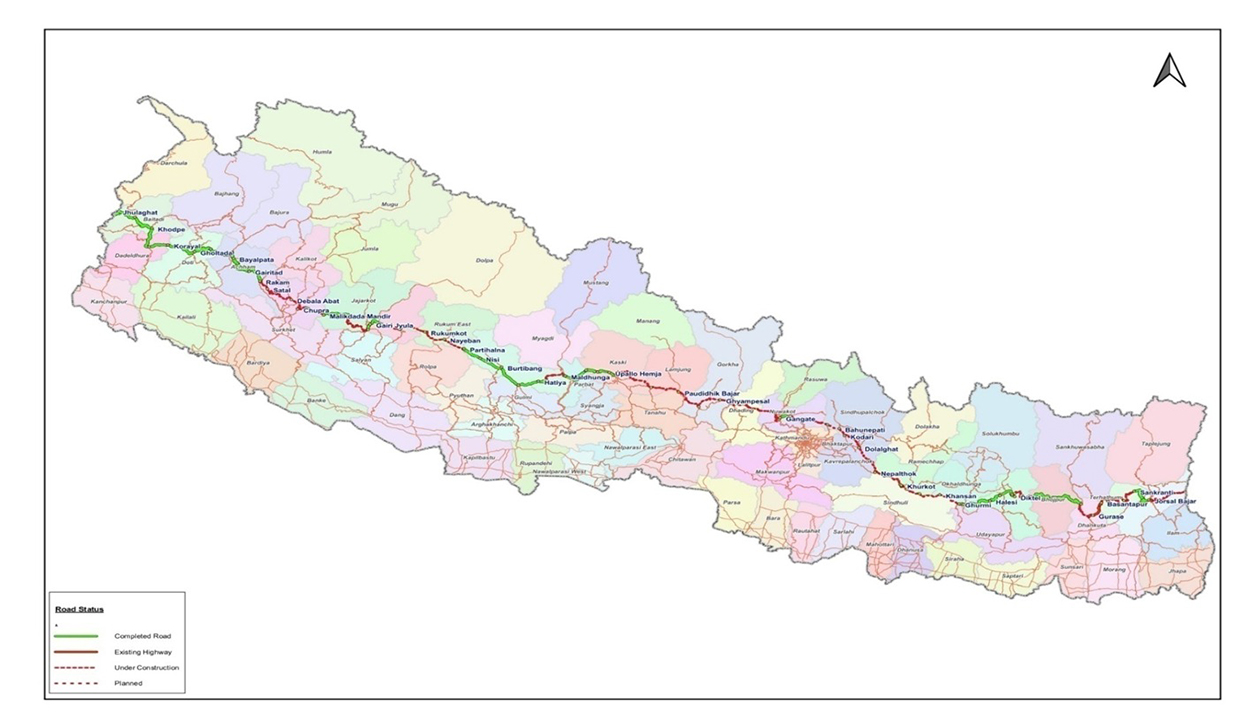
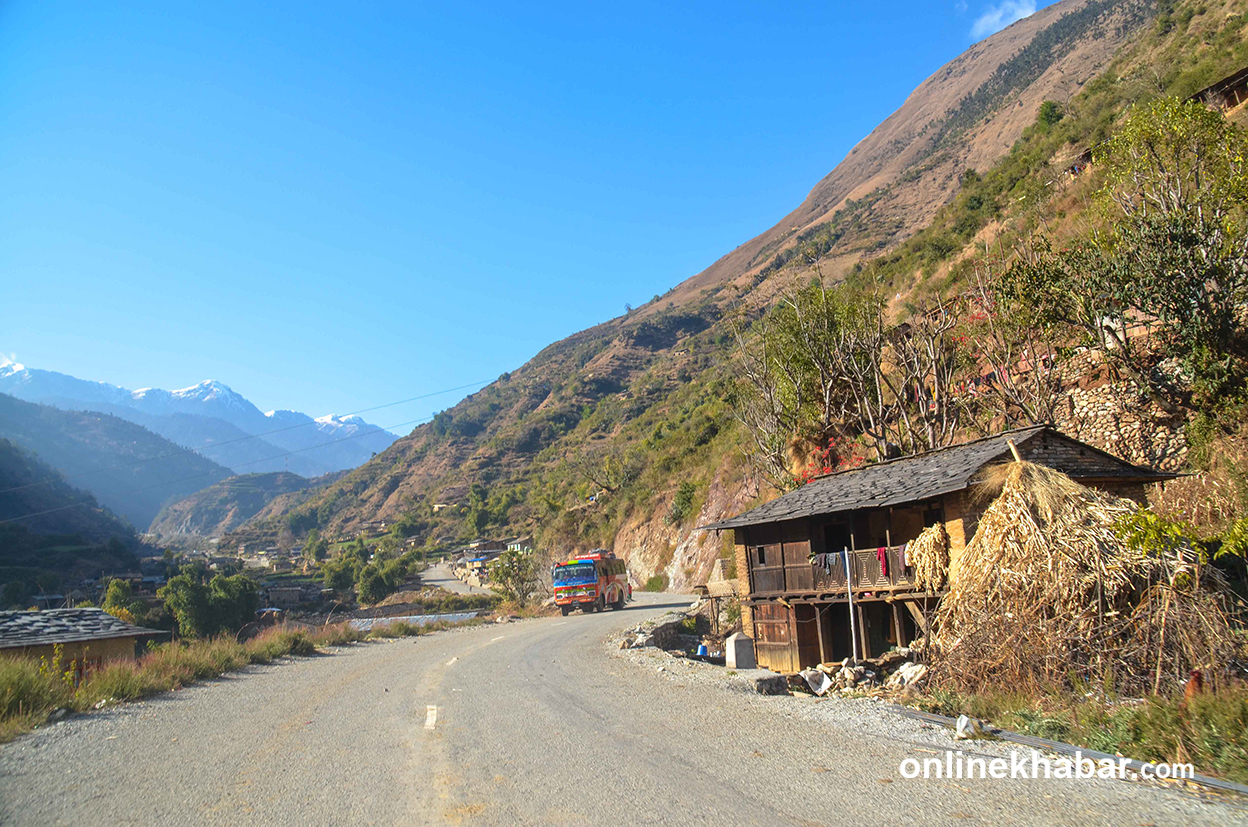
April 14 (Baisakh 31), Panchthar – The national pride project, the Pushpalal (Mid-Hill) Highway, stretching from Chiyabhanjyang in Panchthar to Jhulgad in Baitadi, remains unfinished after 17 years.
The Government of Nepal initiated this project through its own funds in fiscal year 2064/65 (2007/08 AD). Since fiscal year 2069/70 (2012/13 AD), the highway has been declared a ‘national pride project.’
Although the initial target was to complete the construction by fiscal year 2079/80 (2022/23 AD), this was postponed due to delays, with the revised deadline now set for 2084/85 (2027/28 AD). Given the current construction pace and remaining contracts, meeting this deadline looks challenging.
According to the Pushpalal (Mid-Hill) Highway Directorate in Kathmandu, out of the total 1,879 kilometers, 328.36 kilometers of blacktopping remain incomplete. Information Officer Sachin Shrestha reported that contracts for 111 kilometers of blacktopping are yet to be awarded, along with contracts for 18 bridges.
Progress on projects under contract is sluggish. Across five project offices, 31 contracts have been awarded, but contractors have delayed work.
Project Director Buddhiratna Tuladhar stated, “The lack of work by contractors has caused increasing problems. Many contracts are in a dormant state. Although funding is available, contractors are not carrying out work. There is no solution yet on how to handle dormant contracts. Only if contractors accelerate work immediately can the project be finished by 2084/85.” He also mentioned that new contracts have been sent to the planning bank and will be awarded once the budget is available.
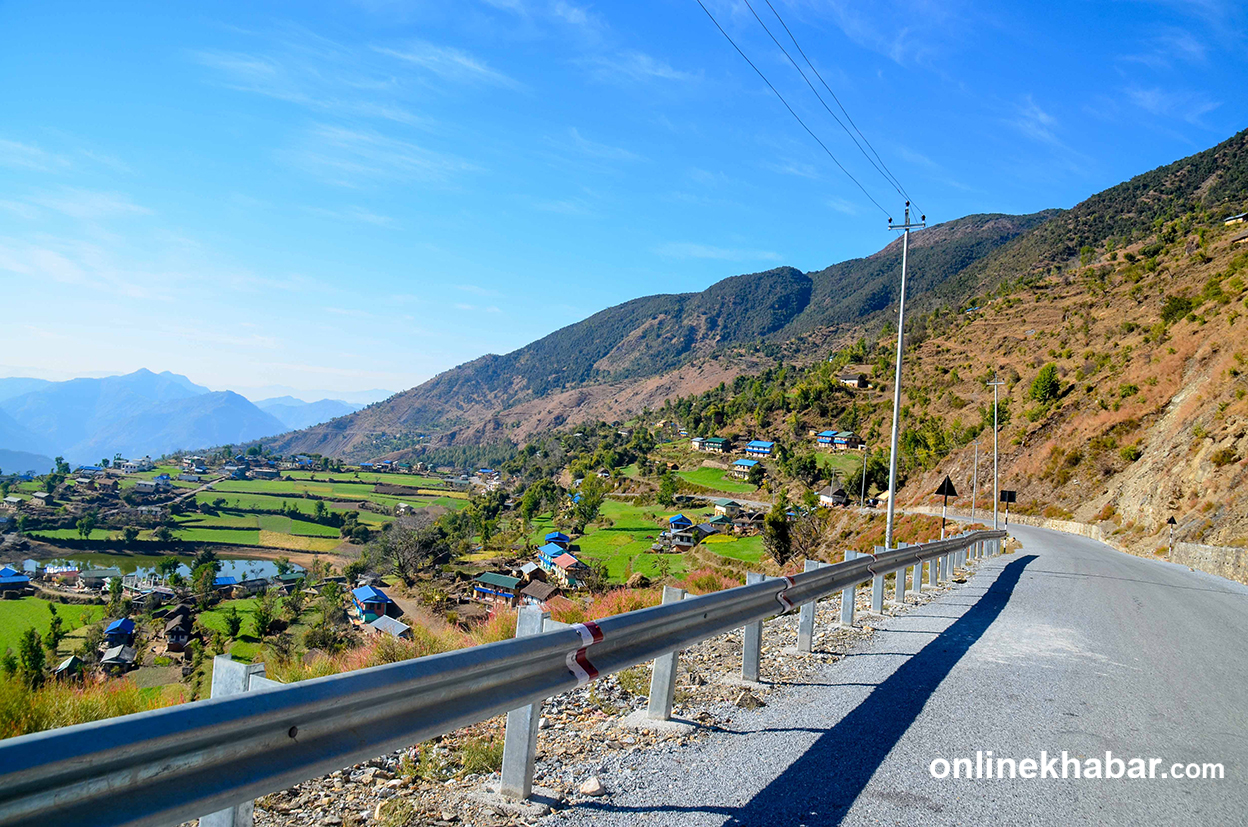
So far, 83.29% of the project is complete, with 1,550.64 kilometers of road already blacktopped, including 462 kilometers constructed under other projects. As the project has been prolonged, costs have increased, and 7.242 billion NPR has been spent to date.
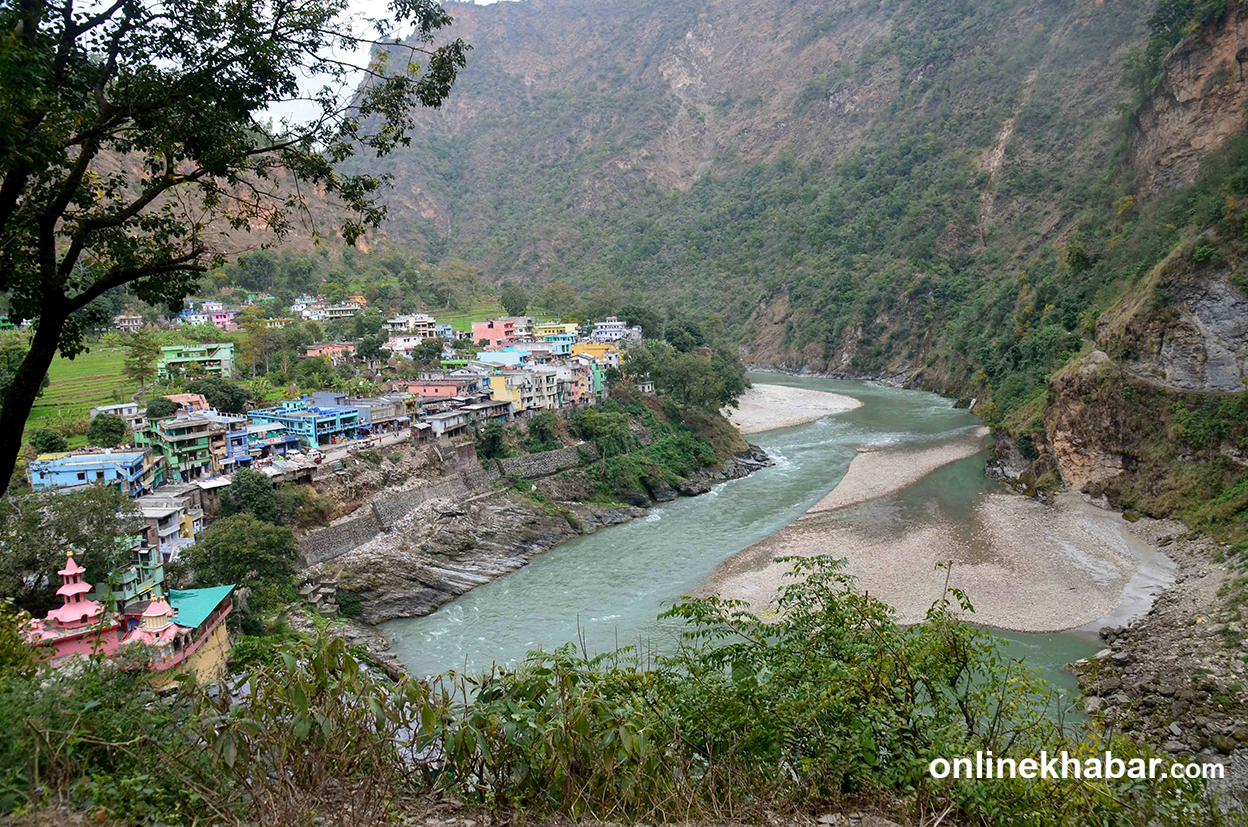
The starting point of the Mid-Hill Highway at Chiyabhanjyang, Panchthar
The revised estimated cost has reached 8.433 billion NPR, and questions loom over when the project will finally be completed.
Arjun Jung Thapa, former secretary and current member of the National Planning Commission, commented, “The revised goal of completing by 2084/85 seems unlikely. In the Dhading–Gorkha segment, alignment issues persist due to the Budhigandaki hydropower project. Additionally, land and household disputes in certain areas are causing delays.”
He added that delays have also occurred because contractors failed to deliver on time from Chiyabhanjyang to Tharpu, pending contracts remain, and existing works have slowed down, all affecting the Mid-Hill Highway’s completion target.
Thapa cited land disputes, contractor delays, lack of coordination among three government administrations, and budget shortages as contributing factors to the delay. “Several road segments were pieced together by various divisions and former Village Development Committees, resulting in winding routes that need straightening,” he said.
He also noted, “Despite being declared a national pride project, the budget has been reduced in recent years, prompting efforts to introduce multi-year contract policies.”
The old highways also require upgrades. Currently, 243 kilometers of older highways up to Chaukhatte in Achham are in use, along with 463 kilometers of old roads.
The terminal point of the Mid-Hill Highway at the Mahakali River in Jhulgad, adjacent to the Indian market
In the current fiscal year, only 34.32% of the allocated budget has been spent. Of the 384.36 million NPR allocated, only 131.9168 million NPR was spent by the end of Chaitra.
According to Information Officer Shrestha, the goal was to blacktop 75 kilometers this year, but only 39 kilometers have been completed. Of six targeted bridges, only three have been constructed.
Which Contracts Remain Pending?
Contracts for nine road segments and 18 bridges are yet to be awarded on the Mid-Hill Highway. Delays have led to terminated contracts not being reassigned. In Tehrathum, 13.7 km; Khotang, 10 km; and Sindhuli, 4.5 km of road contracts were terminated but not yet reissued.
Due to the Budhigandaki project, contracts for 29.73 km in Gorkha, 14 km at Palase-Rakathum in Ramechhap, 13 km from Jordhara to Chaurikhola, and 16.53 km at Chaurikhola-Daulalghat in Kavre remain to be awarded.
In Baglung, 5.46 km; Lamjung, 1.7 km; and Dailekh, 2.5 km of blacktopping contracts are also pending.
The absence of a bridge over the Bheri River connecting Rukum and Jajarkot districts has created problems. Although motorcycles can cross a suspension bridge, vehicles must take a lengthy detour. The 98.5-meter Bheri bridge project has faced multiple deadline extensions and has been repeatedly suspended due to contractor inaction, with no new contract awarded.
In Sindhuli, contracts for Kangasang Khola and Sokhu Khola bridges, and in Khotang for Pankhu Khola bridge, were terminated but not resumed. Flood damage to the Phalam Khola and Oyam Khola bridges in Panchthar has also prevented contract reissuance.
Rukum segment of the Mid-Hill Highway
Feasibility studies have only been conducted for the 334-meter bridge over the Sun Koshi River and the Jhdadi Khola bridge in Sindhupalchok. Bridge construction contracts remain pending for the Jageni Khola in Ramechhap, Kanle, Ripeni, and Khar Khola in Sindhupalchok, Pistikholah in Lamjung, and Khandu Khola in Parbat. Additionally, DPRs for Sai Khola in Dailekh and Vijaypur Khola in Kaski are still awaiting completion.
Districts and Tasks Delayed
Across Panchthar, Ramechhap, Gorkha, Parbat, and Dailekh project offices, 31 contracts have been issued. Most contractors have secured bids at low prices but are progressing slowly. According to the directorate, while work is slow overall, only certain contracts face specific obstacles.
In Panchthar, six contracts are active, yet work is stalled on blacktopping 50.64 kilometers between the starting point at Chiyabhanjyang and Tharpu. Contract progress is low due to contractor inactivity; a contract worth 147 million NPR was awarded in 2020 but remains incomplete.
In Tehrathum, the 10 km blacktopping contract awarded in 2015 remains incomplete. The construction of Khaduwa Khola bridge is also delayed.
Progress is also poor in the four contracts from the Ramechhap project office. The 14.5 km blacktopping from Bahunepati to Daulalghat faces contractor negligence and landslide issues. Delays also affect the 16.53 km blacktopping and Sitka Khola bridge contracts.
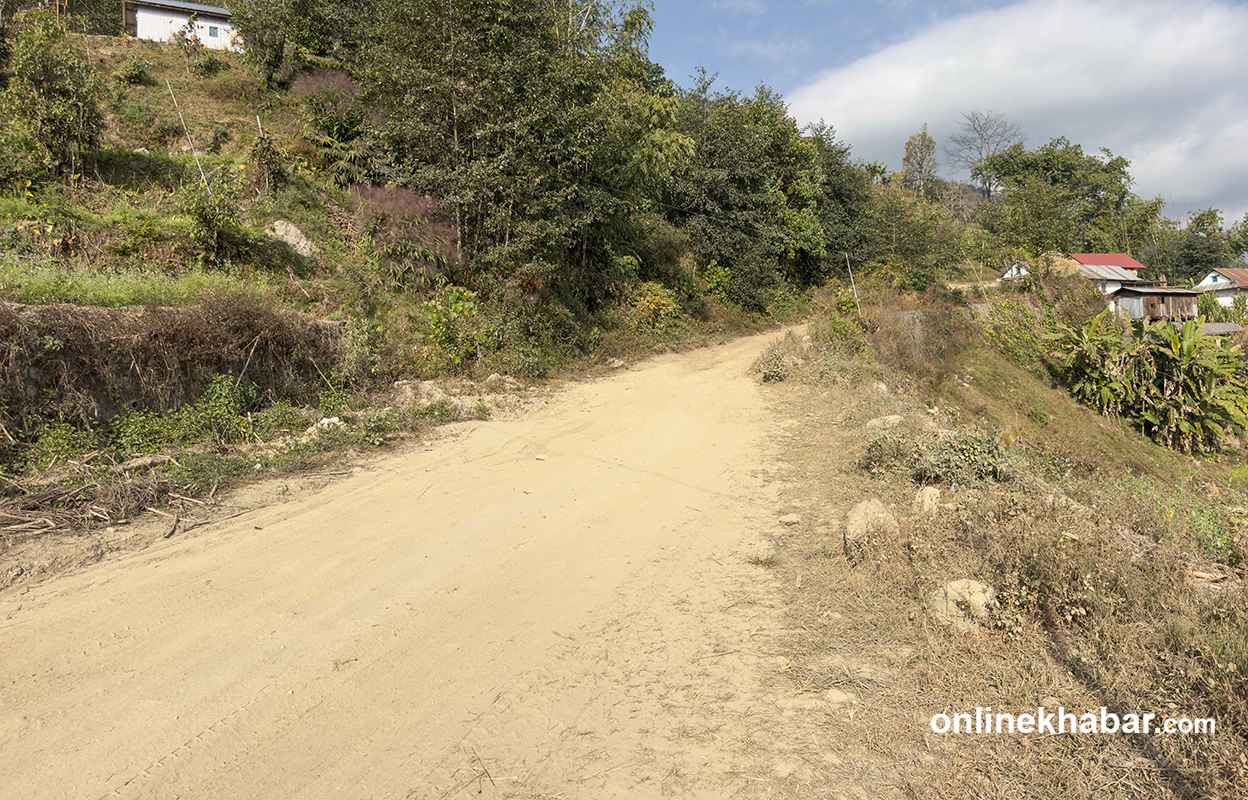
Road in Tehrathum yet to be blacktopped
The Gorkha project office is managing 15 contracts, with most contractors delaying work. Construction has been halted in certain areas due to disputes and landslides. Lamjung and Nuwakot face alignment issues along with land and forest-related disputes.
The Parbat project office faces a 38.8 km road alignment dispute along the Bhaiseng-Armalakot-Lamachaur-Yamdi segment.
Similarly, the Dailekh project office’s eight contracts are progressing slowly.
Road Providing Dozens of Benefits to Hill Villages
The Mid-Hill Highway serves as an alternative route allowing travel from east to west through the hills, providing road access to remote and underserved residents.
Many districts with limited or no highway access have villages now connected by this highway.
The Mid-Hill Highway links approximately 225 settlements. Some areas have experienced urban expansion, yet many rural communities continue to grow along the roadside.
The highway provides the most service in Panchthar, Tehrathum, Bhojpur, Khotang, Sindhuli, Ramechhap, Gorkha, Lamjung, Baglung, East and West Rukum, Jajarkot, Dailekh, and Achham districts.
Chiyabhanjyang Border Remains Closed, No Bridge Built Over Mahakali River
Although Chiyabhanjyang in Panchthar is considered the highway’s starting point, the border checkpoint remains closed, and the bridge over the Mahakali River at Jhulgad has not been constructed.
Chiyabhanjyang connects to India’s Sikkim district. Road access exists up to this border, making it the only road connecting Sikkim to Nepal, but locals say no efforts have been made to open the border.
Meanwhile, the bridge linking Jhulgad in Baitadi to Pithoragarh in India remains unbuilt despite years of delay. People are forced to use a risky suspension bridge for crossing and transporting goods.
April 13, Kathmandu – The Confederation of Nepalese Industries (CNI) has voiced serious concerns over recent crackdowns on businesspeople, stating these actions have created fear within the commercial environment. On Thursday, the Confederation issued a letter of concern highlighting that investigations into economic matters are sending negative signals to investors due to ongoing arrests.
“The Confederation of Nepalese Industries is deeply concerned about the recent arrests of entrepreneurs, construction professionals, and banking officials from various sectors under the guise of economic investigations,” the letter read.
“The practice of detaining leading figures from the private sector and banking industry—key pillars of the economy—in a criminal manner has generated widespread fear across the business community and conveyed negative messages to investors.”
The Confederation also noted that the arrest of banking executives involved in loan recoveries, which are based on public trust and deposits collected from the general public, could potentially harm the reputation of the banking sector.
“Furthermore, these actions may affect decision-making capacity related to loan disbursement within the banking sector and, as a result, the contraction in investments could negatively impact the overall economic system of the country,” the letter cautioned.
The Confederation pointed out that government actions of detaining entrepreneurs before completing initial investigations and the media trial of those individuals also tarnish their personal reputations.
“We urge that investigations be carried out discreetly and that civil liability issues against entrepreneurs be addressed and prosecuted accordingly,” emphasized the letter.
Reaffirming the constitutional right to a dignified life and the presumption of innocence until proven guilty, the Confederation urged the government to approach this matter with seriousness and responsibility.
US President Donald Trump and Chinese President Xi Jinping have reached an agreement to halt the flow of fentanyl precursors. In October, Beijing committed to tightening chemical controls in exchange for trade tariff concessions.
The Chinese Ministry of Public Security and the US Department of Justice jointly announced the dismantling of an international drug trafficking network. The agreement between Trump and Xi aims to strengthen efforts to block the supply of chemicals used in producing fentanyl entering the United States.
Back in October, Beijing agreed to enhance regulation of such chemicals as part of the deal that granted it tariff relief. Since then, both sides have been working collaboratively to address various drug-related issues.
Meanwhile, on Monday, Beijing announced that through a joint operation by the Chinese Ministry of Public Security and the US Department of Justice, an international drug trafficking network had been dismantled.
In the House of Representatives, four opposition parties have boycotted the parliamentary session, while the Nepali Congress staged an obstruction in protest. Since Prime Minister Ballen Shah was absent during the question and answer session on the policy program, Finance Minister Dr. Swarnim Wagle took responsibility to respond. The CPN-UML, CPN, Labor Culture Party, and Rastriya Prajatantra Party (RPP) boycotted the session, whereas the Congress protested and some of its members left the meeting hall.
April 13, Kathmandu – Four opposition parties boycotted the parliament session in the House of Representatives, and the main opposition party, the Nepali Congress, engaged in obstruction as a form of protest. The opposition demanded the Prime Minister Ballen Shah himself be present to answer questions raised about the government’s policy and program. However, the Prime Minister assigned Finance Minister Dr. Swarnim Wagle to provide the responses. Due to the Prime Minister’s absence from the house, the CPN-UML, CPN, Labor Culture Party, and RPP boycotted the parliament. Meanwhile, the Congress created disruptions and some of its lawmakers left the session. Congress parliamentary party leader Bhishmaraj Angdembe and other leaders stood up and voiced their opposition.
Although wheat production in Nepal exceeds 2.1 million tons annually, approximately 24,000 tons of wheat were imported during the first nine months of the current fiscal year. Despite a continuous decline in wheat cultivation area over the past 12 years, productivity has improved, with an estimated production of 2.1 million tons on 685,000 hectares this fiscal year. However, challenges such as irrigation shortages, disease outbreaks, and insufficient availability of fertilizers and seeds persist, leading farmers to reduce wheat cultivation due to perceived losses, according to agricultural experts.
April 14, Kathmandu — In Nepal, wheat ranks as the third major cereal crop after rice and maize in total food grain production. It plays a vital role not only in ensuring national food security but also as a backbone of the rural economy. Being a major winter crop, wheat is particularly significant as it can be grown successfully during periods of low rainfall by utilizing irrigation and appropriate technology.
Traditionally, wheat has been used in Nepali society to prepare roti, dhido, and puwa. With changing lifestyles and market expansion, wheat has transcended the kitchen to become a key ingredient in larger industries. Wheat is now the primary raw material for biscuits, instant noodles, bread, and increasingly popular products such as pasta and macaroni. Consequently, demand for wheat is rising rapidly, not only for household consumption but also for commercial processing.
Despite producing around 2.1 million tons of wheat annually, Nepal has yet to achieve full self-sufficiency. Data from the Ministry of Agriculture and Livestock Development indicate a rise in wheat production along with continued imports. During the first nine months of fiscal year 2082/83 (2025/26), Nepal imported about 24,000 tons of wheat. Customs records show 23,964 tons of wheat and seed entered the country by the end of Chaitra (mid-April), amounting to foreign expenditures of NPR 103.7 crore.
The imports primarily fulfill the demand of flour mills and pasta industries that use wheat as raw material. Additionally, 500 kg of wheat seed was also imported during this period. The rapid growth of instant noodle, pasta, macaroni, and biscuit industries drives this demand. Since durum wheat with high protein content is not produced domestically, large quantities are imported to meet industrial needs.
The Ministry anticipates a 2.5% increase in wheat production for the current fiscal year. Production last year (2081/82) reached 2,056,000 tons on 683,977 hectares. For this year, production is projected at 2,107,206 tons on 685,687 hectares. Productivity per hectare improved from 3.01 tons last year to an expected 3.07 tons this year.
Analysis of 12 years of wheat production data reveals a consistent decline in the area under wheat cultivation out of Nepal’s 3.09 million hectares of arable land. The cultivation area shrank from 754,474 hectares in fiscal year 2070/71 (2013/14) to 681,851 hectares in 2080/81 (2023/24). However, a slight recovery occurred in 2081/82 to 683,977 hectares, with projections showing further increase to 685,687 hectares this fiscal year.
Wheat production has fluctuated over the years. It reached a peak of 2,185,289 tons in 2076/77 (2019/20) but fell to a low of 1,736,849 tons in 2072/73 (2015/16). Production dropped to 2,035,551 tons in 2080/81, then rose again to 2,055,811 tons in 2081/82.
Productivity improvements have been substantial. After decades of effort, yields increased from 1.47 tons per hectare in 2070/71 to 2.49 tons in 2080/81 and 3.01 tons in 2081/82. The highest observed productivity was 3.09 tons per hectare in 2076/77. This year, productivity is expected to reach 3.07 tons per hectare.
Newly developed nutritious wheat varieties in Nepal have raised hopes for better production. The National Wheat Research Program has introduced zinc- and iron-rich varieties, which are gaining popularity among farmers, and are expected to contribute further to food and nutrition security.
Nevertheless, challenges such as shrinking cultivation areas, disease outbreaks, and shortages of fertilizers and seeds remain significant. Though research centers have developed improved varieties, inefficient distribution systems prevent timely seed delivery to farmers. Irrigation remains inadequate as most farmers irrigate only once, although wheat requires at least two to three irrigations. The shortage of potassium fertilizer and improper urea use negatively affect soil health. To enhance productivity, policy interventions are needed to improve seed distribution, irrigation investment, and fertilizer availability.
Agricultural expert Uddhav Adhikari states that farmers increasingly perceive wheat cultivation as “loss-making farming.” They are shifting toward other crops like mustard, with the wheat cultivation area reduced to less than half compared to rice. Difficulties in cultivation, low returns, and lack of irrigation have discouraged farmers from growing wheat.
He remarked, “Demand for wheat-based products like pizza, burgers, and bread is increasing, but wheat production is declining,” which forces Nepal to import large quantities of wheat.
Customs department data over the past five years show fluctuating wheat imports. Imports steadily declined from 97,069 tons in 2077/78 (2020/21) and 191,585 tons in 2078/79 (2021/22) to only 6,664 tons in 2079/80 (2022/23), and then further to 6,543 and 2 tons in 2080/81 and 2081/82 respectively. However, imports surged again to 24,000 tons in the first nine months of the current fiscal year 2082/83. This pattern highlights volatility and significant annual fluctuations in wheat imports.
April 13, Kathmandu – After Speaker D.P. Aryal controversially conducted the House of Representatives session, the Communist Party of Nepal (Unified Marxist-Leninist) also decided to boycott the meeting. Opposition parties demanded that Prime Minister Balendra Shah respond to questions regarding the government’s policy and programs. However, Finance Minister Swarnim Wagle answered on behalf of the Prime Minister. When Minister Wagle began his response, opposition parties including the UML, Labor Culture Party, and Rastriya Prajatantra Party started boycotting the session. Shortly thereafter, UML lawmakers also resolved to boycott the meeting. Nepali Congress members stood up to voice their protest during the session.