Author: space4knews

तत्काललाई ठिक, भविष्य अनिश्चित – Online Khabar

Current Conditions Are Manageable, But Future Remains Uncertain for Displaced Communities

At the holding center in Kirtipur, concerns about the situation of displaced people surfaced when police denied their entry. The center currently accommodates 192 individuals, including displaced persons, among whom 41 are students attending Janvikas Secondary School. The federal government is conducting screening for identification purposes, delaying any decision on their relocation from the holding center.

On 25th Baisakh, Kathmandu — Upon arriving at the entrance of the holding center in Kirtipur for reporting, police barred our media team from entering despite our identification and explaining the purpose. Both Nepal Police and two municipal police officers from Kathmandu reiterated that higher authorization is required for entry.

Meanwhile, two displaced women approached the gate carrying yogurt they had purchased. The police insultingly remarked that they had likely bought alcohol under the guise of yogurt. The women responded that they preferred a meal without yogurt. Ms. Samjana Tamang was willing to talk but reluctant to be photographed. She mentioned that the media has created unnecessary hype by highlighting negative aspects. Her words revealed that displaced individuals fear both the authorities and the media.

Ms. Tamang shared that she has spent two weeks at the holding center, describing the government tent she occupies as a ‘shack.’ Though the food arrangements are adequate, living conditions are very uncomfortable. She smiles when seeing the children, and they smile back. However, she expressed worry that prolonged stay could deteriorate people’s well-being. She appeals to the government to provide a safe environment to secure the future of their children.

However, the police also pressured her to seek psychiatric help, intimating where such services were available. Ms. Tamang made clear she did not want to visit a psychiatrist and conveyed her anxiety. While she conversed with the police, other displaced people arrived at the gate, where their names were logged before going outside.

Though police attempted to present the center’s conditions positively to those denied entry, spending an hour at the gate revealed a contrast between official accounts and the realities inside.

At the entrance, 66-year-old Sita Nepali, who had lived in Gairigaun, Sarlahi for many years, was found. After her settlement was demolished by a bulldozer, she sought refuge here. She expressed concerns about floods submerging her hut and the bulldozer worsening her uncertainty.

Also present was 52-year-old Anita Rai from Thapathali’s displaced community, who had lived with her husband there. Following the government’s demolition of their home, they are forced to live in a makeshift shelter. Despite relocation, displacement has worsened their situation.

Rajkumar Maji, also from Thapathali settlement, aimed to travel daily to Shankhamul for work. After marriage and increased expenses, he shifted to a riverside settlement. Since demolition of government-built housing, he has been unable to repay debts. The government has yet to decide on their relocation plan. He stated, “The government must either help me repay my debts or secure employment. I refuse to move to an apartment. What will I eat or do there? Is life only about having a place to stay?”

Geeta Lama is also at the Kirtipur holding center. Before the demolition of the Thapathali settlement, her house was already damaged. She is worried about the continuous rain ruining her belongings. She said, “We have become like delicate potters without a caregiver, unsure how long we can hold on or what to do.” Geeta does not want to move to an apartment and urges the government to provide suitable housing and employment.

Among the displaced, there are 41 students enrolled at Janvikas Secondary School located in Balkhu Ward No. 14. Kathmandu Metropolitan City is preparing a supportive environment for displaced students, and uniform measurements have already been taken.

Currently, the holding center houses 192 people, including 77 men, 50 women, 34 boys, and 31 girls. The duration of their stay remains unclear. According to Metropolitan Police Chief Bishnu Joshi, since screening is ongoing under the federal government, transfer decisions will be made only after the process is complete.

Gagan Thapa Affirms Full Support from Nepali Congress for Democratic Reforms

Gagan Kumar Thapa, President of the Nepali Congress, has affirmed that the party fully supports reforms within democracy. He emphasized that the party will strongly oppose any attempts to weaken democracy or establish a regime of fear. Furthermore, Thapa announced that party leaders who do not support candidates in the 21st Falgun election will be temporarily relieved from their responsibilities. The statement was made on 26th Baisakh in Kathmandu.

Speaking at a province-level gathering focused on provincial and local bodies held in Dhangadhi, Kailali, President Thapa said, “We will continue to provide full support for democratic reforms, but we will firmly stand against any effort to replace democracy with authoritarianism or a regime of fear.”

He also revealed plans to temporarily relieve party leaders who do not assist candidates during the 21st Falgun election from their duties.

स्थानीय तहको संख्या र सिमाना हेरफेरबारे के भन्छन् सुदूरपश्चिमका जनप्रतिनिधि ?

Local Representatives in Sudurpashchim Discuss Changes to Number and Boundaries of Local Governments

April 9, Doti. Following the federal government’s release of a preliminary draft proposing new standards for adjusting the number and boundaries of rural municipalities, municipalities, and wards, intense debate has erupted on the topic. Local representatives in Sudurpashchim Province have expressed varied reactions to the government’s draft.

Susila Shahi, Mayor of Lamkichuha Municipality in Kailali, emphasized the necessity of modifying the number and boundaries of local governments but insisted that such decisions require detailed study. “The boundary demarcations made during restructuring were not accurate,” Shahi stated. “In some settlements, ward offices are not easily accessible, while residents of others have difficulty reaching the municipality offices. Improvements are essential.” She also highlighted the need to upgrade certain rural municipalities to municipality status. Overall, she supports reducing the total number of local governments. “Most fundamental services are delivered through ward offices. Increasing ward numbers while decreasing local government units would enhance practicality,” she explained.

Sher Singh Parki, Chairperson of Alital Rural Municipality in Dadeldhura, does not consider an immediate change in the number and boundaries appropriate. According to him, “Considering development, public accessibility, and geographical distances, it is not suitable to hastily alter boundaries.” He supports increasing the number of wards further and believes local government units should not be reduced or merged based solely on population.

Mahavir Bohara, Chairperson of Saipal Rural Municipality in Bajhang, stressed that changes to the number and boundaries should take geographical distance and development status into account. “If the decision is based only on low population, citizens will face significant difficulties accessing services,” Bohara warned.

Santosh Prakash Joshi, Chairperson of Dilasaini Rural Municipality in Baitadi, acknowledged the necessity for changes but cautioned against rushing the decision. “Local governments need thorough discussion on this issue, and expert committees should conduct comprehensive consultations,” he said. Umesh Prasad Bhatt, Chairperson of Ajaymeru Rural Municipality in Dadeldhura, expressed disagreement with the draft standards, stating, “Altering the number and boundaries without including local leaders in the study committee is not feasible.”

Jaman Singh Dhami, Chairperson of Marma Rural Municipality in Darchula, pointed out the need to resolve boundary inconsistencies and geographic mismatches from the previous local government restructuring. “Many areas have boundary disputes between municipalities, and numerous settlements find it difficult to receive services from their ward or municipality offices. These issues must be addressed,” he explained.

Meanwhile, Durgadatta Ojha, Chairperson of Jorayal Rural Municipality in Doti, argued that restructuring is not currently required. “The present system has not even completed ten years, and major work remains unfinished. Significant funds have already been spent on infrastructure like offices. Basic sectors such as education, health, and transportation require more development,” he said. According to Ojha, the current number and boundaries should remain unchanged for at least the next 20 years to focus on development efforts.

Gyawali Warns That Social Media Control Is Pushing Society Towards Self-Censorship

Pradip Gyawali, leader of the CPN-UML, has emphasized that constitutional amendments should not undermine the fundamental pillars of the republic and democracy. He stressed the need for caution in the amendment process, given the current political power balance is unfavorable to democratic and leftist forces. Gyawali expressed concern over efforts to weaken independent media and warned that the country is moving toward elected authoritarianism. (April 9, Kathmandu)

Speaking at a seminar organized by the National People’s Front on the topic “Constitutional Amendment, Protection of the Republic, and Nationalism,” Gyawali pointed out that the current political power distribution does not favor democratic and leftist factions. He also noted the weakening of the main parties responsible for constitution-building in the House of Representatives. “The three major parties that crafted the constitution have only 79 representatives combined. In such a situation, the capacity to block adverse constitutional amendments is limited. Attempts are being made to undermine independent media, and controlling social media is pushing society towards self-censorship,” Gyawali stated.

Commenting on the government’s recent approach, Gyawali raised concerns that the country may be heading toward elected dictatorship. He accused the government of undermining fundamental rights, trade union freedoms, and press independence. On the debate over a directly elected executive system, Gyawali argued that such an arrangement would be harmful for a country like Nepal, given its geopolitical realities. “I have heard that the Prime Minister has expressed intention to learn from Hitler’s ‘administrative art’ and to shape society toward a single way of thinking. Holding such views in a diverse and pluralistic society is highly problematic,” Gyawali clarified.

प्रश्न सालिकको होइन, खुम्चिँदो ऐतिहासिक चेतको हो – Online Khabar

The Issue Is Not Lenin’s Statue but the Decline of Historical Consciousness

After the statue of Vladimir Lenin was toppled in West Bengal, questions about its necessity surfaced repeatedly on social media. Lenin’s statue symbolized the global influence of socialist ideology and the workers’ movement. The author argues that societies that engage in dialogue with history can avoid the destruction of memory.

Following the fall of Lenin’s statue in West Bengal, a frequently asked question on social platforms was, “Why is Lenin’s statue necessary in Bengal?” This is not merely a matter of a statue; it reflects the narrowing of our historical awareness and political memory. History is never confined within the closed borders of geography. Ideas, struggles, revolutions, and philosophies have always transcended boundaries.

The Lenin statue in Bengal stood as a symbol that socialist ideology, labor movements, and anti-imperialist politics had influenced political consciousness not only in Bengal but across different parts of the world. One may criticize Lenin or reject communist politics, but reducing the relevance of a historical figure solely to their nationality diminishes our understanding of history.

We could even reverse the question: why are statues of Mahatma Gandhi erected in many countries? Why are figures like Dr. Bhimrao Ambedkar, Jawaharlal Nehru, or Rabindranath Tagore remembered beyond India? It is because these personalities transcended their country’s borders to position themselves within a broader discourse of humanity. The strength of democracy should not rest on a single historical figure or ideology; rather, a society must be able to coexist comfortably with memory and history, even amid differing perspectives and debates.

Mohan Vikram Singh Claims Constitutional Amendment Serves Ruling Class Interests

Mohan Vikram Singh, General Secretary of the Communist Party of Nepal (Masal), has stated that the constitutional amendment is increasingly favoring the interests of the ruling elite. Speaking at a debate on constitutional amendments held in Kathmandu, he accused that the amendments are driven more by the ruling class’s vested interests and efforts to maintain power rather than by genuine national necessity. (April 26, Kathmandu)

General Secretary Singh emphasized the importance of constitutional amendments that reflect the country’s historical needs and benefit the people. He alleged that the current government has chosen the path of amendments to institutionalize fascist tendencies. Although the constitution is an internal matter of Nepal, he expressed concern over the undesirable and serious interference of foreign powers in the process.

Singh further highlighted that foreign interference in Nepal’s internal affairs raises questions about the country’s sovereignty. He stated, “The constitution should be created or amended based on the country’s national needs. However, in some cases, the ruling class drafts laws based on their self-interests. A serious question arises because the current government is adopting a fascist form, and the constitutional amendment seems aimed at solidifying this, rather than curbing it.”

बढ्दै देउवा समूहको सक्रियता, प्रदेश भेलाबाट शक्ति एकत्रित गर्ने रणनीति

Deuba Faction Intensifies Activities with Strategy to Consolidate Power Through Provincial Assemblies

News Summary

Prepared by AI. Editorial review completed.

  • The faction led by former Nepali Congress president Sher Bahadur Deuba is preparing to organize provincial-level gatherings across all seven provinces.
  • The Deuba group has stated that these meetings aim to strengthen party organization and unity ahead of the 15th general convention.
  • Provincial assemblies will begin in Koshi Province on May 12 in Biratnagar, with other provinces scheduling meetings accordingly.

May 8, Kathmandu – The faction of former Nepali Congress president Sher Bahadur Deuba is actively preparing to hold provincial-level assemblies.

While the party continues to conduct programs at the provincial level through the Central Policy Research and Training Institute, the Deuba faction is organizing its internal strategy by convening provincial assemblies.

The secretariat of incumbent acting president Purna Bahadur Khadka has confirmed that the faction is preparing to hold provincial meetings in all seven provinces.

Close Deuba ally leader Min Bishwakarma informed that the decision to conduct these gatherings aims to maintain unity among the faction’s leaders and to make internal discussions more effective.

He stated that the faction is organizing provincial-level assemblies in preparation for the upcoming 15th general convention.

“The objective of the faction’s provincial assemblies is to strengthen the party organization, advance preparations for the 15th general convention, and reactivate and unify those members who are feeling disheartened,” Bishwakarma explained.

The assemblies will also discuss the current political situation and the direction of the country to reach a shared understanding and decide on future actions.

For coordination of provincial assemblies, the Deuba faction has appointed Krishna Prasad Sitaula for Koshi Province and Anand Prasad Dhungana for Madhesh Province. Mekhlal Shrestha, Prakash Man Singh, and Dr. Prakash Sharan Mahat are coordinating for Gandaki and Bagmati Provinces respectively.

According to leader Bishwakarma, incumbent deputy general secretary Kishor Singh Rathore is responsible for Lumbini Province, former Chief Minister Jeevan Bahadur Shahi for Karnali Province, and NP Saud for Sudurpashchim Province.

The first provincial assembly will commence in Koshi Province, with the meeting scheduled for May 12 in Biratnagar, leader Bishwakarma stated.

Regarding the organization of a meeting in Sudurpashchim Province, a discussion took place on Thursday in Kathmandu between provincial president Veer Bahadur Balayar, leader NP Saud, and Ramesh Lekhak.

The discussion was also attended by Nepali Congress leaders Narayan Bhatt of Kailali, Padam Bogati of Kanchanpur, and Narendra Bahadur Singh of Doti.

Former chief minister of Karnali Province, Jeevan Bahadur Shahi, confirmed that preparations for the provincial assembly are underway but the date has not yet been finalized.

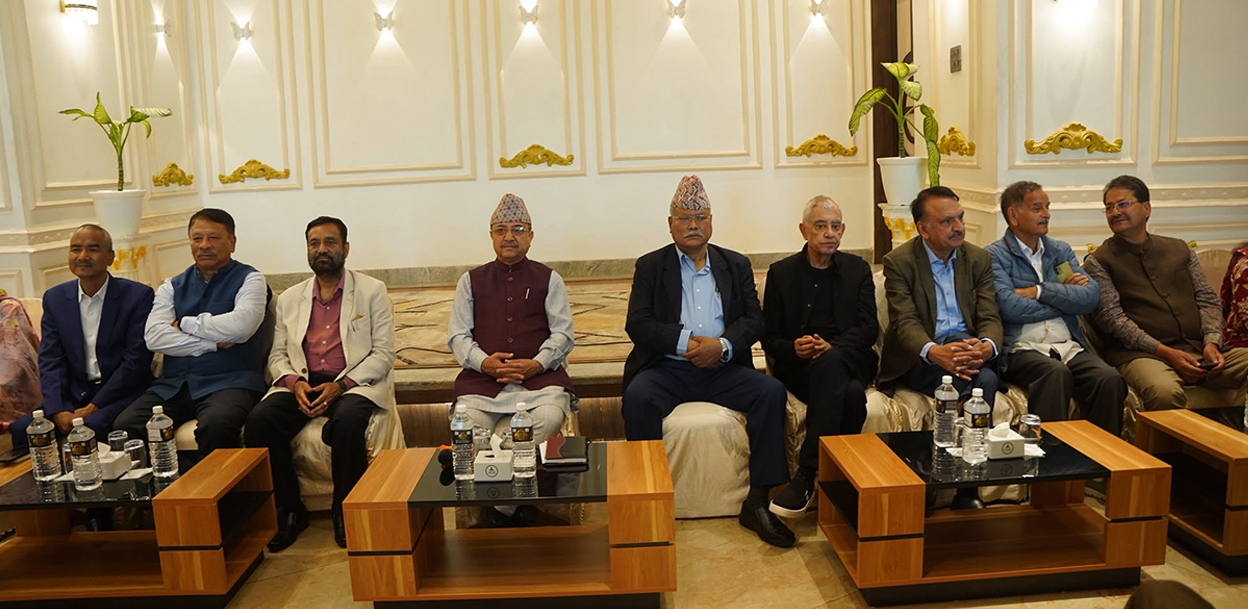
Leaders of the Deuba faction attending a meeting called by incumbent acting president Purna Bahadur Khadka.

Incumbent central member Guru Baral, involved in preparing for the Gandaki provincial assembly, has been sending notifications to the related leaders.

“In light of the unusual situation emerging within the Nepali Congress, we cordially invite everyone to discuss upcoming strategies and the party’s condition,” the notification states.

According to a leader who received the notice, a discussion is scheduled for the upcoming Sunday (May 11) at 4:30 pm near the central bank intersection in Pokhara.

Leader Baral confirmed the meeting and said, “We have decided to hold gatherings in all seven provinces and preparations are underway accordingly.”

Baral added that the meeting will include incumbent central members from Gandaki Province, district presidents, provincial committee members, provincial assembly members, and House of Representatives candidates.

The Deuba faction also decided to hold the Bagmati provincial-level assembly during a discussion at leader Prakash Man Singh’s residence in Chaksibari last Wednesday.

The Bagmati assembly is scheduled for May 13 and will begin at 1 pm at Karki Banquet Hall in Babarmahal.

This large gathering aims to promote party unity within Bagmati Province. Previously, acting president Khadka had convened a two-day meeting on May 1-2.

The earlier meeting included former office bearers and members elected at the 14th general convention, provincial presidents, district presidents, regional presidents, and leaders of affiliated and allied organizations.

Meanwhile, the party is conducting ‘province- and local-level focused provincial assemblies’ across all seven provinces through its policy research and training institute.

Accordingly, Sudurpashchim Province’s assembly is scheduled for April 9-10 in Dhangadhi, Kailali. The Karnali provincial assembly will take place on April 11-12 in Surkhet.

The Gandaki assembly is set for April 13-14 in Pokhara, and the Bagmati provincial assembly will be held on April 16-17 in Dhulikhel, Kavrepalanchok.

Similarly, Madhesh Province’s assembly will be conducted on April 18-19 in Bardibas, Mahottari; Koshi Province on April 20-21 in Laukahi, Sunsari; and Lumbini Province on April 26-27 in Tilottama.

Kulman Ghising Expresses Serious Concern Over Halt in Muglin Road Expansion

April 26, Kathmandu – Kulman Ghising, chairman of Ujhyalo Nepal Party, has raised serious concern about the suspension of the expansion of the Muglin road, which connects the Kathmandu Valley. He brought this issue to the government’s attention on Saturday via Facebook. He stated, “It is extremely worrying to see that the expansion work of the Nagdhunga–Nauvise–Muglin road, the main lifeline linking Kathmandu Valley to the rest of the country, has come to an almost complete halt.”

During his tenure as the Minister of Physical Infrastructure and Transport, Ghising claimed that the project had accelerated due to necessary initiatives and coordination. He said, “However, with current issues such as shortages of construction materials and rising costs causing work stoppages, thousands of travelers are forced to endure risky and arduous journeys every day. This has become even more serious as the monsoon season approaches.”

With approximately 15,000 vehicles passing through this road daily, Ghising noted that delays in the expansion increase the risk of accidents, long traffic jams, economic losses, and greater hardships for the public. He added, “This is not just about road construction; it is a sensitive matter affecting the capital’s supply chain, the economy, and citizens’ everyday lives. Therefore, I urge the concerned authorities to immediately resume construction work and advance it efficiently.” He also requested the government to address the legitimate demands of the contractors involved.

‘दुईतिहाइकै किन नहोस्, डर र प्रभावमा न्याय सम्भव छैन’

‘Why Fear the Two-Thirds Majority? Justice Cannot Be Attained Through Influence and Fear’

First and foremost, I extend my heartfelt greetings to all of you on the occasion of Law Day, 2083. As we institutionalize the concept of an independent, impartial, and capable judiciary and uphold the rule of law, may this special day provide us all with renewed energy, encouragement, and inspiration to promote good governance, prosperity, and social justice in our country, ensuring a justice system that is accessible and trusted by the people. Nepal’s Supreme Court has observed Law Day annually on the 26th of Baishakh since its establishment on Baishakh 26, 2065 (2008 AD).

According to the principle of separation of powers, the three main branches of the state—the executive, the legislature, and the judiciary—have a division of state power. Built on the foundation laid by this act, the judiciary’s independence, the rule of law, and the establishment of a modern judicial system have been realized. We are deeply honored by the special presence of the Honorable President at this ceremony. The Constitution is not only the legal document governing state conduct, but it must become the way of life for citizens, through which the general public can experience genuine constitutional governance changes.

On this special day, I hope that all three branches of the state internalize these core values, remain actively engaged, and contribute with strong support. I pay my highest respect and tribute to former Chief Justices and all judicial workers who, even under extremely complex and difficult circumstances in judicial history, have preserved the core values of an independent judiciary, protected this institution from arbitrary and improper interference by the executive, and upheld judicial sanctity on the foundation of constitutional dignity.

Today is a day to demonstrate commitment to the honest implementation and observance of the Constitution and to uphold the rule of law. It is also a day for all of us—champions and stakeholders of democracy and the rule of law—to scrutinize our efforts for the proper protection and implementation of the Constitution and democracy. After the unexpected events of Bhadra 23 and 24, we found ourselves in a difficult situation. The judiciary is moving forward toward revitalization. Certainly, no one is above the Constitution, constitutionalism, and constitutional ethics, and no one can be.

However, there is a growing concern regarding whether there are attempts to weaken the foundations of constitutional supremacy, independence, and sovereign justice under the pretext of the use of authority and laws—efforts that could create a compliant judiciary and enable the unequal application of the rule of law. Questions are being raised whether justice is being turned into a facade for protecting self-interests rather than being the ultimate goal. There is anxiety that attempts to destabilize governance under various pretexts could create an environment where compromising justice becomes tolerated in the future.

If such tendencies are accepted within the constitutional and governmental framework, immediate power intoxication might be sustained or legitimized, which would inevitably bring uncertainty. One cannot expect a tiger feeding on one to spare another. Keeping the Constitution as it is while undertaking acts against it cannot bring revolution or change. Those violating the Constitution must be held accountable; otherwise, faithful implementation of the Constitution is not possible.

Attempts to establish excellence by destroying the structure under the pretense of change will extinguish the zeal of those in power but certainly will shatter the dreams of those who expect law and legitimate practices. Actions motivated by self-interest that murder legal and traditional procedures embody a glimpse of despotism. Tampering with the law under the guise of expediency is arbitrary and unacceptable for those who believe in the rule of law. Failure to address these issues will make it rare to protect the constitutional system, democratic governance, and the vision of a just society.

The Honorable Speaker once stated that the judiciary could work according to the government’s will; I assert that the judiciary must work according to the spirit of the Constitution. When the government’s pace aligns with the Constitution’s spirit, the judiciary can cooperate effectively. The judiciary becomes strong when it is resourced adequately. I call upon all judges that justice cannot be delivered under fear or influence—whether fear of a two-thirds government or fear of impeachment. I urge all judicial workers to advance courageously, free from fear and intimidation.

Personally, I have spent my life fighting against discrimination and injustice as a legal professional. The struggle continues. Let today inspire us all to work with commitment for capable, transparent, and just justice. At this critical time, I appeal sincerely to all citizens, the Nepal Bar Association, the media, civil society, and concerned stakeholders to protect constitutionalism, the rule of law, citizens’ rights, and judicial independence. I express my heartfelt gratitude to the Honorable President and Vice President for their guardianship in this program. The remarkable tradition of uniting all branches of the state on this special occasion of Law Day continues uninterrupted. We are extremely pleased and honored to witness this vibrant tradition today. Finally, the esteemed presence of the Honorable President at this special ceremony is a profound source of pride for us. I extend my sincere thanks and gratitude to the Honorable President and express warm appreciation to all distinguished guests for their participation, and convey best wishes to everyone on the occasion of Law Day. Thank you and greetings. (These are edited excerpts from the remarks given by Chief Justice Sapana Pradhan Malla on Law Day, Saturday.)

American Corner Reopens at Purbanchal University

The American Corner at the School of Management (PUSOM) of Purbanchal University in Biratnagar officially reopened on May 7th at a new location. This revamped American Corner will offer English language learning, free access to digital tools, business-related training, and Education USA services. Student volunteers from PUSOM will be organized as ‘Student Associates’ to actively manage programs and raise awareness.

The reopening coincides with the relocation of Purbanchal University’s School of Management to Morang, marking a renewed commitment to making the American Corner a key hub for learning, engagement, and opportunity for youth in Koshi Province.

At its new site, the American Spaces Network of the U.S. Embassy reaffirmed its dedication to expanding access to quality education, innovation, and global opportunities. The relaunch event was attended by students, teachers, journalists, and community stakeholders.

Moving forward, the American Corner housed within PUSOM aims to provide enhanced services to students, educators, and young professionals. It will facilitate English learning, free access to digital devices, business training programs, educational resources, and Education USA support. Upcoming programs will focus on youth leadership development, entrepreneurship, innovation, digital skills training, and civic engagement.

रेसिङ सहाराले जित्यो कोहलपुर गोल्डकप फुटबलको उपाधि

Kohalpur Racing Sahara Clinches Fourth Kohalpur Gold Cup Football Title

Kohalpur Racing Sahara Club has secured the title of the fourth Kohalpur Gold Cup 2083. After the final match ended in a 1–1 draw during regular time, the winner was decided through penalties, ultimately leading to Kohalpur Racing Sahara’s victory in sudden death.

Kohalpur Racing Sahara Club received a prize of NPR 800,000 along with the trophy, medals, and certificates, while Nepal Police Club was awarded NPR 400,000.

In the final, both teams scored one goal each within the scheduled time, pushing the match to a tiebreaker. Early in the game, in the 5th minute, Chetan Chaudhary of Kohalpur Racing Sahara Club scored the opening goal, giving his team the lead. Shortly after the start of the second half, Sanjiv Lama from Nepal Police scored an excellent goal, leveling the match.

With no additional goals scored during the 90 minutes of play, the match proceeded to a penalty shootout. Even the penalties were tied, prompting sudden death to determine the winner.

During sudden death, Kohalpur Racing Sahara’s Faguram Chaudhary, Chetan Chaudhary, Sandip KC, and Sujan Magar successfully converted their shots to secure the win. From Nepal Police, only Ram Waji, Sanjiv Lama, and Hemant Shrestha managed to score.

The victorious Kohalpur Racing Sahara Club received the trophy, medals, certificates, and NPR 800,000 in prize money, while the runner-up Nepal Police Club was awarded medals, certificates, and NPR 400,000. Additionally, Mukund Ghartimagar, captain and goalkeeper of Kohalpur Racing Sahara Club, was named Player of the Tournament and presented with a cash prize of NPR 51,000.

Labour Culture Party Protests Alleged State Oppression of Squatters

April 26, Kathmandu – The Labour Culture Party staged a protest alleging that the state is suppressing squatters and unorganized residents. Holding the slogan “This country belongs to the poor as well,” the party organized the demonstration at Maitighar, Kathmandu, on Saturday. According to the party, the state has brutally oppressed squatters and unplanned inhabitants.

Participants carried placards reading “Prioritize the management of the landless,” “Let us unite for human rights,” “Protecting vulnerable groups is the state’s duty,” and “Give land to the landless.” They expressed anger over the state’s authoritarian approach, which they say suppresses squatters and unorganized residents without offering alternatives or proper management.

प्रिमियर लिगमा युनाइटेड र सन्डरल्यान्डको गोलरहित बराबरी

Manchester United and Sunderland Play to a Goalless Draw in Premier League

In the English Premier League football, Manchester United and Sunderland played to a goalless draw. The match held at Sunderland’s home ground saw United create several excellent goal-scoring opportunities but fail to convert any. Sunderland also missed chances to score, resulting in both teams sharing the points.

Following this draw, Manchester United, positioned third, has accumulated 65 points from 36 matches, while Sunderland sits 12th with 48 points. In other Saturday fixtures, Brighton defeated Wolves 3-0, and Bournemouth edged Fulham 1-0.

Rastriya Swatantra Party Deputy Leader Ganesh Parajuli’s Expectations from Parliamentarians

April 9, Patan (Lalitpur) – Ganesh Parajuli, Deputy Leader of the Rastriya Swatantra Party (RSP) parliamentary caucus, emphasized that the public is seeking not only new faces but also new thinking, culture, and working style. Speaking at the inauguration ceremony of a training program organized today by the party’s training department here, he urged the parliamentarians to act responsibly and effectively in line with public expectations. Deputy Leader Parajuli stressed the growing expectation to connect politics with service, accountability, and results, and underscored the need to translate these expectations and trust in the party into tangible outcomes.

“Nepal’s democracy stands at a critical juncture. It is now our responsibility to strengthen it. The new generation’s energy, transparency, good governance, diligence in study, and practice of public accountability are essential in politics. This training is organized with the purpose of laying that foundation,” he said. Parajuli expressed confidence that the experience and knowledge gained from the training would play a crucial role in making the upcoming parliamentary session more effective. He explained that the training would focus on topics such as the role of parliament and parliamentary committees, coordination between the party, parliament, and government, parliamentary ethics and conduct, fact-based debate, accountable political behavior, and effective leadership development.

“Today’s politics cannot be sustained by slogans alone. Politics is defined by capability, readiness, study, and results. The citizens have begun to evaluate political figures based on what they deliver rather than what they say,” Deputy Leader Parajuli remarked. “From the start, the RSP has prioritized good governance, transparency, accountability, and result-oriented politics. Therefore, capable parliamentarians and a strong parliament are essential to implement commitments made to the people.” He urged the participants to regard the training not merely as a formal event but as an opportunity for learning, self-assessment, knowledge exchange, and fostering a future political culture. Following the inauguration, Deputy Chairperson and Finance Minister Dr. Swarnim Wagle provided training to parliamentarians in a closed session. Similarly, General Secretary Bhupadev Shah conducted sessions on coordination between the party, government, and parliament, while Deputy Leader Parajuli trained members on their roles in parliamentary committees. General Secretary Kavindra Burlakoti informed that the training program would continue on Sunday as well.

बुटवलमा महिला फुटबल सुरु, डिफेन्डिङ च्याम्पियन ट्रिनिटीको विजयी सुरुवात

Second National Women’s Football Tournament Kicks Off in Butwal, Defending Champions Trinity Win Opening Match

The second National Women’s Football Tournament 2083 BS commenced on Saturday in Butwal. In the opening match, defending champions Trinity Club, Walting, defeated Padma Sports Club 1–0. A total of eight teams are participating in the competition, with the winner set to receive a prize of NPR 250,000.

The opening game was held at the Siddheshwar Secondary School playground located in Butwal-7. Trinity Club player Bhumika Budhathoki scored the decisive goal in the 6th minute of the first half. Diksha Ranpal delivered a precise ball from a right corner kick, which Bhumika converted into a goal with one touch. The first half was competitive, and although Padma Club earned a penalty in the 20th minute, Posani Bohora missed the opportunity to score.

Despite repeated attacks from Padma Club, Trinity Club’s goalkeeper Savitri Kisan made crucial saves. Savitri Kisan was named Player of the Match for her outstanding performance and received a cash prize of NPR 5,000. The next match on Sunday will feature the host team Bis Pachhattar Youth Club Butwal against Abhishek Church Nawalpur. The tournament is organized by Bis Pachhattar Youth Family and the opening ceremony was inaugurated by Khelraj Pandey, Chief of Butwal Sub-Metropolitan City.

The tournament offers NPR 250,000 to the winner and NPR 125,000 to the runner-up. The best player will receive NPR 25,000, and outstanding players in various categories will be awarded NPR 10,000 each. Additionally, the Player of the Match in every game will receive NPR 5,000. A temporary parapet with a seating capacity of approximately 3,000 has been constructed for spectators. The competition will run until Jestha 2.