Since the formation of the second Provincial Assembly in Madhesh Province in 2021 (2078 BS), there have been four changes in the Chief Minister position. Political instability has caused many development projects and key initiatives under the ‘Province Pride’ program to stall or come to a halt. During the province’s establishment, Lalbabu Raut successfully led the government for a full five-year term. Under his leadership, several women-centric programs were introduced. Notable initiatives under the Province Pride included the ‘Save the Daughter, Educate the Daughter’ campaign, distribution of bicycles to school-going girls, free insurance for families with daughters, and legislation against untouchability.
Former Chief Minister Raut explained, “The ‘Save the Daughter, Educate the Daughter’ program was initially launched to promote the education of girls. Under the daughters’ insurance scheme, a provision was made to offer insurance coverage of NPR 300,000 for each girl born. This was intended to reduce female feticide and encourage families to welcome daughters with joy.”
“From the outset, my belief was to eradicate discrimination against women. These programs were designed to guide society in a positive direction,” he added. However, after corruption was confirmed in the bicycle procurement of 2022 (2079 BS), the ‘Save the Daughter, Educate the Daughter’ program was halted. Those bicycles remain unused, stored in the ruins of a cigarette factory warehouse in Janakpur. Similarly, the daughter education insurance scheme has become ineffective. According to Raut, 5,666 girls were insured in 2018/19 (2075/76 BS), but to date, only about 16 beneficiaries have continuously received insurance services. Nearly 9,000 applications have yet to be implemented.
Satish Kumar Singh, Chief Minister from the Janamat Party, acknowledges his inability to sustain previous programs. “I could not implement even three to four major schemes I introduced,” Singh admitted. He attributes the failure to administrative issues, stating, “Corruption allegations arose, employee attendance declined, and procedures were unclear. Although staff became experts, their lack of honest effort further complicated issues. As a result, we could not advance the Province Pride initiatives.”
Meanwhile, during Chief Minister Saroj Yadav’s tenure from the JSP, the construction of the Ram Janaki multi-purpose stadium in Janakpur was announced. In 2020 (2077 BS), under the provincial transport program, five modern buses were purchased for NPR 30.9 million, intended to operate on Janakpur-Virganj and Janakpur-Rajbiraj routes. However, these buses were later transferred to other organizations. Saroj Yadav, who served only 24 days as Chief Minister from the UML, introduced plans to award ‘Madhesh Ratna’ to Madhesh movement martyrs, provide relief to farmers, and offer allowances to unemployed youth, but all these announcements remained unimplemented.
Currently, Surendra Labh Karn serves as the sixth Chief Minister of Madhesh Province and has appointed Krishna Prasad Yadav from the Nepali Congress in accordance with Article 168, Subsection (2) of the Constitution. Krishna Prasad Yadav has publicly pledged to eliminate irregularities in the province, establish good governance, and foster development in agriculture and farmer-related sectors, reflecting the province’s agrarian base.
Dr. Sohan Prasad Sah, former vice-chairperson of the Madhesh Province Planning Commission, states, “Previous plans lie incomplete. There has been no proper investigation, study, or monitoring of their current status.”
Political analyst Chandra Kishor comments, “Coalition governments tend to prioritize individual interests. Social justice programs must be continuous. Even in the seventh year of federalism, if ongoing projects were prioritized and sustained, it would lead to positive changes. Ultimately, citizens are directly impacted by these initiatives.” Despite the launch of various programs, many remain unimplemented, which has eroded public trust and increased dissatisfaction with the government.
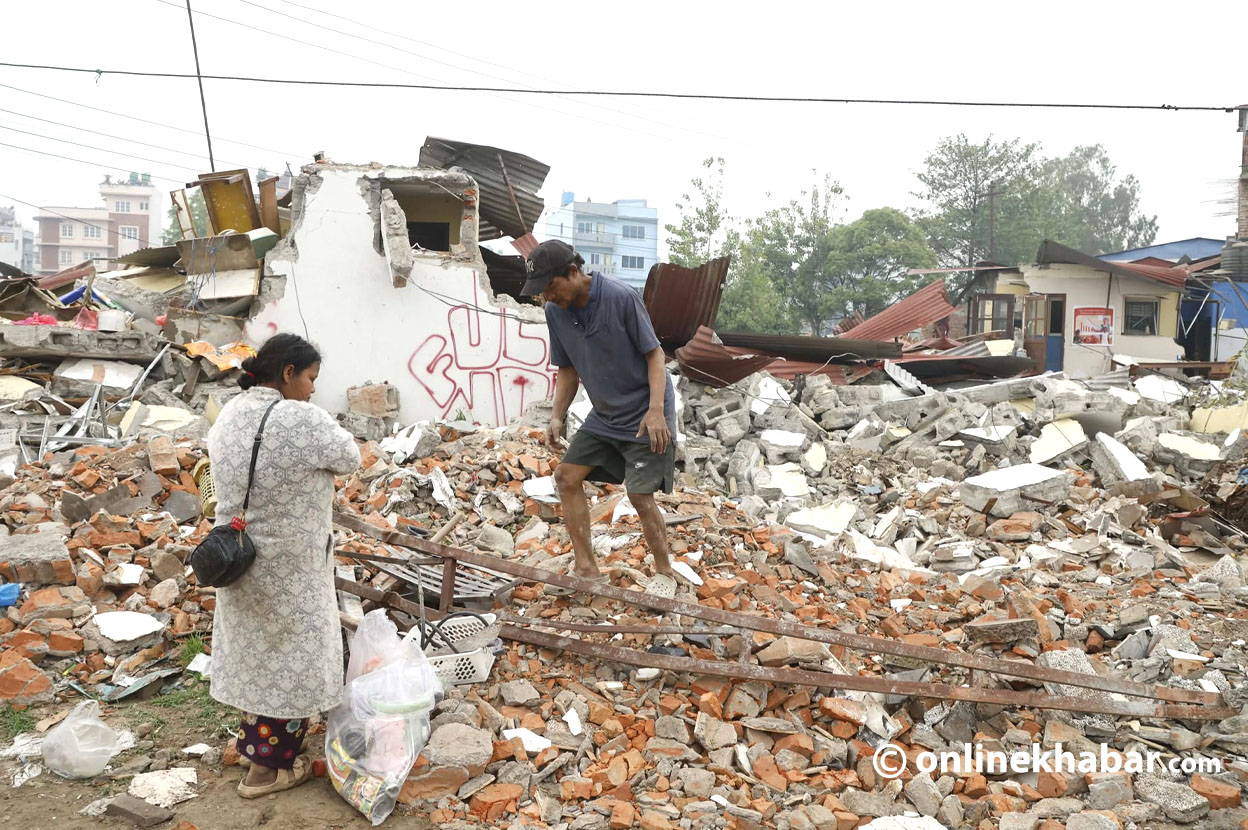
April 27, Kathmandu – The demolition of the remaining informal houses in Manohara’s squatter settlements began early this morning with the assistance of dozers. Starting at 7 a.m., 13 dozers were deployed to dismantle the remaining structures. The demolition had commenced on Sunday morning along the banks of the Manohara River. Since some houses remain, the process is ongoing today. Police forces from Bhaktapur and municipal police teams from Kathmandu Metropolitan City have been deployed alongside the dozers to carry out the operation.
Previously, under the direction of Prime Minister Balendra Shah, houses in squatter settlements located in Thapathali and Gairigaun areas were demolished. The displaced residents from those areas have been managed by municipal police in Kirtipur, Nagarjun, and Bhaktapur. Across the Kathmandu Valley, nearly 27 locations—including along the Bagmati Riverbanks—have experienced encroachment on government land by squatter settlements.
According to written submissions made to the Supreme Court on December 19, 2023, by the concerned party and the empowered Bagmati Civilization Integrated Development Committee, there are 3,496 houses in these areas. Of these, 2,170 are under Kathmandu Metropolitan City, 90 in Kageshwari Manohara, 156 in Budhanilkantha, 215 in Godawari, 17 in Lalitpur Metropolitan City, and 773 in Bhaktapur district. Government data indicate there are approximately 1.5 to 1.6 million squatter families nationwide.
April 27, Kathmandu – Various trade unions active in the civil service sector have appealed not to reduce trade union rights in the Federal Civil Service Bill. They demand full trade union rights for all professionals to organize and become members of their chosen unions as ensured by Nepal’s Constitution and conventions ratified by Nepal under the International Labour Organization (ILO).
In a joint statement, they also called for strengthening the legal protection of rights, participation, and collective bargaining of employees working in public services. The Nepal Civil Service Employees’ Organization, Nepal Civil Service Employees Union, Nepal National Civil Service Employees Organization, Unified Government Employees Organization, Nepal Madhesi Civil Service Employees Forum, and Independent National Servants’ Employees Organization issued the joint statement highlighting these demands.
The Ministry of Federal Affairs and General Administration had publicly released a draft bill on April 24 (Baisakh 11, 2081 BS), concerning the formation, operation, and service conditions of the federal civil service, inviting necessary suggestions as per the Legislative Act, 2081. The unions welcomed this step as a positive development.
However, the draft bill has drawn serious attention from national-level trade unions in the civil service sector for efforts to curtail the existing trade union rights that allow civil servants to organize for their professional interests. The statement emphasized that Nepal’s Constitution, 2015 clearly guarantees under Article 26(2)(c) the freedom of every citizen to form associations and organizations, and under Article 34 the right of every worker to fair labor practices, including the right to form trade unions, participate in them, and engage in collective bargaining.
Moreover, the unions reminded the government that Nepal, as a ratifying member of key ILO conventions, recognizes trade union rights as fundamental labor rights even in public services. These conventions ensure that workers and employees can freely organize under their chosen unions and are entitled to collective bargaining rights.
Apollo 8 astronauts captured a unique photograph of Earth in 1968 known as the ‘Earthrise.’ In 2026, Artemis astronauts took a similar iconic photo of our planet. Comparing these two images reveals the diverse changes our blue planet has undergone.
Apollo 8 commander Frank Borman was amazed when, in 1968, he first saw the lunar surface’s upper terrain through the spacecraft window, marvelling at its strange appearance.
In an interview he gave in 2018, Borman said, “The moon’s surface showed craters from meteorite impacts and remnants of volcanoes. The colors were brown, black, or white. There was no real color on the moon’s surface, and the view was quite desolate.”
But after completing the fourth orbit around the moon, an unexpected scene unfolded.
Borman said, “Looking up, Earth was clearly visible rising from the lunar surface, and Bill Anders took the photograph, which is probably one of the most significant images ever.”
“Earth was the only object in the entire universe with any color. It was a stunning sight. We who live on this planet are indeed fortunate.”
The ‘Earthrise’ photograph became one of the most widely reproduced images ever, inspiring viewers to see our planet against the stark lunar surface and vastness of space, and it helped initiate Earth Day celebrations starting in 1970.
Fifty-eight years later, NASA astronauts captured another impressive Earth photograph set against the moon’s backdrop, called ‘Earthset,’ depicting Earth as it appears setting. Earlier this month, during the Artemis II mission, the crew took a new photo of our fragile blue planet amid the vastness of space.
(The specific astronaut who took the photo is unknown since the four-member crew collectively holds the rights without individual claims.)
Image source, NASA
Image caption, The Earthset photo was taken by the Artemis crew during their seven-hour orbit around the moon.
Geographically, fifty-eight years is not a very long time, yet climate change has brought significant transformations to Earth’s surface over the past six decades. Experts note that differences between the ‘Earthrise’ and ‘Earthset’ images effectively illustrate the changes evident between then and now.
Interestingly, no one at NASA had planned to capture the original Earthrise photo.
“They might have taken that photo purely by chance, right?” said Cian Proctor, pilot of the first full “citizen mission” named Inspiration. “Apollo 8 altered how we view our planet, and that perspective remains crucial, as it continues to inspire.”
Following the Artemis launch, I asked during a press conference about plans to take a new Earthrise photo, and NASA made it clear this time they would make no mistakes.
“We will do everything possible to make that happen,” said Larry Glaze, director of the Exploration Systems Development Mission.
Image source, NASA
Image caption, Earthrise remains one of the most widely reproduced images and helped spark the environmental movement.
The Earthset photo was taken on April 6th at 18:41 Eastern Daylight Time (23:41 BST) through the window of the Orion spacecraft during a seven-hour orbit around the moon.
“Sunlight illuminated Earth’s shell, showing white clouds over Oceania and blue water, with nighttime in the darkened portion. The moon’s surface, craters, and basins are also visible in this photo,” NASA stated.
Compared to 1968, by 2026 numerous satellites capture thousands of daily images of Earth.
These satellites measure oceans, land masses, and ice layers using various methods to monitor ongoing changes on the planet. These images aren’t directly visible to us.
Similarly, continuous video feeds from the International Space Station and robotic spacecraft capturing perspectives of Earth from the moon and beyond provide additional insights.
However, the ‘Earthset’ photo stands apart as it was taken directly by astronauts.
Craig Donlon, head of European Space Agency’s upcoming satellite programs, says, “Photos taken by people give us a different perspective.”
“Human-taken photos are carefully framed and focused. These pictures selected consciously or subconsciously by astronauts carry emotion, evoking awe at the small, beautiful Earth we call home. That is the essence.”
Because of their human connection, the ‘Earthrise’ and ‘Earthset’ images are not only iconic but also reveal environmental changes on Earth over those 58 years.
Richard Allan, climate science professor at the University of Reading, UK, explains, “Since Earthrise, atmospheric carbon dioxide has increased by about a third and global temperatures have risen rapidly—at least one degree Celsius.”
“Human activity has altered land surfaces, transforming our planet visibly from space: expanding cities, dark forests turning into bright agricultural lands, and the drying up of the Aral Sea, which is now less than 10% of its 1960s size.”
Though Earth is often covered by clouds, some changes are visible in these images.
Benjamin Wallis, glaciologist at Leeds University, UK, notes, “While these photographs show various regions, the common element in both is Antarctica and the Southern Ocean.”
“The Antarctic Peninsula is one of the Earth’s most rapidly warming areas, with 28,000 square kilometers of ice having melted.”
Studies show that recent changes in Antarctic ice over the last 10,000 years are unprecedented. Similar effects are seen in other cryosphere regions, where water remains frozen.
Petra Heil, science director at the British Antarctic Survey, states, “We are witnessing dramatic changes today.”
“We have observed significant reductions in seasonal sea ice in both hemispheres, earlier snowmelt, and shortened snow cover periods across North America, Eurasia, and Asia.”
“Based on observations and numerical models, I estimate that 90 to 95 percent of these changes are caused by human activity,” Heil notes.
While these trends are alarming, it is important to remember that damage to our planet was already visible in the 1968 view from space.
Kathleen Rogers, president of the Earth Day Network, observes, “Earthrise revealed Earth’s beauty and the harm it was suffering.”
“I recall the time — during Los Angeles rush hour, smog would obscure even nearby streets, and our rivers were polluted.”
“From afar, Earth looks whole and beautiful; up close, you can see 150 years of progress or damage,” Rogers said.
Frank Borman passed away in 2023, but his Apollo 8 mission legacy lives on, and his words remain relevant for the new generation of lunar explorers: “I believe we will go to the moon and enjoy seeing Earth from there, but many have not yet given that much consideration.”
This article is also available on YouTube, Facebook, Instagram, and Twitter. Visit our channels and pages for more content.
April 27, Kathmandu. Rainfall from Koshi to the Lumbini region has provided some relief during the hot season, but heat persists in the Terai areas west of Lumbini. According to meteorologists, rain is also likely tomorrow in the western Terai region of Nepal, which will help reduce the heat. The Department of Hydrology and Meteorology’s Weather Forecast Division has forecast moderate rainfall accompanied by thunder and lightning over the Terai and hilly regions of all provinces tomorrow, with snow or rain expected in the mountainous areas. Meteorologist Binu Maharjan stated, “From Wednesday to Thursday, there is a possibility of moderate rainfall in many parts of the Koshi province and some areas of Madhesh, Bagmati, Gandaki, Lumbini, and Sudurpashchim provinces.”
According to the Department of Hydrology and Meteorology, while the Terai regions of Lumbini and Sudurpashchim provinces are expected to experience hot weather today, the onset of rainfall starting tomorrow will bring cooler temperatures. Many parts of the central and eastern regions witnessed rainfall on Sunday, which helped reduce the heat as well as wildfires and pollution. However, some areas also suffered damage due to strong winds and hailstorms. The department noted that this week, weather will remain cloudy with rain due to the partial influence of westerly and local winds as well as a low-pressure area near the eastern part of the lower atmosphere.
In the past 24 hours, the highest rainfall was recorded in Musikot, Gulmi, where 78.2 millimeters of rain was measured. Rainfall of 48.4 millimeters was recorded in Aapchaur, 35 millimeters in Badigad Rudraveni, and 18 millimeters in Bharsé, causing floods in local small rivers and streams. Additionally, 45.6 millimeters of rain fell in Seulibang, Pyuthan, and 40 millimeters in Kechana, Jhapa. Kathmandu Valley also experienced rainfall yesterday, with the highest measurement of 26.2 millimeters recorded in Naikap.
Spain has initiated a legalization process for immigrants who arrived before December 31, 2025, open until June 30, 2026.
The Spanish Consulate in Kathmandu announced that from April 24, 2026, it will no longer certify Nepali documents; all certifications must be done through the Embassy of Spain in Delhi.
Within five days of opening, over 130,000 applications were submitted in Spain’s extraordinary legalization process, with approximately 3,000–4,000 police report certifications still pending.
April 26, Barcelona – Spain’s extraordinary legalization program for immigrants has sparked great hope among thousands of Nepalis. However, this hope has now been clouded by administrative hurdles and paperwork complications.
The Spanish government launched this procedure to grant legal status to immigrants who arrived before December 31, 2025, and have been continuously residing there for at least five months. The opportunity is open only until June 30, 2026.
A criminal background certificate (police report) is mandatory for the process. Consequently, thousands of Nepalis residing in Spain have simultaneously applied for these police reports.
Even after obtaining the police report, applicants were required to have the documents certified by the Spanish Consulate in Kathmandu. This has led to heavy crowds and long waits in recent weeks at the consulate, where thousands are queuing for document certification. However, a significant change has recently been implemented during this process.
From April 24, 2026, the Spanish Consulate in Kathmandu has been temporarily stripped of the authority to certify Nepali documents.
Following instructions from Spain’s Ministry of Foreign Affairs, such certifications must now be conducted solely through the Spanish Embassy in New Delhi, India. This decision has complicated the procedure significantly.
What was expected to be a local document certification process in Nepal now requires documents to be sent to Delhi and then to Madrid, increasing time, costs, and procedural uncertainty.
The Spanish Consulate in Kathmandu stated in a notice issued on April 24, 2026: “In accordance with directives from the European Union and the Ministry of Foreign Affairs, the authority and responsibility to legalize signatures on Nepali public documents have been revoked with immediate effect until further notice.”
The notice further clarifies that all future document legalizations must be processed through the Spanish Embassy in New Delhi.
Cross-border complications arise
For Dilbahadur Kshetri of Pokhara Metropolitan City-22, this opportunity has turned from a source of joy into a cause for concern. “My son stayed awake all night queuing at the municipal office to obtain the ‘Certificado de Vulnerabilidad’,” he explains. “We finally had hope of getting the papers, but now that hope is stuck here in Nepal.”
According to the latest notice from the Spanish Consulate in Kathmandu, Nepali documents will no longer be certified locally but must be sent to the Spanish Embassy in New Delhi. This has prolonged the process, increased expenses, and added uncertainty.
Dilbahadur adds, “There were already long lines, delays, and crowds. Now we have to physically take the documents to Delhi, meaning even more time will be required.”
He continues, “We had registered our names at the consulate, hoping to be called, but then this announcement came. What should we do? Do we need to go directly to Delhi? Do we need appointments there? We have no clear information. It’s causing great confusion and stress.”
“Fear of losing the opportunity caused sleepless nights”
Another voice of concern comes from Kavita Rai in Kathmandu’s Kapan area, who arrived in Spain eight months ago. She has prepared all necessary documents to participate in Spain’s legalization program, but is stuck with the final hurdle of police report certification.
“Only certification from the Spanish Consulate was pending on the police report,” she explains. “But they told us it would take at least two months to get an appointment.” Her husband has been visiting the consulate regularly with no success. “He went on Thursday and Friday but returned empty-handed both times.”
Now the issue has become more complicated. “The new notice says certification must be done in Delhi,” Kavita shares. “This has increased my anxiety and fear that this golden opportunity might slip away. Thousands of Nepalis like me are living in mental distress. Without proper paperwork here, work is impossible.”
She asks, “Where can we turn for help? The Nepal government, the Spanish Embassy in Delhi, and the Consulate in Kathmandu need to understand and address this problem immediately.”
“Documents ready but process stalled”
Bimala Moktan from Nuwakot shares a similar story. She has nearly completed two years in Spain. The “Open Immigration” legalization process had given her hope, but now that hope hangs in limbo.
“I expected the police report certification to be handled by the consulate,” she remarks, “but when I sent my sister there, she was only asked to register her name and sent back.”
While waiting for her turn, the situation further deteriorated. “Now they say I have to go to Delhi,” Bimala explains. “Who will go? Costs and complications have increased, and we’re unclear about the procedures there. We lack official information.”
She continues, “All documents are ready, but the process is stopped because we can’t get the police report certified in Nepal.”
Many others share her predicament. “Thousands of Nepalis like me are facing the same issue,” she says. “The fear of losing this opportunity is adding to our stress.”
Santosh Shrestha, President of the Non Resident Nepali Association (NRNA) in Spain, describes the situation as increasingly serious. “Many people are already discouraged,” he says. “While passport issues remain unresolved, new problems have emerged. Some passports have still not arrived at the embassy.”
He explains that certification through the consulate was already complex, but the new requirement to travel to Delhi has compounded the difficulties. “This is very distressing news for Nepalis living here,” he states. “The temporary suspension of the Kathmandu consulate’s certification authority is especially unfortunate at such a critical moment.”
Shrestha notes the extended process: “After certification in Delhi, documents must be taken to Madrid for legalization. Only about two months remain to submit all documents by June 30.”
Approximately 3,000–4,000 police reports are still awaiting certification, impacting a large number of Nepali immigrants. NRNA is preparing to issue guidance on how to ease certification procedures in Delhi soon.
He also emphasizes the urgent need for diplomatic intervention by the Nepal government to resolve this crisis. “The Nepal government must act swiftly through diplomatic channels to address this issue,” he urges.
130,000 applications received in five days
Meanwhile, within five days since the extraordinary legalization decree came into effect in Spain, 130,000 applications have been submitted. According to Spain’s Ministry of Social Security and Migration, appointments have been scheduled for 55,000 applicants up to April 30.
This represents approximately 26 percent of the government’s target of legalizing 500,000 immigrants.
On the first day of the decree’s implementation, long lines and disorder were observed nationwide. Especially in Catalonia, the demand for the “Certificado de Vulnerabilidad” overwhelmed social service offices, making this document a major bottleneck. Originally optional, it became mandatory in some cases after recommendations from the State Council.
840,000 irregular immigrants in Spain
Prior to this, Spain had conducted nine extraordinary immigrant legalization programs between 1986 and 2005, which granted legal status to over a million immigrants.
According to a 2025 report by the analysis center Fuenlabrada, the number of irregular non-European immigrants in Spain is about 840,000.
Of these, approximately 760,000 are from the Americas, with Colombians (about 290,000), Peruvians (about 110,000), and Hondurans (about 90,000) comprising the largest groups.
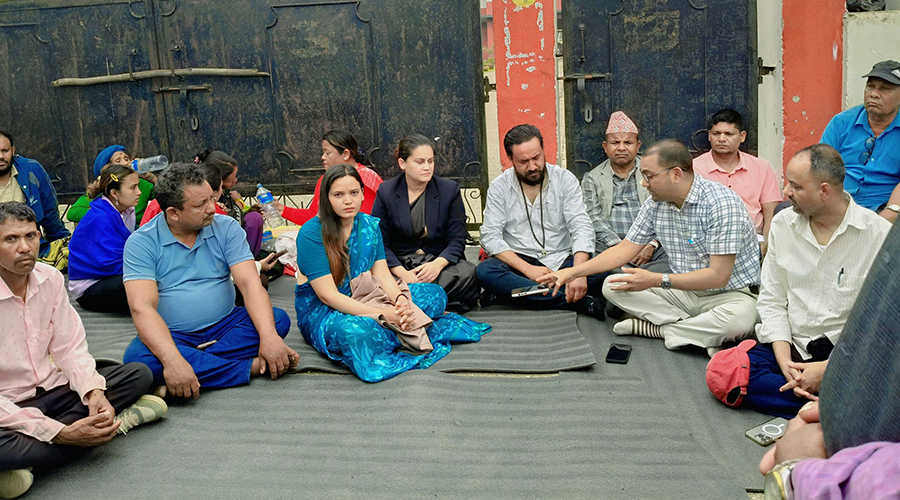
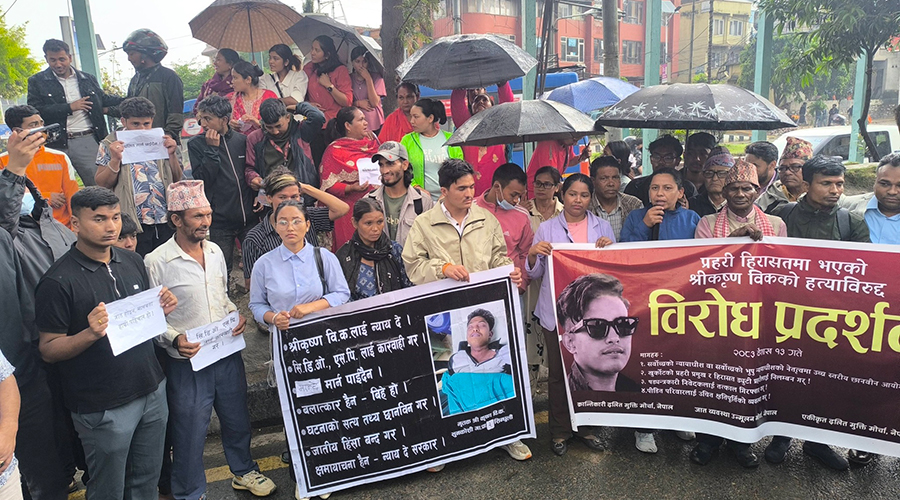
Following the suspicious death of Dalit youth Shreekrishna Bik in police custody in Sindhuli, six MPs from Rastriya Swatantra Party (Raswapa) and CPN held a sit-in protest in front of the district administration office.
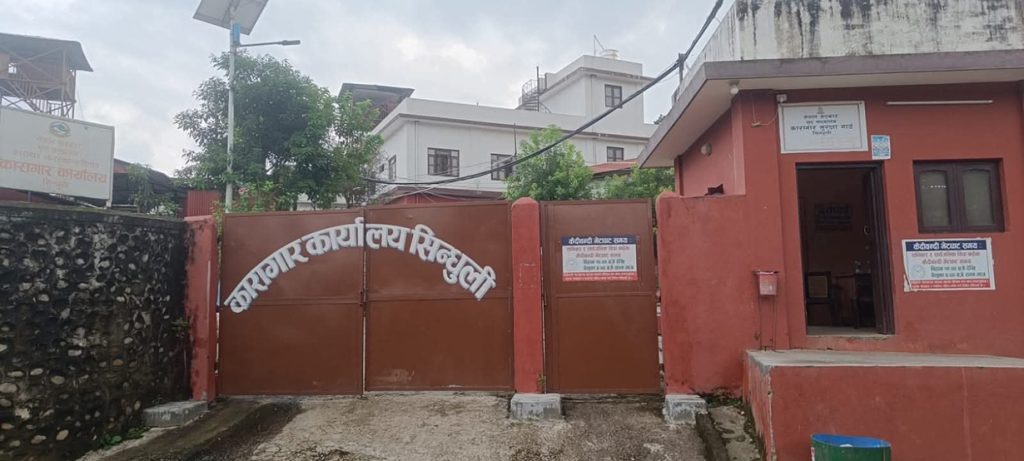
The police claim that after filing a rape complaint against Shreekrishna, he was sent to Sindhuli and committed suicide while in Khurkot custody, but his family suspects foul play.
Inspector General of Police Dan Bahadur Karki has formed an investigative committee chaired by DIG Dinesh Kumar Acharya to probe the case, yet the family and MPs demand a fair investigation.
April 13, Kathmandu – On Thursday evening (April 10), six parliamentarians staged a sit-in protest at the gate of the District Administration Office in Sindhuli. Among them, five were MPs from Rastriya Swatantra Party (Raswapa), currently close to a two-thirds majority in government.
The protesters included Raswapa MPs Khagendra Sunar, Rima Bishwakarma, Sushma Swarnakar, Khima Bishwakarma, Ashish Gajurel, and CPN MP Ganesh Bik.
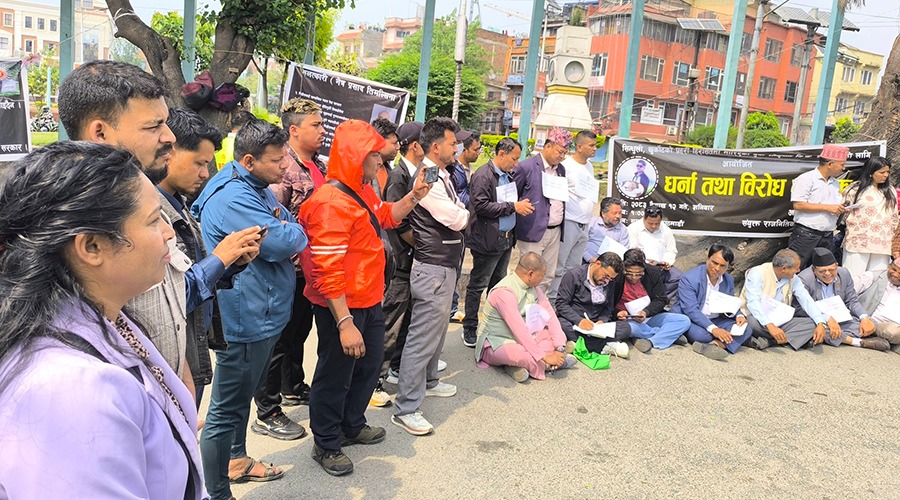
Except for Gajurel, all are Dalit representatives. Gajurel is an MP representing the constituency where the protest took place. The sit-in continued on Friday and expanded to Maitighar, Kathmandu, on Saturday.
The protest also drew participation from former lawmaker Bimala Bik, Laxmi Pariyar, J.B. Bishwakarma, President of the Dalit NGO Federation, Vice President Sushila Bik, General Secretary of the Dalit Women’s Centre Gauri Nepali, among others.
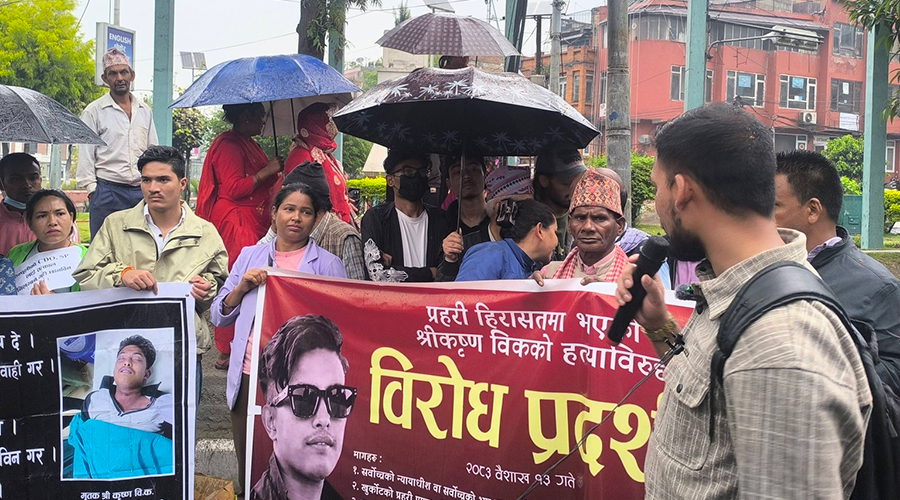
All these Dalit MPs and activists share a common commitment: “Justice for Sindhuli’s Shreekrishna Bik, who died suspiciously in custody.” On Sunday, family members of the victim and other Dalits held a sit-in at Maitighar.
Although 275 MPs were elected to the House of Representatives on February 21 with a commitment to political, economic, and social justice, only Dalit MPs and activists have so far demanded an impartial investigation into the suspicious death of Dalit youth Shreekrishna Bik in custody. It appears that while other issues concern everyone, Dalit issues are considered solely theirs.
Apart from one CPN MP, all those protesting belong to the ruling Raswapa. MPs from other parties and non-Dalit representatives appear unaffected by this incident. The Nepali Congress’s reaction was limited to a press statement. On April 11, their Central Working Committee expressed concerns and called for a fair investigation.
The UML party did not even dare to issue a statement. Despite a CPN MP participating in the protest, the party has not made this an issue.
Harka Sampang, chairperson of the Fifth State Power Labor Culture Party, has consistently spoken out about squatters on Facebook but remained silent on this Sindhuli incident.
Shreekrishna Bik’s death came shortly after Raswapa apologized to the Dalit community for historic oppression—less than a month after Raswapa Chairperson Ravi Lamichhane offered a public apology on the House floor on March 19.
“When in doubt if a mistake happened, Khagendra Sunar apologized. Have we been apologizing for centuries of injustice against Dalits?” Lamichhane said. “To the Dalit community of this country, I want to say: this government is publicly and collectively asking forgiveness from this House for centuries of discrimination, injustice, and oppression.”
Lamichhane emphasized that the discrimination and injustice faced by Dalits are organized crimes and that “no Nepali will feel insulted based on caste from now on.”
However, less than a month after this declaration, Shreekrishna’s love marriage was forcibly broken because he was Dalit, leading to his death. The Dalit youth, in an inter-caste relationship, was taken from Satdobato, Lalitpur to Sindhuli, where he mysteriously died in police custody at Khurkot.
Though some Raswapa MPs raised the issue of Shreekrishna, the party that apologized to Dalits has not officially spoken on the matter. No official party stance has been made public.
This demonstrates a developing political culture that confines caste-based violence to Dalit issues alone.
Shreekrishna’s mysterious death reflects not just a family tragedy but also serves as a mirror to the structural psychology of the Nepali state. Similarly, the decade-old case of Ajit Mijar’s body in the forensic department of the Teaching Hospital shows the same pattern: Dalits speak, while others listen. This is not coincidence but a structural trend.
How Did an Inter-Caste Love Relationship Become a Rape Case?
According to the victim’s family and police, Shreekrishna Bik and the girl who filed the rape complaint were acquaintances for about two years. The victim’s uncle, Labikumar Bik, said, “They reportedly had a love relationship for around two years.”
Yet, a rape case was filed against Shreekrishna, which ultimately led to his death. Initially, no rape complaint was reported to the police.
The girl lived in the same Satdobato area. Her family filed a report on March 30 after she went missing on March 28. SP and spokesperson of Lalitpur Police Gautam Mishra explained that the girl’s family requested a search.
On April 3, the missing girl and Shreekrishna visited the Satdobato police station with their relatives. According to SP Mishra, the girl’s relatives filed a written rape complaint at that time.
“Since the victim was only 16, the law does not permit marriage even with consent, so it was impossible to settle the matter through mutual agreement,” SP Mishra explained.
On April 4, the Satdobato police sent Shreekrishna to Sindhuli with a police team. Subsequently, Khurkot Police Office registered the rape case and began investigation.
“The law prohibits marriage for persons under 16. Since a complaint was filed, investigation was necessary,” said Sindhuli Police Chief SP Lal Dhwaj Subedi.
MP Khagendra Sunar, vocal about Shreekrishna’s death, revealed that the girl was allegedly coerced into signing the complaint. “Her uncle was a policeman. After threatening that they would accept the relationship only if the boy stayed separate, she was tricked into signing the document, which was a rape complaint,” Sunar stated.
Though sent to Sindhuli after the complaint, Sunar voiced that dying in custody is a serious concern.
Shreekrishna’s uncle Labikumar said that after receiving a call from the girl’s side proposing marriage, Shreekrishna was brought to Kathmandu from Sindhuli, but police lodged him at Satdobato Police Station, which he alleges led to the tragic outcome.
The deceased Bik.
How Did the Death Occur?
Upon arriving at Khurkot Police Office, Shreekrishna’s uncle Labikumar stated that he advised Shreekrishna to admit any mistakes, maintain calm, and not be afraid.
Police called the family on April 3 and on April 4 transferred Shreekrishna to Khurkot, where the police obtained a seven-day extension to continue investigations.
According to SP Lal Dhwaj Subedi, he was kept in judicial custody at Khurkot because legal proceedings were ongoing.
Shreekrishna was kept alone in custody. Under Inspector Commander Basant Bhujel’s leadership, 23 police personnel were stationed at Khurkot. On April 7, when he was to be transferred to Sindhuli for legal matters, relatives did not visit.
The family was informed that Shreekrishna committed suicide at 6 PM by hanging himself with a black shirt in the custody bathroom and was taken to Sindhuli hospital, where he died during treatment, according to SP Subedi.
He dismissed rumors of police beating and murder, noting that the investigation committee was formed even before the post-mortem. Nevertheless, he admitted that death in custody is tragic and reflects police lapses.
Family’s Account: Suspicious Circumstances
Despite police claims that Shreekrishna hanged himself, the family refuses to accept this. They argue that as he was the only detainee in custody, no other prisoners could have been involved. Hence, they suspect police involvement.
“Though police claim he hanged himself, they have not shown us the photo. We have not seen CCTV footage. There are bruises on his body,” said uncle Labikumar Bik.
MP Sunar also labeled the incident mysterious, alleging that after coercion into a rape complaint and subsequent threats, the girl chose to stay with Shreekrishna. He further asserted that police tortured him when she considered leaving.
“All these events followed by such a sudden death make the police responsible. A five-foot man cannot hang himself in a three-foot window,” expressed Sunar’s doubts.
The family demands an investigation and punishment for those responsible.
Shreekrishna’s mother, Nandamaya Bik, has come to Kathmandu seeking justice for her son.
The National Dalit Commission has also met IGP Dan Bahadur Karki to demand a fair investigation. Chairman Devaraj Bishwakarma said, “We have requested a fair investigation and brought this to the police chief’s attention.”
Police Investigate Police?
Following the suspicious circumstances, IGP Dan Bahadur Karki formed an investigative committee on Friday. The committee, signed by Karki, is chaired by DIG Dinesh Kumar Acharya and includes officials from the National Police Training Academy Maharajgunj, UN branch SP Ravindranath Paudel, Central Investigation Bureau Inspector Indrajit Sunar, Kathmandu Valley Crime Investigation Office Inspector Prem Regmi, and Assistant Police Inspector Rajeshwar Devkota. They were given seven days to complete the probe.
The team has already started investigating in Sindhuli. However, given suspicions about police involvement, questions remain about how credible a police-led investigation can be. Former DIG Hemant Mall agrees.
“This is an internal police investigation with no outside members. If dissatisfaction persists, the government may need to form another committee,” he said.
The committee will examine police negligence and areas needing improvement. Once the post-mortem report is out, the death circumstances will become clearer, Mall added. “Hanging cases are usually clarified by post-mortem reports.”
Given doubts about police roles, the possibility of a judicial or parliamentary inquiry is also being discussed.
Who Was Shreekrishna?
Shreekrishna Bik, 23, was from Jumli Danda, Ward No. 3, Sunkoshi Rural Municipality in Sindhuli. A vehicle driver by profession, his family depended on him after his father died a few years ago.
He was the youngest among five brothers. Shreekrishna had been supporting the family, and the brothers had even taken a loan to buy another vehicle.
In a longstanding love relationship, Shreekrishna had brought his girlfriend from Khotang to his home in Jumli Danda on March 28.
Why Do Suspicious Deaths in Custody Continue?
Shreekrishna is not the first to die suspiciously in custody. Numerous such deaths have occurred, affecting Dalits and non-Dalits alike.
These incidents raise repeated questions about the role of police within their own detention facilities, which remain largely unreformed despite reports of torture.
The Human Rights Commission occasionally monitors detention centers, noting their unsuitability for habitation and citing ongoing torture, while suggesting reforms. Despite this, custody deaths persist.
Former DIG Mall emphasizes the need to improve police duties. “When the police arrest someone, questions naturally arise if any incident happens. Most custody deaths involve hanging in bathrooms without CCTV coverage. When families fail to trust the police, problems follow,” he stated.
He insists on necessary reforms in custody facilities and police conduct to prevent deaths. Without improvements, incidents like the one in Sindhuli may continue.
April 27, Kathmandu – According to the exchange rates set by Nepal Rastra Bank for today, the value of the US dollar remains stable. However, the Australian and Canadian dollars have seen an increase in value. The buying rate for the US dollar is fixed at NPR 150.50, and the selling rate at NPR 151.10. Similarly, the European euro has a buying rate of NPR 176.37 and a selling rate of NPR 177.07. The British Pound Sterling is priced with a buying rate of NPR 203.66 and a selling rate of NPR 204.48. The Swiss franc stands at a buying rate of NPR 191.68 and a selling rate of NPR 192.45.
The Australian dollar’s buying rate is NPR 107.65 with a selling rate of NPR 108.08. The Canadian dollar is set at a buying rate of NPR 110.11 and selling rate of NPR 110.55. Singapore dollar buying rate is NPR 117.94 and selling rate is NPR 118.41. The Japanese yen’s buying rate is NPR 9.44 per 100 yen and selling rate NPR 9.48. The Chinese yuan is priced at NPR 22.01 for buying and NPR 22.10 for selling. Saudi Arabian riyal buying rate is NPR 40.12 with a selling rate of NPR 40.28, while Qatari riyal buying rate is NPR 41.28 and selling rate NPR 41.45.
According to the central bank, the Thai baht’s buying rate is NPR 4.65 with a selling rate of NPR 4.67. UAE dirham is set at NPR 40.97 for buying and NPR 41.14 for selling. Malaysian ringgit is fixed at NPR 37.96 buying and NPR 38.11 selling. South Korean won stands at NPR 10.19 per 100 won buying rate and NPR 10.23 selling rate. Swedish krona’s buying rate is NPR 16.35 with a selling rate of NPR 16.41. Danish kroner buying rate is NPR 23.61 and selling rate NPR 23.70. Nepal Rastra Bank has set the Hong Kong dollar at a buying rate of NPR 19.21 and selling rate of NPR 19.28. Kuwaiti dinar is priced at NPR 490.87 buying and NPR 492.82 selling. Bahraini dinar has a buying rate of NPR 398.60 and selling rate of NPR 400.19, while Omani riyal’s buying and selling rates are NPR 390.90 and NPR 392.46, respectively. The Indian rupee is set at a buying rate of NPR 160.00 and a selling rate of NPR 160.15.
The central bank has announced that it may revise these exchange rates at any time as required. Commercial banks may offer different rates, and updated exchange rates will be available on the central bank’s official website.
The government led by senior leader Balendra Shah of the Rastriya Swatantra Party has committed to creating a national commitment document within its first month, incorporating the electoral manifestos of all parties.
The government has decided to ensure that 10 percent of hospital beds in both public and private hospitals are allocated free of charge to the impoverished and destitute patients, with strict implementation.
The government has decided to remove squatter settlements and has committed to certifying landless individuals and providing land, though the process remains controversial.
April 13, Kathmandu. The government formed under the leadership of senior leader Balendra Shah of the Rastriya Swatantra Party (RSP) has shown some positive signs within its first month in office. A prime example is its commitment to integrate positive aspects of all political parties’ manifestos into a unified national commitment.
On the day the government was formed, March 27, the cabinet approved a 100-point governance reform plan, with the third point emphasizing preparation of a ‘national commitment’ by incorporating electoral manifestos, pledges, and commitments from all participating parties, establishing government ownership of the document.
The government has drafted the ‘national commitment’; whether it gains momentum will become clear with time. However, this represents a promising start. As the ancient Greek philosopher Aristotle said, a good beginning is half the work done.
Despite the tendency in coalition governments for coalition partners to criticize good policies and programs introduced by others due to ideological differences, the Balendra-led government’s approach deserves praise for setting an example.
This decision signals a move away from opposition purely for opposition’s sake. This change in mindset is significant and could foster a culture where future governments acknowledge the positive aspects of opposition parties.
Former secretary Sharad Prasad Trital remarks that the initial signs from RSP, which secured almost two-thirds of the votes, are positive. He says, “The work done by this government within its first month is different compared to previous ones. While past governments were preoccupied with meetings and unnecessary expenses, this government has given a message of hope.”
Experts note that the government’s commitments to administrative reform, good governance, and improved service delivery are starting to show results. Prime Minister Shah has been operating governance from the Singha Durbar office and has kept the Council of Ministers office active rather than the traditional Baluwatar residence.
Other cabinet members have reduced unnecessary meetings and inaugurations common in previous administrations. Service recipients have begun to see improvements.
Prime Minister Shah’s collective discussions with heads of foreign embassies have been viewed positively. Foreign Minister Shishir Khanal clearly stated that although the government has changed, foreign policy will remain consistent.
However, the government’s buffer state issues mentioned in the manifesto have faced criticism. Having made education scholarships transparent as mayor, Shah has made a similar decision in the health sector. The decision to provide free treatment for 10 percent of beds for impoverished, helpless, and abandoned patients in both public and private hospitals has received widespread praise.
Experts say that this arrangement is necessary due to lack of ease of access to health services in Nepal.
Public health expert Dr. Rita Thapa suggests making the 10 percent free beds in private hospitals more transparent and ensuring fully free treatment for the impoverished in public hospitals. She also advocates for more effective implementation of health insurance.
According to an Oxfam International report, the richest one percent of Nepal’s population has 519 times more wealth than the poorest 50 percent.
The government has formed an Asset Investigation Commission to collect and scrutinize asset details from senior political officials and high-ranking discharged employees holding public positions. If the commission conducts impartial and effective investigation, it could become a major milestone for good governance.
Efforts to eliminate intermediaries and streamline services in agencies frequently crowded with service seekers like Land Revenue, Passport Department, and District Administration Offices appear positive, though only time will tell if these changes are sustained.
The RSP has also shown efforts to end party factionalism and syndicates, challenging citizens not to become mere party members.
The decision to disband employee unions and student organizations has received mixed reactions. The decision to remove squatter settlements is also controversial. While criticized from human rights and constitutional perspectives, it has been welcomed legally and executive-wise.
Senior advocate Rajuprasad Chapagain expresses dissatisfaction with the investigation and certification process carried out during the settlement removals, stating, “Eviction followed by certification is like a penal procedure.”
The problem of squatter settlements is not new and can be resolved according to constitutional and legal frameworks. There is legal clarity on providing land to landless Dalits and squatters.
However, landless people complain about the lack of humane treatment from the government. Pawan Gurung, vice-chairman of the United National Squatters’ Front, calls the eviction process incomplete and flawed. He accuses police of initiating action without any prior negotiation, calling it inhumane.
Gurung says, “Squatters should have been relocated to proper places only after certification. Had that been done, this step would have been welcomed.”
As a guardian of all, the government’s actions must have legitimacy and recognition. According to British Chief Justice Lord Hewart, justice must not only be done but also seen to be done.
Yet hasty government decisions are raising questions about legality and acceptance.
Political analyst Ramchandra Shrestha described the government as active but unclear about its direction. Based in Butwal, he comments, “The government is action-oriented, but the lack of dialogue and parliamentary consensus leads to confusion about its path.”
Constitutional expert Dr. Bipin Adhikari noted the government’s good start on squatter issues. While acknowledging some problems, he believes the government is undertaking necessary work.
The government had committed to collecting costs and certifying within two months and providing land within 1000 days under its 100-point governance reform initiative. Progress is evident in this regard.
Nonetheless, some activities appear rushed and incomplete, Dr. Adhikari says, pointing out that legal procedures were not fully observed in the arrests of former Prime Minister KP Sharma Oli and ex-Home Minister Ramesh Lekhak.
In his main report, he stated, “The arrests of the former prime minister and ex-home minister were unlawful.”
While the government’s intent may not be misguided, stakeholders caution that constitutional and legal compliance is lacking. The federal government issuing directives that challenge the constitutional rights of provinces and local governments has been controversial.
The constitution’s Schedule 8 vests the authority for basic and secondary education with local governments. When the federal government unilaterally decided when and how long schools should remain open, schools’ associations and the National Rural Municipalities Federation opposed the move.
Although the government planned to open schools after April 21, most schools have already resumed operations.
The government’s immaturity became evident during the parliamentary session convocation. The session began on April 9 following the president’s recommendation on April 8, but the government recommended postponement the very next day.
Experts describe this as not only immaturity but a repeat of the old practice of bypassing parliament and resorting to ordinances, unexpected given the two-thirds majority.
Less than a month into office, two ministers resigned: Home Minister Sudhan Gurung and Labor Minister Deepak Sah, exposing the government’s weak tolerance. This is considered a mistake in personnel selection.
A task force has been formed for the constitutional amendment white paper. Previously constitutional commissions were led by prominent elders, but this time the administrative approach has drawn criticism.
Constitutional expert Dr. Bipin Adhikari urges a positive perspective towards the task force’s initial draft.
Sociologist Ajay Yadav states that the government amid political instability has earned substantial hope and trust from the public. Teaching at Ram Swarup Ramsagar Multipurpose Campus in Janakpur, Yadav remarks, “People voted with hope, pinning their expectations on one individual due to past disappointments. Hence, aspirations are high, and current work looks promising. The enthusiasm exceeds caution; balance is needed.”
Nepal is set to participate in the 22nd World Kempo Championship held in Antalya, Turkey, with a 16-member team. The Nepal Kempo Khukuri Federation’s team, led by President Pavel Shah, departed for Turkey on Monday. The athletes expressed confidence in winning medals across various weight categories and disciplines, aiming to bring honor to the country.
The championship is taking place from Monday until April 26 in Antalya, Turkey. Representing Nepal, 6 male and 4 female athletes will compete. Among the women, Anjana Shahi will participate in the Semi Kempo 50 kg category, Prisha Rajyalaxmi Shah in Semi Kempo 22 kg, Ayra Gautam in Semi Kempo 25 kg, and Monalisha Dhami in Semi Kempo 60 kg.
Federation President Pavel Shah informed that Anjana will also compete in Kata and Self Defense events. On the men’s side, Suresh Parajuli will compete in Semi Kempo 65 kg, Sulabh Shrestha in 30 kg, and Kridix Bikram Kunwar in 25 kg. Dilman Lama will participate in 25 kg Full Kempo, as well as Kata and Self Defense disciplines.
During the send-off event, President Pavel Shah expressed his confidence that the athletes, through their dedication and rigorous preparation, will perform exceptionally and secure numerous medals for Nepal. He stated, “Our athletes have been training hard and with great commitment. We are confident they will deliver outstanding performances and bring many medals home for Nepal.”
A hailstorm on April 25 caused extensive damage to apple orchards in Dolpa. The hail destroyed all apple blossoms and developing fruit across areas including Tripurasundari Municipality. Farmers have been pushed into financial distress due to the lack of crop insurance, prompting calls to the government for relief measures and the implementation of insurance schemes. April 25, Dolpa.
In this Himalayan district, heavy rain accompanied by hail on Saturday evening severely impacted apple orchards. The hailstorm damaged apple trees in multiple locations considered major production centers, including Tripurasundari Municipality—wards 3 Jiu, Sun, 4 Rang villages, Dangiwada in Thulibheri, Jufal, and Thala, according to affected farmers.
Ram Bahadur Gurung, operator of Mahadev Fruit and Garden Industry in Tripurasundari-3, reported that approximately half an hour of hail caused all recently blossomed apple flowers and newly formed fruitlets to fall and perish. He stated, “A brief hailstorm destroyed a year’s worth of hard work. Last year, income from apple farming ranged between NPR 300,000 to 500,000, but due to the hail, the expected yield this year will not be realized.”
Natural disasters have placed Dolpa’s apple farmers at significant economic risk, compounded by the absence of crop insurance. While districts such as Jumla, Manang, and Mustang have established apple crop insurance, farmers in Dolpa lament the lack of similar effective provisions. Govinda Bahadur Mall, head of the National Agriculture Modernization and Program Implementation Office, noted ongoing efforts to provide insurance for apple growers, though interest remains insufficient. Dolpa farmers have urged the government to conduct fair damage assessments, provide immediate relief, and implement crop insurance schemes promptly.
Residents displaced from Thapathali and Gairigaun were relocated without force by security personnel to the Radhaswami Satsang Byas Ashram in Kirtipur.
The Kathmandu Metropolitan City arranged temporary accommodation for 232 individuals at the ashram, with only 132 having eaten meals on Sunday.
Displaced residents expressed concerns about living conditions at the new location, as well as education and healthcare arrangements for their children.
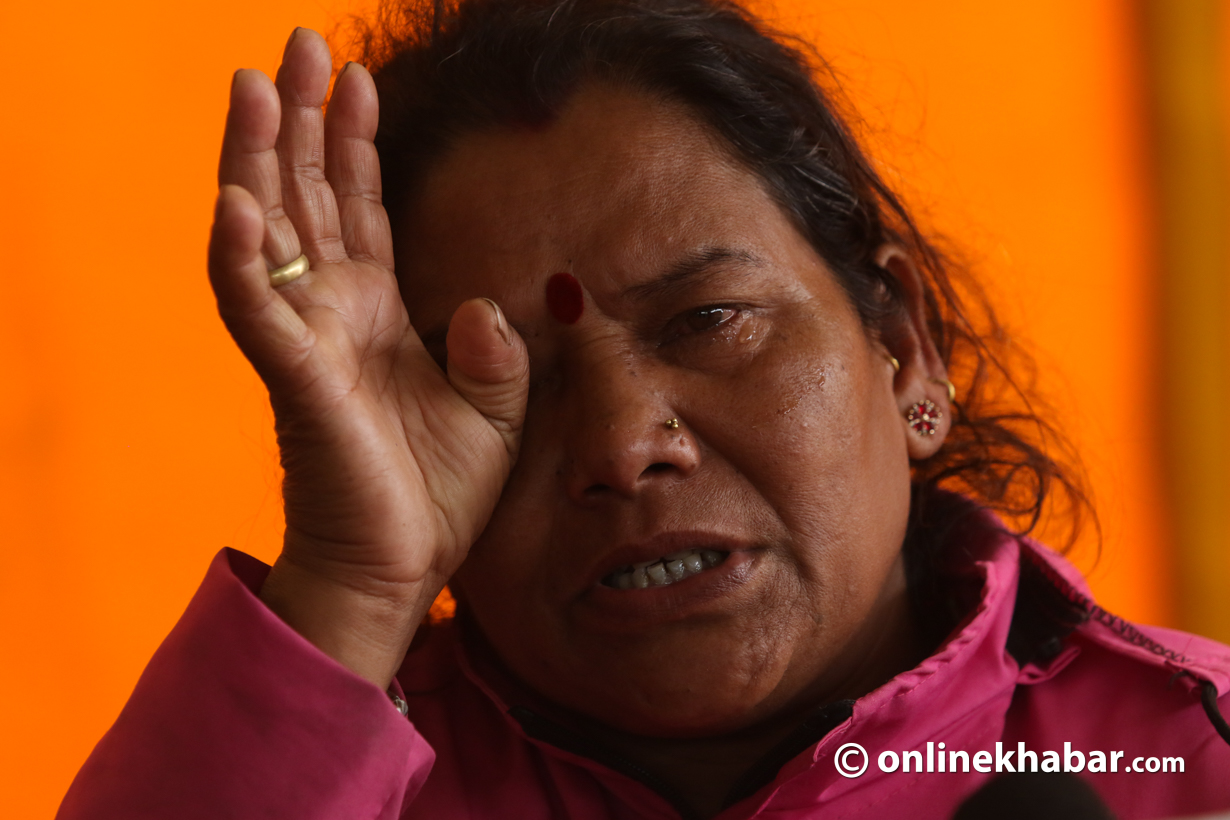
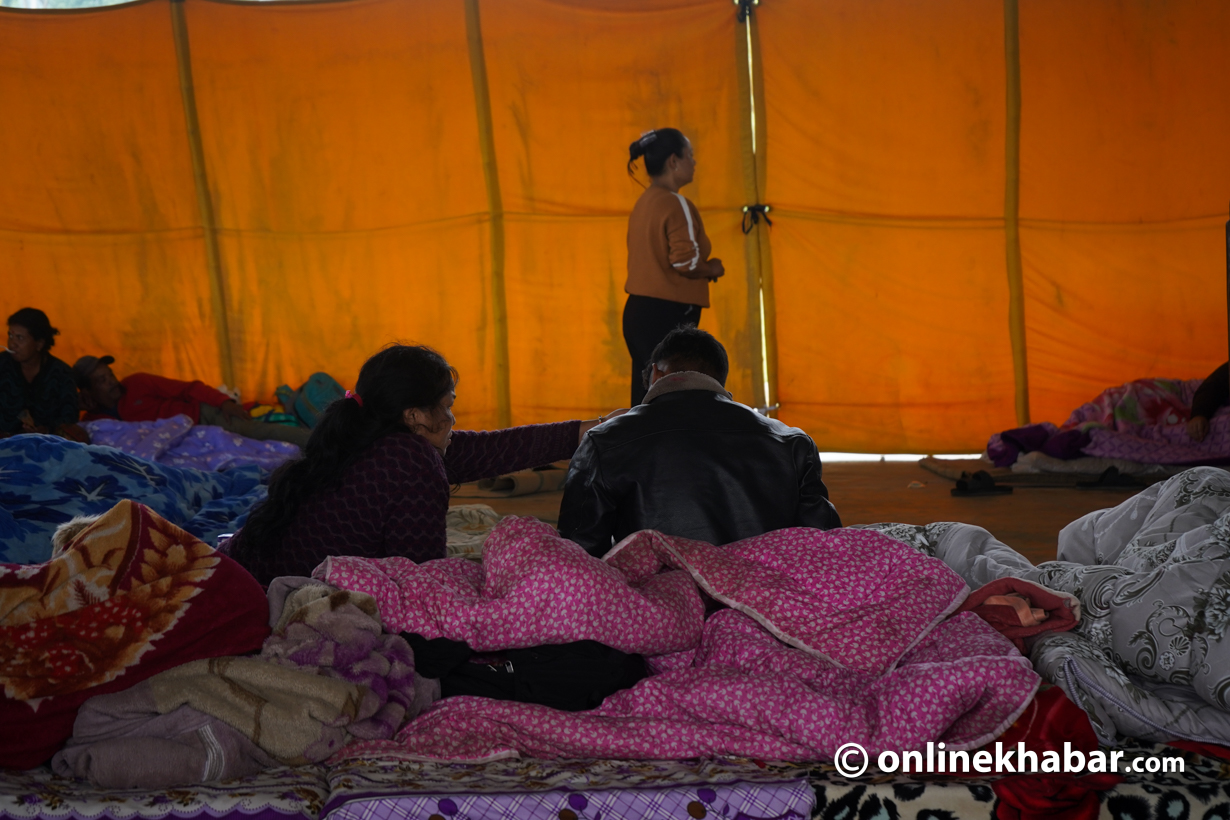
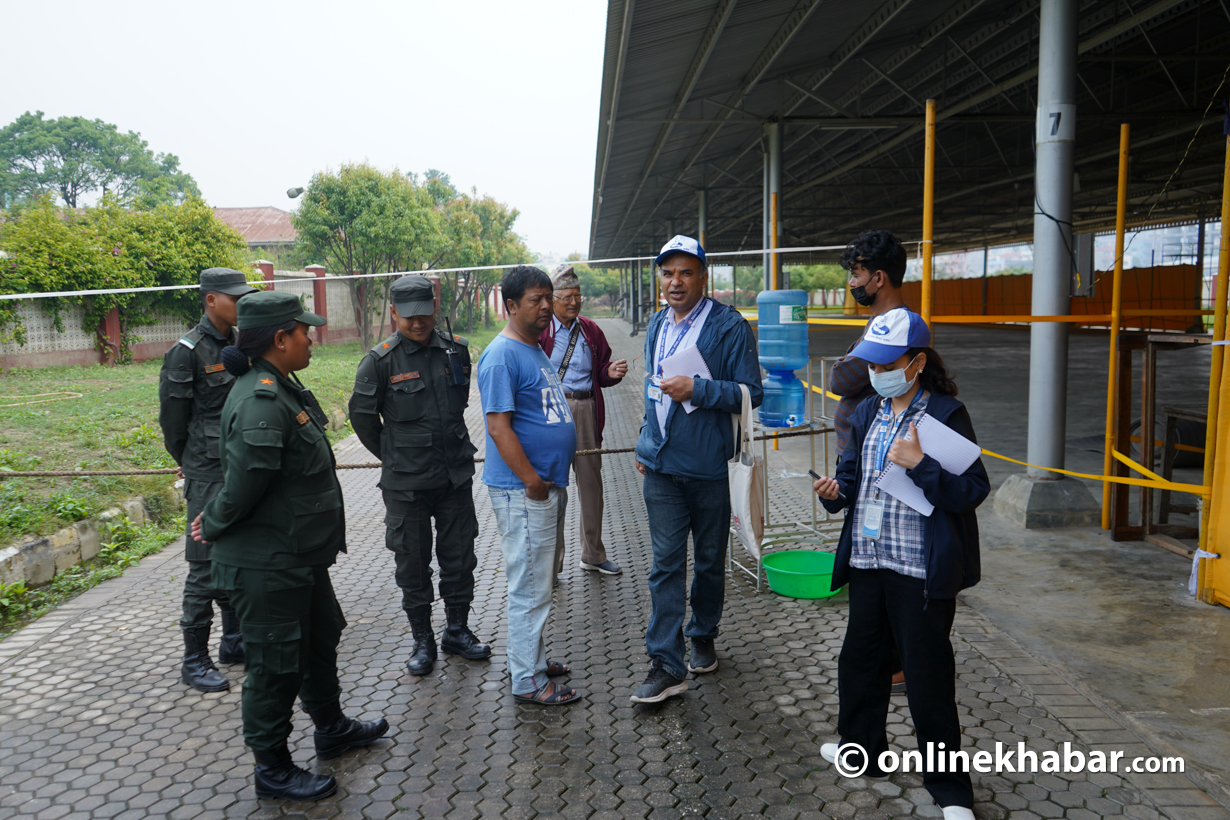
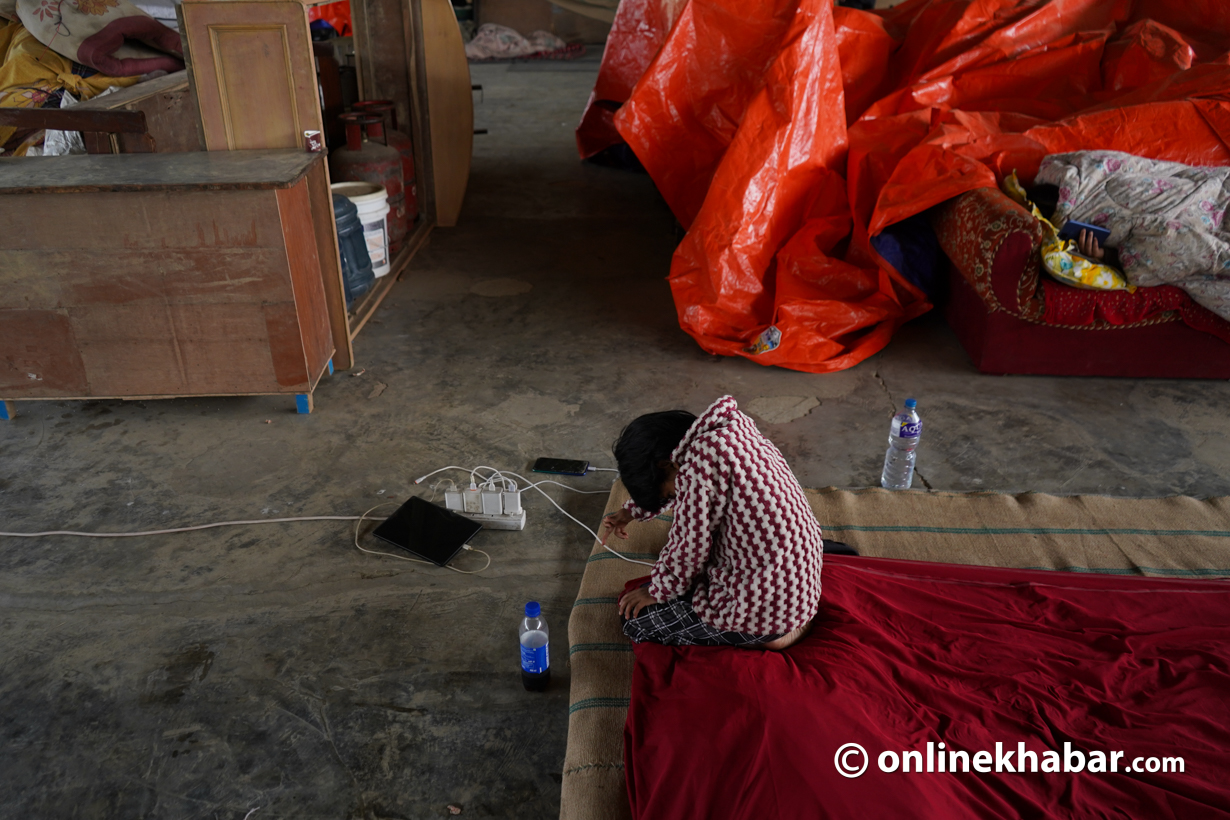
April 13, Kathmandu — Residents displaced from settlements in Thapathali and Gairigaun were relocated without any use of force by security personnel who assisted in the transfer. The residents were given time to pack their belongings and moved to a government-designated site.
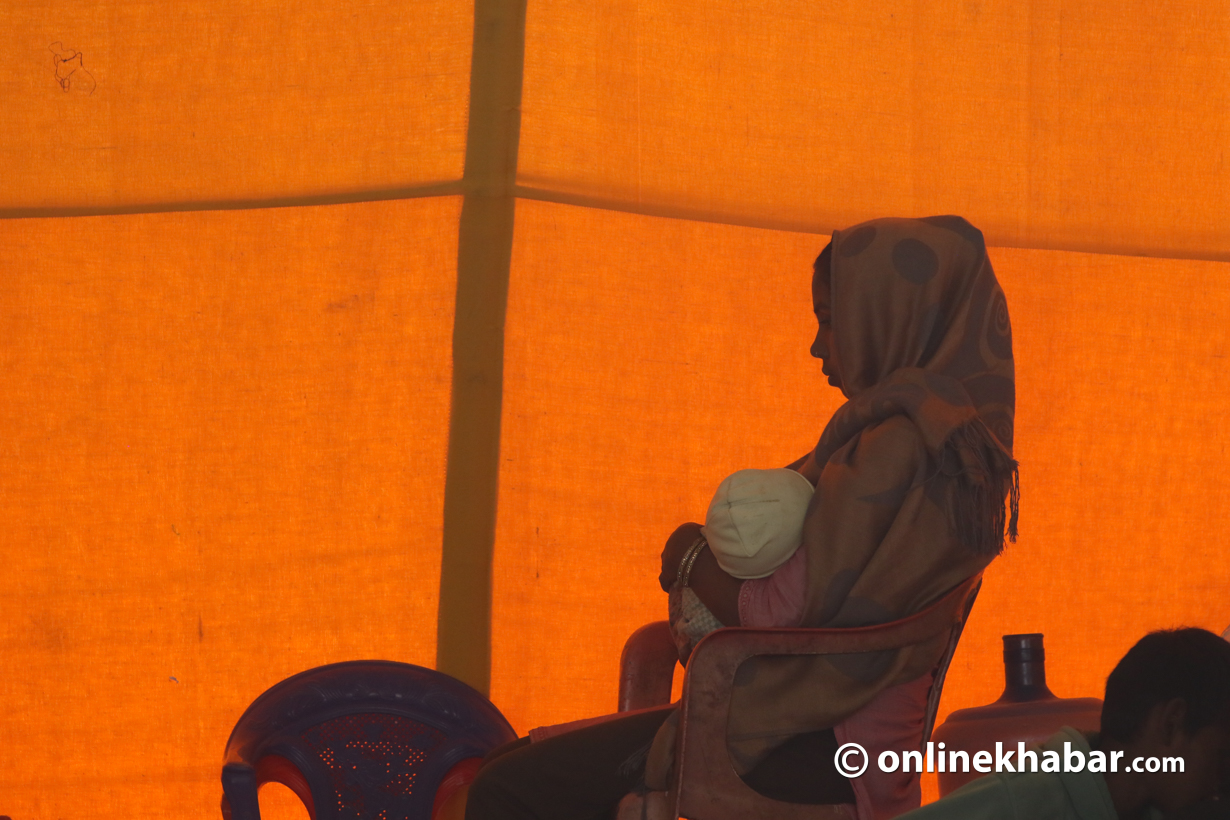
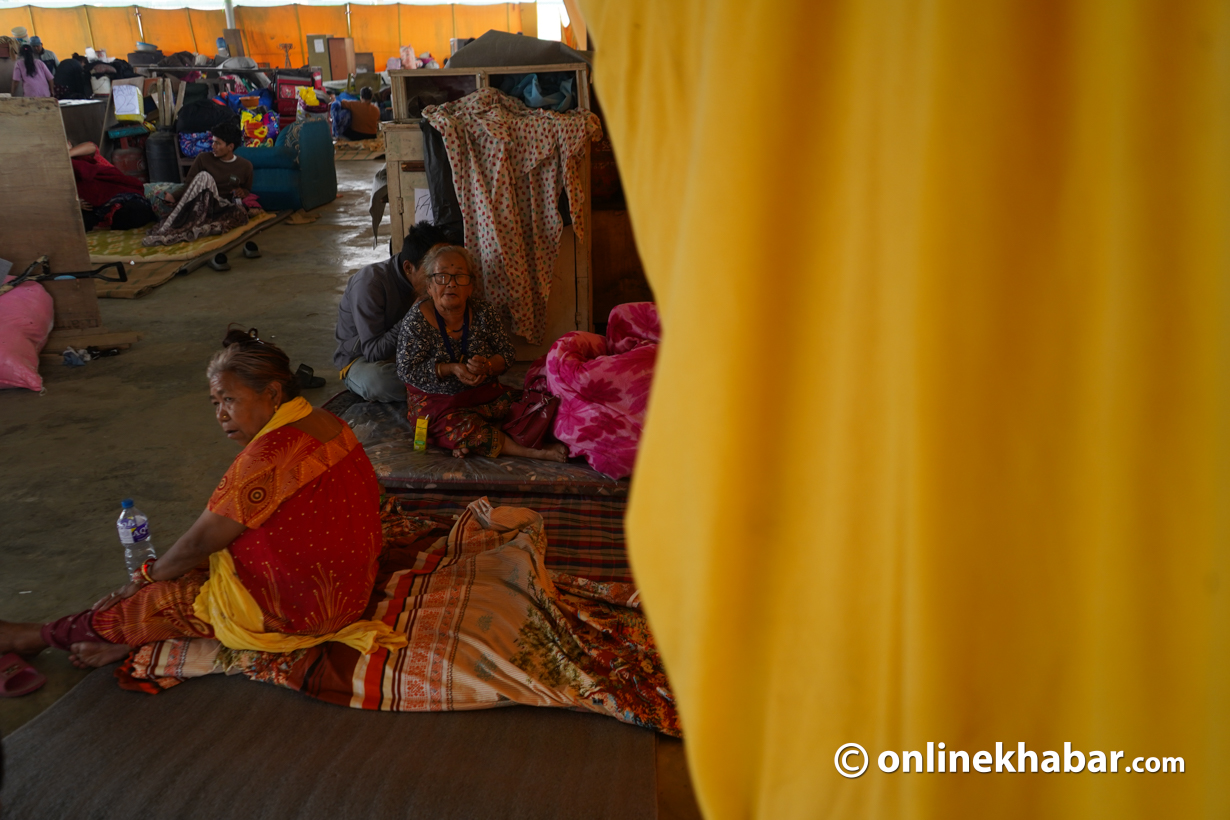
Most of those relocated on Saturday have been temporarily settled at the Radhaswami Satsang Byas Ashram in Kirtipur. According to the Kathmandu Metropolitan City, 232 people registered to stay at the ashram. From morning to evening, members of 51 families were brought to Kirtipur on Saturday.
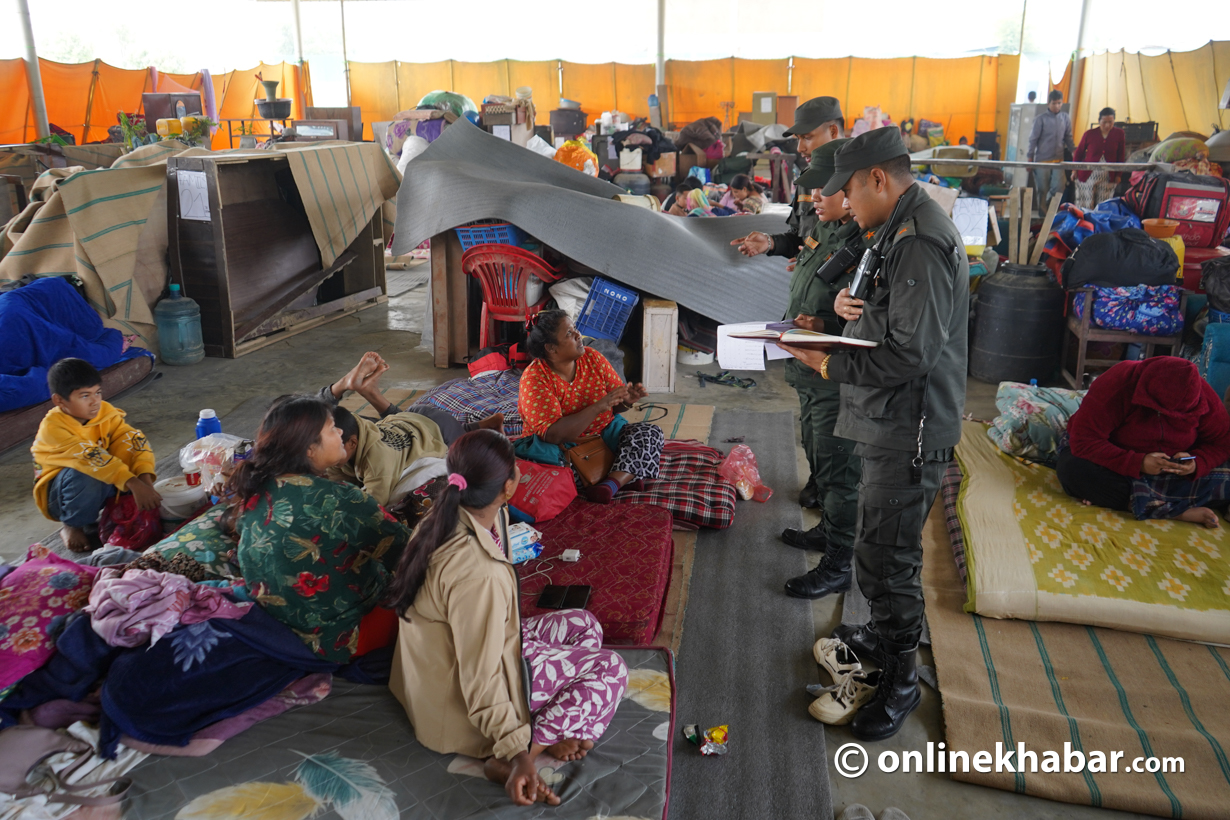
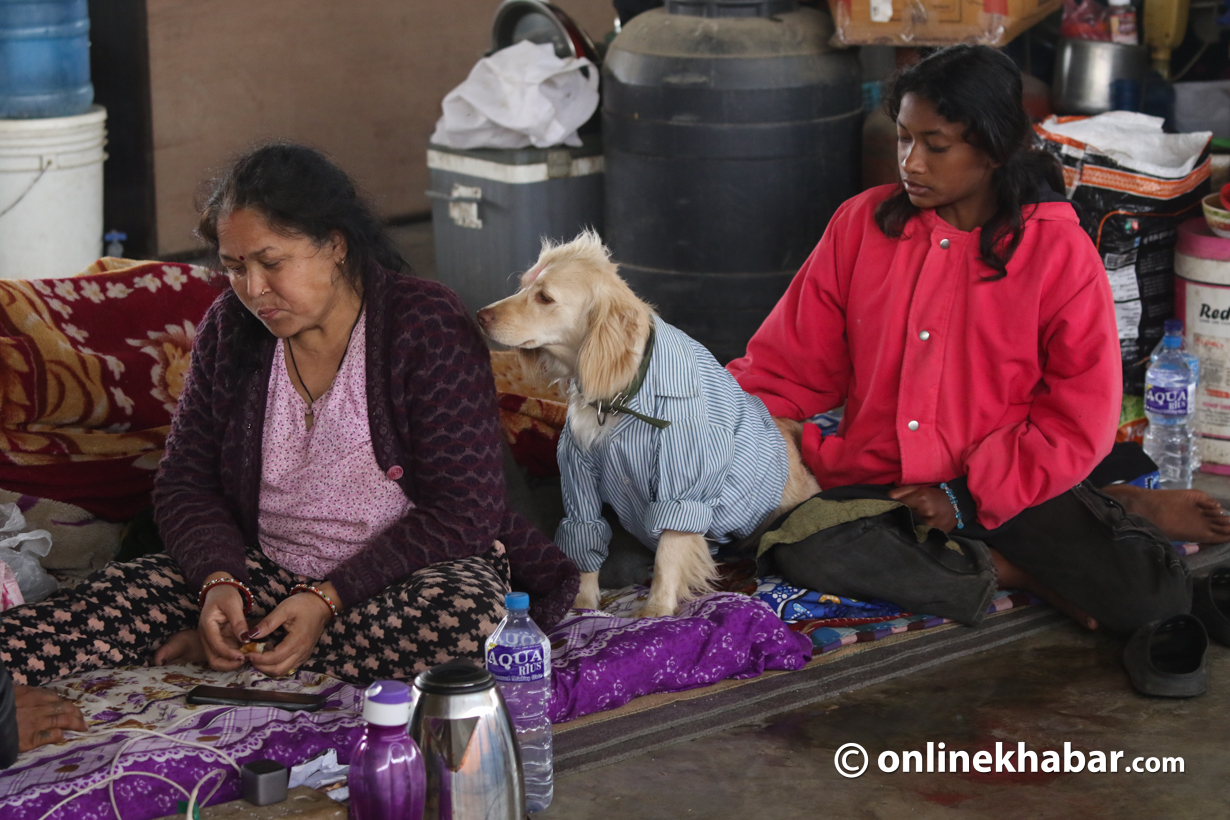
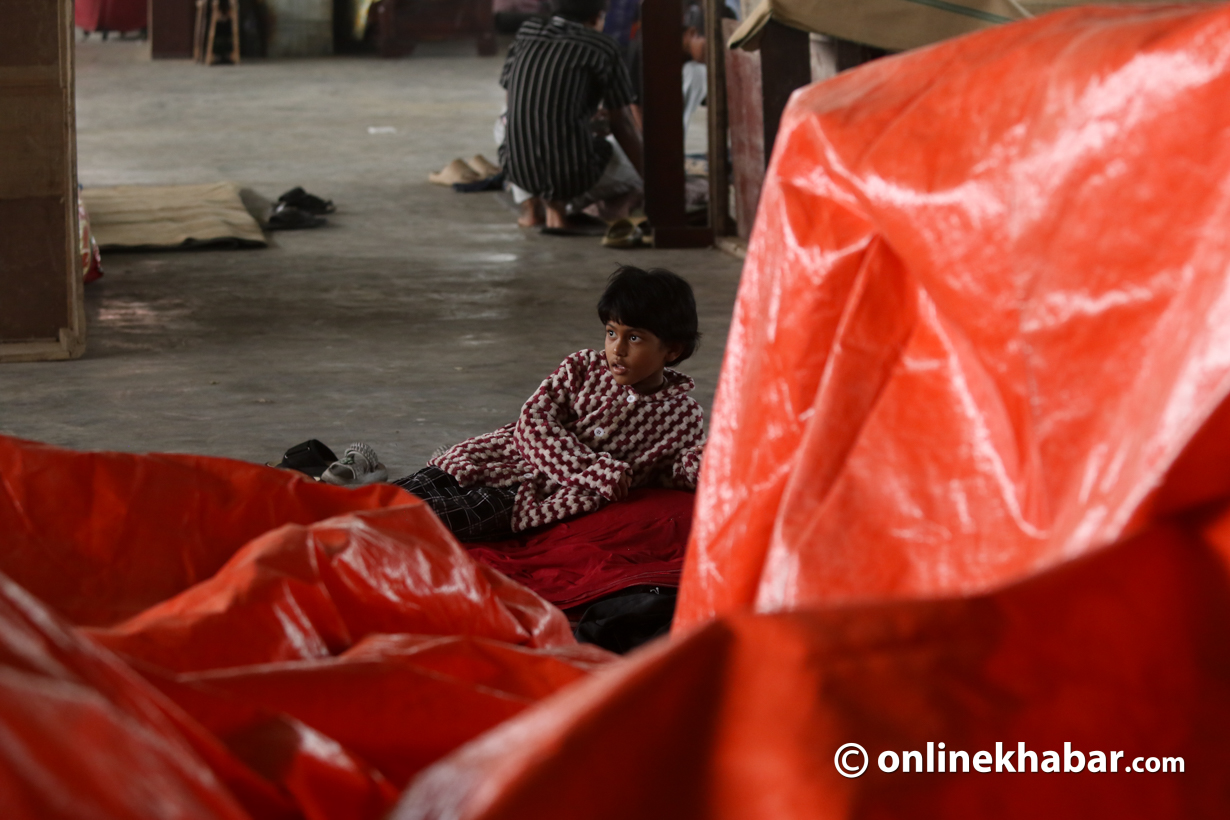
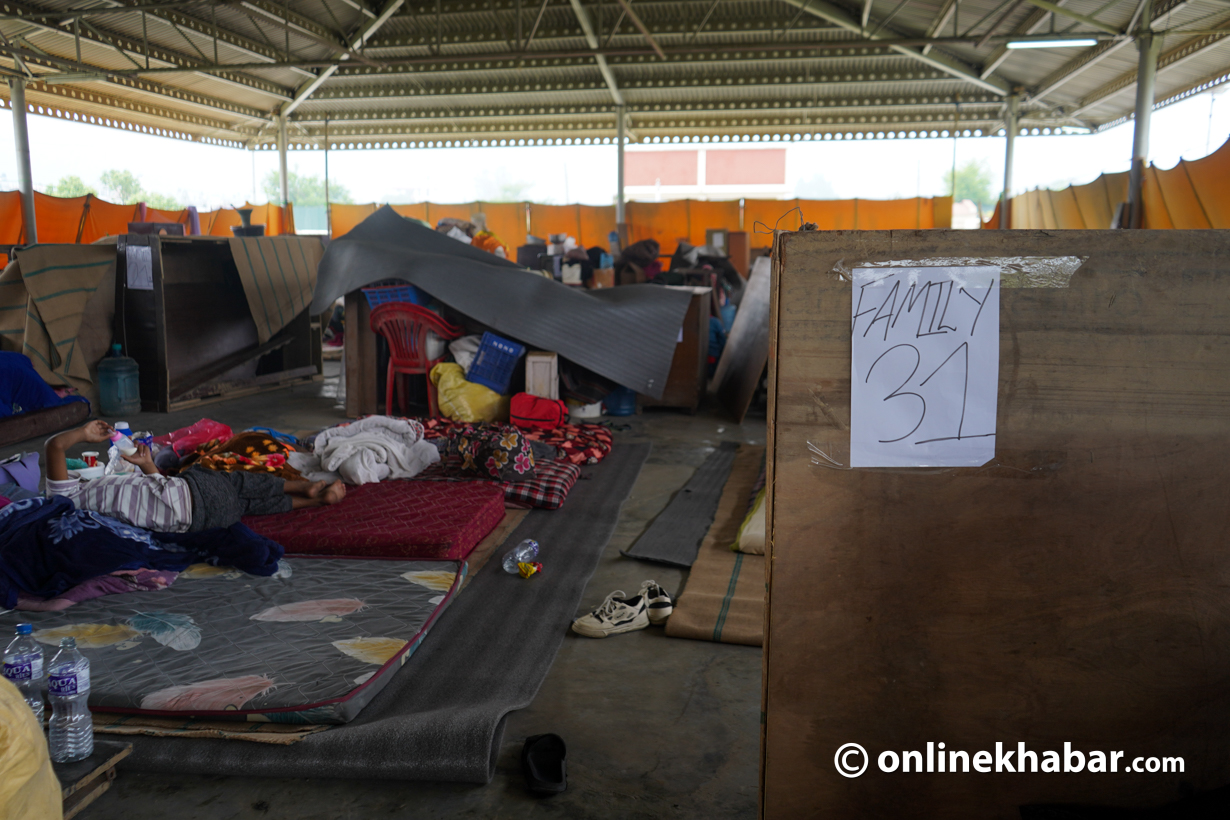
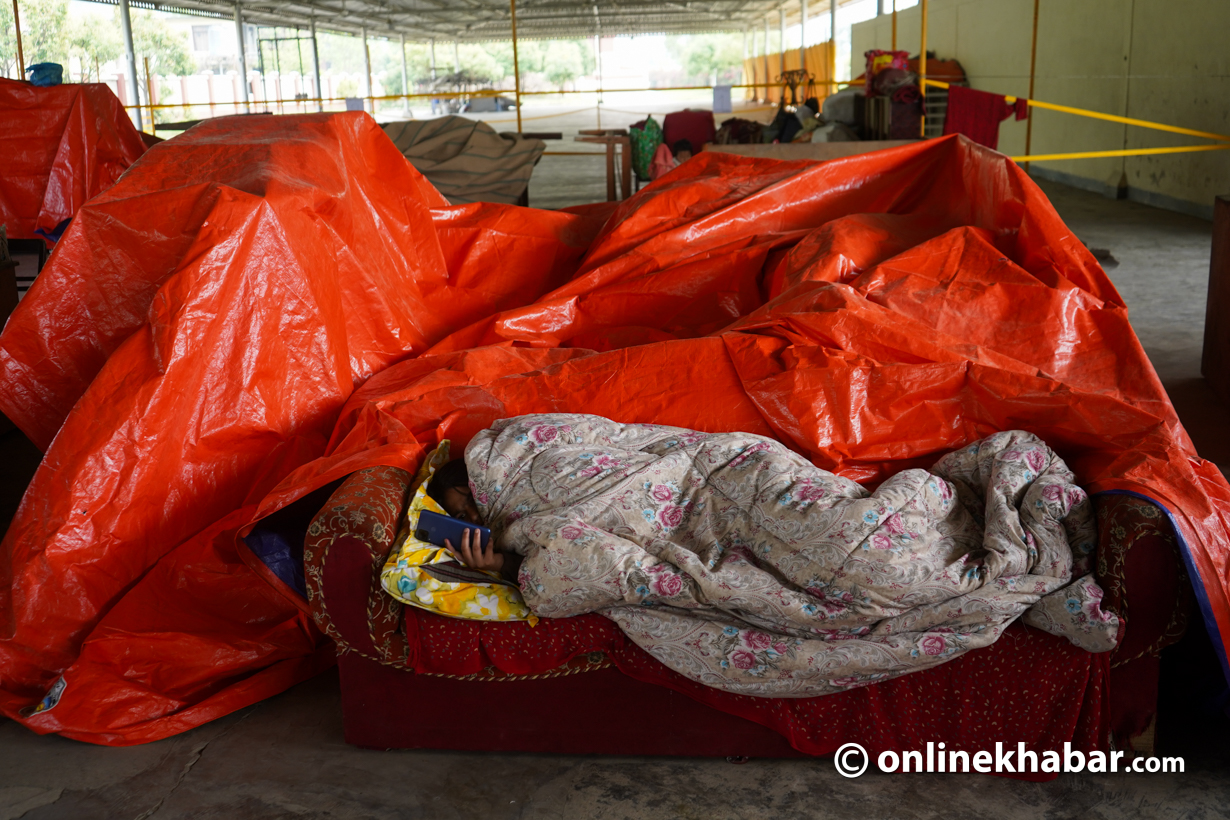
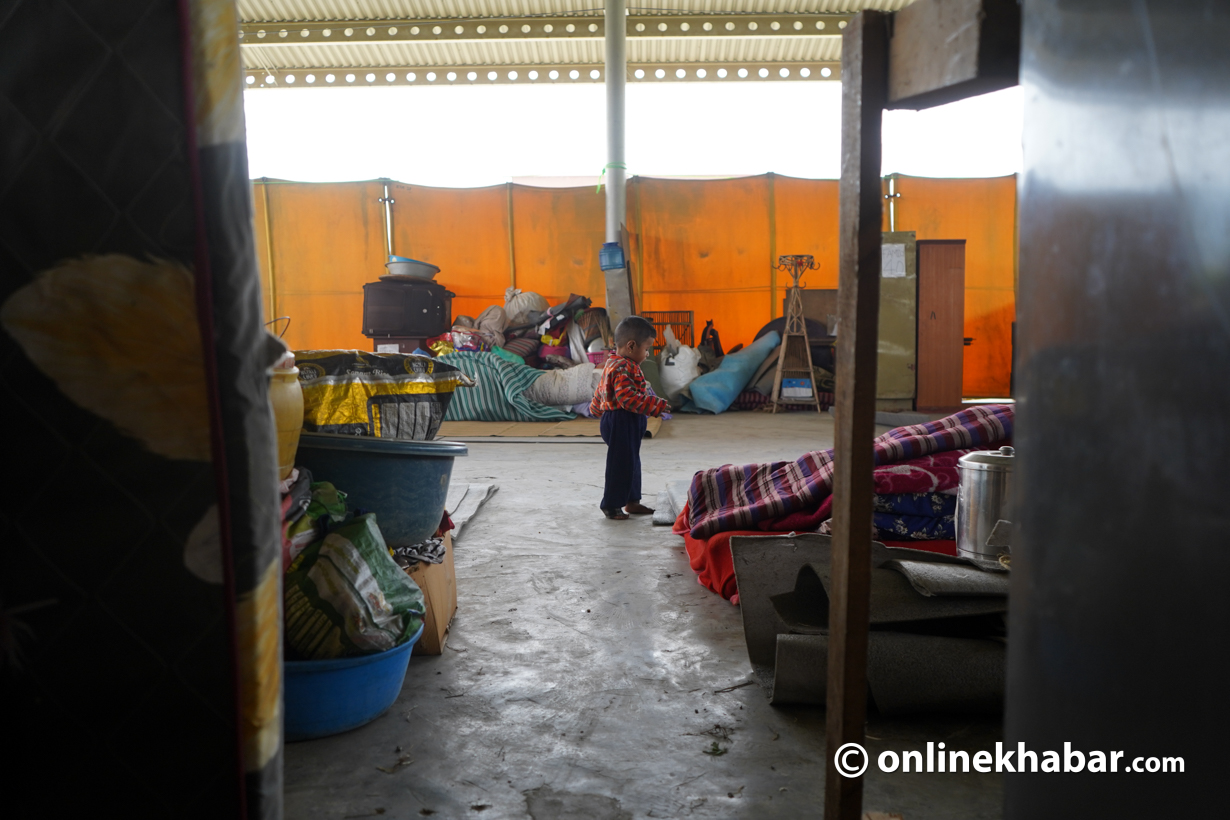
The metropolitan city allocated space within the ashram’s large hall where beds were arranged together. Residents placed their belongings separately according to nameplates labeled “Family One,” “Family Two,” and so forth. Beds were spaced to maintain distance between families. They ate meals provided in packets brought by the metropolitan city. Some could satisfy their hunger, while many said the food was insufficient. The displaced residents spent their first night in the new environment at the ashram.
On Sunday morning, the metropolitan city supplied tea and biscuits. Those who had woken up enjoyed the tea and biscuits, while some still asleep were not disturbed by security personnel. Those wishing to leave had their names and phone numbers recorded and were granted permission by security forces. Two individuals left with permission on the grounds that they had homes elsewhere, according to officers stationed at the ashram.
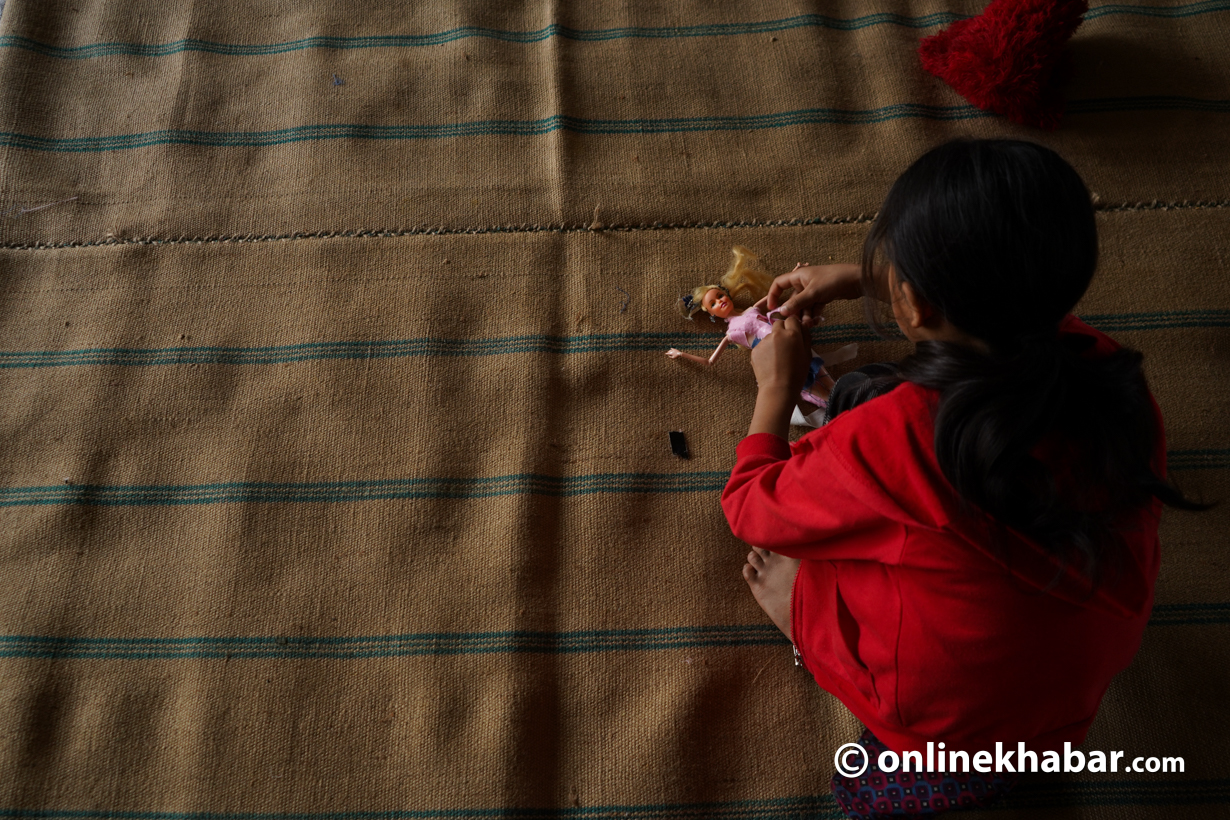
Routines among the displaced changed with the new setting. Children started playing, elders engaged in chores around the ashram, some occupied themselves with phone calls, others played games on their mobiles while lying in bed. Mothers of newborns attended carefully to their infants. Some families brought their pet dogs along, spending mornings lovingly tending to them.
As food had not arrived by 11 a.m. on Sunday, frustration grew among the displaced. A young man showed a neck injury and questioned security personnel sharply over lack of treatment. Health workers attempted to reassure them by saying, “Medical supplies will arrive soon.” Anxiety about the future increased among those lacking permanent addresses.
The residents voiced concerns regarding the government’s designated settlement, its infrastructure, and the arrangements for the education, health, and employment of their children. A woman from an eastern hill district expressed particular worry about her child’s schooling. The new academic session is about to begin, but educational provisions for the relocated children remain unsettled. She said, “We don’t know where we will live. My son is to be enrolled in grade five. What will the conditions be like at the new place?”
Some residents possess knowledge about a government housing facility built in Nagarjun Municipality during former Prime Minister Dr. Baburam Bhattarai’s administration. At that time, plans were made to settle displaced residents there, but many were reluctant to leave Thapathali for that location. Even now, they are unwilling to move to that area.
About 100 people who reached the ashram yesterday went out seeking rooms and relatives. According to the metropolitan city, 232 people were brought to the ashram on Saturday; however, only 132 had meals on Sunday, with others continuing to leave to find accommodation or relatives.
Nilam Thapa, who has lived in the squatter area since 2006 BS (circa 1949), said the main reason for leaving Thapathali was the ability to work and earn a living. She said, “In Thapathali, we could work and get food, transport was easy if we had to go somewhere, and the hospital was nearby. It was comfortable for poor people to live there.”
A woman from an eastern hill district, who had earned a livelihood by cleaning others’ houses and doing laundry, expressed curiosity about the new location. She asked, “Will transportation to work be available from there?”
With food delayed on Sunday morning, the displaced gathered discussing the government-assigned location. Five to seven adults were engaged in conversation; among them was Gopal Bahadur Sunar, a leader in the Thapathali squatter community. He expressed little interest in moving to the government-built facility in the village. He stated, “Our demand is to be provided with three and a half aana (a unit of land) plots on the outskirts of Kathmandu, Bhaktapur, or Lalitpur on installments.”
They envision purchasing land through installments and constructing homes. Another woman described the building from Bhattarai’s time as unsuitable, saying, “You bump into things everywhere, it’s hard to fit even a single bed in the room.” They also raised questions about past classification and documentation processes. Their demands included access to medical care, employment, and attention to their children’s education.
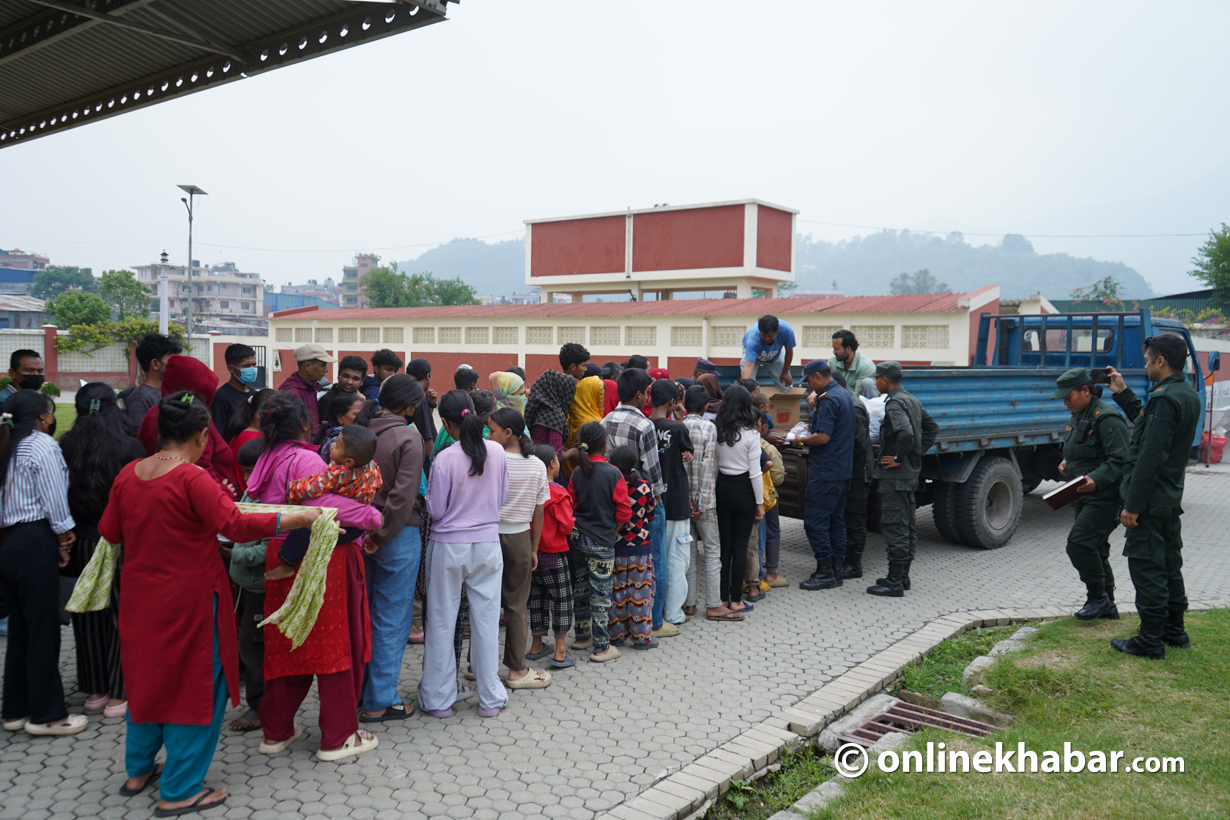
Near noon, the metropolitan city sent a vehicle with packaged food. Security personnel organized the displaced into lines and distributed equal-sized meal packets to children, youth, adults, and elders alike. The meal included a small portion of vegetables and pickles on both sides.
However, many youths and adults expressed dissatisfaction with the quantity of food, some complaining about insufficient portions and others criticizing delays in food delivery. Many took extra packets with them.
Some fearful of the metropolitan city’s presence moved away after taking food and remarked, “Food was delivered at 12 o’clock. Will this amount suffice?” A notable decrease in the number of meals served Sunday morning was observed compared to Saturday night. According to metropolitan data, 232 people were present at Radhaswami Satsang Byas Ashram on Saturday, but only 132 took meals on Sunday.
For security and care, three police officers from Nepal Police are deployed at the site, along with three metropolitan officials and three municipal police officers assigned to the ashram.
Municipal employees working at the ashram said no decision has been made yet regarding how long the displaced will remain there. They noted, “Painting and repair work is underway at their new designated location. Once completed, a relocation plan will be implemented.”
The municipality has also arranged children’s play materials and made preparations for school to start.
In summary, the Gen Z movement on September 8 and 9 (Bhadra 23 and 24) significantly altered Nepal’s traditional political trends, helping the Rastriya Swatantra Party (Raswapa) establish a sole government. Senior Raswapa leader Balendra Shah became Nepal’s Prime Minister at the age of 36, earning a spot among the world’s 100 most influential people, as named by Time Magazine. Balendra’s government has unveiled a 100-point reform plan focused on administrative restructuring, digital governance, transparency, corruption control, and swift public service delivery. The year 2082 in the Vikram Samvat calendar (2025–26 AD) marks a period when Nepali politics drew considerable international attention.
The Gen Z movement not only shifted Nepal’s conventional political alignments but also weakened long-established political parties. The election results six months following the movement were unexpected and unprecedented for these parties. After three decades marked by limited power rotations among the top leaders of three parties, the electoral outcome has effectively imposed a pause on this practice for at least five years. Balendra Shah, a senior Raswapa leader, now leads a powerful government. The single-party Raswapa government has received historic public mandate and has been operational for three weeks, undertaking initiatives to make service delivery more efficient, accessible, and simple. The effectiveness of early steps to meet citizens’ expectations will clarify in time, but initial government efforts deserve positive recognition.
Balendra Shah’s Global Recognition
At 36, Prime Minister Balendra Shah’s inclusion in Time Magazine’s 2026 list of the world’s 100 most influential individuals underscores his global prominence. As the youngest elected Prime Minister in Nepal since the establishment of democracy, Balendra has become a beacon of hope for a significant portion of the population. Elected as an independent candidate for Kathmandu’s mayoral post four years ago, Balendra rapidly gained political momentum. Winning strong public support as mayor, he has garnered similar endorsement as Prime Minister, reaffirming his popularity.
Despite robust public trust, Balendra faces significant challenges. He has publicly acknowledged the inability to resolve Kathmandu’s solid waste management issues due to foreign interests. Now as Prime Minister, such interests may become even broader, and his capacity to uphold public confidence is under serious scrutiny.
Government Priorities and the 100-Point Reform Plan
This government prioritizes administrative restructuring, digital governance, transparency, anti-corruption measures, good governance, and expedited service delivery. Following its formation, the Balendra administration unveiled a 100-point reform agenda endorsed in its first cabinet meeting. Most items feature specific implementation timelines. Given the long-standing perception of limited tangible change, this roadmap is considered significant. Previous governments have complained that bureaucratic inertia hindered effective service delivery. The government led by Sushila Karki after the Gen Z movement also faced accusations of insufficient cooperation from civil servants. Even ministers and the Prime Minister have recognized the need for reforms in the bureaucracy. How much support the Balendra government receives from the civil service will be crucial.
The 100-point plan aims to harness the aspirations of ordinary citizens by strengthening the Prime Minister’s Office. Various mechanisms have been established to enhance government efficiency, which is essential. Traditional bureaucratic habits require reform, emphasizing outcome-oriented service over merely procedural processes. The government has shown focus on digitization to improve service delivery. Publicizing the 100-point plan has increased pressure on the bureaucracy to reform.
Before his oath-taking, Balendra requested a list of urgent reform tasks from every ministry, including deadlines. This groundwork served as the basis for the 100-point plan adopted in the first cabinet meeting. Historically, frequent protests have arisen from dissatisfaction with systemic flaws, but such movements have failed to produce substantive change. The Prime Minister has already instructed ministers to diligently ensure the timely and effective implementation of their portfolios.
Expectations and Role of the Nepali Diaspora
The sentiments of Nepali expatriates span numerous countries globally, with their numbers increasing steadily. Political instability at home, unemployment, conflict, an uncertain future, and other factors have compelled people to seek opportunities abroad. Even those prospering domestically increasingly look overseas for additional safety and prospects. Unofficial statistics estimate over six million Nepalis living abroad, excluding India. Despite their locations, their love and responsibility towards Nepal remain strong. Many wish development, service delivery, and digital infrastructure improvements to occur within Nepal itself.
The Nepali diaspora played a significant role in the recent political transformation and election outcomes. The government led by Prime Minister Balendra Shah has drafted an 18-point ‘National Commitment’ document after studying manifestos and pledges of six nationally recognized political parties. This draft includes provisions specifically addressing Nepalis overseas, which has been welcomed.
The plan proposes issuing a ‘Diaspora Bond’ worth one hundred billion Nepali rupees annually, aiming to channel diaspora capital, experience, and labor into the country’s development. The government also plans to guarantee voting rights for Nepalis abroad and accord them the status of ‘Supreme Organic Investors.’ The commitment enshrines the principle that ‘once Nepali, always Nepali.’ It pledges to resolve double taxation issues and to fast-track policies facilitating diaspora investments. While encouraging, it remains to be seen whether these initiatives advance beyond plans into tangible implementation.
At the same time, the extent of bureaucratic cooperation will be a decisive factor since the civil service’s work ethic and proactivity will shape the government’s efficacy. The government formed on the mandate of the Gen Z movement must not weaken the trust of Nepalis, both domestic and abroad. Unlike previous coalition governments that struggled with poor governance, Raswapa currently enjoys an overwhelming two-thirds majority.
Balendra Shah, accepted by a large segment of the country as its leader, is the most powerful Prime Minister in recent times. With his authority, he is positioned to address legal, administrative, structural, and procedural challenges. The public’s faith in Raswapa and the government is substantial. The recurring pattern of systemic dissatisfaction sparking protests without altering the fundamental condition of the country and its people must end. Let us hope that strengthened public trust and inclusive participation will guide Nepal toward a prosperous future.
Rastriya Swatantra Samajwadi Party (Raswapa) lawmaker Ganesh Parajuli has expressed concern over impractical taxes imposed by local governments and the delays in solving the issue of squatters. He emphasized the need to establish a tax system at the local level that aligns with the federal government’s agricultural policies and highlighted the necessity for genuine coordination to address the squatter problem. Parajuli criticized the practice, ongoing for the past 37 years, of forming commissions that distribute land to party workers, thereby trapping politics in vote-based maneuvering.
Kathmandu, 13 Baisakh – Parajuli stressed that local governments should develop tax systems compatible with the federal government’s agricultural strategies. Speaking at a program held on Sunday, he stated that while local bodies require resource management, it must be both effective and equitable. On the topic of squatter settlements, Parajuli accused authorities of falling into the trap of vote politics by creating commissions that simply distribute land to affiliated workers over the past 37 years.
He pointed out that genuine cooperation between local and federal levels of government is essential to resolving the squatter issue. Parajuli also noted that Raswapa is committed to building a strong foundation for good governance and prosperity within this five-year term. “Instead of granting agricultural subsidies, taxes have been imposed on chicken eggs, chicks, and even chickens themselves. Such policies discourage production,” he said.
Serving as the parliamentary party’s deputy leader, Parajuli accused previous political leaderships of exploiting systemic changes for personal gain without focusing on meaningful improvements. While he respected the sacrifices and dedication of older political parties, he asserted that their approaches have compelled younger generations to enter politics.
Tribhuvan University has formally notified 18 organizations to vacate land unlawfully occupied on its property. According to a report, over 2,000 ropanis of the university’s total 5,050 ropanis of land have been encroached upon by various associations without authorization. An investigative committee has recommended that the Commission for the Investigation of Abuse of Authority (CIAA) and the Central Investigation Bureau (CIB) conduct inquiries into those responsible for the encroachment.
Dated 13 Baisakh, Kathmandu — Amid government efforts to clear encroached lands and unregulated settlements, Tribhuvan University has also taken steps to reclaim its properties. The university’s General Administration Division issued a 35-day notice on 4 Baisakh to associations and organizations occupying the land illegally. Following this, official correspondence has been sent to 18 organizations requesting them to vacate the premises. In total, 21 organizations have been found occupying sections of Tribhuvan University’s land.
“The 35-day public notice has been issued, and we have sent letters to 18 organizations and entities,” said Raj Bahadur Rai, head of the General Administration Division.
Investigations reveal that more than 2,000 ropanis of Tribhuvan University’s land are claimed by 18 groups, ranging from private to religious organizations. The ‘Land and Property Investigation Committee’ of Tribhuvan University documented these claims in their report. Specifically, in Kirtipur alone, about 1,500 ropanis have been used by different institutions as per the report. Based on these findings, the university has issued notices demanding the land be vacated due to non-utilization for the purposes for which it was allotted.
The letter instructs the concerned organizations, listed in the committee’s report, to relinquish the land. Among the entities involved are the Nepal Cricket Association (CAN), from whose cricket ground to the Professors’ Association and the Laboratory Higher Secondary School are also included.
The investigation committee, chaired by Mahendra Kumar Thapa alongside members Janaki Ballav Adhikari, Professor Prem Sagar Chapagain, and Sushila Adhikari, has recommended recovering Tribhuvan University’s land and taking disciplinary action against those responsible for the encroachment.