Author: space4knews

Impact of the Iran Conflict: Condom Prices Surge Amid Raw Material Shortage, Says World’s Largest Manufacturer

Carrex company CEO Go Mia Kiatt holding a condom

Image source, Reuters

The CEO of Carrex, the world’s largest condom manufacturer, has announced that due to disruptions in raw material supply caused by the Iran conflict, the prices of their products are expected to rise by at least 30 percent.

Go Mia Kiatt, Chief Executive Officer of Carrex, told the media that production costs have surged abruptly since the onset of the conflict.

Based in Malaysia, Carrex produces over 500 million condoms annually.

The company supplies condoms to renowned brands such as ‘Durex’ and ‘Trojan’, as well as to the UK’s National Health Service (NHS).

Kiatt shared insights on potential condom price increases during interviews with Reuters and Bloomberg. Further communication has been established with Carrex.

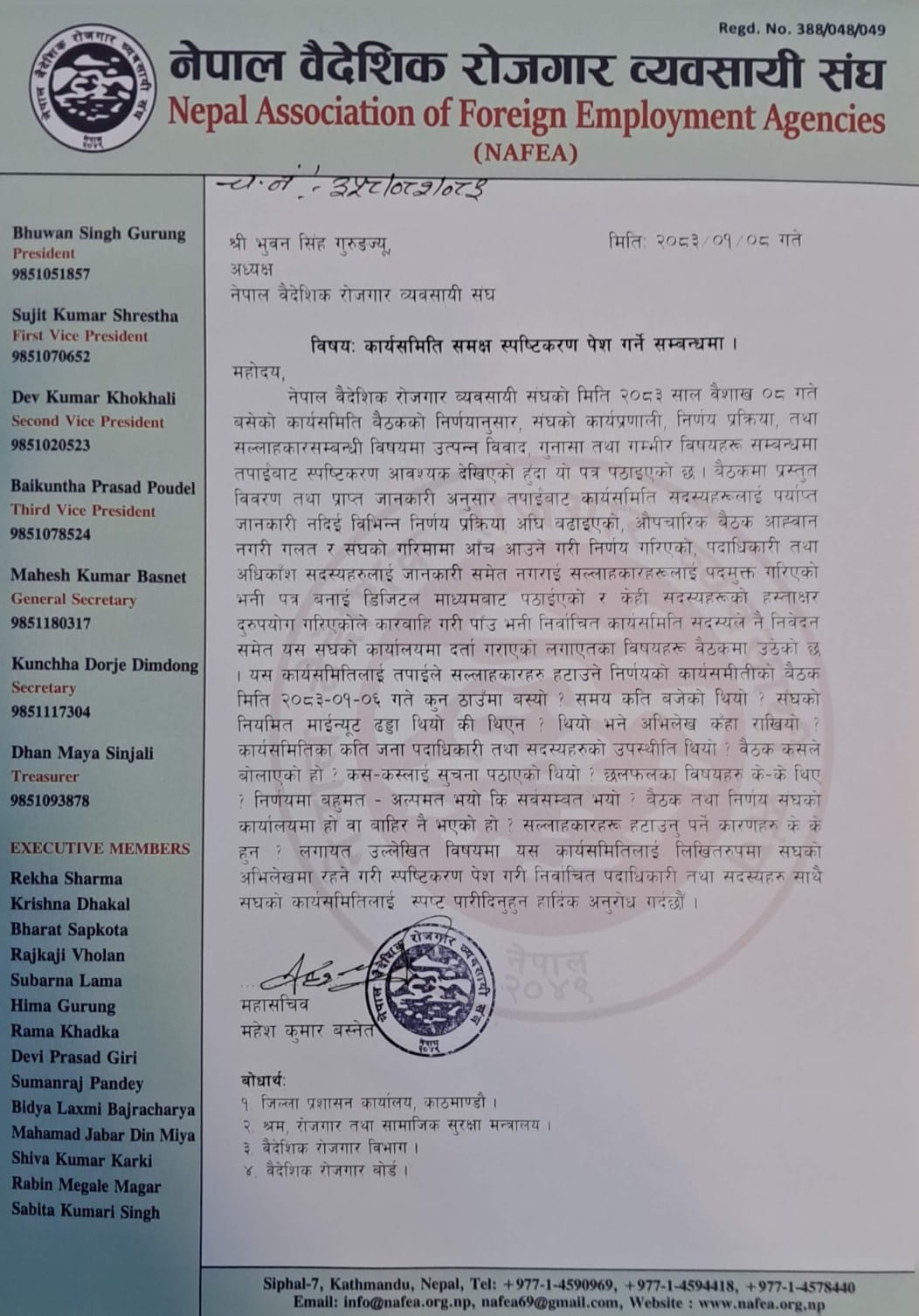
वैदेशिक रोजगार व्यवसायी संघमा विवाद चर्किँदै, अध्यक्षलाई सोधियो स्पष्टीकरण

Dispute Escalates in Foreign Employment Entrepreneurs Association; Chairman Asked for Clarification

News Summary

After editorial review.

  • Dispute intensifies between Chairman Bhuvan Singh Gurung and General Secretary Mahesh Basnet at the Nepal Foreign Employment Entrepreneurs Association.
  • General Secretary Basnet and executive committee members have sought clarification regarding the decision to remove the chairman’s advisors.
  • Chairman Gurung has denied the allegations as baseless and misleading, stating the association is operating according to its rules and regulations.

April 21, Kathmandu – Tensions within the Nepal Foreign Employment Entrepreneurs Association are escalating rapidly. A dispute between the chairman and key officials, including the general secretary, has taken on a critical tone. General Secretary Mahesh Basnet along with some executive committee members have formally requested clarification from Chairman Bhuvan Singh Gurung.

Earlier, Chairman Gurung removed two advisory members from their positions. This move has divided the association members into two factions, each accusing the other of misconduct.

At a meeting held on Wednesday, the group led by General Secretary Basnet demanded an explanation from Chairman Gurung. The clarification sought pertains to the association’s work procedures, decision-making processes, and controversies surrounding the advisors, as well as complaints and serious questions that have arisen.

The chairman faces accusations of advancing decisions without informing the executive committee members, bypassing formal meetings by making informal decisions, and disregarding notifying all officials and members about certain decisions.

The dismissal of the advisors has become a focal point of the controversy. The executive committee particularly requested detailed clarification regarding the meeting reportedly held on April 19, 2026 (Baisakh 6, 2083 BS): the location, timing, how the meeting was conducted, official records, number of attendees, notification procedures, topics discussed, and whether the decisions were made by majority vote or unanimous consent.

Furthermore, the committee asked for explanations on why and how the advisors were removed and the rationale behind this decision. They have formally asked Chairman Gurung to submit comprehensive written responses on all these matters.

General Secretary Basnet criticized Chairman Gurung for removing the two advisors without any prior information, asserting that this action contravenes legal provisions. Basnet said, “Members of the association have repeatedly warned that he has been working solely for his personal and institutional interests. The chairman’s arbitrary approach is why this clarification was demanded.”

On the other hand, Chairman Gurung dismissed the allegations as unfounded, misleading, and orchestrated deliberately. He urged entrepreneurs not to fall for such rumors.

Affirming that the association functions fully in accordance with its laws, regulations, and institutional procedures, he stressed, “The clear majority of the executive committee supports our position, so these activities will have no impact on the organization.”

Gurung emphasized that his leadership has always been focused on protecting the rights and interests of foreign employment entrepreneurs, upholding the dignity of the profession, and developing transparent systems.

Pedestrian Killed in Gaindakot After Being Hit by Government Vehicle

A pedestrian lost his life after being struck by a government-registered vehicle in Gaindakot, located on the East-West Highway in Eastern Nawalparasi. The incident involved a Tata Sumo vehicle with license plate number Ba 2 Jh 3854, which hit 47-year-old Shyam Bahadur Bhujel from Bharatpur Metropolitan City–25 late last night. The vehicle and its driver have been taken into police custody as authorities conduct a thorough investigation.

The vehicle was traveling from Gaindakot towards Kawasoti when it struck Shyam Bahadur Bhujel of Bharatpur Metropolitan City–25 in Chitwan. According to Deputy Superintendent of Police Yuvraj Khadka from Eastern Nawalparasi, Bhujel sustained serious injuries and later died during treatment.

Police have confirmed that the vehicle and driver involved in the accident remain in custody as the investigation continues. The vehicle was reportedly moving at high speed, and a carton of beer was found inside. Authorities have identified the vehicle as belonging to the Controller and Auditor General’s Office (COANIK).

Eyewitnesses reported that the vehicle was traveling at high speed, traveling in one lane and only coming to a stop about 100 meters ahead in another lane. Upon receiving information about the accident, the Armed Police Force, Nepal Police, and local residents promptly carried out rescue efforts. The injured were immediately transported to Bharatpur in Chitwan for medical treatment. It remains unclear whether there were other occupants in the vehicle at the time of the crash.

नोकरशाहीले निल्यो वामपन्थी – Online Khabar

Bureaucracy Sidelines the Leftist Movement

News Summary

With Editorial Review.

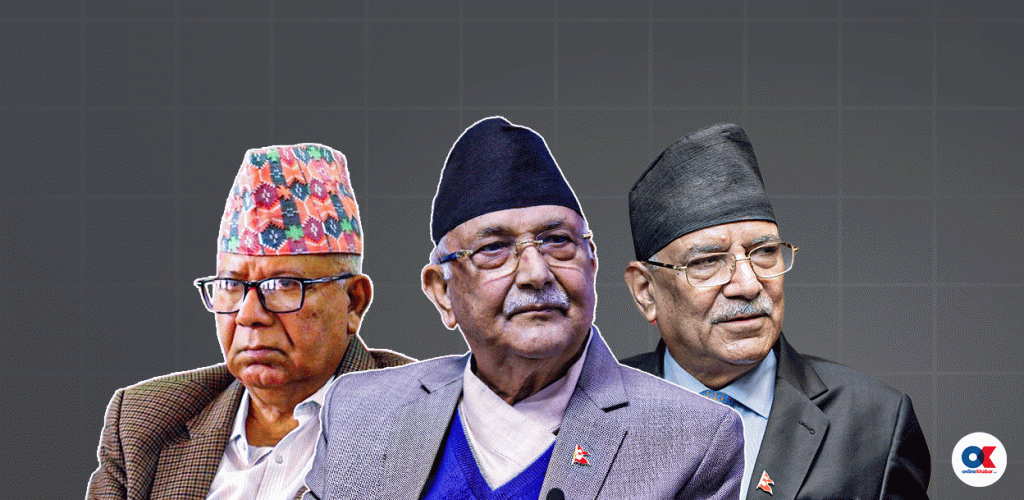
  • Following a humiliating defeat in the House of Representatives elections, pressure for leadership change has mounted in the CPN-UML and Nepal Communist Party (NCP), prompting Prime Minister KP Sharma Oli and NCP Chair Pushpa Kamal Dahal ‘Prachanda’ to engage in efforts for leftist unity.
  • On the occasion of the Communist Party Foundation Day, Prachanda publicly called for unity among all leftist factions aiming for socialism and communism.
  • Since the 2022 elections (2079 BS), leftist parties have been struggling for survival, with prospects indicating they may lose leadership of the Singha Durbar administration for the next five years.

April 22, Kathmandu – Intense debates about restructuring have been ongoing among the older political parties after their disgraceful defeats in the House of Representatives election.

Particularly in CPN-UML, Nepal Communist Party (NCP), and Rastriya Prajatantra Party (RPP), pressure for leadership changes has increased. Following the Supreme Court ruling appointing Gagan Thapa as party chair, the Nepali Congress is also likely to proceed toward its regular general convention.

However, CPN-UML Chairman KP Sharma Oli and NCP Coordinator Pushpa Kamal Dahal ‘Prachanda’ have so far resisted the pressure for leadership change and are actively pursuing renewed leftist unity initiatives. In a statement released today on the occasion of the Communist Party Foundation Day, Prachanda issued a public call for leftist unity.

“…Advancing the Nepali revolution, ending all forms of discrimination, and building an egalitarian society with socialism and communism as the goal, unity among all leftists and communists has become a historic necessity today,” Prachanda stated.

Sources reveal that second and third-tier leaders, who understand the wishes of Oli and Prachanda, have been actively working to foster an environment conducive to unity. Recent disputes on social media also suggest ongoing efforts toward leftist unity.

CPN-UML leaders seeking to remove Oli allege that the talk of leftist unity is being used to sideline party restructuring efforts. Among these leaders are Vice-Chairman Bishnu Prasad Paudel and Deputy General Secretary Yogesh Bhattarai.

Mahesh Basnet, a leader close to Oli, strongly rejects such allegations, saying, “It is natural for those opposed to socialism and populism, fearing destruction if the communist party unites, to resist it.”

However, sources indicate the number of leaders supporting Oli has dwindled since the elections. Only a handful of officials, such as Ram Bahadur Thapa, Mahesh Basnet, and Khag Raj Adhikari, continue to advocate for his continuation. Of these, only Thapa and Basnet have openly voiced their support.

In a short span after the party’s formation, the Rastriya Swatantra Party (Raswap) sent a strong political signal with its performance in the December 2022 elections. However, Oli and Prachanda appear to have overlooked this electoral message, aided by second and third-tier leaders.

Leaders such as Basnet and Thapa have publicly commented against those who express opinions or make decisions contrary to Oli’s wishes. On Chaitra 25 (April 8), addressing a UML gathering in Kaski, Thapa revealed the party’s right-wing elements had surfaced.

“Certain individuals were provoked by that statement and previously hidden ones emerged because it exposed the right-wing tendencies within the party,” he said, implicitly referring to Vice-Chairman Bishnu Prasad Paudel.

Following Thapa’s speech on Chaitra 19 (March 31) in the House of Representatives, the next day a secretariat meeting was held to correct his statements, reportedly under Paudel’s influence to align it with Oli’s stance.

Thapa’s assertion blaming the UML’s electoral loss on the Nepali Army, civil servants, the government led by Sushila Karki, and external powers was rectified at that meeting.

These incidents indicate lobbying by second and third-tier leaders aiming to keep Oli in leadership. Their actions have also prevented young leader Suhang Nembang from becoming the parliamentary party leader.
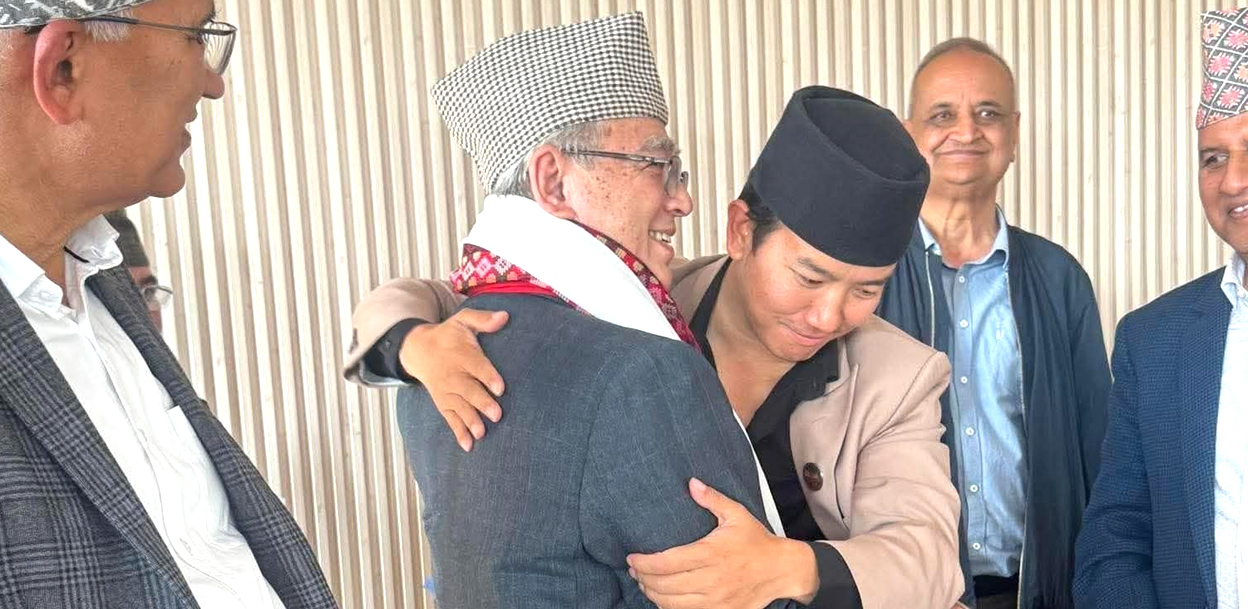
Suhang, who has been directly elected twice and is popular both within and outside the party, had widespread youth demand for him to lead the parliamentary party. Nevertheless, proportional representative member Ram Bahadur Thapa was appointed party leader.

While conflicts and public struggles continue in the UML, there is no shortage of leaders willing to play roles aligned with Prachanda’s wishes. Past experiences show young leaders often provoke public disputes serving Prachanda’s interests.

After the January Movement, Prachanda’s leadership was sustained with support from the party ranks. Agni Sapkota, Pampha Bhusal, Krishna Bahadur Mahara, Dev Gurung, Barshaman Pun, Shakti Basnet, and Devendra Paudel were prepared to relinquish their posts on Prachanda’s proposal. Subsequently, Prachanda, as coordinator, abolished the posts of other leaders.

Leaders questioning leadership restructuring, such as Janardan Sharma, Ram Karki, and Sudan Kiranti, were pressured to leave the party. The list of leaders expelled for opposing Prachanda is extensive.

Upon becoming coordinator and bringing eight factions together, Prachanda abandoned the ‘Maoist’ label, the ‘Maoism’ principle, and the electoral symbol featuring the hammer and sickle within a circle. “Nowadays, referring to the Maoist brand seems to be associated only with Prachanda himself,” noted a party insider.

Post-unity, the party has appeared to be led mainly by Prachanda and Madhav Nepal. “Only Prachanda seems aware of who formed unity and who the leaders are; even Madhav Nepal seems largely uninformed,” the insider added. Nevertheless, election results have confirmed the party’s declining trajectory.

Madhav Nepal had also adopted Prachanda’s style. After Jhulanath Khanal and Ghanshyam Bhusal escalated proposals for party reformation, Madhav prioritized unity with Prachanda.

CPN-UML leader Surendra Pande analyzes the crisis in leftist parties as resultant from their leadership and bureaucratic structures.

“Political parties are not civil service commissions where seniority is based on age; in politics, juniors with capability can become senior leaders. However, we bureaucratized parties, suppressing critical thinkers and fostering an environment of fear,” he explained.

Facts underline that the crisis in leftist forces is not merely due to leadership. For example, voters delivered a clear message for generational change in the 2022 elections. Independent candidates won mayoral posts in Kathmandu Metropolitan, Dharan Sub-Metropolitan, and Dhangadhi Sub-Metropolitan, reflecting public sentiment.

Raswap’s vote share in the short period following its formation also signaled shifting political dynamics in 2022. Yet, Oli and Prachanda disregarded these signals, supported by subordinate party leaders.

The Worst Phase in History

As left parties, which should herald change, maintain the status quo, the country for the first time in 20 years has a fully non-communist government.

Since 1995 (2051 BS), CPN-UML entered government, and since 2005 (2062 BS), Maoists joined at the central level, except for exceptions. Though an election government led by Chief Justice Khil Raj Regmi was formed in 2012 (2069 BS), UML and Maoist-affiliated ministers were included. The January Movement led to a government under Sushila Karki, institutionalizing leftist presence via the 2015 (2071 BS) election.

However, within eight years, leftists are now struggling for survival. The last election weakened UML more than in 2008 (2064 BS) and Maoists more than in 1991 (2048 BS). Some compare this situation to that of 1958 (2015 BS).

If no unforeseen political decisions occur, communists are unlikely to lead Singha Durbar for the next five years.

Communists are no longer the main opposition in the current parliament, securing only 25 seats—15 for UML and 10 for NCP. In direct elections, UML won 9 and NCP 8 seats.

Eight years ago, in 2017 (2074 BS), the left alliance had dominated the 275-member House of Representatives with 176 seats: NCP with 80, Maoist with 36, Nihkpipa and Janamorcha with one each. They held two-thirds majorities in most provinces.

The strongest showing for communists was in the 2010 (2064 BS) Constituent Assembly election where communists held 368 of 601 seats. Maoists won half of 240 seats at that time, with leftists receiving 55.8 percent of the vote.

Even without winning major votes in 2010, communist forces managed to hold power consistently. After the 2017 election, they claimed to have permanent control over the state for 20 years.

However, before eight years passed, leftists are now in existential crisis. The fault lies not only with Oli and Prachanda, but also with their supporting leaders, as confirmed by decisions taken after the January Movement.
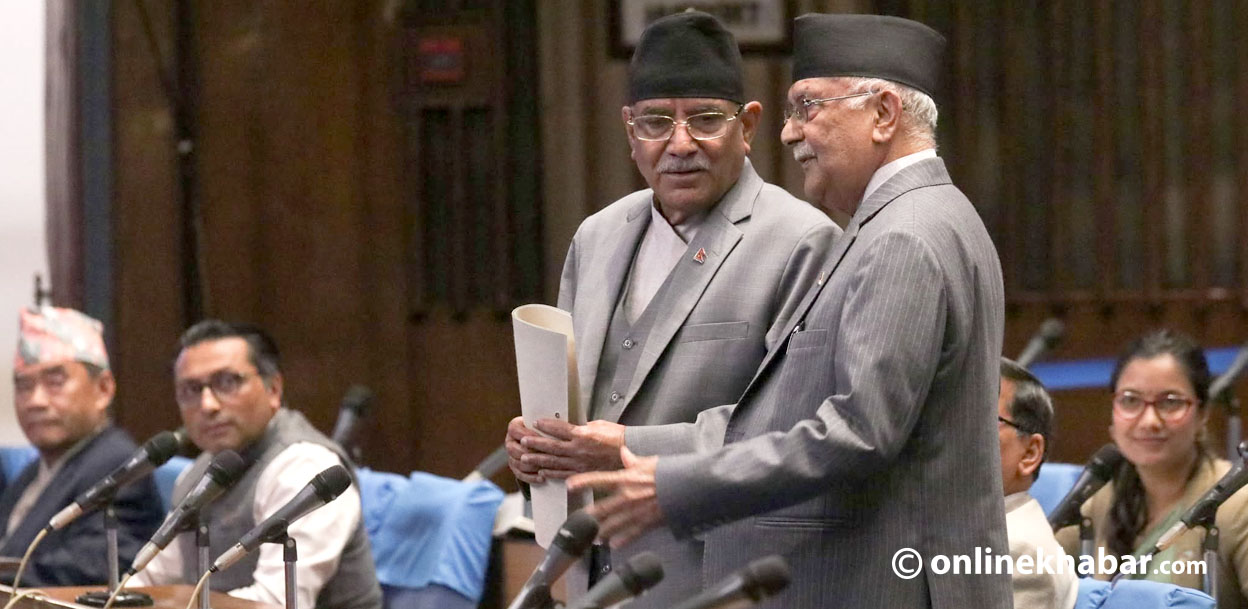
During the January Movement, although the Nepali Army rescued Prime Minister Oli by helicopter, his autocratic leadership did not halt. Oli manipulated party bylaws and decisions in his favor.

General Secretary Shankar Pokharel defended Oli’s statements with reasoned arguments and even mobilized the party.

Vice-Chairmen Bishnu Prasad Paudel, Prithvi Subba Gurung, Raghubir Mahaseth, Lekhraj Bhatt, and Chhabilal Bishwakarma helped maintain Oli in leadership.

In the eleventh general convention in December 2022, Paudel’s faction supported Ishwar Pokharel’s candidacy, creating conditions to ease the party crisis.

Yet, after the February 2023 election, Paudel’s group began pushing for leadership changes.

Prachanda did not have to face such challenges. After Maoists split, a ‘national convention’ at Bhrikuti Mandap led to leadership renewal.

Leftists have failed to pressure for change despite the clear message from street protests, while Congress embraced the rebellion from the same platform.

Leftist analyst Ghanshyam Bhusal believes their continuous crises stem from weak principles and ideologies. After joining power under the name of multiparty populism, right-wing characteristics surfaced within UML and were mirrored by Maoists, worsening the crisis.
According to him, UML was trapped in power since 2002 (2059 BS) and Maoists since 2005 (2062 BS).

Though Madan Bhandari had urged revolution through popular power, the allure of power entangled the party. To please the leadership, subordinate leaders mobilized cadres to win elections.

Former Chief Election Commissioner Dinesh Thapaliya says parties have registered 6 million members as workers, but this structure failed to protect votes of Congress and leftists.

This failure partly explains why the country has yet to develop fully, and it shows why voter sentiment entrusted Balendra Shah with the key to the country.

Rastriya Swatantra Party Forms Federal Leadership Forum to Accommodate Leaders from Other Parties

News Summary

Edited and reviewed.

  • The Rastriya Swatantra Party (Raswapa) has established a Federal Leadership Forum to accommodate leaders who joined from other parties.
  • The Federal Leadership Forum is not recognized under Raswapa’s party statute and will be dissolved after the upcoming general convention.
  • The forum currently includes 25 members, but their roles and authority have not been defined.

April 21, Kathmandu – The Rastriya Swatantra Party (Raswapa) has formed an interim party structure. The Federal Leadership Forum has been created to accommodate individuals who have joined Raswapa from other parties but were unable to secure positions in the central committee.

Leaders say this forum includes leaders and activists who recently joined Raswapa from different parties. The formation of the Federal Leadership Forum is based on a concept presented by Vice-Chair Dr. Swarnim Wagle.

Spokesperson Manish Jha stated that this forum has been formed as a temporary structure until the party’s general convention. It offers an alternative way to integrate leaders from other parties into a central-level body within Raswapa. The forum is intended to be dissolved after the convention.

The Federal Leadership Forum is not officially recognized by Raswapa’s statute. According to the party’s rules, eight central structures exist, including the national general convention, central council, central committee, advisory council, disciplinary commission, election commission, audit, and departments. The Federal Leadership Forum has been created outside these prescribed structures.

The forum initially started as a separate structure to group leaders who joined from the Bibeksheel Sajha Party. After unification with the Bibeksheel Sajha Party, 17 leaders from that party were placed in the Federal Leadership Forum.

Included in the forum were Smiresh Basokota, Prakash Chandra Pariyar, Bimala Adhikari, Ranju Darshana, Pavitra Thapa, Bimal Tamang, Samudra KC, Damodar Nepal, Ashutosh Pradhan, Navaraj Thapa, Suraj Pradhan, Dhanej Thapa, Sudan Shrestha, Ajit Khaadka, Rustam Ansari, Sushil Shah, and Sheetal Bhusal.

Following the unification, seven of these 17 leaders were later integrated into Raswapa’s central committee. Former Bibeksheel Sajha leaders Smrish Basokota, Prakash Chandra Pariyar, Ranju Darshana, Suraj Pradhan, Navaraj Thapa, Ashutosh Pradhan, and Dhanej Thapa currently serve as Raswapa central members. The remaining 10 former Bibeksheel Sajha leaders remain part of the Federal Leadership Forum.

Despite the breakdown of the alliance with Raswapa, some central members from the Ujyaalo Nepal Party affiliated with Raswapa have also been nominated to the Federal Leadership Forum. Among them are Dr. Vishal Bhandari, Nirdesh Silwal, Dr. Tara Joshi, Dr. Shankar Dhakal, Rima Bishwakarma, Sanjiv Bhattarai, and others. Two of them hold parliamentary positions: Joshi won a direct election from Dadeldhura, and Bishwakarma is a proportional representation lawmaker.

On Monday, Raswapa further expanded the Federal Leadership Forum. During a central committee meeting, eight additional members were nominated: Tulsi Prasad Chaudhary, Ramsingh Tharu, Jeevan Dhami, Harisharan Acharya, Prema Chaudhary, Navaraj Rana, Rajendra Bahadur Adhikari, and Ekaraj Chaudhary. This third expansion brought the total size of the forum to 25 members.

Although the Federal Leadership Forum has been formed, the roles, duties, and rights of its members have not yet been defined.

One member of the forum remarked, ‘We have been told that this forum ranks below central members in terms of status and responsibility. However, the exact tasks the forum will undertake have not been decided. So far, not even one meeting has been held.’

Party leadership has not yet engaged in discussions with the forum’s leaders.

According to Spokesperson Jha, members of the Federal Leadership Forum can be invited as special invitees to central committee meetings to provide advice and suggestions. He explained, ‘As long as the general convention has not been conducted, this arrangement remains temporary. Only those who compete and win at the convention can become central members; those who lose are excluded.’

The Raswapa statute provides for a 129-member central committee. Even after the unification with Balen Shah’s faction, the central committee has not been fully established. Currently, including leaders from Balen Shah and former Bibeksheel factions, the Raswapa central committee has 92 members.

Spokesperson Jha said the Federal Leadership Forum was formed as an alternative solution because it was not possible to include all leaders from other parties within the central committee.

सकियो अमेरिकी सहायक विदेशमन्त्रीको नेपाल भ्रमण, रास्वपासँग दुई देशबीच साझेदारीबारे छलफल

US Assistant Secretary of State Sameer Pal Kapoor Completes Visit to Nepal, Discusses Bilateral Partnership with Rastriya Swatantra Party Leader

During his visit to Nepal on April 22, US Assistant Secretary of State for South and Central Asia, Sameer Pal Kapoor, engaged in discussions aimed at strengthening the Nepal–United States partnership. Kapoor met with the ruling Rastriya Swatantra Party (Raswapa) chairman, the Foreign Minister, and the Finance Minister to deliberate on expanding bilateral relations and economic cooperation. He was also meeting with Nepal’s delegation for the US investment conference to explore opportunities for collaboration in the technology sector.

April 22, Kathmandu – The visit of Sameer Pal Kapoor, US Assistant Secretary of State for South and Central Asian Affairs, concluded today. The US Embassy in Nepal confirmed that during his visit Kapoor participated in high-level talks focusing on reinforcing the Nepal–United States partnership and expanding trade relations.

Kapoor, of Indian heritage, arrived in Kathmandu on April 18. He is the highest-ranking foreign diplomat to visit since the formation of the current government led by Prime Minister Pushpa Kamal Dahal. While in Nepal, he held separate meetings with Raswapa Chairman Ravi Lamichhane, Foreign Minister Shishir Khanal, and Finance Minister Dr. Swarnim Wagle. The discussions emphasized strengthening bilateral ties, promoting investment, and expanding economic cooperation.

Assistant Secretary Kapoor also consulted with the Nepalese delegation participating in the ongoing US investment conference about opportunities for American investment in Nepal. Additionally, he engaged with representatives from the private sectors of both countries to explore prospects for collaboration in Nepal’s rapidly developing technology sector. During his stay, Kapoor also visited Nepal’s historic and cultural heritage sites, including Boudhanath Stupa and Patan Durbar Square. He noted ongoing American support for the preservation of these heritage sites through the “Ambassador’s Fund for Cultural Preservation.”

Proposals Submitted to Amend Boundaries and Numbers of Nearly 100 Local Levels

The Ministry of Federal Affairs and General Administration has received 97 proposals aimed at revising the number and boundaries of local levels. The Nepal Association of Municipalities highlighted boundary and jurisdictional issues in 83 wards and recommended immediate resolution. The association also proposed the establishment of Butwal Metropolitan City and the implementation of the Kathmandu Metropolitan City concept. April 21, Kathmandu.

Approximately 100 proposals concerning the amendment of the number and boundaries of local levels have been submitted to the Ministry of Federal Affairs and General Administration. Some of these proposals relate to ward boundary management, while others suggest merging rural municipalities to establish new municipalities. After reviewing the submissions, the Nepal Association of Municipalities submitted a separate report to the Ministry two months ago.

Kalanidhi Devkota, Executive Director of the Nepal Association of Municipalities and coordinator of the report preparation team, confirmed that the report they prepared has been submitted to the ministry, but no further updates on the process have been received. He stated, ‘We have fundamentally studied rural municipalities and municipalities that meet the basic criteria to become municipalities or to be upgraded.’

The Nepal Association of Municipalities proposed forming Butwal Metropolitan City by incorporating Butwal and surrounding appropriate areas. Although Butwal was the temporary capital of Lumbini Province, the capital was later moved to the Rapti Valley in Dang. The association noted that further research is necessary to explore the possibility of developing Butwal into a metropolitan city by including adjacent suitable areas.

Why Has Iran Become Suspicious as the US Extends the Ceasefire?

April 22, Kathmandu – Iranian officials have expressed doubts about the United States’ extension of the ceasefire. Mahdi Mohammadi, advisor to Mohammad Bagher Ghalibaf, Speaker of the Iranian Parliament, voiced skepticism over the US’s commitment to honoring the ceasefire, warning that America might launch a sudden attack. He also questioned the justification for extending the ceasefire.

In a tweet, Mohammadi stated, “The losing side cannot impose conditions. Maintaining a siege is no different from bombing. This must be met with a military response.” He further alleged that the US President extended the ceasefire period in preparation for a sudden assault and declared that now is the time for Iran to strike. On April 22, US President Donald Trump announced an indefinite extension of the ceasefire period. Mohammadi claimed that the extension was granted following appeals from Pakistan’s Prime Minister Shehbaz Sharif and Field Marshal Asim Munir.

Trump Announces Extension of Ceasefire Until Talks with Iran Conclude

U.S. President Donald Trump has announced that the ceasefire period with Iran will be extended until negotiations conclude. Trump stated that the maritime blockade on Iran will continue until Tehran submits a proposed offer. The two-week ceasefire between the United States and Iran is set to expire this Wednesday, with uncertainty surrounding the second phase of talks. Vice President Mike Pence, who was scheduled to travel to Islamabad on Tuesday for discussions, remains in Washington. The White House has confirmed that Pence will not be traveling to Pakistan. Officials from the White House have indicated to CBS that they are preparing to provide direct updates about the talks.

Iran’s Foreign Ministry spokesperson has stated that Iran has not made a decision to send a team for potential talks with the United States. The United Nations has welcomed the decision to extend the ceasefire. Secretary-General António Guterres praised Trump’s announcement and urged all parties to respect the ceasefire and engage constructively in negotiations. Guterres also expressed support for Pakistan’s role and hoped for a long-term resolution.

Before extending the previous ceasefire, the U.S. had sought to maintain economic pressure on Iran. On Monday, the U.S. Office of Foreign Assets Control (OFAC) announced sanctions against 14 individuals and entities involved in transactions with Iran, Turkey, and the United Arab Emirates. The U.S. claims these individuals and organizations are engaged in arms procurement and transportation on behalf of the Iranian government.

Trump Announces Extension of Ceasefire with Iran Until Talks Resume

Donald Trump

Image Source, Reuters

Reading time: 3 minutes

U.S. President Donald Trump has announced that the ceasefire period will be extended until talks with Iran conclude.

Trump stated that the maritime blockade on Iran will continue until Tehran presents a prepared proposal.

The two-week ceasefire between the U.S. and Iran is set to expire on Wednesday, with the second phase of talks still uncertain.

Vice President JD Vance, who was reportedly traveling to Islamabad for talks on Tuesday, remains in Washington. The White House has confirmed that Vance will not be visiting Pakistan as planned.

White House officials have informed CBS, the U.S. partner broadcaster, that direct negotiations will be communicated accordingly.

सातवटा गिनिज वर्ल्ड रेकर्ड राखेका हरिचन्द्र सबैतिरबाट उपेक्षित

Harichandra Giri, Holder of Seven Guinness World Records, Faces Neglect

Harichandra Giri of the Nepalese Army set his seventh Guinness World Record on January 4, 2026, by descending 100 stairs in 4.71 seconds in Yunyang, Chongqing, China. Between 2021 and 2023, Giri has established seven different Guinness World Records in various categories. He stated that all his efforts were initiated and funded by himself and has appealed for financial support. Kathmandu, 23 April.

Giri achieved the feat by descending 100 stairs in just 4.71 seconds using only his hands for support. Many congratulated him upon setting this Guinness World Record. Giri traveled to the event at his own expense. Last year, while auditioning for “Britain’s Got Talent” in London, he set a Guinness World Record by drinking half a liter (500 ml) of lemon juice in 24 seconds using only one hand while descending stairs backwards.

He established this record at the Guinness World Records headquarters in London on September 10, 2025. Lance Corporal Giri from the Physical Training and Sports Center of the Nepalese Army achieved his sixth Guinness World Record by performing 120 skips in one minute on a moving upright tire, earning the record for “Most Skips on an Upright Tire.”

Giri joined the Nepalese Army 13 years ago and despite holding seven Guinness World Records, he has expressed frustration over widespread neglect. He said, “No matter what skills and talents I present, all my efforts have been on my own initiative, labor, and expense. Perhaps the government has its priorities, but I have yet to receive any support.” He appealed for financial aid, saying he would be able to attend the “Britain’s Got Talent” audition if assisted.

29-Year-Old Woman Dies After Visiting Multiple Nursing Homes and Clinics for Abortion

April 20, Butwal – A 29-year-old woman from Palpa lost her life after visiting four different health facilities to undergo an abortion. Gita Pandey, from Bagnaskali Rural Municipality-2 in Palpa, died during the process of seeking abortion services. She had been informed that her approximately 12-week-old fetus was unhealthy and had visited Khatri Nursing Home in Butwal’s Intabatti area with her husband on April 17. She was initially brought to Khatri Nursing Home on March 13 for tests. Dr. DB Khatri there had diagnosed an abnormal pregnancy and scheduled her for a follow-up on April 16.

On April 17, Gita returned to Khatri Nursing Home, which referred her with location details to the Zonal Pharmacy Clinic located on Butwal Hospital Line. According to her husband, Prakash Pandey, the pharmacy informed them that the abortion procedure would cost NPR 16,000 and took a NPR 2,000 advance before providing two types of medication. From there, they were directed to Indu Lekha Clinic for the abortion procedure, where Dr. Satish Rupakheti conducted the examination.

Prakash explained, “The Zonal Pharmacy gave two types of medicine. According to instructions, she took one pill in the evening and one in the morning. The next day, at the appointed time, we returned to the Zonal Pharmacy, where she was given another medication.” He added, “No consent forms were signed. They instructed us to rest at the pharmacy for two hours. After two hours, however, they took her via a back route to Indu Lekha Clinic. I was kept outside, so I don’t know what procedures were done inside.”

Prakash also said he did not see the aborted fetus. After Gita lost consciousness, she was taken without his knowledge to Lumbini City Hospital’s emergency department, where doctors declared her dead. Prakash accused the medical facilities of causing his wife’s death through gross negligence and profit-driven malpractice under the guise of treatment. He also accused the Zonal Pharmacy of hiding location cards and other medical reports.

“For financial gain, they colluded to perform an unauthorized abortion through a criminal conspiracy involving serious negligence. I demand justice,” Prakash said. “Since this death occurred due to medical negligence, I have filed a criminal complaint.”

He named Dr. DB Khatri and Dr. Satish Rupakheti as the primary accused and demanded their arrest and legal action. In addition, he filed complaints against Sandhya Basnet (operator of Zonal Pharmacy/Clinic), Nilam Gharti Magar (Zonal Pharmacy), and Khagendra Prasad Pandey (operator of Indu Lekha Health Clinic). Following the complaint, police arrested three individuals and have begun necessary investigations, said DSP Nishant Srivastava, head of the Butwal Police Station.

The arrested individuals include Sandhya Basnet, Nilam Gharti Magar, and Khagendra Pandey, all of whom are undergoing legal proceedings. Relatives of the deceased have shut down Khatri Nursing Home, Zonal Pharmacy, and Indu Lekha Clinic in protest. The deceased, Gita, was an employee at the Blood Transfusion Service Center in Bhairahawa.

Why Is Petrol Bought for 150 Rupees in India Sold at 219 Rupees in Kathmandu?

In the border market of Rupaidih, adjoining India, petrol is available at 97 Indian rupees, equivalent to 155.20 Nepali rupees per liter. Across the border in Nepalgunj, located in Rupaidih of Uttar Pradesh, the petrol price stands at 216.50 Nepali rupees per liter. This means that after traveling roughly six kilometers from Nepal, petrol can be purchased in India at 61 rupees cheaper than in Nepal. Due to petrol prices being 50 to 60 rupees cheaper in Indian border markets compared to Nepali markets, many Nepali vehicles have started crowding Indian fuel stations in the border regions to refuel.

However, despite the lower price, experienced individuals report that refueling at Indian petrol stations is not as straightforward as in Nepal. Some Nepalis, tempted by the prospect of cheaper fuel amid fuel shortages in India, have faced hours-long queues, and some have even returned empty-handed, as recounted by those affected.

At several petrol pumps in the Rupaidih market across Nepalgunj, notices state there is no availability of diesel or petrol. At pumps where fuel is being distributed, there are long queues of cars and motorcycles. CL Chaudhary, encountered at a petrol station connected to Jamunaha checkpoint in Nepalgunj, shared that he waited one and a half hours in line to buy petrol worth 1,000 Indian rupees. He said, “Initially, people in the line said Nepal-registered motorcycles would not be served petrol, but I directly asked the attendant, and after he confirmed it was allowed, I patiently waited about one and a half hours under the sun in Tantolapur.”

On March 27, India decided to reduce the excise duty on petrol and diesel by 10 Indian rupees. According to the Indian Ministry of Petroleum and Gas, the Indian government is selling petrol at a loss of 26 Indian rupees per liter and diesel at a loss of 81.90 Indian rupees per liter. Manojkumar Thakur, spokesperson for Nepal Oil Corporation, explained that fuel in India is cheaper due to these losses borne by the government alongside tax exemptions. Meanwhile, in Nepal, the high cost of fuel has prompted protests and demands for subsidies from various student organizations and political parties, urging the government to provide relief.

यस्तो छ एकता र विभाजनको श्रृंखला – Online Khabar

77th Anniversary of the Communist Party: A Journey of Unity and Division

9 Baisakh, Kathmandu. Amidst ongoing splits and challenges, Nepal’s Communist parties commemorate their founding anniversary today. Seventy-seven years ago, on this very day in Kolkata, India, the Nepal Communist Party was established. The founding General Secretary was Pushpalal Shrestha, with other founding leaders including Niranjan Govinda Vaidya, Narbahadur Karmacharya, Narayanvilas Joshi, and Motidevi Shrestha. Additionally, leaders such as Manmohan Adhikari, Tulsi Lal Amatya, and Keshar Jung Rayamajhi were involved in the party’s establishment.

The Nepal Communist Party was formed underground during the Rana autocratic regime with the goal of liberating the Nepalese people and nation from feudalism, comprador-bureaucratic capitalism, and imperialism. Manmohan Adhikari served as the party’s second General Secretary and Tulsi Lal Amatya as the third. In 1954, the Congress-led government imposed a ban on the Nepal Communist Party. In the first general election of 1959, the party won four seats. However, after King Mahendra dissolved the popularly elected government and introduced the Panchayat system, the Nepal Communist Party was again banned. During this period, the faction led by Keshar Jung Rayamajhi supported the Panchayat system, leading to a split within the party.

Amidst division, the then revolutionary activists in Jhapa launched the “class enemy extermination” campaign, known as the Jhapa revolution, which evolved into the CPN (Marxist–Leninist) and eventually the current CPN-UML. The factions led by Pushpalal and Manmohan reunited under the UML banner after 1990. Various groups led by Mohan Bikram Singh and Nirmal Lama, including CPN Chaum, CPN Mota Mashal, CPN Patalo Mashal, and CPN Ekta Kendra, later transformed into the Maoist faction. However, Mohan Bikram Singh still leads the Patalo Mashal group.

The Nepal Communist Party, which won four seats during its first election in 1959, split into different factions during the Panchayat era. After the 1990 People’s Movement, the then CPN (Marxist–Leninist) and Maoists united to form the UML, which became a strong opposition with 69 seats in parliament, while the then Janamorecha and today’s Maoists became the third largest party with 9 seats. The Maoists abandoned parliamentary politics in 1995 after launching the People’s War. When the Maoists boycotted the 1994 general election, the UML secured 88 seats, becoming the first communist single-party government in South Asia. After the UML split in 1997, it returned as the second largest party with 70 seats in the 1999 general election.

In the historic 2008 Constituent Assembly election, the CPN-Maoist emerged as the largest party with a direct-vote majority. In the 2013 Constituent Assembly election, UML became the second-largest party while the Maoists fell to third. During this period, the Nepal Communist Party saw several leaders serve as Prime Ministers, including Manmohan Adhikari, Madhav Kumar Nepal, Pushpa Kamal Dahal ‘Prachanda,’ Jhala Nath Khanal, Baburam Bhattarai, and KP Sharma Oli.

In the 2017 House of Representatives and Provincial Assembly elections, the two communist parties, UML and Maoist, formed an electoral alliance that won nearly two-thirds of the seats — the greatest success in almost 70 years of Nepal Communist Party history. Following this alliance, UML and Maoist merged on May 16, 2018, to form the Nepal Communist Party (NCP). However, amid internal conflicts that escalated to the Supreme Court, the party’s unification was annulled, causing UML and Maoist to revert to their previous statuses. The ruling NCP UML experienced division, with Madhav Kumar Nepal breaking off to form the CPN Unified Socialist under his leadership. He registered the Unified Socialist Party with the Election Commission on August 18, 2021, including 28 central members.

Following the events of the ‘Janajati’ movement on September 8-9, 2025, Nepal’s communist parties have seen both unity and polarization. On November 4, 2025, the Prachanda-led CPN Maoist and Madhav Nepal-led Unified Socialist, along with eight other communist factions, unified to form the ‘Nepali Communist Party.’ Prachanda was coordinator and Madhav Kumar Nepal co-coordinator. Approximately a dozen small groups later merged into this party. Nevertheless, in the House of Representatives election of March 5, 2026, the new party Rastriya Swatantra Party (RSP) won 182 seats alone, while Nepali Communist Party secured only 17 seats (8 constituency and 9 proportional) and UML obtained 25 seats (9 constituency and 16 proportional).

Shortly after the election, the newly formed government led by Balen arrested former Prime Minister and UML chairman KP Sharma Oli over accusations of suppressing the Janajati movement. Top leaders including Prachanda are currently under investigation for asset verification and other matters. Declining electoral support and controversies surrounding key leaders have placed communist parties under severe existential challenges.

On the occasion of the 77th founding anniversary of the Communist Party, Nepali Communist Party coordinator Prachanda issued a message emphasizing the need for a complete reorganization of the communist movement in Nepal and called for unity. While internal disputes have fragmented the communist parties and efforts at unification have failed, both leaders and workers are feeling disheartened. Furthermore, lapses in communist conduct and behavior among leaders have increased public disenchantment toward them.

US Extends Ceasefire Period with Iran at Pakistan’s Request, Postpones Military Action

News Summary

Produced by AI. Editorial review completed.

  • US President Donald Trump announced an extension of the ceasefire period with Iran.
  • Trump stated that the decision to extend the ceasefire was made at the request of Pakistani mediators.
  • Iran has accused the US blockade of being an act of war and a violation of the ceasefire.

April 22, Kathmandu – US President Donald Trump has announced the extension of the ceasefire period with Iran. He also stated that military action would be postponed to allow Tehran more time to present further proposals for ending the conflict.

The decision made on Tuesday came following a request from Pakistani mediators, according to Trump. Earlier, Trump had threatened military action if Iran did not come to an agreement by Wednesday.

Despite the extension of the ceasefire, Trump confirmed that the US blockade on Iran remains in effect. “I have instructed our military to maintain the blockade and stay fully prepared,” Trump wrote on social media. “The ceasefire will be extended until their proposals arrive and negotiations reach a conclusion.”

However, Trump did not specify how long the ceasefire extension would last.

The extension marks a sudden policy shift by the Trump administration. Just hours before the announcement on social media, Trump had warned of a major attack on Iran if the ceasefire was not extended.

Meanwhile, Iranian officials have criticized the US naval blockade imposed on Iranian ports, which had raised doubts about their participation in the negotiations scheduled for Wednesday.

Following the announcement, Pakistan Prime Minister Shehbaz Sharif expressed gratitude to Trump for extending the ceasefire and reaffirmed Islamabad’s commitment to continuous diplomatic efforts to resolve the conflict.

“I hope both sides will continue to honor the ceasefire and that the second phase of talks in Islamabad will lead to a permanent resolution,” Sharif wrote on Twitter.

Nevertheless, there remains uncertainty over whether extending the ceasefire alone—while the naval blockade continues—is sufficient to bring Iran to the negotiating table.

Iran has not issued an immediate response to Trump’s statement. The semi-official Tasnim News Agency, based in Tehran, indicated that an official position would be released later.

Earlier on Tuesday, Iranian Foreign Minister Abbas Araghchi described the blockade as an “act of war,” accusing the US of violating the current ceasefire.

“Iran knows how to nullify sanctions, protect its interests, and withstand pressure,” Araghchi wrote.

Trump’s Claim of ‘Leadership Division’ in Iran Called a ‘Misunderstanding’

Since February 28, the US and Israel have launched attacks on Iran, resulting in the deaths of many senior officials, including Supreme Leader Ayatollah Ali Khamenei.

Despite this, there has been no significant division within Tehran’s ruling structure, where the Islamic Revolutionary Guard Corps leads the war effort.

Khamenei’s son, Mojtaba Khamenei, has taken his father’s place but has not made any public appearances since his appointment last month.

According to Ali Hashem, Al Jazeera’s Tehran correspondent, while Trump suggested that leadership divisions in Tehran are preventing agreement in talks, this claim might be a misunderstanding.

“Following the death of the former Supreme Leader Khamenei, leadership in Iran remains very unified. New leader Mojtaba Khamenei and his group have been working together for the past 15 years and currently, decision-making centers on this active team,” Hashem explained.

On April 8, Iran and the US agreed to a preliminary two-week ceasefire. However, persistent disagreements over Lebanon’s involvement and control of the Strait of Hormuz have maintained underlying tensions.

The US demands the complete shutdown of Iran’s nuclear program, restrictions on missile production, and cessation of support to regional allies such as Hezbollah and Hamas as preconditions for ending the war.

Iran, however, insists on its right to enrich uranium domestically for peaceful purposes and refuses to make military capabilities or regional relations part of any agreement.

Another contentious issue is Iran’s stockpile of highly enriched uranium. Trump claims Iran has agreed to remove nuclear materials from sites damaged by bombings. Iran has clearly stated it will not allow these materials to be taken out of the country.