
Author: space4knews

Risks in Overseas Employment: 2 Million Nepalis Affected

Increasing conflicts in West Asia have directly impacted the employment and safety of more than 1.7 million Nepali migrant workers. The government has halted sending new laborers to high-risk countries, and over 80,000 workers have already registered to return home. The conflict threatens to exacerbate domestic employment issues and invigorate the activities of labor brokers. 10 Chaitra, Kathmandu.

Rising military tensions in West Asia are seriously affecting Nepal’s overseas employment sector alongside the global economy. Millions of migrant workers are employed in Gulf countries, Israel, Jordan, Lebanon, Iran, and Palestine, including over two million Nepali workers. According to official data, the Ministry of Foreign Affairs reports around 1.7 million Nepalis in these countries, with even more residing informally, bringing the total to approximately two million.

The conflict is beginning to directly affect Nepali workers’ employment, income, and safety. According to the Department of Foreign Employment’s data for fiscal year 2081/82, 839,266 people obtained labor permits for overseas employment. This highlights how tensions in Nepal’s major labor destination countries clearly impact foreign employment opportunities.

Labor and migration expert Dr. Jeevan Baniya noted the conflict’s potential to directly affect overseas employment. He explained that if the war prolongs, the number of workers going abroad will naturally decrease, creating new risks. With the government’s ban on sending workers to risk-prone areas, outgoing labor flows from Nepal will decline, and many migrant workers abroad may be compelled to return home, he added.

Harish, the First Person Granted Passive Euthanasia in India, Passes Away After 13 Years in Coma

News Summary

Editorially Reviewed.

  • Harish Rana, the first person in India permitted for passive euthanasia, has died at AIIMS Delhi.
  • The Supreme Court granted Harish permission for passive euthanasia on March 11.
  • Harish had been in a coma since 2013 and was moved to the palliative care unit at AIIMS on March 14.

Kathmandu – Harish Rana, the first individual in India granted passive euthanasia, passed away on Tuesday at AIIMS in Delhi.

On March 11, the Supreme Court of India issued a verdict permitting Harish to undergo passive euthanasia.

According to PTI, 31-year-old Harish had been in a coma since 2013. On March 14, he was transferred from his home in Ghaziabad to the palliative care unit at Dr. B.R. Ambedkar Institute Rotary Cancer Hospital, AIIMS.

Harish was a B.Tech student at Punjab University. In 2013, he suffered a severe head injury after falling from a fourth-floor balcony.

He remained in a coma from that time onward, sustained by artificial nutrition and occasional oxygen support.

Harish’s father stated that the Supreme Court’s verdict marked the first time in India that permission for “voluntary death” was granted.

मोहमद सालाहले लिभरपुल छाड्ने – Online Khabar

Mohamed Salah Set to Leave Liverpool After 2025-26 Season

News Summary

Editorially reviewed.

  • Egyptian star Mohamed Salah has agreed to leave Liverpool after the 2025-26 season.
  • Salah has spent nine years at Liverpool, helping the club win two Premier League titles, the UEFA Champions League, and more.
  • His farewell from Anfield will take place near the end of his final season, with formal honors planned to celebrate his achievements.

March 24, Kathmandu – Egyptian forward Mohamed Salah has announced that he will leave Liverpool following the 2025-26 season. The club’s official statement referred to the conclusion of his “glorious journey”.

According to an agreement between Salah and the club, he will close a highly successful nine-year chapter at Anfield. Expressing respect and gratitude towards the fans, Salah wished to maintain transparency regarding his future by publicly confirming this decision early.

Since joining Liverpool from AS Roma in the summer of 2017, Salah has established himself among the all-time greats in the club’s history.

He has played a crucial role in Liverpool’s triumphs including two Premier League titles, the UEFA Champions League, the FIFA Club World Cup, the UEFA Super Cup, the FA Cup, two League Cups, and an FA Community Shield.

Having scored 255 goals in 435 appearances, Salah ranks as Liverpool’s third highest goal scorer. Individually, he has earned the Premier League Golden Boot on four occasions, underlining his outstanding accomplishments.

With several matches still remaining in the current season, Salah is focused on delivering his best performances for the team.

His farewell event at Anfield is expected towards the end of the season, where his contributions will be formally celebrated.

Banks Primarily Used for Loans, Payments Increasingly Made via Mobile – New Data

News Summary

  • According to Nepal Rastra Bank’s study, financial access has reached 67.3% of the population nationwide, with the number of deposit accounts nearly double the population.
  • By mid-February of the current fiscal year, the number of bank and financial institution branches reached 11,490, with population per branch decreasing to 2,538.
  • Digital transactions have reduced the work of bank branches, with customers primarily visiting branches for loans only.

March 24, Kathmandu – With increased use of digital technology in the banking sector, customers now primarily visit bank and financial institution branches only to apply for loans.

While branches still handle cheque and cash transactions, advancements in technology have widely reduced the need for branch visits for most banking operations.

When examining financial access from the branch perspective, every one of the country’s 753 local units has commercial bank branches available.

Nepal Rastra Bank conducted a study on financial access in 2019 (2076 BS), revealing that 67.3% of the country’s population had access to financial services.

Since then, technological advancements have brought banking services to every individual’s mobile device, with the number of deposit accounts now almost double the total population, according to the central bank.

Due to the extensive use of technology, the workload at bank branches has declined. Nepal Rastra Bank Governor Professor Dr. Bishwonath Paudel explains that daily average customers visiting financial institutions for services used to be around 150 per branch but have now decreased to between 20 and 30.

“Expanding branches alone will not suffice,” Paudel said. “Reducing the number of branches to cut costs will help lower the cost of funds and interest rates.”

Consequently, both banks and Nepal Rastra Bank are working in alignment with digitization plans. Efforts are underway to ensure people do not need to physically visit banks or the central bank, he added.

The 2019 study showed that Nepal’s banks and financial institutions had approximately 3,300 people per branch. At that time, the total number of deposit accounts was 27.8 million and loan accounts reached 1.44 million.

Similarly, mobile banking users numbered approximately 8.35 million, and there were about 6.79 million debit cards in circulation.

By mid-February 2026 (2082 BS), the central bank reported significant improvements. Deposit accounts at Class A, B, and C banks and financial institutions rose to 61.85 million, and loan accounts increased to 2.03 million.

By that time, the total number of bank and financial institution branches reached 11,490, while the population per branch dropped to 2,538.

Nepal Rastra Bank spokesperson Gurupasad Paudel confirmed the considerable achievements in digital transactions. He stated, “With at least one bank branch every 10 kilometers, digital transactions are expected to increase further.”

He added that branch closures are appropriate if multiple branches exist in the same location, yet branches remain necessary to maintain financial access and awareness.

The central bank noted that QR payment transactions increased from 855,000 in July 2020 (Ashad 2077) to 46.2 million by mid-February of the current fiscal year.

Mobile banking transactions also rose from 13.7 million five years ago to 67.3 million by mid-February of this fiscal year.

By mid-February, decisive payments via QR amounted to NPR 125 billion, while mobile banking payments totaled NPR 558 billion.

Despite recent central bank policies and growth in digital transactions, the number of branches has decreased. Branch numbers fell starting 2022/23 (2079/80 BS), partly due to mergers and acquisitions.

Three years prior, there were 11,580 branches; currently, they are limited to 11,490.

Financial access will now be reviewed based on payments, service centers, and savings and loan accounts. According to central bank director Sushil Paudel, access can be assessed through payments, savings, credit, and insurance coverage.

While financial access has expanded, quality remains a concern. Paudel stated, “Nearly 90% financial access is reflected by savings accounts, branches, and payment transactions, but borrowing activity is low. There is reluctance to take loans, and improvements in financial resource deployment are limited.”

Financial literacy levels are weak, and consumer protection standards remain inadequate. Since 2019, no comprehensive financial access survey has been conducted.

They have also noted an increase in fraud cases and the need to improve financial awareness. While financial transactions occur normally, easy access to credit is critical, with collateral and loan repayment methods playing major roles.

The QR system has successfully expanded the number of service centers without limitations. In the digital era, this access is not confined to specific locations. Payments can be conveniently made via mobile at shops, effectively turning each store into a financial service center.

“For loans, branch visits are still necessary, but in the future, digital delivery methods will make this possible,” he said. “The central bank is preparing the required policy framework for this.”

Fire Destroys Over 10 Bighas of Sugarcane Crop in Sarlahi

News Summary

  • In Mahadev Tol, Ward No. 1 of Ramnagar Rural Municipality in Sarlahi, about 10 bighas of sugarcane were destroyed by fire started while burning discarded sugarcane leaves.
  • Ward Chairman Brahmadev Chaudhary stated that the fire went out of control while burning the sugarcane leaves.
  • Previously, in Rohuwa of Godaita Municipality-4, over 50 bighas of sugarcane were destroyed due to a short circuit in an electric wire.

March 24, Sarlahi – A fire broke out this Tuesday afternoon in Ramnagar Rural Municipality of Sarlahi, resulting in the destruction of more than 10 bighas of sugarcane crops.

The fire ignited suddenly in a sugarcane field located east of Mahadev Tol in Ward No. 1 of Ramnagar Rural Municipality.

According to Ward Chairman Brahmadev Chaudhary, the fire started while burning sugarcane leaves discarded after harvesting sugarcane on five katthas of land owned by local resident Bacchhelal Rai, and it spread to the remaining sugarcane fields.

He said, “The fire went out of control while burning the sugarcane leaves, causing significant damage.”

Earlier, in Rohuwa of Ward No. 4, Godaita Municipality, a short circuit in an electric wire led to the destruction of more than 50 bighas of sugarcane fields due to fire.

UNICEF Raises Alarm Over Impact of Middle East Conflict on Children


March 23, Kathmandu – As the conflict in the Middle East enters its fourth week, over 118 children have died in Lebanon and more than 200 in Kuwait. According to UNICEF estimates, since the onset of the war, an average of approximately 87 children are being killed or injured daily.

UNICEF Deputy Executive Director Ted Chaiban has called on all parties involved to immediately halt hostilities, protect civilian infrastructure, and ensure that humanitarian aid is delivered without obstruction.

UNICEF has warned that the ongoing violence is triggering a severe crisis in the Middle East. The deaths of innocent children undermine public trust and cause long-term damage to scientific and social development, they stated.

Nearly a month into this devastating war, rising prices of oil, fuel, and gas have severely impacted the global economy, according to the United Nations.

With airspace, transportation, shipping routes, and major humanitarian corridors in the Middle East closed or blocked, access to essential supplies and medicines, as well as the delivery of human services and supply chains for businesses, have been disrupted.

Attacks on commercial ships in the Strait of Hormuz have increased risks to the supply of essential goods and contributed to rising food prices.

Due to threats to food security and market instability, developing nations across Asia and Africa are expected to be among the most severely affected. – Rastriya Samachar Samiti

दावा लामाको उम्मेदवारी स्थगन गर्ने अन्तरिम आदेशलाई निरन्तरता

High Court Upholds Interim Order Suspending Dawa Lama’s Candidacy for ANFA Senior Vice President

The Patan High Court has extended the interim order suspending the candidacy of Dawa Lama for the position of Senior Vice President of the All Nepal Football Association (ANFA). The court has directed that additional details regarding the narcotics case involving Dawa Lama be sought from the Supreme Court, with a further hearing scheduled for Chaitra 12 (March 26). As the interim order remains in effect, the issue will continue to impact the ongoing ANFA election process. (Chaitra 10, Kathmandu)

The Patan High Court’s joint bench, presided over by Justices Surya Prasad Parajuli and Basudev Nyaupane, heard a writ petition filed by Deepak Khatri challenging Lama’s eligibility. The court observed that further examination was necessary before making a final decision on the interim order and accordingly ordered the retrieval of detailed case information from the Supreme Court.

The petition alleged that Lama, a candidate for the ANFA executive committee, is ineligible due to a prior conviction in a narcotics-related case. However, Lama has filed a writ petition at the Supreme Court challenging that verdict. The High Court has requested related documents and current status updates from the Supreme Court to clarify the situation.

Upon receipt of these documents, a detailed discussion on the interim order will be held on Chaitra 12. Until then, the court has maintained the previously issued interim order, ensuring that the matter continues to influence the ANFA election proceedings.

Government Disputes Over Odd-Even System to Mitigate Fuel Crisis

News Summary

Prepared following editorial review.

  • The ongoing military tensions between Israel, the US, and Iran are disrupting international petroleum supplies, raising concerns about a deepening fuel crisis in Nepal.
  • Nepal’s LPG storage capacity only covers about one week’s supply, with petroleum products primarily imported via pipeline and tankers.
  • The Nepal Oil Corporation demands tax relief and price adjustments from the government to reduce losses, while discussions continue regarding the potential implementation of an odd-even vehicle system.

March 23, Kathmandu – There is no immediate sign that the military conflict between Israel, the United States, and Iran will end soon. As the nature of the war evolves, both sides have started targeting non-military areas beyond military centers, notably impacting petroleum extraction sites and refineries.

This prolonged conflict has caused disruptions in the global supply chain of petroleum products and gas, projecting a potentially severe fuel crisis for Nepal in the coming days.

Nepal consumes around 45,000 to 46,000 tons of LPG monthly. However, due to inadequate storage, the existing stock in the Nepal Oil Corporation lasts only about one week.

Similarly, the corporation has storage capacity for only 10 days of petrol, 12 to 13 days of diesel, and 15 days of aviation fuel.

Currently, LPG is transported via bullet trucks, while most petroleum products are imported through the Motihari-Amlekhgunj pipeline.

The Ministry of Industry, Commerce and Supplies is closely monitoring the supply issues caused by rising tensions in West Asia and has stated there is no immediate cause for panic in the market.

Netra Prasad Suvedi, the ministry’s spokesperson and joint secretary, explained that while fuel supply is not fully regular, it continues via pipeline, and there is no widespread crisis. The government is currently adopting a “wait and watch” strategy.

He further noted that Indian authorities have imposed some controls on fuel transport via tankers, which has mildly affected supply outside the pipeline.

“Fuel supply cannot be claimed as fully regular. Adequate fuel is not provided for transport through alternative modes beyond the pipeline. India has urged to avoid haste. The situation will depend on whether the Middle East conflict continues or ends,” Suvedi said.

In a previous meeting, the Oil Corporation informed that Indian Oil Corporation (IOC) has a three-month stock of crude oil. The issue appears to be with tanker supplies rather than the pipeline, according to Suvedi.

“Sufficient fuel has not been allotted for other transport means. Additionally, controlled supply in India’s distribution system has caused some impact,” he added.

The Nepal Oil Corporation is incurring significant losses due to rising international market prices. The prices in Nepal are set twice a month based on the IOC’s price list.

The latest price list from India showed a rise of 54 rupees per liter for diesel and 31 rupees for petrol. However, the corporation passed on only a 15-rupee increase for petrol and 10-rupee for diesel to consumers.

Following this, petrol prices rose from 157 to 172 rupees per liter, and diesel from 142 to 152 rupees. Despite a deficit of 216 rupees per LPG cylinder used for cooking, the corporation has not increased its price.

Manoj Thakur, corporation spokesperson, stated that despite comparatively small price hikes, the corporation faced a loss of about 393 crore rupees over the past 15 days.

“Historically, fuel prices were not raised during festivals like Dashain, Tihar, Chhath, and even recently during elections to lessen the burden on the public,” he explained.
Nepal Oil Corporation building

Thakur added, “Before festivals and elections, losses were about 10 crore rupees, then 48 crore in two weeks, but now after a single price hike, losses have reached roughly 400 crore rupees within 15 days.”

The ongoing conflict in the Middle East and impacts on refineries have caused prices of refined petroleum products to more than double compared to crude oil prices. Thakur anticipates the losses to increase with upcoming price lists.

Although the Oil Corporation continues regular payments to IOC, the corporation’s cash reserves of around 19.5 billion rupees could be depleted within one and a half to two months if the situation persists.

“If payments to IOC are delayed, India may restrict oil supplies, potentially impacting the market,” the spokesperson warned.

To avert the crisis, the corporation is pursuing a three-pronged strategy. For immediate relief, funds are withdrawn from the Price Stabilization Fund to pay the IOC. However, these funds will last only about one and a half months.

Recognizing the upcoming depletion of the fund, the corporation has requested a backup plan from the ministry regarding when and how to source funds for future oil purchases.

Thakur clarified that the corporation cannot absorb losses alone without profit-sharing.

He stated, “The government should provide tax relief on fuel, the corporation must reduce expenses to bear part of the losses, and consumers should accept some price adjustment.”
“Only through collaboration among these three stakeholders can the burden be fairly balanced, enabling the corporation to manage the crisis.”

The greater the fuel consumption in the market, the larger the corporation’s losses. Due to instability and rising prices in the international energy market, countries like Sri Lanka have taken initiatives to reduce fuel consumption.

Options such as implementing an odd-even system for vehicles to cut fuel use are under discussion in Nepal, but no decision has yet been made, according to the ministry.

Spokesperson Suvedi confirmed ongoing discussions between the Nepal government and the Oil Corporation on measures to reduce the fuel crisis.
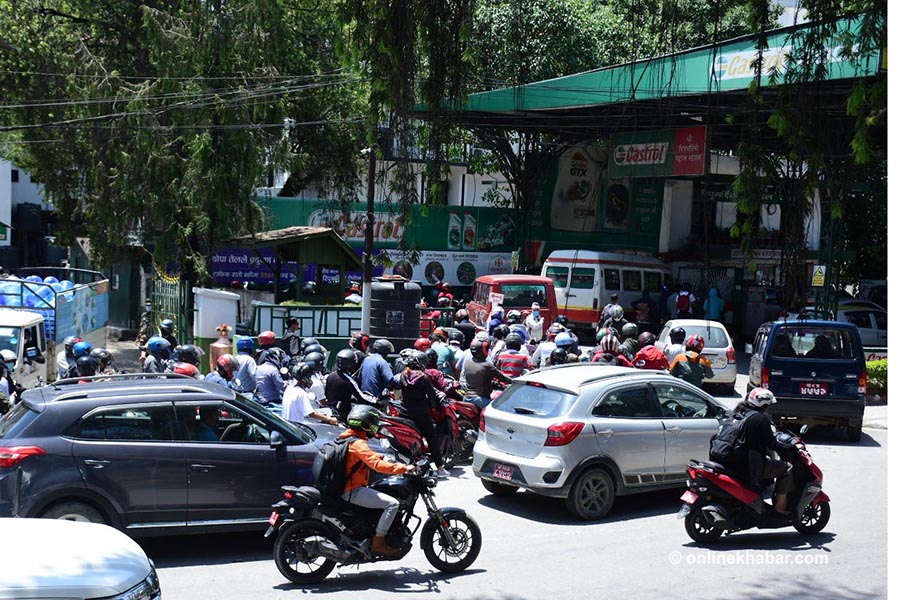
Long petrol queue at a petrol pump

Suvedi said, “Discussions have included focusing on domestic energy sources, introducing odd-even vehicle restrictions, and promoting induction stoves, but no decisions have been finalized.”

Currently, there are no long queues for fuel in the market, so the government prefers to monitor international developments before making necessary decisions.

“Though discussions continue, the situation does not yet warrant a final decision. People are a bit anxious, hence rumors have spread,” Suvedi clarified.

While there have been some minor disruptions in transporting food grains and other goods, business representatives state no serious problems have occurred.

In response to energy conservation, the Sri Lankan government has switched to a four-day workweek and replaced weekly public holidays, while implementing strict rationing of vehicles under a national fuel pass system.

Similarly, Asian countries including Pakistan, the Philippines, Thailand, South Korea, and China have adopted various measures to cope with the energy crisis.

Senior stakeholders in Nepal emphasize the need to adopt similar strategies.

Former Commerce Secretary Purushottam Ojha suggested both short- and long-term solutions based on prior experience.

Petrol pipeline and tank

Ojha recalled the crisis during 2008 when oil prices reached $147 per barrel, noting that using the Price Stabilization Fund was appropriate for immediate loss management but did not provide a sustainable solution.

He suggested leveraging high-level political initiatives with India to secure credit oil supplies, as done previously, as a possible current option.

He also mentioned the practice of borrowing from the employees’ provident fund and citizen investment fund for fuel purchases, with repayments made when prices normalize.

Ojha advised the government to take firm steps to reduce fuel imports and consumption, institute odd-even vehicle usage regulations, promote electric vehicles, and expand public transportation usage.

Finally, while hoping for a swift resolution to the international conflict, he noted that damage to oil infrastructure would require time to stabilize supply and urged immediate discussions on alternatives to mitigate the crisis.

Nine Municipalities in Mahottari Face High Flood Risk


March 23, Jaleshwar. It has been disclosed that nine municipalities in Mahottari are at high risk of flooding. These findings were revealed during a disaster preparedness and logistics study consultation program held on Tuesday in the district headquarters, Jaleshwar.

Jaleshwar, Matihan, Manrajiwa, Loharpatti municipalities as well as Ekdara, Sonma, Samsi, Mahottari, and Pipara rural municipalities have been identified as facing high flood risk. Meanwhile, Balawa, Bhangaha, Aurahi, and Ramgopalpur municipalities are categorized as having moderate risk, whereas Bardibas and Gaushala municipalities have been assessed as low flood risk areas.

Suresh Sah Sonar, Chief of Jaleshwar Municipality, emphasized the need for collective efforts in disaster preparedness among the 15 most vulnerable local units. He stressed identifying high-risk locations within municipalities, raising public awareness, and implementing flood mitigation programs as essential measures. – Rastriya Samachar Samiti

बिरामी कर्मचारीतन्त्रलाई दोषारोपण कि उपचार ? – Online Khabar

Civil Service: Blame or Reform?

The civil service is the backbone of public administration and the permanent government. Recently, various debates have emerged on social media and other communication platforms about it. Criticisms have been raised regarding the excessive politicization of the civil service. Arguments also point out that the system is overly procedural and slow. Furthermore, the civil service faces criticism for failing to keep pace with rapid technological developments and fulfill public expectations. Some advocates call for comprehensive reforms, while others suggest that mere reforms are insufficient and argue for a fundamental transformation of the civil service’s very ‘DNA.’

As societies evolve, change within the governance system and civil service becomes necessary and must be accepted as natural. The civil service itself has recognized the need for transformation. However, the question of whether the civil service is capable or incapable should not be viewed in an absolute sense but within a relative context. To address this, worldwide characteristics of civil services need to be analyzed. Only through focused debate on areas that require improvement can effective solutions be found.

According to Max Weber, the pioneer of the modern civil service, its fundamental features include merit-based selection, supremacy of rules and laws, neutrality, impartiality, hierarchical structures, and defined job descriptions. Scholars such as Karl Marx, Robert K. Merton, and Victor Thompson have emphasized the practical and psychological aspects of the civil service, highlighting its permanence, bureaucratic procedures, professionalism, supervision, and control mechanisms.

Overall, the civil service is a permanent apparatus working within legally defined jurisdiction. It bears the primary responsibility of implementing government policies professionally and maintaining political neutrality. It converts political will and programs into execution and upholds key accountability for implementation. The civil service maintains designated positions with corresponding job descriptions and systematic career development paths.

Change in governance and civil service is imperative in tune with societal transformation. It must be naturally accepted. The civil service itself acknowledges the need for transformation.

When discussing civil service transformation, its foundational character must not be forgotten. Assessing the extent to which the present civil service retains those characteristics provides the best basis for recommending improvements.

Two weeks ago (on Falgun 21), the House of Representatives elections were held. An 18-year-old girl voter questioned, “If voting procedures are so simple and well-organized, why do other government services involve so much hassle?”

Similarly, during an employee skill enhancement program, a notable discussion emerged where leadership-level civil servants expressed excellent views about policy-making and integrity. The facilitator asked, “Why do such capable employees fail to reflect these qualities in their workplaces?”

Reflecting on these questions leads to another: Is the civil service genuinely incompetent and ineffective? The answer is no. The recent elections were conducted in a changing political environment following the ‘Janajati’ movement. The election, announced six months prior, was peacefully and harmoniously completed nationwide. Like the young first-time voter, we all experienced the excellence of the election civil service. The factors contributing to this successful election include:

Clear Definition of Tasks, Outcomes, and Timelines: The responsibilities, expected results, and deadlines for election staff were clearly outlined. All focused on conducting a free and fair election. The fixed timeline made it a top priority. There was clarity on “what to do, why, and when.” Effective coordination determined who would do what. Guidance, codes of conduct, and authority prevented duplication and enabled timely completion.

Extensive Coordination and Collaboration: The entire country became election-focused during the period. The government’s priorities were shared by the civil service. Offices nationwide provided manpower support. Training and alternative arrangements were made for risk management. This created national synergy and the civil service upheld its historic responsibility.

Political Priority and Ownership: The civil service never hesitates to enact political priorities. With political leadership support, the civil service takes risks and creates an environment for smooth operation. Such an environment prevailed during the election.

Alternative arrangements for structures affected by the ‘Janajati’ movement were also made. Despite criticisms, the undeniable contribution of the civil service to the successful conduct of the election must be acknowledged.

Measurable accountability was ensured. Stakeholders clearly understood the election process, with regular monitoring, control, and reporting mechanisms in place. Authorities were empowered to resolve issues promptly. The assured disciplinary consequences fostered a sense of mandatory work among responsible officials.

Local elections could not be held for a long period after 2054 BS. Only in 2074 BS were elections conducted under federalism. During this interval, the civil service managed service delivery in the absence of active local bodies.

In numerous disasters and crises, employees have risked their lives, dedicating themselves to public service. The civil service also leads in managing transition periods following each political change.

The civil service’s role in managing alternative structures and records impacted by the ‘Janajati’ movement was crucial. Despite criticism, its significant contribution to the successful conduct of elections cannot be overlooked.

While expecting results from the civil service, it is essential to recognize its professional lapses and limitations. Although bound to operate within rules, laws, and procedures, professional shortcomings exist and reform is imperative:

1. Lack of Political Neutrality: Trade unions affiliated with specific political parties are active within the civil service. Their pressure on transfers, promotions, and disciplinary actions reveals professional lapses. This must be legally prohibited.

2. Absence of an Evaluation System: There is no objective performance evaluation system. Without clear distinctions between performing and non-performing employees, healthy competition is lacking. Morale has declined among deserving staff, while protected individuals’ confidence has risen. Laws should incorporate measurable indicators along with reward and punishment mechanisms.

3. Influence of Intermediaries: Professional monitoring is weak. The absence of depoliticization and the influence of intermediaries from procurement processes to large projects have weakened the civil service. Political and administrative leadership must demonstrate commitment to eliminating intermediary influence in all sectors.

Where the civil service has operated independently and resisted political pressure, significant improvements have occurred. Promoting such good practices and encouraging employees is essential to nurturing a culture of excellence.

The Nepalese civil service has experience managing the country prudently even amid political transitions. The recent elections confirm its continued capability. Going forward, it is necessary to streamline it further while boosting morale.

Only with correct political oversight and support can the civil service deliver effective results. With clear policies, laws, resources, and timelines supported by proper monitoring, the civil service can demonstrate transformative progress. Thus, blaming the civil service for inefficiencies is a leadership failure. The civil service’s capacity is relative to the capability of its leadership.

Despite the promulgation of the constitution, the absence of laws to systematize the civil service is challenging. Recognizing its deficiencies, the civil service is willing to reform. The current government and parliament hold significant opportunities to enact laws that will transform and enhance civil service effectiveness, and they must seize these opportunities.

– Niraula is the Joint Secretary of the Government of Nepal and Paudel is a Study Director at the Nepal Administrative Training Institute.

Read the Good Governance Series:

Rainfall Reported in Kathmandu and Various Districts Across the Country

Summary

  • Rainfall has occurred in Kathmandu and several other districts due to partial influence of western and local winds.
  • In the last hour, Jhapa recorded the highest rainfall with 9.4 millimeters.
  • The Meteorological Department has forecasted light rain accompanied by thunder and lightning, as well as possible snowfall, in Koshi, Bagmati, Gandaki, Karnali, and Sudurpashchim provinces.

March 23, Kathmandu: Due to the partial influence of western and local winds, rainfall has been observed today in Kathmandu and several other districts.

Kathmandu received 1.2 millimeters of rain in the last hour, with light rain also reported in other districts. According to the Department of Hydrology and Meteorology, some areas have experienced hail, snowfall, and strong winds.

Data from various rainfall measurement centers shows that in the recent hour, the highest rainfall of 9.4 millimeters was recorded in Jhapa. Additionally, light rain was reported in Taplejung, Bhojpur, Nuwakot, Lamjung, Gorkha, Kaski, and Kalikot. In the past three hours, Tanahun recorded 24.6 millimeters and Jhapa 12.2 millimeters of rainfall.

According to Dayankar Kayastha, Information Officer at the Meteorological Department, the hill and mountainous regions, including Koshi Province, generally have cloudy skies, while other areas are partly cloudy.

The department’s bulletin issued at 6:00 PM today states that some locations in Koshi, Bagmati, Gandaki, Karnali, and Sudurpashchim provinces are experiencing light rain or snowfall accompanied by thunder and lightning.

The department further expects mostly cloudy conditions on Wednesday in the hill and mountain regions of Koshi, Bagmati, Gandaki, and Lumbini provinces, whereas partly cloudy conditions will prevail in other hill and mountainous areas. The Terai region is expected to remain mostly clear.

There is a chance of light rain or snowfall accompanied by thunder and lightning in some hilly and mountainous areas of Koshi and Gandaki provinces and one or two locations in other provinces.

Eighteen Deaths from Tuberculosis in Bajura Over the Past Five Years


March 24, Bajura – Data released on World Tuberculosis Day revealed that 18 people have died from tuberculosis in Bajura over the past five years. The statistics were made public by the Bajura Health Office on Tuesday.

According to the Health Office, there was one death in the fiscal year 2077/78, three in 2078/79, two in 2079/80, six in 2080/81, four in 2081/82, and two deaths reported up to the end of Falgun in 2082/83 due to tuberculosis, stated Kumar Nyaupane, the Public Health Officer and Information Officer at the Bajura Health Office.

He also mentioned that in the last fiscal year 2081/82, 141 cases of tuberculosis were recorded in the district. Currently, 81 of these patients are regularly taking their medication. Among the nine local units in the district, Badimalika Municipality has the highest rate of tuberculosis, with 219 cases per 100,000 population, according to the figures.

Dr. Chandrashekhar Yadav, Chief of the District Hospital, emphasized that tuberculosis should not be addressed only on World Tuberculosis Day but requires consistent and serious efforts through effective programs across all sectors to eradicate the disease. He urged everyone to fulfill their responsibilities in their respective areas.

The Government of Nepal has set a goal to control tuberculosis by the year 2035 and to eliminate it entirely by 2050. – RASAS

Pakistan Proposes Mediation for Dialogue Between the United States and Iran


March 24, Kathmandu — Pakistan’s Prime Minister Shahbaz Sharif has offered to mediate dialogue between the United States and Iran, both currently engaged in conflict. On Tuesday evening, Sharif extended this proposal to both countries via X (formerly Twitter).

“Pakistan welcomes and appreciates the ongoing efforts toward dialogue to halt the conflict in the Middle East,” Prime Minister Sharif wrote. “This is essential not only for the region but also for external nations seeking peace and stability.”

Sharif further stated that Pakistan is prepared to host the talks if the United States and Iran agree. “If the U.S. and Iran consent, Pakistan is ready to serve as the host nation for these discussions and will consider this an honor, facilitating a comprehensive and sustainable resolution to the conflict,” he said.

Times International Clinches Victory Over Kirtipur with a Final Two-Point Shot

News Summary

Content generated and editorially reviewed.

  • Times International Club defeated Kirtipur 81-79 in the HJNBL.
  • Times’ Manish KC scored a game-high 31 points and was named Man of the Match.
  • The second edition of the league, organized by the Nepal Basketball Association, features eight teams with the top four advancing to the playoffs.

March 23, Kathmandu – In a thrilling encounter on Tuesday as part of the Himalayan Java National Basketball League (HJNBL) 2026, Times International Club secured a dramatic win over Kirtipur.

The match, held at the Dashrath Rangasala Covered Hall in Tripureshwor, saw Times snatch victory by 81-79 after scoring two crucial points on the final rebound.

Trailing for most of the game, Times managed to equalize in the closing moments. Times took the lead in the final seconds, and although Kirtipur managed to draw level, Times capitalized on their last opportunity by adding two points to seal the victory.

With just 12 seconds remaining, Times captain Sadish Pradhan missed a three-point attempt, but Kamal Thapa grabbed the rebound and scored two points, securing the win for Times.

Kirtipur dominated the first quarter 20-14 and extended their advantage by winning the second quarter 22-20, leading 42-34 at halftime. Times outperformed in the third quarter 20-16, but Kirtipur still held a 58-54 lead going into the final period.

In the decisive final quarter, Times delivered an impressive 27-21 surge to overcome the deficit. Their performance in this final quarter was instrumental in securing a two-point victory.

Manish KC led Times with a match-high 31 points and earned the Man of the Match honors. This win marked Times’ seventh consecutive victory. With seven wins and one loss from eight games, Times currently holds the top position on the leaderboard with 15 points.

The second edition of the HJNBL, organized by the Nepal Basketball Association (NEBA), features eight teams competing.

The league follows a double round-robin format comprising a total of 56 matches. After the league stage, the top four teams will advance to the playoffs. The first and second-placed teams will face off in the first qualifier, while the third and fourth-placed teams will compete in an eliminator match.

The loser of the first qualifier and the winner of the eliminator will then meet in the second qualifier. The winners of the first and second qualifiers will compete in the final.

The champion of the tournament will receive a cash prize of NPR 400,000, with the runner-up earning NPR 200,000 and the third-place team awarded NPR 100,000.

Additionally, the player exhibiting the best overall performance throughout the tournament will be named the Most Valuable Player (MVP) and receive attractive awards, NEBA stated.

कुलमानले भने- जनादेशविपरीत वैकल्पिक बाटोबाट मन्त्री बन्ने कल्पनासमेत गर्दिनँ

Kulman Ghising States He Will Not Become Minister Against the Mandate Through Alternative Means


March 23, Kathmandu – Kulman Ghising, chairman of the Ujhyalo Nepal Party, has clearly stated that he will not become a minister through any alternative means against the popular mandate amid ongoing discussions about his participation in the new government. On Tuesday evening, he also mentioned via Facebook that he will focus on strengthening his party.

“I cannot even imagine becoming a member of parliament and a minister through any alternative route contrary to the mandate received from the people,” Chairman Ghising wrote. “I want to clarify that I have not had any discussions with anyone regarding participation in the government so far.”

He expressed his intention to respect the election results and move forward by learning from them. “We are committed to further strengthening the Ujhyalo Nepal Party. Our dedication to building a prosperous and well-governed Ujhyalo Nepal remains unwavering,” Ghising said.

He also requested people not to be misled by false propaganda spread against him.