Author: space4knews

Proposal to Convene Joint Session of Parliament if Constitutional Amendment Bill Is Rejected by National Assembly

According to the summary of the news, the draft rules of the new House of Representatives propose a provision to convene a joint session of parliament if the National Assembly rejects the constitutional amendment bill. Legal expert Purnaman Shakya has stated that a joint meeting of the federal parliament cannot be held for such a bill, and that this arrangement would be unconstitutional. The draft committee chair Ganesh Parajuli presented the new rules report at the House of Representatives meeting on 28th Baishakh. Kathmandu, 11th Jestha.

If the constitutional amendment bill, which has been passed by the House of Representatives, is rejected by the National Assembly, the draft rules of the new House of Representatives include a legal provision for convening a joint session of parliament. At the House meeting on 28th Baishakh, draft committee chair Ganesh Parajuli presented the “House of Representatives Rules Committee Report 2083”. Rule 140 outlines the procedure for constitutional amendment bills. Sub-rule 11 states, “If a constitutional amendment bill passed by the House and sent to the National Assembly with a message receives a favorable vote of at least two-thirds of all the existing members in both houses, the Speaker shall certify it and forward it to the President for promulgation.”

This provision was not included in the House of Representatives Rules of 2079. Regarding the additional provision, draft committee member Madhu Chaulagain says, “This clause has been introduced to enable discussion through a joint session if the constitutional amendment bill is rejected by either house. Passing the bill with a two-thirds majority in the joint session is also a democratic approach.” He explained that this provision was included with the understanding that a joint session can be convened specifically for constitutional amendment bills.

Why Did Trump Direct Negotiators Not to Rush the Iran Deal?

Trump

Image Source, AFP via Getty Images

US President Donald Trump has stated that he instructed negotiators not to rush into any deal with Iran.

Earlier, he had mentioned that they were very close to reaching an agreement.

The current proposal under discussion includes extending a 60-day ceasefire, reopening the Strait of Hormuz, and planning further negotiations regarding Iran’s nuclear program.

Posting on social media, Trump described the talks as progressing “constructively” and emphasized that both sides need to take the necessary time to ensure everything is properly arranged.

On Saturday, Trump had said that the deal was “largely agreed upon,” raising expectations of an imminent announcement.

तलब वृद्धिमा सरकारको संशय, मौन ट्रेड युनियन र दुई तिहाइ अभिभारा

Government Hesitant on Salary Increases Amid Silent Trade Unions and Burden of Two-Thirds Majority

Summary

  • There has been a freeze on salary increases for civil servants for the past four years, resulting in approximately a 25 percent decline in their purchasing power.
  • Although the Civil Service Act of 2049 mandates salary reviews every three years, the government has failed to implement this provision.
  • Despite the Supreme Court’s order not to enforce decisions affecting trade unions, employee organizations have remained silent.

The relationship between public administration and politics in Nepal has always been fluctuating. While political leadership changes, it is the civil service – the ‘permanent government’ – that ensures continuity of state machinery and delivers services to citizens’ homes. However, this permanent government is currently facing serious disappointment, economic hardship, and an identity crisis. Civil servants have not received any salary increases for four years.

With consumer price indexes setting new monthly records, the livelihoods and daily lives of those steering governance and administration are being squeezed.

Recent political and legal developments—especially the formation of a powerful two-thirds majority government, restrictions on trade unions, and the Supreme Court’s interim order—coupled with the silence of these unions, raise questions about the future direction of employee administration. Will there be salary increases after four years, or will the status quo persist? This question concerns not only millions of employees but also the future of good governance, corruption control, and federal implementation in the country.

Mockery of the Civil Service Act and Legal Obligations

When discussing a legal state, it is necessary to examine whether the state itself complies with the laws it creates. Section 27 (1kh) of the Civil Service Act 2049 clearly stipulates the formation of a Salary Review Committee, chaired by the Government Secretary, which must reassess salaries and allowances every three years based on revenue growth, total sanctioned posts, and consumer price indices over the past three years.

This is not merely a moral appeal but a legal obligation. Although the government increased salaries by 15 percent in the fiscal year 2079/80 budget, this mechanism has since become defunct.

Failing to implement the required salary review after four years is a clear violation of the law. Even high-level salary recommendation commissions have submitted minimum wage reports that remain pending in Singha Durbar.

Soaring Inflation and Depleted Pockets

Economic data from the past three to four years indicate that Nepal’s average annual consumer price inflation has hovered around 6 percent. Over four years, prices for goods and services have risen by 20 to 24 percent. With stagnant incomes, employees’ purchasing power has declined by about 25 percent.

Lower- and middle-level civil servants (such as Subba or Kharidar) can no longer sustain the modern, expensive urban lifestyle. Their salaries often get exhausted on rent, children’s school fees, gas, food, and healthcare before the month ends.

The government’s recent policy to disburse half the salary every 15 days has somewhat eased cash flow but does not address the fundamental inadequacy. The key issue remains whether the total amount suffices to cover monthly expenses.

The Vicious Cycle of Corruption Control and Low Wages

Good governance and a corruption-free society are main objectives of the current government. However, expecting good governance while keeping employees hungry or under economic distress is futile. International studies show that corruption in public service arises not solely from moral decay but also from economic insecurity and survival struggles.

When the state fails to provide fair wages aligned with market rates, employees become more vulnerable to unethical or illegal practices such as bribery and revenue leakage.

Conversely, providing employees with adequate salaries and social security boosts morale and diminishes tendencies toward corruption. Therefore, salary increases should be viewed not as unproductive expenditure but as the primary, effective investment in maintaining good governance and curbing corruption.

Goals and Leadership Challenges of the Two-Thirds Majority Government

Currently, the country has a strong government with a two-thirds majority formed through cooperation among main parties. This government has a significant opportunity to establish political stability and lead the country toward economic prosperity, with priorities including promoting good governance, financial discipline, and public service reform.

However, dissatisfaction and disillusionment within the civil administration—the key service delivery mechanism—raise doubts about achieving these goals. A demoralized civil service cannot effectively implement political plans and reforms with enthusiasm. For the two-thirds government to genuinely energize and deliver results to citizens, addressing civil servants’ just demands in the upcoming budget is essential.

Supreme Court Orders and Trade Unions’ Silence

Recently, the government issued an ordinance amending the Civil Service Act to abolish official trade union provisions and close offices, which was widely seen as an attempt to suppress collective employee rights. The Nepal Civil Servants Organization challenged this through a writ petition, and the Supreme Court issued an interim order restraining the government from enforcing this decision immediately.

The Supreme Court reinforced constitutional protections for association freedom under Article 17 and trade union rights under Article 34. Yet, trade unions have remained silent. Once vigorously mobilizing for salary increases in protests and parliamentary pressure, why have unions adopted a quiet, wait-and-see stance now?

Whether salaries will increase after a prolonged freeze depends on the government’s political will and attitude. The two-thirds government can no longer ignore legal provisions citing resource constraints or economic downturns.

There are two main reasons for the unions’ silence: first, political pressure and fear—union leaders hesitate to confront the government given its two-thirds majority. Second, partisan affiliations—as most unions operate like party-affiliated groups, they are reluctant to mount aggressive opposition against their own party-led government. Consequently, unions are playing a passive role, suppressing employee voices.

Ironically, with a powerful two-thirds government, there is no excuse to disregard legal provisions or jeopardize civil servants’ livelihoods.

If Nepal truly aims for good governance, corruption control, and a dynamic permanent government, the following steps are imperative in the next budget:

Substantial Salary Increase

Basic salaries, unchanged for four years, must be raised by at least 25 to 30 percent to offset inflation and restore purchasing power.

Elimination of Wasteful Expenditures

The government has already reduced ministries from 22 to 18 and plans to cut around 25,000 posts. Savings must be redirected from unproductive allowances and political appointments to employee benefits.

Result-Oriented Administration

Trade unions should be reformed from political arenas into professional, performance-based organizations through legal changes.

The civil service must be strong and content; otherwise, the country’s path to prosperity will be blocked. Instead of becoming entangled in publicity and technical disputes, the two-thirds government must empower the permanent government with economic justice and security. Empty pockets under white aprons or formal attire cannot sustain good governance for long.

(Author: Shahi, Civil Servant Working in Dolpa, Karnali Province)

Government Decides to Review Approximately 11,495 Temporary Positions

The government has decided to review the 11,495 temporary positions created two years ago without conducting an organizational and management survey. The 63rd Annual Report of the Office of the Auditor General has recommended a comprehensive review of federal employee positions and appropriate management based on service delivery needs. The government is preparing to reduce the number of ministries from 22 to 18 and reassess the positions of secretaries and joint secretaries across various agencies.

May 24, Kathmandu – The government is planning to review about 11,495 temporary employee positions added two years ago without an organizational and management survey. The Prime Minister’s Office is currently investigating the necessity of these positions. According to the latest annual report from the Civil Service Accounting Office, there are 86,485 employees working across the country’s three levels of government. Approximately half of these, or 41,330 employees, serve at the federal level, while the province level has 13,115, and the local level employs 32,075 staff members. Over the past five years, the total number of employees at all three levels has decreased by 2,000, with the federal level’s workforce remaining nearly stable. In 2018, there were 48,500 federal level positions. In the last seven years, the number of federal positions has increased by 3,175. Additionally, around 11,000 temporary positions have been created without procedural compliance, as highlighted by the Auditor General.

The Auditor General’s report states, “The ministry approved 11,495 temporary positions for fiscal year 2081/82 without conducting an organizational and management survey as per the Civil Service Act. A systematic process is needed for the addition and removal of positions applicable across all three government levels.” Recently, the government reduced the number of ministries from 22 to 18; however, the number of employees from secretary to deputy secretary levels has not decreased. There are situations where two administrative directorates exist within a single ministry to manage personnel. An employee from the Secretariat of Prime Minister Balendra Shah said, “Initially, there was a plan to have two secretaries in one ministry. Later, some were considered for transfer to the provincial level. Within the next three months, around 7-8 secretaries are due for retirement. There are limited options to transfer or reassign them extensively. We expect some decisions to be made within this week.”

कांग्रेस नेता धनराजकी पूर्वपत्नी ज्योतिलाई २१ दिनभित्र अदालत उपस्थित हुन आदेश

Former Wife of Congress Leader Dhanraj Ordered to Appear in Court Within 21 Days

News Summary

Prepared after careful review.

  • The Lalitpur District Court has issued a 21-day notice to Jyoti Gurung, who is involved in the Miterei Cooperative embezzlement case.
  • Jyoti, the former wife of Nepali Congress leader Dhanraj Gurung, is accused of embezzling NPR 125 million from the cooperative.
  • Bodhvikram Thapa, secretary of the cooperative, filed a complaint at the Central Investigation Bureau against Jyoti and four others.

May 24, Kathmandu — Jyoti Gurung, named in the Miterei Cooperative embezzlement case, has been served a 21-day notice by the Lalitpur District Court to present her response along with evidence.

Jyoti, aged 48, originally from Lamdanda Ward No. 2, Arjun Chaupari Rural Municipality, Syangja, currently residing in Thasikhel, Ward No. 14, Lalitpur Metropolitan City, is the former wife of Congress leader Dhanraj Gurung.

The court’s notice mentions her explicitly as “wife of Dhanraj Gurung” with a multigenerational identity description.

The notice states that Bodhvikram Thapa filed a transaction case against Jyoti. The district court annulled the previously issued deadline and in accordance with the Order dated Jestha 5, 2083 B.S., has issued a 21-day notice under Section 105, Subsection 22 of the Muluki Civil Procedure Code, 2074 B.S.

The notice published in Gorkhapatra instructs: “From the date this notice is published, you are requested to appear in this court within 21 (twenty-one) days, either personally or through a legal representative, submitting a reply letter along with supporting evidence.”

The notice further warns that failure to appear within the stipulated time will lead to legal proceedings in absentia and no further complaints will be entertained.

Case Details

The Miterei Cooperative was established by former soldiers who served in the British and Indian armies, headquartered at Mahalaxmi, Ward No. 5, Lalitpur Metropolitan City.

Secretary Bodhvikram Thapa filed a complaint at the Central Investigation Bureau (CIB) last Sunday against five individuals, including the general manager Jyoti Gurung, accusing them of embezzling NPR 125 million from the cooperative.

Jyoti Gurung, accused of embezzlement, is the former wife of Nepali Congress former vice-chairman Dhanraj Gurung. The couple married in 1994 (2051 B.S.). According to Dhanraj, he was only a regular member of the cooperative while Jyoti was employed there.

Jyoti had been associated with the cooperative since 2001 (2057 B.S.), initially participating as a savings collector. In 2013 (2070 B.S.), she became the treasurer and later was appointed general manager.

It is alleged that misappropriation of funds occurred after she took the role of general manager. Former employees Jyotibahadur Bhandari, Sujan Shakya, Hitman Thapa, and Prakash Thapa allegedly aided her, according to cooperative officials. Despite repeated requests to return the funds, Jyoti reportedly refused and absconded.

Nvidia’s Monopoly and the Geopolitics of the Chip Market

News Summary

Produced with editorial insights.

  • Nvidia’s dominance is not just a business success but an ecosystem monopoly challenging even giants like Google and Meta, who struggle to break free from this complex web.
  • There is a mysterious saying in the tech market: Nvidia is essentially not a chip manufacturer but a software company deploying hardware illusions to trap the world in its network.
  • The key question before you now is: Will we remain mere spectators or become active players? The game has only just begun!

Recently, US President Donald Trump flew prominent Silicon Valley leaders Elon Musk of SpaceX, Tim Cook of Apple, and Jensen Huang of Nvidia on the special “Air Force One” aircraft to Beijing for “high-stakes” talks with Chinese President Xi Jinping, an event that stunned diplomats worldwide.

While it appeared to be a business visit on the surface, internally it was a competition among the world’s powerful leaders. This event made clear that the current global top concern is not tankers or ballistic missiles, but artificial intelligence (AI) and the tiny silicon pieces controlling it—the microchips. These minute chips govern everything from households to banking systems in every nation.

The world’s leading tech giants like Google, Microsoft, Meta, and Amazon lineup at Nvidia’s door for the world’s most advanced AI chips. Nvidia alone controls nearly 90% of the global market for cutting-edge AI chips.

Despite established competitors like AMD and Intel in hardware manufacturing, why are global billionaires eager to procure Nvidia’s chips? Why have other companies failed to develop alternatives to Nvidia’s offerings?

This article aims to clarify this complex global technology market game through examples from our own industry.

Difference Between CPU and GPU: An In-Depth Processor Comparison

To understand the politics in the chip market, it’s essential to grasp the distinction between two fundamental processors inside computers or mobiles — the CPU (Central Processing Unit) and the GPU (Graphics Processing Unit).

Let’s compare this to an orange orchard in our village. Suppose 10,000 oranges must be picked and delivered to the market. We have two options.

First option: A clever, strong porter (i.e., CPU) carries 100 oranges at a time and runs the shorter route. But he can’t carry more than 100 oranges at once, so he must run 100 times to deliver all 10,000 oranges. In technological terms, this is called ‘serial processing.’

Second option: Five hundred school children (i.e., GPU), each carrying a basket, are sent simultaneously via a wide road. Each carries 20 oranges, resulting in all reaching the market simultaneously and completing the task faster. This is ‘parallel processing.’

AI applications like facial recognition or language translation don’t require complex math but rather millions of simple operations done rapidly. Hence, GPUs are millions of times more useful than CPUs in AI. Nvidia realized this back in 2006 and focused fully on GPU development while other companies remained tied to CPUs.

The ‘CUDA’ Software Web

For two decades, Nvidia has concentrated on GPU chip development. Its success and power stem not only from hardware but from its software platform called CUDA (Compute Unified Device Architecture). CUDA teaches programmers a language for direct, optimized communication with GPUs.

CUDA can be thought of as a major highway that all customers and businesses have been using continuously for 20 years. All vehicles, petrol stations, hotels, and other infrastructure have been designed around this road.

Nvidia has strengthened its monopoly by advancing software development dubbed a ‘software moat.’

Although competitors like AMD introduce cheaper new chips, those using them must abandon the CUDA highway, leading to significant financial and technical challenges.

Thus, major tech firms must invest heavily and spend time developing new software alternatives. AI’s main digital platforms like PyTorch and TensorFlow run exclusively on CUDA, creating a ‘software ecosystem lock-in’ that prevents customers from switching to cheaper chip options.

Pre-made Software Libraries and Tools

AI software development doesn’t require rewriting code from scratch. Alongside CUDA, Nvidia has created various AI and tensor optimization software libraries making coding faster and easier.

This is comparable to having a pre-made mix of spices at a momos shop for quick and delicious momos. Competitors might have the utensils but without the spice mix, they must labor to create their own.

New and experienced programmers alike find themselves compelled to stay within Nvidia’s established ecosystem because their investment and time are tied to it.

Old Licenses and New Vehicles

How fast software code runs on hardware depends on the compatibility of components. The CUDA highway aligns perfectly with Nvidia’s wheels and gears, resulting in faster, more fuel-efficient rides.

Trying to use AMD’s vehicle on the CUDA highway results in mismatched wheels and road problems. Programmers face the challenge of constantly rewriting new software for new chips. Nvidia, however, ensures that codes over a decade old run in seconds on modern chips.

This can be likened to old driving licenses still being legally valid for operating today’s electric cars.

All these reasons have enabled Nvidia to eliminate competitors and maintain a monopoly.

Network Management Power: InfiniBand and DGX

To extend AI capabilities, millions of chips must be connected to form supercomputers. When thousands of chips join, the biggest issue is traffic jams—data bottlenecks.

This can be compared to trucks causing a jam on a narrow wooden bridge connecting two villages.

Nvidia acquired a networking company called Melanox and took over the InfiniBand technology, which enables thousands of trucks to move on a modern 24-lane highway without traffic jams at exceptionally high speed.

Nvidia does not just sell chips; it sells complete supercomputer systems called DGX, which package chips, InfiniBand cables, cooling systems, and software together. Competitors lack such extensive mega-networks.

The World’s Most Complex Factory: The Story of TSMC

Though a large company, Nvidia does not manufacture chips itself. It designs and delivers digital blueprints to Taiwan’s TSMC for production. More than 90% of the world’s most advanced AI chips are produced by TSMC.

Why can’t other wealthy nations or companies like Intel establish factories like TSMC? There are primary reasons:

First, enormous capital investment. Opening a modern chip factory costs $15-20 billion, exceeding Nepal’s total annual budget. Its key machine, the EUV lithography machine, costs over $300 million and is made only by a single company, ASML, mostly pre-booked by TSMC.

Second, atomic-level precision. TSMC currently manufactures commercially viable 2-nanometer chips, where even a single dust particle can ruin the chip. The factory’s cleanroom is 10,000 times cleaner than Mount Everest’s summit.

Third, production yield experience. TSMC is an expert factory achieving over 80% successful chip yield, while competitors continue to struggle.

One might think, “What difference does this make for us running Facebook in Kathmandu or Pokhara?” But the reality is much tougher.

Supply Chain Control and Speed

Building chips requires not only silicon but also high-speed memory (HBM), which can be likened to the village’s “grain banks.”

Three years ago, Nvidia paid billions of rupees upfront to secure deals with those who operate these mills and farms, locking down supplies.

Competitors might approach TSMC, but not only is this year’s production booked, future years are fully reserved as well.

Furthermore, Nvidia CEO Jensen Huang follows the “one-year product cycle” strategy, releasing new chips every year. Before the market fully absorbs old chips, a new generation is launched.

Opportunities for Nepal

Whether it’s the US political strategy of flying technology tycoons on Air Force One to Beijing or Nvidia’s software web, the message is clear: future conflicts will not be over territorial control but digital colonization where control over thought and data prevails.

Nvidia’s dominance is not just business success; this monopoly has even challenged giants like Google and Meta. As chip prices rise, our AI technology, educational tools, and mobile apps will become more expensive.

Unknowingly, we are becoming subjects of an invisible digital empire ruled by Jensen Huang.

But is it impossible to break this web? While we cannot build a hardware factory with billions of rupees, Nvidia has kept its AI software running openly on the internet on the ‘CUDA highway.’

This means dominating the tech world doesn’t require being a superpower. Sitting in an ordinary room in Kathmandu with a simple laptop, one can use Nvidia’s network to build AI models that could impact the global technology market.

In conclusion, the mystery of the tech market is this: “Nvidia is essentially not a chip manufacturer but a software company that lures the world with hardware illusions into its net.”

The question is clear: will we be spectators or players? The game has begun!


KP Sharma Oli: Process Underway to Explore Alternatives for Leadership Protection

A Secretariat meeting was held on Sunday night to discuss leadership changes within the CPN-UML party. Party Deputy General Secretary Lekhraj Bhatt expressed confidence that the meeting would energize party ranks and the general public. He stated, “The debate concluded with this meeting. Regardless of the report submitted by the task force, there will be further discussions. The matter will be decided by the Central Committee.”
According to Mahesh Basnet, close secretary to Chairman KP Sharma Oli, all proposals put forward by the chairman were passed unanimously. The task force, chaired by Rambahadur Thapa, is expected to submit a report on election review within one month. Basnet added, “The meeting’s spirit is primarily to strengthen the chairman moving forward.”
However, a leader in favor of leadership change described the formation of the task force as the formal beginning of change in Oli’s leadership. Many leaders, including Oli, were elected at the general convention held five months ago. Leaders close to Oli commented, “We have just emerged from the general convention. I do not think there is an immediate need for a special general convention.”
Following opposition within the Secretariat, Oli’s faction appears to be relying on the Central Committee. Another central committee member close to Oli, Kiran Paudel, indicated that discussions would reach the Central Committee. He said, “Various issues regarding preparations for a special general convention had been raised earlier.” Because Oli’s close leaders have faith in resolving matters through legal processes and party bodies, the current process has been paused.

मापसेबाट गत वैशाखमा देशभर १२४ सवारी दुर्घटना, १२ जनाको मृत्यु

124 Accidents Caused by Driving Under Influence in Last Vaisakh Month Result in 12 Deaths

May 24, Kathmandu – The Nepal Police have reported that during the last Vaisakh month, 124 traffic accidents occurred across the country due to driving under the influence of intoxicants. These accidents resulted in 12 deaths and 174 injuries. Within the Kathmandu Valley alone, 37 such accidents took place in Vaisakh, causing 2 deaths and 50 injuries, informed Central Police Spokesperson and Deputy Inspector General of Police Avin Narayan Kafle.

According to him, in Koshi Province, 35 accidents due to intoxicated driving led to 2 deaths and 53 injuries. Madhesh Province recorded 20 accidents with 27 injuries. Bagmati Province saw 12 accidents resulting in 1 death and 19 injuries. Palpa Province experienced 5 accidents with 4 deaths and 3 injuries. Lumbini Province had 9 accidents with 3 fatalities and 15 injuries. Karnali Province reported 3 accidents causing 3 injuries, while Sudurpashchim Province also had 3 accidents with 4 injuries, the police added.

Highlighting the increasing risk of traffic accidents due to substance consumption, Spokesperson Kafle urged all drivers to strictly adhere to traffic regulations. He emphasized that driving under the influence has become particularly prevalent during nighttime hours, public holidays, and festival occasions. He stated, “Driving under the influence is not only a legal offense but also an extremely dangerous act that endangers human lives.”

The traffic police have recently intensified campaigns to control intoxicated driving nationwide. Stringent traffic checks are being conducted especially in urban areas, highways, busy intersections, and during nighttime. Drivers caught under the influence are being prosecuted according to law, alongside initiatives to raise public awareness, said Navaraj Adhikari, Chief of Kathmandu Valley Traffic Police Office and Senior Superintendent of Police. He added, “The traffic police continuously conduct awareness programs urging all drivers and the general public to avoid intoxicated driving and to be responsible for safe travel.”

According to Adhikari, intoxication impairs a driver’s decision-making ability, complicates vehicle control, and increases tendencies to speed, thereby substantially raising the risk of accidents. He urged all drivers to maintain full vigilance and strictly follow traffic rules while driving.

Dalit Woman Assaulted Over Alleged Buffalo Trespassing in Siraha

May 24, Siraha – A man has been arrested for allegedly assaulting a Dalit woman in Siraha district. The police detained 55-year-old Pavitra Narayan Yadav from Naraha Rural Municipality-3 on Saturday evening near Naya Choharwa. Yadav is accused of attacking 60-year-old Phoolkumari Mandal.

The incident reportedly occurred on April 10 afternoon after Mandal’s buffalo allegedly entered Yadav’s farmland. Following the assault, Mandal filed a complaint at the District Police Office accusing Yadav of abusive behavior and injustice.

Based on her complaint and after obtaining an arrest warrant from the District Administration Office of Siraha, the Choharwa Police team took Yadav into custody. He is currently held for further investigation, according to Ramesh Bahadur Pal, Information Officer and Deputy Superintendent of Police at the Siraha District Police Office.

Shanti Thami Overcomes Rare Cancer with Resilience and Modern Treatment

Shanti Thami has proven that mental strength surpasses physical pain, enduring five major surgeries, infections, and uncertainty with remarkable courage.

News Summary

Editorial review completed.

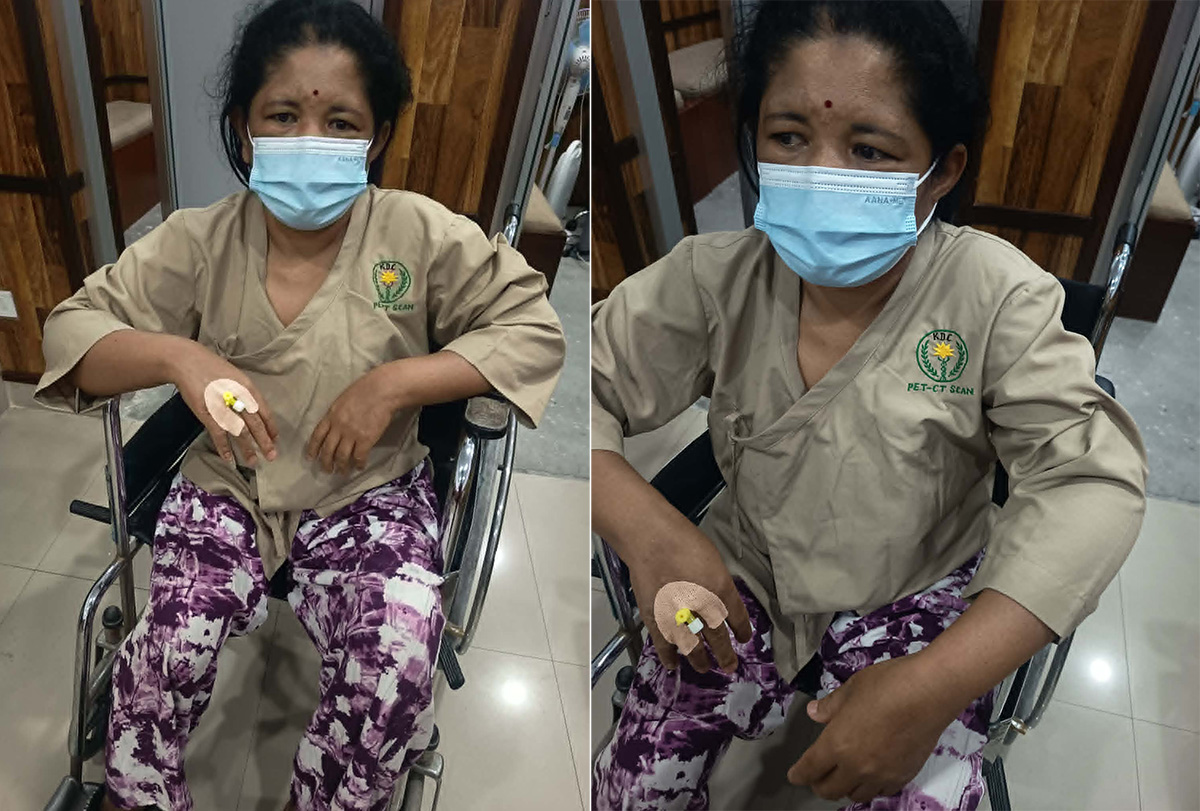
  • Shanti Thami, a patient of rare melanoma cancer, has become cancer-free after four cycles of immunotherapy at Patan Hospital.

Shanti Thami’s daily life had been a constant battle as she struggled with thyroid issues, back pain, and other health problems over the years. Approximately one year ago, she noticed a small black spot on her ankle.

Initially, she thought it was a simple wound, allergy, or injury and tried home remedies. However, the spot grew larger, became an ulcer, turned numb, and started to hurt.

As the condition worsened, her family took her to Bir Hospital. From there, she was referred sequentially to thyroid specialists, dermatologists, and finally to the plastic surgery department. After numerous tests and consultations, her first biopsy was performed in late August.

She was admitted to the hospital the day after Dashain Tika in October 2025, undergoing five major surgeries within three months. Repeated wounds were cut from the ankle, knee, and other areas. Infections occurred, and her recovery was delayed. Her family spent over three hundred thousand Nepali rupees but did not receive a definitive diagnosis.

Only after the fifth surgery did doctors reveal to the family that she had melanoma, a rare and aggressive form of cancer.

This cancer spreads rapidly, attacks other organs, and is difficult to control with standard treatments. The family heard many discouraging statements such as “treatment is impossible” and “life expectancy is short.”

A New Ray of Hope: Immunotherapy

Disheartened after Bir Hospital, the family found renewed hope at Patan Hospital, where a cancer specialist team led by Dr. Arun Shahi decided on immunotherapy treatment for Shanti.

The therapy used medication produced in Bangladesh and approved in Nepal. Shanti has completed four cycles of immunotherapy, with the fourth cycle administered on April 27, 2026 (Baisakh 15). The treatment is administered in intervals of 21 days and is advised to continue for up to two years. PET scans are performed after every three cycles.

The latest PET scan brought joy to the family as no cancer was detected in Shanti’s body. Doctors declared her ‘cancer-free.’ The old wounds are healing, numbness has lessened, and her health is gradually improving.

Cancer specialist Dr. Arun Shahi described this outcome as a ‘medical miracle,’ noting that such a positive response in a rare and aggressive cancer within a short period is seldom seen.

Ongoing Financial Struggles

Shanti’s journey has been not only a medical challenge but also an economic and emotional ordeal. One cycle of immunotherapy costs between NPR 360,000 and NPR 400,000. The family’s monthly income is less than NPR 40,000.

Treatment has been possible through loans, help from relatives, and support from grandchildren living abroad. Due to the expenses, Shanti’s daughters have gone overseas for employment. A family member shared, “The pain of sisters leaving abroad is also a result of this treatment.”

Despite some relief, the family continues to worry about the costs of upcoming cycles.

An Inspirational Message

Shanti Thami’s story exemplifies resilience, hope, and continuous struggle, serving as an example for every Nepali facing adversity. This success bears two vital messages. First, advanced treatments are available within Nepal, and patients should consult local experts before seeking care abroad.

Second, delayed diagnosis and negative advice are major obstacles in cancer treatment. Medical professionals must provide hopeful and supportive counseling.

Shanti’s journey clearly shows that cancer is not an end, but can be a new beginning. With the right treatment at the right time, strong willpower, and family support, victory is possible. Late diagnosis exacerbates problems, but expert care and modern therapy can save lives.

One should not lose hope after hearing negative remarks, as medical science is unlocking new possibilities every day. Despite five surgeries, infections, and uncertainties, Shanti has displayed enormous mental strength.

A Call to Government and Society

Shanti’s struggle is not just that of a single family but a strong appeal to Nepali society and government. Dr. Arun Shahi has urged the government to provide tax exemptions, regulate prices, and integrate modern immunotherapy and cancer drugs into health insurance schemes.

He further recommends establishing special subsidy funds and affordable loan systems for costly medications, alongside promoting domestic production of cancer drugs by supporting Nepal’s pharmaceutical industry with technical assistance.

Such initiatives are expected to reduce drug costs, create employment, and prevent skilled professionals from leaving the country.

Dr. Shahi emphasizes the need to expand cancer treatment centers in all government hospitals, including rural areas, to make advanced treatments like immunotherapy more accessible and save more lives.

He notes that support is essential from all levels of society, and cancer patients and their families should not be unnecessarily frightened. Financially vulnerable families need support from individuals, communities, and organizations.

Shanti Thami is still undergoing treatment and dreams of the day she will be fully recovered and reunited with her family.

सुधन गुरुङको बयान लिने तयारी, समिति भन्छ– हामी बोल्दैनौं, प्रमाण बोल्छ

Investigation Committee Prepares to Record Sudhan Gurung’s Statement; Committee Emphasizes Evidence Over Words

News Summary

Editorial Reviewed.

  • The committee investigating former Home Minister Sudhan Gurung has completed half of its work and is now preparing to record his statement.
  • Led by former High Court Justice Achyut Prasad Bhandari, the committee plans to submit a detailed report with facts and evidence within the stipulated 15-day timeframe.
  • Gurung resigned on April 22 following a business dispute with entrepreneur Deepak Bhatt; if cleared by the investigation, discussions suggest he may be reappointed Home Minister.

June 10, Kathmandu – The committee formed to investigate former Home Minister and National Independent Party MP Sudhan Gurung is set to proceed with recording his statement in connection with the inquiry.

The cabinet meeting on April 11 had constituted the panel headed by former High Court Justice Achyut Prasad Bhandari, with Auditor General Shobhakant Paudel and Assistant Attorney Achyutmani Neupane as members.

The committee has completed about half of its investigation. According to sources, the next step is to record Gurung’s statement. Up to now, the panel has been studying the allegations against him, gathering information from concerned parties, and reviewing details of his assets.

With the investigation halfway done, the committee is preparing to question Gurung directly. “We will now question the honorable member (Sudhan Gurung) regarding the raised concerns,” a committee source stated.

Chairman Bhandari explained that their mandate is to investigate matters arising during Gurung’s tenure as minister, and the work is progressing accordingly.

“Our scope is to investigate issues from the time he was minister, prepare a report, and suggest recommendations. We are working strictly within this framework,” Bhandari clarified.

Clear Findings to be Presented in the Report

The committee has announced it will present a clear and conclusive report. If found guilty, the report will detail the charges; if innocent, reasons for exoneration will be documented transparently.

“We don’t speak ourselves; the evidence and documents speak. A clear report will be prepared with reasons and proof,” said Chairman Bhandari.

He added that every aspect is being thoroughly analyzed with factual support. The report will provide opportunity for defense where necessary and recommend actions when warranted, thereby earning public trust.

“Just as courts make decisions based on clear reasons and evidence, our report will be the same. The evidence will speak,” he emphasized.

Report to Be Submitted Within the Designated Timeline

The committee is on track to submit its report within the 15-day period allocated from the start of their work. More than a week has elapsed, and they continue to work diligently to complete within the remaining time.

“We plan to submit the report on schedule. Unless there are major obstacles, the report will be delivered as promised,” Chairman Bhandari assured.

The report will include assessments related to matters that surfaced during Gurung’s tenure as Home Minister.

What Are the Allegations Against Sudhan Gurung?

Businessman Deepak Bhatt was arrested in Kathmandu on March 2 on charges of money laundering, and he remains in police custody. Due to his business partnership with Bhatt, Gurung became embroiled in controversy.

After property disclosures revealed hidden shares and involvement in Bhatt’s contentious company, Gurung resigned on April 22, submitting his resignation to the Prime Minister. His asset declarations, including land and gold, had sparked various public discussions.

When resigning, Gurung posted on Facebook, “In recent days, I have taken seriously the questions, comments, and public interest raised at the citizen level concerning shares and related matters. For me, ethics are greater than position. There is no power greater than public trust. I hope for an impartial investigation on the related matters.”

On May 15, twenty days after his resignation and demand for investigation, the government established the inquiry committee.

Who Will Be the Next Home Minister?

On Saturday, Sudhan Gurung visited the Armed Police Hospital in Balambu to check on the condition of personnel injured during training. This visit sparked speculation among many that Gurung could be reappointed as Home Minister. Some also believe he attended in the capacity of a shadow Home Minister.

However, the secretariat clarified that Gurung’s visit was humanitarian. He brought fruit to visit the injured personnel after receiving news of unconscious trainees during exercises.

During the visit, Gurung inquired about the patients’ conditions and expressed willingness to offer personal assistance. He also met with the hospital director for further information about the injured.

As months pass without the investigation concluding or a new appointment, public interest has intensified over who will become the next Home Minister. The ruling party has yet to make a decision. Due to delays in the investigation and indecision, the possibility of Gurung returning to the post has increased.

Party leaders acknowledge that if the committee clears Gurung of wrongdoing, he is likely to be reinstated as Home Minister. However, the final decision rests with Prime Minister Balendra Shah according to their understanding.

Given that Prime Minister Shah previously appointed Gurung to the position, it is widely believed that if the committee exonerates him, Shah could reappoint Gurung once again as Home Minister.

Trump Praises Modi, Pledges Support Whenever Needed

U.S. President Donald Trump praised Indian Prime Minister Narendra Modi, stating that India can place complete trust in him. U.S. Secretary of State Marco Rubio expressed optimism about an imminent trade agreement between the two countries during his visit to India. Indian External Affairs Minister S. Jaishankar emphasized the need for a ‘zero tolerance’ approach to terrorism, underscoring the strengthening India-U.S. partnership. Kathmandu, May 24. President Trump openly lauded India and Prime Minister Modi, affirming that he would always be there to support India whenever required. Speaking via phone at an event held at India Habitat Centre in New Delhi on the occasion of America’s 250th year of independence, Trump was connected by U.S. Ambassador Sergio Garcia-Bedoya who activated the call. During this interaction, Trump said, “I am a great admirer of Prime Minister Modi. India can have one hundred percent confidence in me. If they ever need help, they know exactly where to call. They will call here.” Trump also told Secretary of State Marco Rubio, “I love India and the Prime Minister. Modi is a great man. He is my friend. Please convey my regards to PM Modi.” He openly praised Rubio as well, saying, “Marco is one of the finest people. He will be remembered as one of the greatest Secretaries of State in American history.”

The U.S. Ambassador said Trump always inquires about Modi. Ambassador Sergio Garcia-Bedoya explained that President Trump’s first question whenever they speak is about Prime Minister Modi. He described the India-U.S. relationship as not new but deeply rooted in trust. The Ambassador noted that “America First” does not mean America alone, emphasizing that both nations seek mutually beneficial opportunities. He added that the U.S. Embassy in India has helped facilitate $20.5 billion in investments into the United States this year.

On Sunday, U.S. Secretary of State Marco Rubio stated that momentum in India-U.S. relations remains strong, and he expects a trade agreement shortly. On the second day of his visit to India, Marcelo Rubio met with Indian External Affairs Minister S. Jaishankar. He called his trip excellent. Rubio’s visit comes amid growing economic and diplomatic tensions between India and the U.S., primarily stemming from President Trump’s tariff policy, which has increased duties on many Indian goods.

Indian Foreign Minister S. Jaishankar stressed the critical importance of India-U.S. relations in the present context. He said that both Prime Minister Modi and President Trump have charted a course to strengthen the partnership between the two countries. This, he noted, benefits the citizens of both nations and sends a positive message to the world. Jaishankar highlighted collaborative efforts by India and the U.S. against terrorism, emphasizing the need for ‘zero tolerance’ on terrorism and the vital significance of bilateral cooperation in this area. He observed that the world is undergoing rapid change, and in such times, the India-U.S. relationship continues to grow stronger. Both countries are cooperating to secure the global economy and provide alternative options internationally. Jaishankar pointed out that India and the U.S. are democratic countries with open economies and open societies, commonalities that form a solid strategic partnership. He also noted ongoing expansion of cooperation in trade, defense, technology, semiconductors, artificial intelligence (AI), energy, space, education, health, and culture.

US Dollar Stable, How Are the Exchange Rates of Other Foreign Currencies?

May 24, Kathmandu – Nepal Rastra Bank has today published the exchange rates for various foreign currencies. According to the released data, the buying rate for the US dollar is set at NPR 152.81 and the selling rate at NPR 153.41. Similarly, the European Euro has a buying rate of NPR 177.31 and a selling rate of NPR 178. The British Pound Sterling is priced at NPR 205.23 for buying and NPR 206.04 for selling. The Swiss Franc’s buying rate is NPR 194.20, with a selling rate of NPR 194.57. The Australian dollar rates are NPR 108.85 for buying and NPR 109.27 for selling.

According to the central bank, the Canadian dollar buying rate is NPR 110.76 and selling rate NPR 111.19. The Singapore dollar is priced with a buying rate of NPR 119.34 and selling rate of NPR 119.81. The Japanese yen (per 10 units) is set at NPR 9.60 for buying and NPR 9.64 for selling. The Chinese yuan has a buying rate of NPR 22.59 and selling rate of NPR 22.58. The Saudi Arabian Riyal’s buying rate is NPR 40.72 and selling rate NPR 40.88, while the Qatari Riyal buying and selling rates stand at NPR 41.94 and NPR 42.10 respectively.

The Thai Baht is priced at NPR 4.67 for buying and NPR 4.69 for selling. The UAE Dirham’s buying rate is NPR 41.61 and selling rate NPR 41.77. The Malaysian Ringgit has been fixed at NPR 38.51 for buying and NPR 38.66 for selling. Similarly, the South Korean Won (per 100 units) is priced at NPR 10.07 for buying and NPR 10.11 for selling. The Swedish Krona has a buying rate of NPR 16.31 and selling rate of NPR 16.37.

The Danish Krone’s buying rate is NPR 23.71 and selling rate NPR 23.80. The Hong Kong dollar is priced at NPR 19.50 for buying and NPR 19.58 for selling. The Kuwaiti Dinar is valued at NPR 498.08 for buying and NPR 500.03 for selling, while the Bahraini Dinar is set at NPR 405.28 for buying and NPR 406.87 for selling. The Omani Riyal’s buying and selling rates are NPR 396.90 and NPR 398.46 respectively, the central bank reported. The Indian Rupee (per 100 units) has a buying rate of NPR 160.00 and a selling rate of NPR 160.15.

The central bank has stated that these exchange rates are subject to revision at any time as required. Exchange rates set by commercial banks may differ, and the updated exchange rates will be available on the central bank’s official website.

महाकालीमा अवैध उत्खननको विषय अख्तियारमा, अनुसन्धान सुरु

Complaint Filed with Anti-Corruption Commission Against Illegal Mining in Mahakali; Investigation Underway

A complaint has been lodged with the Commission for the Investigation of Abuse of Authority regarding illegal mining activities along the banks of the Mahakali River, prompting the initiation of legal proceedings. Pancheshwar Rural Municipality has confirmed that no construction company was authorized to conduct mining, and an illegal crusher operation has been discovered. The District Administration Office and the Coordination Committee are monitoring the situation closely and preparing to take necessary legal action. 10 Jestha, Baitadi.

The illegal mining activities along the Mahakali River at the Nepal-India border have raised concerns following the complaint submitted to the Commission for the Investigation of Abuse of Authority. Rajmani Niraula, Assistant Chief District Officer of Baitadi, confirmed the receipt of the complaint and assured that legal procedures are underway. He stated, “A complaint has been filed with the Commission, and mining has now been halted. Necessary actions will be taken.”

Following the complaint, the District Administration Office has formally communicated with Pancheshwar Rural Municipality to provide accurate information. Vir Singh Bhandari, Chief Administrative Officer of the Municipality, confirmed receipt of the Commission’s letter and said the necessary measures are being implemented. He added, “Monitoring has been conducted by teams from the Chief District Officer and the District Coordination Committee. Legal processes will proceed.” Bhandari also confirmed that the municipality did not grant permission to any construction company for mining and verified that the company was conducting unauthorized extraction.

Since Magh last year, the joint venture Kankai Kumar KS JV had been conducting mining activities at Jungle Tada, Ward No. 4 of Pancheshwar Rural Municipality. The company secured a contract for the Melouli-Pancheshwar road upgrade through the Physical Infrastructure Development Office in Baitadi. The company had been operating a crusher along the Mahakali riverbank, extracting stones, gravel, and sand. According to the Crusher Standards 2077, crushers can only operate after an Environmental Impact Assessment (EIA) has been completed for an area at least one kilometer away. However, the company proceeded with mining and crusher operations illegally along the riverbank without completing these procedures.

There is a legal provision for a committee led by the Chief Coordinator of the District Coordination Committee to control illegal mining. In response to public disputes, the District Administration Office and the Coordination Committee have expressed heightened concern. The committee, including Baitadi Chief Khagendra Singh Dhami and Office Chief Raghunath Awasthi, visited the municipality to discuss the matter with local representatives. However, the discussions have yet to produce definitive decisions regarding legal action.

Ramesh Lekhak: The Sudurpaschim Gathering Aims to Strengthen Unity within the Party

Ramesh Lekhak, a leader of the Nepali Congress, clarified that the gathering held in Sudurpaschim Province was not intended to create division within the party, but rather to unify and strengthen it. According to him, internal problems and discord within the party have contributed to poor election results. Lekhak emphasized the importance of respecting party president Sher Bahadur Deuba’s democratic contributions and creating a respectful political environment. Kathmandu, 24 May.

Addressing the gathering held in Dhangadhi, Lekhak emphasized that the meeting in Sudurpaschim Province was organized to foster greater unity and organization within the party. “This gathering is not to cause division in the party. It is meant to unite the Nepali Congress and enhance its administrative structure,” the leader stated.

Considering the unique situation after the Jana Andolan movement, he stressed the need for the party to move forward cohesively. However, internal problems and divisions have led to unfavorable election outcomes. “Following the events of 8 and 9 September (Bhadra 23 and 24 in the Nepali calendar), the country faced a special situation. In this context, the Nepali Congress should have emerged as the strongest, united, and most hopeful force for the people. Unfortunately, internal problems arose,” Lekhak explained.

Furthermore, he acknowledged the significant contributions of party president Sher Bahadur Deuba to democracy, stressing the need to cultivate a respectful environment in politics around him. “Sher Bahadur Deuba has played a vital role in the country’s democratic movement. His contributions should not be underestimated compared to any other leader,” Lekhak added.