
Tensions Escalate Among Supreme Court Judges
The judiciary was tense throughout Monday following an incident where senior officials in the judicial administration left their offices and walked out after a written order from the acting Chief Justice.
The judiciary was tense throughout Monday following an incident where senior officials in the judicial administration left their offices and walked out after a written order from the acting Chief Justice.

Nepali entrepreneurs and businesspeople based in the UAE have reported challenges regarding the quality, packaging, labeling, and supply continuity of Nepali products. They have suggested the need for customs policy reform in Nepal, concessions on air cargo charges, and bilateral legal agreements. Ambassador Tej Bahadur Kshetri highlighted extensive potential for trade, investment, energy, agriculture, and tourism cooperation between Nepal and the UAE. Kathmandu, 18 May.
Entrepreneurs and business operators of Nepalese origin residing in the United Arab Emirates expressed that due to issues related to product quality, packaging, labeling, supply reliability, and government policy complexities, Nepali products have not secured a significant share in the vast UAE market. During the interactive session titled “Diaspora Dynamics: Bridging the Borders from Migration to Markets,” organized by the Nepali Embassy in Abu Dhabi, participants emphasized the need for structural reforms to expand Nepali product exports.
The event featured Nepali entrepreneurs, economists, and business researchers from New York University Abu Dhabi, all involved in trade, production, supply, and investment in the UAE. According to the embassy, the discussions covered experiences, challenges, and opportunities faced by Nepali diaspora entrepreneurs as they seek to establish themselves in the UAE market. Counselor and Deputy Head of Mission Ranjita Dahal noted that Nepali entrepreneurs importing and selling primarily agricultural products in the UAE reported problems with product quality, packaging, labeling, and consistent supply.
“Our products find it difficult to compete in the market due to the lack of international standard quality, attractive packaging, and proper labeling,” Dahal stated. “Even after gaining initial recognition, business expansion is hindered by the inability to maintain supply at a large scale.” Business representatives pointed out delays in quarantine procedures and transportation for vegetables and other agricultural products sent from Nepal, resulting in deterioration and spoilage by the time they reach the market.
While halal certification and Arabic labeling are mandatory for selling food products in the UAE and Gulf countries, many Nepali exports lack these features, causing them to miss easy access to Muslim consumer markets. Businesses also reported that many Nepali operators in the UAE face challenges due to insufficient knowledge about the local tax system, value-added tax, and other legal regulations.
They appealed to the embassy to organize programs on financial literacy and legal awareness tailored for entrepreneurs. Participants recommended timely improvements in Nepal’s customs policies, concessions on air cargo fees, establishment of innovation centers at the provincial level, creation of a business-friendly environment, and removal of export barriers through bilateral legal agreements. Emphasizing the need for government attention, they urged for capacity enhancement of Nepali workers and assurance of agricultural product quality. With approximately 600,000 to 700,000 Nepalis working in the UAE, the potential market for Nepali products appears promising. The participants believed that addressing these issues would facilitate smoother business operations in the UAE.
In the program, Ambassador Tej Bahadur Kshetri mentioned the extensive prospects for cooperation between Nepal and the UAE in trade, investment, energy, agriculture, and tourism. He noted that efforts are underway to finalize necessary understandings and agreements between the two countries. The ambassador reaffirmed the embassy’s commitment to facilitating policy and legal reforms in coordination with the Nepalese government to promote economic and trade relations.

Medical professional Durga Prasain was arrested by police at Diyolo Hotel in Birgunj. Police sources have confirmed that the arrest was made following a ‘higher order.’ However, no details have been provided regarding the reason for the arrest. Reported on 4 Jestha from Kathmandu.
Prasain was detained in Birgunj. According to police sources, the arrest took place at Diyolo Hotel. While authorities confirmed the arrest, they have not disclosed the charges or allegations leading to his detention.
Prasain, who is also the coordinator of Mahabhiyan Nepal, an initiative aimed at protecting the nation, nationality, religion, culture, and citizens, had arrived in Birgunj via Simara Airport on Monday. He had come to participate in an event scheduled to be held in Birgunj on Tuesday. During this visit, he spoke briefly with reporters at the airport, expressing various critical remarks about the current government and Rashtriya Swatantra Party (Raswapa) members of parliament.

A nine-member Nepali delegation, including seven athletes, is set to depart for Ulaanbaatar, Mongolia, to compete in the 27th Asian Kyorugi Taekwondo Championship. In the male categories, Sumit Bista (under 58 kg), Sahil Sunuwar (under 63 kg), and Abhishek Baral (under 80 kg) will represent Nepal. In the ninth Asian Poomsae Taekwondo Championship, Yuvraj Rana Magar and Swastika Tamang will showcase their skills.
The Nepali team will leave for Ulaanbaatar on Tuesday. This championship serves as a crucial qualifier for the 20th Asian Games, scheduled to be held in Aichi-Nagoya, Japan. The team comprises three experienced male and four female athletes representing Nepal. From the 5th to the 11th of Jestha, competition will take place, with male competitors Sumit Bista (under 58 kg), Sahil Sunuwar (under 63 kg), and Abhishek Baral (under 80 kg) participating.
On the women’s side, Santoshi Rai (under 46 kg), Geeta Kathayat (under 53 kg), Shubhangi Shrestha (under 57 kg), and Sonia Gaire (under 49 kg) will represent Nepal. Athletes who advance to the quarterfinals will secure qualification for the Asian Games. Nepali athletes’ matches begin on Jestha 7. The coaching team includes Purn Kumar Yonjan, Said Hasan Reze, and Sandipa Amgain.
On Monday, Ramchitra Mehta, Member-Secretary of the National Sports Council (Rakhap), and Bhanu Bahadur Chand, former executive committee member of Rakhap, formally bid farewell to the team during an event, wishing them success. The Nepali team participating in the ninth Asian Poomsae Taekwondo Championship has already arrived in Mongolia, where Yuvraj Rana Magar and Swastika Tamang will compete.

Prepared after editorial review.
May 18, Kathmandu – Expressing dissatisfaction over the refusal to register writs and other petitions filed at the Supreme Court, Acting Chief Justice Sapana Pradhan Malla on Monday issued a written order directing the judicial administration to accept these petitions.
She accused Chief Registrar Bimal Paudyal, Case Registrar Man Bahadur Karki, and staff of the writ registration branch of obstructing judicial processes and issued the written order against them.
The order requires the registration of writs and other petitions by Monday, 1 PM, and scheduling hearings for these petitions on Tuesday, May 19. It is a rare instance that the Acting Chief Justice had to give written instructions to her own judicial administration to ensure normal court proceedings.
How Did This Situation Arise?
There appear to be two main causes: the ordinance issued by the President and the disagreements within the judiciary following the Constitutional Council’s recommendation for Chief Justice. The Acting Chief Justice’s Monday order is a direct outcome of this sequence of events.
On April 5, 2022, President Ram Chandra Paudel issued the first ordinance concerning the Constitutional Council. According to it, quorum in the six-member council was considered fulfilled if four members were present, with the chairman (Prime Minister) and at least two other members supporting, allowing proposals to be approved.
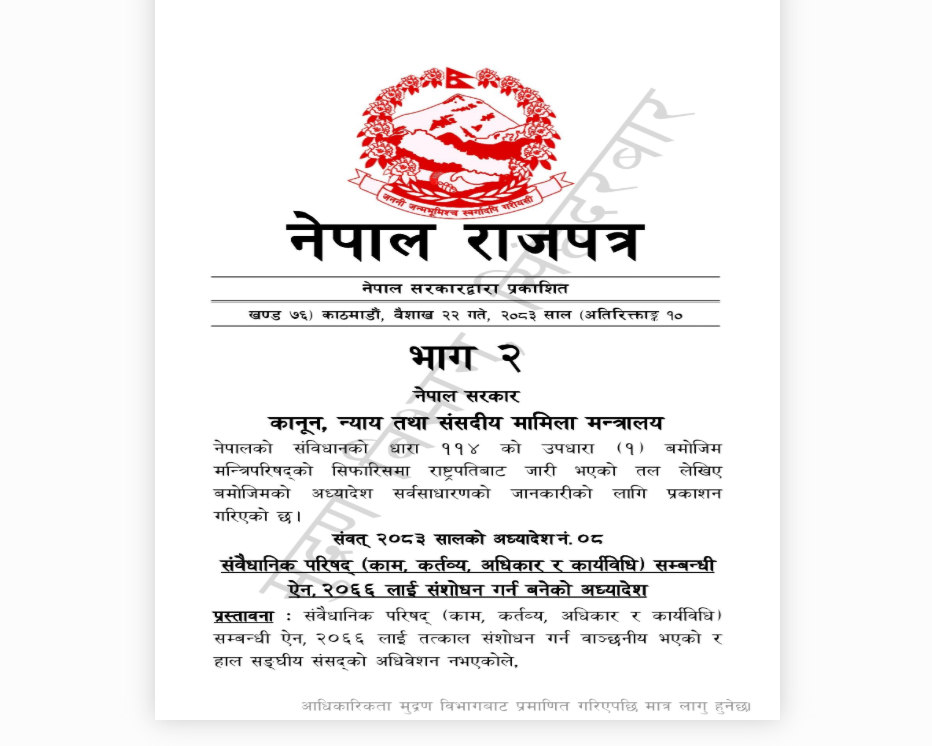
According to the ordinance, the Constitutional Council meeting of April 6 recommended Judge Dr. Manoj Sharma, the fourth senior most judge, as Chief Justice. Despite two dissenting members, the council broke past practice and tradition by endorsing this judge.
The Two Categories of Blocked Writ Petitions
Following the President’s ordinance and the Constitutional Council’s recommendation, two types of writ petitions were filed in the Supreme Court challenging these decisions. The court administration has hesitated to register writs filed by Dr. Prem Silwal and Geeta Thapa, while an order to reject a writ petition against the Chief Justice recommendation has already been issued.
As per judicial procedure, petitions submitted must be registered by the court administration; if not registered, an order explaining the refusal (dismissal) should be given. According to legal professionals, no decision has been made on the writ against the ordinance, while the writ against the Chief Justice recommendation has already been dismissed.
If court administration refuses to register a petition, petitioners can submit another application, which must be registered and heard directly before a bench.
Senior advocate Dinesh Tripathi mentioned the initial dismissal order was delayed, and the subsequent petition filed against that dismissal has yet to be registered, although it must be registered and presented before the bench.
Due to the failure to register petitions, legal professionals repeatedly approached Acting Chief Justice Sapana Pradhan Malla to complain. The Nepal Bar Association also issued a statement opposing the actions of the court administration.
On Monday as well, a team of lawyers met with the Acting Chief Justice. Shortly thereafter, she issued an order under Article 136 of the Constitution.
Article 136 of the Constitution vests the Chief Justice with the ultimate responsibility to ensure effective judicial administration of the Supreme Court and subordinate courts. It is a rare occurrence that the judicial leadership has to issue a written directive to the judicial administration to resume routine operations.
What Are the Underlying Reasons?
https://www.youtube.com/watch?v=WizE0OpUSVk[/embed>
According to sources and staff connected to the Supreme Court administration, during Chief Justice Prakash Man Singh Raut’s tenure, Chief Registrar Bimal Paudyal sought appointment as a judge. He aimed to become a judge by first serving as Chief Registrar of a High Court and progressing in the seniority list for Chief Justice succession.
However, Senior Justice Sapana Pradhan Malla did not approve this proposal. When she led the Judicial Council, the likelihood of recommending Chief Registrar Paudyal as a judge was low.
After Raut retired, Sapana Pradhan Malla became Acting Chief Justice. Meanwhile, Dr. Manoj Sharma was unexpectedly recommended as Chief Justice.
According to discontented judges at the Supreme Court, Chief Registrar Paudyal deployed his subordinates to obstruct registration of writ petitions that could trouble the government and proposed Chief Justice Dr. Sharma.
Acting Chief Justice Malla’s written order also alludes to this issue. The order states that when judges questioned Chief Registrar Paudyal about the refusal to register writ petitions, he replied that the directive came from the proposed Chief Justice Dr. Manoj Sharma.
Following the Constitutional Council’s recommendation, the trust deficit between the group led by proposed Chief Justice Dr. Sharma and the acting Chief Justice Sapana Pradhan Malla has deepened.
Dr. Sharma’s group advocates for the registration of petitions against the ordinance and the Constitutional Council’s recommendation and issuing interim orders from a single bench. If that happens, it may challenge the legality of the Constitutional Council meeting as per the Constitution.
Moreover, granting interim orders against the Constitutional Council’s recommendation risks stalling the process of Chief Justice appointment itself. Dissenting judges also fear that if such petitions progress, the constitutionality of the ordinance and recommendation will be questioned.
Distribution of Responsibilities Among Staff
At the time of this briefing, there was no indication that the Supreme Court administration intended to register writs and other petitions. Chief Registrar Paudyal has been absent from the Acting Chief Justice’s office since Monday morning, reportedly attending meetings.
Case Registrar Man Bahadur Karki is also not present at his workplace, while Case Division Head and Co-Registrar Arjun Koirala is at training. Under their direction, the Deputy Secretary and staff of the writ branch had been registering writ petitions, and their absence has caused a bottleneck.
“If compliance with the order is not seen within a few hours, the judges will hold discussions to decide the next strategy,” a source close to the Supreme Court said. “Further decisions will be made following those discussions.”

The government plans to position the upcoming fiscal year 2083/84 budget as a starting point for a new phase of economic reform. The Federation of Nepalese Chambers of Commerce and Industry (FNCCI) has requested policy reforms through the budget to restore declining business confidence and generate employment. The private sector has advised the government on the stability of long-term tax policies, legal reforms, industrial development, and opening investment opportunities abroad. Kathmandu, 4 Jestha. The government has announced its intention to use the fiscal year 2083/84 budget as a foundation for initiating a new phase of economic reform. According to the Appropriation Bill 2083 presented by Finance Minister Dr. Swarnim Wagle in parliament, the budget focuses on the restructuring of the economy by achieving high and broad economic growth alongside sufficient employment generation. The private sector has also committed to playing its role in this so-called transformative budget. Representative institutions from the private sector have met with the Finance Minister to present their suggestions, and the Finance Minister has assured that such inputs will be incorporated to the greatest possible extent.
Boosting Declining Morale
This budget is being presented at a time when, contrary to expectations following the formation of the new government, the private sector is comparatively anxious. This concern was also raised during the discussion on the principles and priorities of the Appropriation Bill in parliament. Opposition lawmakers prioritized raising issues about the government’s strict measures against private sector entrepreneurs and businesspeople. Congress MP Nishcal Rai sarcastically noted that even the Finance Minister heard about some incidents of industrialists’ arrests through the media. Minister Dr. Wagle highlighted activities contrary to his commitments toward the private sector, drawing attention to the fact that the private sector has neither been opened up nor has it been able to confidently oppose the so-called strong government or invest with assurance. Umbrella organizations of the private sector, such as the Federation of Nepalese Chambers of Commerce and Industry and Nepal Industries Association, institutionalized suggestions submitted to Finance Minister Wagle prominently stressed the need to revive declining business confidence.

Rastriya Swatantra Paaila (Raswapa) lawmaker Krantishikha Dhital has advised the government to prioritize quality education, skills, creativity, and genuine learning. She emphasized that regulations aiming to empower students must be established, but these rules should not be enforced merely to suppress them. Dhital expressed concern that the 80% mandatory physical attendance rule implemented through Tribhuvan University cannot effectively measure knowledge, stating that thinking must be more modern. 4 Jestha, Kathmandu.
During Monday’s House of Representatives session, Dhital stated, “It is necessary to formulate rules that empower students, but these regulations should not merely suppress them or be applied restrictively. Rules should serve to strengthen students, not to oppress them.” She further added, “Tribhuvan University has mandated an 80% physical attendance rule each semester, which might have good intentions, but is knowledge assessed solely based on attendance?” she questioned.
Dhital explained, “The 80% physical attendance rule at Tribhuvan University was intended to ensure regularity and quality education. However, can knowledge truly be gauged only through physical presence?” She highlighted concerns over the mindset focused solely on physical attendance in an era where the world has entered an age of open knowledge.
She continued, “If learning is not taking place despite students being physically present in the classroom, then a 100% attendance rate is pointless.” Citing international practices as examples, she urged attention to access to alternatives and technology. “There are options and technology available. Education does not become modern by copying rules; we must modernize our thinking,” she stressed. Addressing the government, she further urged, “I call on the government and university administration to have the courage to prioritize quality education, skills, creativity, and genuine learning above strict attendance accounting.”

Two Nepali athletes will compete in the para taekwondo selection tournament for the Aichi–Nagoya Asian Para Games to be held in Mongolia. Amir Blon in the men’s under 63 kg category and Renu Tamang in the women’s under 47 kg category will represent Nepal, with the team scheduled to depart for Ulaanbaatar on Friday.
Palesha Govardhan has already qualified for the women’s under 57 kg category in the Asian Para Games based on her ranking. Kathmandu, May 18—Nepal will send two competitors to battle in the para taekwondo selection event for the forthcoming Asian Para Games in Mongolia.
Alongside the two athletes, a four-member Nepali contingent will leave Ulaanbaatar on Friday to participate in the 11th Asian Para Taekwondo Championship. The competition, held on May 26, will see Amir and Renu contesting in the K-44 category. The team is coached by Kaviraj Negi Lama, with Ramchandra Shrestha serving as team manager.
The athlete who reaches the finals will earn the opportunity to compete at the Asian Para Games in Japan. In the women’s under 57 kg K-44 category, Palesha Govardhan, ranked 10th globally, has already secured her spot for the Asian Para Games. Prior to this, Nepali athletes will also take part in the 11th Asian Para Taekwondo event on May 25 in Ulaanbaatar, where Amir, Renu, and Palesha will all compete. The National Sports Council (NSC) member-secretary Ramcharitra Mehta and former NSC executive committee member Bhanbahadur Chand formally saw off the team during a ceremony held on Monday, wishing them success in their endeavors.

The National Assembly of Landless Squatters and Informal Settlers has formed the Nepal Landless Squatters and Settlers Protection Central Committee. The assembly demanded an immediate halt to forced evictions and demolition of homes, along with submitting a 12-point memorandum to the government. The assembly has also decided to hold a press conference on May 21, submit the memorandum on May 24, and organize a street interaction on May 27. (Dates converted from Nepali calendar: Jestha 8 = May 21, Jestha 11 = May 24, Jestha 14 = May 27) The announcement was made on May 18 in Butwal.
The national assembly, held in Butwal, formed the Nepal Landless Squatters and Settlers Protection Central Committee. Alongside this, a 75-member ad hoc committee was established under the coordination of Khagendra Paudel of Butwal. Members include Harish Giri and Prem Bohara from Dang; Virman Lama, Risab Pokharel, Rajkumar Bhattarai, Bibek Gubhaju, Purn Bahadur Bik, and Tej Bahadur Kunwar Kshetri from Rupandehi.
The assembly has passed a working paper including the 12-point demands to be submitted to the government. The national assembly has urgently demanded the immediate cessation of forced evictions using bulldozers, demolition of homes, and inhumane treatment targeting landless Dalits, squatters, and informal settlers nationwide. Additionally, it requests the swift completion of remaining administrative and legal procedures in areas where survey and mapping have been completed in accordance with the Land Act, followed by expedited distribution of ownership certificates (lalpurja).
It also calls for providing land ownership certificates to informal settlers within the maximum residential area defined by the Land Act, by charging minimal fees from the registration revenue collected by the land revenue office. Moreover, it seeks smooth distribution of land ownership certificates within the maximum area established by the Land Act for agricultural purposes.
The national assembly, as informed by campaign advisor Birendra Bik, has decided to hold a press conference in Kathmandu on May 21, submit the memorandum to the Prime Minister, ministers, top leaders of political parties, and human rights activists on May 24, and conduct a street interaction in Kathmandu on May 27 in the presence of political party heads, land experts, and intellectuals. Furthermore, programs for street dialogue and interaction with parliament, political parties, and the National Human Rights Commission will be conducted, followed by launching a strong nationwide movement centered in Kathmandu in the third phase.

Summary: After the Nepali Congress delayed the selection of its parliamentary leader, the formation of the Constitutional Council was also delayed, with Congress adopting an opposition stance. Leader Bhishmaraj Angdembe expressed disagreement over seniority and tradition during the Constitutional Council meeting while debating with the Prime Minister. The Congress is conducting a party reorganization and mobilization campaign, aiming to include all factions ahead of its 15th general convention.
The Nepali Congress’s delay in choosing its parliamentary leader caused a setback in the formation of the Constitutional Council. After the leader was finally selected, former co-general secretary Bhishmaraj Angdembe stated that Congress has started actively asserting its role as opposition. During the Constitutional Council meeting regarding the recommendation of the Chief Justice’s name, Angdembe submitted a written dissent and engaged in a heated debate with Prime Minister Balendra Shah. Despite having fewer MPs compared to the ruling party, Congress has begun voicing its positions in Parliament.
Congress is currently running a mobilization campaign across all seven provinces. After completing a program in Gandaki Province on Saturday, the campaign will commence in Koshi Province. The general secretary is discussing updating party membership records digitally in Koshi Province. The party is making comprehensive efforts to reorganize itself and unite through new approaches as part of the mobilization drive.
In an interview about internal party politics, Angdembe noted: “Disputes within the party have decreased. The entire process from the Election Commission to the courts took several months, during which elections were also held. We are meeting with all office bearers, former presidents, and leaders to foster unity. Leaders are supportive of uniting the party and endeavoring to accelerate the political process.”

A foreign national was arrested at the Eastern border point of Kakarbhitta carrying illegal foreign currency and 570 grams of raw gold. Authorities seized $20,000 USD, 85,510 Indian Rupees, and 570 grams of raw gold from the individual. The market value of the seized gold is estimated at NPR 14,030,815, with further investigation currently underway. (May 18, Ilam)
The individual was apprehended by the passenger section of the Mechi Customs Office during a routine inspection at the Kakarbhitta border crossing. According to Ishwarkumar Humagain, Information Officer at Mechi Customs, the confiscated items include $20,000 USD, 85,510 Indian Rupees, and 570 grams of raw gold. The confirmation that the metal was indeed gold was provided by the Jhapa Gold and Silver Traders Association.
According to the association, the market value of the seized gold as of today is approximately NPR 14,030,815. The attempted smuggling of such a large amount of gold and foreign currency through the border has heightened alertness among security and customs agencies. The Customs Office stated that the incident is being taken very seriously and further investigations are ongoing. However, to avoid compromising the investigation, the name, nationality, and address of the arrested foreign national have not yet been disclosed. Information Officer Humagain confirmed that a detailed inquiry is currently in progress.

With declining water levels in reservoirs Lake Mead and Lake Powell, the western United States faces a severe water crisis. Nearly 40 million people in the region depend on the Colorado River, prompting Arizona, California, and Nevada to implement emergency water conservation plans. The U.S. Bureau of Reclamation is expected to decide on water allocation cuts among 17 western states by the end of this year, highlighting the urgent need for long-term changes in water usage. (May 18, Kathmandu)
The Colorado River is in critical danger due to soaring water demand driven by a growing population and rising temperatures reducing supply. This winter, the Rocky Mountains, a major source of the river, experienced record-low snowfall, causing significant declines in water levels at downstream reservoirs Lake Mead and Lake Powell.
Approximately 40 million residents across various western states rely daily on the Colorado River for drinking water, often underestimating its vulnerability. However, as the river continues to shrink, the region faces the necessity of swift and stringent actions. Sara Porter, director of the Kyl Center for Water Policy at Arizona State University, explained that the reservoir water level drop is a multifaceted issue, with no natural relief this year.
To prevent disruptions in hydroelectric power, federal authorities recently began releasing billions of gallons from Lake Powell in Utah and Arizona. Meanwhile, Arizona, California, and Nevada have introduced emergency water-saving proposals, including compensation for some users who reduce consumption. Nonetheless, disputes over water shares persist among states dependent on the river, with experts warning that without a comprehensive agreement, severe water cuts are inevitable.
This crisis threatens agriculture, hydropower generation, and drinking water supplies in major cities stretching from Phoenix to Los Angeles. The primary federal operating agreement, managed by the U.S. Bureau of Reclamation overseeing dams, power plants, and canals across 17 western states, expires later this year. Officials are expected to determine water cutbacks during the upcoming summer, while experts emphasize that without substantial long-term changes, the Colorado River faces catastrophic depletion.
Meanwhile, some unexpected natural relief has occurred. Following an untimely storm last week, the Rocky Mountain region received significant snowfall in May, providing temporary respite. However, experts agree that this will not be sufficient to end the prolonged crisis affecting millions.

Interim Chief Justice Sapana Pradhan Malla’s directive to the Supreme Court administration to register writ petitions challenging the recommendation for the new Chief Justice has sparked widespread discussion—from parliamentarians to legal professionals’ umbrella organizations. While ruling Rastriya Swatantra Party (Raswapa) MPs have opposed the administrative order, opposition Nepali Congress MPs have voiced objections to the ruling party’s stance. In an emergency meeting, the Nepal Bar Association upheld the interim Chief Justice’s decision as justified and issued a warning that the ruling side must “pay the price” for their actions.
Sapana Pradhan Malla accused the administration led by Chief Justice designate Manojkumar Sharma of failing to register writ petitions pending before the court. The Supreme Court administration has not commented on the recent developments, and efforts to contact them have been unsuccessful. Nepal Bar Association Chair Vijay Prasad Mishra stated that the interim Chief Justice exercised her authority under rare circumstances. “Such a situation necessitated this action. The ultimate responsibility lies with the Chief Justice or the acting Chief Justice. Unfortunately, the administration has not complied when duty was exercised,” he said.
Mishra recalled that the interim Chief Justice fulfilled her constitutional duty to uphold the country’s system and maintain the judiciary’s rightful place through her order. “The administration appears to have disregarded the order, assuming the issue would resolve once the new Chief Justice assumes office. Disobedience today offers no guarantee that problems won’t arise tomorrow. The administration’s duty is to comply with directives from the judiciary’s highest authority, not to flout them,” he added.
Addressing attempts to suppress parliamentary discussion on decisions made by the Chief Justice or judges, Mishra emphasized that the constitution and previous orders explicitly protect such discourse. “This is clearly stated in a past Supreme Court order and Article 105 of the current constitution.” Mishra strongly criticized Raswapa MPs for their comments during the House of Representatives session on Monday. “Some honorable members have made impassioned and arrogant remarks. The Nepal Bar Association is clear that their course will result in necessary atonement,” he warned.

CPN-UML Chairman KP Sharma Oli has described the earlier decision to halt former President Bidya Devi Bhandari’s party membership renewal as a matter of political circumstances. Oli put forward a proposal to renew Bhandari’s membership during a secretariat meeting, and the proposal was passed. In the previous Shrawan session, UML had decided not to renew Bhandari’s membership, but now that the process is complete, the renewal has been approved. Kathmandu, 4 Jestha.
During the secretariat meeting, Oli stated, ‘The constitution does not prohibit it, but due to political circumstances, we had made that decision earlier; now let us proceed.’ According to an official, Bhandari submitted her application according to the required procedure, and Oli announced the decision to renew her membership. He added, ‘The process was certainly not complete earlier, but she submitted a request to remain active within UML.’
In the first week of last year’s Shrawan, UML had decided not to renew Bhandari’s membership. At that time, three reasons were cited — Bhandari’s roles as the guardian of the constitution, the chief of the army, and as a symbol of the republic. Some officials had expressed disagreement with that decision. Oli had stated earlier that membership renewal would not happen without a formal application as per procedure. However, today Oli introduced a proposal to renew her membership, which was unanimously approved. According to sources, ‘No dissenting votes were raised against the chairman’s proposal, and renewal was decided.’

The government has recommended that MBBS and BDS intern doctors receive an allowance equivalent to at least 50 percent of the starting salary of eighth-level medical officers. Currently, intern doctors receive only NPR 10,000 per month and have complained about labor exploitation due to heavy workloads. The Barakoti report had suggested providing intern doctors with 50 percent of the starting salary of medical officers, but this recommendation has yet to be implemented. Kathmandu, April 17. Intern doctors at medical colleges are serving patients amidst minimal allowances and heavy workloads. They handle responsibilities from patient treatment to ward management, yet receive only NPR 10,000 per month as a living allowance. For a long time, interns have demanded an increase in allowances, citing labor exploitation.
A government-formed task force has recommended providing MBBS and BDS intern doctors with at least 50 percent of the starting salary of eighth-level medical officers as monthly living allowance. The Ministry of Education and Sports formed a seven-member task force led by Under-Secretary and Director of Technical Education Department, Chandrakanta Paudel, to address the living allowance issue for intern doctors.
The task force was established on April 27 to gather feedback on the monthly living allowance for MBBS and BDS intern doctors. In its report submitted on May 13, the task force recommended that all private and government colleges and institutions provide living allowances. The report stated, “It is appropriate for all public and private teaching institutions to provide intern doctors with 50 percent of the starting salary scale of the eighth-level government medical officers. This allowance system can also be applied to students in other medical programs with a one-year internship.”
The committee indicated that the recommendation could be implemented under the duties and authority of the commission as per Section 6 of the National Education Act 2018. It also suggested that the Medical Education Meeting chaired by the Prime Minister make appropriate decisions.
Completing an MBBS degree takes approximately five and a half years, including about four and a half years of study and a mandatory one-year internship. During the internship, interns must serve in different hospital departments, often working around the clock. Intern doctors are expected to spend significant time in hospitals during their training. However, due to the lack of scientifically determined allowances, doctors have expressed dissatisfaction over inadequate service benefits.
Intern doctors pursuing bachelor’s-level medical education must treat patients under the supervision of specialist doctors. They continuously engage in checking admitted and emergency patients, managing admissions, ward arrangements, and discharges. According to a doctor interning at Kathmandu Medical College in Sinamangal, interns work 10 to 12 hours daily but receive allowances insufficient for such workloads, resulting in labor exploitation. Most interns face hardship due to low allowances, with some bearing familial financial responsibilities.
Most hospitals provide interns only NPR 13,000 per month as a living allowance. “Considering the work we perform, this amount is extremely low,” the doctor said. “We handle responsibilities in wards, outpatient departments, and operation theaters for admitted patients.” Despite working under specialists’ guidance, interns play a critical role in the daily treatment process.
The same doctor noted that MBBS study duration is long, usually about six years, though it can extend to seven years due to delayed college procedures. The cost of MBBS education is approximately NPR 4 million. “Most students are over 25 years old and still rely on family support for expenses,” the doctor said. “Hence, there is a demand for allowances sufficient to cover interns’ personal expenses during their internship.”
There is also a demand that the allowance rates applicable in government medical colleges be implemented in private medical colleges as well. “We are not requesting salaries, only stipends, which must align with labor laws,” an intern said. “There should be no disparity in allowances between government and private medical colleges.”
The Barakoti report was prepared by the Committee for Safe Workplace for Health Workers, formed in 2024, based on an agreement between health sector representatives and the government to assess the standardization of minimum government-level benefits for intern doctors, medical officers, and residential doctors. The committee was chaired by then Additional Secretary of the Ministry of Health, Dr. Tank Prasad Barakoti.
The report recommended that intern doctors receive an allowance equal to 50 percent of the starting salary of medical officers, paid over 13 months annually. It concluded that interns should be provided with minimum government-level service benefits. Since interns regularly provide medical services at hospitals, the report noted that their low allowance reflects a misvaluation of their labor and services.
The Medical Education Commission has been recommended to set standards on intern doctors’ allowances. Medical officers at the eighth level currently receive NPR 48,000, and the task force suggests interns should be paid half of that, totaling NPR 24,000. The report also calls for universities, institutions, and private medical colleges to be instructed to regularly pay intern doctors’ allowances monthly.
The report advises setting policy to avoid unnecessary increases in student enrollment fees while maintaining government-level allowance rates. It further recommends making allowance payments transparent and mandating disbursement through bank transfers. Compliance with intern service benefits should also be monitored during health institution registration and renewal processes.
However, it has been over a year since the Barakoti report’s recommendations were made, yet they have not been implemented. On April 17, 2026, the Ministry of Labor, Employment, and Social Security issued a statement directing adherence to minimum wages and social security provisions as per the Labor Act 2017. The Ministry of Health issued a circular to the Medical Education Commission on January 15, 2023, to eliminate disparities in health workers’ living allowances.
On November 7, 2025, various associations agreed on providing minimum wages to nurses and health workers in health institutions. Based on this, on March 3, the Ministry of Health reissued a circular to the Medical and Dental College Association emphasizing the need to increase intern doctors’ allowances as per workshops and consensus.
The internship phase is crucial in producing skilled health workers, during which doctors gain direct patient care experience. However, experts warn that minimal services and benefits lower morale and increase professional dissatisfaction.
Dilli Harijan, coordinator of the Intern Doctors’ Campaign, said, “We carry responsibilities equivalent to regular doctors in hospitals. We have been continuously voicing our concerns and are working within the Health Ministry for implementation of the report. Discussions are also underway at the Prime Minister’s Office.”
However, private medical college operators argue that paying salaries to interns is unnecessary, claiming that internships are part of medical education and a learning process, not work. Intern doctors, however, perceive this as labor exploitation.
Intern doctors’ primary grievance is the disparity in allowances between government and private medical colleges. Government colleges pay up to NPR 23,000, while some private colleges offer only NPR 10,000. Dilli Harijan stated, “Committees and reports were formed before, but implementation never happened. This time the government has given a commitment, and we are struggling until the end, trusting that.”