Advertisement1200×100-inside-1

Author: space4knews

500 Solar Power Banks Delivered to Provide Alternative Electricity Services in Nuwakot and Rasuwa

The Ministry of Energy has delivered 500 solar power banks to provide alternative electricity services in flood and disaster-affected areas of Nuwakot and Rasuwa. Through the Alternative Energy Promotion Centre, these power banks have been made available, capable of charging mobile phones and powering four to five lights. The ministry stated that this initiative aims to ensure communication and lighting facilities for citizens whose electricity services have been disrupted due to the disasters.

September 27, Kathmandu – The Ministry of Energy, Water Resources, and Irrigation has handed over 500 solar power banks to supply alternative electricity services in the flood and disaster-impacted districts of Nuwakot and Rasuwa. This measure, facilitated through the Alternative Energy Promotion Centre, is intended to immediately meet electricity needs in the affected areas.

The power banks, suitable for use in areas with interrupted electrical supply, are capable of charging mobile phones and powering approximately four to five lights. The ministry shared that these solar power banks will prove essential in providing critical communication and lighting support to citizens affected by disruptions in regular electricity services due to the disasters.

The ministry emphasized that such initiatives are undertaken to ensure prompt availability of alternative energy services and maintain continuous electricity access, thereby easing daily life for those impacted by natural calamities.

Redbull Donates NPR 20 Million to Prime Minister’s Disaster Relief Fund for Flood Victims

Redbull has contributed NPR 20 million to the Prime Minister’s Disaster Relief Fund to provide immediate relief and rehabilitation for citizens affected by the flooding in Rasuwa. Surendra Silwal, Managing Director of Sars Beverages, handed over the donation to Finance Minister Dr. Swarnim Wagle on Thursday. The company expressed deep sorrow over the human and material losses caused by the floods and conveyed sympathy to the affected families. Kathmandu, 11 Bhadra – To support urgent relief and rehabilitation efforts for flood victims in Rasuwa, Redbull has donated NPR 20 million. The contribution was officially handed over to the Prime Minister’s Disaster Relief Fund on Thursday by Surendra Silwal, Managing Director of Sars Beverages, to Finance Minister Dr. Swarnim Wagle. The company expressed condolences over the humanitarian and material damages caused by the floods and extended sympathy to the impacted families.

Central Bank Directs Continuous Banking Services During Holidays to Support Flood Relief Efforts

Nepal Rastra Bank has directed banks and financial institutions to remain operational continuously from Friday through Sunday to facilitate relief and rescue efforts for those affected by the Rasuwa floods. The central bank has emphasized the importance of providing essential banking services to assist in distributing aid and supporting rescue operations. Additionally, the bank has requested that financial institutions inform the public that their services will remain available during this period. Kathmandu, 11 Bhadra.

Banks and financial institutions will provide uninterrupted financial services from Friday to Sunday following the directive from Nepal Rastra Bank. This measure aims to support flood victims in Rasuwa by ensuring ongoing access to essential banking operations necessary for relief distribution and rescue activities. The central bank stressed the need for banks to actively communicate their continuous service availability to the public.

Rasuwa Faces Road Disruptions as 35 Bridges Were Washed Away

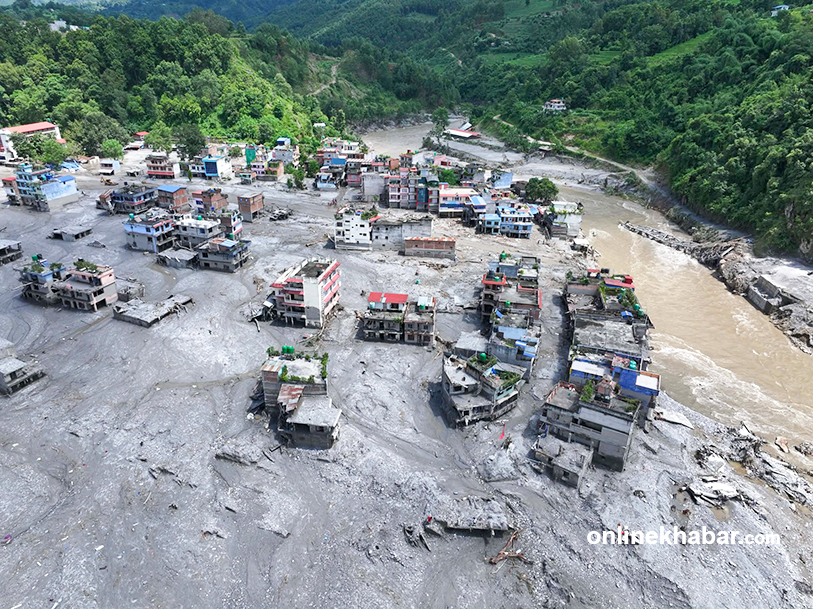
In Rasuwa district, the devastating floods on Wednesday damaged a total of 41 bridges, including 13 major ones. The Bhote Koshi floods completely destroyed 40 kilometers of road, severing the district’s road connectivity. The Ministry of Infrastructure Development is preparing to install Bailey bridges in Betravati to restore road connections in Rasuwa. According to the ministry, the government has made available seven Bailey bridges, each 50 meters long, and has received commitments from India and China to supply additional Bailey bridges.

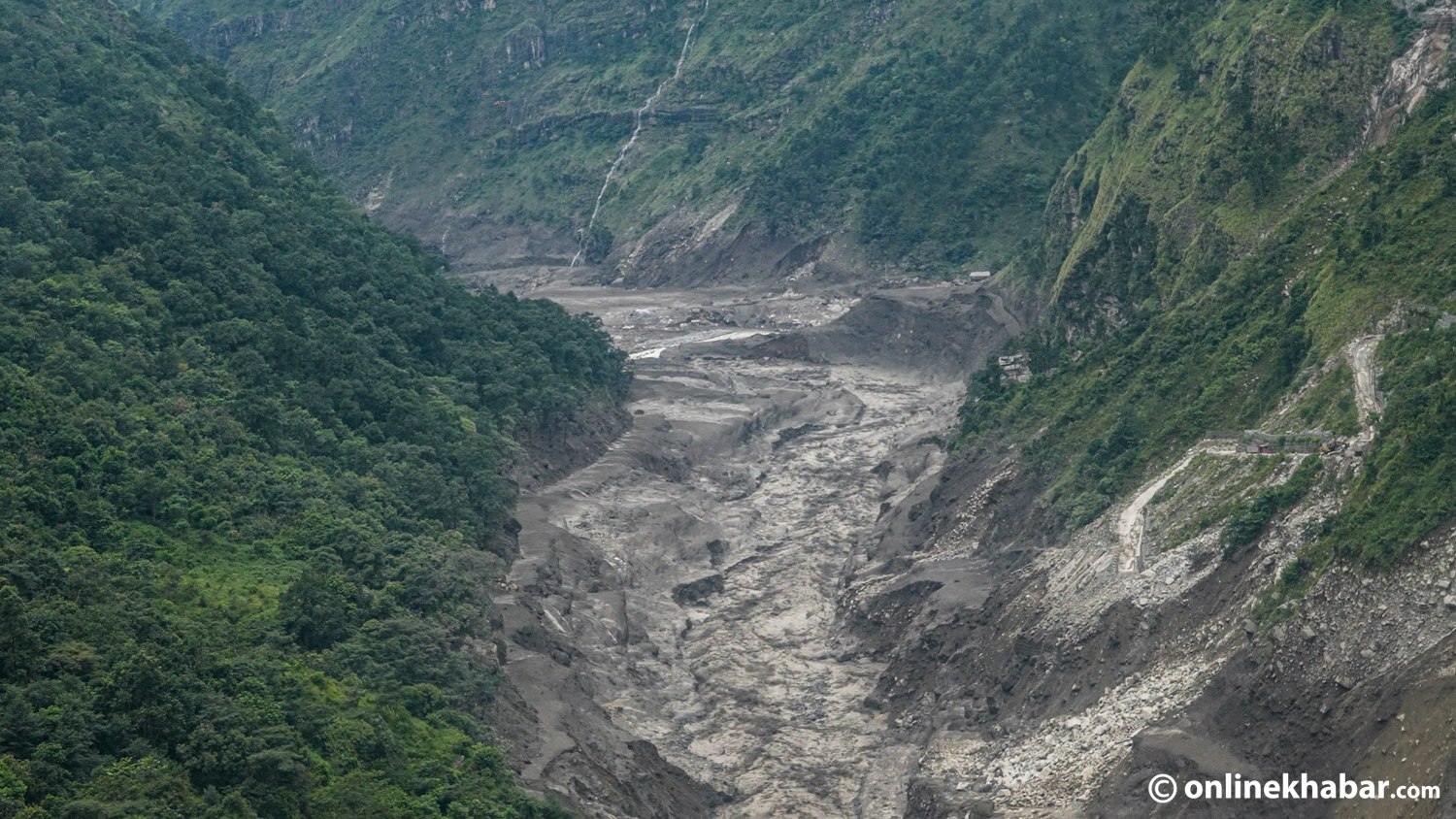
The road connecting Betravati to Mailung and further to Syafru Bensi-Rasuwa Gadhi has been completely damaged. A 13-kilometer stretch of the Prithvi Highway has been covered by sediment. Until the road up to Betravati is operational, reaching Syafru Bensi via Dhunche is not possible. Floodwaters caused significant damage to bridges ranging from Mitere Bridge to the old suspension bridge at Muglin.

Other bridges in Rasuwa, such as the Chilime concrete bridge, Hydropower Bailey bridge, and several bridges over the Trishuli River, were also affected by the floods. However, some bridges in Dhading and Chitwan districts remained intact. The government has currently deployed 20 machines to reopen the roads. Reconstruction of damaged roads and bridges, along with restoring transportation services, has been prioritized.

Flood Disaster at Northern Border Disrupts Supply Chain

News Summary

  • The flood of the Bhote Koshi River at the Rasuwa Gadhi customs yard swept away hundreds of containers, cargo trucks, and infrastructure, causing severe human and economic losses.
  • Following the blockage of Rasuwa Gadhi and Tatopani border points, traders have turned to Mustang’s Korala border as an alternative, though transport costs and delivery times are expected to rise.
  • With upcoming festivals, imports have been disrupted, triggering concerns over shortages and price increases in essential goods; business and economic experts urge the government to immediately arrange rescue, rehabilitation, and relief support.

Kathmandu, September 27 — Nepal’s major festivals including Teej, Dashain, Tihar, and Chhath are approaching fast. In major commercial hubs of Kathmandu such as New Road, Bhotahity, and Ranjana Lane, traders wear expressions of deep disappointment.

The cause is an unexpected natural calamity at the key trade border with China, Rasuwa Gadhi.

Hundreds of containers carrying billions worth of goods such as clothing, footwear, electrical appliances, garlic, onions, ginger, and fruits ordered on loans for the festive season were swept away by the Bhote Koshi river flood.

This devastating flood completely destroyed the Rasuwa Gadhi customs yard. In addition, the Tatopani border in Sindhupalchok district has been closed for over a month due to landslides damaging the road section, halting transportation.

Customs staff, agents, and drivers who went to bring goods from Rasuwa Gadhi are out of contact, creating a serious human tragedy as well as financial loss.

Not only physical infrastructure but also major human losses have occurred. The dry port and customs yard in Rasuwa Gadhi are currently in ruins. Hundreds of parked cargo containers and expensive electric vehicles have been engulfed by floodwaters.

Business owners are now facing a severe mental and financial crisis.

Jayant Kumar Agrawal, General Secretary of the Nepal Overseas Exporters Association, said the situation at the border without infrastructure is extremely distressing from a human perspective.

According to General Secretary Agrawal, “There is currently no possibility of reopening Rasuwa and Tatopani border points. The area is infrastructure-less and completely destroyed. There is no confirmation on the safety of 14 customs employees. Many containers and empty trucks have been swept away by the flood.”

He warned that traders have lost the ability to make rational decisions and urged the state to immediately focus on rescue and relief efforts.

Parshuram Dahal, President of the RB Complex Traders Association based in New Road, also confirmed disruptions in supply and communication.

“Drivers and helpers’ phones are switched off. It’s very difficult to ascertain their condition,” said Dahal. “Although festival-related goods had reached customs, the flood and landslides destroyed many items. CCTV footage shows the warehouse and surrounding areas completely damaged, indicating significant economic losses.”

Although the government is attempting to reopen Tatopani border, the situation remains bleak. Nepal has cleared landslides and constructed a temporary road, but the Chinese side has not approved the container schedule.

According to Dipendra Prakash Giri, Chief Customs Officer of the Tatopani customs office, “China has refused to allow container release as per prior agreements. Due to the additional two to four days expected for road construction, vehicles can come into Nepal but are not allowed to return, effectively halting the border.”

Earlier, direct meetings allowed communication, but now interactions occur only via messages between both sides.

Chinese customs workers were relocated after landslides damaged the Liping area and surroundings on the Chinese side.

Increased Pressure on Mustang’s Korala Border

With issues at Tatopani and Rasuwa Gadhi border points, the Customs Department advised traders to use Mustang’s Korala border as an alternative.

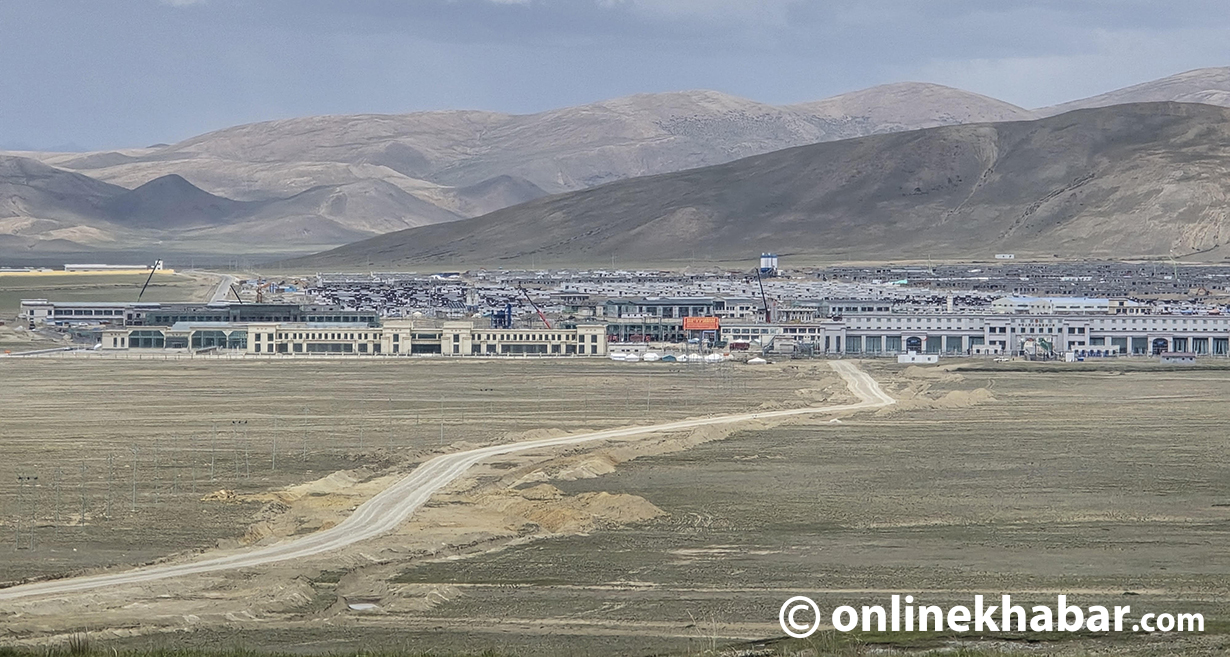
Korala, located on flat terrain, is less prone to landslides, but traders consider this only as a last resort. Unlike Rasuwa and Tatopani, Korala lacks proper customs infrastructure, wide roads, or suitable arrangements for heavy cargo trucks.

Vidur Chudal, Chief Customs Officer of Mustang Customs Office, reported regular movement of cargo vehicles through Korala. Although there is no advanced infrastructure on the Chinese side, available resources and facilities are operational.

“We are working with basic infrastructure about 14 kilometers inside the border. There are no facilities similar to those on the Chinese side, but the border is operational and vehicles are arriving,” he said.

Attraction to electric vehicle imports is growing; recently, 100 BYD units and 63 vehicles from Foton company have been imported through this border. Vehicles from other companies are also arriving.
Ready-made clothes, shoes, bags, and fabric rolls are being imported through Korala. With increased pressure at Rasuwa, traders have started prioritizing Korala.

“Previously, one to two containers arrived daily; now it’s eight to ten,” Chudal said.

However, the lack of quarantine facilities poses problems for importing perishable items such as food, fruits, and vegetables.

“Until quarantine facilities are established, such goods cannot be imported. So, currently, use of Tatopani or other borders remains necessary,” he added. Mustang Customs has 18 sanctioned posts but currently only 10 employees are present.

Parshuram Dahal mentioned that importing goods through Korala is “better than not having any option.”

He noted, “While transport costs and times increase via this route, there’s no alternative given the current circumstances.”

Ramchandra Parajuli, General Secretary of the Nepal Himalaya Cross Border Commerce Association, said the road from Rasuwa to Kerung in China is completely destroyed for about 50-60 kilometers.

“The physical condition of Rasuwa border is damaged; national budget and active cooperation from the Chinese side are needed to rebuild road infrastructure.”

With uncertainties at Rasuwa border, changing the route to Korala will significantly increase transportation costs and delivery time. “It takes nearly two days to travel from Korala to Kathmandu. Route alteration will inflate transport expenses, potentially doubling prices in the market,” he explained.

With the blockade of Nepal’s border crossings, imports via sea through Kolkata and other routes are options but these are expensive, complicated, and time-consuming, making them unfeasible for the festival market.

Jayant Agrawal noted, “Geopolitical issues are affecting maritime routes. Goods from Kolkata take a long time and customs fees have risen.”

He added, “From a Chinese port to Kolkata takes about 45 days, plus 20-25 days to reach Nepal. Importing via maritime routes incurs high bank interest costs and delays, making it impractical for the winter season.”

This disaster has devastated Nepal’s small and medium-sized business community.
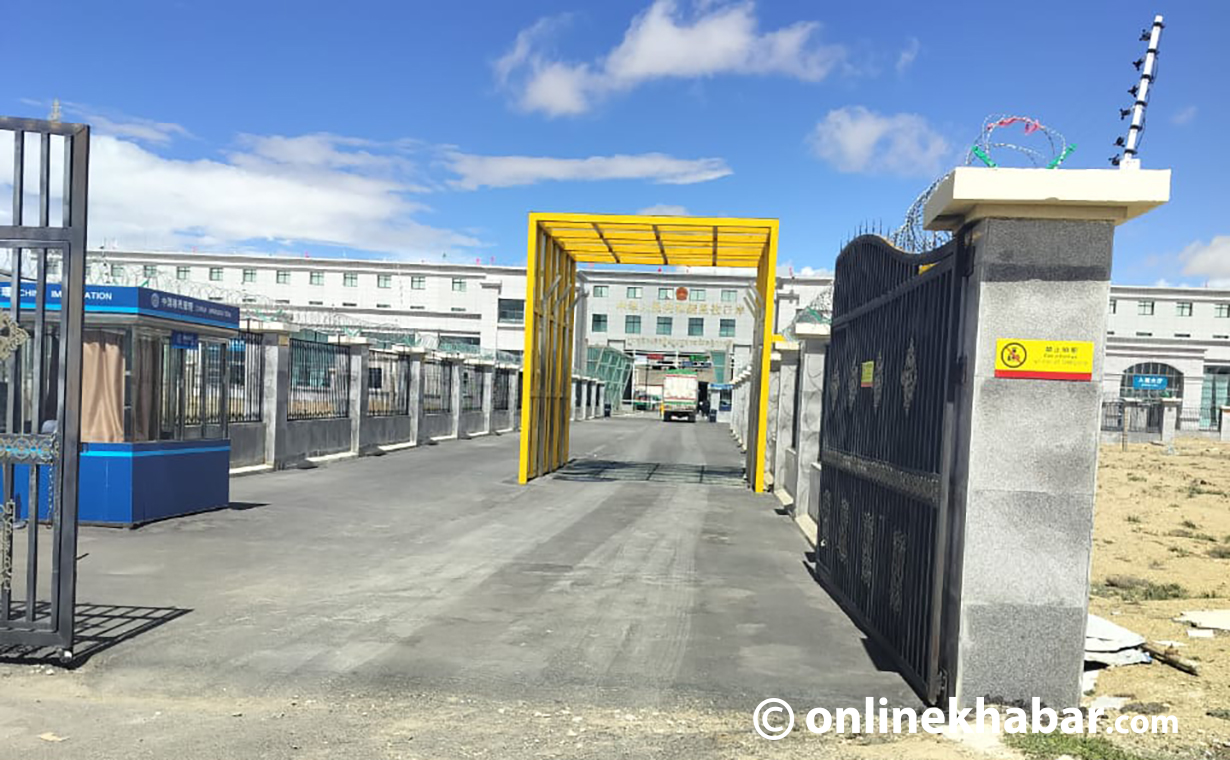
Thousands of traders who ordered goods on personal loans or letters of credit are at risk of losing capital. Parajuli said, “The flood damaged not only products and infrastructure but also capital. Many business owners may have to cease operations due to depleted funds.”

Securing new capital is difficult, and damaged imports may cause severe market shortages. Traders have requested Chinese authorities for assistance in rerouting supplies by air or sea.

This is not the first disaster to affect borders on the Chinese side. The 2014 Jure landslide, the 2015 mega earthquake, and various annual monsoon disasters have all impacted trade routes.

On August 30, 2017, the Chinese government officially declared Rasuwa Gadhi-Kerung as an international border point, yet the connecting roads remain similar in condition to rural local roads.

Every year, monsoon floods and landslides block the road during the months of August-September, halting goods worth billions and causing massive losses in a short time.

In the fiscal year 2083/84, goods worth 3.174 billion Nepalese rupees were imported from China in just the first month of Shrawan. The previous fiscal year saw imports exceeding 40 billion rupees.

Trade and commerce expert Ravishankar Sainju urged the government for special initiatives to prevent shortages during the festivals.

He pointed out that while Korala can be an alternative, transportation costs there could be significantly higher.

“Importing via Korala is an option but costs nearly double compared to Kerung or Tatopani,” he said.

“Delivery costs from Korala are higher than from Rasuwa, which will ultimately burden consumers.”

Initial estimates indicate the Bhote Koshi flood washed away between 200 to 300 containers of goods at Rasuwa Gadhi, causing losses worth billions and dampening trader morale.

“Container drivers and traders are also out of contact or missing. Under such circumstances, it is difficult to encourage traders to switch to alternate border points.”

With the blockade of Rasuwa Gadhi, Korala or sea/air routes may be the only options, but such disruptions during festival times are unfortunate.

Sainju called it an “emergency” situation requiring urgent government measures. “During festivals, coordination is essential to avoid artificial shortages and price hikes.”

He emphasized that the state should provide relief to cover extra costs via alternate routes to ease the burden on consumers.

Economist Dr. Dilliraj Khanal described the disaster as a major setback for the country’s overall development.

“Besides human loss, billions worth of damage to roads, bridges, and electricity production have severely affected the economy.”

Khanal remarked, “The Rasuwa Gadhi disaster has also impacted foreign trade and businessmen morale.”

Since imports through India and other alternate routes might be costly, the government should consider subsidies or grants to alleviate the impact.

He called for coordinated, comprehensive, and timely plans involving all political parties, the private sector, and donor agencies for post-disaster rehabilitation.

“Disaster management needs to be executed at a war footing. The 2.5 billion rupees promised by the World Bank and assistance from countries like India and China must be utilized effectively.”

Khanal urged the government to implement effective disaster management systems immediately to control shortages and price hikes in the market.

When the country’s main supply chain is disrupted during festivals, the effects will certainly reach the consumers’ kitchens and households. Price increases will cause a “chain effect,” impacting daily expenses of low- and middle-income families and the overall economy.


‘There Is a Shortage of Manpower for Rescue and Body Management in the Field’

Summary: Deputy Mayor Prabha Bogati of Vidur Municipality has reported a shortage of manpower in the field for rescue operations and body management following the Bhote Koshi flood. According to her, bodies have been carried away by the river, and many bodies have been spotted in the Belkotgadhi area. Although helicopters and food supplies are available for rescue efforts, road blockages are causing difficulties in reaching flood-affected riverside areas.

Deputy Mayor Prabha Bogati of Vidur Municipality in Nuwakot, affected by the Bhote Koshi flood on Wednesday, has stated that there is a lack of personnel working on rescue and body management in the field. She noted that bodies have been brought along by the river. In an interview, Deputy Mayor Bogati said, “The flood caused unimaginable damage the other day. Since then, continuous efforts are underway for rescue. Injured people are being transferred to safe locations and rescued.”

Providing further information, Deputy Mayor Bogati said, “Helicopters and food supplies have arrived, but delivering these materials to the affected areas is challenging.” She added, “Rescue operations here are continuing under extremely difficult conditions.”

She emphasized, “We urgently need security personnel, additional manpower, and volunteers who can immediately proceed to the field.” Regarding the status of medical teams, she noted, “Trishuli Hospital can be accessed from two directions.”

Shortage of Manpower in Field Rescue and Body Management After Bhote Koshi Flood

News Summary

  • Prabha Bogati, deputy mayor of Vidur Municipality, reported a shortage of manpower in rescue operations and body management following the Bhote Koshi flood.
  • According to her, bodies have been swept away by the river, with several bodies reported in the Belkotgadhi area.
  • While helicopters and food supplies have arrived for rescue, road blockages are hindering access to flood-affected riverside areas.

Prabha Bogati, deputy mayor of Vidur Municipality in Nuwakot, affected by the Bhote Koshi flood on Wednesday, has highlighted a shortage of manpower in field rescue efforts and body management. She reported that bodies have been swept away by the river.

An interview with Deputy Mayor Bogati:

Prabha Ji, what is the current situation in Vidur and surrounding areas?

The flood caused unimaginable damage recently. Since then, we have been continuously striving for rescue operations. Efforts are underway to move the injured to safe locations and provide assistance. Rescue operations have been ongoing since early morning. However, there is an insufficient number of personnel deployed in the field.

What kinds of support are needed now for rescue efforts?

Helicopters and food supplies have arrived, but difficulties persist in delivering these materials to the affected areas.

Can the federal, provincial governments, or other unaffected municipalities assist?

Helicopters are continuously flying, and we are collaboratively working. However, the required manpower on the ground has yet to arrive. Rescue operations are ongoing under very complex conditions here.

If security forces from across the country can be concentrated here, such as deploying 20 Nepali Army personnel, 20 Armed Police Force members, and 20 Nepal Police officers at Trishuli, working alongside locals, it would greatly ease clearing soil, searching for individuals, and rescuing the injured.

Similarly, deploying trained security personnel in Betrawati for search and rescue would increase efficiency. Yet, blockages on the roads add challenges in delivering relief materials. We are drafting plans to safely relocate children and guardians, but resources remain insufficient.

What is the condition of the road from Kathmandu or Muglin to Vidur?

The route from Kathmandu through Chhahare to Vidur is relatively easy to navigate. There are no major difficulties there. However, reaching the flood-affected riverside areas remains problematic.

You mentioned deploying volunteers in the field. What is the status of that?

Our focus remains on field operations, and helicopters are actively involved in rescues. However, there is a shortage of manpower on the ground. Bodies have been swept away by the river, with many found in Belkotgadhi. The municipal chief has been in constant contact. Failure to manage these bodies could pose significant health risks. We are working on policies but have yet to finalize them.

How are the medical teams operating?

Trishuli Hospital can be accessed from two sides. Primary medical treatment is being provided at the Nepali Army training center for those rescued by helicopter. Treatment is also ongoing at local and private hospitals, with seriously ill patients transferred to Kathmandu.

We urgently need secure security personnel, additional manpower, and volunteers who can immediately deploy in the field. Some locations are unreachable by helicopter or road access. In such places, clearing soil, building access paths, and searching for people stranded near riverbanks or houses remain difficult.

Listen to the full conversation below:

Drone Pilots Urged to Assemble at One Location for Rescue and Survey Operations

File photo news summary prepared after editorial review. Following the devastating flood in the Bhote Koshi River in Rasuwa, drone pilots have been called to join the Drone Rapid Response Team to expedite search and rescue efforts. Kathmandu, 11 Bhadra. In the wake of the catastrophic flood in the Bhote Koshi River, Rasuwa, drone pilots are being requested to gather at a single location to accelerate search and rescue operations in affected areas. The Robotics Association of Nepal (RAN) has issued a call to form the Drone Rapid Response Team (DRRT). The DRRT will cooperate directly with the Prime Minister and Council of Ministers’ office team in rescue and relief efforts.

The DRRT will play a crucial role in conducting aerial surveys of riverbank areas inaccessible by foot, identifying stranded communities and missing persons through aerial technology. It will also assist in evaluating the real-time status of washed-away bridges, damaged roads, and vulnerable settlements and provide rapid real-time photos and videos to rescue and relief deployment teams. Interested pilots can click here to join the DRRT.

27 Pilgrims and Bus Driver from Dhading Missing After Devastating Flood; Village in Silence

Twenty-seven pilgrims from Dhading and a bus driver have been missing since Wednesday following a severe flood during the Gosainkunda pilgrimage in Rasuwa. Prior to losing contact, driver Chhabilal Shrestha informed his family that “the flood swept the bus away, and we are stranded on the roof.” Relatives in Salbote and Gairi Tole are actively engaged in search and rescue efforts, but no reliable information has emerged so far. (September 11, Dhading)

The group, all from the same area in Dhading, went missing after a powerful flood struck during their pilgrimage to Gosainkunda in Rasuwa. Since Wednesday morning, a deep silence has engulfed Salbote in Nilkantha Municipality Ward 9 and Gairi Tole in Ward 12, due to the missing pilgrims. The bus with license number Ba 5 Kha 1250, carrying pilgrims from Dhadingbesi towards Rasuwa, lost contact after reaching Betrawati in Nuwakot.

According to family sources, the bus was confirmed to have arrived at Betrawati around 9:15 AM Wednesday. Subsequently, a massive flood originating from the Tibetan area into the Bhote Koshi River caused destruction of roads, bridges, and communication lines, leaving the pilgrims unreachable. In the last phone call, passenger Prakash Lamsal reported, “The flood swept the vehicle away, and we are on the roof of a house,” but the call disconnected shortly thereafter.

Local resident Prakash Khanal stated that all available resources and networks are being utilized for search and rescue operations. “No trustworthy information has been received yet,” he said. The missing pilgrims include Chhabilal Shrestha (bus driver), Dayaram Lamsal, Sita Lamsal, Thakur Lamsal, Sharda Lamsal, Prakash Lamsal, Indira Lamsal from Nilkantha Municipality Ward 12; Ram Lamsal, Januka Lamsal, Krishnaprasad Khanal, Radhika Khanal, Ramchandra Khanal, Bhagwati Khanal, Shivahari Lamsal, Gayatri Lamsal, Narayanprasad Lamsal, Sita Lamsal, Rajan Lamsal, Nyauri Lamsal from Nilkantha Municipality Ward 9; Hariprasad Silwal and Binda Silwal from Siddhalekh Rural Municipality Ward 1; Ghanshyam Bhatt and Kalpana Bhatt; and Sita Tiwari, Tulsi Timalsina, and Ishwari Timalsina from Nilkantha Municipality Ward 3.

List of Unidentified Bodies from Rosuwa Bhotekoshi Flood Available via QR Code Scan

The Nepal Police have compiled a list of unidentified bodies of individuals who lost their lives in the Bhotekoshi flood in Rosuwa, accompanied by photos showing their faces and physical features. Kathmandu, 11 Bhadra. The police collected the bodies of those who died in the flood and prepared the list accordingly.

To facilitate the identification process, the police included photographs in the list that clearly show the faces and physical characteristics of the deceased. This list can be accessed by scanning a QR code. The police have made the QR code public on their Facebook page, allowing people to scan it and gain access to view the list of unidentified bodies.

24-Hour Hotline Launched for Animal Rescue and Treatment in Flood-Affected Areas

The Nepal Veterinary Association has launched a 24-hour hotline service, 1159, to assist with animal rescue and treatment in flood-affected districts including Rasuwa, Nuwakot, and Dhading. Kathmandu, September 27 — Following the floods that struck districts such as Rasuwa, Nuwakot, and Dhading, the Nepal Veterinary Association has initiated a round-the-clock hotline to support animal rescue and medical treatment efforts. According to Dr. Shankar Nyaupane, General Secretary of the Association, livestock farmers affected by the floods can contact hotline number 1159 for technical advice regarding animal health, treatment, and rescue operations.

Based on the information received through the hotline, the Association will coordinate with veterinarians and rescue and treatment teams on the ground to deploy support teams promptly where needed.

This morning, the Association dispatched an inclusive team comprising Dr. Pravesh Sharma, Dr. Nishant Sharma Gelal, Dr. Sudip Regmi, Dr. Dinesh Aryal, and Dr. Keshav Kharel to the flood-affected areas.

With the risk of various infectious diseases and epidemics emerging after the floods, the Association is working closely with the Department of Livestock Services and other government bodies to monitor and prevent disease outbreaks.

The free public hotline number is 1159. In addition, the Association has provided direct contact numbers for further assistance: Dr. Shankar Nyaupane (9845440404), Dr. Vishal Pokhrel (9843397587), and Dr. Dinesh Aryal (9840017076).

Nepal Defeats Malaysia in Second Practice Match with Outstanding Bowling Performance

In preparation for the ACC Premier Cup, the Nepalese cricket team secured a 27-run victory over Malaysia in their second practice match. This marked Nepal’s second consecutive win. Batting first, Nepal was all out for 170 runs in 41.4 overs, highlighted by Rohit Paudel’s excellent innings of 61 runs and a crucial 59-run partnership with Gulshan Jhanda. Gulshan contributed 45 runs.

Malaysia’s Akil Wahid took 4 wickets, while Syed Aziz claimed 3 wickets; Rizwan Haider and Mohammad Amir Azim took 2 and 1 wicket respectively. Chasing a target of 171 runs, Malaysia started strongly with a score of 94/1, but Nepal’s bowlers consistently took wickets and shifted the momentum of the game. Malaysia was bowled out for 143 runs in 40.1 overs. Lalit Rajbanshi took 3 wickets for Nepal, while Sandeep Lamichhane, Dipendra Singh Airee, and Rohit Paudel each took 2 wickets. Hemant Dhami also contributed with 1 wicket.

Malaysia’s Akil Wahid scored 56 runs and Najmus Saqib made 51 runs, but their efforts were not enough to secure the win. Earlier, Nepal had defeated Malaysia by 9 wickets in the first practice match.

On September 27, in Kathmandu, this victory has further boosted the morale of the Nepalese cricket team as they continue preparations for the ACC Premier Cup.

Nepal Exits Top End T20 Series After Third Defeat, Fails to Reach Semifinals

After a 31-run defeat to the Kingsmen, Nepal has been eliminated from the semifinal contention of the Top End T20 Series. In Thursday’s match, chasing a target of 198 runs set by the Kingsmen, Nepal was bowled out for 166 runs in 19.2 overs. Kushal Bhurtel scored the highest 66 runs for Nepal, but it was insufficient to secure a win. Lokesh Bam and Anil Sah added 11 runs each, while Bipin Khatri contributed 10 runs. For the Kingsmen, Scott Kuggeleijn and Usama Mir took three wickets each. Ali Sheikh claimed two wickets, while Umar Khan and Hamad Azam took one wicket apiece.

The Kingsmen, having won the toss, chose to bat first and posted 197 for 5 wickets in their 20 overs. Shehan Jayasuriya was the top scorer with 67 runs. Shayan Jahangir scored 27, Hamad Azam made 26, Milind Kumar scored 25, and Tayyab Arif contributed 22 runs. For Nepal, Narayan Joshi took two wickets, while Rashid Khan, Pawan Sarraf, and Kushal Bhurtel took one wicket each. Prior to this match, Nepal had played four games with a balanced record of 2 wins and 2 losses, with one game remaining. Even if Nepal wins the final match, they will only reach 6 points, while the top four teams have already secured at least 8 points, effectively ending Nepal’s chances of advancing.

Kingsmen Set a Challenging Target for Nepal in Top End T20 Series

In the Top End T20 series, the Kingsmen posted a competitive total of 197 runs for the loss of 5 wickets in 20 overs, setting Nepal a target of 198 runs to chase. Shehan Jayasuriya was the top scorer for Kingsmen with 67 runs, while Nepal’s Narayan Joshi took 2 wickets. Nepal has secured 2 wins and 2 losses in their previous 4 matches and must win both remaining games to advance to the semifinals.

11 Bhadra, Kathmandu – Nepal is currently playing their fifth match in the Top End T20 series, facing a challenging target set by the Kingsmen. After losing the toss and batting first, the Kingsmen managed to score 197 runs for the loss of 5 wickets in their allotted 20 overs, giving Nepal a demanding target of 198 runs.

Shehan Jayasuriya led the innings for the Kingsmen with an impressive 67 runs. Other notable contributions came from Shayan Jahangir with 27 runs, Hammad Azam with 26, Milind Kumar with 25, and Tayyab Arif adding 22 runs. On the bowling side, Nepal’s Narayan Joshi claimed 2 wickets, while Rashid Khan, Pawan Sarraf, and Kushal Bhurtel each took one wicket.

Prior to this match, Nepal has recorded 2 wins and 2 losses in the series. Nepal must secure victories in both remaining games, including today’s match, to strengthen their chances of qualifying for the semifinals.

NSSF and Nepal Climbing Association Sign Collaboration Agreement

The Nepal School Sports Federation (NSSF) and Nepal Climbing Sport Association (NCSA) have signed a collaboration agreement aimed at developing climbing sports from the school level. The agreement was formalized during an event held on Wednesday, where NSSF President Binod Shrestha and NCSA President Ramesh Kumar Paudel signed the pact.

According to the agreement, efforts will be made to promote, develop, and expand climbing sports at the school level. This initiative also aims to enhance the participation of Nepali athletes in competitions organized by the NSSF and the International School Sport Federation (ISF).

President Binod Shrestha commented that the agreement marks a significant starting point for systematically developing climbing from the school level, beyond just being a formal signature. He expressed confidence that this sport will contribute to promoting adventure sports and tourism in Nepal.

Ramesh Kumar Paudel, President of the Nepal Climbing Sport Association, highlighted the vast potential for climbing in Nepal and emphasized that collaboration with the NSSF is vital for producing athletes starting at the school level. NSSF General Secretary Rajkumar Karki noted that recognizing climbing activities currently taking place at the grassroots level will support the development of future national and international athletes through this partnership.